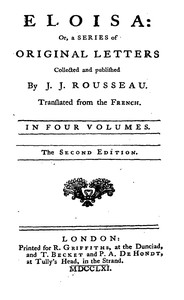
Eloisa: Or, a Series of Original Letters
Collected and published by J.J. Rousseau
Translated from the French.
In Four Volumes.
The Second Edition.
London: Printed for R. Griffiths, at the Dunciad, and T. Becket and P.A. DeHondt at Tully's Head, in the Strand.
MDCCLXI.
Translation of M. Rousseau’s Preface
Great cities require public theatres, and romances are necessary to a corrupt people. I saw the manners of the times, and have published these letters. Would to heaven I had lived in an age when I ought rather to have thrown them in the fire!
Though I appear only as the editor of this work, I confess that I have had some share in the composition. But am I the sole author, and is the entire correspondence fictitious? Ye people of the world, of what importance is it to you? Certainly, to you, it is all a fiction.
Every honest man will avow the books which he publishes. I have prefixed my name to these letters, not with a design to appropriate them to myself, but that I might be answerable for them. If they deserve censure, let it fall on me; if they have any merit, I am not ambitious of the praise. If it is a bad book, I am the more obliged to own it: I do not wish to pass for better than I am.
As to the reality of the history, I declare that, though I have been several times in the country of the two lovers, I never heard either of Baron D’Etange, his daughter, Mr. Orbe, Lord B----, or Mr. Wolmar. I must also inform the reader that there are several topographical errors in this work; but whether they are the effect of ignorance or design, I leave undetermined. This is all I am at liberty to say: let every one think as he pleases.
The book seems not calculated for an extensive circulation, as it is not adapted to the generality of readers. The stile will offend people of taste, to austere men the matter will be alarming, and all the sentiments will seem unnatural to those who know not what is meant by the word virtue. It ought to displease the devotee, the libertine, the philosopher; to shock all the ladies of gallantry, and to scandalize every modest woman. By whom, therefore, will it be approved? Perhaps only by myself: certain I am, however, that it will not meet with _moderate_ approbation from any one.
Whoever may resolve to read these letters ought to arm himself with patience against faults of language, rusticity of stile, and pedantry of expression; he ought to remember that the writers are neither natives of France, wits, academicians, nor philosophers; but that they are young and unexperienced inhabitants of a remote village, who mistake the romantic extravagance of their own imagination, for philosophy.
Why should I fear to speak my thoughts? This collection of letters, with all their gothic air, will better suit a married lady than books of philosophy: it may even be of service to those who, in an irregular course of life, have yet preserved some affection for virtue. As to young ladies, they are out of the question; no chaste virgin ever read a romance: but if perchance any young girl should dare to read a single page of this, she is inevitably lost. Yet let her not accuse me as the cause of her perdition: the mischief was done before; and since she has begun, let her proceed, for she has nothing worse to fear.
May the austere reader be disgusted in the first volume, revile the Editor, and throw the book into the fire. I shall not complain of injustice; for probably, in his place, I might have acted in the same manner. But if after having read to the end, any one should think fit to blame me for having published the book, let him, if he pleases, declare his opinion to all the world, except to me; for I perceive it would never be in my power to esteem such a man.
Preface by the Translator
It is by no means my design to swell the volume, or detain the reader from the pleasure he may reasonably expect in the perusal of this work: I say _reasonably_, because the author is a writer of great reputation. My sole intention is to give a concise account of my conduct in the execution of this arduous task; and to anticipate such accusations as may naturally be expected from some readers: I mean those who are but imperfectly acquainted with the French language, or who happen to entertain improper ideas of translation in general.
If I had chosen to preserve the original title, it would have stood thus: _Julia, or the New Eloisa_, in the general title-page; and in the particular one, _Letters of two Lovers, inhabitants of a small village at the foot of the Alps, collected and published,_ &c. Whatever objection I might have to this title, upon the whole, my principal reason for preferring the name of Eloisa to that of Julia, was, because the public seemed unanimous in distinguishing the work by the former rather than the latter, and I was the more easily determined, as it was a matter of no importance to the reader.
The English nobleman who acts a considerable part in this romance, is called in the original, Lord Bomston, which I suppose Mr. Rousseau thought to be an English name, or at least very like one. It may possibly sound well enough in the ears of a Frenchman; but I believe the English reader will not be offended with me for having substituted that of Lord B---- in its room. It is amazing that the French novelists should be as ignorant of our common names, and the titles of our nobility, as they are of our manners. They seldom mention our country, or attempt to introduce an English character, without exposing themselves to our ridicule. I have seen one of their celebrated romances, in which a British nobleman, called the Duke of _Workinsheton_, is a principal personage; and another, in which the one identical lover of the heroine is sometimes a Duke, sometimes an Earl, and sometimes a simple Baronet; _Catombridge_ is, with them, an English city: and yet they endeavour to impose upon their readers by pretending that their novels are translations from the English.
With regard to this _Chef d’oeuvre_ of Mr. Rousseau, it was received with uncommon avidity in France, Italy, Germany, Holland, and, in short, through every part of the Continent where the French language is understood. In England, besides a very considerable number first imported, it has been already twice reprinted; but how much soever the world might be delighted with the original, I found it to be the general opinion of my countrymen, that it was one of those books which could not possibly be translated with any tolerable degree of justice to the author: and this general opinion, I own, was my chief motive for undertaking the work.
There are, in this great city, a considerable number of industrious labourers, who maintain themselves, and perhaps a numerous family, by writing for the booksellers, by whom they are ranged in separate classes, according to their different abilities; and the very lowest class of all, is that of _Translators_. Now it cannot be supposed that such poor wretches as are deemed incapable of better employment, can be perfectly acquainted either with their own or with any other language: besides, were they ever so well qualified, it becomes their duty to execute as much work, in as little time, as possible; for, at all events, their children must have bread: therefore it were unreasonable to expect that they should spend their precious moments in poring over a difficult sentence in order to render their version the more elegant. This I take to be the true reason why our translations from the French are, in general, so extremely bad.
I confess, the idioms of the two languages are very different, and therefore that it will, in some instances, be impossible to reach the sublime delicacy of expression in an elegant French writer; but in return, their language is frequently so vague and diffuse, that it must be entirely the fault of the English translator if he does not often improve upon his original; but this will never be the case, unless we sit down with a design to translate the _ideas_ rather than the _words_ of our author.
Most of the translations which I have read, appear like a thin gauze spread over the original: the French language appears through every paragraph; but it is entirely owing to the want of bread, the want of attention, or want of ability in the translator. Mr. Pope, and some few others, have shewn the world, that not only the ideas of the most sublime writers may be accurately expressed in a translation, but that it is possible to improve and adorn them with beauties peculiar to the English language.
If in the following pages, the reader expects to find a servile, literal, translation, he will be mistaken. I never could, and never will, copy the failings of my author, be his reputation ever so great, in those instances where they evidently proceed from want of attention. Mr. Rousseau writes with great ease and elegance, but he sometimes wants propriety of thought, and accuracy of expression.
As to the real merit of this performance, the universal approbation it has met with is a stronger recommendation than any thing I could say in its praise.
A Dialogue Between a Man of Letters and Mr. J. J. Rousseau
N. There, take your Manuscript: I have read it quite through.
R. _Quite through?_ I understand you: you think there are not many readers will follow your example.
N. _Vel duo, vel nemo._
R. _Turpe & miserabile._ But let me have your sincere opinion.
N. I dare not.
R. You have dared to the utmost by that single word: Pray explain yourself.
N. My opinion depends upon your answer to this question: is it a real, or fictitious, correspondence?
R. I cannot perceive the consequence. In order to give one’s sentiments of a book, of what importance can it be to know how it was written?
N. In this case it is of great importance. A portrait has its merit if it resembles the original, be that original ever so strange; but in a picture which is the produce of imagination, every human figure should resemble human nature, or the picture is of no value: yet supposing them both good in their kind, there is this difference, the portrait is interesting but to a few people, whilst the picture will please the public in general.
R. I conceive your meaning. If these letters are portraits, they are uninteresting; if they are pictures, they are ill done. Is it not so?
N. Precisely.
R. Thus I shall snatch your answers before you speak. But, as I cannot reply, directly to your question, I must beg leave to propose one in my turn. Suppose the worst: my Eloisa----
N. Oh! if she had really existed.
R. Well.
N. But certainly it is no more than a fiction.
R. Be it so.
N. Why then, there never was any thing more absurd: the letters are no letters, the romance is no romance, and the personages are people of another world.
R. I am sorry for it, for the sake of this.
N. Console yourself; there is no want of fools among us; but yours have no existence in nature.
R. I could----No, I perceive the drift of your curiosity. But why do you judge so precipitately? Can you be ignorant how widely human nature differs from itself? how opposite its characteristics? how prejudice and manners vary according to times, places, and age. Who is it that can prescribe bounds to nature and say, Thus far shalt thou go, and no farther?
N. If such reasoning were allowed, monsters, giants, pygmies and chimeras of all kinds might be specifically admitted into nature: every object would be disfigured, and we should have no common model of ourselves. I repeat it, in a picture of human nature, every figure should resemble man.
R. I confess it; but then we should distinguish between the variety in human nature and that which is essential to it. What would you say of one who should only be able to know mankind in the picture of a Frenchman?
N. What would you say of one who, without expressing features or shape, should paint a human figure covered with a veil? Should we not have reason to ask, where is the man?
R. Without expressing features or shape? Is this just? There is no perfection in human nature: that is indeed chimerical. A young virgin in love with virtue, yet swerving from its dictates, but reclaimed by the horror of a greater crime; a too easy friend punished at last by her own heart for her culpable indulgence; a young man, honest and sensible, but weak, yet in words a philosopher; an old gentleman bigotted to his nobility, and sacrificing every thing to opinion; a generous and brave Englishman, passionately wise, and, without reason, always reasoning.
N. A husband, hospitable and gay, eager to introduce into his family his wife’s quondam paramour.
R. I refer you to the inscription of the plate. [1]
N. _Les belles ames_----Vastly fine!
R. O philosophy! What pains thou takest to contract the heart and lessen human nature!
N. It is fallaciously elevated by a romantic imagination. But to the point. The two friends----What do you say of them?----and that sudden conversion at the altar?----divine grace, no doubt.----
R. But Sir.
N. A pious Christian, not instructing her children in their catechism; who dies without praying; whose death nevertheless edifies the parson, and converts an Atheist----Oh!
R. Sir----
N. As to the reader being interested, his concern is universal, and therefore next to none. Not one bad action; not one wicked man to make us fear for the good. Events so natural, and so simple, that they scarce deserve the name of events; no surprize; no dramatic artifice; every thing happens just as it was expected. Is it worth while to register such actions as every man may see any day of his life in his own house or in that of his neighbour?
R. So that you would have common men, and _un_common events? Now I should rather desire the contrary. You took it for a romance: it is not a romance: but, as you said before, a collection of letters.
N. Which are no letters at all: this, I think, I said also. What an epistolary stile! how full of bombast! What exclamations! What preparation! How emphatical to express common ideas! What big words and weak reasoning! Frequently neither sense, accuracy, art, energy, nor depth. Sublime language and groveling thoughts. If your personages are in nature, confess, at least, that their stile is unnatural.
R. I own that in the light in which you are pleased to view them, it must appear so.
N. Do you suppose the public will not judge in the same manner; and did you not ask my opinion?
R. I did, and I answer you with a design to have it more explicitly: now it appears that you would be better pleased with letters written on purpose to be printed.
N. Perhaps I might; at least I am of opinion that nothing should be printed which is not fit for the press.
R. So that in books we should behold mankind only as they chuse to appear.
N. Most certainly, as to the author; those whom he represents, such as they are. But in these letters this is not the case. Not one strong delineation; not a single personage strikingly characterized; no solid observations; no knowledge of the world. What can be learnt in the little sphere of two or three lovers or friends constantly employed in matters only relative to themselves?
R. We may learn to love human nature, whilst in extensive society we learn to hate mankind. Your judgment is severe; that of the public ought to be still more so. Without complaining of injustice, I will tell you, in my turn, in what light these letters appear to me; not so much to excuse their defects, as to discover their source.
The perceptions of persons in retirement are very different from those of people in the great world; their passions being differently modified, are differently exprest; their imaginations constantly imprest by the same objects, are more violently affected. The same small number of images constantly return, mix with every idea, and create those strange and false notions so remarkable in people who spend their lives in solitude; but does it follow that their language is energic? No; ’tis only extraordinary: it is in our conversation with the world that we learn to speak with energy; first, because we must speak differently and better than others, and then, being every moment obliged to affirm what may not be believed, and to express sentiments which we do not feel, we endeavour at a persuasive manner which supplies the place of interior persuasion. Do you believe that people of real sensibility express themselves with that vivacity, energy, and ardor which you so much admire in our drama and romances? No; true passion, full of itself, is rather diffusive than emphatical; it does not even think of persuasion, as it never supposes that its existence can be doubtful. In expressing its feelings it speaks rather for the sake of its own ease, than to inform others. Love is painted with more vivacity in large cities, but is it in the village therefore less violent?
N. So that the weakness of the expression is a proof of the strength of their passion.
R. Sometimes, at least, it is an indication of its reality. Read but a love letter written by an author who endeavours to shine as a man of wit; if he has any warmth in his brain, his words will set fire to the paper; but the flame will spread no farther: you may be charmed, and perhaps a little moved, but it will be a fleeting agitation which will leave nothing except the remembrance of words. On the contrary, a letter really dictated by love, written by a lover influenced by a real passion, will be tame, diffuse, prolix, unconnected, and full of repetitions: his heart overflowing with the same sentiment, constantly returns to the same expressions, and like a natural fountain flows continually without being exhausted. Nothing brilliant, nothing remarkable; one remembers neither words nor phrases; there is nothing to be admired, nothing striking: yet we are moved without knowing why. Though we are not struck with strength of sentiment, we are touched with its truth, and our hearts, in spite of us, sympathize with the writer. But men of no sensibility, who know nothing more than the flowery jargon of the passions, are ignorant of those beauties and despise them.
N. I am all attention.
R. Very well. I say, that in real love letters, the thoughts are common, yet the stile is not familiar. Love is nothing more than an illusion; it creates for itself another universe; it is surrounded with objects which have no existence but in imagination, and its language is always figurative; but its figures are neither just nor regular: its eloquence consists in its disorder, and when it reasons least it is most convincing. Enthusiasm is the last degree of this passion. When it is arrived at its greatest height, its object appears in a state of perfection; it then becomes its idol; it is placed in the heavens; and as the enthusiasm of devotion borrows the language of love, the enthusiasm of love also borrows the language of devotion. Its ideas present nothing but Paradise, angels, the virtue of saints, and the delights of heaven. In such transport, surrounded by such images, is it not natural to expect sublime language? Can it possibly debase its ideas by vulgar expressions? Will it not on the contrary raise its stile, and speak with adequate dignity? What then becomes of your _epistolary stile?_ it would do mighty well, to be sure, in writing to the object of one’s adoration: in that case they are not letters, but hymns.
N. We shall see what the world will say.
R. No: rather see the winter on my head. There is an age for experience, and another for recollection. Our sensibility may be extinguished by time; but the soul which was once capable of that sensibility remains. But to return to our letters: if you read them as the work of an author who endeavours to please, or piques himself on his writing, they are certainly detestable. But take them for what they are, and judge of them in their kind. Two or three young people, simple, if you will, but sensible, who mutually expressing the real sentiments of their hearts, have no intention to display their wit. They know and love each other too well for self-admiration to have any influence among them. They are children, and therefore think like children. They are not natives of France, how then can they be supposed to write correctly? They lived in solitude, and therefore could know but little of the world. Entirely filled with one single sentiment, they are in a constant delirium, and yet presume to philosophise. Would you have them know how to observe, to judge, and to reflect? No: of these they are ignorant; but they are versed in the art of love, and all their words and actions are connected with that passion. Their ideas are extravagant, but is not the importance which they give to these romantic notions more amusing than all the wit they could have displayed. They speak of every thing; they are constantly mistaken; they teach us nothing, except the knowledge of themselves; but in making themselves known, they obtain our affection. Their errors are more engaging than the wisdom of the wise. Their honest hearts, even in their transgressions, bear still the prejudice of virtue, always confident and always betrayed. Nothing answers their expectations; every event serves to undeceive them. They are deaf to the voice of discouraging truth: they find nothing correspond with their own feelings, and therefore, detaching themselves from the rest of the universe, they create, in their separate society, a little world of their own, which presents an entire new scene.
N. I confess, that a young fellow of twenty, and girls of eighteen, though not; uninstructed, ought not to talk like philosophers, even though they may suppose themselves such. I own also, for this distinction has not escaped me, that these girls became wives of merit, and the young man a better observer. I make no comparison between the beginning and the end of the work. The detail of domestic occurrences may efface, in some measure, the faults of their younger years: the chaste and sensible wife, the worthy matron, may obliterate the remembrance of former weakness. But even this is a subject for criticism: the conclusion of the work renders the beginning reprehensible: one would imagine them to be two different books, which ought not to be read by the same people. If you intended to exhibit rational personages, why would you expose them before they were become so? Our attention to the lessons of wisdom is destroyed by the child’s play by which they are preceded: we are scandalized at the bad, before the good can edify us. In short, the reader is offended and throws the book aside in the very moment when it might become serviceable.
R. On the contrary, I am of opinion, that to those who are disgusted with the beginning, the end would be entirely superstitious: and that the beginning will be agreeable to those readers to whom the conclusion can be useful. So that, those who do not read to the end will have left nothing, because it was an improper book for them; and those to whom it may be of service would never have read it, if it had begun with more gravity. Our lessons can never be useful unless they are so written as to catch the attention of those for whose benefit they were calculated.
I may have changed the means, and not the object. When I endeavoured to speak to _men_, I was not heard; perhaps in speaking to children I shall gain more attention; and children would have no more relish for naked reason, than for medicines ill disguised.
_Cosi all’ egro fanciul porgiamo aspersi Di soave licor gl’orli del vaso; Succhi amari ingannato in tanto ei beve, E da l’ inganno suo vita riceve._
N. Here again I am afraid you are deceived: they will sip on the edge of the vessel, but will not drink the liquor.
R. Be it so; it will not be my fault: I shall have done all in my power to make it palatable. My young folks are amiable; but to love them at thirty it is necessary to have known them when they were ten years younger: One must have lived with them a long time to be pleased with their company; and to taste their virtues, it is necessary we should first have deplored their failings. Their letters are not interesting at first; but we grow attached by degrees, and can neither continue nor quit them. They are neither elegant, easy, rational, sensible, nor eloquent; but there is sensibility which gradually communicates itself to our hearts, and which at last is found to supply the place of all the rest. It is a long romance, of which no one part has power to move us, and yet the whole produces a proper effect. At least, such were its effects upon me: pray were not you touched in reading it?
N. No; yet I can easily conceive your being affected: if you are the author, nothing can be more natural; and if not, I can still account for it. A man of the world can have no taste for the extravagant ideas, the affected pathos, and false reasoning of your good folks; but they will suit a recluse, for the reason which you have given: now, before you determine to publish the manuscript, you would do well to remember that the world is not composed of hermits. All you can expect is that your young gentleman will be taken for a Celadon, your Lord B---- for a Don Quixote, your young damsels for two Astreas, and that the world will laugh at them for a company of fools. But a continued folly cannot be entertaining. A man should write like Cervantes before he can expect to engage his reader to accompany him through six volumes of nonsense.
R. The very reason which would make you suppress this work, will induce me to print it.
N. What! the certainty of its not being read?
R. A little patience, and you will understand me. As to morals, I believe that all kinds of reading are useless to people of the world: first, because the number of new books which they run through, so generally contradict each other, that their effect is reciprocally destroyed. The few choice books which deserve a second perusal, are equally ineffectual: for, if they are written in support of received opinions, they are superfluous; and if in opposition, they are of no use; they are too weak to break the chain which attaches the reader to the vices of society. A man of the world may possibly, for a moment, be led from his wonted path by the dictates of morality; but he will find so many obstacles in the way, that he will speedily return to his former course. I am persuaded there are few people, who have had a tolerable education, that have not made this essay, at least once in their lives; but, finding their efforts vain, they are discouraged from any future attempt, and consider the morality of books as the jargon of idleness. The farther we retreat from business, great cities, and numerous societies, the more the obstacles to morality diminish. There is a certain point of distance where these obstacles cease to be insurmountable and there it is that books may be of use. When we live in solitude, as we do not then read with a design to display our reading, we are less anxious to change our books, and bestow on them more reflection; and as their principles find less opposition from without, their internal impression is more effectual. In retirement, the want of occupation, obliges those who have no resource in themselves, to have recourse to books of amusement. Romances are more read in the provincial towns than at Paris, in towns less than in the country, and there they make the deepest impression: the reason is plain.
Now it happens unfortunately that the books which might amuse, instruct, and console the people in retirement, who are unhappy only in their own imagination, are generally calculated to make them still more dissatisfied with their situation. People of rank and fashion are the sole personages of all our romances. The refined taste of great cities, court maxims, the splendour of luxury, and epicurean morality; these are their precepts, these their lesson of instruction. The colouring of their false virtues tarnishes their real ones. Polite manners are substituted for real duties, fine sentiments for good actions, and virtuous simplicity is deemed want of breeding.
What effect must such representations produce in the mind of a country gentleman, in which his freedom and hospitality is turned into ridicule, and the joy which he spreads through his neighbourhood is pronounced to be a low and contemptible amusement? What influence must they not have upon his wife, when she is taught, that the care of her family is beneath a lady of her rank; and on his daughter, who being instructed in the jargon and affectation of the city, disdains for his clownish behaviour, the honest neighbour whom she would otherwise have married. With one consent, ashamed of their rusticity, and disgusted with their village, they leave their ancient mansion, which soon becomes a ruin, to reside in the metropolis; where the father, with his cross of St. Lewis, from a gentleman becomes a sharper; the mother keeps a gaming house; the daughter amuses herself with a circle of gamesters: and frequently all three, after having led a life of infamy, die in misery and dishonour.
Authors, men of letters, and philosophers are constantly insinuating, that in order to fulfil the duties of society, and to serve our fellow creatures, it is necessary that we should live in great cities: according to them, to fly from Paris, is to hate mankind; people in the country are nobody in their eyes; to hear them talk, one would imagine that where there are no pensions, academies, nor open tables, there is no existence.
All our productions verge to the same goal. Tales, romances, comedies, all are levelled at the country; all conspire to ridicule rustic simplicity; they all display and extol the pleasures of the great world; it is a shame not to know them; and not to enjoy them, a misfortune. How many of those sharpers and prostitutes, with which Paris is so amply provided, were first seduced by the expectations of these imaginary pleasures? Thus prejudice and opinion contribute to effect the political system by attracting the inhabitants of each country to a single point of territory, leaving all the rest a desert: thus nations are depopulated, that their capitals may flourish; and this frivolous splendor with which fools are captivated, makes Europe verge with celerity towards its ruin. The happiness of mankind requires that we should endeavour to stop this torrent of pernicious maxims. The employment of the clergy is to tell us that we must be good and wise, without concerning themselves about the success of their discourses; but a good citizen, who is really anxious to promote virtue, should not only tell us to be good, but endeavour to make the path agreeable which will lead us to happiness.
N. Pray, my good friend, take breath for a moment. I am no enemy to useful designs; and I have been so attentive to your reasoning, that I believe it will be in my power to continue your argument. You are clearly of opinion, that to give to works of imagination the only utility of which they are capable, they must have an effect diametrically opposite to that which their authors generally propose; they must combat every human institution, reduce all things to a state of nature, make mankind in love with a life of peace and simplicity, destroy their prejudices and opinions, inspire them with a taste for true pleasure, keep them distant from each other, and instead of exciting people to crowd into large cities, persuade them to spread themselves all over the kingdom, that every part may be equally enlivened. I also comprehend, that it is not your intention to create a world of Arcadian shepherds, of illustrious peasants labouring on their own acres and philosophising on the works of nature, nor any other romantic beings which exist only in books; but to convince mankind that in rural life there are many pleasures which they know not how to enjoy; that these pleasures are neither so insipid nor so gross as they imagine; that they are susceptible of taste and delicacy; that a sensible man, who should retire with his family into the country, and become his own farmer, might enjoy more rational felicity, than in the midst of the amusements of a great city; that a good housewife may be a most agreeable woman, that she may be as graceful and as charming as any town coquet of them all; in short, that the most tender sentiments of the heart will more effectually animate society, than the artificial language of polite circles, where the ill-natured laugh of satyr is the pitiful substitute of that real mirth which no longer exists. Have I not hit the mark?
R. ’Tis the very thing; to which I will add but one reflection. We are told that romances disturb the brain: I believe it true. In continually displaying to the reader the ideal charms of a situation very different from his own, he becomes dissatisfied, and makes an imaginary exchange for that which he is taught to admire. Desiring to be that which he is not, he soon believes himself actually metamorphosed, and so becomes a fool. If, on the contrary, romances were only to exhibit the pictures of real objects, of virtues and pleasures within our reach, they would then make us wiser and better. Books which are designed to be read in solitude, should be written in the language of retirement: if they are meant to instruct, they should make us in love with our situation; they should combat and destroy the maxims of the great world, by shewing them to be false and despicable, as they really are. Thus, Sir, a romance, if it be well written, or at least if it be useful, must be hissed, damned, and despised by the polite world, as being a mean, extravagant and ridiculous performance; and thus what is folly in the eyes of the world is real wisdom.
N. Your conclusion is self-evident. It is impossible better to anticipate your fall, nor to be better prepared to fall with dignity. There remains but one difficulty. People in the country, you know, take their cue from us. A book calculated for them must first pass the censure of the town: if we think fit to damn it, its circulation is entirely stopt. What do you say to that?
R. The answer is quite simple. You speak of _wits_ who reside in the country; whilst I would be understood to mean real country folks. You gentlemen who shine in the capital, have certain prepossessions of which you must be cured: you imagine that you govern the taste of all France, when in fact three fourths of the kingdom do not know that you exist. The books which are damned at Paris often make the fortune of country booksellers.
N. But why will you enrich them at the expense of ours?
R. Banter me as you please, I shall persist. Those who aspire to fame must calculate their works for the meridian of Paris; but those who write with a view to do good, must write for the country. How many worthy people are there who pass their lives in cultivating a few paternal acres, far distant from the metropolis, and who think themselves exiled by the partiality of fortune? During the long winter evenings, deprived of society, they pass the time in reading such books of amusement as happen to fall into their hands. In their rustic simplicity they do not pride themselves on their wit or learning; they read for entertainment rather than instruction; books of morality and philosophy are entirely unknown to them. As to your romances, they are so far from being adapted to their situation, that they serve only to render it insupportable. Their retreat is represented to be a desert, so that whilst they afford a few hours amusement, they prepare for them whole months of regret and discontent. Why may I not suppose that, by some fortunate accident, this book, like many others of still less merit, will fall into the hands of those inhabitants of the fields, and that the pleasing picture of a life exactly resembling theirs will render it more tolerable? I have great pleasure in the idea of a married couple reading this novel together, imbibing fresh courage to support their common labours, and perhaps new designs to render them useful. How can they possibly contemplate the representation of a happy family without attempting to imitate the pleasing model? How can they be affected with the charms of conjugal union, even where love is wanting, without increasing and confirming their own attachment? In quitting their book, they will neither be discontented with their situation, nor disgusted at their labour: on the contrary, every object around them will assume a more delightful aspect, their duties will seem ennobled, their taste for the pleasures of nature will revive; her genuine sensations will be rekindled in their hearts, and perceiving happiness within their reach, they will learn to taste it as they ought: they will perform the same functions, but with another soul; and what they did before as peasants only, they will now transact as real patriarchs.
N. So far, you sail before the wind. Husbands, wives, matrons----but with regard to young girls; d’ye say nothing of those?
R. No. A modest girl will never read books of love. If she should complain of having been injured by the perusal of these volumes, she is unjust: she has lost no virtue; for she had none to lose.
N. Prodigious! attend to this, all ye amorous writers; for thus ye are all justified.
R. Provided they are justified by their own hearts and the object of their writings.
N. And is that the case with you?
R. I am too proud to answer to that question; but Eloisa had a certain rule by which she formed her judgment of books: [2] if you like it, use it in judging of this. Authors have endeavoured to make the reading of romances serviceable to youth. There never was a more idle project. It is just setting fire to the house in order to employ the engines. Having conceived this ridiculous idea, instead of directing the moral of their writings towards its proper object, it is constantly addressed to young girls, [3] without considering that these have no share in the irregularities complained of. In general, though their hearts may be corrupted, their conduct is blameless. They obey their mothers in expectation of the time when it will be in their power to imitate them. If the wives do their duty, be assured the girls will not be wanting in theirs.
N. Observation is against you in this point. The whole sex seem to require a time for libertinism, either in one state or the other. It is a bad leaven, which must ferment soon or late. Among a civilized people the girls are easy, and the wives difficult, of access; but where mankind are less polite, it is just the reverse: the first consider the crime only, the latter the scandal. The principal question is, how to be left secured from the temptation: as to the crime it is of no consideration.
R. If we were to judge by its consequences, one would be apt to be of another opinion. But let us be just to the women: the cause of their irregularities are less owing to themselves, than to our bad institutions. The extreme inequality in the different members of the same family must necessarily stifle the sentiments of nature. The vices and misfortunes of children are owing chiefly to the father’s unnatural despotism. A young wife, unsuitably espoused, and a victim to the avarice or vanity of her parents, glories in effacing the scandal of her former virtue by her present irregularities. If you would remedy this evil, proceed to its source. Public manners can only be reformed by beginning with private vices, which naturally arise from parents. But our reformers never proceed in this manner. Your cowardly authors preach only to the oppressed; and their morality can have no effect, because they have not the art to address the most powerful.
N. You, Sir, however run no risk of being accused of servility; but may you not possibly be too sincere? In striking at the root of this evil, may you not be the cause of more----
R. Evil? to whom? In times of epidemical contagion, when all are infected from their infancy, would it be prudent to hinder the distribution of salutary medicines under a pretence that they might do harm to people in health? You and I, Sir, differ so widely on this point, that if it were reasonable to expect that these letters can meet with any success, I am persuaded they will do more good than a better book.
N. Certainly your females are excellent preachers. I am pleased to see you reconciled with the ladies; for I was really concerned when you imposed silence on the sex. [4]
R. You are too severe; I must hold my tongue: I am neither so wise nor so foolish as to be always in the right. Let us leave this bone for the critics.
N. With all my heart, lest they should want one. But suppose you had nothing to fear from any other quarter, how will you excuse to a certain severe censor of the stage, those warm descriptions, and impassioned sentiments, which are so frequent in those letters? Shew me a scene in any of our theatrical pieces equal to that in the wood at Clarens, or that of the dressing room. Read the letter on theatrical amusements; read the whole collection. In short, be confident, or renounce your former opinions. What would you have one think?
R. I would have the critics be confident with themselves, and not judge till they have thoroughly examined. Let me intreat you to read once more with attention the parts you have mentioned; read again the preface to _Narcisse_, and you will there find an answer to the accusation of inconsistency. Those forward gentlemen who pretend to discover that fault in the _Devin du Village_, will undoubtedly think it much more glaring in this work. They will only act in character; but you----
N. I recollect two passages. [5] You do not much esteem your cotemporaries.
R. Sir, I am also their cotemporary! O why was I not born in an age in which I ought to have burnt this collection!
N. Extravagant as usual! however, to a certain degree, your maxims are just. For instance; if your Eloisa had been chaste from the beginning, she would have afforded us less instruction; for to whom would she have served as a model? In the most corrupt ages mankind are fond of the most perfect lessons of morality: theory supplies the place of practice, and at the small expense of a little leisure reading, they satisfy the remnant of their taste for virtue.
R. Sublime authors, relax a little your perfect models, if you expect that we should endeavour to imitate them. To what purpose do you vaunt unspotted purity? rather shew us that which may be recovered, and perhaps there are some who will attend to your instructions.
N. Your young hero has already made those reflections; but no matter, you would be thought no less culpable in having shewn us what _is done_, in order to shew what _ought to be done_. Besides, to inspire the girls with love, and to make wives reserved, is overturning the order of things, and recalling those trifling morals which are now totally proscribed by philosophy. Say what you will, it is very indecent, nay scandalous for a girl to be in love: nothing but a husband can authorise a lover. It was certainly very impolitic to be indulgent to the unmarried ladies, who are not allowed to read you, and severe upon the married ones, by whom you are to be judged. Believe me, if you were fearful of success, you may be quite easy: you have taken sufficient care to avoid an affront of that nature. Be it as it may, I shall not betray your confidence. I hope your imprudence will not carry you too far. If you think you have written a useful book, publish it; but by all means conceal your name.
R. Conceal my name! Will an honest man speak to the public from behind a curtain? Will he dare to print what he does not dare to own? I am the editor of this book, and I shall certainly fix my name in the title page.
N. Your name in the title-page!
R. Yes, Sir, in the title-page.
V. You are surely in jest.
R. I am positively in earnest.
N. What your real name? _Jean Jacques Rousseau_, at full length?
R. _Jean Jacques Rousseau_ at full length.
N. You surely don’t think. What will the world say of you?
R. What they please. I don’t print my name with a design to pass for the author, but to be answerable for the book. If it contains any thing bad, let it be imputed to me; if good, I desire no praise. If the work in general deserves censure, there is so much more reason for prefixing my name. I have no ambition to pass for better than I am.
N. Are you content with that answer?
R. Yes, in an age when it is impossible for any one to be good.
N. Have you forgot _les belles ames?_
R. By nature _belles_, but corrupted by your institutions.
N. And so we shall behold, in the title-page of a book of love- epistles, by _J.J. Rousseau, Citizen of Geneva!_
R. No, not _Citizen of Geneva_. I shall not profane the name of my country. I never prefix it, but to those writings by which I think it will not be dishonoured.
N. Your own name is no dishonourable one, and you have some reputation to lose. This mean and weak performance will do you no service. I wish it was in my power to dissuade you; but if you are determined to proceed, I approve of your doing it boldly and with a good grace. At least this will be in character. But a propos; do you intend to prefix your motto?
R. My bookseller asked me the same question, and I thought it so humorous that I promised to give him the credit of it. No, Sir, I shall not prefix my motto to this book; nevertheless, I am now less inclined to relinquish it than ever. Remember that I thought of publishing those letters at the very time when I wrote against the theatres, and that a desire of excusing one of my writings, has not made me disguise truth in the other. I have accused myself before hand, perhaps, with more severity than any other person will accuse me. He who prefers truth to fame, may hope to prefer it to life itself. You say that we ought to be confident: I doubt whether that be possible to man, but it is not impossible to act with invariable truth. This I will endeavour to do.
N. Why then, when I ask whether you are the author of these letters, do you evade the question?
R. I will not lie, even in that case.
N. But you refuse to speak the truth.
R. It is doing honour to truth to keep it secret. You would have less difficulty with one who made no scruple of a lie. Besides, you know men of taste are never mistaken in the pen of an author. How can you ask a question which it is your business to resolve?
N. I have no doubt with regard to some of the letters; they are certainly yours: but in others you are quite invisible, and I much doubt the possibility of disguise in this case. Nature, who does not fear being known, frequently changes her appearance; but art is often discovered, by attempting to be too natural. These epistles abound with faults, which the most arrant scribbler would have avoided. Declamation, repetitions, contradictions, &c. In short, it is impossible that a man, who can write better, could ever resolve to write so ill. What man in his senses would have made that foolish Lord B---- advance such a shocking proposal to Eloisa? Or what author would not have corrected the ridiculous behaviour of his young hero, who though positively resolved to die, takes good care to apprize all the world of his intention, and finds himself at last in perfect health? Would not any writer have known that he ought to support his characters with accuracy, and vary his stile accordingly, and he would then infallibly have excelled even nature herself?
I have observed that in a very intimate society, both stile and characters are extremely similar, and that when two souls are closely united, their thoughts, words, and actions will be nearly the same. This Eloisa, as she is represented, ought to be an absolute enchantress; all who approach her, ought immediately to resemble her; all her friends should speak one language; but these effects are much easier felt than imagined: and even if it were possible to express them, it would be imprudent to attempt it. An author must be governed by the conceptions of the multitude, and therefore all refinement is improper. This is the touch-stone of truth, and in this it is that a judicious eye will discover real nature.
R. Well, and so you conclude----
N. I do not conclude at all. I am in doubt, and this doubt has tormented me inexpressibly, during the whole time I spent in reading these letters. If it be all a fiction, it is a bad performance; but say that these two women have really existed, and I will read their epistles once a year to the end of my life.
R. Strange! what signifies it whether they ever existed or not? They are no where to be found: they are no more.
N. No more? So they actually did exist.
R. The conclusion is conditional: if they ever did exist, they are now no more.
N. Between you and I, these little subtilties are more conclusive than perplexing.
R. They are such as you force me to use, that I may neither betray myself nor tell an untruth.
N. In short, you may do as you think proper; your Title is sufficient to betray you.
R. It discovers nothing relative to the matter in question; for who can tell whether I did not find this title in the manuscript? Who knows whether I have not the same doubts which you have? Whether all this mystery be not a pretext to conceal my own ignorance?
N. But however you are acquainted with the scene of action. You have been at Vevey, in the _Pays de Vaud_?
R. Often; and I declare that I never heard either of Baron D'Etange, or his Daughter. The name of Wolmar is entirely unknown in that country. I have been at Clarens, but never saw any house like that which is described in these letters. I passed through it in my return from Italy, in the very year when the sad catastrophe happened, and I found no body in tears for the death of Eloisa Wolmar. In short, as much as I can recollect of the country, there are, in these letters, several transpositions of places, and topographical errors, proceeding either from ignorance in the author, or from a design to mislead the reader. This is all you will learn from me on this point, and you may be assured that no one else shall draw any thing more from me.
N. All the world will be as curious as I am. If you print this work, tell the public what you have told me. Do more, write this conversation as a Preface: it contains all the information necessary for the reader.
R. You are in the right. It will do better than any thing I could say of my own accord. Though these kind of apologies seldom succeed.
N. True, where the author spares himself. But I have taken care to remove that objection here. Only I would advise you to transpose the parts. Pretend that I wanted to persuade you to publish, and that you objected. This will be more modest, and will have a better effect.
R. Would that be consistent with the character for which you praised me a while ago?
N. It would not. I spoke with a design to try you. Leave things as they are.
Advertisement
_The following Dialogue was originally intended as a Preface to_ Eloisa;_ but its form and length permitting me to prefix to that Work only a few extracts from it, I now publish it entire, in hopes that it will be found to contain some useful hints concerning Romances in general. Besides, I thought it proper to wait till the Book had taken its chance, before I discussed its inconveniences and advantages, being unwilling either to injure the Bookseller, or supplicate the indulgence of the Public._
The following Account of this Work is taken from the _Journal des Sçavans_ for June 1761, Printed at Paris.
This work is a strange, but memorable monument of the eloquence of the passions, the charms of virtue, and the force of imagination. Unfeeling spirits may, as long as they please, remark and exaggerate the faults of which the author does not scruple to accuse himself in his two most singular prefaces; they may arraign him for frequent want of taste, call his stile unequal and incorrect, his sentiments too refined, and his paradoxes inexplicable; they may complain that his notes are ludicrous and misplaced, as they frequently break in upon a tender sentiment, a pathetic situation, and that in general they are nothing more than an anticipated parody on the objections, whether just or groundless, which the author seems to expect from certain critics; they may even attempt to undermine the foundation of the work, and accuse the author of cold prolixity in his description of the peace and happiness of Clarens, after the violent agitation of those grand movements by which it is preceded; they may be shocked with the useless and abortive passion of Clara for St. Preux, the negotiation begun concerning their marriage, the impenetrable, obscure, and consequently uninteresting amours of Lord B---- in Italy; they may think the author extravagant in the general choice of his events; but whatever may be the present and future judgment of the public,
_Ut cumque ferent ea facta minores, Vincet Amor._
What heart can be unaffected with the dangers, the misfortunes, the weakness, and the virtues of Eloisa? Who can possibly be insensible to the ardor of her lover, the vigilant, active, and impatient friendship of Clara, the noble and encouraging protection of Lord B----, the unshaken wisdom of Wolmar, and all these characters moved by the most extraordinary springs? Who can resist those torrents of pathetic language which penetrate the inmost soul, and so tyrannically command our tears; those master-strokes of simplicity which open the recesses of the human heart, and excite the pleasure of weeping sensibility? How can we help admiring his talent of giving life to every object, of transporting the reader in the middle of the scene, and engaging him as a party in every action, by the happy choice of incidents, and if I may be allowed the expression, by the use of words the most identical to the things intended to be described? Can there be a reader who is not enamoured of the soul of Eloisa? Can there be a reader who does not feel the loss of her as if she were his own, and who does not join in the general mourning at Clarens, and the despair of Clara on the death of her friend?
A common author would have satisfied himself with giving us, once for all, a beautiful picture of his heroine, in which he would have shewn us, in one general point of view, the accomplishment of every duty, and the expansion of every sentiment, by loading our imagination with all the particular applications of this virtuous principle to every single event. Mr. Rousseau, on the contrary, in one continued adion, always before our eyes, displays his Eloisa fulfilling without study, and without the least confusion, all the duties of a wife, a friend, a daughter, a mother, and mistress of a family; so that we behold her constantly employed in these several situations, without confounding the rights of any of them; without favouring one at the expense of the other. He does not relate her actions, but makes her perform them in our sight, and by that means renders those things real, which in recital would appear hyperbolical, romantic, and incredible.
In the great number of different pictures which the author has here collected, whether he paints the respectable simplicity of Valesian manners, the brilliant corruption of great cities, the restricted impatience of expecting love, the wildness of despair, or the pathetic regret of a generous passion after an extraordinary sacrifice; whether, in the interesting scene of Meillerie, he displays all the eloquence of genius, and every tender emotion of the heart; whether excited by the plausibility of logic he collects his whole strength to destroy the sophisms of false honour; whether Virtue herself thunders with her respectable and sublime voice against the crime of suicide justified by eloquence; we always find his manner properly adapted both to the subject and to the speaker, which renders the illusion compleat.
Almost every trial which the soul can experience is represented either in the principal or accessory situations, or in the reflections. In short, the human soul is here penetrated and displayed in every point of view; so that every sensible heart may be certain of beholding itself in this mirror.
The nature and form of this work will not allow of a regular extract. It consists entirely of a gradual unfolding of ideas and sensations which admit of no analysis, and which can be pursued only in the work itself. The author in the catastrophe imitates the happy artifice of the artist who painted the sacrifice of Iphigenia. Eloisa dies; they weep round her ashes. The author paints this universal grief; he paints the silent but sincere affliction of her husband, the affecting stupor of the father, the extravagant sorrow of her friend: and now the despair of her lover remains to be described; but that was inexpressible: the author wisely draws a veil before him, and leaves the rest to our imagination.
The picture of Eloisa dying can be compared only to the scene of Alcestes expiring, in Euripides.
Upon the whole, it were needless to say how much this work deserves to be read, since the eagerness of the Public hath already sufficiently prevented us. We cannot better express our approbation of a performance in which even vice itself breathes an air of virtue, than in the words of Eloisa, who in speaking of Lord B---- says, was there ever a man without faults who possessed great virtues? And in like manner we ask, whether there was ever a work without blemish which might boast of such penetrating and sublime beauties?
Eloisa
Volume I
Letter I. To Eloisa.
I must fly from you, madam, in truth I must. I am to blame for continuing with you so long, or rather, I ought never to have beheld you. But, situated as I am, what can I do? How shall I determine? You have promised me your friendship; consider my perplexity, and give me your advice.
You are sensible that I became one of your family in consequence of an invitation from your mother. Believing me possessed of some little knowledge, she thought that I might be of service in the education of her beloved daughter, in a situation where proper masters were not to be obtained. Proud to be instrumental in adding a few embellishments to one of nature’s most beautiful compositions, I dared to engage in the perilous task, unmindful of the danger, or, at least, unapprehensive of the consequence. I will not tell you that I begin to suffer for my presumption. I hope I shall never so far forget myself as to say any thing which you ought not to hear, or fail in that respect which is due to your virtue, rather than to your birth or personal charms. If I must suffer, I have the consolation, at least, that I suffer alone. I can enjoy no happiness at the expense of yours.
And yet I see you and converse with you every day of my life, and am but too sensible that you innocently aggravate a misfortune which you cannot pity, and of which you ought to be ignorant. It is true, I know what prudence would dictate, in a case like this, where there is no hope; and I should certainly follow her advice if I could reconcile it with my notions of probity. How can I with decency quit a family into which I was so kindly invited, where I have received so many obligations, and where, by the tenderest of mothers, I am thought of some utility to a daughter whom she loves more than all the world? How can I resolve to deprive this affectionate parent of the pleasure she proposes to herself in, one day, surprizing her husband with your progress in the knowledge of things of which he must naturally suppose you ignorant? Shall I impolitely quit the house without taking leave of her? Shall I declare to her the cause of my retreat, and would not she even have reason to be offended with this confession from a man whose inferior birth and fortune must for ever remain insuperable bars to his happiness?
There seems but one method to extricate me from this embarrassment: the hand which involved me in it must also relieve me. As you are the cause of my offence, you must inflict my punishment: out of compassion, at least, deign to banish me from your presence. Shew my letter to your parents; let your doors be shut against me; spurn me from you in what manner you please; from you I can bear any thing; but of my own accord I have no power to fly from you.
Spurn me from you! fly your presence! why? Why should it be a crime to be sensible of merit, and to love that which we cannot fail to honour? No, charming Eloisa; your beauty might have dazzled my eyes, but it never would have misled my heart, had it not been animated with something yet more powerful. It is that captivating union between a lively sensibility and invariable sweetness of disposition; it is that tender feeling for the distresses of your fellow creatures; it is that amazing justness of sentiment, and that exquisite taste which derive their excellence from the purity of your soul; they are, in short, your mental charms much more than those of your person, which I adore. I confess it may be possible to imagine beauties still more transcendently perfect; but more amiable, and more deserving the heart of a wise and virtuous man,----no, no, Eloisa, it is impossible.
I am sometimes inclined to flatter myself that, as in the parity of our years, and similitude of taste, there is also a secret sympathy in our affections. We are both so young that our nature can hitherto have received no false bias from any thing adventitious, and all our inclinations seem to coincide. Before we have imbibed the uniform prejudices of the world, our general perceptions seem uniform; and why dare I not suppose the same concord in our hearts, which in our judgment is so strikingly apparent? Sometimes it happens that our eyes meet; involuntary sighs betray our feelings, tears steal from----O! my Eloisa! if this unison of soul should be a divine impulse----if heaven should have destined us----all the power on earth----Ah pardon me! I am bewildered: I have mistaken a vain wish for hope: the ardour of my desires gave to their imaginary object a solidity which did not exist. I foresee with horror the torments which my heart is preparing for itself. I do not seek to flatter my misfortune; if it were in my power I would avoid it. You may judge of the purity of my sentiments by the favour I ask. Destroy, if possible, the source of the poison that both supports and kills me. I am determined to effect my cure or my death, and I therefore implore your rigorous injunction, as a lover would supplicate your compassion.
Yes, I promise, I swear, on my part, to do every thing within my power to recover my reason, or to bury my growing anxiety in the inmost recesses of my soul. But, for mercy’s sake, turn from me those lovely eyes that pierce me to the heart; suffer me no longer to gaze upon that face, that air, those arms, those hands, that engaging manner; disappoint the imprudent avidity of my looks; no longer let me hear that enchanting voice, which cannot be heard without emotion; be, alas! in every respect, another woman, that my soul may return to its former tranquillity.
Shall I tell you, without apology? When we are engaged in the puerile amusements of these long evenings, you cruelly permit me, in the presence of the whole family, to increase a flame that is but too violent already. You are not more reserved to me than to any of the rest. Even yesterday you almost suffered me, as a forfeit, to take a kiss: you made but a faint resistance. Happily, I did not persist. I perceived by my increasing palpitation, that I was rushing upon my ruin, and therefore stopped in time. If I had dared to indulge my inclination, that kiss would have proved my last sigh, and I should have died the happiest of mortals.
For heaven’s sake, let us quit those plays, since they may possibly be attended with such fatal consequences; even the most simple of them all is not without its danger. I tremble as often as our hands meet, and I know not how it happens, but they meet continually. I start the instant I feel the touch of your finger; as the play advances I am seized with a fever, or rather delirium; my senses gradually forsake me, and, in their absence, what can I say, what can I do, where hide myself, or how be answerable for my conduct?
The hours of instruction are not less dangerous. Your mother, or your cousin, no sooner leave the room than I observe a change in your behaviour. You at once assume an air so serious, so cold, that my respect, and the fear of offending, destroys my presence of mind, and deprives me of my judgment: with difficulty and trembling, I babble over a lesson, which even your excellent talents are unable to pursue. This affected change in your behaviour is hurtful to us both: you confound me and deprive yourself of instruction, whilst I am entirely at a loss to account for this sudden alteration in a person naturally so even-tempered and reasonable. Tell me, pray tell me, why you are so sprightly in public, and so reserved when by ourselves? I imagined it ought to be just the contrary, and that one should be more or less upon their guard, in proportion to the number of spectators. But instead of this, when with me alone, you are ceremonious, and familiar when we join in mixed company. If you deign to be more equal, probably my torment will be less.
If that compassion which is natural to elevated minds, can move you in behalf of an unfortunate youth, whom you have honoured with some share in your esteem; you have it in your power, by a small change in your conduct, to render his situation less irksome, and to enable him, with more tranquility, to support his silence and his sufferings: but if you find yourself not touched with his situation, and are determined to exert your power to ruin him, he will acquiesce without murmuring: he would rather, much rather, perish by your order, than incur your displeasure by his indiscretion. Now, though you are become mistress of my future destiny, I cannot reproach myself with having indulged the least presumptive hope. If you have been so kind as to read my letter, you have complied with all I should have dared to request, even though I had no refusal to fear.
Letter II. To Eloisa.
How strangely was I deceived in my first letter! instead of alleviating my pain, I have increased my distress by incurring your displeasure: and, alas! that, I find, is the least supportable of all misfortunes. Your silence, your cold, and reserved behaviour, but too plainly indicate my doom. You have indeed granted one part of my petition, but it was to punish me with the greater severity.
_E poi ch’ amor di me vi fece accorta Fur i biondi capelli allor velati, E l’amorosi sguardo in se raccolto._
You have withdrawn that innocent familiarity in public of which I foolishly complained; and in private you are become still more severe: you are so ingeniously cruel, that your complaisance is as intolerable as your refusal.
Were it possible for you to conceive how much your indifference affects me, you would certainly think my punishment too rigorous. What would I not give to recall that unfortunate letter, and that I had born my former sufferings without complaint! So fearful am I of adding to my offence, that I should never have ventured to write a second letter, if I did not flatter myself with the hopes of expiating the crime I committed in the first. Will you deem it any satisfaction if I confess that I mistook my own intention? or shall I protest that I never was in love with you?----O! no; I can never be guilty of such a horrid perjury! The heart which is impressed with your fair image must not be polluted with a lye. If I am doomed to be unhappy----be it so. I cannot stoop to any thing mean or deceitful to extenuate my fault. My pen refuses to disavow the transgression of which my heart is but too justly accused.
Methinks I already feel the weight of your indignation, and await its final consequence as a favour which I have some right to expect; for the passion which consumes me deserves to be punished, but not despised. For heaven’s sake, do not leave me to myself; condescend, at least, to determine my fate; deign to let me know your pleasure. I will obey implicitly whatever you think proper to command. Do you impose eternal silence? I will be silent as the grave. Do you banish me your presence? I swear that I will never see you more. Will my death appease you? that would be, of all, the least difficult. There are no terms which I am not ready to subscribe, unless they should enjoin me not to love you; yet even in that I would obey you if it were possible.
A hundred times a day I am tempted to throw myself at your feet, bathe them with my tears, and to implore your pardon, or receive my death: but a sudden terror damps my resolution; my trembling knees want power to bend; my words expire upon my lips, and my soul finds no support against the dread of offending you.
Was ever mortal in so terrible a situation! My heart is but too sensible of its offence, yet cannot cease to offend: my crime and my remorse conspire in its agitation, and, ignorant of my destiny, I am cruelly suspended between the hope of your compassion and the fear of punishment.
But, no! I do not hope; I have no right to hope: I ask no indulgence, but that you will hasten my sentence. Let your just revenge be satisfied. Do you think me sufficiently wretched to be thus reduced to solicit vengeance on my own head? Punish me, it is your duty; but if you retain the least degree of compassion for me, do not, I beseech you, drive me to despair with those cold looks, and that air of reserve and discontent. When once a criminal is condemned to die, all resentment should cease.
Letter III. To Eloisa.
Do not be impatient, madam; this is the last importunity you will receive from me. Little did I apprehend, in the dawn of my passion, what a train of ills I was preparing for myself! I then foresaw none greater than that a hopeless passion, which reason, in time, might overcome; but I soon experienced one much more intolerable in the pain which I felt at your displeasure, and now the discovery of your uneasiness is infinitely more afflicting than all the rest. O Eloisa! I perceive it with bitterness of soul, my complaints affect your peace of mind. You continue invincibly silent; but my heart is too attentive not to penetrate into the secret agitations of your mind. Your eyes appear gloomy, thoughtful, and fixed upon the ground; sometimes they wander and fall undesignedly upon me; your bloom fades; an unusual paleness overspreads your cheeks; your gaiety forsakes you; you seem oppressed with grief and the unalterable sweetness of your disposition alone enables you to preserve the shadow of your good humour.
Whether it be sensibility, whether it be disdain, whether it be compassion for my sufferings, I see you are deeply affected. I fear to augment your distress, and I am more unhappy on this account, than flattered with the hope it might possibly occasion; for, if I know myself, your felicity is infinitely dearer to me than my own.
I now begin to be sensible that I judged very erroneously of the feelings of my heart, and, too late, I perceive, that what I at first took for a fleeting phrenzy, is but too inseparably interwoven with my future destiny. It is your late melancholy that has made the increasing progress of my malady apparent. The lustre of your eyes, the delicate glow of your complexion, your excellent understanding, and all the enchantment of your former vivacity, could not have affected me half so much as your present manifest dejection. Be assured, divine maid, if it were possible for you to feel the intolerable flame, which your last eight pensive days of languor and discontent have kindled in my soul, you yourself would shudder at the misery you have caused. But there is now no remedy: my despair whispers, that nothing but the cold tomb will extinguish the raging fire within my breast.
Be it so: he that cannot command felicity may at least deserve it. You may possibly be obliged to honour with your esteem the man whom you did not deign to answer. I am young, and may, perchance, one day, merit the regard of which I am now unworthy. In the mean time, it is necessary that I should restore to you that repose which I have lost for ever, and of which you are, by my presence, in spite of myself, deprived. It is but just that I alone should suffer, since I alone am guilty. Adieu, too, too charming Eloisa! Resume your tranquillity, and be again happy. Tomorrow I am gone for ever. But be assured, that my violent, spotless passion for you, will end only with my life; that my heart, full of so divine an object, will never debase itself by admitting a second impression; that it will divide all its future homage between you and virtue, and that no other flame shall ever profane the altar where Eloisa was adored.
Billet I. From Eloisa.
Be not too positive in your opinion that your absence is become necessary. A virtuous heart will overcome its folly, or be silent, and so might, perhaps, in time----But you----you may stay.
Answer.
I was a long time silent; your cold indifference forced me to speak at last. Virtue may possibly get the better of folly, but who can bear to be despised by one they love? I must be gone.
Billet II. From Eloisa.
No, Sir; after what you have seemed to feel; after what you have dared to tell me; a man, such as you feign yourself, will not fly; he will do more.
Answer.
I have feigned nothing except the _moderate_ passion of a heart filled with despair. To-morrow you shall be satisfied; and notwithstanding all you can say, the effort will be less painful than to fly from you.
Billet III. From Eloisa.
Foolish youth! if my life be dear to thee, do not dare to attempt thy own. I am beset, and can neither speak nor write to you till to- morrow. Wait.
Letter IV. From Eloisa.
Must I then, at last, confess, the fatal, the ill-disguised, secret! How often have I sworn that it should never burst from my heart but with my life! Thy danger wrests it from me. It is gone, and my honour is lost for ever. Alas, I have but too religiously performed my vow; can there be a death more cruel than to survive one’s honour?
What shall I say, how shall I break the painful silence? or rather, have I not said all, and am I not already too well understood? Alas! thou hast seen too much not to divine the rest; Imperceptibly deluded into the snare of the seducer, I see, without being able to avoid it, the horrid precipice before me. Artful man! It is not thy passion, but mine, that excites thy presumption. Thou observest the distraction of my soul; thou availest thyself of it to accomplish my ruin, and now that thou hast rendered me despicable, my greatest misfortune is, that I am forced to behold thee also in a despicable light. Ungrateful wretch! In return for my esteem, thou hast ruined me. Had I supposed thy heart capable of exulting, believe me, thou hadst never enjoyed this triumph.
Well thou knowest, and it will increase thy remorse, that there was not in my soul one vicious inclination. My virtue and innocence were inexpressibly dear to me, and I pleased myself with the hopes of cherishing them in a life of industrious simplicity. But to what purpose my endeavour, since heaven rejects my offering? The very first day we met, I imbibed the poison which now infects my senses and my reason; I felt it instantly, and thy eyes, thy sentiments, thy discourse, thy guilty pen, daily increase its malignity.
I have neglected nothing to stop the progress of this fatal passion. Sensible of my own weakness, how gladly would I have evaded the attack; but the eagerness of thy pursuit hath baffled my precaution. A thousand times I have resolved to cast myself at the feet of those who gave me being; a thousand times I have determined to open to them my guilty heart: but they can form no judgment of its condition; they would apply but common remedies to a desperate disease; my mother is weak and without authority; I know the inflexible severity of my father, and I should bring down ruin and dishonour upon myself, my family, and thee. My friend is absent, my brother is no more.
I have not a protector in the world to save me from the persecution of my enemy. In vain I implore the assistance of heaven; heaven is deaf to the prayers of irresolution. Every thing conspires to increase my anxiety; every circumstance combines to abandon me to myself, or rather cruelly to deliver me up to thee; all nature seems thy accomplice; my efforts are vain, I adore thee in spite of myself. And shall that heart which, in its full vigour, was unable to resist, shall it only half surrender? Shall a heart which knows no dissimulation attempt to conceal the poor remains of its weakness? No, the first step was the most difficult, and the only one which I ought never to have taken. Shall I now pretend to stop at the rest? No, that first false step plunged me into the abyss, and my degree of misery is entirely in thy power.
Such is my horrid situation, that I am forced to turn to the author of my misfortunes, and implore his protection against himself. I might, I know I might, have deferred this confession of my despair; I might, for some time longer, have disguised my shameful weakness, and by yielding gradually, have imposed upon myself. Vain dissimulation! which could only have flattered my pride, but could not save my virtue: away, away! I see but too plainly whither my first error tends, and shall not endeavour to prepare for, but to escape, perdition.
Well then, if thou art not the very lowest of mankind, if the least spark of virtue lives within thy soul, if it retains any vestige of those sentiments of honour which seemed to penetrate thy heart, thou canst not possibly be so vile as to take any unjust advantage of a confession forced from me by a fatal distraction of my senses. No, I know thee well; thou wilt support my weakness, thou wilt become my safeguard, thou wilt defend my person against my own heart. Thy virtue is the last refuge of my innocence; my honour dares confide in thine, for thou canst not preserve one without the other. Ah! let thy generous soul preserve them both, and, at leas, for thy own sake, be merciful.
Good God! am I thus sufficiently humbled? I write to thee on my knees; I bathe my paper with my tears; I pay to thee my timorous homage: and yet thou art not to believe me ignorant that it was in my power to have reversed the scene; and that, with a little art, which would have rendered me despicable in my own eyes, I might have been obeyed and worshipped. Take the frivolous empire, I relinquish it to my friend, but leave me, ah! leave me my innocence. I had rather live thy slave and preserve my virtue, than purchase thy disobedience at the price of my honour. Shouldst thou deign to hear me, what gratitude mayest thou not claim from her who will owe to thee the recovery of her reason? How charming must be the tender union of two souls unacquainted with guilt! Thy vanquished passions will prove the source of happiness, and thy pleasures will be worthy of heaven itself.
I hope, nay I am confident, that the man to whom I have given my whole heart will not belie my opinion of his generosity; but I flatter myself also, if he is mean enough to take the least unseemly advantage of my weakness, that contempt and indignation will restore my senses, and that I am not yet sunk so low as to fear a lover for whom I should have reason to blush. Thou shalt be virtuous, or be despised; I will be respected, or be myself again; it is the only hope I have left, preferable to the hope of death.
Letter V. To Eloisa.
Celestial powers! I possessed a soul capable of affliction, O inspire me with one that can bear felicity! Divine love! spirit of my existence, O support me! for I sink down opprest with extasy. How inexpressible are the charms of virtue! How invincible the power of a beloved object! fortune, pleasure, transport, how poignant your impression! O how shall I withstand the rapid torrent of bliss which overflows my heart! and how dispel the apprehensions of a timorous maid? Eloisa----no! my Eloisa on her knees! My Eloisa weep!----Shall she, to whom the universe should bend, supplicate the man who adores her, to be careful of her honour, and to preserve his own? Were it possible for me to be out of humour with you, I should be a little angry at your fears; they are disgraceful to us both. Learn, thou chaste and heavenly beauty, to know better the nature of thy empire. If I adore thy charming person, is it not for the purity of that soul by which it is animated, and which bears such ineffable marks of its divine origin? You tremble with apprehension: good God! what hath she to fear, who stamps with reverence and honour every sentiment she inspires? Is there a man upon earth who could be vile enough to offer the least insult to such virtue?
Permit, O permit me, to enjoy the unexpected happiness of being beloved----beloved by such----Ye princes of the world, I now look down upon your grandeur. Let me read a thousand and a thousand times, that enchanting epistle, where thy tender sentiments are painted in such strong and glowing colours; where I observe with transport, notwithstanding the violent agitation of thy soul, that even the most lively passions of a noble heart never lose sight of virtue. What monster, after having read that affecting letter, could take advantage of your generous confession, and attempt a crime which must infallibly make him wretched and despicable even to himself. No, my dearest Eloisa, there can be nothing to fear from a friend, a lover, who must ever be incapable of deceiving you. Though I should entirely have lost my reason, though the discomposure of my senses should hourly increase, your person will always appear to me, not only the most beautiful, but the most sacred deposit with which mortal was ever instructed. My passion, like its object, is unalterably pure. The horrid idea of incest does not shock me more than the thought of polluting your heavenly charms with a sacrilegious touch: you are not more inviolably safe with your own parent than with your lover. If ever that happy lover should in your presence forget himself but for a moment----O ’tis impossible. When I am no longer in love with virtue, my love for my Eloisa must expire: on my first offence, withdraw your affection and cast me off for ever.
By the purity of our mutual tenderness, therefore, I conjure you, banish all your suspicion. Why should your fear exceed the passions of your lover! To what greater felicity can I aspire, when that with which I am blest, is already more than I am well able to support? We are both young, and in love unexperienced, it is true: but is that honour which conducts us, a deceitful guide? can that experience be needful which is acquired only from vice? I am strangely deceived, if the principles of rectitude are not rooted in the bottom of my heart. In truth, my Eloisa, I am no vile seducer, as, in your despair, you were pleased to call me; but am artless and of great sensibility, easily discovering my feelings, but feeling nothing at which I ought to blush. To say all in one word, my love for Eloisa is not greater than my abhorrence of the crime. I am even doubtful, whether the love which you inspire be not in its nature incompatible with vice; whether a corrupt heart could possibly feel its influence. As for me, the more I love you, the more exalted are my sentiments. Can there be any degree of virtue, however unattainable for its own sake, to which I would not aspire to become more worthy of my Eloisa?
Letter VI. Eloisa To Clara.
Is my dear cousin resolved to spend her whole life in bewailing her poor Chaillot, and will she forget the living because of the dead? I sympathize in your grief, and think it just, but shall it therefore be eternal? Since the death of your mother, she was assiduously careful of your education; she was your friend rather than your governess. She loved you with great tenderness, and me for your sake; her instructions were all intended to enrich our hearts with principles of honour and virtue. All this I know, my dear, and acknowledge it with gratitude; but confess with me also, that in some respects she acted very imprudently; that she often indiscreetly told us things with which we had no concern; that she entertained us eternally with maxims of gallantry, her own juvenile adventures, the management of amours; and that to avoid the snares of men, though she might tell us not to give ear to their protestations, yet she certainly instructed us in many things with which there was no necessity for young girls to be made acquainted. Reflect therefore upon her death as a misfortune, not without some consolation. To girls of our age, her lessons grew dangerous, and who knows but heaven may have taken her from us the very moment in which her removal became necessary to our future happiness. Remember the salutary advice you gave me when I was deprived of the best of brothers. Was Chaillot dearer to you? Is your loss greater than mine?
Return, my dear, she has no longer any occasion for you. Alas! whilst you are wasting your time in superfluous affliction, may not your absence be productive of greater evils? Why are you not afraid, who know the beatings of my heart, to abandon your friend to misfortunes which your presence might prevent. O Clara! strange things have happened since your departure. You will tremble to hear the danger to which I have been exposed by my imprudence. Thank heaven, I hope I have now nothing to fear: but unhappily I am as it were at the mercy of another. You alone can restore me to myself: haste therefore to my assistance. So long as your attendance was of service to poor Chaillot, I was silent; I should even have been the first to exhort you to such an act of benevolence. Now that she is no more, her family are become the objects of your charity: of this obligation we could better acquit ourselves, if we were together, and your gratitude might be discharged without neglecting your friend.
Since my father took his leave of us we have resumed our former manner of living. My mother leaves me less frequently alone; not that she has any suspicion. Her visits employ more time than would be proper for me to spare from my little studies, and in her absence Bab fills her place but negligently. Now though I do not think my good mother sufficiently watchful, I cannot resolve to tell her so. I would willingly provide for my own safety, without losing her esteem, and you alone are capable of managing this matter. Return then, my dear Clara, prithee return. I regret every lesson at which you are not present, and am fearful of becoming too learned. Our preceptor is not only a man of great merit, but of exemplary virtue, and therefore more dangerous. I am too well satisfied with him to be so with myself. For girls of our age, it is always safer to be two than one, be the man ever so virtuous.
Letter VII. Answer.
I understand, and tremble for you: not that I think your danger so great as your imagination would suggest. Your fears make me less apprehensive for the present; but I am terrified with the thought of what may hereafter happen: should you be unable to conquer your passion, what will become of you! Alas, poor Chaillot, how often has she foretold, that your first sigh would mark your fortune. Ah! Eloisa, so young, and thy destiny already accomplished? Much I fear we shall find the want of that sensible woman whom, in your opinion, we have lost for our advantage. Sure I am, it would be advantageous for us to fall into still safer hands; but she has made us too knowing to be governed by another, yet not sufficiently so to govern ourselves: she only was able to shield us from the danger to which, by her indiscretion, we are exposed. She was extremely communicative, and, considering our age, we ourselves seem to have thought pretty deeply. The ardent and tender friendship which hath united us, almost from our cradles, expanded our hearts, and ripened them into sensibility perhaps a little premature. We are not ignorant of the passions, as to their symptoms and effects; the art of suppressing them seems to be all we want. Heaven grant that our young philosopher may know this art better than we.
By _we_ you know who I mean: for my part, Chaillot used always to say, that my giddiness would be my security in the place of reason, that I should never have sense enough to be in love, and that I was too constantly foolish to be guilty of a great folly. My dear Eloisa, be careful of yourself! the better she thought of your understanding, the more she was apprehensive of your heart. Nevertheless, let not your courage sink. Your prudence and your honour, I am certain, will exert their utmost, and I assure you, on my part, that friendship shall do every thing in its power. If we are too knowing for our years, yet our manners have been hitherto spotless and irreproachable. Believe me, my dear, there are many girls, who though they may have more simplicity, have less virtue than ourselves: we know what virtue means, and are virtuous by choice; and that seems to me the most secure.
And yet, from what you have told me, I shall not enjoy a moment’s repose till we meet; for if you are really afraid, your danger is not entirely chimerical. It is true, the means of preservation are very obvious. One word to your mother, and the thing is done: but I understand you; the expedient is too conclusive: you would willingly be assured of not being vanquished, without losing the honour of having sustained the combat. Alas! my poor cousin----if there was the least glimmering----Baron D'Etange consent to give his daughter, his only child, to the son of an inconsiderable tradesman, without fortune! Dost thou presume to hope he will?----or what dost thou hope? what would’st thou have? poor Eloisa!----Fear nothing however on my account. Your friend will keep your secret. Many people might think it more honest to reveal it, perhaps they are right. For my part, who am no great casuist, I have no notion of that honesty, which is incompatible with confidence, faith, and friendship. I imagine that every relation, every age, have their peculiar maxims, duties, and virtues; but what might be prudence in another, in me would be perfidy; and that to confound these things, would more probably make us wicked than wise and happy. If your love be weak, we will overcome it; but if it be extreme, violent measures may produce a tragical catastrophe, and friendship will attempt nothing for which it cannot be answerable. After all, I flatter myself that I shall have little reason to complain of your conduct when I have you once under my eye. You shall see what it is to have a duenna of eighteen!
You know, my dear girl, that I am not absent upon pleasure; and really the country is not so agreeable in the spring as you imagine: one suffers at this time both heat and cold; for the trees afford us no shade, and in the house it is too cold to live without fire. My father too, in the midst of his building, begins to perceive that the gazette comes later hither than to town; so that we all wish to return, and I hope to embrace thee in a few days. But what causes my inquietude is, that a few days make I know not what number of hours, many of which are destined to the philosopher: to the philosopher, cousin! you understand me. Think, O think, that the clock strikes those hours entirely for him!
Do not blush, my dear girl, nor drop thy eyes, nor look grave; thy features will not suffer it. Thou knowest I never, in my life, could weep without laughing, and yet I have not less sensibility than other people: I do not feel our separation less severely, nor am less afflicted with the loss of poor Chaillot. Her family I am resolved never to abandon, and I sincerely thank my kind friend for her promise to assist me: but to let slip an opportunity of doing good, were to be no more thyself. I confess the good creature was rather too talkative, free enough on certain occasions, a little indiscreet with young girls, and that she was fond of old stories and times past. So that I do not so much regret the qualities of her mind, though among some bad ones, many of them were excellent: the loss which I chiefly deplore is the goodness of her heart, and that mixture of maternal and sisterly affection, which made her inexpressibly dear to me. My mother I scarce knew; I am indeed loved by my father, as much as is possible for him to love; your amiable brother is no more; and I very seldom see my own. Thus am I left desolate, like an orphan. You are my only consolation. Yes, my Eloisa lives, and I will weep no more!
P. S. For fear of accident, I shall direct this letter to our preceptor.
Letter VIII. [6] To Eloisa.
O, my fair Eloisa, what a strange capricious deity is Love! My present felicity seems far to exceed my most sanguine expectations, and yet I am discontented. You love me, you confess your passion, and yet I sigh. My presumptuous heart dares to wish still farther, though all my wishes are gratified. I am punished with its wild imaginations; they render me unhappy in the very bosom of felicity. Do not, however, believe that I have forgotten the laws you have imposed, or lost the power of obedience: no, but I am displeased to find the observance of those laws irksome to me alone; that you, who not long ago, was all imbecility, are now become so great a heroine; and that you are so excessively careful to prevent every proof of my integrity.
How you are changed, and _you_ alone, within these two months! Where is now your languor, your disgust, your dejected look? The graces have again resumed their post; your charms are all returned; the new-blown rose is not more fresh and blooming; you have recovered your vivacity and wit; you banter, even with me, as formerly; but what hurts me more than all this, is that you swear eternal fidelity with as much gaiety and good humour as if it were something droll, or indifferent.
O, my fair inconstant! is this characteristic of an ungovernable passion? If you were, in any degree, at war with your inclinations, would not the constraint throw a damp upon your enjoyments? O how infinitely more amiable you were, when less beautiful! How do I regret that pathetic paleness, that precious assurance of a lover’s happiness, and hate the indiscretion of that health which you have recovered at the expense of my repose! Yes, I could be much better satisfied with your indisposition, than with that air of content, those sparkling eyes, that blooming complexion, which conspire to insult me. Have you already forgot the time when you were glad to sue for mercy? Eloisa, Eloisa! the violent tempest hath been very suddenly allayed.
But what vexes me most, is that, after having committed yourself entirely to my honour, you should seem apprehensive and mistrustful where there is no danger. Is it thus I am rewarded for my discretion? Does my inviolable respect deserve to be thus affronted? Your father’s absence is so far from giving you more liberty, that it is now almost impossible to catch you alone. Your _constant_ cousin never leaves you a moment. I find we are insensibly returning to our former circumspection, with this difference only that what was then irksome to you is now become matter of amusement.
What recompense can I expect for the purity of my adoration, if not your esteem? And to what purpose have I abstained even from the least indulgence, if it produces no gratitude? In short, I am weary of suffering ineffectually, and of living in a state of continued self- denial, without being allowed the merit of it. I cannot bear to be despised whilst you are growing every day more beautiful. Why am I to gaze eternally at those delicious fruits which my lips dare not touch? Must I relinquish all hope, without the satisfaction of a voluntary sacrifice? No, since you depend no longer upon my honour, it stands released from its vain engagement; your own precautions are sufficient. You are ungrateful, and I am too scrupulous; but for the future I am resolved not to reject the happiness which fortune, in spite of you, may throw in my way. Be it as it will, I find that I have taken upon me a charge that is above my capacity. Eloisa, you are once more your own guardian. I must resign the deposit which I cannot preserve without being tempted to a breach of faith, and which you yourself are able to secure with less difficulty than you were pleased to imagine.
I speak seriously; depend upon your own strength, else banish me, or in other words, deprive me of existence. The promise I made, was rash and inconsiderate; and I am amazed how I have been able to keep it so long. I confess it ought to remain for ever inviolable; but of that I now perceive the impossibility. He who wantonly exposes his virtue to such severe trials, deserves to fall. Believe me, fairest among women! by him who desired life only on your account, you will always be honoured and respected; but reason may forsake me, and my intoxicated senses may hint the perpetration of a crime, which, in my cooler hours, I should abhor. I am however happy in the reflection that I have not hitherto abused your confidence. Two whole months have I triumphed over myself; but I am intitled to the reward due to as many ages of torment.
Letter IX. From Eloisa.
I comprehend you: the pleasures of vice, and the reward of virtue, would just constitute the felicity you wish to enjoy. Are these your morals? Truly, my good friend, your generosity had a short duration. Is it possible that it could be entirely the effect of art? There is something droll, however, in complaining of my health. Was it that you hoped to see it entirely destroyed by my ridiculous passion, and expected to have me at your feet, imploring your pity to save my life? or did you treat me with respect whilst I continued frightful, with an intention to retract your promise as soon as I should, in any degree, become an object of desire? I see nothing so vastly meritorious in such a sacrifice.
With equal justice, you are pleased to reproach me for the care I have lately taken to prevent those painful combats with yourself, when in reality you ought to deem it an obligation. You then retract your engagement, on account of its being too burthensome a duty; so that in the same breath, you complain of having too much trouble, and of not having enough. Recollect yourself a little, and endeavour to be more uniform, that your pretended sufferings may have a less frivolous appearance: or perhaps it would be more advisable to put off that dissimulation which is inconsistent with your character. Say what you will, your heart is much better satisfied with mine than you would have me think. Ungrateful man! you are but too well acquainted with its feelings. Even your own letter contradicts you by the gaiety of its stile; you would not have so much wit if you had less tranquility. But, enough of vain reproach to you: let me now reproach myself; it will probably be with more reason.
The content and serenity with which I have been blest of late, is inconsistent with my former declaration, and I confess you have cause to be surprized at the contrast. You were then a witness to my despair, and you now behold in me too much tranquility; hence you pronounce me inconstant and capricious. Be not, my good friend, too severe in your judgment. This heart of mine cannot be known in one day. Have patience, and, in time, you may probably discover it to be not unworthy your regard.
Unless you were sensible how much I was shocked when I first detected my heart in its passion for you, it is impossible to form any idea of what I suffered. The maxims I imbibed in my education were so extremely severe, that love, however pure, seemed highly criminal. I was taught to believe, that a young girl of sensibility was ruined the moment she suffered a tender expression to pass her lips: my disordered imagination confounded the crime with the confession of my love, and I had conceived so terrible an idea of the first step, that I saw little or no interval between that and the last. An extreme diffidence of myself increased the alarm; the struggles of modesty appeared to be those of virtue; and the uneasiness of silence seemed the importunity of desire. The moment I had spoke I concluded myself lost beyond redemption; and yet I must have spoken, or have parted with you for ever. Thus, unable to disguise my sentiments, I endeavoured to excite your generosity, and depending rather upon you than on myself, I chose to engage your honour in my defence, as I could have little reliance on a resource of which I believed myself already deprived.
I soon discovered my error: I had scarce opened my mind when I found myself much easier; the instant I received your answer I became perfectly calm; and two months experience has informed me that my too tender heart hath need of love, but that my senses can rest satisfied without a lover. Now judge, you who are a lover of virtue, what joy I must have felt at this discovery. Emerged from the profound ignominy into which my fears had plunged me, I now taste the delicious pleasure of a guiltless passion: it constitutes all my happiness; it hath influenced my temper and my health, I can conceive no paradise on earth equal to the union of love and innocence.
I feared you no longer; and when I endeavoured to avoid being alone with you, it was rather for your sake than my own. Your eyes, your sighs betrayed more transport than prudence; but though _you_ had forgotten the bounds you yourself prescribed, _I_ should not.
Alas, my friend, I wish I could communicate to you that tranquility of soul which I now enjoy! Would it were in my power to teach you to be contented and happy! What fear, what shame can imbitter our felicity? In the bosom of love we might talk of virtue without a blush.
_E v’ è il piacer con l’ onestade accanto._
And yet a strange foreboding whispers to my heart, that these are the only days of happiness allotted us by heaven. Our future prospect presents nothing to my view, but absence, anxiety, dangers and difficulties. The least change in our present situation must necessarily be for the worse. Were we even united for ever, I am not certain whether our happiness would not be destroyed by its excess; the moment of possession is a dangerous crisis.
I conjure thee, my kind, my only friend, endeavour to calm the turbulence of those vain desires which are always followed by regret, repentance and sorrow. Let us peaceably enjoy our present felicity. You have a pleasure in giving me instruction, and you know, but too well, with what delight I listen to be instructed. Let your lessons be yet more frequent, that we may be as little asunder as decency will allow. Our absent moments shall be employed in writing to each other, and thus none of the precious time will pass in vain, which one day possibly we might give the world to recall. Would to heaven, that our present happiness might end only with our lives! To improve one’s understanding, to adorn one’s mind, to indulge one’s heart: can there possibly be any addition to our felicity?
Letter X. To Eloisa.
How entirely was my Eloisa in the right when she said that I did not yet know her sufficiently! I constantly flatter myself that I have discovered every excellence of her soul, when new beauties daily meet my observation. What woman, but yourself, could ever unite virtue and tenderness so as to add new charms to both? In spite of myself I am forced to admire and approve that prudence which deprives me of all comfort, and there is something so excessively engaging in the manner of imposing your prohibitions, that I almost receive them with delight.
I am every day more positive, that there is no happiness equal to that of being beloved by Eloisa; and so entirely am I of this opinion that I would not prefer even the person of Eloisa to the possession of her heart. But why this bitter alternative? Can things be incompatible which are united in nature? Our time, you say, is precious; let us enjoy our good fortune without troubling its pure stream with our impatience. Be it so: but shall we, because we are moderately happy, reject supreme felicity? Is not all that time lost which might have been better employed? If it were possible to live a thousand years in one quarter of an hour, what purpose would it answer to tell over the tedious number of days when they were past?
Your opinion of our present situation is very just; I am convinced I ought to be happy, and yet I am much the reverse. The dictates of wisdom may continue to flow from your lips, but the voice of nature is stronger than yours: and how can we avoid listening to her, when she speaks the language of our own hearts? Of all sublunary things, I know of nothing, except yourself, which deserves a moment’s attention. Without you, nature would have no allurements: her empire is in your charms, and there she is irresistible.
Your heart, divine Eloisa, feels none of this. You are content to ravish our senses, and are not at war with your own. It should seem that your soul is too sublime for human passions, and that you have not only the beauty but the purity of angels: a purity which murmuring I revere, and to which I would gladly aspire. But, no: I am condemned to creep upon the earth, and to behold Eloisa a constellation in the heavens. O may you continue to be happy though I am wretched; enjoy your virtues; and perdition catch the vile mortal who shall ever attempt to tarnish one of them! Yes, my Eloisa, be happy, and I will endeavour to forget my own misery, in the recollection of your bliss. If I know my heart, my love is as spotless as its adorable object. The passions which your charms have inflamed, are extinguished by the purity of your soul; I dare not disturb its serenity. Whenever I am tempted to take the least liberty, I find myself restrained rather by the dread of interrupting your peace of mind, than by the fear of offending. In my pursuit of happiness, I have considered only in what degree it might affect my Eloisa; and finding it incompatible with hers, I can be wretched without repining.
With what inexplicable, jarring, sentiments you have inspired me! I am at once submissive and daring, mild and impetuous. Your looks inflame my heart with love, and when I hear your voice I am captivated with the charms of innocence. If ever I presume to indulge a wishful idea, it is in your absence. Your image in my mind is the only object of my passionate adoration.
And yet I languish and consume away; my blood is all on fire, and every attempt to damp the flame serves but to increase its fervour. Still I have cause to think myself very happy; and so I do. Surely I have little reason to complain, when I would not change my situation with the greatest monarch on earth. But yet some sad fiend torments me whose pursuits it is impossible to elude. Methinks I would not die, and yet I am daily expiring; for you only I wish to live, and you alone are the cause of my death.
Letter XI. From Eloisa.
My attachment to my dear friend grows every day stronger; your absence becomes insupportable, and I have no relief but in my pen. Thus my love keeps pace with yours; for I judge of your passion by your real fear of offending: your former fears were only feigned, with an intent to advance your cause. It is an easy matter to distinguish the dictates of an afflicted heart from the phrenzy of a heated imagination, and I see a thousand times more affection in your present constraint than in your former delirium. I know also that your situation, confined as it is, is not entirely bereft of pleasure. A sincere lover must be very happy in making frequent sacrifices to a grateful mistress, when he is assured that not one of them will be forgotten, but that she will treasure the remembrance in her heart.
But who knows whether, presuming on my sensibility, this may not be a deeper, and therefore a more dangerous plot than the former? O, no! the supposition was unjust; you certainly cannot mean to deceive me. And yet prudence tells me to be more suspicious of compassion than even of love; for I find myself more affected by your respect than by all your transport: so that, as you are grown more honest, you are become in proportion more formidable.
In the overflowing of my heart I will tell you a truth, of which your own feelings cannot fail to convince you: it is, that in spite of fortune, parents, and of ourselves, our fates are united for ever, and we can be only happy or miserable together. Our souls, if I may use the expression, touch in all points, and we feel an entire coherence: correct me if I speak unphilosophically. Our destiny may part us, but cannot disunite us. Henceforward our pains and pleasures must be mutual; and, like the magnets, of which I have heard you speak, that have the same motion though in different places, we should have the same sensations at the two extremities of the world.
Banish, therefore, the vain hope, if you ever entertained it, of exclusive happiness to be purchased at the expense of mine. Do not flatter yourself with the idle prospect of felicity founded upon Eloisa’s dishonour, or imagine that you could behold my ignominy and my tears, without horror. Believe me, my dear friend, I know your heart better than yourself. A passion so tender and so true, cannot possibly excite an impure wish; but we are so attached, that if we were on the brink of perdition it would be impossible for us to fall singly; of my ruin yours is the inevitable consequence.
I should be glad to convince you how necessary it is for us both that I should be entrusted with the care of our destiny. Can you doubt that you are as dear to me as myself, or that I can enjoy any happiness exclusive of yours? No, my dear friend, our interest is exactly the same, but I have rather more at stake, and have therefore more reason to be watchful. I own I am youngest; but did you never observe that if reason be generally weaker and sooner apt to decay in our sex, it also comes more early to maturity than in yours? as in vegetation the most feeble plants arrive at their perfection and dissolution in the least time. We find ourselves, from our first conception of things, instructed with so valuable a treasure, that our dread of consequences soon unfolds our judgment, and an early sense of our danger excites our vigilance.
In short, the more I reflect upon our situation, the more I am convinced that love and reason join in my request: suffer yourself then to be lead by the gentle deity; for though he is blind, he is not without a guide.
I am not quite certain that this language of my heart will be perfectly intelligible to yours, or that my letter will be read with the same emotion with which it was written: nor am I convinced that particular objects will ever appear to us in the same light; but certain I am, that the advice of either which tends least towards separate happiness, is that which we ought to follow.
Letter XII. To Eloisa.
O my Eloisa, how pathetic is the language of nature! How plainly do I perceive in your last letter, the serenity of innocence and the solicitude of love! Your sentiments are exprest without art or trouble, and convey a more delicious sensation to the mind, than all the refined periods of studied elocution. Your reasons are incontrovertible, but urged with such an air of simplicity, that they seem less cogent at first than they really are; and your manner of expressing the sublimest sentiments is so natural and easy, that without reflection one is apt to mistake them for common opinions.
Yes, my Eloisa, the care of our destiny shall be entirely yours: not because it is your right, but as your duty, and as a piece of justice I expect from your reason, for the injury you have done to mine. From this moment to the end of my life, I resign myself to your will; dispose of me as of one who hath no interest of his own, and whose existence hath no connection but with you. Doubt not that I will fly from my resolution, be the terms you impose ever so rigorous; for though I myself should profit nothing by my obedience, if it adds but one jot to your felicity, I am sufficiently rewarded. Therefore I relinquish to you without reserve, the entire care of our common happiness; secure but your own and I will be satisfied. As for me, who can neither forget you a single moment, nor think of you without forbidden emotion, I will now give my whole attention to the employment you were pleased to assign me.
It is now just a year since we began our studies, and hitherto they have been directed partly by chance, rather with a design to consult your taste than to improve it. Besides, our hearts were too much fluttered to leave us the perfect use of our senses. Our eyes wandered from the book, and our lips pronounced words, without any ideas. I remember, your arch cousin, whose mind was unengaged, used frequently to reproach us with want of conception; she seemed delighted to leave us behind, and soon grew more knowing than her preceptor. Now though we have sometimes smiled at her pretensions, she is really the only one of the three who retains any part of our reading.
But to retrieve, in some degree, the time we have lost, (Ah! Eloisa, was ever time more happily spent?) I have formed a kind of plan, which may possibly, by the advantage of method, in some measure, compensate our neglect. I send it you inclosed; we will read it together; at present I shall only make a few general observations on the subject.
If, my charming friend, we were inclined to parade with our learning, and to study for the world rather than for ourselves, my system would be a bad one; for it tends only to extract a little from a vast multiplicity of things, and from a large library to select a small number of books.
Science, in general, may be considered as a coin of great value, but of use to the possessor, only in as much as it is communicated to others; it is valuable but as a commodity in traffic. Take from the learned the pleasure of being heard, and their love of knowledge would vanish. They do not study to obtain wisdom, but the reputation of it: philosophy would have no charms if the philosopher had no admirers. For our parts, who have no design but to improve our minds, it will be most advisable, to read little and think much; or, which is better, frequently to talk over the subjects on which we have been reading. I am of opinion, when once the understanding is a little developed by reflection, it is better to reason for ourselves than to depend upon books for the discovery of truth; for by that means it will make a much stronger impression; whilst on the contrary, by taking things for granted, we view objects by halves and in a borrowed light. We are born rich, says Montaigne, and yet our whole education consists in borrowing. We are taught to accumulate continually, and, like true misers, we chuse rather to use the wealth of other men, than break into our own store.
I confess there are many people whom the method I propose would not suit, who ought to _read much_ and _think little_, because every borrowed reflection is better than any thing they could have produced. But I recommend the contrary to you, who improve upon every book you read. Let us therefore mutually communicate our ideas; I will relate the opinions of others, then you shall tell me yours upon the same subject, and thus shall I frequently gather more instruction from our lecture than yourself.
The more we contract our circle, the more necessary it is to be circumspect in the choice of our authors. The grand error of young students, as I told you before, is a too implicit dependence upon books, and too much diffidence in their own capacity; without reflecting that they are much less liable to be misled by their own reason, than by the sophistry of systematical writers. If we would but consult our own feelings, we should easily distinguish _virtue_ and _beauty_: we do not want to be taught either of these; but examples of extreme virtue, and superlative beauty are less common, and these are therefore more difficult to be understood. Our vanity leads us to mistake our own peculiar imbecility for that of nature, and to think those qualities chimerical which we do not perceive within ourselves; idleness and vice rest upon pretended impossibility, and men of little genius conclude that things which are uncommon have no existence. These errors we must endeavour to eradicate, and by using ourselves to contemplate grand objects, destroy the notion of their impossibility: thus, by degrees, our emulation is roused by example, our taste refines, and every thing indifferent becomes intolerable.
But let us not have recourse to books for principles which may be found within ourselves. What have we to do with the idle disputes of philosophers, concerning virtue and happiness? Let us rather employ that time in being virtuous and happy, which others waste in fruitless enquiries after the means: let us rather imitate great examples, than busy ourselves with systems and opinions.
I always believed, that virtue was in reality active beauty; or at least that they were intimately connected, and sprung from the same source in nature. From this idea it follows, that wisdom and taste are to be improved by the same means, and that a mind truly sensible of the charms of virtue, must receive an equal impression from every other kind of beauty. Yet accurate and refined perceptions are to be acquired only by habit; and hence it is, that we see a painter, in viewing a fine prospect or a good picture, in raptures at certain objects, which a common observer would not even have seen. How many real impressions do we perceive, which we cannot account for? How many _Je-ne-sais-quois_ frequently occur, which taste only can determine? Taste is, in some degree, the microscope of judgment; it brings small objects to our view, and its operations begin where those of judgment end. How then shall we proceed in its cultivation? By exercising our sight as well as feeling, and by judging of the beautiful from inspection, as we judge of virtue from sensation. I am persuaded there may be some hearts upon which the first sight, even of Eloisa, would make no impression.
For this reason, my lovely scholar, I limit your studies to books of taste and manners. For this reason, changing my precepts into examples, I shall give you no other definitions of virtue than the pictures of virtuous men; nor other rules for writing well, than books which are well written.
Be not surprized that I have thus contracted the circle of your studies; it will certainly render them more useful: I am convinced, by daily experience, that all instruction which tends not to improve the mind, is not worth your attention. We will diminish the languages, except the Italian, which you understand and admire. We will discard our elements of algebra and geometry. We would even quit our philosophy were it not for the utility of its terms. We will, for ever, renounce modern history, except that of our own country, and that only on account of our liberty, and the ancient simplicity of our manners: for let nobody persuade you that the history of one’s own country is the most interesting; it is false. The history of some countries will not even bear reading. The most interesting history is, that which furnishes the most examples, manners, and characters; in a word, the most instruction. We are told that we possess all these in as great a degree as the ancients; but turn to their histories and you will be convinced that this is also a mistake.
There are people whose faces are so unmeaning, that the best painter cannot catch their likeness, and there are governments so uncharacteristic as to want no historian; but able historians will never be wanting where there is matter deserving the pen of a good writer. In short, they tell us that men are alike in all ages, that their virtues and vices are the same, and that we admire the ancients only because they are ancients. This is also false: in former times great effects were produced by trifling causes, but in our days it is just the reverse. The ancients were cotemporary with their historians, and yet we have learnt to admire them: should posterity ever admire our modern historians, they certainly will not have grounded their opinion upon ours.
Out of regard to our _constant_ companion, I consent to a few volumes of belles lettres, which I should not have recommended to you. Except Petrarch, Tasso, Metastasio, and the best French theatrical authors, I leave you none of those amorous poets, which are the common amusement of your sex. The most inspired of them all cannot teach us to love? Ah, Eloisa, we are better instructed by our own hearts! The phrases borrowed from books are cold and insipid to us who speak the language of our souls. It is a kind of reading which cramps the imagination, enervates the mind, and dims its original brightness. On the contrary, real love influences all our sentiments, and animates them with new vigour.
Letter XIII. From Eloisa.
I told you we were happy, and nothing proves it more than the uneasiness we feel upon the least change in our situation: if it were not true, why should two days separation give us so much pain? I say _us_, for I know my friend shares my impatience; he feels my uneasiness, and is unhappy upon his own account; but to tell me this were now superfluous.
We have been in the country since last night only; the hour is not yet come in which I should see you if I were in town; and yet this distance makes me already find your absence almost insupportable. If you had not prohibited geometry, I should say, that my inquietude increases in a compound ratio of the intervals of time and space; so sensible am I that the pain of absence is increased by distance. I have brought with me your letter, and your plan of study, for my meditation; I have read the first already twice over, and own I was a good deal affected with the conclusion. I perceive, my dear friend, that your passion deserves the name of real love, because you still preserve your sense of honour, and are capable of sacrificing every thing to virtue. To delude a woman in the disguise of her preceptor is surely, of all the wiles of seduction, the most unpardonable; and he must have very little resource in himself, who would attempt to move his mistress by the assistance of romance. If you had availed yourself of philosophy to forward your designs, or if you had endeavoured to establish maxims favourable to your interest, those very methods of deceit would soon have undeceived me; but you have more honesty, and are therefore more dangerous. From the first moment I perceived in my heart the least spark of love, and the desire of a lasting attachment, I petitioned heaven to unite me to a man whose soul was amiable rather than his person; for well I knew that the charms of the mind were least liable to disgust, and that probity and honour adorn every sentiment of the heart. I chose with propriety, and therefore, like Solomon, I have obtained, not only what I asked for, but also what I did not ask. I look upon this as a good omen, and I do not despair but I shall, one day, have it in my power to make my dear friend as happy as he deserves. We have indeed many obstacles to surmount, and the expedients are slow, doubtful and difficult. I dare not flatter myself too much; be assured, however, that nothing shall be forgotten which the united efforts of love and patience can accomplish. Mean while, continue to humour my mother, and prepare yourself for the return of my father, who at last retires, after thirty years services. You must learn to endure the haughtiness of a hasty old gentleman, jealous of his honour, who will love you without flattering, and esteem you without many professions.
I broke off here to take a ramble in the neighbouring woods. You, my amiable friend, you were my companion, or rather I carried thee in my heart. I sought those paths which I imagined we should have trod, and marked the shades which seemed worthy to receive us. The delightful solitude of the groves seemed to heighten our sensibility, and the woods themselves appeared to receive additional beauty from the presence of two such faithful lovers.
Amidst the natural bowers of this charming place, there is one still more beautiful than the rest, with which I am most delighted, and where, for that reason, I intend to surprize you. It must not be said that I want generosity to reward your constant respect. I would convince you, in spite of vulgar opinions, that voluntary favours are more valuable than those obtained by importunity. But lest the strength of your imagination should lead you too far, I must inform you, that we will not visit these pleasant bowers without my _constant companion_.
Now I have mentioned my cousin, I am determined, if it does not displease you, that you shall accompany her hither on Monday next. You must not fail to be with her at ten o’clock. My mother’s chaise will be there about that time; you shall spend the whole day with us, and we will return all together the next day after dinner.
I had wrote so far when I bethought myself, that I have not the same opportunity here, for the conveyance of my letter, as in town. I once had an inclination to send you one of your books by Gustin the gardener’s son, and to inclose my letter in the cover. But, as there is a possibility that you may not be aware of this contrivance, it would be unpardonably imprudent to risk our all on so precarious a bottom. I must therefore be contented to signify the intended rendezvous on Monday by a billet, and I will myself give you this letter. Besides, I was a little apprehensive lest you might comment too freely on the mystery of the bower.
Letter XIV. To Eloisa.
Ah! Eloisa, Eloisa! what have you done? You meant to requite me, and you are the cause of my ruin. I am intoxicated, or rather, I am mad. My brains are turned, all my senses are disordered by this fatal kiss. You designed to alleviate my pain; but you have cruelly increased my torment. The poison I have imbibed from your lips will destroy me, my blood boils within my veins; I shall die, and your pity will but hasten my death.
O immortal remembrance of that illusive, frantic, and enchanting moment! Never, never to be effaced so long as Eloisa lives within my soul; till my heart is deprived of all sensation thou wilt continue to be the happiness and torment of my life!
Alas! I possessed an apparent tranquility; resigned myself entirely to your supreme will, and never murmured at the fate you condescended to overrule. I had conquered the impetuous sallies of my imagination; I disguised my looks, and put a lock upon my heart; I but half expressed my desires, and was as content as possible. Thus your billet found me, and I flew to your cousin; we arrived at Clarens, my heart beat quick at the sight of my beloved Eloisa; her sweet voice caused a strange emotion; I became almost transported, and it was lucky for me that your cousin was present to engage your mother’s attention. We rambled in the garden, dined comfortably, you found an opportunity, unperceived, to give me your charming letter, which I durst not open before this formidable witness; the sun began to decline, and we hastened to the woods for the benefit of shade. Alas! I was quite happy, and I did not even conceive a state of greater bliss.
As we approached the bower, I perceived, not without a secret emotion, your significant winks, your mutual smiles, and the increasing glow in thy charming cheeks. Soon as we entered, I was surprized to see your cousin approach me, and with an affected air of humility, ask me for a kiss. Without comprehending the mystery, I complied with her request; and, charming as she is, I never could have had a more convincing proof of the insipidity of those sensations which proceed not from the heart. But what became of me a moment after, when I felt----My hands shook----A gentle tremor----Thy balmy lips----My Eloisa’s lips---- touch, pressed to mine, and myself within her arms? Quicker than lightening a sudden fire darted through my soul. I seemed all over sensible of the ravishing condescension, and my heart sunk down oppressed with insupportable delight; when all at once, I perceived your colour change, your eyes close; you leant upon your cousin, and fainted away. Fear extinguished all my joy, and my happiness vanished like a shadow.
I scarce know any thing that has past since that fatal moment. The impression it has made on my heart will never be effaced. A favour?----it is an extreme torment----No, keep thy kisses, I cannot bear them----They are too penetrating, too painful----they distract me. I am no more myself, and you appear to me no more the same object. You seem not as formerly chiding and severe; but methinks I see and feel thee lovely and tender as at that happy instant when I pressed thee to my bosom. O Eloisa! whatever may be the consequence of my ungovernable passion, use me as severely as you please, I cannot exist in my present condition, and I perceive I must at last expire at your feet----or in your arms.
Letter XV. From Eloisa.
It is necessary, my dear friend, that we should part for some time: I ask it as the first proof of that obedience you have so often promised. If I am urgent in my request, you may be assured I have good reason for it: indeed I have, and you are too well convinced that I must to be able to take this resolution; for your part, you will be satisfied, since it is my desire.
You have long talked of taking a journey into Valais. I wish you would determine to go before the approach of winter. Autumn, in this country, still wears a mild and serene aspect; but you see the tops of the mountains are already white, and six weeks later you should not have my consent to take such a rough journey. Resolve therefore to set out to-morrow: you will write to me by the direction which I shall send, and you will give me yours when you arrive at Sion.
You would never acquaint me with the situation of your affairs; but you are not in your own country; your fortune I know is small, and I am persuaded you must diminish it here, where you stay only upon my account. I look upon myself therefore as your purse-bearer, and send you a small matter in the little box, which you must not open before the bearer. I will not anticipate difficulties, and I have too great an esteem for you to believe you capable of making any on this occasion.
I beg you will not return without my permission, and also that you will take no leave of us. You may write to my mother or me, merely to inform us, that some unforeseen business requires your presence, that you are obliged to depart immediately; and you may, if you please, send me some directions concerning my studies, until you return. You must be careful to avoid the least appearance of mystery. Adieu, my dear friend, and forget not that you take with you the heart and soul of Eloisa.
Letter XVI. Answer.
Every line of your terrible letter made me shudder. But I will obey you; I have promised, and it is my duty: yes, you shall be obeyed. But you cannot conceive, no, barbarous Eloisa, you will never comprehend how this cruel sacrifice affects my heart. There wanted not the trial in the bower to increase my sensibility. It was a merciless refinement of inhumanity, and I now defy you to make me more miserable.
I return your box unopened. To add ignominy to cruelty is too much; you are indeed the mistress of my fate, but not of my honour, I will myself preserve this sacred deposit; alas! it is the only treasure I have left! and I will never part with it so long as I live.
Letter XVII. Reply.
Your letter excites my compassion; it is the only senseless thing you have ever written.
I affront your honour! I would rather sacrifice my life. Do you believe it possible that I should mean to injure your honour? Ingrate! Too well thou knowest that for thy sake I had almost sacrificed my own. But tell me what is this honour which I have offended? Ask thy groveling heart, thy indelicate soul. How despicable art thou if thou hast no honour but that which is unknown to Eloisa! Shall those whose hearts are one, scruple to share their possessions? Shall he who calls himself mine refuse my gifts? Since when is it become dishonourable to receive from those we love? But the man is despised whose wants exceed his fortune. Despised! by whom? By those abject souls who place their honour in their wealth, and estimate their virtue by their weight of gold. But is this the honour of a good man? Is virtue less honourable because it is poor?
Undoubtedly there are presents which a man of honour ought not to accept; but I must tell you, those are equally dishonourable to the person by whom they are offered; and that what may be given with honour, it cannot be dishonourable to receive: now my heart is so far from reproaching me with what I did, that it glories in the motive. Nothing can be more despicable than a man whose love and assiduities are bought, except the woman by whom they are purchased. But where two hearts are united, it is so reasonable and just that their fortunes should be in common, that if I have reserved more than my share, I think myself indebted to you for the overplus. If the favours of love are rejected, how shall our hearts express their gratitude?
But, lest you should imagine that in my design to supply your wants I was inattentive to my own, I will give you an indisputable proof of the contrary. Know then, that the purse which I now return contains double the sum it held before, and that I could have redoubled it if I had pleased. My father gives me a certain allowance, moderate indeed, but which my mother’s kindness renders it unnecessary for me to touch. As to my lace and embroidery, they are the produce of my own industry. It is true, I was not always so rich; but, I know not how, my attention to a certain fatal passion has of late made me neglect a thousand little expensive superfluities; which is another reason why I should dispose of it in this manner: it is but just that you should be humbled as a punishment for the evil you have caused, and that love should expiate the crimes he occasions.
But to the point. You say your honour will not suffer you to accept my gift. If this be true, I have nothing more to say, and am entirely of opinion that you cannot be too positive in this respect. If therefore you can prove this to be the case, I desire it may be done clearly, incontestably, and without evasion; for you know I hate all appearance of sophistry. You may then return the purse; I will receive it without complaining, and you shall hear no more of this affair.
You will be pleased, however, to remember, that I neither like false honour, nor people who are affectedly punctilious. If you return the box without a justification, or if your justification be not satisfactory, we must meet no more. Think of this. Adieu.
Letter XVIII. To Eloisa.
I received your present, I departed without taking leave, and am now a considerable distance from you. Am I sufficiently obedient? Is your tyranny satisfied?
I can give you no account of my journey; for I remember nothing more than that I was three days in travelling twenty leagues. Every step I took seemed to tear my soul from my body, and thus to anticipate the pain of death. I intended to have given you a description of the country through which I passed. Vain project! I beheld nothing but you, and can describe nothing but Eloisa. The repeated emotions of my heart threw me into a continued distraction; I imagined myself to be where I was not; I had hardly sense enough left to ask or follow my road, and I am arrived at Sion without ever leaving Vevey.
Thus I have discovered the secret of eluding your cruelty, and of seeing you without disobeying your command. No, Eloisa, with all your rigour, it is not in your power to separate me from you entirely. I have dragged into exile but the most inconsiderable part of myself; my soul must remain with you for ever: with impunity, it explores your beauty, dwells in rapture upon every charm; and I am happier in despite of you than I ever was by your permission.
Unfortunately, I have here some people to visit and some necessary business to transact. I am least wretched in solitude, where I can employ all my thoughts upon Eloisa, and transport myself to her in imagination. Every employment which calls off my attention, is become insupportable. I will hurry over my affairs, that I may be soon at liberty to wander through the solitary wilds of this delightful country. Since I must not live with you, I will shun all society with mankind.
Letter XIX. To Eloisa.
I am now detained here only by your order. Those five days have been more than sufficient to finish my own concerns, if things may be so called in which the heart has no interest: so that now you have no pretence to prolong my exile, unless with design to torment me.
I begin to be very uneasy about the fate of my first letter. It was written and sent by the post immediately upon my arrival, and the direction was exactly copied from that which you transmitted me: I sent you mine with equal care; so that if you had answered me punctually, I must have received your letter before now. Yet this letter does not appear, and there is no possible fatality which I have not supposed to be the cause of its delay. O Eloisa, how many unforeseen accidents may have happened in the space of one week, to dissolve the most perfect union that ever existed! I shudder to think that there are a thousand means to make me miserable, and only one by which I can possibly be happy. Eloisa, is it that I am forgotten! God forbid! that were to be miserable indeed. I am prepared for any other misfortune; but all the powers of my soul sicken at the bare idea of that.
O no! it cannot be: I am convinced my fears are groundless, and yet my apprehensions continue. The bitterness of my misfortunes increases daily; and as if real evils were not sufficient to depress my soul, my fears supply me with imaginary ones to add weight to the others. At first my grief was much more tolerable. The trouble of a sudden departure, and the journey itself were some sort of dissipation! but this peaceful solitude assembles all my woes. Like a wounded soldier, I felt but little pain till after I had retired from the field.
How often have I laughed at a lover, in romance, bemoaning the absence of his mistress! Little did I imagine that your absence would ever be so intolerable to me! I am now sensible how improper it is for a mind at rest to judge of other men’s passions; and how foolish, to ridicule the sensations we have never felt. I must confess, however, I have great consolation in reflecting that I suffer by your command. The sufferings which you are pleased to ordain, are much less painful than if they were inflicted by the hand of fortune; if they give you any satisfaction, I should be sorry not to have suffered; they are the pledges of their reward; I know you too well to believe you would exercise barbarity for its own sake.
If your design be to put me to the proof, I will murmur no more. It is but just that you should know whether I am constant, endued with patience, docility, and, in short, worthy of the bliss you design me. Gods! if this be your idea, I shall complain that I have not suffered half enough. Ah, Eloisa! for heaven’s sake, support the flattering expectation in my heart, and invent, if you can, some torment better proportioned to the reward.
Letter XX. From Eloisa.
I received both your letters at once, and I perceive, by your anxiety in the second, concerning the fate of the other, that when imagination takes the lead of reason, the latter is not always in haste to follow, but suffers her, sometimes, to proceed alone. Did you suppose, when you reached Sion, that the post waited only for your letter, that it would be delivered to me the instant of his arrival here, and that my answer would be favoured with equal dispatch? No, no, my good friend, things do not always go on so swimmingly. Your two epistles came both together; because the post happened not to set out till after he had received the second. It requires some time to distribute the letters; my agent has not always an immediate opportunity of meeting me alone, and the post from hence does not return the day after his arrival: so that, all things calculated, it must be at least a week before we can receive an answer one from the other. This I have explained to you with design, once for all, to satisfy your impatience. Whilst you are exclaiming against fortune and my negligence, you see that I have been busied in obtaining the information necessary to insure our correspondence, and prevent your anxiety. Which of us hath been best employed, I leave to your own decision.
Let us, my dear friend, talk no more of pain; rather partake the joy I feel at the return of my kind father, after a tedious absence of eight months. He arrived on Thursday evening, since which happy moment I have thought of nobody else. [7] O thou, whom, next to the Author of my being, I love more than all the world! why must thy letters, thy complainings affect my soul, and interrupt the first transports of a reunited happy family?
You expect to monopolize my whole attention. But tell me, could you love a girl, whose passion for her lover could extinguish all affection for her parents? Would you, because you are uneasy, have me insensible to the endearments of a kind father? No, my worthy friend, you must not imbitter my innocent joy by your unjust reproaches. You, who have so much sensibility, can surely conceive the sacred pleasures of being prest to the throbbing heart of a tender parent. Do you think that in those delightful moments it is possible to divide one’s affection?
_Sol che son figlia io mi rammento adesso._
Yet you are not to imagine I can forget you. Do we ever forget what we really love? No, the more lively impressions of a moment have no power to efface the other. I was not unaffected with your departure hence, and shall not be displeased to see you return. But----be patient like me, because you must, without asking any other reason. Be assured that I will recall you as soon as it is in my power; and remember, that those who complain loudest of absence, do not always suffer most.
Letter XXI. To Eloisa.
How was I tormented in receiving the letter which I so impatiently expected! I waited at the post-house. The mail was scarce opened before I gave in my name, and begun to importune the man. He told me there was a letter for me; my heart leaped; I asked for it with great impatience, and at last received it. O Eloisa! how I rejoiced to behold the well-known hand! A thousand times would I have kissed the precious characters, but I wanted resolution to press the letter to my lips, or to open it before so many witnesses. Immediately I retired, my knees trembled; I scarce knew my way; I broke the seal the moment I had past the first turning; I run over, or rather devoured, the dear lines, till I came to that part which so movingly speaks your tenderness and affection for your venerable father; I wept; I was observed; I then retired to a place of greater privacy, and there mingled my joyful tears with yours. With transport I embraced your happy father, though I hardly remember him. The voice of nature reminded me of my own, and I shed fresh tears to his memory.
O incomparable Eloisa! what can you possibly learn of me? It is from you only can be learnt every thing that is great and good, and especially that divine union of nature, love, and virtue, which never existed but in you. Every virtuous affection is distinguished in your heart by a sensibility so peculiar to yourself, that, for the better regulation of my own, as my actions are already submitted to your will, I perceive, my sentiments also must be determined by yours.
Yet what a difference there is between your situation and mine! I do not mean as to rank or fortune; sincere affection, and dignity of soul, want none of these. But you are surrounded by a number of kind friends who adore you; a tender mother, and a father who loves you as his only hope; a friend and cousin who seem to breathe only for your sake: you are the ornament and oracle of an entire family, the boast and admiration of a whole town; these, all these divide your sensibility, and what remains for love is but a small part in comparison of that which is ravished from you by duty, nature and friendship. But I, alas! Eloisa, a wanderer without a family, and almost without country, have no one but you upon earth, and am possessed of nothing, save my love. Be not, therefore, surprized, though your heart may have more sensibility, that mine should know better how to love; and that you, who excel me in every thing else, must yield to me in this respect.
You need not, however, be apprehensive lest I should indiscreetly trouble you with my complaints. No, I will not interrupt your joy, because it adds to your felicity, and is in its nature laudable. Imagination shall represent the pathetic scene; and, since I have no happiness of my own, I will endeavour to enjoy yours.
Whatever may be your reasons for prolonging my absence, I believe them just; but though I knew them to be otherwise, what would that avail? Have I not promised implicit obedience? Can I suffer more in being silent, than in parting from you? But remember, Eloisa, your soul now directs two separate bodies, and that the one she animates by choice will continue the most faithful.
_--------Nodo piu forte: Fabricato da noi, non dalla forte._
No, Eloisa, you shall hear no repining. Till you are pleased to recall me from exile, I will try to deceive the tedious hours in exploring the mountains of Valais, whilst they are yet practicable. I am of opinion that this unfrequented country deserves the attention of speculative curiosity, and that it wants nothing to excite admiration, but a skilful spectator. Perhaps my excursion may give rise to a few observations, that may not be entirely undeserving your perusal. To amuse a fine lady one should describe a witty and polite nation; but, I know, my Eloisa will have more pleasure in a picture where simplicity of manners and rural happiness are the principal objects.
Letter XXII. From Eloisa.
At last, the ice is broken: you have been mentioned. Notwithstanding your poor opinion of my learning, it was sufficient to surprize my father; nor was he less pleased with my progress in music and drawing: Indeed, to the great astonishment of my mother, who was prejudiced by your scandal, [8] he was satisfied with my improvement in every thing, except heraldry, which he thinks I have neglected. But all this could not be acquired without a master: I told him mine, enumerating at the same time all the sciences he proposed to teach me, except one. He remembers to have seen you several times on his last journey, and does not appear to retain any impression to your disadvantage.
He then enquired about your fortune; he was told, it was not great: Your birth? he was answered, _honest_. This word _honest_ sounds very equivocal in the ears of nobility; it excited some suspicions, which were confirmed in the explanation. As soon as he was informed that your birth was not noble, he asked, what you had been paid per month. My mother replied, that you had not only refused to accept a stipend, but that you had even rejected every present she had offered. This pride of yours served but to inflame his own: who indeed could bear the thought of being obliged to a poor _plebeian_? Therefore it was determined, that a stipend should be offered, and that, in case you refused it, notwithstanding your merit, you should be dismissed. Such, my friend, is the result of a conversation held concerning my most honoured master, during which his very humble scholar was not entirely at ease. I thought I could not be in too great a hurry to give you this information, that you might have sufficient time to consider it maturely. When you have come to a resolution, do not fail to let me know it; for it is a matter entirely within your own province, and beyond my jurisdiction.
I am not much pleased with your intended excursion to the mountains: not that I think it will prove an unentertaining dissipation, or that your narrative will not give me pleasure; but I am fearful lest you may not be able to support the fatigue. Besides, the season is already too far advanced. The hills will soon be covered with snow, and you may possibly suffer as much from cold as fatigue. If you should fall sick in that distant country, I should be inconsolable. Come therefore, my dear friend, come nearer to your Eloisa: it is not yet time to return to Vevey; but I would have you less rudely situated, and so as to facilitate our correspondence. I leave the choice of place to yourself; only take care that it be kept secret from the people here, and be discreet without being mysterious. I know you will be prudent for your own sake, but doubly so for mine.
Adieu. I am forced to break off. You know I am obliged to be very cautious. But this is not all: my father has brought with him a venerable stranger, his old friend, who once saved his life in a battle. Judge then of the reception he deserves! To-morrow he leaves us, and we are impatient to procure him every sort of entertainment that will best express our gratitude to such a benefactor. I am called, and must finish. Once more, adieu.
Letter XXIII. To Eloisa.
I have employed scarce eight days in surveying a country that would require some years. But, besides that I was driven off by the snow, I chose to be before the post, who brings me, I hope, a letter from Eloisa. In the mean time I begin this, and shall afterwards, if it be necessary, write another in answer to that which I shall receive.
I do not intend to give you an account of my journey in this letter; you shall see my remarks when we meet; they would take up too much of our precious correspondence. For the present, it will be sufficient to acquaint you with the situation of my heart: it is but just to render you an account of that which is entirely yours.
I set out, dejected with my own sufferings, but consoled with your joy; which held me suspended in a state of languor that is not disagreeable to true sensibility. Under the conduct of a very honest guide, I crawled up the towering hills through many a rugged unfrequented path. Often would I muse, and then, at once, some unexpected object caught my attention. One moment I beheld stupendous rocks hanging ruinous over my head; the next, I was enveloped in a drizling cloud, which arose from a vast cascade that dashing thundered against the rocks below my feet; on one side, a perpetual torrent opened to my view a yawning abyss, which my eyes could hardly fathom with safety; sometimes I was lost in the obscurity of a hanging wood, and then was agreeably astonished with the sudden opening of a flowery plain. A surprising mixture of wild, and cultivated, nature, points out the hand of man, where one would imagine man had never penetrated. Here you behold a horrid cavern, and there a human habitation; vineyards where one would expect nothing but brambles; delicious fruit among barren rocks, and corn fields in the midst of cliffs and precipices.
But it is not labour only that renders this strange country so wonderfully contrasted; for here nature seems to have a singular pleasure in acing contradictory to herself, so different does she appear in the same place, in different aspects. Towards the east, the flowers of spring; to the south; the fruits of autumn; and northwards the ice of winter. She unites all the seasons in the same instant, every climate in the same place, different soils on the same land, and with a harmony elsewhere unknown, joins the produces of the plains to those of the highest Alps. Add to these, the illusions of vision, the tops of the mountains variously the illumined, the harmonious mixture of light and shade, and their different effects in the morning and the evening as I travelled; you may then form some idea of the scenes which engaged my attention, and which seemed to change, as I past, as on an enchanted theatre; for the prospect of mountains being almost perpendicular to the horizon, strikes the eye at the same instant, and more powerfully, than that of a plane, where the objects are seen obliquely and half concealed behind each other.
To this pleasing variety of scenes I attributed the serenity of my mind during my first day’s journey. I wondered to find that inanimate beings should over-rule our most violent passions, and despised the impotence of philosophy for having less power over the soul than a succession of lifeless objects. But finding that my tranquility continued during the night, and even increased with the following day, I began to believe it followed from some other source, which I had not yet discovered. That day I reached the lower mountains, and passing over their rugged tops, at last ascended the highest summit I could possibly attain. Having walked a while in the clouds, I came to a place of greater serenity, whence one may peacefully observe the thunder and the form gathering below: ah! too flattering picture of human wisdom, of which the original never existed, except in those sublime regions whence the emblem is taken.
Here it was that I plainly discovered; in the purity of the air, the true cause of that returning tranquility of soul, to which I had been so long a stranger. This impression is general, though not universally observed. Upon the tops of mountains, the air being subtle and pure, we respire with greater freedom, our bodies are more active, our minds more serene, our pleasures less ardent, and our passions much more moderate. Our meditations acquire a degree of sublimity from the grandeur of the objects around us. It seems as if, being lifted above all human society, we had left every low, terrestrial, sentiment behind; and that as we approach the aethereal regions, the soul imbibes something of their eternal purity. One is grave without being melancholy, peaceful, but not indolent, pensive yet contented: our desires lose their painful violence, and leave only a gentle emotion in our hearts. Thus the passions which in the lower world are man’s greatest torment, in happier climates contribute to his felicity. I doubt much whether any violent agitation, or vapours of the mind, could hold out against such a situation, and I am surprized that a bath of the reviving and wholesome air of the mountains is not frequently prescribed both by physic and morality.
_Quì non palazzi, non teatro o loggia, Ma’n lor vece un’ abete, un faggio, un pino Trà l’erba verde e’l bel monte vicino Levan di terra al Ciel nostr’ intelletto._
Imagine to yourself all these united impressions; the amazing variety, magnitude and beauty of a thousand stupendous objects; the pleasure of gazing at an entire new scene, strange birds, unknown plants, another nature, and a new world. To these even the subtilty of the air is advantageous; it enlivens their natural colours, renders every object more distinct, and brings it nearer to the eye. In short, there is a kind of supernatural beauty in these mountainous prospects which charms both the senses and the mind into a forgetfulness of one’s self and of every thing in the world.
I could have spent the whole time in contemplating these magnificent landskips, if I had not found still greater pleasure in my conversation with the inhabitants. In my observations you will find a slight sketch of their manners, their simplicity, their equality of soul, and of that peacefulness of mind, which renders them happy by an exemption from pain, rather than by the enjoyment of pleasure. But what I was unable to describe, and which is almost impossible to be conceived, is their disinterested humanity, and hospitable zeal to oblige every stranger whom chance or curiosity brings to visit them. This I myself continually experienced, I who was entirely unknown, and who was conducted from place to place only by a common guide. When, in the evening, I arrived in any hamlet at the foot of a mountain, each of the inhabitants was so eager to have me lodge at his house, that I was always embarrassed which to accept; and he who obtained the preference seemed so well pleased that, at first, I supposed his joy to arise from a lucrative prospect. But I was amazed, after having used the house like an inn, to find my host not only refuse to accept the least gratuity, but offended that it was offered. I found it universally the same. So that it was true hospitality, which, from its unusual ardour, I had mistaken for avarice. So perfectly disinterested are this people, that during eight days, it was not in my power to leave one dollar among them. In short, how is it possible to spend money in a country where the landlord will not be paid for his provisions, nor the servant for his trouble, and where there are no beggars to be found? Nevertheless, money is by no means abundant in the upper Valais, and for that very reason the inhabitants are not in want; for the necessaries of life are plentiful, yet nothing is sent out of the country; they are not luxurious at home, nor is the peasant less laborious. If ever they have more money they will grow poor? and of this they are so sensible that they tread upon mines of gold which they are determined never to open.
I was at first greatly surprized at the difference between the customs and manners of these people and those of the lower Valais; for in the road through that part of the country to Italy, travellers pay dearly enough for their passage. An inhabitant of the place explained the mystery. The strangers, says he, which pass through the lower Valais are chiefly merchants, or people that travel in pursuit of gain; it is but just that they should leave us a part of their profit; and that we should treat them as they treat others; but here our travellers meet with a different reception, because we are assured their journey must have a disinterested motive: they visit us out of friendship, and therefore we receive them as our friends. But indeed our hospitality is not very expensive; we have but few visitors. No wonder, I replied, that mankind should avoid a people, who live only to enjoy life, and not to acquire wealth and excite envy. Happy, deservedly happy, mortals! I am pleased to think that one must certainly resemble you in some degree, in order to approve your manners and taste your simplicity.
What I found particularly agreeable whilst I continued among them was the natural ease and freedom of their behaviour. They went about their business in the house, as if I had not been there; and it was in my power to act as if I were the sole inhabitant. They are entirely unacquainted with the impertinent vanity of _doing the honours of the house_, as if to remind the stranger of his dependence. When I said nothing, they concluded I was satisfied to live in their manner; but the least hint was sufficient to make them comply with mine, without any repugnance or astonishment. The only compliment which they made me, when they heard that I was a Swiss, was that they looked upon me as a brother, and I ought therefore to think myself at home. After this, they took but little notice of me, not supposing that I could doubt the sincerity of their offers, or refuse to accept them whenever they could useful. The same simplicity subsists among themselves: when the children are once arrived at maturity, all distinction between them and their parents seems to have ceased; their domestics are seated at the same table with their master; the same liberty reigns in the cottage as in the republic, and each family is an epitome of the state.
They never deprived me of my liberty, except when at table: indeed it was always in my power to avoid the repast; but, being once seated, I was obliged to sit late, and drink much. What a Swiss, and not drink! so they would exclaim. For my own part, I confess, I am no enemy to good wine, and that I have no dislike to a chearful glass; but I dislike compulsion. I have observed that deceitful men are generally sober, and that peculiar reserve at table frequently indicates a duplicity of soul. A guileless heart is not afraid of the unguarded eloquence and affectionate folly which commonly precede drunkenness; but we ought always to avoid the excess. Yet even that was sometimes impossible among these hearty Valaisians, their wine being strong, and water absolutely excluded. Who could act the philosopher here, or be offended with such honest people? In short, I drank to shew my gratitude, and since they refused to take my money, I made them a compliment of my reason.
They have another custom, not less embarrassing, which is practised even in the houses of the magistrates themselves; I mean that of their wives and daughters standing behind one’s chair, and waiting at table like so many servants. This would be insupportable to the gallantry of a Frenchman, especially as the women of this country are in general so extremely handsome that one can hardly bear to be attended by the maid. You may certainly believe them beautiful, since they appeared so to me; for my eyes have been accustomed to Eloisa, and are therefore extremely difficult to please.
As for me, who pay more regard to the manners of the people with whom I reside, than to any rules of politeness, I received their services in silence, and with a degree of gravity equal to that of Don Quixote when he was with the Duchess. I could not however help smiling now and then at the contrast between the rough old grey-beards at the table, and the charming complexions of the fair attendant nymphs, in whom a single word would excite a blush, which rendered their beauty more glowing and conspicuous. Not that I could admire the enormous compass of their necks, which resemble, in their dazzling whiteness only, that perfect model which always formed in my imagination (for though veiled, I have sometimes stolen a glance) that celebrated marble which is supposed to excel in delicate proportion the most perfect work of nature.
Be not surprized to find me so knowing in mysteries which you so carefully conceal: it happens in spite of all your caution; one sense instructs another. Notwithstanding the most jealous vigilance, there will always remain some friendly interstice or other, through which the sight performs the office of the touch. The curious, busy eye insinuates itself with impunity under the flowers of a nosegay, wanders beneath the spreading gauze, and conveys that elastic resistance to the hand which it dares not experience.
_Parte appar deble mamme acerbe e crude, Parte altrui ne ricopre invida vesta; Invida, ma s’ agli occhi il varco chiude, L’amoroso pensier gia non arresta._
I am also not quite satisfied with the dress of the Valaisian ladies: their gowns are raised so very high behind, that they all appear round shouldered; yet this, together with their little black coifs, and other peculiarities of their dress, has a singular effect, and wants neither simplicity nor elegance. I shall bring you one of their compleat suits, which I dare say will fit you; it was made to the finest shape in the whole country.
But whilst I traversed with delight these regions which are so little known, and so deserving of admiration, where was my Eloisa? Was she banished my memory? Forget my Eloisa! Forget my own soul! Is it possible for me to be one moment of my life alone, who exist only through her? O no! our souls are inseparable, and, by instinct, change their situation together according to the prevailing state of mine. When I am in sorrow, she takes refuge with yours, and seeks consolation in the place where you are; as was the case the day I left you. When I am happy, being incapable of enjoyment alone, they both attend upon me, and our pleasure becomes mutual: thus it was during my whole excursion. I did not take one step without you, nor admire a single prospect without eagerly pointing its beauties to Eloisa. The same tree spread its shadow over us both, and we constantly reclined against the same flowery bank. Sometimes as we sat I gazed with you at the wonderful scene before us, and sometimes, on my knees I gazed with rapture on an object more worthy the contemplation of human sensibility. If I came to a difficult pass, I saw you skip over it with the activity of the bounding doe. When a torrent happened to cross our path, I presumed to press you in my arms, walked slowly through the water, and was always sorry when I reached the opposite bank. Every thing in that peaceful solitude brought you to my imagination; the pleasing awfulness of nature, the invariable serenity of the air, the grateful simplicity of the people, their constant and natural prudence, the unaffected modesty and innocence of the sex, and every object that gave pleasure to the eye or to the heart, seemed inseparably connected with the idea of Eloisa.
O divine maid! I often tenderly exclaimed, that we might spend our days in there unfrequented mountains, unenvied and unknown! Why can I not here collect my whole soul into thee alone, and become, in turn, the universe to Eloisa! Thy charms would then receive the homage they deserve; then would our hearts taste without interruption the delicious fruit of the soft passion with which they are filled: the years of our long elysium would pass away untold, and when the frigid hand of age should have calmed our first transports, the constant habit of thinking and acting from the same principle would beget a lasting friendship no less tender than our love, whose vacant place should be filled by the kindred sentiments which grew and were nourished with it in our youth. Like this happy people, we would practice every duty of humanity, we would unite in acts of benevolence, and at last die with the satisfaction of not having lived in vain.
Hark----it is the post. I will close my letter, and fly to receive another from Eloisa. How my heart beats? Why was I roused from my reverie? I was happy at least in idea. Heaven only knows what I am to be in reality.
Letter XXIV. To Eloisa.
I sit down to give you an immediate answer to that article of your letter concerning the stipend; thank God, it requires no reflection. My sentiments, my Eloisa, on this subject, are these.
In what is called honour, there is a material distinction between that which is founded on the opinion of the world, and that which is derived from self esteem. The first is nothing but the loud voice of foolish prejudice, which has no more stability than the wind; but the basis of the latter is fixed in the eternal truth of morality. The honour of the world may be of advantage with regard to fortune but as it cannot reach the soul, it has no influence on real happiness. True honour, on the contrary, is the very essence of felicity; for it is that alone inspires the permanent interior satisfaction which constitutes the happiness of a rational being. Let us, my Eloisa, apply these principles to your question, and it will be soon resolved.
To become an instructor of philosophy, and like the fool in the fable, receive money for teaching wisdom, will appear rather low in the eyes of the world, and, I own, has something in it ridiculous enough. Yet, as no man can subsist merely of himself, and as there can be nothing wrong in eating the fruit of one’s labour, we will regard this opinion of mankind as a piece of foolish prejudice, to which it would be madness to sacrifice our happiness. I know you will not esteem me the less on this account, nor shall I deserve more pity for living upon the talents I have cultivated.
But, my Eloisa, there are other things to be considered. Let us leave the multitude and look a little into ourselves. What shall I in reality be to your father, in receiving from him a salary for instructing his daughter? Am I not from that moment a mercenary, a hireling, a servant? and do I not tacitly pledge my faith for his security, like the meanest of his domestics? Now what has a father to lose of greater value than his only daughter, even though she were not an Eloisa? and what should the man do who had thus pledged his faith and sold his service? Ought he to stifle the flame within his breast? Ah! Eloisa, that you know to be impossible: or should he rather indulge this passion, and wound, in the most sensible part, the man who has an undoubted right to his fidelity? In this case I behold a perfidious teacher, trampling under foot every sacred bond of society, [9] a seducer, a domestic traitor, whom the law hath justly condemned to die. I hope Eloisa understands me. I do not fear death, but the ignominy of deserving it, and my own contempt.
When the letters of your name’s sake and Abelard fell into your hands, you remember my opinion of the conduct of that priest. I always pitied Eloisa; she had a heart made for love: but Abelard seemed to deserve his fate, as he was a stranger both to love and virtue. Ought I then to follow his example? What wretch dares preach that virtue which he will not practise? Whosoever suffers himself to be thus blinded by his passions, will soon find himself punished in a loathing for those very sensations to which he sacrificed his honour. There can be no pleasure in any enjoyment which the heart cannot approve, and which tends to sink in our estimation the object of our love. Abstract the idea of perfection, and our enthusiasm vanishes: take away our esteem, and love is at an end. How is it possible for a woman to honour a man who dishonours himself? and how can he adore the person who was weak enough to abandon herself to a vile seducer? Mutual contempt therefore is the consequence; their very passions will grow burthensome, and they will have lost their honour without finding happiness.
But how different, my Eloisa, is it with two lovers of the same age, influenced by the same passion, united by the same bonds, under no particular engagements, and both in possession of their original liberty. The most severe laws can inflict no other punishment, than the natural consequences of their passion: their sole obligation is to love eternally; and if there be in the world some unhappy climate where men’s authority dares to break such sacred bonds, they are surely punished by the crimes that must inevitably ensue.
These, my ever prudent and virtuous Eloisa, are many reasons; they are indeed but a frigid commentary on those which you urged with so much spirit and energy in one of your letters; but they are sufficient to shew you how entirely I am of your opinion. You remember that I did not persist in refusing your offer, and that notwithstanding the first scruples of prejudice, being convinced that it was not inconsistent with my honour, I consented to open the box. But in the present case, my duty, my reason, my love, all speak too plainly to be misunderstood. If I must chose between my honour and Eloisa, my heart is prepared to resign her. Oh I love her too well to purchase her at the price of my honour!
Letter XXV. From Eloisa.
You will easily believe, my dear friend, how extremely I was entertained with the agreeable account of your late tour. The elegance of the detail itself, would have engaged my esteem, even though its author had been wholly a stranger; but its coming from you, was a circumstance of additional recommendation. I could, however, find in my heart to chide you for a certain part of it, which you will easily guess, though I could scarce refrain from laughing at the ridiculous finesse you made use of to shelter yourself under Tasso. Have you never really perceived the wide difference that should be made between a narration intended for the view of the public, and that little sketch of particulars which is solely to be referred to the inspection of your mistress. Or is love, with all its fears, doubts, jealousies, and scruples, to have no more regard paid to it than the mere decencies of good breeding are entitled to? Could you be at a moment’s loss to conceive that the dry preciseness of an author must be displeasing, where the passionate sentiments of inspiring tenderness were expected? And could you deliberately resolve to disappoint my expectations? But I fear I have already said too much on a subject which perhaps had better been entirely passed over. Besides, the contents of your last letter have so closely engaged my thoughts, that I have had no leisure to attend to the particulars of the former. Leaving then, my dear friend, the Valais to some future opportunity, let us now fix our attention on what more immediately concerns ourselves; we shall find sufficient matter of employment.
I very clearly foresaw what your sentiments would be, and indeed the time we have known each other, had been spent to little purpose, if now our conjectures were vague or uncertain. If virtue ever should forsake us, be assured, it will not, cannot be in those instances, which require resolution and resignation. [10] When the assault is violent, the first step to be taken is, resistance; and we shall ever triumph, I hope, so long as we are forewarned of our danger. A taste of careless security is the most to be dreaded, and we may be taken by sap, e’er we perceive that the citadel is attacked. The most fatal circumstance of all, is the continuance of misfortunes; their very duration makes them dangerous to a mind that might bear up against the sharpest trials and most vigorous sudden onsets; it may be worn out by the tedious pressure of inferior sufferings, and give way to the length of those afflictions which have quite exhausted its forbearance. This struggle, my dear friend, falls to our lot. We are not called upon to signalize ourselves by deeds of heroism, or renowned exploits; but we are bound to the more painful task of supporting an indefatigable resistance, and enduring misfortunes without the least relaxation.
I foresaw but too well the melancholy event. Our happiness is passed away like a morning cloud, and our trials are beginning without the least prospect of any alteration for the better. Every circumstance is to me an aggravation of my distress, and what at other times would have passed unheeded and unobserved, now serves but too plainly to increase my dismay: my body sympathises with my mind in distressed situation, the one is as languid and spiritless as the other is alarmed and apprehensive. Involuntary tears are ever stealing down my cheeks, without my being sensible of any immediate cause of sorrow. I do not indeed foresee any very distressful events, but I perceive, alas, too well, my fondest hopes blasted, my most sanguine expectations continually disappointed, and what good purpose can it serve to water the leaves, when the plant is decayed and withered at the root.
I feel myself unable to support your absence; I feel, my dear friend, that I can never live without you, and this is a fresh subject to me of continual apprehensions. How often do I traverse the scenes which were once the witness of our happy interviews; but, alas! you are no where to be found. I constantly expect you at your usual time; but time comes and goes without your return. Every object of my senses presents a new monument, and every object, alas! reminds me that I have lost you. Whatever your sufferings may be in other respects, you are exempted however from this aggravation. Your heart alone is sufficient to remind you of my unhappy absence. Oh, if you did but know what endless pangs these fruitless expectations, there impatient longings perpetually occasion, how they imbitter and increase the torments I already feel, you would, without hesitation, prefer your condition to mine.
If indeed I might give vent to my sad tale, and trust the tender recital of my numberless woes to the kind bosom of a faithful friend, I should in some sort be eased of my misfortunes. But even this relief is denied me, except when I find an opportunity to pour a few tender sighs into the compassionate bosom of my cousin: but in general I am constrained to speak a language quite foreign to my heart, and to assume an air of thoughtless gaiety, when I am ready to sink into the grave.
_Sentirsi, Oh Dei, morir, E non poter mai dir, Morir mi Sento!_
A farther circumstance of distress, if any thing more distressful can yet be added, is that my disorder is continually increasing. I have of late thought so gloomily, that I seldom now think otherwise; and the more anxiety I feel at the remembrance of our past pleasures, the more eagerly do I indulge myself in the painful recollection. Tell me, my dear, dear friend, if you can tell me by experience, how nearly allied love is to this tender sorrow, and if disquiet and uneasiness itself be not the cement of the warmest affections?
I have a thousand other things to say, but first I would fain know, precisely where you are. Besides, this train of thinking has awakened my passion, and indeed rendered me unfit for writing any more. Adieu, my dear, and though I am obliged to lay down my pen, be assured, I can never think of parting with you.
Billet. As this comes to your hands by a waterman, an entire stranger to me, I shall only say at present, that I have taken up my quarters at _Meillerie_, on the opposite shore. I shall now have an opportunity of seeing at least the dear place, which I dare not approach.
Letter XXVI. To Eloisa.
What a wonderful alteration has a short space of time produced in my affairs! The thoughts of meeting, delightful as they were, are now too much allayed with disquieting apprehensions. What should have been the object of my hopes is now, alas! become the subject of my fears, and the very spirit of discernment, which on most occasions is so useful, now serves but to dismay, to disquiet and torment me. Ah, Eloisa! too much sensibility, too much tenderness, proves the bitterest curse instead of the most fruitful blessing: vexation and disappointment are its certain consequences. The temperature of the air, the change of the seasons, the brilliancy of the sun, or thickness of the fogs, are so many moving springs to the unhappy possessor, and he becomes the wanton sport of their arbitration: his thoughts, his satisfaction, his happiness, depend on the blowing of the winds, and the different points of east or west can throw him off his bias, or enliven his expectations: swayed as he is by prejudices, and distracted by passions, the sentiments of his heart find continual opposition from the axioms of his head. Should he perchance square his conduct to the undeniable rule of right, and set up truth for his standard, instead of profit and convenience, he is sure to fall a martyr to the maxims of his integrity; the world will join in the cry, and hunt him down as a common enemy. But supposing this not the case, honesty and uprightness, though exempted from persecution, are neither the channels of honour, nor the road to riches; poverty and want are their inseparable attendants; and man, by adhering to the one, necessarily attaches himself to the inheritance of the other; and by this means he becomes his own tormentor. He will search for supreme happiness, without taking into the account the infirmities of his nature. Thus his affections and his reason will be engaged in a perpetual warfare, and unbounded ideas and desires must pave the way for endless disappointments.
This situation, dismal as it is, is nevertheless the true one, in which the hard fate of my worldly affairs, counteracted by the ingenuous and liberal turn of my thoughts, have involved me, and which is aggravated and increased by your father’s contempt and your own milder sentiments, which are at once both the delight and disquiet of my life. Had it not been for thee, thou fatal beauty, I could never have experienced the insupportable contrast between the greatness of my soul, and the low estate of my fortune. I should have lived quietly, and died contented in a situation that would have been even below notice. But to see you without being able to possess you; to adore you, without raising myself from my obscurity; to live in the same place, and yet be separated from each other, is a struggle, my dearest Eloisa, to which I am utterly unequal. I can neither renounce you, nor get the better of my cruel destiny; I can neither subdue my desires, nor better my fortune.
But, as if this situation itself were not sufficiently tormenting, the horrors of it are increased by the gloomy succession of ideas ever present to my imagination. Perhaps too, this is heightened by the nature of the place I live in; it is dark, it is dreadful; but then it suits the habit of my soul; and a more pleasant prospect of nature would reflect little comfort on the dreary view within me. A ridge of barren rocks surrounds the coast, and my dwelling is still made more dismal, by the uncomfortable face of winter. And yet, Eloisa, I am sensible enough that if I were once forced to abandon you, I should stand in need of no other abode, no other season.
While my mind is distracted with such continual agitations, my body too is moving as it were in sympathy with those emotions. I run to and fro and get upon the rocks, explore my whole district, and find every thing as horrible without, as I experience it within. There is no longer any verdure to be seen, the grass is yellow and withered, the trees are stripped of their soilage, and the north-eastern blast heaps snow and ice around me. In short, the whole face of nature appears as decayed to my outward senses, as I myself from within am dead to hope and joy.
Amidst this rocky coast, I have found out a solitary cleft from whence I have a distinct view of the dear place you inhabit. You may easily imagine how I have feasted on this discovery, and refreshed my sight with so delightful a prospect. I spent a whole day in endeavouring to discern the very house, but the distance, alas, is too great for my efforts; and imagination was forced to supply what my wearied sight was unable to discover. I immediately ran to the curate’s, and borrowed his telescope, which presented to my view, or at least to my thoughts, the exact spot I desired. My whole time has been taken up ever since in contemplating those walls, that inclose the only source of my comfort, the only object of my wishes: notwithstanding the inclement severity of the season, I continue thus employed from day break until evening. A fire made of leaves and a few dry sticks defends me in some measure from the intenseness of the cold. This place, wild and uncultivated as it is, is so suited to my taste, that I am now writing to you in it, on a summit which the ice has separated from the rock.
Here, my dearest Eloisa, your unhappy lover is enjoying the last pleasure that perhaps he may ever relish on this side the grave. Here, in spite of every obstacle, he can penetrate into your very chamber. He is even dazzled with your beauty, and the tenderness of your looks reanimates his drooping soul; nay he can wish for those raptures which he experienced with you in the grove. Alas! it is all a dream, the idle phantom of a projecting mind. Pleasing as it is, it vanishes like a vision, and I am soon forced to awake from so agreeable a delirium; and yet, even then, I have full employment for my thoughts. I admire and revere the purity of your sentiments, the innocence of your life; I trace out in my mind the method of your daily conduct, by comparing it with what I formerly well knew in happier days, and under more endearing circumstances; I find you ever attentive to engagements, which heighten your character: need I add that such a view most movingly affects me. In the morning I say to myself, she is just now awaking from calm and gentle slumbers, as fresh as the early dew, and as composed as the most spotless innocence, and is dedicating to her Creator a day, which she determines shall not be lost to virtue. She is now going to her mother, and her tender heart is feeling the soft ties of filial duty; she is either relieving her parents from the burthen of domestic cares, soothing their aged sorrows, pitying their infirmities, or excusing those indirections in others, which she knows not how to allow in herself. At another time, she is employing herself in works of genius or of use, storing her mind with valuable knowledge, or reconciling the elegancies of life to its more sober occupations. Sometimes I see a neat and studied simplicity set off those charms which need no such recommendations, and at others, she is consulting her holy pastor, on the circumstances of indigent merit. Here she is aiding, comforting, relieving the orphan or the widow; there she is the entertainment of the whole circle of her friends, by her prudent and sensible conversation. Now she is tempering the gaiety of youth, with wisdom and discretion: and some few moments (forgive me the presumption) you bestow on my hapless love. I see you melted into tears at the perusal of my letters, and can perceive, it is thy devoted lover is the subject of the lines you are penning, and of the passionate discourse between you and your cousin. O Eloisa, Eloisa! shall we never be united? Shall we never live together? can we, can we part for ever? No, be that thought quite banished from my soul. I start into the phrenzy at the very idea, and my distempered mind hurries me from rock to rock. Involuntary sighs and groans betray my inward disorder; I roar out like a lioness robbed of her young. I can do every thing but lose you; there is nothing, nothing, I would not attempt for you, at the risk of my life.
I had wrote thus far, and was waiting an opportunity to convey it, when your last came to my hands from Sion. The melancholy air it breathes, has lulled my griefs to rest. Now, now am I convinced of what you observed long ago, concerning that wonderful sympathy between lovers. Your sorrow is of the calmer, mine of the more passionate kind, yet though the affection of the mind be the same, it takes its colour in each from the different channels through which it runs; and indeed it is but natural, that the greatest misfortunes should produce the most disquieting anxieties; but why do I talk of misfortunes? They would be absolutely insupportable. No, be assured, my Eloisa, that the irresistible decree of heaven has designed us for each other. This is the first great law we are to obey, and it is the great business of life, to calm, sooth, and sweeten it while we are here. I see, and lament it too, that your designs are too vague and inconclusive for execution. You seem willing to conquer insurmountable difficulties, while at the same time you are neglecting the only feasible methods: an enthusiastic idea of honour has supplanted your reason, and your virtue is become little better than an empty delirium.
If indeed it were possible for you to remain always as young and beautiful as you are at present, my only wish, my only prayer to heaven would be, to know of your continual happiness, to see you once every year, only once, and then spend the rest of my time in viewing your mansion from afar, and in adoring you among the rocks. But behold, alas, the inconceivable swiftness of that fate which is never at rest. It is constantly pursuing, time flies hastily, the opportunity is irretrievable, and your beauty, even your beauty is circumscribed by very narrow limits of existence: it must some time or other decay and wither away like a flower, that fades before it was gathered. In the mean time, I am consuming my health, youth, strength, in continual sorrow, and waste away my years in complaining. Think, oh think, Eloisa, that we have already lost some time; think too that it will never return, and that the case will be the same with the years that are to come, if we suffer them to pass by neglected and unimproved. O fond, mistaken fair! you are laying plans for a futurity at which you may never arrive, and neglecting the present moments, which can never be retrieved. You are so anxious, and intent on that uncertain hereafter, that you forget that in the mean while, our hearts melt away like snow before the sun. Awake, awake, my dearest Eloisa, from so fatal a delusion! Leave all your concerted schemes, the wanton sallies of a fruitful fancy, and determine to be happy. Come, my only hope, my only joy! to thy fond expecting lover’s arms: come and re-unite the hitherto divided portions of our existence. Come, and before heaven, let us solemnly swear to live and die for each other. You have no need, I am sure, of any encouragement, any exhortations, to bear up against the fear of want. Though poor, provided we are happy, what a treasure will be in our possession! but let us not so insult either the dignity or the humanity of the species, as to suppose that this vast world cannot furnish an Asylum for two unfortunate lovers. But we need not despair while I have health and strength; the bread earned by the sweat of my brow will be more relishing to you, than the most costly banquet that luxury could prepare. And indeed can any repast, provided and seasoned by love, be insipid? Oh my angel, if our happiness were sure to last us but one day, could you cruelly resolve, to quit this life, without tasting it?
One word more, and I have done. You know, Eloisa, the use which was formerly made of the rock of Leucatia; it was the last sad refuge of disappointed lovers. The place I am now in, and my own distressed situation, bear but too close a resemblance. The rock is craggy, the water deep, and I am in despair.
Letter XXVII. From Clara.
I have been lately so distracted with care and grief, that it is with much difficulty I have been able to summon sufficient strength for writing. Your misfortunes and mine are now at their utmost crisis. In short, the lovely Eloisa is very dangerously ill, and ere this can reach you, may perhaps be no more. The mortification she underwent in parting with you, first brought on her disorder, which was considerably increased by some very interesting discourse she has since had with her father. This has been still heightened by circumstances of additional aggravation, and as if all this were too little, your last letter came in aid, and compleatd, alas, what was already scarce supportable. The perusal of it affected her so sensibly, that after a whole night of violent agitations and cruel struggles, she was seized with a high fever which has increased to such a degree, that she is now delirious. Even in this situation she is perpetually calling for you, and speaks of you with such emotions as plainly point out, that you alone are the object of her more sober thoughts. Her father is kept out of the way as much as possible, which is no inconsiderable proof that my aunt suspects the truth. She has even asked me, with some anxiety, when you intended to return? so entirely does her concern for her daughter outweigh every other consideration! I dare say she would not be sorry to see you here.
Come then, I intreat you, as soon as you possibly can. I have hired a man and boat to transmit this to you; he will wait your orders, and you may come with him. Indeed if you ever expect to see our devoted Eloisa alive, you must not lose an instant.
Letter XXVIII. From Eloisa to Clara.
Alas, my dear Clara, how is the life you have restored me imbittered by your absence. What satisfaction can there be in my recovery, when I am still preyed upon by a more violent disorder? Cruel Clara! to leave me, when I stand most in need of your assistance. You are to be absent eight days, and perhaps by that time my fate will be determined, and it will be out of your power to see me any more. Oh if you did but know his horrid proposals, and the manner of his stating them! to elope----to follow him----to be carried off----What a wretch! But of whom do I complain, my heart, my own base heart has said a thousand times more than ever he has mentioned. Good God, if he knew all! Oh it would hasten my ruin----I should be hurried to destruction, be forced to go with him----I shudder at the very thought.
But has my father then sold me? Yes, he has considered his daughter as his merchandize, and consigned her with as little remorse, as he would a bale of goods. He purchases his own ease and quiet, at the dear price of all my future comfort, nay of my life itself----for I see but too well, I can never survive it. Barbarous, unnatural, unrelenting father! Does he deserve?----But why do I talk of deserving? he is the best of fathers, and the only crime I can alledge against him, is his desire of marrying me to his friend. But my mother, my dear mother, what has she done? Alas, too much; she has loved me too much, and that very love has been my ruin.
What shall I do, Clara? What will become of me? Hans is not yet come. I am at a loss how to convey this letter to you. Before you receive it, before you return----perhaps a vagabond, abandoned, ruined and forlorn. It is over, it is over: the time is come. A day----an hour ----perhaps a moment----but who can resist their fate?----Oh wherever I live, wherever I die, whether in honour or dishonour, in plenty or poverty, in pleasure or in despair, remember, I beseech you, your dear, dear friend. But misfortunes too frequently produce changes in our affections. If ever I forget you, mine must be altered indeed!
Letter XXIX. From Eloisa to Clara.
Stay, stay, where you are! I intreat, I conjure you, never never think of returning, at least, not to me. I ought never to see you more; for now, alas, I can never behold you as I ought. Where wert thou my tender friend, my only safeguard, my guardian angel? When thou withdrewest, ruin instantly ensued. Was that fatal absence of yours so indispensable, so necessary, and couldest thou leave thy friend in the most critical time of danger? What an inexhaustible fund of remorse hast thou laid up for thyself by so blameable a neglect! It will be as bitter, as lasting, as my unhappy sorrows. Thy loss is indeed as irretrievable as my own, and it were equally difficult to gain another friend as worthy of yourself, as alas! it is impossible to recover my innocence.
Ah! what have I said? I can neither speak nor yet be silent; and to what purpose were my silence, when my very sorrows would cry out against me? And does not all created nature upbraid me with my guilt? Does not every object before me remind me of my shame? I will, I must pour my whole soul into thine, or my poor heart will burst. Canst thou hear all this, my secure and careless friend, without applying some reproaches at the least to thyself? Even thy faith and truth, the blind confidence of thy friendship, but above all thy pernicious indulgencies, have been the unhappy instruments of my destruction.
What evil genius could inspire you to invite him to return; him, alas! who is now the cruel author of my disgrace? And am I indebted to his care for a life, which he has since made insupportable by his cruelty? Inhuman as he is, let him fly from me for ever, and deny himself the savage pleasure, of being an eye witness of my sorrows. But why do I rave thus? He is not to be blamed, I alone am guilty. I alone am the author of my own misfortunes, and should therefore be the only object of anger and resentment. But vice, new as it is to me, has already infected my very soul; and the first dismal effect of it is displayed in reviling the innocent.
No, no, he was ever incapable of being false to his vows. His virtuous soul disdains the low artifice of imposing upon credulity, or of injuring her he loves. Doubtless, he is much more experienced in the tender passions than I ever was, since he found no difficulty to overcome himself, and I alas fell a victim to my unruly desires. How often have I been a witness of his struggles and his victory, and when the violence of his transports seemed to get the better of his reason, he would stop on a sudden, as if awed and checked by virtue, when he might have led on to certain triumph. I indulged myself too much in beholding so dangerous an object. I was afflicted at his sighs, moved with his intreaties, and melted with his tears; I shared his anxieties when I thought I was only pitying them. I have seen him so affected, that he seemed ready to faint at my feet. Love alone might perhaps have been my security; but compassion, O my Clara! has fatally undone me.
Thus my unhappy passion assumed the form of humanity, the more easily to deprive me of the assistance of my virtue. That very day he had been particularly importunate and pressed me to elope with him. This proposal, connected as it was with the misery and distress of the best of parents, shocked my very soul; nor could I think with any patience, of thus imbittering their comforts. The impossibility of ever fulfilling our plighted troth, the necessity there was of concealing this impossibility from him, the regret which I felt at deceiving so tender and passionate a lover, after having flattered his expectations; all these were dreadful circumstances which lessened my resolution, increased my weakness, blinded and subdued my reason. I was then either to kill my parents, discard my lover, or ruin myself: without knowing what I did, I resolved on the latter; and forgetting every thing else, thought only of my love. Thus one unguarded minute has betrayed me to endless misery. I am fallen into the abyss of infamy from whence there is no return, and if I am to live, it is only to be wretched.
However, while I am here, sorrow shall be my only comfort. You, my dearest friend, are my only resource; oh do not, do not leave me! and since I am lost to the sweets of love, oh never take from me the delicacy of friendship. I have lost all pretensions, but my situation makes it requisite, my distresses now demand it. If you cannot esteem, you may at least pity so wretched a creature. Come then, my dear Clara, and open thy whole heart, that I may pour in my complaints, receive thy friend’s tears, and shield, oh shield me from myself! Convince me, by the kind continuance of your soothing friendship, that I am not so entirely forsaken.
Letter XXX. The Answer.
Oh my dear, dear friend, what have you done! you who were the praise of every parent, and the envy of every child! What a mortal blow has virtue itself received through your means, who were the very pattern of discretion! But what can I say to you in so dreadful a situation? Can I think of aggravating your sorrows, and wounding a heart already opprest with grief; or can I give you a comfort, which, alas! I want? Shall I reflect your image in all the dismal colours of your present distress, or shall I have recourse to artifice, and remind you, not of what you are, but of what you ought to be? Do thou, most holy and unspotted friendship, steal thy soft veil over all my awakened senses, and mercifully remove the sight of those disasters, thou wert unable to prevent!
You know I have long feared the misfortune you are bewailing. How often have I foretold it, and alas, how often been disregarded? Do you blame me then for having trusted you too much to your own heart? Oh doubt not but I would have betrayed you, if even that could have been made the means of your preservation; but I knew better than yourself your own tender sensations. I perceived but too plainly that death or ruin were the melancholy alternatives; and even when your apprehensions made you banish your lover, the only matter then in question, was whether you should despair, or he be recalled. You will easily believe how dreadfully I was alarmed, when I found you determined as it were against living, and just on the verge of death. Charge not then your lover, nor accuse yourself of a crime of which I alone am guilty, since I foresaw the fatal effects, and yet did not prevent them.
I left you indeed against my inclination, but I was cruelly forced to it. Oh could I have foreseen the near approach of your destruction, I would have put every thing to the hazard sooner than have complied. Though certain as to the event, I was mistaken as to the time of it. I thought your weakness and your distemper a sufficient security during so short an absence, and forgot indeed the sad dilemma you was so soon to experience. I never considered that the weakness of your body left your mind more defenceless in itself, and therefore more liable to be betrayed. Mistaken as I was, I can scarce be angry with myself, since this very error is the means of saving your life. I am not, Eloisa, of that hardy temper which can reconcile me to thy loss as thou wert to mine. Had I indeed lost you, my despair would have been endless; and, unfeeling as it may seem, I had rather you should live in sorrow, I had almost said in disgrace, than not live at all.
But my dear, my tender friend, why do you cruelly persist in your disquietude? Wherefore should your repentance exceed your very crime, and your contempt fall on the object which least of all deserves it, yourself? Shall the weakness of one unguarded moment be attended with so black a train of baleful consequences? And are not the very dangers you have been struggling with, a self-evident demonstration of the greatness of your virtue? You lose yourself so entirely in the thought of your defeat, that you have no leisure to consider the triumphs by which it was preceded. If your trials have been sharper, your conquests more numerous, and your resistance more frequent, than those who have escaped, have not you then, I would ask, done more for virtue than they? If you can find no circumstances to justify, dwell on those at least, which extenuate and excuse you. I myself am a tolerable proficient in the art of love, and though my own temper secures me against its violent emotions, if ere I could have felt such a passion as yours was, my struggles would have been much fainter, my surrender more easy, and more dishonourable. Freed as I have been from the temptation, it reflects no honour on my virtue. You are the chaster of the two, though perhaps the more unfortunate.
You may perchance be offended that I am so unreserved; but unhappily your situation makes it necessary. I wish from my soul, what I have said were not applicable to you; for I detest pernicious maxims, more than bad actions. [11] If the deed were not already done, and I could have been so base to write, and you to read and hear these axioms, we both of us must be numbered in the wretched class of the abandoned. But as matters stand at present, my duty as your friend requires this at my hands, and you must give me the hearing, or you are lost, lost for ever. For you still possess a thousand rare endowments which a proper esteem of yourself can alone cultivate and preserve. Your real worth will ever exceed your own opinion of it.
Forbear then giving way to a self disesteem more dangerous and destructive than any weakness of which you could be guilty. Does true love debase the soul? No: nor can any crime, which is the result of that love, ever rob you of that enthusiastic ardour for truth and honour, which so raised you above yourself? Are there not spots visible in the sun? How many amiable virtues do you still retain, notwithstanding one error, one relaxation in your conduct? Will it make you less gentle, less sincere, less modest, less benevolent? Or will you be less worthy of all our admiration, of all our praise? Will honour, humanity, friendship, and tender love, be less respected by you, or will you cease to revere even that virtue with which you are no longer adorned. No, my dear, my charming Eloisa, thy faithful Clara bewails and yet adores thee; she is convinced that you can never fail admiring what you may be unable to practise. Believe me, you have much yet to lose, before you can sink to a level with the generality of females.
After all, whatever have been your failings, you yourself are still remaining. I want no other comfort, I dread no other loss than you. Your first letter shocked me extremely, and would have thrown me into despair, had I not been kindly relieved, at the same time, by the arrival of your last. What! and could you leave your friend, could you think of going without me? You never mention this, your greatest crime. It is this you should blush at, this too you should repent of. But the ungrateful Eloisa neglects all friendship, and thinks only of her love.
I am extremely impatient till I see you, and am continually repining at the slow progress of time. We are to stay at Lausanne six days longer; I shall then fly to my only friend, and will then either comfort or sympathize, wipe away, or share her sorrows. I flatter myself I shall be able to make you listen, rather to the soothing tenderness of friendship, than the harsh language of reflection. My dear cousin, we must bewail our misfortunes, and pour out our hearts to each other in silence; and, if possibly by dint of future exemplary virtue, bury in oblivion the memory of a failing which can never be blotted out by our tears.
Letter XXXI. To Eloisa.
What an amazing mystery is the conduct and sentiments of the charming Eloisa! Tell me I beseech you, by what surprizing art you alone can unite such inconsistent counteracting emotions? Intoxicated as I am with love and delight, my soul is overwhelmed with grief and with despair. Amidst the most exquisite pleasures, I feel the most excruciating anxieties; nay the very enjoyment of those pleasures is made the subject of self accusation, and the aggravation of my distress. Heavens! what a torment to be able to indulge no one sensation but in a perpetual struggle of jarring passions; to be ever allaying the soothing tenderness of love, with the bitter pangs of rigorous reflection! A state of certain misery were a thousand times preferable to such doubtful disquietudes. To what purpose is it, alas, that I myself have been happy, when your misfortunes can torment me much more sensibly than my own? In vain do you attempt to disguise your own sad feelings, when your eyes will betray what your heart labours to conceal; and can those expressive eyes hide any thing from love’s all penetrating sight? Notwithstanding your assumed gaiety, I see, I see the cankering anxiety; and your melancholy, veiled, as you may think, by a smile, affects me the more sensibly.
Surely you need no longer disguise any thing from me! While I was in your mother’s room yesterday, she was accidentally called out, and left me alone. In the mean time, I heard sighs that pierced my very soul. Could I, think you, be at a loss to guess the fatal cause? I went up to the place from which they seemed to proceed, and on going into your chamber, perceived the goddess of my heart, sitting on the floor, her head reclining on a couch, and almost drowned in tears. Oh! had my blood thus trickled down, I should have felt less pain. Oh how my soul melted at the sight! Remorse stung me to the quick. What had been my supremest bliss, became my excruciating punishment. I felt only then for you, and would have freely purchased with my life, your former tranquility. I would fain have thrown myself at your feet, kissed off your falling tears, and burying them at the bottom of my heart, have died or wiped them away for ever; but your mother’s return made me hasten back to my post, and obliged me to carry away your griefs, and that remorse which can never end but in my death.
Oh how am I sunk and mortified by your grief! How you must despise me if our union is the cause of your own self-contempt, and if what has been the utmost of my bliss, proves the destruction of your peace! Be more just to yourself, my dearest Eloisa, and less prejudiced against the sacred ties which your own heart approved. Have you not acted in strict conformity to the purest laws of nature? Have you not voluntarily entered into the most solemn engagements? Tell me then, what you have done, that all laws divine, as well as human, will not sufficiently justify? Is there any thing wanting to confirm the sacred tie, but the mere formal ceremony of a public declaration? Be wholly mine, and you are no longer to blame. O my dear, my lovely wife, my tender and chaste companion, thou soother of all my cares, and object of all my wishes, oh think it not a crime to have listened to your love; but rather think it will be one to disobey it for the future. To marry any other man, is the only imputation you can fix on your unimpeached honour. Would you be innocent, be ever mine. The tie that unites us is legal, is sacred. The disregarding this tie should be the principal object of your concern. Love from henceforward can be the only guardian of your virtue.
But were the foundation of your sorrows ever so just, ever so necessary, why am I robbed of my property in them? Why should not my eyes too overflow and share your grief? You should have no one pang that I ought not to feel, no one anxiety that ought not to share. My heart then, my jealous heart, but too justly reproaches you for every single tear you pour not into my bosom. Tell me, thou cold dissembling fair, is not every secret of this kind an injury to my passion? Do you so soon forget the promise you so lately made! Oh if you loved as I do, my happiness would comfort you as much as your concern affects me, and you would feel my pleasures as I share your anxieties.
But alas! you consider me as a poor wretch whose reason is lost amidst the transports of delight. You are frightened at the violence of my joy, and compassionate the extravagance of my delirium, without considering that the utmost strength of human nature is not proof against endless pleasures? How, think you, can a poor weak mortal support the ineffable delights of infinite happiness? How do you imagine he can bear such ecstatic raptures without being lost to every other consideration. Do not you know that reason is limited, and that no understanding can command itself at all times, and upon all occasions? Pity then, I beseech you, the distraction you occasion, and forgive the errors you, yourself have thrown me into. I own freely to you I am no longer master of myself. My soul is absorbed totally in yours. However it may affect me in other respects, it fits me at least for the reception of your griefs, and the participation of your sorrows. Oh my dearest Eloisa! no longer conceal any thing from your other self.
Letter XXXII. Answer.
There was a time, my dear friend, when the stile of our letters was as easy to be understood as the subject of them was agreeable and delightful; animated as they were with the warmth of a generous passion, they stood in need of no art to elevate, no colourings of a luxuriant fancy to heighten them. Native simplicity was their best, their only character. That time, alas, is now no more, it is gone beyond the hope of a return; and the first melancholy proof that our hearts are less interested, is, that our correspondence is become less intelligible.
You have been an eye-witness of my concern, and fondly therefore imagine you can discover its true source. You endeavour to relieve me by the mere force of elocution, and while you are thinking to delude me, are yourself the dupe of your own artifice. The sacrifice I have made to my passion is a great one indeed; yet great as it is, it provokes neither my sorrow nor my repentance. But I have deprived this passion of its most engaging circumstances; ah there’s the cause! that virtue which enchanted every thing around it, is itself vanished like a dream. Those inexpressible transports which at once gave both vigour to our affections, and purity to our desires, are now no more. We have made pleasure our sole pursuit, and neglected happiness has bid adieu to us for ever. Call but to mind those Halcyon days, when the fervency of our passion bore a proportion to its innocence, when the violence of our affections gave us weapons against itself; then, the purity of our intentions could reconcile us to restraint, while with comfort we reflected, that even these restraints served to heighten our desires. Compare those charming times with our present situation. Violent emotions, disquieting fears, endless suspicions, perpetual alarms, are the melancholy substitutes of our former gay companions. Where is that zeal for prudence and discretion which inspired every thought, directed every action, and sweetened and refined the delicacy of our love? Is the passion itself altered, or rather are not we most miserably changed? Our enjoyments were formerly both temperate and lasting; they are now degenerated into transports, resembling rather the fury of madness than the caresses of love. A pure and holy flame once lived in our hearts, but now we are sunk into mere common lovers, through a blind gratification of sensual indulgencies. We can now think ourselves sufficiently happy, if jealousy can give a poignancy to those pleasures, which even the very brutes can taste without it.
This, my dear friend, is the subject which nearly concerns us both, and which indeed pains me more on your account than my own. I say nothing of the distress which is more immediately mine. Your disposition, tender as it is, can sufficiently feel it: consider the shame of my present situation, and if you still love me, give a sigh to my lost honour. My crime is unatonable, my tears then I should hope will be as lasting as my dishonour. Do not you then, who are the cause of this sorrow, seek to deprive me of this also. My only hope is founded in its continuance. Hard as my lot is, it would be still more deplorable if I could ever be comforted. The being reconciled to disgrace is the last, worst state of the abandoned.
I am but too well acquainted with all the circumstances of my condition, and yet amidst all my horror, all my grief, I have one comfort left: it is the only one, but it is solid, it is pleasing. You, my dear friend, are its constant object; and since I dare no longer consider myself, I take the greater satisfaction in thinking of you. The great share of self esteem which you, alas, have taken from me, is now transferred entirely to yourself; and what should have been your crime, is with me your apology, and endearment. Love, even that fatal love which has proved my destruction, is become the material circumstance in your favour. You are exalted while I am abased; nay, my very abasement is the cause of your exaltation. Be henceforward then my only hope. Your business is to justify my crime by your conduct. Excuse it at least by your virtuous demeanor. May your deserts prove a covering to my disgrace, and let the number of your virtues make the loss of mine less sensible to my view. Since I am no longer any thing, be thou my whole existence. The only honour I have left is solely centered in thee; and while thou in any degree art respected, I can never be wholly despised or rejected.
However sorry I may be for the quick recovery of my health, yet my artifice will no longer stand me in any stead. My countenance will soon give the lie to my pretences, and I shall no longer be able to impose on my parents a feigned indisposition. Be quick then in taking the steps we have agreed on; before I am forced to resume my usual business in my family. I perceive but too plainly, that my mother is suspicious, and continually watches us. My father, indeed, seems to know nothing of the matter. His pride has been hitherto our security. Perhaps he thinks it impossible, that a mere common tutor can be in love with his daughter. But after all, you know his temper. If you do not prevent him, he will you; do not then through a fond desire of gaining your usual access, banish yourself entirely from the possibility of a return. Take my advice and speak to my mother in time. Pretend a multiplicity of engagements, in order to prevent your teaching me any longer; and let us give up the satisfaction of such frequent interviews that we may make sure, at least, of meeting sometimes. Consider, if you are once shut out, it is for ever; but if you can resolve to deny yourself for a time, you may then come when you please, and in time and by management may repeat your visits often, without any fear of suspicion. I will tell you this evening some other schemes I have in view for our more frequent meeting, and you will then be convinced that that _constant_ cousin, whom we used so grievously to detest, will now be very useful to two lovers, whom in truth she ought never to have left alone.
Letter XXXIII. From Eloisa.
Ah! my dear friend, what a miserable asylum for lovers is a crowded assembly! What inconceivable torment, to see each other under the restraints of what is called good breeding! Surely absence were a thousand times more supportable! Is calmness and composure compatible with such emotions? Can the lover be self-consistent, or with what attention can he consider such a number of objects, when one alone possesses his whole soul? When the heart is fired, can the body be at rest? You cannot conceive the anxiety I felt, when I heard you were coming. Your name seemed a reproach to me, and I could not help imagining that the whole company’s attention was fixed upon me alone. I was immediately lost, and blushed so exceedingly, that my cousin, who observed me, was obliged to cover me with her fan, and pretend to whisper me in the ear. This very artifice, simple as it was, increased my apprehensions, and I trembled for fear they should perceive it. In short, every the most minute circumstance was a fresh subject for alarm; never did I so fully experience the truth of that well known axiom, that a guilty conscience needs no accuser.
Clara pretended to observe that you was equally embarrassed, uncertain what to do, not daring either to advance or retire, to take notice of me or not, and looking all around the room to give you a pretence, as she said, to look, at last, on me. As I recovered from my confusion by degrees, I perceived your distress, till, by Mrs. Belon’s coming up to you, you was relieved.
I perceive, my dear friend, that this manner of living, which is imbittered with so much constraint, and sweetened with so little pleasure, is not suited to us. Our passion is too noble to bear perpetual chains. These public assemblies are only fit for those who are strangers to love, or who can with ease dispense with ceremony. My anxieties are too disquieting, and your indiscretions too dangerous; I cannot always have a Mrs. Belon to make a convenient diversion. Let us return, let us return to that calm state of life from whence I have so inadvertently drawn you. It was that situation which gave rise and vigour to our passion; perhaps too it may be weakened by this dissipated manner of living. The truest passions are formed and nourished in retirement. In the busy circle of the world there is no time for receiving impressions, and even, when received, they are considerably weakened by the variety of avocations which continually occur. Retirement too best suits my melancholy, which like my love can be supported only by thy dear image. I had rather see you tender and passionate in my heart, than under constraint and dissipation in an assembly. There may perhaps come a time, when I shall be forced to a much closer retreat. O that that time were already come! Common prudence, as well as my own inclinations, require that I should inure myself betimes to habits which necessity may demand. Oh, if the crime itself could produce the cause of its atonement! The pleasing hope of being one day----but I shall inadvertently say more than I am willing on the design I have in view. Forgive me this one secret, my dear friend; my heart shall never conceal any thing that would give you pleasure: yet you must, for a time, be ignorant of this. All I can say of it at present is, that love, which was the occasion of our misfortunes, ought to furnish us with relief. You may reason and comment upon this hint as much as you please; but I positively forbid all questions.
Letter XXXIV. The Answer.
_No, non vedrete mai Cambiar gl’ affeti mici, Bei lumi onde imparai A sospirar d’amor._
How greatly am I indebted to dear Mrs. Belon for the pleasure she procured me! Forgive me, my dearest Eloisa, when I tell you, that I even dared to take some pleasure in your distress, and that your very anxiety afforded me most exquisite delight. Oh, what raptures did I feel at those stolen glances, that downcast modesty, that care with which you avoided meeting my eyes! What then, think you, was the employment of your too, too happy lover? Was he indeed converting with Mrs. Belon? Did you really think so, my lovely Eloisa? Oh, no, enchanting fair! he was much more worthily employed. With what an amazing sympathy did my heart share each emotion of thine! With what a greedy impatience did I explore the beautiful symmetry of thy person! Thy love, thy charms, entirely filled my whole soul, which was hardly able to contain the ravishing idea. The only allay to all this pleasure was, that I feasted at your expense, and felt the tender sensations which you, alas, was absolutely unable to participate. Can I tell one word that Mrs. Belon said to me? Could I have told it at the very time she was speaking? Do I know what answers I made? or did she understand me at all? But indeed how could she comprehend the discourse of one who spoke without thinking, and answered without conceiving the question.
_Com’ buom, che par ch’ ascolti, e nulla intende._
I appeal to the event for a confirmation. She has since told all the world, and perhaps you among the rest, that I have not common sense; but what is still worse, not a single grain of wit, and that I am as dull and foolish as my books. But no matter how she thinks, or what she says of me. Is not Eloisa the sole mistress of my fate, and does not she alone determine my future rank and estimation? Let the rest of the world say of me what they think proper; myself, my understanding, and my accomplishments, all absolutely depend on the value you are pleased to fix on them.
Be assured, neither Mrs. Belon, nor any superior beauty, could ever delude my attention from Eloisa. If after all this, you still doubt my sincerity, and can injure my love and your own charms so much as still to suspect me, pray tell me, how I became acquainted with every minute particular of your conduct? Did not I see you shine among the inferior beauties, like the sun among the stars, that were eclipsed by your radiance? Did not I see the young fellows hovering about your chair, and buzzing in your ear? Did not I perceive you singled out from the rest of your sex to be the only object of universal admiration? Did not I perceive their studied assiduities, their continual compliments, and your cold and modest indifference, infinitely more affecting than the most haughty demeanor you could possibly have assumed? Yes, my Eloisa, I saw the effect produced by the sight of your snowy delicate arm, when you pulled off your glove; I saw too that the young stranger who picked it up seemed tempted to kiss the charming hand that received it. And did not I see a still bolder swain, whose steady stare obliged you to add another pin to your tucker? All this may perhaps convince you I was not so absent as you imagine; not that I was the least jealous; for I know your heart was not cast in such a mold as to be susceptible of every passion: nor will you, I hope, think otherwise of mine.
Let us then return to that calm, blest retirement, which I quitted with such regret. My heart finds no satisfaction in the tumultuous hurry of the world. Its empty tinsel pleasures dispose it only to lament the want of more substantial joys the more feelingly, and make it prefer its own real sufferings to the melancholy train of continual disappointments. Surely, Eloisa, we may attain much more solid satisfaction, in any situation, than under our present restraint. And yet you seem to forget it. To be so near each other for a whole fortnight without meeting! Oh, it is an age of time to an enamoured enraptured heart! Absence itself would be infinitely more supportable. Tell me to what end you can make use of a discretion, which occasions more misfortunes than it is able to prevent? Of what importance can it be to prolong a life, in which every succeeding moment brings fresh punishment? Were it not better, yes surely a thousand times, to meet once more at all events, and then submit to our fate with resignation.
I own freely, my dear friend, I would fain know the utmost of the secret you conceal. There never was a discovery that could interest me so deeply: but all my endeavours are in vain. I can however be as silent as you would wish, and repress my forward curiosity. But may I not hope soon to be satisfied? Perhaps you are still in the castle- building system. Oh thou dear object of my affections! surely now it is high time to improve all our schemes into reality.
P. S. I had almost forgot to tell you that M. Roguin made me the offer of a company in the regiment he is raising for the king of Sardinia. I was highly pleased at this brave man’s signal mark of his esteem, and thanking him for his kindness, told him, the shortness of my sight, and great love of a studious and sedentary life, unfitted me for so active an employment. My love can claim no great share in this sacrifice. Every one in my opinion owes his life to his country, which therefore he should not risk in the service of those princes to whom he is no ways indebted; much less is he at liberty to let himself out for hire, and turn the noblest profession in the world into that of a vile mercenary. These maxims I claim by inheritance from my father; and happy enough should I be, could I imitate him as well in his steady adherence to his duty, and love to his country. He never would enter into the service of any foreign prince, but in the year 1712, acquired great reputation in fighting for his country: he served in many engagements, in one of which he was wounded, and at the battle of Wilmerghen was so fortunate as, in the fight of general Sacconex, to take a standard from the enemy.
Letter XXXV. From Eloisa.
I could never think, my dear friend, that what I hinted of Mrs. Belon in jest could have excited so long or so serious an explanation. An over eagerness in one’s own defence is sometimes productive of the very reverse of its intention, and fixes a lasting suspicion instead of removing or lightening the accusation. The most trifling incidents, when attended to minutely, immediately grow up into events of importance. Our situation indeed secures us from making this case our own; for our hearts are too busy to listen to mere punctilios; though all disputes between lovers on points of little moment, have too often a much deeper foundation than they imagine.
I am rather glad however of the opportunity which this accident has given me, of saying somewhat to you on the subject of jealousy; a subject which, alas, but too nearly concerns me. I see, my dear friend, by the similitude of our tempers and near alliance of our dispositions, that love alone will be the great business of our lives: and surely when such impressions as we feel have been once made, love must either extinguish or absorb every other passion. The least relaxation in our passion must inevitably produce a most dangerous lethargy: a total apathy, an indifference to every enjoyment, and a disrelish of every present comfort would very soon take place if our affections were once cooled, and indeed life itself would then become a burthen. With respect to myself, you cannot but perceive, that the present transports of my passion could alone veil over the horror of my disastrous situation, and the sad alternative proposed to my choice, is the extravagance of love, or a death of despair. Judge then if after this I am able to determine a point on which the happiness or misery of my future life so absolutely depends.
If I may be allowed to know any thing of my own temper and disposition, though I am oftentimes distracted with violent emotions, it is but seldom that their influence can hurry me into action. My sorrows must have preyed on my heart for a long time before I could ever be prevailed on to discover the source of them to their author; and being firmly persuaded that there can be no offence without intention, I would much rather submit to a thousand real subjects of complaint than ever come to an explanation. A disposition of this kind will neither easily give way to suspicion, nor be anxiously concerned at the jealousy of others. Oh, shield me, gracious heaven, from the tormenting pangs of causeless jealousy! I am fully assured that your heart was made for mine and for no other; but self-deceit is of all others the most easy imposition: a transient liking is often mistaken for a real passion, as it is difficult to distinguish the effects of sudden fancy from the result of a sincere and settled affection. If you yourself can doubt your own constancy without any reason, how could you blame me were I capable of mistrusting you? But that way leads to misery. So cruel a doubt as that would imbitter the remainder of my life. I should sigh in secret without complaining, and die an inconsolable martyr to my passion.
But let me intreat you to prevent a misfortune, the idea of which shocks my very soul. Swear to me, my dear, dear friend! but not by love, for lover’s oaths are never made but with intention to be broken; but swear by the sacred name of honour, which you highly revere, that I shall ever be the confident of your inmost thoughts, the repository of all your secrets, the witness of all your emotions, and if perchance, (which gracious heaven avert!) if any change should take place in your affections, swear moreover that you will instantly inform me of so interesting a revolution. Think not to excuse yourself by alleging, that such a change is impossible. I believe, I hope, nay, I am well assured of your sincerity; oblige me, however, and prevent all false alarms; take from me the possibility of doubting, and secure my present peace. To hear my fate from you, how hard soever it might be, were much better than through ignorance of the truth to be perpetually exposed to the tortures of imaginary evils. Some comfort, some alleviation of my sorrows would arise from your remorse; though my affections must cease, you would necessarily become the partner of my griefs: and even my own anxiety, when poured into your breast, would seem less distracting.
’Tis on this account, my dear friend, that I congratulate myself more especially on the fond choice of my heart; that honour strengthens and confirms the bond which affection first begun; and that my security depends not on the violence of passion, but the more sober and settled dictates of principle: ’tis this which cements, at the same time that it ensures, the affections; ’tis this virtue that must reconcile us to our woes. Had it been my sad misfortune to have fixed my affections on a lover void of principle, even supposing those affections should continue unchangeable, yet what security should I have of the continuance of his lover? By what methods could I silence those perpetual misgivings that would be ever rising in my mind, and in what manner could I be assured that I was not imposed on, either by his artifice or my own credulity? But thou, my dear, my honourable friend, who hast no dark designs to cover, no secret frauds to practise, thou wilt, I am well assured, preserve the constancy thou hast vowed. You will never be shamed out of your duty, through the false bashfulness of owning an infidelity, and when you can no longer love your Eloisa, you will frankly tell her----yes, you will say, my Eloisa I do not---- I cannot; indeed I cannot, finish the sentence.
What do you think of my proposal? I am sure it is the only one I can think of to pluck up jealousy by the root. There is a certain delicacy, a tender confidence which persuades me to rely so entirely on your sincerity, as to make me incapable of believing any accusation which came not from your own lips. These are the good effects I expect from your promise; for though I should easily believe, that you are as fickle as the rest of your sex, yet I can never be persuaded, that you are equally false and deceitful, and however I might doubt of the constancy of your affections, I can never bring myself to suspect your honour. What a pleasure do I feel in taking precautions in this matter, which I hope will always be useless, and to prevent the very possibility of a change, which I am persuaded will never happen! Oh how delightful is it to talk of jealousy to so faithful a lover! If I thought you capable of inconstancy I should not talk thus. My poor heart would not be so discreet in the time of so much danger, and the least real distrust would deprive me of the prudence necessary for my security.
This subject, _honoured master_, may be more fully discussed this evening; for your two _humble scholars_ are to have the honour of supping with you at my uncle’s. Your learned commentaries on the Gazette have raised you so highly in his esteem, that no great artifice was wanting to persuade him to invite you. The daughter has put her harpsicord in tune, the father has been poring over Lamberti, and I shall perhaps repeat the lesson I first learnt in Clarens grove. You who are a master of every science must adapt your knowledge and instructions to our several capacities. Mr. Orbe (who is invited you may be sure) has had notice given him to prepare a dissertation on the nature of the king of Naples’s future homage; this will give us three an opportunity of going into my cousin’s apartment. There, vassal, on thy knees, before thy sovereign mistress, thy hands clasped in hers, and in the presence of her chancellor, thou shalt vow truth and loyalty on every occasion; I do not say eternal love, because that is a thing which no one can absolutely promise; but truth, sincerity, and frankness are in every one’s disposal; to these therefore thou shalt swear. You need not vow eternal fealty; but you must and shall vow to commit no act of felonious intention, and at least to declare open war before you shake off the yoke. This done, you shall seal it with an embrace and be owned and acknowledged for a true and loyal knight.
Adieu, my dear friend; the expectations I have formed of this evening have given me all these spirits. I shall be doubly blessed to see you a partaker of my joy.
Letter XXXVI. From Eloisa.
Kiss this welcome letter, and leap for joy at the news I am going to tell you: but be assured that though my emotions should prove less violent, I am not a whit less rejoiced. My father being obliged to go to Bern on account of a law suit, and from thence to Soleure for his pension, proposes to take my mother along with him, to which she is the more willing to consent, as she hopes to receive benefit from the journey and change of air. They were so obliging as to offer to take me along with them. I did not think proper to say all I thought on the occasion; but their not being able to find convenient room for me made them change their intentions with respect to my going, and they are now all endeavouring to comfort me for the disappointment. I was obliged to assume a very melancholy air, as if almost inconsolable; and, ridiculous as it is, I have dissembled so long, that I am sometimes apt to fancy I feel a real sorrow.
I am not however to be absolutely my own mistress while my parents are absent, but to live at my uncle’s; so that during the whole time I shall be always with my _constant_ cousin. My mother choses to leave her own woman behind; Bab, therefore, will be considered as a kind of governess to me. But we need not be very apprehensive of those whom we have no need either to bribe or to trust, but who may be easily got rid of whenever they grow troublesome, by means of any trifling allurement.
You will readily conceive, I dare say, what opportunities we shall have of meeting during their absence; but our discretion must furnish those restraints, which our situation has taken off for a while, and we must then voluntarily submit to that reserve, to which at present we are obliged by sad necessity. You must, when I am at my cousin’s, come no oftener than you did before, for fear of giving her offence, and I hope there will be no need of reminding you of the assiduous respect and civility, which her sex and the sacred laws of hospitality require; and that you yourself will sufficiently consider what is due to the friendship that gives an asylum to your love. I know your eager disposition; but I am convinced, at the same time, that there are bounds which can restrain it. Had you never governed your violence by the known laws of honour, you had not been troubled at present with any admonitions, at least with none from me.
But why that downcast look, that louring air? why repine at the restraints which duty prescribes? Be it thy Eloisa’s care to sooth and soften them. Had you ever cause to repent of having listened to my advice? Near the flowery banks of the head of the river _Vevey_ there stands a solitary hut, which serves sometimes as a shelter to sportsmen, and surely may also shelter lovers. Hard by the mansion house which belongs to Mr. Orbe are several thatched dairy houses sufficiently remote, which may serve to cover love and pleasure, ever the truest friends to rustic simplicity. The prudent milkmaids will keep the secret; for they have often need of secrecy. The streams which water the adjoining meadows are bordered with flowering shrubs, and charming shady groves, while at some little distance the thickness of the neighbouring wood seems to promise a more gloomy and secluded retreat.
_Al bel seggio riposto, ombroso e fosco, Ne mai pastori appressan, ne bifolci._
In this delightful place, no vestiges are seen of human toil, no appearance of studied and laborious art; every object around presents only a view of the tender care of nature, our common mother. Here then, my dear friend, we shall be only under nature’s directions, and know no other laws but hers. At Mr. Orbe’s invitation, Clara has already persuaded her father to take the diversion of hunting for two or three days in this part of the world, and to carry the two inseparables with him. These inseparables have others likewise closely connected with them, as you know but too well. The one assuming the character of master of the house, will consequently do the honours, while the other with less parade will do the honours of a dairy-house, and this rural hut dedicated to love, will be to them the temple of Gnidus. To succeed the more effectually in this charming project, there will be wanting a little previous contrivance, which may be easily settled between us, and the very consideration of which will form a part of those pleasures they are intended to produce. Adieu, my dear life! I leave off abruptly for fear of being surprized. The heart of thy devoted Eloisa anticipates, alas, too eagerly the pleasures of the dairy-house.
P. S. Upon second thoughts, I begin to be of opinion that we may meet every day without any great danger; at my cousin’s every other day, and in the field on every intermediate one.
Letter XXXVII. From Eloisa.
They left me this very morning; my tender father and still fonder mother, took leave of me but just now, overwhelming their beloved daughter (too unworthy, alas, of all their affection) with repeated caresses. For my own part, indeed, I did not feel much reluctance at this separation! I embraced them with an outward appearance of concern, while my ungrateful and unnatural heart was leaping within me for joy. Where, alas, is now that happy time, when I led an innocent life under their continual observation, when my only joy was their approbation, my only concern their absence or neglect? Behold now the melancholy reverse! Guilty and fearful as I now am, the very thought of them gives me pain, and the recollection of myself makes me blush with confusion. All my virtuous ideas now vanish away like a dream, and leave in their stead empty disquietudes and barren remorse, which, bitter as they are, are nevertheless insufficient to lead me to repentance. These cruel reflections have brought on all that sorrow, which the taking leave of my parents was unable to effect. And yet immediately on their departure, I felt an agony of grief. While Bab was setting the things to rights, I went into my mother’s room as it were mechanically, without knowing what I did, and seeing some of her cloaths lying scattered about, I took them up one by one, kissed them and bathed them with my tears. This vent to my anxiety afforded me present ease, and it was some comfort to me to reflect, that I was still awake to nature’s soft emotions, and that her gentle fires were not entirely extinguished in my soul. In vain, cruel tyrant! dost thou seek to subject this weak and tender heart, to thy absolute dominion: notwithstanding all thy fond illusions, it still retains the sentiments of duty, still cherishes and reveres parental rights, much more sacred than thy own.
Forgive me, my dear friend, these involuntary emotions, nor imagine that I carry these reflections farther than I ought. Love’s soft moments are not to be expected amidst the tortures of anxiety. I cannot conceal my sufferings from you, and yet I would not overwhelm you with them; nay, you must know them, though not to share, yet to soften them. But into whose bosom dare I pour them, if not into, thine? Are not you my faithful friend, my prudent counselor, my tender comfort? Have not you been fostering in my soul the love of virtue, when, alas! that virtue itself was no longer within me? How often should I have sunk under the pressure of my afflictions had not thy pitying hand relieved me from my sorrows, and wiped away my tears? It is your tender care alone supports me. I dare not abuse myself while you continue to esteem me, and I flatter myself, that if I were indeed contemptible, none of you would or could so honour me with your regard. I am flying to the arms of my dear cousin, or rather to the heart of a tender sister, there to repose the load of grief with which I am oppressed. Come thither this evening, and contribute to restore to me that peace and serenity, of which I have long been deprived.
Letter XXXVIII. To Eloisa.
No, Eloisa, it is impossible! I can never bear to see you every day, if I am always to be charmed in the manner I was last night. My affection must ever bear proportion to the discovery of your beauties, and you are an inexhaustible source of endless wonder and delight, beyond my utmost hopes, beyond my most sanguine expectations! What a delicious evening to me was the last! What amazing raptures did I feel! O enchanting sorrow! How infinitely doth the pleasing languor of a heart softened by concern, surpass the boisterous pleasures, the foolish gaiety, and the extravagant joy with which a boundless passion inspires the ungovernable lover! O peaceful bliss! never, never shall thy pleasing idea be torn from my memory! Heavens, what an enchanting sight! it was extasy itself, to see two such perfect beauties embrace each other so affectionately; your face reclined upon her breast, mixing your tender tears together, and bedewing that charming bosom, just as heaven refreshes a bed of new blown flowers. I grew jealous of such a friendship, and thought there was some thing more interesting in it than even in love itself. I was grieved at the impossibility of consoling you, without disturbing you at the same time by the violence of my emotion. No, nothing, nothing upon earth is capable of exciting so pleasing a sensation as your mutual caresses. Even the sight of two lovers would have been less delightful.
Oh how could I have admired, nay, adored your dear cousin, if the divine Eloisa herself had not taken up all my thoughts! You throw, my dearest angel, an irresistible charm on every thing that surrounds you. Your gown, your gloves, fan, work, nay every thing that was the object of my outward senses, enchanted my very soul; and you yourself compleatd the enchantment. Forbear, forbear, my dear, dear Eloisa, nor deprive me of all sensation, by making my enjoyment too exquisite. My transports approach so nearly to phrenzy, that I begin to be apprehensive I shall lose my reason. Let me, at least, be sensible of my felicity; let me at least have a rational idea of those raptures, which are more sublime, and more penetrating, than my glowing imagination could paint. How can you think yourself disgraced? This very thought is a sure proof that your senses likewise are affected. Oh, you are too perfect for frail mortality! I should believe you to be of a more exalted purer species, if the violence of my passion did not clearly evince, that we are of a kindred frame. No human being conceives your excellence; you are unknown even to yourself; my heart alone knows and can estimate its Eloisa. Were you only an idol of worship, could you have been enraptured with the dull homage of admiring mortals? Were you only an angel, how much you would lose of your real value!
Tell me, if you can, how such a passion as mine is capable of increasing? I am ignorant of the means, yet am but too sensible of the fact. You are indeed ever present with me, yet there are some days in which thy beautiful image is peculiarly before me, and haunts me as it were with such amazing assiduity that neither time nor place can deprive me of the delightful object. I even believe you left it with me in the dairy-house, at the conclusion of your last letter. Since you mentioned that rural spot, I have been continually rambling in the fields, and am always insensibly led towards the same place. Every time I behold it, it appears still more enchanting.
_Non vide il mondo si leggiadri rami, Ne mosse’l vento mai si verdi frondi._
I find the country more delightful, the verdure fresher and livelier, the air more temperate and serene than ever I did before; even the feathered songsters of the sky seem to tune their tender throats with more harmony and pleasure; the murmuring rills invite to love- inspiring dalliance, while the blossoms of the vine regale me from afar with the choicest perfumes. Some secret charm enlivens every object, or raises my sensations to a more exquisite degree. I am tempted to imagine that even the earth adorns herself to make a nuptial bed for your happy lover, worthy of the passion which he feels, and the goddess he adores. O, my Eloisa, my dearer better half! let us immediately add to these beauties of the spring, the presence of two faithful lovers. Let us carry the true sentiments of pleasures to places which comparatively afford but an empty idea of it. Let us animate all nature which is absolutely dead without the genial warmth of love. Am I yet to stay three days, three whole days? Oh what an age to a fond expecting lover! Intoxicated with my passion, I wait that happy moment with the most melancholy impatience. Oh how happy should we be, if heaven would annihilate those tedious intervals which retard the blissful moment!
Letter XXXIX. From Eloisa.
There is not a single emotion of your heart, which I do not share with the tenderest concern. But talk no more of pleasures, whilst others, who have deserved much better than either of us, are suffering under the pressure of the severest afflictions. Read the inclosed, and then be composed if you can. I indeed, who am well acquainted with the good girl who wrote it, was not able to proceed without shedding tears of sorrow and compassion. The recollection it gave me of my blameable negligence, touched my very soul, and, to my bitter confusion, I perceive but too plainly, that a forgetfulness of the principal points of my duty, has extended itself to all those of inferior consideration. I had promised this poor child to take care of her; I recommended her to my mother, and kept her in some degree under my continual inspection: but, alas! when I became unable to protect myself, I abandoned her too, and exposed her to worse misfortunes than even I myself have fallen into. I shudder to think that had I not been roused from my carelessness, in two days time my ward would have been ruined; her own indigence, and the snares of others, would have ruined, for ever ruined, a modest and discreet girl, who may hereafter possibly prove an excellent parent. O, my dear friend! can there be such vile creatures upon earth, who would extort from the depth of misery what the heart alone should give? That any one can submit to receive the tender embraces of love from the arms of famine itself!
Can you be unmoved at my Fanny’s filial piety, at the integrity of her sentiments, and the simplicity of her innocence? But are you not affected with the uncommon tenderness of the lover, who will sell even himself to assist his poor mistress? Would not you think yourself too happy to be the instrument of uniting a couple so well formed for each other? If we, alas, (whose situation so much resembles theirs) do not compassionate lovers who are united by nature, but divided by misfortunes, where else can they seek relief with a probability of success? For my own part, I have determined to make some amends for my neglect, by contributing my utmost endeavours to unite these two young people. Heaven will, I hope, assist the generous undertaking, and my success may prove a good omen to us. I desire, nay, conjure you, by all that is good and dear to you, to set out for Neufchatel the very moment you receive this, or to-morrow morning at farthest. You will then go to Mr. Merveilleux, and try to obtain the young man’s release; spare neither money nor intreaties. Take Fanny’s letter along with you. No breast, that is not absolutely void of all sentiments of humanity, can read it without emotion. In short, whatever money it may cost, whatever pleasure of her own it may defer, be sure not to return without an entire free discharge for Claudius Anet; if you do, you may be assured, I shall never enjoy a single moment’s satisfaction during the remainder of my life.
I am aware that your heart will be raising many objections to the proposal I have made; but can you think, that I have not foreseen all those objections? Yet, notwithstanding them all, I repeat my request; for virtue must either be an empty name, or it requires of us some mortifying self-denials. Our appointment, my friend, my dear, dear friend, though lost for the present, may be made again and again. A few hours of the most agreeable intercourse vanish like a flash of lightening; but when the happiness of an honest couple is in your power, think, only think, what you are preparing for hereafter, if you neglect the opportunity; on the use then of the present time, depends an eternity of contentment or remorse. Forgive such frequent repetitions, they are the overflowings of my zeal. I have said, more than was necessary to any honest man, and an hundred times too much to my dear friend. I well know how you abominate that cruel turn of mind which hardens us to the calamities of others. You yourself have told me a thousand times, that he is a wretch indeed who scruples giving up one day of pleasure to the duties of humanity.
Letter XL. From Fanny Regnard to Eloisa.
Honoured Madam,
Forgive this interruption, from a poor girl in despair, who being ignorant what to do, has taken the liberty of addressing herself to your benevolence; for you, Madam, are never weary of comforting the afflicted, and I am so unfortunate, alas, that I have tired all but God Almighty, and you, with my complaints. I am very sorry I was obliged to leave the mistress you had been so kind to put me apprentice to, but on my mother’s death, (which happened this winter) I was obliged to return home to my poor father, who is confined to his bed by the palsy.
I have never forgotten the advice you gave my mother, to try to settle me with some honest man, who might be of use to the family. Claud Anet (formerly in your father’s service) is a very sober discreet person, master of a good trade, and has taken a liking to me. Having been already so much indebted to your bounty, I did not dare to apply to you for any farther assistance, so that he has been our only support during the whole winter. He was to have married me this spring, and indeed had set his heart on it; but I have been so teased for three years rent due last Easter, that not knowing where to get so much money, the young man listed at once in M. Marveilleux’s company, and brought me all the money he had received for enlisting. M. Merveilleux stays at Neufchatel about a week longer, and Claud Anet is to set out in three or four days with the rest of the recruits. So that we have neither time nor money to marry, and he is going to leave me without any help. If, through your interest or the Baron’s, five or six weeks longer might be given us, we would endeavour in that time either to get married, or repay the young man his money. But I am sure he can never be prevailed on to take the money again.
I received this morning some great offers from a very rich gentleman, but thank God, I have refused them. He told me, he would come again to-morrow to know my mind; but I desired him not to give himself so much trouble, and that he knew it already. By God’s assistance, he shall have the same answer to-morrow. I might indeed apply to the parish; but one is so despised after that, that my misfortunes are better than such a relief, and Claud Anet has too much pride to think of me after this. Forgive the liberty I have taken; you are the only person I could think of, and I feel so distressed, that I can write no more about it.
I am, Your humble servant to command. Fanny Regnard.
Letter XLI. The Answer.
I have been wanting in point of memory, and you Fanny have been deficient in your confidence in me; in short, we have both of us been to blame, but I am the most inexcusable. However, I shall now endeavour to repair the injury which my neglect may have occasioned. Bab, the bearer of this, has orders to satisfy your more immediate wants, and will be with you again to-morrow, for fear the gentleman should return. My cousin and I propose calling on you in the evening; for I know you cannot leave your poor father alone, and indeed I shall be glad of this opportunity, to inspect your economy a little.
You need not be uneasy on Claud Anet’s account; my father is from home, but we shall do all we can towards his immediate release. Be assured, that I will neither forget you, nor your generous lover. Adieu, my dear, and may God ever bless you. I think you much in the right for not having recourse to public charity. Such steps as those, are never to be taken, while the hearts and purses of benevolent individuals are open, and accessible.
Letter XLII. To Eloisa.
I have received your letter, and shall set out this instant. This is all the answer I shall make. O Eloisa! how could you cruelly suppose me possessed of such a selfish unfeeling heart? But you command, and shall be obeyed. I would rather die a thousand times, than forfeit your esteem.
Letter XLIII. To Eloisa.
I arrived at Neufchatel yesterday morning, and on enquiry was told, that M. Merveilleux was just gone into the country. I followed him immediately, but as he was out a hunting all day, I was obliged to wait till the evening, before I could speak with him. I told him the cause of my journey, and desired he would set a price on Claud Anet’s discharge; to which he raised a number of objections. I then concluded, that the most effectual method of answering them, would be to increase my offers, which I did in proportion as his difficulties multiplied. But finding, after some time, that I was not likely to succeed, I took my leave, having previously desired the liberty to wait on him the next morning; determined in my own mind not to stir out of the house a second time, till I had obtained my request, by dint of larger offers, frequent importunity, or in short by whatever means I could think most effectual. I arose early next morning to put this resolution in practice, and was just going to mount my horse, when I received a note from M. Merveilleux with the young man’s discharge, in due form and order. The contents of the note were these.
“Inclosed, Sir, is the discharge, you request. I denied it to your pecuniary offers, but have granted it in consideration of your charitable design, and desire you would not think that I am to be bribed into a good action.”
You will easily conceive by your own satisfaction, what joy I must have felt. But why is it not as compleat as it ought to be? I cannot possibly avoid going to thank, and indeed to reimburse M. Merveilleux, and if this visit, necessary as it is, should retard my return a whole day, as I am apprehensive it will, is he not generous at my expense? But no matter: I have done my duty to Eloisa, and am satisfied. Oh what a happiness it is thus to reconcile benevolence to love! to unite in the same action the charms of conscious virtue, with the soft sensations of the tendered affection. I own freely, Eloisa, that I began my journey, full of sorrow and impatience; I even dared to reproach you with feeling too much the calamities of others, while you remained insensible to my sufferings, as if I alone of all created beings had been unworthy your compassion. I thought it quite barbarous in you, after having disappointed me of my sweetest hopes, thus unnecessarily and wantonly as it were to deprive me of a happiness which you had voluntarily promised. All these secret repinings are now happily changed into a fund of contentment, and solid satisfaction, to which I have hitherto lived a stranger. I have already enjoyed the recompense you bade me expect; you spake from experience. Oh! what an amazing kind of empire is yours, which can convert even disappointment into pleasure, and cause the same satisfaction in obeying you, as could result from the greatest self-gratification! Oh my dearest, kindest Eloisa, you are indeed an angel; if any thing could be wanting to confirm the truth of this, your unbounded empire over my soul would be a sufficient confirmation. Doubtless it partakes much more of the divine nature, than of the human; and who can resist the power of heaven? And to what purpose should I cease to love you, since you must ever remain the object of my adoration?
P. S. According to my calculation we shall have five or six days to ourselves before your mother returns. Will it be impossible for you during this interval to undertake a pilgrimage to the dairy-house?
Letter XLIV. From Eloisa.
Repine not, my dear friend, at this unexpected return. It is really more advantageous to us than you can possibly imagine, and indeed, supposing our contrivances could have effected what our regard to appearance has induced us to give up, we should have succeeded no better. Judge what would have been the consequence, had we followed our inclinations. I should have gone into the country but the very evening before my mother’s return, should have been sent for them thence, before I could have possibly given you any notice, and must consequently have left you in the most dreadful anxiety; we should have parted just on the eve of our imaginary bliss, and the disappointment would have been cruelly aggravated by the near approach of our felicity. Besides, notwithstanding the utmost precautions we could have taken, it would have been known that we were both in the country; perhaps too, they might have heard that we were together, it would have been suspected at least, and that were enough. An imprudent avidity of the present moment, would have deprived us of every future resource, and the remorse for having neglected such an act of benevolence, would have imbittered the remainder of our lives.
Compare then, I beseech you, our present situation with that I have been describing. First, your absence has been productive of several good effects. My Argus will not fail to tell my mother, that you have been but seldom at my cousin’s. She is acquainted with the motives of your journey; this may probably prove a means of raising you in her esteem, and how think you, can they conceive it possible that two young people who have an affection for each other should agree to separate, at the very time they are left most at liberty? What an artifice have we employed to destroy suspicions which are but too well founded! The only stratagem in my opinion consistent with honour, is the carrying our discretion to such an incredible height, that, what is in reality the utmost effort of self-denial, may be mistaken for a token of indifference. How delightful, my dear friend, must a passion thus concealed be to those who enjoy it! Add to this the pleasing consciousness of having united two despairing lovers, and contributed to the happiness of so deserving a couple. You have seen my Fanny; tell me, is not she a charming girl? Does not she really deserve every thing you have done for her? Is not she too beautiful and too unfortunate to remain long unmarried, without some disaster? And do you think that Claud Anet, whose natural good disposition has miraculously preserved him during three years service, could have resolution to continue three years more without becoming as perfidious, and as wretched as all those of that profession? Instead of that, they love, and will be united, they are poor, and will be relieved; they are honest, and will be enabled to continue so; for my father has promised them a competent provision. What a number of advantages then has your kindness procured to them, and to ourselves; not to mention the additional obligations you have conferred on me? Such, my friend, are the certain effects of sacrifices to virtue; which, though they are difficult to perform, are always grateful in remembrance. No one ever repented of having performed a good action.
I suppose, you will say, with the _constant_, that all this is mere _preaching_, and indeed it is but too true that I no more practise what I preach than those who are preachers by profession. However, if my discourses are not so elegant, I have the satisfaction to find that mine are not so entirely thrown away as theirs. I do not deny it, my dear friend, that I would willingly add as many virtues to your character, as a fatal indulgence to love has taken away from mine; and Eloisa herself having forfeited my regard, I would gladly esteem her in you. Perfect affection is all that is required on your part, and the consequence will flow easy and natural. With what pleasure ought you to reflect, that you are continually increasing those obligations, which love itself engages to pay!
My cousin has been made privy to the conversation you had with her father, about M. Orbe, and seems to think herself as much indebted to you, as if we had never been obliged to her in our lives. Gracious heaven, how every particular incident contributes to my happiness! How dearly am I beloved, and how I am charmed with their affection! Father, mother, friend and lover, all conspire in their tender concern for my happiness, and notwithstanding my eager endeavours to requite them, I am always either prevented or outdone. It should seem, as if all the tenderest feelings in nature verged towards my heart, whilst I, alas, have but one sensation to enjoy them.
I forgot to mention a visit you are to receive to-morrow morning. ’Tis from L. B---- lately come from Geneva, where he has resided about eight months; he told me he had seen you at Sion, in his return from Italy. He found you very melancholy, but speaks of you in general in the manner you yourself would wish, and in which I have long thought. He commended you so a propos to my father yesterday, that he has prejudiced me already very much in his favour: and indeed his conversation is sensible, lively and spirited. In reciting heroic actions, he raises his voice, and his eyes sparkle as men usually do who are capable of performing the deeds they relate. He speaks also emphatically in matters of taste, especially of the Italian music which he extols to the very skies. He often reminded me of my poor brother. But his lordship seems not to have sacrificed much to the graces; his discourse in general is rather nervous than elegant, and even his understanding seems to want a little polishing.
Letter XLV. To Eloisa.
I was reading your last letter, the second time, only, when Lord B---- came in. But as I have so many other things to say, how can I think of his lordship? When two people are entirely delighted and satisfied with each other, what need is there of a third person? However since you seem to desire it, I will tell you what I know of him. Having passed the Semplon, he came to Sion, to wait for a chaise which was to come from Geneva to Brigue; and as want of employment often makes men seek society, we soon became acquainted, and as intimate, as the reserve of an Englishman, and my natural love of retirement, would permit. Yet we soon perceived, that we were adapted to each other; there is a certain union of souls which is easily discernable. At the end of eight days, we were full as familiar, as we ever were afterwards, and as two Frenchmen would have been in the same number of hours. He entertained me with an account of his travels; and knowing he was an Englishman, I immediately concluded he would have talked of nothing but pictures or buildings. But I was soon pleased to find, that his attention to the politer arts had not made him neglect the study of men and manners: yet whatever he said on those subjects of refinement was judicious, and in taste, but with modesty and diffidence. As far as I could perceive, his opinions seemed rather founded on reflection, than science, and that he judged from effects, rather than rules, which confirmed me in my idea of his excellent understanding. He spake to me of the Italian music with as much enthusiasm as he did to you, and indeed gave me a specimen of it; his valet plays extremely well on the violin, and he himself tolerably on the violencello. He picked out what he called some very affecting pieces, but whether it was by being unused to it, or that music, which is so soothing in melancholy, loses all its soft charms when our grief is extreme, I must own I was not much delighted; the melody was agreeable, but wild, and without the least expression.
Lord B---- was very anxious to know my situation. I accordingly told him, as much as was necessary for him to know. He made an offer of taking me with him into England, and proposed several advantages, which were no inducements to me in a country where Eloisa was not. He had formerly told me that he intended to pass the winter at Geneva, the summer at Lausanne and that he would come to Vevey before he returned into Italy.
Lord B---- is of a lively hasty temper, but virtuous and steady. He piques himself on being a philosopher, and upon those principles which we have frequently discussed. But I really believe his own disposition leads him naturally to that which he imagines the effect of method and study, and that the varnish of stoicism, which he glosses over all his actions, only covers the inclination of his heart.
I do not know what want of polish you have found in his manner; it is really not very engaging, and yet I cannot say there is any thing disgusting in it. Though his address is not so easy and open as his disposition, and he seems to despise the trifling punctilios of ceremony, yet his behaviour in the main is very agreeable: though he has not that reserved and cautious politeness, which confines itself alone to mere outward form, and which our young officers learn in France, yet he is less solicitous about distinguishing men and their respective situations at first sight, than he is assiduous in paying a proper degree of respect to every one in general. Shall I tell you the plain truth? Want of elegance is a failing which women never overlook, and I fear that in this instance, Eloisa has been a woman for once in her life.
Since I am now upon a system of plain dealing, give me leave to assure you, my pretty preacher, that it is to no purpose that you endeavour to invalidate my pretensions, and that sermons are but poor food for a famished lover. Think, think of all the compensations you have promised, and which indeed are my due; but though every thing you have said is exceeding just and true, one visit to the dairy-house would have been a thousand times more agreeable.
Letter XLVI. From Eloisa.
What, my friend, still the dairy-house? Surely this dairy house sits heavy on your heart. Well, cost what it will, I find you must be humoured. But is it possible you can be so attached to a place you never saw, that no other will satisfy you? Do you think that Love, who raised Armida’s palace in the midst of a desert, cannot give us a dairy-house in the town? Fanny is going to be married, and my father, who has no objection to a little parade and mirth, is resolved it shall be a public wedding. You may be sure there will be no want of noise and tumult, which may not prove unfavourable to a private conversation. You understand me. Do not you think it will be charming to find the pleasures we have denied ourselves in the effect of our benevolence?
Your zeal to apologize for Lord B---- was unnecessary, as I was never inclined to think ill of him. Indeed how should I judge of a man, with whom I spent only one afternoon? or how can you have been sufficiently acquainted with him in the space of a few days? I spoke only from conjecture; nor do I suppose that you can argue on any better foundation: his proposals to you are of that vague kind of which strangers are frequently lavish, from their being easily eluded, and because they give them an air of consequence. But your character of his Lordship is another proof of your natural vivacity, and of that ease with which you are prejudiced for or against people at first sight. Nevertheless, we will think of his proposals more at leisure. If love should favour my project, perhaps something better may offer. O, my dear friend, patience is exceeding bitter; but its fruits are most delicious!
To return to our Englishman, I told you he appeared to have a truly great and intrepid soul; but that he was rather sensible than agreeable. You seem almost of the same opinion, and then, with that air of masculine superiority, always visible in our humble admirers, you reproach me with being a woman once in my life; as if a woman ought ever to belie her sex.
Have you forgot our dispute, when we were reading your _Republic of Plato_, about the moral distinction between the sexes? I have still the same difficulty to suppose there can be but one common model of perfection for two beings so essentially different. Attack and defence, the impudence of the men, and female modesty, are by no means effects of the same cause as the philosophers have imagined; but natural institutions which may be easily accounted for, and from which may be deduced every other moral distinction. Besides, the designs of nature being different in each, their inclinations, their perceptions ought necessarily to be directed according to their different views: to till the ground, and to nourish children, require very opposite tastes and constitutions. A higher stature, stronger voice and features, seem indeed to be no indispensable marks of distinction; but this external difference evidently indicates the intention of the Creator in the modification of the mind. The soul of a perfect woman and a perfect man ought to be no more alike than their faces. All our vain imitations of your sex are absurd; they expose us to the ridicule of sensible men, and discourage the tender passions we were made to inspire. In short, unless we are near six foot high, have a bass voice, and a beard upon our chins, we have no business to pretend to be men.
What novices are you lovers in the art of reproaching! You accuse me of a fault which I have not committed, or of which, however, you are as frequently guilty as myself; and you attribute it to a defeat of which I am proud. But in return for your plain dealing, suffer me to give you my plain and sincere opinion of your sincerity. Why then, it appears to be a refinement of flattery, calculated, under the disguise of an apparent freedom of expression, to justify to yourself the enthusiastic praises which, upon every occasion, you are so liberally pleased to bestow on me. You are so blinded by my imaginary perfections, that you can discover no real ones to excuse your prepossessions in my favour.
Believe me, my friend, you are not qualified to tell me my faults. Do you think the eyes of love, piercing as they are, can discover imperfect? No, ’tis a power which belongs only to honest friendship, and in that your pupil Clara is much your superior. Yes, my dear friend, you shall praise me, admire me, and think me charming and beautiful and spotless. Thy praises please without deceiving me I know it to be the language of error and not of deceit; that you deceive yourself, but have no design to deceive me. O how delightful are the illusions of love! and surely all its flattery is truth; for the heart speaks, though the judgment is silent. The lover who praises in us that which we do not possess, represents our qualities truly as they appear to him; he speaks a falsity without being guilty of a lie; he is a flatterer without meanness, and one may esteem without believing him.
I have heard, not without some little palpitation, a proposal to invite two philosophers to-morrow to supper. One is my Lord B----, and the other a certain sage whose gravity hath sometimes been a little discomposed at the feet of a young disciple. Do you know the man? If you do, pray desire that he will to-morrow preserve the philosophic decorum a little better than usual. I shall take care to order the young damsel to cast her eyes downward, and to appear in his as little engaging as possible.
Letter XLVII. To Eloisa.
Malicious girl! Is this the circumspection you promised? Is it thus you spare my heart, and draw a veil over your charms? How often did you break your engagement! First, as to your dress; for you were in an undress, though you well know that you are never more bewitching. Secondly, that modest air and sweetness in your manner so calculated for the gradual display of all your graces. Your conversation more refined, more studied, more witty than usual, which made every one so uncommonly attentive, that they seemed impatiently to anticipate every sentence you spoke. That delightful air you sung below your usual pitch, which rendered your voice more enchantingly soft, and which made your song, though French, please even Lord B----. Your down-cast eyes, and your timid glances which pierced me to the soul. In a word, that inexpressible enchantment which seemed spread over your whole person to turn the brains of the company, even without the least apparent design. For my part, I know not how to manage; but if this is the method you take to be _as little engaging as possible_, I assure you, however, it is being infinitely too much so for people to retain their senses in your company.
I doubt much whether the poor English philosopher has not perceived a little of the same influence. After we had conducted your cousin home, seeing us all in high spirits, he proposed that we should retire to his lodgings and have a little music, and a bowl of punch. While his servants were assembling, he never ceased talking of you; but with so much warmth, that, I confess, I should not hear his praise from your lips with as much pleasure as you did from mine. Upon the whole, I am not fond of hearing any body speak of you, except your cousin. Every word seems to deprive me of a part of my secret, or my pleasure, and whatever they say appears so suspicious, or is so infinitely short of what I feel, that I would hear no discourse upon the subject but my own.
It is not that, like you, I am at all inclined to jealousy: no, I am better acquainted with the soul of my Eloisa; and I have certain sureties that exclude even the possibility of your inconstancy. After your protestations, I have nothing more to say concerning your other pretenders; but this Lord, Eloisa----equality of rank----your father’s prepossession----In short, you know my life is depending. For heaven’s sake, deign to give me a line or two upon this subject: one single word from Eloisa, and I shall be satisfied for ever.
I passed the night in attending to, and playing, Italian music; for there were some duets, and I was forced to take a part. I dare not yet tell you what effect it had on me; but I fear, I fear, the impression of last night’s supper influenced the harmony, and that I mistook the effect of your enchantment for the power of music. Why should not the same cause which made it disagreeable at Sion, gave it a contrary effect in a contrary situation? Are not you the source of every affection of my soul, and am I proof against the power of your magic? If it had really been the music which produced the enchantment, every one present must have been affected in the same manner; but whilst I was all rapture and extasy, Mr. Orbe sat snoring in an armed chair, and when I awoke him with my exclamations, all the praise he bestowed was to ask, whether your cousin understood Italian.
All this will be better explained to-morrow; for we are to have another concert this evening. His Lordship is determined to have it compleat, and has sent to Lausanne for a second violin, who, he says, is a tolerable hand. On my part, I shall carry some French _scenes_ and cantatas.
When I first returned to my room I sunk into my chair, quite exhausted and overcome; for want of practice I am but a poor rake: but I no sooner took my pen to write to you, than I found myself gradually recover. Yet I must endeavour to sleep a few hours. Come with me; my sweet friend, and do not leave me whilst I slumber but whether thy image brings me pain or pleasure, whether it reminds me, or not, of Fanny’s wedding, it cannot deprive me of that delightful moment, when I shall awake and recollect my felicity.
Letter XLVIII. To Eloisa.
Ah! my Eloisa, how have I been entertained! What melting sounds! what music! delightful source of sensibility and pleasure! Lose not a moment; collect your operas, your cantatas, in a word all your French music; then make a very hot fire, and cast the wretched, stuff into the flames: be sure you stir it well, that, cold as it is, it may once at least send forth a little warmth. Make this sacrifice to the God of taste, to expiate our mutual crime in having profaned your voice with such doleful psalmody, and so long mistaking a noise that stunned our ears for the pathetic language of the heart. How entirely your worthy brother was in the right; and in what unaccountable ignorance have I lived, concerning the productions of that charming art! It gave me but little pleasure, and therefore I thought it naturally impotent. music, I said, is a vain sound, that only flatters the ear, and makes little or no impression upon the mind. The effect of harmonic sounds is entirely mechanical or physical; and what have these to do with sentiment? Why should I expect to be moved with musical chords more than with a proper agreement of colours? But I never perceived, in the accents of melody applied to those of language, the secret but powerful unison between music and the passions. I had no idea that the same sensations which modulate the voice of an orator, gives the singer a still greater power over our hearts, and that the energic expression of his own feelings is the sympathetic cause of all our emotion.
This lesson I was taught by his lordship’s Italian singer, who, for a musician, talks pretty sensibly of his own art. Harmony, says he, is nothing more than a remote accessory in imitative music; for, properly speaking, there is not in harmony the least principle of imitation. Indeed, it assures the intonations, confirms their propriety, and renders the modulation more distinct; it adds force to the expression and grace to the air. But from melody alone proceeds that invincible power of pathetic accents over the soul. Let there be performed the most judicious succession of chords, without the addition of melody, and you would be tired in less than a quarter of an hour; whilst on the contrary, a single voice, without the assistance of harmony, will continue to please a considerable time. An air, be it ever so simple, if there be any thing of the true pathos in the composition, becomes immediately interesting; but, on the contrary, melody without expression will have no effect, and harmony alone can never touch the heart.
In this, continued he, consists the error of the French with regard to the power of music. As they can have no peculiar melody in a language void of musical accent, nor in their uniform and unnatural poetry, they have no idea of any other effect than that of harmony and a loud voice, which instead of softening the tones, renders them more intolerably noisy; nay they are even so unfortunate in their pretensions, that they suffer the very harmony they expect to escape them; for in order to render it more compleat, they sacrifice all choice, they no longer distinguish the powers and effects of particular tones, their compositions are overcharged, they have spoilt their ears, and are become insensible to every thing but noise: so that, in their opinion, the finest voice is that which roars the loudest. Having no original stile or taste of their own, they have always followed us heavily and at a great distance, and since their, or rather our Lulli, who imitated the operas which were then quite common in Italy, we have beheld them, thirty or forty years behind us, copying, mutilating and spoiling our ancient compositions, just as other nations do by their fashions. Whenever they boast of their _chansons_, they pronounce their own condemnation; for if they could express the passions, they would not set wit to music: but because their music is entirely incapable of any expression, it is better adapted to _chansons_ than operas, and ours is more fit for the latter because it is extremely pathetic.
He then repeated a few Italian scenes without singing, made me sensible of the harmony between the music and the words in the recitative, between the sentiment and the music in the airs, and in general the energy which was added to the expression by the exact measure and the proper choice of chords. In short, after joining to my knowledge of the Italian, the most perfect idea in my power of the oratorial and pathetic emphasis, namely the art of speaking to the ear and to the heart in an inarticulate language, I sat down and gave my whole attention to this enchanting music, and, by the emotions I felt, soon perceived that there is a power in the art infinitely beyond what I imagined. It is impossible to describe the voluptuous sensation which imperceptibly stole upon me. It was not an unmeaning succession of sounds, as in our musical recitals. Every phrase imprest my brain with some new image, or conveyed a fresh sensation to my heart. The pleasure did not stop at the ear; it penetrated my soul. The performance, without any extraordinary effort, seemed to flow with charming facility; and the performers appeared to be all animated by one soul. The singer, who was quite master of his voice, expressed, with ease, all that the music and the words required. Upon the whole, I was extremely happy to find myself relieved from those heavy cadences, those terrible efforts of the voice, that continual combat between the air and the measure which in our music so seldom agree, and which is not less fatiguing to the audience than the musician.
But when, after a succession of agreeable airs, they struck into those grand pieces of expression, which, as they paint, excite the more violent passions, I every moment lost the idea of music, song, imitation; and imagined I heard the real voice of grief, rage, despair. Sometimes methought I saw a weeping disconsolate mother, a lover betrayed, a furious tyrant, and the sympathy was frequently so powerful that I could hardly keep my seat. I was thus affected, because I now fully conceived the ideas of the composer, and therefore his judicious combination of sounds acted upon me with all its force. No, Eloisa, it is impossible to feel those impressions by halves; they are excessive or not at all; one is either entirely insensible or raised to an immoderate degree of enthusiasm: either it is an unintelligible noise, or an impetuosity of sensation that hurries you along, and which the soul cannot possibly resist.
Yet I had one cause of regret throughout the whole: it was, that any other than my Eloisa should form sounds that were capable of giving me pleasure, and to hear the most tender expressions of love from the mouth of a wretched eunuch. O my lovely Eloisa! can there be any kind of sensibility that belongs not to us? Who is there that can feel and express better than we, all that can possibly be exprest or felt by a soul melting into tenderness and love? Where are those who in softer and more pathetic accents could pronounce the _Cor mio_, the _Idolo amato_? Ah! what energy would our hearts add to the expression, if together we should ever sing one of those charming duets which draw such delicious tears from one’s eyes! I conjure you to taste this Italian music as soon as possible, either at home or with your cousin. Lord B---- will order his people to attend when and where you shall think proper. With your exquisite sensibility, and more knowledge than I had of the Italian declamation, one single essay will raise you to a degree of enthusiasm at least equal to mine. Let me also persuade you to take a few lessons of this virtuoso: I have begun with him this morning. His manner of instruction is simple, clear, and consists more in example than precept. I already perceive that the principal requisite is to feel and mark the _time_, to observe the proper emphasis, and instead of swelling every note, to sustain an equality of tone; in short to refine the voice from all that French bellowing, that it may become more just, expressive and flexible. Yours, which is naturally so soft and sweet will be easily reformed, and your sensibility will soon instruct you in that vivacity and expression, which is the soul of Italian music.
_E ’l cantar che nell’ animo si sente._
Leave then, for ever leave, that tedious and lamentable French sing- song, which bears more resemblance to the cries of the cholic than the transports of the passion; and learn to breathe those divine sounds inspired by sensation, which only are worthy of your voice, worthy of your heart, and which never fail to charm and fire the soul.
Letter XLIX. From Eloisa.
You know, my dear friend, that I write to you by stealth, and in continual apprehension of a surprize. Therefore, as it is impossible for me to write long letters, I must confine myself to those parts of yours which more especially require answering, or to supply what was left unsaid in our conversations, which, alas, are no less clandestine than our interchange of letters: at least I shall observe this method to day; your mentioning Lord B---- will make me neglect the rest.
And so you are afraid to lose me, yet you talk to me of singing! surely this were sufficient cause for a quarrel between two people who were less acquainted. No, no, you are not jealous it is evident: nor indeed will I be so; for I have dived into your heart, and perceive that which another might mistake for indifference, to be absolute confidence. O what a charming security is that which springs from the sensibility of a perfect union! Hence it is, I know, that from your own heart you derive your good opinion of mine; and hence it is you are so entirely justified, that I should doubt your affection, if you were more alarmed.
I neither know nor care whether Lord B---- has any other regard for me than all men have for girls of my age. But of what consequence are his sentiments of the matter? Mine and my father’s are the only proper subjects of enquiry and these are both the same as they were with regard to the two pretended pretenders, of whom you say you will say nothing. If his exclusion and theirs will add to your repose, rest satisfied. How much soever we might think ourselves honoured in the addresses of a man of his Lordship’s rank, never, with her own or her father’s consent, would Eloisa D’Etange become Lady B----. Of this you may be very certain: not that you are hence to conclude that he was ever thought of in that light. I am positive you are the first person who supposed that he has the least inclination for me. But be that as it will, I know my father’s sentiments as well as if he had already declared them. Surely this is sufficient to calm your fears; at least it is as much as it concerns you to know. The rest is matter of mere curiosity, and you know I have resolved that it shall not be satisfied. You may reproach me as you please with reserve, and pretend that our concerns and our interest are the same. If I had always been reserved, it would now have been less important. Had it not been for my indiscretion in repeating to you some of my fathers words, you would never have retired to Meillerie, you would never have written the letter which was the cause of my ruin, I should still have possessed my innocence, and might yet have aspired to happiness. Judge then, by my sufferings for one indiscretion, how I ought to dread the commission of another! You are too violent to have any prudence. You could with less difficulty conquer your passions than disguise them. The least suspicion would set you mad, and the most trivial circumstance would confirm all your suspicions. Our secrets would be legible in your face, and your impetuous zeal would frustrate all my hopes. Leave therefore to me the cares of love, and do you preserve its pleasures only. You surely have no reason to complain with this division: acquiesce, and be convinced that all you can possibly contribute to the advancement of our felicity, is, not to interrupt it.
But, alas! what avail my precautions now? Is it for me to be cautious how I step, who am already fallen headlong down the precipice, or to prevent the evils with which I am already oppressed? Ah wretched girl! is it for thee to talk of felicity? Was ever happiness compatible with shame and remorse? Cruel, cruel fate! neither to be able to bear nor to repent of my crime; to be beset by a thousand terrors, deluded by a thousand hopes, and not even to enjoy the horrible tranquility of despair. The question is not now of virtue and resolution, but of fortune and prudence. My present business is not to extinguish a flame which ought never to expire, but to render it innocent, or to die guilty. Consider my situation, my friend, and then see whether you dare depend upon my zeal.
Letter L. From Eloisa.
I refused to explain to you, before we parted yesterday, the cause of that uneasiness you remarked in me, because you were not in a condition to bear reproof. In spite, however, of my aversion to explanations, I think I ought to do it now, to acquit myself of the promise I then made you.
I know not whether you may remember your last night’s unaccountable discourse and strange behaviour; for my part, I shall remember them too long for your honour or my repose; indeed they have hurt me too much to be easily forgotten. Similar expressions have sometimes reached my ears from the street; but I never thought they could come from the lips of any worthy man. Of this however I am certain, there are no such in the lover’s dictionary, and nothing was farther from my thoughts than that they should ever pass between you and me. Good heaven! what kind of love must yours be, thus to season its delights! It is true, you were flushed with wine, and I perceive how much one must over-look in a country where such excess is permitted. It is for this reason I speak to you on the subject; for you may be assured that, had you treated me in the same manner when perfectly sober, it should have been the last opportunity you should ever have had.
But what alarms me most on your account is, that the conduct of men in liquor is often no other than the image of what passes in their hearts at other times. Shall I believe that, in a condition which disguises nothing, you discovered yourself to be what you really are? What will become of me if you think this morning as you did last night? Sooner than be liable to such insults, I had rather extinguish so gross a passion, and lose for ever a lover who, knowing so little how to respect his mistress, deserves so little of her esteem.
Is it possible that you who should delight in virtuous sentiments, should have fallen into that cruel error, and have adopted the notion, that a lover once made happy need no longer pay any regard to decorum, and that those have no title to respect whose cruelty is no longer to be feared. Alas, had you always thought thus, your power would have been less dreadful, and I should have been less unhappy. But mistake not, my friend; nothing is so pernicious to true lovers as the prejudices of the world; so many talk of love and so few know what it is, that most people mistake its pure and gentle laws for the vile maxims of an abject commerce, which, soon satiated, has recourse to the monsters of imagination, and, in order to support itself, sinks into depravity.
Possibly I may be mistaken; but it seems to me that true love is the chastest of all human connections; and that the sacred flame of love should purify our natural inclinations, by concentring them in one object. It is love that secures us from temptation, and makes the whole sex indifferent, except the beloved individual.
To a woman indifferent to love, every man is the same, and all are men; but to her whose heart is truly susceptible of that refined passion, there is no other man in the world but her lover. What do I say? Is a lover no more than a man? He is a being far superior! There exists not a man in the creation with her who truly loves: her lover is more, and all others are less; they live for each other, and are the only beings of their species. They have no desires; they love. The heart is not led by, but leads, the senses, and throws over their errors the veil of delight. There is nothing obscene but in lewdness and its gross language. Real love, always modest, seizes not impudently its favours, but steals them with timidity. Secrecy, silence, and a timorous bashfulness heighten and conceal its delicious transports; its flame purifies all its caresses, while decency and chastity attend even its most sensual pleasures. It is love alone that knows how to gratify the desires without trespassing on modesty. Tell me, you who once knew what true pleasures were, how can a cynic impudence be consistent with their enjoyment? Will it not deprive that enjoyment of all its sweetness? Will it not deface that image of perfection that represents the beloved object? Believe me, my friend, lewdness and love can never dwell together; they are incompatible. On the heart depends the true happiness of those who love; and where love is absent, nothing can supply its place.
But, supposing you were so unhappy as to be pleased with such immodest discourse, how could you prevail on yourself to make sure of it so indifferently, and address her who was so dear to you, in a manner in which a virtuous man certainly ought to be ignorant? Since when is it become delightful to afflict the object one loves? and how barbarous is that pleasure which delights in tormenting others? I have not forgotten that I have forfeited the right I had to be respected: but if I should ever forget it, is it you that ought to remind of it? Does it belong to the author of my crime to aggravate my punishment? Ought he not rather to administer comfort? All the world may have reason to despise me, but you have none. It is to you I owe the mortifying situation to which I am reduced; and surely the tears I have shed for my weakness call upon you to alleviate my sorrow, I am neither nice nor prudish. Alas, I am but too far from it; I have not been even discreet. You know too well, ungrateful as you are, that my susceptible heart can refuse nothing to love. But, whatever I may yield to love, I will make no concessions to any thing else; and you have instructed me too well in its language to be able to substitute one so different in its room. No terms of abuse, not even blows could have insulted me more than such demonstrations of kindness. Either renounce Eloisa, or continue to merit her esteem. I have already told you I know no love without modesty; and, how much soever it may cost me to give up yours, it will cost me still more to keep it at so dear a price.
I have yet much to say on this subject; but I must here close my letter, and defer it to another opportunity. In the mean time, pray observe one effect of your mistaken maxims regarding the immoderate use of wine. I am very sensible your heart is not to blame; but you have deeply wounded mine; and, without knowing what you did, afflicted a mind too easily alarmed, and to which nothing is indifferent that comes from you.
Letter LI.
There is not a line in your letter that does not chill the blood in my veins; and I can hardly be persuaded, after twenty times reading, that it is addressed to me. Who I? Can I have offended Eloisa? Can I have profaned her beauties? Can the idol of my soul, to whom every moment of my life I offer up my adorations, can she have been the object of my insults? No, I would have pierced this heart a thousand times before it should have formed so barbarous a design. Alas! you know but little of this heart that flies to prostrate itself at your feet; a heart anxious to contrive for thee a new species of homage, unknown to human beings. Ah! my Eloisa, you know that heart but little, if you accuse it of wanting towards you the ordinary respect which even a common lover entertains for his mistress. Is it possible I can have been impudent and brutal? I, who detest the language of immodesty, and never in my life entered into places where it is held! But that I should repeat such discourse to you; that I should aggravate your just indignation! Had I been the most abandoned of men, had I spent my youth in riot and debauchery, had even a taste for sensual and shameful pleasures found a place in the heart where you reside, tell me, Eloisa, my angel, tell me, how was it possible I could have betrayed before you that impudence, which no one can have but in the presence of those who are themselves abandoned enough to approve it. Ah, no! it is impossible. One look of yours had sealed my lips and corrected my heart. Love would have veiled my impetuous desires beneath the charms of your modesty; while in the sweet union of our souls their own delirium only would have led the senses astray. I appeal to your own testimony, if ever in the utmost extravagance of an unbounded passion, I ceased to revere its charming object. If I received the reward of my love, did I ever take an advantage of my happiness, to do violence to your bashfulness? If the trembling hand of an ardent but timid lover hath sometimes presumed too far, did he ever with brutal temerity profane your charms? If ever an indiscreet transport drew aside their veil, though but for a moment, was not that of modesty as soon substituted in its place? Unalterable as the chastity of your mind, the flame that glows in mine can never change. Is not the affecting and tender union of our souls sufficient to constitute our happiness? Does not in this alone consist all the happiness of our lives? Have we a wish to know, or taste of any other? And canst thou conceive that this enchantment can be broken? How was it possible for me to forget in a moment all regard to chastity, to our love, my honour, and that invincible reverence and respect which you must always inspire even in those by whom you are not adored? No; I cannot believe it. It was not I that offended you? I have not the least remembrance of it; and, were I but one instant culpable, can it be that my remorse should ever leave me? No, Eloisa, some demon, envious of happiness, too great for a mortal, has taken upon him my form to destroy my felicity.
Nevertheless, I abjure, I detest a crime which I must have committed, since you are my accuser, but in which my will had no part. How do I begin to abhor that fatal intemperance, which once seemed to me favourable to the effusions of the heart, and which has so cruelly deceived mine! I have bound myself, therefore, by a solemn and irrevocable vow, to renounce wine from this day, as a mortal poison. Never shall that fatal liquor again touch my lips, bereave me of my senses, or involve me in guilt to which my heart is a stranger. If I ever break this solemn vow, may the powers of love inflict on me the punishment I deserve! May the image of Eloisa that instant forsake my heart, and abandon it for ever to indifference and despair!
But, think not I mean to expiate my crime by so slight a mortification. There is a precaution and not a punishment. It is from you I expect that which I deserve; nay, I beg it of you to console my affliction. Let offended love avenge itself and be appeased to punish without hating me, and I will suffer without murmuring. Be just and severe; it is necessary, and I must submit; but if you would not deprive me of life, you must not deprive me of your heart.
Letter LII. From Eloisa.
What! my friend renounce his bottle for his mistress! This is indeed a sacrifice! I defy any one to find me a man in the four cantons more deeply in love than your-self. Not but there may be found some young frenchified petit-maîtres among us that drink water through affectation; but you are the first Swiss that ever love made a water- drinker, and ought to stand as an example for ever in the lover’s chronicle of your country. I have even been informed of your abstinent behaviour, and have been much edified to hear that, being to sup last night with M. de Vueillerans, you saw six bottles go round after supper without touching a drop; and that you spared your water as little as your companions did their wine. This state of self-denial and penitence, however, must have lasted already three days, and in three days you must have abstained from wine at least for six meals. Now to the abstinence for six meals, observed through fidelity, may be added six others, through fear, six through shame, six through habit, and six more through obstinacy. How many motives might be found to prolong this mortifying abstinence, of which love alone will have all the credit? But can love condescend to pride itself in merit, to which it hath no just pretensions?
This idle raillery may possibly be as disagreeable to you, as your stuff the other night was to me: it is time, therefore, to stop its career. You are naturally of a serious turn, and I have perceived ere now that a tedious scene of trifling hath heated you as much as a long walk usually does a fat man; but I take nearly the same vengeance of you as Henry the fourth took of the duke of Maine: your sovereign also will imitate the clemency of that best of kings. In like manner, I am afraid lest, by virtue of your contrition and excuses, you should in the end make a merit of a fault so fully repaired; I will therefore forget it immediately, lest by deferring my forgiveness too long it should become rather an act of ingratitude than generosity.
With regard to your resolution of renouncing your bottle for ever; it has not so much weight with me as perhaps you may imagine; strong passions think nothing of these trifling sacrifices, and love will not be satisfied with gallantry. There is besides more of address sometimes than resolution, in making for the present moment an advantage of an uncertain futurity, and in reaping before hand the credit of an eternal abstinence, which may be renounced at pleasure. But, my good friend, is the abuse of every thing that is agreeable to the senses inseparable from the enjoyment of it? Is drunkenness necessarily attached to the taste of wine? and is philosophy so cruel or so useless, as to offer no other expedient to prevent the immoderate use of agreeable things than that of giving them up entirely?
If you keep true to your engagement, you deprive yourself of an innocent pleasure, and endanger your health in changing your manner of living: on the other hand, if you break it, you commit a double offence against love; and even your honour will stand impeached. I will make use therefore on this occasion of my privilege; and do not only release you from the observance of a vow, which is null and void, as being made without my consent; but do absolutely forbid you to observe it beyond the term I am going to prescribe. On Tuesday next my Lord B---- is to give us a concert. At the collation I will send you a cup about half full of a pure and wholesome nectar; which it is my will and pleasure that you drink off in my presence, after having made, in a few drops, an expiatory libation to the graces. My penitent is permitted afterwards to return to the sober use of wine, tempered with the chrystal of the fountain; or as your honest Plutarch has it, moderating the ardors of Bacchus by a communication with the nymphs.
But to our concert on Tuesday; that blunderer Regianino has got it into his head that I am already able to sing an Italian air, and even a duo with him. He is desirous that I should try it with you; in order to shew his two scholars together; but there are certain tender passages in it dangerous to sing before a mother, when the heart is of the party: it would be better therefore to defer this trial of our skill to the first concert we have at our cousin’s. I attribute the facility with which I have acquired a taste for the Italian music to that which my brother gave me for their poetry; and for which I have been so well prepared by you, that I perceive easily the cadence of the verse: and, if may believe Regianino, have already a tolerable notion of the true _accent_. I now begin every lesson by reading some passages of Tasso, or some scene of Metastasio; after this, he makes me repeat and accompany the recitative, so that I seem to continue reading or speaking all the while; which I am pretty certain could never be the case in the French music. After this I practise, in regular time, the expression of true and equal tones; an exercise which the noise I had been accustomed to, rendered difficult enough. At length we pass on to the air, wherein he demonstrates that the justness and flexibility of the voice, the pathetic expression, the force and beauty of every part, are naturally affected by the sweetness of the melody and precision of the measure; insomuch that what appeared at first the most difficult to learn need hardly be taught me. The nature of the music is so well adapted to the sound of the language, and of so refined a modulation, that one need only hear the bass and know how to speak, to decypher the melody. In the Italian music all the passions have distinct and strong expressions: directly contrary to the drawling, disagreeable tones of the French, it is always sweet and easy, while at the same time lively and affecting; its smallest efforts produce the greatest effects. In short, I find that this music elevates the soul without tearing the lungs, which is just the music I want. On Tuesday then, my dear friend, my preceptor, my penitent, my apostle, alas! what are you not to me? Ah! why should there be only one title wanting!
P. S. Do you know there is some talk of such another agreeable party on the water, as we made two years ago, in company with poor Chaillot? How modest was then my subtle preceptor! How he trembled when he handed me out of the boat? Ah! the hypocrite! He is greatly changed.
Letter LIII. From Eloisa.
Thus every thing conspires to disconcert our schemes, every thing disappoints our hopes, every thing betrays a passion which heaven ought to sanctify! And are we always to be the sport of fortune, the unhappy victims of delusive expectation? Shall we still pant in pursuit of pleasure without ever attaining it? Those nuptials, which we so impatiently expected, were first to have been celebrated at Clarens; but the bad weather opposed it, and the ceremony was performed in town: however we had still some hopes of a private interview; but we were so closely beset by officious importunity, that it was impossible for us both to escape at the same instant. At last a favourable opportunity offers, but we are again disappointed by the cruelest of mothers, and that which ought to have been the moment of our felicity went near to have proved our destruction. Nevertheless, I am so far from being abashed by these numberless obstacles, that they serve but to inflame my resolution. I know not by what new powers I am animated, but I feel an intrepidity of soul to which I have been hitherto ignorant; and if you are inspired with the same spirit this evening, this very evening I will perform my promises, and discharge at once all the obligations of love.
Weigh this affair maturely, and consider well at what rate you estimate your life; for the expedient I am going to propose may probably lead us to the grave. If thou art afraid, read no farther; but if thy heart shrinks no more at the point of a sword than formerly at the precipice of Meillerie, mine shares the danger and hesitates no longer. Be attentive.
Bab, who generally lies in my chamber, has been ill there three days, and though I offered to attend her, she is removed in spite of me; but as she is now somewhat better, possibly to-morrow she may return. The stairs, which lead to my mother’s apartment and mine, are at some distance from the room where they sup, and, at that hour, the rest of the house, except the kitchen, is entirely uninhabited. The darkness of the night will then favour your progress through the streets without the least risk of being observed, and you are not unacquainted with the house.
I believe I have said enough to be understood. Come this afternoon to Fanny’s; I will there explain the rest, and give the necessary instructions: but if that should be impossible, you will find them in writing, in the old place, to which I consign this letter. The subject is too important to be trusted with any person living.
O! I see the violent palpitation of thy heart! How I feel thy transports! No, no, my charming friend, we will not quit this short existence without having, for a moment, tasted happiness. Yet remember that the fatal moment is environed with the horrors of death! That the way to bliss is extremely hazardous, its duration full of perils, and your retreat beyond measure dangerous; that if we are discovered, we are inevitably lost, and that to prevent it fortune must be uncommonly indulgent. Let us not deceive ourselves: I know my father too well to doubt that he would not instantly pierce your heart, or that even I should not be the first victim to his revenge; for certainly he would shew me no mercy, nor indeed can you imagine that I would lead you into dangers to which I myself were not exposed.
Remember also that you are not to have the least dependence on your courage; it will not bear a thought: I even charge you very expressly, to come entirely unarmed; so that your intrepidity will avail you nothing. If we are surprized; I am resolved to throw myself into thy arms, to grasp thee to my heart, and thus to receive the mortal blow, that they may part us no more; so shall my exit be the happiest moment of my life.
Yet I hope a milder fate awaits us; it surely is our due, and fortune must at last grow weary of her injustice. Come then, soul of my heart, life of my life, come and be re-united to thyself. Come, under the auspices of love, and receive the reward of thy obedience and thy sacrifices. O come and confess, even in the bosom of pleasure, that from the union of hearts, proceed its greatest delights.
Letter LIV. To Eloisa.
Am I then arrived?----how my heart flutters, in entering this asylum of love! Yes, Eloisa, I am now in your closet: I am in the sanctuary of my soul’s adored. The torch of love lighted my steps, and I passed through the house unperceived----Delightful mansion! happy place! once the scene of tenderness and infant love suppressed! These conscious walls have seen my growing, my successful passion, and will now a second time behold it crowned with bliss: witness of my eternal constancy, be witness also of my happiness, and conceal for ever the transports of the most faithful and most fortunate of men.
How charming is this place of concealment! Every thing around me serves to inflame the ardour of my passion. O Eloisa, this delightful spot is full of thee, and my desires are kindled by every footstep of thine. Every sense is at once intoxicated with imaginary bliss. An almost imperceptible sweetness, more exquisite than the scent of the rose, and more volatile than that of the Iris, exhales from every part. I fancy I hear the delightful sound of your voice. Every part of your scattered dress presents to my glowing imagination the charms it has concealed. That light head dress, which is adorned by those bright locks it affects to hide, that simple elegant dishabille, which displays so well the taste of the wearer; those pretty slippers that fit so easily on your little feet; these stays, which encircle and embrace your slender----Heavens, what a charming shape! how the top of the stomacher is waved in two gentle curves? luxurious sight! the whalebone has yielded to their impression----delicious impression! let me devour it with kisses! O Gods! how shall I be able to bear? Ah! methinks I feel already a tender heart beat softly under my happy hand; Eloisa, my charming Eloisa, I see, I feel thee at every pore. We now breathe the same air. How thy delay inflames and torments me! My impatience is insupportable. O, come, Eloisa, fly to my arms, or I am undone! How fortunate it was to find pen, ink and paper! By expressing what I feel, I moderate my extasy, and give a turn to my transports by attempting to describe them.
Ha! I hear a noise----Should it be her inhuman father? I do not think myself a coward----but death would terrify me just now. My despair would be equal to the ardour which consumes me. Grant me, good heaven! but one more hour to live, and I resign the remainder of my life to thy utmost rigour. What impatience! what fears! what cruel palpitation! Ah! the door opens! It is she, it is Eloisa! I see her enter the chamber and lock the door. My heart, my feeble heart, sinks under its agitation. Let me recover myself, and gather strength to support the bliss that overwhelms me!
Letter LV. To Eloisa.
O let us die, my sweet friend! let us die, thou best beloved of my heart! How shall we hereafter support an insipid life, whose pleasures we have already exhausted? Tell me, if you can, what I experienced last night? give me an idea of a whole life spent in the same manner, or let me quit an existence which has nothing left that can equal the pleasures I have tasted.
I had tasted bliss, and formed a conception of happiness. But, alas! I had only dreamt of true pleasure, and conceived only the happiness of a child! My senses deceived my unrefined heart; I sought supreme delight in their gratification; and I find that the end of sensual pleasures is but the beginning of mine. O thou choice master piece of nature’s works! divine Eloisa! to the ecstatic possession of whom all the transports of the most ardent passion hardly suffice! Yet it is not those transports I regret the most. Ah! no: deny me, if it must be so, those intoxicating favours, for the enjoyment of which I would nevertheless die a thousand deaths, but restore me all the bliss which does not depend on them, and it will abundantly exceed them. Restore me that intimate connection of souls, which you first taught me to know, and have so well instructed me to taste. Restore to me that delightful languor, accomplished by the mutual effusions of the heart. Restore to me that enchanting slumber that lulled me in your breast! Restore to me the yet more delicious moments when I awake, those interrupted sighs, those melting tears, those kisses slowly, sweetly impressed in voluptuous languishment; let me hear those soft, those tender complaints, amidst whose gentle murmurs you pressed so close those hearts which were made for each other.
Tell me, Eloisa, you, who ought from your own sensibility to judge so well of mine, do you think I ever tasted real love before? My feelings, are greatly changed, since yesterday; they seem to have taken a less impetuous turn; but more agreeable, more tender, and more delightful. Do you remember that whole hour we spent, in calmly talking over the circumstances of our love, and of the fearful consequences of what might happen hereafter, by which the present moment was made the more interesting? That short hour in which a slight apprehension of future sorrow rendered our conversation the more affecting? I was tranquil, and yet was near my Eloisa. I adored her, but my desires were calm. I did not even think of any other felicity than to perceive your face close to mine, to feel your breath on my cheek, and your arm about my neck. What a pleasing tranquillity prevailed over all my senses! How refined, how lasting, how constant the delight! The mind possessed all the pleasure of enjoyment, not momentary, but durable. What a difference is there between the impetuous sallies of appetite, and a situation so calm and delightful! It is the first time I have experienced it in your presence; and judge of the extraordinary change it has effected. That hour I shall ever think the happiest of my life, as it is the only one which I could wish should have been prolonged to eternity. Tell me then, Eloisa, did I not love you before, or have I ceased to love you since?
If I cease to love you! What a doubt is that? Do I cease to exist or does my life not depend more on the heart of Eloisa than my own? I feel, I feel you are a thousand times more dear to me than ever; and I find myself enabled, from the slumber of my desires, to love you more tenderly than before. My sentiments, it is true, are less passionate, but they are more affectionate, and are of different kinds: without loosing any thing of their force, they are multiplied; the mildness of friendship moderates the extravagance of love; and I can hardly conceive any kind of attachment which does not unite me to you. O my charming mistress! my wife! my sister! my friend! By what name shall I express what I feel, after having exhausted all those which are dear to the heart of man?
Let me now confess a suspicion which, to my shame and mortification, I have entertained; it is that you are more capable of love than myself. Yes, my Eloisa, it is on you that my life, my being depends: I revere you with all the faculties of my soul; but yours contains more of love. I see, I feel, that love hath penetrated deeper into your heart than mine. It is that which animates your charms, which prevails in your discourse, which gives to your eyes that penetrating sweetness, to your voice such moving accents: it is that which your presence alone imperceptibly communicates to the hearts of others, the tender emotions of your own. Alas! How far am I from such an independent state of love! I seek the enjoyment, and you the love, of the beloved object: I am transported, and you enamoured; not all my transports are equal to your languishing softness; and it is in such sensations as yours, only that supreme felicity consists. It is but since yesterday that I have known such refined pleasure. You have left me something of that inconceivable charm peculiar to yourself; and I am persuaded that your sweet breath hath inspired me with a new soul. Haste then, I conjure you, to compleat the work you have begun. Take from me all that remains of mine, and give me a soul entirely yours. No, angelic beauty, celestial mind, no sentiments but such as yours can do honour to your charms. You alone are worthy to inspire a perfect passion; you alone are capable of feeling it. Ah! give me _your_ heart, my Eloisa, that I may love you as you deserve?
Letter LVI. From Clara to Eloisa.
I have a piece of information for my dear cousin, in which she will find herself a little interested. Last night there happened an affair between your friend and Lord B---- which may possibly become serious. Thus it was, as I had it from Mr. Orbe, who was present, and who gave me the following account this morning.
Having supped with his Lordship, and entertained themselves for a couple of hours with their music, they sat down to chat and drink punch. Your friend drank only one single glass mixt with water. The other two were not quite so sober; for though Mr. Orbe declares he was not touched, I intend to give him my opinion of that matter some other time. You naturally became the subject of their conversation; for you know this Englishman can talk of no body else. Your friend, who did not much relish his Lordship’s discourse, seemed so little obliged to him for his confidence, that at last, my Lord, slushed with liquor, and piqued at the coldness of his manner, dared to tell him, in complaining of your indifference, that it was not so general as might be imagined, and that those who were silent had less reason to complain. You know your friend’s impetuosity: he instantly took fire, repeated the words with great warmth and insult, which drew upon him the _lie_, and, they both flew to their swords. Lord B----, who was half seas over, in running gave his ancle a sudden twist which obliged him to stagger to a chair. His leg began immediately to swell, and this more effectually appeased their wrath than all Mr. Orbe’s interposition. But as he continued attentive to what past, he observed your friend, in going out, approach his Lordship, and heard him whisper: _As soon as you are able to walk, you will let me know it, or shall take care to inform myself----You need not give yourself that trouble,_ said the other with a contemptuous smile, _you shall know it time enough----We shall see,_ returned your friend, and left the room. Mr. Orbe when he delivers this letter, will tell you more particularly. It is your prudence that must suggest the means of stifling this unlucky affair. In the mean time, the bearer waits your commands, and you may depend on his secrecy.
Pardon me, my dear, my friendship forces me to speak: I am terribly apprehensive on your account. Your attachment can never continue long concealed in this small town; it is indeed a miraculous piece of good fortune, considering it is now two years since it begun, that you are not already the public talk of the place. But it will very soon happen, if you are not extremely cautious. I am convinced your character would long since have suffered, if you had been less generally beloved; but the people are so universally prejudiced in your favour, that no one dares to speak ill of you for fear of being discredited and despised. Nevertheless every thing must have an end; and must I fear that your mystery draws near its period; I have great reason to apprehend that Lord B----’s suspicions proceed from some disagreeable tales he has heard. Let me intreat you to think seriously of this affair. The watch-man has been heard to say, that, some time ago, he saw your friend come out of your house at five o’clock in the morning. Fortunately he himself had early intelligence of this report and found means to silence the fellow; but what signifies such silence? It will serve only to confirm the reports that will be privately whispered to all the world. Besides, your mother’s suspicions are daily increasing. You remember her frequent hints. She has several times spoke to me in such bitter terms, that if she did not dread the violence of your father’s temper, I am certain she would already have opened her mind to him; but she is conscious that the blame would fall chiefly on herself.
It is impossible I should repeat it too often; think of your safety before it be too late. Prevent those growing suspicions, which nothing but his absence can dispel: and indeed, to be sincere with you, under what pretext can he be supposed to continue here? Possibly in a few weeks more his removal may be to no purpose. If the least circumstance should reach your father’s ear, you will have cause to tremble at the indignation of an old officer, so tenacious of the honour of his family, and at the petulance of a violent youth. But we must first endeavour to terminate the affair with Lord B----, for it were in vain to attempt to persuade your friend to decamp, till that is in some shape accomplished.
Letter LVII. From Eloisa.
I have been informed, my friend, of what has passed between you and my Lord B----; and from a perfect knowledge of the fact, I have a mind to discuss the affair, and give you my opinion of the conduct you ought to observe on this occasion, agreeable to the sentiments you profess, and of which I suppose you do not make only an idle parade.
I do not concern myself whether you are skilled in fencing, nor whether you think yourself capable of contending with a man who is famous all over Europe for his superior dexterity in that art, having fought five or six times in his life, and always killed, wounded, or disarmed his man. I know that in such a case as yours, people consult not their skill, but their courage; and that the fashionable method to be revenged of a man who has insulted you, is to let him run you through the body. But let us pace over this _wise_ maxim; you will tell me that your honour and mine are dearer to you than life. This, therefore, is the principle on which we must reason.
To begin with what immediately concerns yourself. Can you ever make it appear in what respect you were personally offended by a conversation that related solely to me? We shall see presently whether you ought on such an occasion to take my cause upon yourself: in the mean time, you cannot but allow that the quarrel was quite foreign to your own honour in particular, unless you are to take the suspicion of being beloved by me as an affront. I must own you have been insulted; but then it was after having begun the quarrel yourself by an atrocious affront; and, as I have had frequent opportunities, from the many military people in our family, of hearing these horrible questions debated, I am not to learn that one outrage committed in return to another does not annul the first, and that he who receives the first insult is the only person offended. It is the same in this case, as in a rencounter, where the aggressor is only in fault: he who wounds and kills another in his own defence, is not considered as being guilty of murder.
To come now to myself; we will agree that I was insulted by the conversation of my Lord B----, although he said no more of me than he might justify. Do you know what you are about in defending my cause with so much warmth and indiscretion? You aggravate his insults; you prove he was in the right; you sacrifice my honour to the false punctilios of yours, and defame your mistress to gain at most the reputation of a good swords-man. Pray tell me what affinity there is between your manner of justifying me and my real justification? Do you think that to engage in my behalf with so much heat is any great proof that there are no connections between us? And that it is sufficient to shew your courage to convince the world you are not my lover? Be assured, my Lord B----’s insinuations are less injurious to me than your conduct. It is you alone who take upon yourself, by this bustle to publish and confirm them. He may, perhaps, turn aside the point of your sword in conflict; but never will my reputation, nor perhaps my being, survive the mortal blow you meditate.
These reasons are too solid to admit of a reply; but I foresee you will oppose custom to reason; you will tell me there is a fatality in some things which hurries us away in spite of ourselves; that we can, in no case whatever, bear the lie; and that, when an affair is gone a certain length, it is impossible to avoid fighting or infamy. We will examine into the validity of this argument.
Do not you remember a distinction you once made, on an important occasion, between real and apparent honour? Under which of these classes shall we rank that in question? For my part, I cannot see that it will even admit of a doubt. What comparison is there between the glory of cutting another’s throat, and the testimony of a good conscience? And of what importance is the idle opinion of the world, set in competition with true honour, whose foundation is rooted in the heart? Can we be deprived of virtues we really possess by false aspersions of calumny? Does the insult of a drunken man prove such insults deserved? Or does the honour of the virtuous and prudent lie at the mercy of the first brute he meets? Will you tell me that fighting a duel shews a man to have courage, and that this is sufficient to efface the dishonour, and prevent the reproach, due to all other vices? I would ask you, what kind of honour can dictate such a decision? Or what arguments justify it? On such principles a knave need only fight, to cease to be a knave; the assertions of a liar become true when they are maintained at the point of the sword; and, if you were even accused of killing a man, you have only to kill a second, to prove the accusation false. Thus virtue, vice, honour, infamy, truth, and falsehood, all derive their existence from the event of a duel: a gallery of small arms is the only court of justice; there is no other law than violence, no other argument than murder: all the reparation due to the insulted, is to kill them, and every offence is equally washed away by the blood of the offender or the offended. If wolves themselves could reason, would they entertain maxims more inhuman than these? Judge yourself, from the situation you are in, whether I exaggerate their absurdity? What is it you resent? That the lie has been given you on an occasion wherein you actually asserted a falsehood. Do you think to destroy the truth, by killing him you would punish for having told it? Do you consider that, in risking the success of a duel, you call heaven to witness the truth of a lie, and impiously bid the supreme disposer of events to support the cause of injustice, and give the triumph to falsehood? Does not such absurdity shock you? Does not such impiety make you shudder? Good God! what a wretched sense of honour is that, which is less afraid of vice than reproach; and will not permit that another should give us the lie, which our own hearts had given us before?
Do you, who would have every one profit by their reading, make use of yours: see if you can find one instance of a challenge being given, when the world abounded with heroes? Did the most valiant men of antiquity ever think of revenging private injuries by personal combat? Did Caesar send a challenge to Cato, or Pompey to Caesar, for their many reciprocal affronts? Or was the greatest warrior of Greece disgraced, because he put up the threats of being cudgelled? Manners, I know, change with the times; but are they all equally commendable? Or is it unreasonable to enquire whether those of any times are agreeable to the dictates of true honour? This is not of a fickle or changeable nature: true honour does not depend on time, place or prejudice; it can neither be annihilated nor generated anew; but has its constant source in the heart of the virtuous man, and in the unalterable rules of his conduct. If the most enlightened, the most brave, the most virtuous people upon earth had no duels, I will venture to declare it not an institution of honour, but a horrid and savage custom worthy its barbarous origin. It remains for you to determine whether, when his own life or that of another is in question, a man of real honour is to be governed by the mode of the times, or if it be not a greater instance of his courage to despise than follow it. What do you think he would do in places where a contrary custom prevails? At Messina or Naples he would not challenge his man, but wait for him at the corner of a street, and stab him in the back. This is called bravery in those countries, where honour consists in killing your enemy, and not in being killed by him yourself. Beware then of confounding the sacred name of honour with that barbarous prejudice, which subjects every virtue to the decision of the sword, and is only adapted to make men daring villains! Will it be said this custom may be made use of as a supplement to the rules of probity? Wherever probity prevails, is not such a supplement useless? And what shall be said to the man who exposes his life, in order to be exempted from being virtuous? Do you not see that the crimes, which shame and a sense of honour have not prevented, are screened and multiplied by a false shame and the fear of reproach? It is this fear which makes men hypocrites and liars: it is this which makes them embrue their hands in the blood of their friends, for an indiscreet word, which should have been forgotten, for a merited reproach too severe to be borne. It is this which transforms the abused and fearful maid into an infernal fury: It is this which arms the hand of the mother against the tender fruit of----I shudder at the horrible idea, and give thanks at least to that being who searcheth the heart, that he hath banished far from mine a sense of that horrid honour, which inspires nothing but wickedness, and makes humanity tremble.
Look into yourself, therefore, and consider whether it be permitted you to make a deliberate attempt on the life of a man, and expose yours to satisfy a barbarous and fatal notion, which has no foundation in reason or nature. Consider whether the sad reflection of the blood spilt on such occasions can cease to cry out for vengeance on him who has spilt it. Do you know any crime equal to wilful murder? If humanity also be the basis of every virtue, what must be thought of the man, whose blood-thirsty and depraved disposition prompts him to seek the life of his fellow-creature? Do you remember what you have yourself said to me, against entering into foreign service? Have you forgot that a good citizen owes his life to his country, and has not a right to dispose of it, without the permission of its laws, and much less in direct opposition to them? O my friend, if you have a sincere regard for virtue, learn to pursue it in its own way, and not in the ways of the world. I will own some slight inconvenience may arise from it; but is the word virtue no more to you than an empty sound? and will you practise it only when it costs you no trouble? I will ask, however, in what will such inconvenience consist? In the whispers of a set of idle or wicked people, who seek only to amuse themselves with the misfortunes of others, and to have always some new tale to propagate. A pretty motive, truly, to engage men to cut each other’s throats! If the philosopher and man of sense regulate their behaviour, on the most important occasions of life, by the idle talk of the multitude, to what purpose is all their parade of study, if they are at last no better than the vulgar? Dare you not sacrifice your resentment to duty, to esteem, to friendship, for fear it should be said you are afraid of death? Weigh well these circumstances, my good friend, and I am convinced you will find more cowardice in the fear of that reproach than in the fear of death. The braggard, the coward, would, at all hazards, pass for brave men.
_Ma verace valor, ben che negletto, E’ di se stesso a fe freggio assai chiaro._
He, who affects to meet death without fear, is a liar. All men fear to die; it is a law with all sensible Beings, without which every species of mortals would soon be destroyed. This fear is the simple emotion of nature, and that not in itself indifferent, but just and conformable to the order of things. All that renders it shameful, or blameable, is, that it may sometimes prevent us from well doing, and the proper discharge of our duty. If cowardice were to no obstacle to virtue, it would never be vicious. Whoever is more attached to life than his duty, I own, cannot be truly virtuous; but can you, who pique yourself on your judgment, explain to me what sort of merit there is in braving death in order to be guilty of a crime?
What though it be true, that a man is despised who refuses to fight; which contempt is most to be feared, that of others for doing well, or that of ourselves for having acted ill? Believe me, he, who has a proper esteem for himself, is little sensible to the unjust reproach cast on him by others, and is only afraid of deserving it. Probity and virtue depend not on the opinion of the world, but on the nature of things; and though all mankind should approve of the action you are about, it would not be less shameful in itself. But it is a false notion, that to refrain from it, though a virtuous motive, would be bringing yourself into contempt. The virtuous man, whose whole life is irreproachable, and who never betrayed any marks of cowardice, will refuse to stain his hands with blood, and will be only the more respected for such refusal. Always ready to serve his country, to protect the weak, to discharge his duty on the most dangerous occasions, and to defend in every just and reasonable cause whatever is dear to him, at the hazard of his life, he displays throughout the whole of his conduct that unshaken fortitude, which is inseparable from true courage. Animated by the testimony of a good conscience, he appears undaunted; and neither flies from, nor seeks, his enemy. It is easily observed that he fears less to die than to act basely; that he dreads the crime, but not the danger. If at any time the mean prejudices of the world raise a clamour against him, the conduct of his whole life is his testimony, and every action is approved by a behaviour so uniformly irreproachable.
But do you know what makes this moderation so painful to the generality of men? It is the difficulty of supporting it with propriety. It is the necessity they lie under of never impeaching it by an unworthy action: for if the fear of doing ill does not restrain men in one case, why should it in another, where that restraint may be attributed to a more natural motive? Hence, it is plain, it does not proceed from virtue, but cowardice; and it is with justice that such scruples are laughed at, as appear only in cases of danger. Have you not observed that persons, captious and ready to affront others, are, for the most part, bad men, who, for fear of having the contempt in which they are universally held publicly exposed, endeavour to screen, by some _honourable_ quarrels, the infamy of their lives? Is it for you to imitate such wretches as these? Let us set aside men of a military profession, who fell their blood for pay, and who, unwilling to be degraded from their rank, calculate from their interest what they owe to their honour, and know to a shilling the value of their lives. Let us, my friend, leave these gentlemen to their fighting. Nothing is less honourable than that honour about which they make such a noise; and which is nothing more than an absurd custom, a false imitation of virtue, which prides itself in the greatest crimes. Your honour is not in the power of another: it depends on yourself, and not on the opinion of the world; its defence is neither in the sword nor the buckler, but in a life of integrity and virtue; a proof of greater courage than to brave death in a duel.----
On these principles you may reconcile the encomiums I have always bestowed on true valour, with the contempt I have as constantly expressed for the base pretenders to magnanimity. I admire men of spirit, and hate cowards; I would break with a pusillanimous lover, who should betray the want of a proper resolution in cases of danger, and think with all the rest of my sex, that the ardours of true courage heighten those of love. But, I would have such courage exerted only on lawful occasions, and not an idle parade made of it when it is unnecessary, as if there was some fear of not having it ready when it should be called for. There are cowards who will make one effort to exert their courage, that they may have a pretence to avoid danger the rest of their lives. True courage is more constant and less impetuous; it is always what it ought to be, and wants neither the spur nor the rein; the man of real magnanimity carries it always about him; in fighting he exerts it against his enemy; in company against back-biting and falsehood, and on a sick bed against the attacks of pain and the horrors of death. That fortitude of mind which inspires true courage is always exerted; it places virtue out of the reach of events, and does not consist in braving danger, but in not fearing it. Such, my friend, is the merit of that courage I have often commended, and which I would admire in you. All other pretences to bravery are wild, extravagant, and brutal; it is even cowardice to submit to them; and I despise as much the man who runs himself into needless danger, as him who turns his back on what he ought to encounter.
If I am not much mistaken, I have now made it clear, that, in this your quarrel with Lord B----, your own honour is not at all concerned; that you are going to compromise mine by drawing your sword to avenge it; that such conduct is neither just, reasonable, nor lawful; that it by no means agrees with the sentiments you profess, but belongs only to bad men, who make use of their courage as a supplement to virtues they do not possess, or to officers that fight not for honour but interest; that there is more true courage in despising than adopting it, that the inconveniences to which you expose yourself by rejecting it are inseparable from the practice of our duty, and are more apparent than real; in fine, that men who are the most ready to recur to the sword, are always those of the most suspicious characters. From all which I conclude, that you cannot either give or accept a challenge on this occasion, without giving up at once the cause of reason, virtue, honour, and Eloisa. Canvas my arguments as you please, heap sophism on sophism, as you will, it will be always found that a man of true courage is not a coward, and that a man of virtue cannot be without honour. And I think I have demonstrated as clearly that a man of true courage despises, and a man of virtue abhors, duelling.
I thought proper, my friend, in so serious and important an affair, to speak to you only in the plain language of reason, and to represent things simply as they are. If I would have described them as they appear to me, and engaged the passions and humanity in the cause, I should have addressed you in a different stile. You know that my father had the misfortune, in his youth, to kill his antagonist in a duel: that antagonist was his friend; they fought with regret, but were obliged to it by that absurd notion of a point of honour. That fatal blow which deprived the one of life, robbed the other of his piece of mind for ever. From that time has the most cruel remorse incessantly preyed on his heart; he is often heard to sigh and weep in private: his imagination still represents to him the fatal steel pushed by his cruel hand into the breast of the man he loved; his slumbers are disturbed by the appearances of his pale and bleeding friend: he looks with terror on the mortal wound; he endeavours to stop the blood that flows from it; he is seized with horror, and cries out, will this corpse never cease pursuing me? It is five years since he lost the only support of his name, and hope of his family; since when, he has reproached himself with his death, as a just judgment from heaven, which avenged on him the loss of that unhappy father, whom he deprived of an only son.
I must confess that all this, added to my natural aversion to cruelty, fills me with such horror at duels, that I regard them as instances of the lowest degree of brutality into which mankind can possibly descend. I look upon those, who go chearfully to a duel, in no other light than as wild beasts going to tear each other to pieces; and, if there remains the least sentiment of humanity within them, I think the murdered less to be pitied than the murderer. Observe those men who are accustomed to this horrid practice; they only brave remorse by stifling the voice of nature; they grow by degrees cruel and insensible; they sport with the lives of others, and their punishment for having turned a deaf ear to humanity, is to lose at length every sense of it. How shocking must be such a situation? Is it possible you can desire to be like them? No, you were never made for such a state of detestable brutality: be careful of the first step that leads to it; your mind is yet undepraved and innocent: begin not to debase it, at the hazard of your life, by an attempt that has no virtue, a crime that has no temptation, and a point of honour founded only on absurdity.
I have said nothing to you of your Eloisa; she will be a gainer, no doubt, by leaving your heart to speak for her. One word, only one word, and I leave her to you. You have sometimes honoured me with the endearing name of wife; perhaps I ought at this time to bear that of mother. Will you leave me a widow before we are legally united?
P. S. I make use of an authority in this letter, which no prudent man ever resisted. If you refuse to submit to it, I have nothing farther to say to you: but think of it well before hand. Take a week’s time for reflection, and to meditate on this important subject. It is not for any particular reason I demand this delay, but for my own pleasure. Remember, I make use only on this occasion of a right; which you yourself have given me over you, and which extends at least to what I now require.
Letter LVIII. From Eloisa to Lord B----.
I have no intention in writing to your Lordship, to accuse or complain of you; since you are pleased to affront me, I must certainly be the offender, though I may be ignorant of my offence. Would any gentleman seek to dishonour a reputable family without a cause? Surely no: therefore satisfy your revenge, if you believe it just. This letter will furnish you with an easy method of ruining an unhappy girl, who can never forgive herself for having offended you, and who commits to your discretion that honour which you intend to blast. Yes, my Lord, your imputations were just: I have a lover, whom I sincerely love; my heart, my person, are entirely his, and death only can dissolve our union. This lover is the very man whom you honour with your friendship, and he deserves it, because he loves you and is virtuous. Nevertheless, he must perish by your hand. Offended honour, I know, can be appeased only by a human sacrifice. I know that his own courage will prove his destruction. I am convinced, that in a combat in which you have so little to fear, his intrepid heart will impatiently rush upon the point of your sword. I have endeavoured to restrain his inconsiderate ardour, by the power of reason; but alas! even whilst I was writing, I was conscious of the inutility of my arguments: What opinion soever I may have of his virtue, I do not believe it so sublime as to detach him from a false point of honour. You may safely anticipate the pleasure you will have in piercing the heart of your friend: but be assured, barbarous man, that you shall never enjoy that of being witness to my tears and my despair. No, I swear by that sacred flame which fills my whole heart, that I will not survive, one single day, the man for whom alone I breathe! Yes, Sir, you will reap the glory of having, in one instant, sent to the grave two unhappy lovers, whose offence was not intentional, and by whom you were honoured and esteemed.
I have heard, my Lord, that you have a great soul and a feeling heart: if these will allow you the peaceful enjoyment of your revenge, heaven grant, when I am no more, that they may inspire you with some compassion for my poor, disconsolate parents, whose grief for their only child will endure for ever.
Letter LIX. From Mr. Orbe to Eloisa.
I snatch the first moment, my dear cousin, in obedience to your commands, to render an account of my proceedings. I am this instant returned from my visit to Lord B---- who is not yet able to walk without a support. I gave him your letter, which he opened with impatience. He shewed some emotion whilst he was reading; he paused; read it a second time, and the agitation of his mind was then more apparent. When he had done, these were his words: _You know, Sir, that affairs of honour have their fixt rules which cannot be dispensed with. You were a witness to what passed in this. It must be regularly determined. Chuse two of your friends, and give yourself the trouble to return with them hither to-morrow morning, and you shall then know my resolution._ I urged the impropriety of making others acquainted with an affair which had happened among ourselves. To which he hastily replied: _I know what ought to be done, and shall act properly. Bring your two friends, or I have nothing to say to you._ I then took my leave and have ever since racked my brain ineffectually to penetrate into his design. Be it as it will, I shall see you this evening, and to-morrow shall act as you may advise. If you think it proper that I should wait on his lordship with my attendants, I will take care to chuse such as may be depended on, at all events.
Letter LX. To Eloisa.
Lay aside your fears, my gentle Eloisa; and from the following recital of what has happened, know and partake of the sentiments of your friend.
I was so full of indignation when I received your letter, that I could hardly read it with the attention it deserved. I should have made fine work in attempting to refuse it: I was then too rash and inconsiderate. You may be in the right, said I to myself, but I will never be persuaded to put up an affront injurious to my Eloisa.---- Though I were to lose you, and even die in a wrong cause, I will never suffer any one to shew you less respect than is your due; but, whilst I have life, you shall be revered by all that approach you, even as my own heart reveres you. I did not hesitate, however, on the week’s delay you required: the accident which had happened to Lord B----, and my vow of obedience concurred, in rendering it necessary. In the mean time, being resolved agreeable to your commands to employ that interval in meditating on the subject of your letter, I read it over again and again, and am reflecting on it continually; not with a view, however, to change my design, but to justify it.
I had it in my hand this morning, perusing again, with some uneasiness of mind, those too sensible and judicious arguments that made against me, when somebody knocked at the door of my chamber. It was opened, and immediately entered Lord B----, without his sword, leaning on his cane; he was followed by three gentlemen, one of whom I observed to be Mr. Orbe. Surprized at a visit so unexpected, I waited silently for the consequence; when my Lord requested of me a moment’s audience and begged leave to say, and do, as he pleased without interruption. You must, says he, give me your express permission: the presence of these gentlemen, who are your friends, will excuse you from any supposed indiscretion. I promised without hesitation not to interrupt him; when, to my great astonishment, his Lordship immediately fell upon his knee. Surprized at seeing him in such an attitude, I would have raised him up; but, after putting me in mind of my promise, he proceeded in the following words. “I am come, Sir, to make an open retraction of the abuse, which, when in liquor, I uttered in your company. The injustice of such behaviour renders it more injurious to me than to you; and therefore I ought publicly to disavow it. I submit to whatever punishment you please to inflict on me, and shall not think my honour re-established till my fault is repaired. Then, grant me the pardon I ask, on what conditions you think fit, and restore me your friendship.” My Lord, returned I, I have the truest sense of your generosity and greatness of mind, and take a pleasure in distinguishing between the discourse which your heart dictates, and that which may escape you when you are not yourself: let that in question be for ever forgotten, I immediately raised him, and, falling into my arms, he cordially embraced me. Then, turning about to the company, “Gentlemen, said he, I thank you for your complaisance. Men of honour, like you,” added he, with a bold air and resolute tone of voice, “know that he who thus repairs the injury he has done, will not submit to an injury from any man. You may publish what you have seen.” He then invited all of us to sup with him this evening, and the gentlemen left us. We were no sooner alone, than his lordship embraced me again, in a more tender and friendly manner; then, taking me by the hand, and seating himself down by me, happy man! said he, may you long enjoy the felicity you deserve! The heart of Eloisa is yours, may you be both.----What do you mean, my Lord? said I, interrupting him; have you lost your senses? No, returned he, smiling, but I was very near losing them, and it had perhaps been all over with me, if she who took them away, had not restored them. He then gave me a letter that I was surprized to see written by a hand, which never before wrote to any man but myself. What emotions did I feel in its perusal. I traced the passion of an incomparable woman who would make a sacrifice of herself to save her lover; and I discovered Eloisa. But when I came to the passage, wherein she protests she would never survive the most fortunate of men, how did I not shudder at the dangers I had escaped! I could not help complaining that I was loved too well, and my fears convinced me you are mortal. Ah! restore me that courage of which you have deprived me! I had enough to set death at defiance, when it threatened only myself, but I shrunk when my better half was in danger.
While I was indulging myself in these cruel reflections, I paid little attention to his lordship’s discourse; till I heard the name of Eloisa. His conversation gave me pleasure as it did not excite my jealousy. He seemed extremely to regret his having disturbed our mutual passion and your repose; he respects you indeed beyond any other woman in the world; and, being ashamed to excuse himself to you, begged me to receive his apology in your name, and to prevail on you to accept it. “I consider you, says he, as her representative, and cannot humble myself too much to one she loves; being incapable, without having compromised the affair, to address myself personally to her, or even mention her name to you.” He frankly confessed to me he had entertained for you those sentiments, which every one must do who looks too intensely on Eloisa; but that his was rather a tender admiration than love; that he had formed neither hope nor pretension: but had given up all thoughts of either, on hearing of our connections; and that the injurious discourse which escaped him was the effect of liquor, and not of jealousy. He talked of love like a philosopher, who thinks his mind superior to the passions; but, for my part, I am mistaken if he has not already felt a passion, which will prevent any other from taking deep root in his breast. He mistakes a weakness of heart for the effect of reason; but I know that to love Eloisa, and be willing to renounce her, is not among the virtues of human nature.
He desired me to give him the history of our amour, and an account of the causes which prevented our happiness. I thought that, after the explicitness of your letter, a partial confidence might be dangerous and unreasonable. I made it therefore compleat, and he listened to me with an attention that convinced me of his sincerity. More than once I saw the tears come into his eyes, while his heart seemed most tenderly affected: above all, I observed the powerful impressions which the triumphs of virtue made on his mind; and I please myself in having raised up for Claud Anet a new protector, no less zealous than your father. When I had done, there are neither incidents nor adventures, said he, in what you have related; and yet the catastrophe of a Romance could not equally affect me; so well is a want of variety atoned for by sentiments; and of striking actions supplied by instances of a virtuous behaviour. Yours are such extraordinary minds that they are not to be guided by common rules: your happiness is not to be attained in the same manner, nor is it of the same species with that of others. They seek power and pre-eminence; you require only tenderness and tranquillity. There is blended with your affections a virtuous emulation, that elevates both; and you would be less deserving of each other if you were not mutually in love. But love, he presumed to say, will one day lose its power (forgive him, Eloisa, that blasphemous expression, spoken in the ignorance of his heart) the power of love, said he, will one day be lost, while that of virtue will remain. Oh my Eloisa! may our virtues but subsist as long as our love! Heaven will require no more.
In fine, I found that the philosophical inflexibility of his nation had no influence over the natural humanity of this honest Englishman; but that his heart was really interested in our difficulties. If wealth and credit can be useful to us, I believe we have some reason to depend on his service. But alas! how shall credit or riches operate to make us happy?
This interview, in which we did not count the hours, lasted till dinner time; I ordered a pullet for dinner, after which we continued our discourse. Among other topics, we fell upon the step his lordship had taken, with regard to myself in the morning; on which I could not help expressing my surprize at a procedure so solemn and uncommon. But, repeating the reasons he had already given me, he added, that to give a partial satisfaction was unworthy a man of courage: that he ought to make a compleat one or none at all; lest he should only debase himself without making any reparation; and lest a concession made involuntarily, and with an ill grace, should be attributed to fear. Besides, continued he, my reputation is established; I can do you justice without incurring the suspicion of cowardice; but you, who are young and just beginning the world, ought to clear yourself so well of the first affair you are engaged in as to tempt no one to involve you in a second. The world is full of those artful cowards, who are upon the catch, as one may say, to taste their man; that is, to find out some greater coward than themselves to shew their valour upon. I would save a man of honour, like you, the trouble of chastising such scoundrels; I had rather, if they want a lesson, that they should take it of me than you: for one quarrel, more or less, on the hands of a man, who has already had many, signifies nothing; whereas it is a kind of disgrace to have had but one, and the lover of Eloisa should be exempt from it.
This is, in abstract, my long conversation with Lord B----; of which I thought proper to give you an account, that you might prescribe the manner in which I ought to behave to him.
As you ought now to be composed, chase from your mind, I conjure you, those dreadful apprehensions which have found a place there for some days past. Think of the care you should take in the uncertainty of your present condition. O should you soon give me life in a third being! Should a charming pledge----Too flattering hope! Dost thou come again to deceive me? I wish! I fear! I am lost in perplexity! Oh! Thou dearest charmer of my heart, let us live but to love, and let heaven dispose of us, as it may?
P. S. I forgot to tell you that my Lord offered me your letter, and that I made no difficulty of taking it; thinking it improper that it should remain in the hands of a third person. I will return it you the first time I see you: for, as to myself, I have no occasion for it; it is deeply engraven in my heart.
Letter LXI. From Eloisa.
Bring my Lord B---- hither to-morrow, that I may throw myself at his feet, as he has done at yours. What greatness of mind! What generosity! Oh how little, do we seem, compared to him! Preserve so inestimable a friend as you would the apple of your eye. Perhaps he would be less valuable, were he of a more even temper; was there ever a man without some vices who had great virtues?
A thousand distresses of various kinds had sunk my spirits to the lowest ebb; but your letter has rekindled my extinguished hopes. In dissipating my fears, it has rendered my anxiety the more supportable. I feel now I have strength enough to bear up under it. You live, you love me; neither your own nor the blood of your friend has been spilt, and your honour is secured; I am not then compleatly miserable.
Fail not to meet me to-morrow. I never had so much reason for seeing you, nor so little hope of having that pleasure long. Farewell, my dear friend, instead of saying let us live but to love, you should have said alas! let us love that we may live.
Letter LXII. From Clara.
Must I be always, my dear cousin, under the necessity of performing the most disagreeable offices of friendship? Must I always, in the bitterness of my own heart, be giving affliction to yours, by cruel intelligence? Our sentiments, alas! are the same, and you are sensible I can give no new uneasiness to you which I have not first experienced myself. O that I could but conceal your misfortune without increasing it! or that a friendship like ours were not as binding as love! How readily might I throw off that chagrin I am now obliged to communicate. Last night, when the concert was over, and your mother and you were gone home, in company with your friend and Mr. Orbe, our two fathers and my Lord B---- were left to talk politics together; the disagreeableness of the subject, of which indeed I am quite surfeited, soon made me retire to my own chamber. In about half an hour, I heard the name of your friend repeated with some vehemence; on which I found the conversation had changed its subject, and therefore listened to it with some attention; when I gathered, by what followed, that his lordship had ventured to propose a match between you and your friend, whom he frankly called his, and on whom, as such, he offered to make a suitable settlement. Your father rejected the proposal with disdain, and upon that the conversation began to grow warm. “I must tell you sir, said my lord, that, notwithstanding your prejudices, he is of all men the most worthy of her, and perhaps the most likely to make her happy. He has received from nature every gift that is independent of the world; and has embellished them by all those talents, which depended on himself. He is young, tall, well-made, and ingenious: he has the advantages of education, sense, manners, and courage; he has a fine genius and a sound mind; what then does he require to make him worthy of your daughter? Is it a fortune? He shall have one. A third part of my own will make him the richest man of this country; nay, I will give him, if it be necessary, the half. Does he want a title? Ridiculous prerogative, in a country where nobility is more troublesome than useful! But, doubt it not, he is noble: not that his nobility is made out in writing upon an old parchment, but it is engraven in indelible characters on his heart. In a word if you prefer the dictates of reason and sense to groundless prejudices, and if you love your daughter better than empty titles, you will give her to him.”
On this your father expressed himself in a violent passion: he treated the proposal as absurd and ridiculous. How! my lord! said he, is it possible a man of honour, as you are, can entertain such a thought, that the last surviving branch of an illustrious family should go to lose and degrade its name, in that of nobody knows who; a fellow without home, and reduced to subsist upon charity. Hold, sir, interrupted my lord, you are speaking of my friend; consider that I must take upon myself every injury done him in my company, and that such language as is injurious to a man of honour, is more so to him who makes use of it. Such _fellows_ are more respectable than all the country squires in Europe; and I defy you to point out a more honourable way to fortune, than by excepting the debts of esteem, and the gifts of friendship. If my friend does not trace his descent, as you do, from a long and doubtful succession of ancestors, he will lay the foundation, and be the honour of his own house, as the first of your ancestors did that of yours. Can you think yourself dishonoured by your alliance to the head of your family, without falling under the contempt you have for him? How many great families would sink again into oblivion, if we respected only those which descended from truly respectable originals? Judge of the past by the present; for two or three honest citizens ennobled by virtuous means, a thousand knaves find every day the way to aggrandize themselves and families. But to what end serves that nobility, of which their descendants are so proud, unless it be to prove the injustice and infamy of their ancestors? [12] There are, I must confess, a great number of bad men among the common people; but the odds are always twenty to one against a gentleman, that he is descended from a rascal. Let us, if you will, set aside descent, and compare only merit and utility. You have borne arms in the service and pay of a foreign prince; his father fought without pay in the service of his country. If you have well served, you have been well paid; and, whatever honour you may have acquired by arms, a hundred plebeians may have acquired still more.
In what consists the honour then, continued my lord, of that nobility of which you are so tenacious? How does it affect the glory of one’s country or the good of mankind? A mortal enemy to liberty and the laws, what did it ever produce in most of those countries where it has flourished, but the rod of tyranny and the oppression of the people? Will you presume to boast, in a republic, of a rank that is destructive to virtue and humanity? Of a rank that makes its boast of slavery, and wherein men blush to be men? Read the annals of your own country; what have any of the nobility merited of her? Were any of her deliverers nobles? The _Fursts_, the _Tills_, the _Stauffachers_, were they gentlemen? What then is that absurd honour, about which you make so much noise?
Think, my dear, what I suffered to hear this respectable man thus injure, by an ill-concerted application, the cause of that friend whom he endeavoured to serve. Your father, being irritated by so many galling, though general invectives, strove to retort them by personal ones. He told his lordship plainly, that never any man of his condition talked in the manner he had done. Trouble not yourself to plead another’s cause, added he roughly, honourable as you are, I doubt much if you could make your own good, on the subject in question. You demand my daughter for your pretended friend, without knowing whether you are yourself an equal match for her; and I know enough of the English nobility to entertain, from your discourse, a very indifferent opinion of yours.
To this his lordship answered; whatever you may think of me, sir, I should be very sorry to be able to give no other proof of my merit than the name of a man who died five hundred years ago. If you know the nobility of England, you know that it is the least prejudiced, best informed, most sensible, and bravest of all Europe; after which it is needless to ask whether it be the most ancient; for, when we talk of what is, we never mind what was. We are not, it is true, the slaves, but the friends of a prince; not the oppressors of a people, but their leaders. The guardians of liberty, the pillars of our country, and the support of the throne, we maintain an equilibrium between the people and the king. Our first regards are due to the nation, our second to him that governs: we consult not his will, but his just prerogative. Supreme judges in the house of peers, and sometimes legislators, we render equal justice to the king and people, and suffer no one to say _God and my sword, but only God and my right._
Such, sir, continued he, is that respectable nobility with which you are unacquainted; as ancient as any other, but more proud of its merit than of its ancestors. I am one, not the lowest in rank of that illustrious order, and believe, whatever be your pretensions, that I am your equal in every respect. I have a sister unmarried; she is young, amiable, rich and in no wise inferior to Eloisa, except in those qualities which with you pass for nothing. Now, sir, if after being enamoured with your daughter, it were possible for any one to change the object of his affections and admire another, I should think it an honour to accept the man for my brother, though he had nothing, whom I propose to you for a son with half my estate.
I knew matters would be only aggravated by your father’s reply; and, though I was struck with admiration at my Lord B----’s generosity, I saw plainly that he would totally ruin the negotiation he had undertaken. I went in, therefore, to prevent things from going farther. My entrance broke up the conversation, and immediately after they coldly took leave of each other, and parted. As to my father, he behaved very well in the dispute. At first he seconded the proposal; but, finding that yours would hear nothing of it, he took the side of his brother-in-law, and, by taking proper opportunities to moderate the contest, prevented them from going beyond those bounds they would certainly have trespassed, had they been alone. After their departure, he related to me what had happened; and, as I foresaw where his discourse would end, I readily told him, that things being in such a situation, it would be improper the person in question should see you so often here; and that it would be better for him not to come hither at all, if such an intimation would not be putting a kind of affront on Mr. Orbe, his friend; but that I should desire him to bring Lord B---- less frequently for the future. This, my dear, was the best I could do to prevent our door being entirely shut against him.
But this is not all. The crisis in which you stand at present obliges me to return to my former advice. The affair between my Lord B---- and your friend has made all the noise in town, which was natural to expect. For, though Mr. Orbe has kept the original cause of their quarrel a secret, the circumstances are too public, to suffer it to lie concealed. Every one has suspicions, makes conjectures, and some go so far as to name Eloisa. The report of the watch was not so totally suppressed but it is remembered; and you are not ignorant that, in the eye of the world, a bare suspicion of the truth is looked upon as evidence. All that I can say for your consolation is, that in general your choice is approved, and every body thinks with pleasure on the union of so charming a couple. This confirms me in the opinion that your friend has behaved himself well in this country, and is not less beloved than yourself. But what is the public voice to your inflexible father? All this talk has already reached, or will come to his ear; and I tremble to think of the effect it may produce, if you do not speedily take some measures to prevent his anger. You must expect from him an explanation terrible to yourself, and perhaps still worse for your friend. Not that I think, at his age, he will condescend to challenge a young man he thinks unworthy his sword: but the influence he has in the town will furnish him, if he has a mind to it, with a thousand means to stir up a party against him; and it is to be feared that his passion will be too ready to excite him to do it.
On my knees, therefore, I conjure you, my dear friend, to think on the dangers that surround you, and the terrible risk you run; which increases every moment. You have been extremely fortunate to escape hitherto, in the midst of such hazards; but, while it is yet time, I beg of you to let the veil of prudence be thrown over the secret of your amours; and not to push your fortune farther; lest it should involve in your misfortunes the man who has been the cause of them. Believe me, my dear, the future is uncertain, a thousand accidents may happen unexpectedly, in your favour; but, for the present, I have said and repeat it more earnestly, send away your friend, or you are undone.
Letter LXIII. From Eloisa to Clara.
All that you foresaw, my dear, is come to pass. Last night, about an hour after we got home, my father entered my mother’s apartment, his eyes sparkling and his countenance inflamed with anger; in a word, so irritated as I never saw him before. I found immediately that he had either just left a quarrel, or was seeking occasion to begin one; and my guilty conscience made me tremble for the consequence.
He began by exclaiming violently, but in general terms, against such mothers as indiscreetly invite to their houses young fellows without family or fortune, whose acquaintance only brings shame and scandal on those who cultivate it. Finding this not sufficient to draw an answer from an intimidated woman, he brought up particularly, as an example, what had passed in our own house, since she had introduced a pretended wit, an empty chatterer, more fit to debauch the mind of a modest young woman than to instruct her in any thing that is good.
My mother, who now saw she should get little by holding her tongue, took him up at the word debauch, and asked what he had ever seen in the conduct, or knew of the character of the person he spoke of, to authorize such base suspicions. I did not conceive, she added, that genius and merit were to be excluded from society. To whom, pray, would you have your house open, if fine talents and good behaviour have no pretensions to admittance? To our equals, Madam, he replied in a fury; to such as might repair the honour of a daughter if they should injure it. No, sir, said she, but rather to people of virtue who cannot injure it. Know, Madam, that the presumption of soliciting an alliance with my family, without a title to that honour, is highly injurious. So far from thinking it injurious, returned my mother, I think it, on the contrary, the highest mark of esteem: but, I know not that the person you exclaim against has made any such pretensions. He has done it, Madam, and will do worse, if I do not take proper care to prevent him; but, for the future, I shall take upon myself the charge you have executed so ill.
On this began a dangerous altercation between them; by which I found they were both ignorant of those reports, which you say have been spread about the town. During this time your unworthy cousin could, nevertheless, have wished herself buried a hundred feet in the earth. Think of the best and most abused of mothers lavishing encomiums on her guilty daughter, and praising her for all those virtues she has lost, in the most respectful, or rather to me the most mortifying terms. Think of an angry father, profuse of injurious expressions; and yet in the height of his indignation, not letting one escape him in the least reflecting on the prudence of her, who, torn by remorse and humbled with shame, could hardly support his presence.
O the inconceivable torture of a bleeding heart, reproaching itself with unsuspected crimes! How depressing and insupportable is the burthen of unmerited praise, and of an esteem of which the heart is conscious it is unworthy! I was indeed so terribly oppressed, that, in order to free myself from so cruel a situation, I was just going, if the impetuosity of his temper would have given me time, to confess all. But he was so enraged as to repeat over and over a hundred times the same things, and to change the subject every moment. He took notice of my looks, cast down, and affrighted, in consequence of my remorse; and if he did not construe them into those of my guilt he did into looks of my love; but, to shame me the more, he abused the object of it in terms so odious and contemptible that, in spite of all my endeavours, I could not let him proceed without interruption. I know not whence my dear, I had so much courage, or how I came so far to trespass the bounds of modesty and duty: but, if I ventured to break for a moment that respectful silence they dictate, I suffered for it, as you will see, very severely. For Heaven’s sake, my dear father, said I, be pacified: never could your daughter be in danger from a man deserving such abuse. I had scarce spoken, when, as if he had felt himself reproved by what I said, or that his passion wanted only a pretext for extremities, he flew upon your poor friend, and for the first time in my life I received from him a box on the ear: nor was this all but, giving himself up entirely to his passion, he proceeded to beat me without mercy, notwithstanding my mother threw herself in between us, to screen me from his blows, and, received many of those which were intended for me. At length, in running back to avoid them, my foot slipt, and I fell down with my face against the foot of a table.
Here ended the triumph of passion, and begun that of nature. My fall, the sight of my blood, my tears, and those of my mother greatly affected him. He raised me up with an air of affliction and solicitude; and, having placed me in a chair, they both eagerly enquired where I was hurt. I had received only a slight bruise on my forehead, and bled only at the nose. I saw nevertheless, by the alteration in the air and voice of my father, that he was displeased at what he had done. He was not, however, immediately reconciled to me; paternal authority did not permit so abrupt a change; but he apologized with many tender excuses to my mother; and I saw plainly, by the looks he cast on me, to whom half of his apologies were indirectly addressed. Surely, my dear, these is no confusion so affecting as that of a tender father, who thinks himself to blame in his treatment of a child.
Supper being ready, it was ordered to be put back that I might have time to compose myself; and my father, unwilling the servants should see any thing of my disorder, went himself for a glass of water; while my mother was bathing the contusion on my forehead. Ah, my dear how I pitied her! already in a very ill and languishing state of health, how gladly would she have been excused from being witness to such a scene! How little less did she stand in need of assistance than I!
At supper my father did not speak to me, but I could see his silence was the effect of shame, and not of disdain: he pretended to find every thing extremely good, in order to bid my mother help me to it; and, what touched me the most sensibly was, that he took all occasions to call me his daughter, and not Eloisa, as is customary with him.
After supper the evening was so cold that my mother ordered a fire in her chamber; she placing herself on one fire and my father on the other. I went to take a chair, to sit down in the middle; when, laying hold of my gown and drawing me gently to him, he placed me on his knee, without speaking a word. This was done so immediately, and by a sort of involuntarily impulse, that he seemed to be almost sorry for it a moment afterwards. But I was on his knee, and he could not well push me from him again, and, what added to his apparent condescension, he was obliged to support me with his arms in that attitude. All this passion in a kind of reluctant silence; but I perceived him, every now and then, ready to give me an involuntary embrace, which however he resisted, at the same time endeavouring to stifle a sigh, which came from the bottom of his heart. A certain false shame prevented his paternal arms from clasping me with that tenderness he too, plainly felt; a certain gravity, he was ashamed to depart from, a confusion he durst not overcome, occasioned between a father and his daughter the same charming embarrassment, as love and modesty cause between lovers; in the mean while a most affectionate mother, transported with pleasure, secretly enjoyed the delightful sight. I saw, I felt it all, and could no longer support a scene of such melting tenderness. I pretended to slip down; and, to save myself, threw my arm round my father’s neck, laying my face close to his venerable cheek, which I pressed with repeated kisses and bathed with my tears. At the same time, by those which flowed plentifully from his eyes, I could perceive him greatly relieved; while my mother, embraced us both and partook of our transports. How sweet; how peaceful is innocence! which alone was wanting to make this the most delightful moment of my life.
This morning, lassitude and the pain I felt from my fall having kept me in bed later than usual, my father came into my chamber before I was up; when, asking kindly after my health, he sat down by the side of my bed; and, taking one of my hands into his, he condescended so far as to kiss it several times, calling me at the same time his dear daughter, and expressing his sorrow for his resentment. I told him I should think myself but too happy to suffer as much every day to have the pleasure he then gave me in return; and that the severest treatment I could receive from him would be fully recompensed, by the smallest instance of his kindness.
Then putting on a more serious air, he resumed the subject of yesterday, and signified his pleasure in civil but positive terms. You know, says he, the husband I designed for you: I intimated to you my intentions concerning him on my arrival, and shall never change them, on that head. As to the man whom Lord B---- spoke of, though I shall not dispute the merit every body allows him, I know not whether he has of himself conceived the ridiculous hopes of being allied to me, or if it has been instilled into him by others; but, be assured, that, had I even no other person in view, and he was in possession of all the guineas in England, I would never accept him for my son-in-law. I forbid you, therefore, either to see or speak to him as long as you live, and that as well for the sake of his honour as your own. I never indeed felt any great regard for him: but I now mortally hate him for the outrages he has been the occasion of my committing, and shall never forgive him the violence I have been guilty of.
Having said this, he rose and left me, without waiting for my answer, and with the same air of severity, which he had just reproached himself for assuming before. Ah, my dear cousin, what an infernal monster is prejudice, that depraves the best hearts, and puts the voice of nature every moment to silence!
Thus ended the explanation you predicted, and of which I could not comprehend the reason till your letter informed me. I cannot well tell what revolution it has occasioned in my mind; but I find myself ever since greatly altered. I seem to look back with more regret to that happy time, when I lived content and tranquil with my family friends around me; and that the sense of my error increases with that of the blessings of which it has deprived me. Tell me, my severe monitor, tell me if you dare be so cruel, are the joyful hours of love all gone and fled? And will they never more return? Do you perceive, alas, how gloomy and horrible is that sad apprehension? And yet my father’s commands are positive; the danger of my lover is certain. Think, my dear Clara, on the result of such opposite emotions, destroying the effects of each other in my heart. A kind of stupidity has taken possession of me, which makes me almost insensible, and leaves me neither the use of my passions nor my reason. The present moment, you tell me, is critical; I know, I feel it is: and yet I was never more incapable to conduct myself than now. I have sat down more than twenty times to write to my lover: but I am ready to sink at every line. I have no resource, my dear friend, but in you. Let me prevail on you then to think, to speak, to act, for me. I put myself into your hands: whatever step you think proper to take, I hereby confirm before hand every thing you do; I commit to your friendship that sad authority over a lover which I have bought so dear. Divide me for ever from myself. Kill me, if I must die; but do not force me to plunge the dagger in my own breast. O my good angel! my protectress! what an employment do I engage you in! Can you have the courage to go through it? Can you find means to soften its severity? It is not my heart alone you will rend to pieces. You know, Clara, yes, you know, how sincerely I am beloved; that I have not even the consolation of being the most to be pitied. Let my heart, I beseech you, speak from your lips, and let yours sympathize with the tender compassion of love. Comfort the poor unfortunate youth, tell him, ah, tell him, again and again----do you not think so, my dear friend? Do you not think that, in spite of prepossessions and prejudice, in spite of all obstacles and crosses, Heaven has made us for each other? Yes, tell him so, I am sure of it, we are destined to be happy. It is impossible for me to lose sight of that prospect: it is impossible for me to give up that delightful hope. Tell him, therefore, not to be too much afflicted; not to give way to despair. You need not trouble yourself to exact a promise of eternal love and fidelity; and still less to make him a needless promise of mine. Is not the assurance of both firmly rooted in our hearts? Do we not feel that we are indivisible, and that we have but one mind between us? Tell him only to hope, and that though fortune persecutes us, he may place his confidence in love; which I am certain, my cousin, will in some way or other compensate for the evils it makes us suffer; as I am that, however heaven may dispose of us, we shall not live long from each other.
P.S. After I had written the above, I went into my mother’s apartment, but found myself so ill that I was obliged to return, and lie down on the bed. I even perceived----alas, I am afraid----indeed, my dear, I am afraid, the fall I had last night will be of a much worse consequence than I imagined. If so, all is over with me; all my hopes are vanished at once.
Letter LXIV. Clara to Mr. Orbe.
My father has this morning related to me the conversation he had yesterday with you. I perceive with pleasure that your expectations of what you are pleased to call your happiness, are not without foundation: you know I hope that it will prove mine too. Esteem and friendship are already in your possession, and all of that more tender sentiment of which my heart is capable is also yours. Yet be not deceived: as woman, I am a kind of monster; by whatsoever strange whim of nature it happens I know not, but this I know, that my friendship is more powerful than my love. When I tell you that my Eloisa is dearer to me than yourself, you only laugh at, me; and yet nothing can be more certain. Eloisa is so sensible of this, that she is more jealous for you than you are for yourself, and whilst you are contented, she is upbraiding me, that I do not love you sufficiently. I am even so strongly interested in every thing which concerns her, that her lover and you hold nearly the same place in my heart, though in a different manner. What I feel for him is friendship only; but it is violent: for you, I think, I perceive something of a certain passion called love; but then it is tranquil. Now, though this might appear sufficiently equivocal to disturb the repose of a jealous mind, I do not believe it will cause much uneasiness in you.
How far, alas, are those two poor souls from that tranquillity which we dare presume to enjoy! and how ill does this contentment become us, whilst our friends are in despair! It is decreed, they must part, and perhaps this may be the very instant of their eternal separation. Who knows but their mutual dejection, with which we reproached them at the concert, might be a foreboding that it was the last time they would ever meet? To this hour your friend is ignorant of his destiny. In the security of his heart he still enjoys the felicity of which he is already deprived. In the very instant of despair he tastes, in idea, the shadow of happiness, and like one who is on the brink of sudden death, the poor wretch dreams of existence unapprehensive of his fate. O heavens! it is from me he is to receive the sad sentence. O friendship divine! the idol of my soul! arm me, I beseech thee, with thy sacred cruelty. Inspire me with barbarous resolution, and enable me to perform this sad duty with becoming magnanimity!
I depend on your assistance, and I should expect it even if you loved me less; for I know your tender heart: it will have no need of the zeal of love when humanity pleads. You will engage our friend to come to me to-morrow morning; but be sure not to mention a syllable of the affair. To day I must not be interrupted. I shall pass the afternoon with Eloisa. Endeavour to find Lord B----, and bring him with you about eight o’clock this evening, that we may come to some determination concerning the departure of this unhappy man, and endeavour to prevent his despair.
I have great confidence in his resolution added to our precautions, and I have still greater dependence on his passion for Eloisa: her will, the danger of her life and honour, are motives which he cannot resist. Be it as it will, you may be assured that I shall not dream of marriage till Eloisa has recovered her peace of mind. I will not stain the matrimonial knot with the tears of my friend, so that if you really love me, your interest will second your generosity, and it becomes your own affair rather than that of another.
Letter LXV. Clara to Eloisa.
All is over; and in spite of her indiscretion my Eloisa is in safety. Her secrets are buried in silence. She is still loved and cherished in the midst of her friends and relations, possessing every one’s esteem, and a reputation without blemish. Consider, my friend, and tremble for the dangers which, through motives of love or shame, through fear of doing too little or too much, you have run. Learn hence, too fond or too fearful girl, never more to attempt to reconcile sentiments so incompatible; and thank heaven that, through a happiness peculiar to yourself, you have escaped the evils that threatened you.
I would spare your sorrowing heart the particulars of your lover’s cruel and necessary departure. But you desired to know them; I promised you should, and will keep my word with that sincerity which ever subsisted between us. Read on then, my dear and unhappy friend; read on, but exert your courage and maintain your resolution.
The plan I had concerted, and of which I advised you yesterday, was punctually followed in every particular. On my return home, I found here Mr. Orbe and my Lord B----; with whom I immediately begun, by declaring to the latter how much we were both affected by his heroic generosity. I then gave them urgent reasons for the immediate departure of your friend, and told them the difficulties I foresaw in bringing it about. His Lordship was perfectly sensible that it was necessary, and expressed much sorrow for the effects of his imprudent zeal. They both agreed it was proper to hasten the separation determined, and to lay hold of the first moment of consent, to prevent any new irresolution: and to snatch him from the danger of delay. I would have engaged Mr. Orbe to make the necessary preparations, unknown to your friend; but his Lordship, regarding this affair as his own, insisted on taking charge of it. He accordingly promised me that his chaise would be ready at eleven o’clock this morning, adding that he would carry him off under some other pretext, and accompany him as far as it might be necessary; opening the matter to him at leisure. This expedient however did not appear to me sufficiently open and sincere, nor would I consent to expose him, at a distance, to the first effects of a despair, which might more easily escape the eyes of Lord B---- than mine. For the same reason I did not close with his Lordship’s proposal of speaking himself to him, and prevailing on him to depart. I foresaw, that negotiation would be a delicate affair, and I was unwilling to trust any body with it but myself; knowing much better how to manage his sensibility, and also that there is always a harshness in the arguments of the men which a woman best knows how to soften. I conceived nevertheless that my Lord might be of use in preparing the way for an eclairissement; being sensible of the effects which the discourse of a man of sense might have over a virtuous mind; and what force the persuasions of a friend might give to the arguments of the philosopher.
I engaged Lord B----, therefore, to pass the evening with him, and, without saying any thing directly of his situation, to endeavour to dispose his mind insensibly to a stoical resolution. You, my Lord, who are so well acquainted with Epictetus, says I, have now an opportunity of making some real use of him. Distinguish carefully between real and apparent good, between that which depends on ourselves and what is dependent on others. Demonstrate to him that, whatever threatens us from without, the cause of evil is within us; and that the wise man, being always on his guard, has his happiness ever in his own power. I understood by his Lordship’s answer that this stroke of irony, which could not offend him, served to excite his zeal, and that he counted much on sending his friend the next day well prepared. This indeed was the most I expected; for in reality, I place no great dependence, any more than yourself, on all that verbose philosophy. And yet I am persuaded a virtuous man must always feel some kind of shame, in changing at night the opinions he embraced in the morning, and in denying in his heart the next day what his reason dictated for truth the preceding night.
Mr. Orbe was desirous of being of their party, and passing the evening with them; but to this I objected; as his presence might only disturb or lay a restraint on the conversation. The interest I have in him, does not prevent me from seeing he is not a match for the other two. The masculine turn of thinking in men of strong minds gives a peculiar idiom to their discourse, and makes them converse in a language to which Mr. Orbe is a stranger. In taking leave of them, I bethought me of the effects of his Lordship’s drinking punch; and, fearing he might when in liquor anticipate my design, I laughingly hinted as much to him: to which he answered, I might be assured he would indulge himself in such habits only when it could be of no ill effect; but that he was no slave to custom; that the interview intended concerned Eloisa’s honour, the fortune and perhaps the life of a man, and that man his friend. I shall drink my punch, continued he, as usual, lest it should give our conversation an air of reserve and preparation; but that punch shall be mere lemonade; and, as he drinks none, he will not perceive it. Don’t you think it, my dear, a great mortification to have contracted habits that make such precautions as these necessary?
I passed the night in great agitation of mind, not altogether on your account. The innocent pleasures of our early youth, the agreeableness of our long intimacy, and the closer connections that have subsisted between us for a year past, on account of the difficulty he met with in seeing you; all this filled me with the most disagreeable apprehensions of your separation. I perceived I was going to lose, with the half of you, a part of my own existence. Awake and restless I lay counting the clock, and when the morning dawned, I shuddered to think it was the dawn of that day which might fix the destiny of my friend. I spent the early part of the morning in meditating on my intended discourse, and in reflecting on the impressions it might make. At length the hour drew nigh, and my expected visitor entered. He appeared much troubled, and hastily asked me after you; for he had heard, the day after your severe treatment from your father, that you was ill, which was yesterday confirmed by my Lord B----, and that you had kept your bed ever since. To avoid entering into particulars on this subject, I told him I had left you better last night, and that he would know more by the return of Hans whom I had sent to you. My precaution was to no purpose, he went on asking me a hundred questions, to which, as they only tended to lead me from my purpose, I made short answers, and took upon me to interrogate him in my turn.
I begun by endeavouring to found his disposition of mind, and found him grave, methodical, and reasonable. Thank heaven, said I to myself, my philosopher is well prepared. Nothing remained therefore but to put him to the trial. It is an usual custom to open bad news by degrees; but the knowledge I had of the furious imagination of your friend, which at half a word’s speaking carries him often into the most passionate extremes, determined me to take a contrary method; as I thought it better to overwhelm him at once, and administer comfort to him afterwards, than needlessly to multiply his griefs and give him a thousand pains instead of one. Assuming, therefore, a more serious tone, and looking at him very attentively; have you ever experienced, my friend, said I, what the fortitude of a great mind is capable of? Do you think it possible for a man to renounce the object he truly loves? I had scarce spoke before he started up like a madman; and, clasping his hands together, struck them against his forehead, crying out, I understand you, Eloisa is dead! my Eloisa is dead! repeated he in a tone of despair and horror that made me tremble. I see through your vain circumspection, your useless cautions, that only render my tortures more lingering and cruel. Frightened as I was by so sudden a transport, I soon entered into the cause; the news he had heard of your illness, the lecture which Lord B---- had read him, our appointed meeting this morning, my evading his questions and those I put to him, were all so many collateral circumstances combining to give him a false alarm. I saw plainly also what use I might have made of his mistake, by leaving him in it a few minutes, but I could not be cruel enough to do it. The thoughts of the death of the person one loves is so shocking, that any other whatever is comparatively agreeable; I hastened accordingly to make the advantage of it. Perhaps, said I, you will never see her again, yet she is alive and still loves you. If Eloisa were dead, what could Clara have to say? Be thankful to heaven that, unfortunate as you are, you do not feel all those evils which might have overwhelmed you. He was so surprized, so struck, so bewildered that, having made him sit down, again, I had leisure to acquaint him with what it was necessary for him to know. At the same time I represented the generous behaviour of Lord B---- in the most amiable light, in order to divert his grief by exciting, in his honest mind, the gentler emotions of gratitude. You see, continued I, the present state of affairs. Eloisa is on the brink of destruction, just ready to see herself exposed to public disgrace, by the resentment of her family, by the violence of an enraged father, and by her own despair. The danger increases every moment, and, whether in her own or in the hand of a father, the poignard is every instant of her life within an inch of her heart. There remains but one way to prevent these misfortunes, and that depends entirely on you. The fate of Eloisa is in your hands. See if you have the fortitude to save her from ruin, by leaving her, since she is no longer permitted to see you, or whether you had rather stay to be the author and witness of her dishonour? After having done every thing for you, she puts your heart to the trial to see what you can do for her. It is astonishing that she bears up under her distresses. You are anxious for her life; know then that her life, her honour, her all depends on you.
He heard me without interruption; and no sooner perfectly comprehended me, than that wild gesture, that furious look, that frightful air, which he had put on just before, immediately disappeared. A gloomy veil of sorrow and consternation spread itself over his features, while his mournful eyes and bewildered countenance betrayed the sadness of his heart. In this situation he could hardly open his lips to make me an answer. Must I then go? said he in a peculiar tone; it is well, I will go. Have I not lived long enough? No, returned I, not so, you should still live for her who loves you. Have you forgot that her life is dependant on yours? Why then should our lives be separated? cried he; there was a time. It is not yet too late.----
I affected not to understand the last words, and was endeavouring to comfort him with some hopes, which I could see his heart rejected, when Hans returned with the good news of your health. In the joy he felt at this, he cried out, My Eloisa lives,----let her live, and if possible be happy. I will never disturb her repose, I will only bid her adieu----and, if it must be so, will leave her for ever.
You surely know, said I, that you are not permitted to see her. You have already bidden farewell, and are parted. Consider, therefore, you will be more at ease when you are at a greater distance, and will have at least the consolation to think you have secured, by your departure, the peace and reputation of her you love. Fly then this hour, this moment; nor let so great a sacrifice be made too slow. Haste, lest even your delay should cause the ruin of her to whose security you have devoted yourself. What! said he in a kind of fury, shall I depart without seeing her? Not see her again! We will both perish if it must be so. I know she will not think much to die with me. But I will see her, whatever may be the consequence; I will lay both my heart and life at her feet before I am thus torn from myself.----It was not difficult for me to shew the absurdity and cruelty of such a project. But the exclamation of, _Shall I see her no more!_ repeated in the most doleful accents, seemed to demand of me some consolation. Why, said I to him, do you make your misfortunes worse than they really are? Why do you give up hopes which Eloisa herself entertains? Can you believe she would think of thus parting with you, if she conceived you were not to meet again? No, my friend, you ought to know the heart of Eloisa better. You ought to know how much she prefers her love to her life. I fear, alas! too much I fear (this I confess I have added) she will soon prefer it to every thing. Believe me, Eloisa lives in hopes, since she consents to live: believe me the cautions which her prudence dictates, regard yourself more than you are aware of; and that she is more careful of herself on your account than her own. I then took out your last letter; and, shewing him what were the hopes of a fond deluded girl, animated his, by the gentle warmth of her tender expressions. These few lines seemed to distil a salutary balsam into his envenomed heart. His looks softened, the tears rose into his eyes, and I had the satisfaction of seeing a sorrowful tenderness succeed by degrees to his former despair; but your last words, so moving, so heart-felt, _we shall not live long asunder_, made him burst into a flood of tears. No, Eloisa, my dear Eloisa! said he, raising his voice and kissing the letter, no, we shall not live long asunder. Heaven will either join our hands in this world, or unite our hearts in those eternal mansions where there is no more separation. He was now in the temper of mind, I wished to have him; his former, sullen sorrow gave me much uneasiness. I should not have permitted him to depart in that disposition; but, as soon as I saw him weep and heard your endearing name come from his lips with so much tenderness, I was no longer in apprehensions for his life; for nothing is less tender than despair. The soft emotions of his heart now dictated an objection which I did not foresee. He spoke to me of the condition in which you lately suspected yourself to be; protesting he would rather die a thousand deaths than abandon you to those perils that threatened you. I took care to say nothing about the accident of your fall; telling him only that your expectations had been disappointed, and that there were no hopes of that kind. To which he answered with a deep sigh, there will remain then no living monument of my happiness; it is gone, and---- Here his heart seemed too full for expression.
After this, it remained only for me to execute the latter part of your commission; and for which I did not think, after the intimacy in which you lived, that any preparation or apology was necessary. I mildly reproached him, therefore, for the little care he had taken of his affairs; telling him that you feared it would be long before he would be more careful, and that in the mean time you commanded him to take care of himself for your sake, and to that end to accept of that small present which I had to make him from you. He seemed neither offended at the offer, nor to make a merit of the acceptance; telling me only that you well knew nothing could come from you that he should not receive with transport; but that your precaution was superfluous: a little house, which he had sold at Grandson, the remains of his small patrimony, having furnished him with more money than he ever had at any one time in his life. Besides, added he, I possess some talents from which I can always draw a subsistence. I shall be happy to find, in the exercise of them, some diversion from my misfortunes; and, since I have seen the use to which Eloisa puts her superfluities, I regard it as a treasure sacred to the widow and the orphan, whom humanity will never permit me to neglect. I reminded him of his former journey to the Valois, your letter, and the preciseness of your orders. The same reasons, said I, now subsist----The same! interrupted he, in an angry tone. The penalty of my refusal then, was never to see her more; if she will permit me now to stay, I will use it on those conditions. If I obey, why does she punish me? If I do not, what can she do worse than banish me?----The same reasons! repeated he, with some impatience. Our union then was just commenced; it is now at an end; and I part from her perhaps for ever; there is no longer any connection between us, we are going to be torn asunder. He pronounced these last words with such an oppression of heart that I trembled with the apprehensions of his relapsing into that disposition of mind, out of which I had taken so much pains to extricate him. I affected therefore an air of gaiety, and told him with a smile, that he was a child, and that I would be his tutor, as he stood greatly in need of one. I will take charge of this, said I; and, that we may dispose of it properly in the business we shall engage in together, I insist upon knowing particularly the state of your affairs. I endeavoured thus to direct his melancholy ideas by that of a familiar correspondence to be kept up in his absence; and he, whose simplicity only sought to lay hold of every twig, as one may say, that grew near to you, came easily into my design. We accordingly settled the address of our letters; and, as the talking about these regulations was agreeable to him, I prolonged our discourse on this subject till Mr. Orbe arrived; who, on his entrance, made a signal to me that every thing was ready. Your friend, who easily understood what was meant, then desired leave to write to you; but I would not permit him. I saw that an excess of tenderness might overcome him, and that after he had got half way through his letter, we might find it impossible to prevail on him to depart. Delays, said I, are dangerous; make haste to go; and, when you are arrived at the end of your first stage, you may write more at your ease. In saying this, I made a sign to Mr. Orbe, advanced towards him with a heavy heart, and took leave. How he left me I know not, my tears preventing my sight; my head began also to turn round, and it was high time my part was ended.
A moment afterwards, however, I heard them go hastily down stairs; on which I went to the stair-head to look after them. There I saw your friend, in all his extravagance, throw himself on his knees, in the middle of the stairs, and kiss the steps; while Mr. Orbe had much to do to raise him from the cold stones, which he pressed with his lips, and to which he clung with his hands, sighing most bitterly. For my part, I retired, that I might not expose myself to the servants.
Soon after Mr. Orbe returned, and, with tears in his eyes, told me it was all over, and that they were set out. It seems the chaise was ready at his door, where Lord B---- was waiting for our friend, whom when his Lordship saw he ran to meet him, and with the most cordial expressions of friendship, placed him in the chaise, which drove off with them, like lightning.
Letter LXVI. To Eloisa.
How often have I taken up, and flung down, my pen! I hesitate in the first period; I know not how, I know not where, to begin. And yet it is to Eloisa I would write. To what a situation am I reduced? That time is, alas! no more, when a thousand pleasing ideas crowded on my mind, and flowed inexhaustibly from my pen. Those delightful moments of mutual confidence, and sweet effusion of souls, are gone and fled. We live no longer for each other. We are no more the same persons, and I no longer know to whom I am writing. Will you deign to receive, to read, my letters? Will you think them sufficiently cautious and reserved? Shall I preserve the stile of our former intimacy? May I venture to speak of a passion extinguished or despised? and am I not to make as defiant approaches to Eloisa, as on the first day I presumed to write? Good heavens! how different are the tedious hours of my present wretchedness from those happy, those delightful days I have passed! I but begin to exist, and am sunk into nothing. The hopes of life that warmed my heart are fled, and the gloomy prospect of death is all before me. Three revolving years have circumscribed the happiness of my days. Would to God I had ended them, ere I had known the misery of thus surviving myself! Oh that I had obeyed the foreboding dictates of my heart, when once those rapid moments of delight were passed, and life presented nothing to my view for which I could wish to live! Better, doubtless, had it been that I had breathed no longer, or that those three years of life and love I enjoyed could be extracted from the number of my days. Happier is it never to taste of felicity than to have it snatched from our enjoyment. Had I been exempted from that fatal interval of happiness; had I escaped the first enchanting look, that animated me to a new life, I might still have preserved my reason, have still been fit to discharge the common offices of life, and have displayed perhaps some virtues in the duration of an insipid existence. One moment of delusion hath changed the scene. I have ventured to contemplate with rapture an object I should not have dared to look on. This presumption has produced its necessary effect, and led me insensibly to ruin; I am become a frantic, delirious wretch, a servile dispirited being, that drags along his chain in ignominy and despair.
How idle are the dreams of a distracted mind! How flattering, how deceitful the wishes of the wandering heart, that disclaims them as soon as suggested! To what end do we seek, against real evils, imaginary remedies, that are no sooner thought of than rejected? Who, that hath seen and felt the power of love, can think it possible there should be a happiness which I would purchase at the price of the supreme felicity of my first transports. No, it is impossible----Let heaven deny me all other blessings; let me be wretched, but I will indulge myself in the remembrance of pleasures past. Better is it to enjoy the recollection of my past happiness, though imbittered with present sorrow, than to be for ever happy without Eloisa. Come then, dear image of my love, thou idol of my soul! come, and take possession of a heart that beats only for thee; live in exile, alleviate my sorrows, rekindle my extinguished hopes, and prevent me from falling into despair. This unfortunate breast shall ever be thy inviolable sanctuary, whence neither the powers of heaven nor earth shall ever expel thee. If I am lost to happiness, I am not to love, which renders me worthy of it; a love irresistible as the charms that gave it birth. Raised on the immoveable foundations of merit and virtue, it can never cease to exist in a mind that is immortal: it needs no future hope for its support, the remembrance of what is past will sustain it for ever.
But how is it with my Eloisa? With her, who was once so sensible of love? Can that sacred flame be extinguished in her pure and susceptible breast? Can she have lost her taste for those celestial raptures, which she alone could feel or inspire?----She drives me from her presence without pity, banishes me with shame, gives me up to despair, and sees not, through the error which misleads her, that, in making me miserable, she robs herself of happiness. Believe me, my Eloisa, you will in vain seek another heart akin to yours. A thousand will doubtless adore you, but mine only is capable of returning your love.
Tell me, tell me, sincerely, thou deceived or deceiving girl! What is become of those projects we formed together in secret? Where are fled those vain hopes, with which you so often flattered my credulous simplicity? What say you now to that sacred union my heart panted after, the secret cause of so many ardent sighs, and with which your lips and your pen have so often indulged my hopes? I presumed alas! on your promises, to aspire to the sacred name of husband, and thought myself already the most fortunate of men. Say, cruel Eloisa, did you not flatter me thus only to render my disappointment the more mortifying, my affliction the more severe? Have I incurred this misfortune by my own crimes? Have I been wanting in obedience, in tractability, in discretion? Have you ever seen me so weak and absurd in my desires, as to deserve to be thus rejected? or have I ever preferred their gratification to your absolute commands? I have done, I have studied, every thing to please you, and yet you renounce me. You undertook to make me happy, and you make me miserable. Ungrateful woman! account with me for the trust I deposited in your hands; account with me for my heart, after having reduced it by a supreme felicity that raised me to an equality with angels. I envied not their lot; I was the happiest of beings; though now alas! I am the most miserable! A single moment has deprived me of every thing, and I am fallen instantaneously from the pinnacle of happiness to the lowest gulph of misery. I touch even yet the felicity that escapes me. I have still hold of, it, and lose it for ever----Ah, could I but believe! ----if the remains of false hope did not flatter----Why, why, ye rocks of Meillerie, whose precipices my wandering eye so often measured, why did you not assist my despair! I had then less regretted life, ere enjoyment had taught me its value.
Letter LXVII. Lord B---- to Mrs. Orbe.
Being arrived at Besançon, I take the first opportunity to write you the particulars of our journey; which, if not passed very agreeably, has at least been attended with no ill accident. Your friend is as well in health as can be expected for a man so sick at heart. He even endeavours to affect outwardly a kind of tranquillity, to which his heart is a stranger; and, being ashamed of his weakness, lays himself under a good deal of restraint before me. This only served, however, to betray the secret agitations of his mind; and though I seemed to be deceived by his behaviour, it was only to leave him to his own thoughts, with the view of opposing one part of his faculties to repress the effects of the other.
He was much dejected during the first day’s journey, which I made a short one, as I saw the expedition of our travelling increased his uneasiness. A profound silence was observed on both sides; on my part, the rather, as I am sensible that ill-timed condolence only imbitters violent affliction. Coldness and indifference easily find words, but silent sorrow is in those cases the language of true friendship. I began yesterday to perceive the first sparks of the fury which naturally succeeded. At dinner time we had been scarce a quarter of an hour out of the chaise, before he turned to me, with an air of impatience, and asked me with an ill-natured smile, why we rested a moment so near Eloisa? In the evening he affected to be very talkative, but without saying a word of her, asking the same questions over and over again. He wanted one moment to know if we had reached the French territories, and the next if we should soon arrive at Vevey. The first thing he did at every stage was to sit down to write a letter, which he rumpled up, or tore to pieces, the moment afterwards. I picked up two or three of these blotted fragments, by which you may judge of the situation of his mind. I believe, however, he has by this time written a compleat letter.----The extravagance which these first symptoms of passion threaten is easily foreseen; but I cannot pretend to guess what will be its effect, or how long may be its continuance; these depend on a combination of circumstances, as the character of the man, the degree and nature of his passion, and of a thousand things which no human sagacity can determine. For my part, I can answer for the transports of his rage, but not for the sullenness of his despair; for, do as we will, every man has always his life in his own power. I flatter myself, however, that he will pay a due regard to his life and my assiduities; though I depend less on the effects of my zeal, which nevertheless shall be exerted to the utmost, than on the nature of his passion, and the character of his mistress. The mind cannot long employ itself in contemplating a beloved object, without contracting a disposition similar to what it admires. The extreme sweetness of Eloisa’s temper must therefore have softened the harshness of that passion it inspired; and I doubt not but love, in a man of such lively passions, is always more alive and violent than it would be in others. I have some dependence also upon his heart: it was formed to struggle, and to conquer. A love like his is not so much a weakness, as strength badly exerted. A violent and unhappy passion may smother for a time, perhaps for ever, some of his faculties; but it is itself a proof of their excellence, and of the use that may be made of them to cultivate his understanding. The sublimest wisdom is attained by the same vigour of mind which gives rise to the violent passions; and philosophy must be attained by as fervent a zeal as that which we feel for a mistress.
Be assured, lovely Clara, I interest myself no less than you in the fate of this unfortunate couple; not out of a sentiment of compassion, which might perhaps be only a weakness, but out of a due regard to justice and the fitness of things, which require that every one should be disposed of in a manner the most advantageous to himself and to society. Their amiable minds were doubtless formed by the hands of nature for each other. In a peaceful and happy union, at liberty to exert their talents and display their virtues, they might have enlightened the world with the splendor of their examples. Why should an absurd prejudice then cross the eternal directions of nature, and subvert the harmony of thinking Beings? Why should the vanity of a cruel father thus _hide their light under a bushel_, and wound those tender and benevolent hearts which were formed to sooth the pangs of others? Are not the ties of marriage the most free, as well as the most sacred of all engagements? Yes, every law to lay a constraint on them is unjust. Every father, who presumes to form, or break them, is a tyrant. This chaste and holy tie of nature is neither subjected to sovereign power nor paternal authority but to the authority only of that common parent who hath the power over our hearts, and, by commanding their union, can at the same time make them love each other.
To what end are natural conveniences sacrificed to those of opinion? A disagreement in rank and fortune loses itself in marriage, nor doth any equality therein tend to make the marriage state happy; but a disagreement in person and disposition ever remains, and is that which makes it necessarily miserable. [13] A child, that has no rule of conduct but her fond passion, will frequently make a bad choice; but the father, who has no other rule for his than the opinion of the world, will make a worse. A daughter may want knowledge and experience to form a proper judgment of the discretion and conduct of men; a good father ought doubtless in that care to advise her. He has a right, it is even his duty, to say “My child, this is a man of probity, or that man is a knave, this is a man of sense, or that is a fool.” Thus far ought the father to judge, the rest belongs of right to the daughter. The tyrants, who exclaim that such maxims tend to disturb the good order of society, are those who, themselves, disturb it most.
Let men rank according to their merit; and let those hearts be united that are objects of each other’s choice. This is what the good order of society requires; those who would confine it to birth or riches are the real disturbers of that order; and ought to be rendered odious to the public, or punished, as enemies to society.
Justice requires that such abuses should be redressed: it is the duty of every man to set himself in opposition to violence, and to strengthen the bonds of society. You may be assured therefore, that, if it be possible for me to effect the union of these two lovers, in spite of an obstinate father, I shall put in execution the intention of heaven, without troubling myself about the approbation of men.
You, amiable Madam, are happy in having a father, who doth not presume to judge better than yourself of the means of your own happiness. It is not, however, from his greater sagacity, perhaps, nor from his superior tenderness, that he leaves you thus mistress of your own choice: but what signifies the cause if the effect be the same? Or whether, in the liberty he allows you his indolence supplies the place of his reason? Far from abusing that liberty, the choice you have made, at twenty years of age, must meet with the approbation of the most discreet parent. Your heart, taken up by a friendship without example, had little room for love. You have yet substituted in its place every thing that can supply the want of passion; and, though less a lover than a friend, if you should not happen to prove the fondest wife, you will be certainly the most virtuous; that union, which prudence dictated, will increase with age and end but with life. The impulse of the heart is more blind, but it is more irresistible; and the way to ruin is to lay one’s self under the cruel necessity of opposing it. Happy are those whom love unites as prudence dictates, who have no obstacles to surmount, nor difficulties to encounter! Such would be our friends, were it not for the unreasonable prejudice of an obstinate father. And such, notwithstanding, may they be yet, if one of them be well advised. By yours and Eloisa’s example, we may be equally convinced that it belongs only to the parties themselves to judge how far they will be reciprocally agreeable. If love be not predominant, prudence only directs the choice, as in your case; if passion prevail, nature has already determined it, as in Eloisa’s. So sacred also is the law of nature, that no human being is permitted to transgress it, or can transgress it with impunity; nor can any consideration of rank or fortune abrogate it, without involving mankind in guilt and misfortune.
Though the winter be pretty far advanced and I am obliged to go to Rome, I shall not leave our friend till I have brought him to such a consistency of temper that I may safely trust him with himself. I shall be tender of him, as well on his own account, as because you have entrusted him to my care. If I cannot make him happy, I will endeavour at least to make him prudent; and to prevail on him to bear the evils of humanity like a man. I purpose to spend a fortnight with him here; in which time I hope to hear from you and Eloisa; and that you will both assist me in binding up the wounds of a broken heart, as yet unaffected by the voice of reason, unless it speak in the language of the passions.
Inclosed is a letter for your friend. I beg you will not trust it to a messenger, but give it her with your own hands.
Fragments, Annexed to the Preceding Letter.
Why was I not permitted to see you before my departure? You were afraid our parting would be fatal! Tender Eloisa! Be comforted----I am well----I am at ease----I live----I think of you----I think of the time when I was dear to you----My heart is a little oppressed----The chaise has made me giddy----My spirits are quite sunk----I cannot write much to-day; tomorrow, perhaps, I shall be able to----or I shall have no more occasion----
Whither do these horses hurry me so fast? Where is this man, who calls himself my friend, going to carry me? Is it from Eloisa? Is it by her order that I am dispatched so precipitately away? Mistaken Eloisa!---- How rapidly does the chaise move! Whence come I? Where am I going? Why all this expedition? Are ye afraid, ye persecutors, that I should not fly fast enough to ruin? O friendship! O love! is this your contrivance? Are these your favours?----
Have you consulted your heart in driving me from you so suddenly? Are you capable, tell me Eloisa, are you capable of renouncing me for ever? No, that tender heart still loves me, I know it does----In spite of fortune, in spite of itself, it will love me for ever.----I see it, you have permitted yourself to be persuaded [14]----What lasting repentance are you preparing for yourself!----Alas! it will be too late----how! forget me! I did not know your heart!----Oh consider yourself, consider me, consider----hear me: it is yet time enough---- ’twas cruel to banish me: I fly from you swifter than the wind.---- Say but the word, but one word, and I return quicker than lightening. Say but one word, and we will be united for ever. We ought to be---- We will be----Alas! I complain to the winds----I am going again----I am going to live and die far from Eloisa----Live I did I say? It is impossible.----
Letter LXVIII. Lord B---- to Eloisa.
Your cousin will give you information concerning your friend. I imagine, also, he has written to you himself, by the post. First satisfy your impatience on that head, that you may afterwards peruse this letter with composure; for, I give you previous notice, the subject of it demands your attention. I know mankind; I have lived a long time in a few years, and have acquired experience at my own cost; the progress of the passions having been my road to philosophy. But of all the extraordinary things that have come within the compass of my observation, I never saw any thing equal to you and your lover. It is not that either the one or the other has any peculiar characteristic, whereby you might at first be known and distinguished, and through the want of which yours might well enough be mistaken, by a superficial observer, for minds of a common and ordinary cast. You are eminently distinguished, however, by this very difficulty of distinguishing you, and in that the features of a common model, some one of which is wanting in every individual, are all equally perfect in you. Thus every printed copy that comes from the press has its peculiar defects, which distinguish it from the rest of its kind; and if there should happen to come one quite perfect, however beautiful it might appear at first sight, it must be accurately examined to know its perfection. The first time I saw your lover, I was struck as with something new; my good opinion of him increasing daily in proportion as I found cause. With regard to yourself, it was quite otherwise; and the sentiments you inspired were such as I mistook for those of love. The impression you made on me, however, did not arise so much from a difference of sex, as from a characteristical perfection of which the heart cannot be insensible, though love were out of the question. I can see what you would be, though without your friend; but I cannot pretend to say what he would prove without you. Many men may resemble him, but there is but one Eloisa in the world. After doing you an injury, which I shall never forgive myself, your letter soon convinced me of the nature of my sentiments concerning you. I found I was not jealous, and consequently not in love. I saw that you were too amiable for me; that you deserved the first fruits of the heart, and that mine was unworthy of you.
From that moment, I took an interest in your mutual happiness, which will never abate; and, imagining it in my power to remove every obstacle to your bliss, I made an indiscreet application to your father; the bad success of which is one motive to animate my zeal in your favour. Indulge me so far as to hear me, and perhaps I may yet repair the mischief I have occasioned. Examine your heart, Eloisa, and see if it be possible for you to extinguish the flame with which it burns. There was a time, perhaps, when you could have stopt its progress; but, if Eloisa fell from a state of innocence, how will she resist after her fall? How will she be able to withstand the power of love triumphing over her weakness, and armed with the dangerous weapons of her past pleasures. Let not your heart impose on itself; but renounce the fallacious presumption that seduces you: you are undone, if you are still to combat with love: you will be debased and vanquished, while a sense of your debasement will by degrees stifle all your virtues. Love has insinuated itself too far into your mind, for you ever to drive it thence. It has eaten its way, has penetrated into its inmost recesses, like a corrosive menstruum, whose impressions you will never be able to efface, without destroying at the same time all that virtuous sensibility you received from the hands of nature: root out love from your mind, and you will have nothing left in it truly estimable. Incapable of changing the condition of your heart, what then remains for you to do? Nothing sure but to render your union legitimate. To this end, I will propose to you the only method that now offers. Make use of it, while it is yet time, and add to innocence and virtue, the exercise of that good sense with which heaven has endowed you.
I have a pretty considerable estate in Yorkshire, which has been long in our family, and was the seat of my ancestors. The mansion-house is old, but in good condition and convenient; the country about is solitary, but pleasant, and variegated. The river Ouse, which runs through the park, presents at once a charming prospect to the view, and affords a commodious transport for all kinds of necessaries. The income of the estate is sufficient for the reputable maintenance of the master, and might be doubled in its value, if under his immediate inspection. Hateful prepossession and blind prejudices harbour not in that delightful country; the peaceful inhabitant of which preserves the ancient manners, whose simplicity presents to you a picture of the Valois, such as it is described by the affecting touches of your lover’s pen. This estate, Eloisa, is yours, if you will deign to accept it, and reside there with your friend. There may you see accomplished all those tender wishes with which he concludes the letter I have just hinted at.
Come, amiable and faithful pair! The choicest pattern of true lovers! come, and take possession of a spot, destined for the asylum of love and innocence. Come, and, in the face of God and man, confirm the gentle ties by which you are united. Come, and let your example do honour to a country where your virtues will be revered, and where the people, bred up in innocence and simplicity, will be proud to imitate them. May you enjoy in that peaceful retirement, and with the same sentiments that united you, the happiness of souls truly refined! May your chaste embraces be crowned with offspring resembling yourselves! may you see your days lengthened to an honourable old age, and peacefully end them in the arms of your children and may our posterity, in relating the story of your union, affectingly repeat, _Here was the asylum of innocence, this was the refuge of the two lovers._
Your destiny, Eloisa, is in your own power. Weigh maturely the proposal I make to you, and examine only the main point; for, as to the rest, I shall take upon myself to settle every thing with your friend, and make firm and irrevocable the engagement into which I am willing to enter. I shall take charge also for the security of your departure, and the care of your person, till your arrival. There you may be immediately married without difficulty: for with us a girl that is marriageable has no need of any one’s consent to dispose of herself as she pleases. Our laws contradict not those of nature; and although there sometimes result from their agreement some slight inconveniencies, they are nothing compared to those it prevents. I have left at Vevey my Valet-de-chambre, a man of probity and courage, as well as discreet, and of approved fidelity. You may easily concert matters with him, either by word of mouth, or by letter, with the assistance of Regianino, without the latter’s knowing any thing of the affair. When every thing is ready, we will set out to meet you, and you shall not quit your father’s house but under the conduct and protection of your husband.
I now leave you to think of my proposal: but give me leave to say again, beware of the consequences of prejudice, and those false scruples, which too often, under the pretext of honour, conduct us to vice. I foresee what will happen to you if you reject my offers. The tyranny of an obstinate father will plunge you into an abyss, you will not be aware of till after your fall. Your gentleness of disposition degenerates sometimes into timidity: you will fall a sacrifice to the chimerical distinction of rank; [15] you will be forced into an engagement which your heart will abhor. The world may approve your conduct, but your heart will daily give the lie to public opinion; you will be honoured and yet contemptible in your own opinion. How much better is it to pass your life in obscurity and virtue?
P. S. Being in doubt concerning your resolution, I write to you, unknown to your friend; lest a refusal on your part should ruin at once the expectations I have formed of the good effects my care and advice may have upon his mind.
Letter LXIX. Eloisa to Clara.
Oh, my dear! in what trouble did you leave me last night! and what a night did I pass in reflecting on the contents of that fatal letter! No, never did so powerful a temptation assail my heart; never did I experience the like agitation of mind; nor was ever more at a loss to compose it. Hitherto reason has darted some ray of light to direct my steps; on every embarrassing occasion I have been able to discern the most virtuous part, and immediately to embrace it. But now, debased and overcome, my resolution does nothing but fluctuate between contending passions: my weak heart has now no other choice than its foibles; and so deplorable is my blindness that, if I even chose for the best, my choice is not directed by virtue, and therefore I feel no less remorse than if I had done ill. You know who my father designs for my husband: you know, also, to whom the indissoluble bond of love has united me: would I be virtuous, filial obedience and plighted vows impose on me contradictory obligations. Shall I follow the inclinations of my heart?----Shall I pay a greater regard to a lover than to a parent? In listening to the voice of either love or nature, I cannot avoid driving the one or the other to despair. In sacrificing myself to my duty, I must either way be guilty of a crime, and which ever party I take, I must die criminal, and unhappy.
Ah, my dear friend! you, who have been my constant and only resource, who have saved me so often from death and despair, O, think of my present horrible state of mind; for never were your kind offices of consolation more necessary. You know I have listened to your advice, that I have followed your counsel: you have seen how far, at the expense of my happiness, I have paid a deference to the voice of friendship. Take pity on me, then, in the trouble you have brought upon me. As you have begun, continue to assist me; sustain my drooping spirits, and think for her who can no longer think for herself, but through you. You can read this heart that loves you, you know it better than I; learn then my difficulties, and chuse in my stead, since I have no longer the power to will, nor the reason to chuse for myself.
Read over the letter of that generous Englishman; read it, my dear, again, and again. Are you not affected by the charming picture he has drawn of that happiness which love, peace, and virtue have yet in store for your friend? How ravishing that union of souls! What inexpressible delight it affords, even in the midst of remorse. Heavens! how would my heart rejoice in conjugal felicity? And is innocence and happiness yet in my power? May I hope to expire with love and joy, in the embraces of a beloved husband amidst the dear pledges of his tenderness! Shall I hesitate then a moment, and not fly to repair my faults in the arms of him who seduced me to commit them? Why do I delay to become a virtuous and chaste mother of an endearing family?----Oh that my parents could but see me thus raised out of my degeneracy! That they might but see how well I would acquit myself, in my turn, of those sacred duties they have discharged towards me!---- And yours! ungrateful, unnatural daughter, (might they not say) who shall discharge yours to them, when you are so ready to forget them? Is it, by plunging a dagger into the heart of your own mother, that you prepare to become a mother yourself? Can she, who dishonours her own family, teach her children to respect theirs? Go, unworthy object of the blind fondness of your doting parents! Abandon them to their grief for having ever given you birth; load their old age with infamy, and bring their grey hairs with sorrow to the grave.----Go, and enjoy, if thou canst, a happiness purchased at such a price.
Good God! what horrors surround me! shall I fly by stealth from my native country, dishonour my family, abandon at once father, mother, friends, relations, and even you, my dear Clara; you my gentle friend, so well beloved of my heart; you, who from our earliest infancy have hardly ever been absent from me a day; shall I leave you, lose you, never see you more?----Ah! no. May never----How wretched, how cruelly afflicted is your unhappy friend! She sees before her variety of evils; and nothing remains to yield her consolation. But my mind wanders----so many conflicts surpass my strength and perplex my reason: I lose at once my fortitude and understanding. I have no hope but in you alone. Advise me; chuse for me; or leave me to perish in perplexity and despair.
Letter LXX. Answer to the Preceding.
There is too just cause, my dear Eloisa, for your perplexity: I foresaw, but could not prevent it: I feel, but cannot remove it: nay, what is still worse in your unhappy situation, there is no one that can extricate you but yourself. Were prudence only required, friendship might possibly relieve your agitated mind; were it only necessary to chuse the good from the evil, mistaken passion might be over-ruled by disinterested advice. But in your case, whatever side you take, nature both authorizes and condemns you; reason, at the same time, commends and blames you; duty is silent or contradicts itself; the consequences are equally to be dreaded on one part or the other: in the mean while you can neither safely chuse nor remain undetermined; you have only evils to take your choice of, and your heart is the only proper judge which of them it can best support. I own, the importance of the deliberation frightens, and extremely afflicts me. Whatever destiny you prefer, it will be still unworthy of you; and, as I can neither point out your duty, nor conduct you in the road to happiness, I have not the courage to decide for you. This is the first refusal you ever met with from your friend; and I feel, by the pain it costs me, that it will be the last: but I should betray your confidence should I take upon me to direct you in an affair, about which prudence itself is silent; and in which your best and only guide is your own inclination.
Blame me not wrongfully, Eloisa, nor condemn me too soon. I know there are friends so circumspect that, not to expose themselves to consequences, they refuse to give their advice on difficult occasions, and by that reserve increase but the danger of those they should serve. Think me not one of those; you will see presently if this heart, sincerely yours, is capable of such timid precautions: permit me therefore, instead of advising you in your affairs, to mention a little of my own.
Have you never observed, my dear, how much every one who knows you is attached to your person?----That a father or mother should be fond of an only daughter, is not at all surprizing; that an amorous youth should be inflamed by a lovely object is also as little extraordinary; but that, at an age of sedateness and maturity, a man of so cold a disposition as Mr. Wolmar should be so taken with you at first sight; that a whole family should be unanimous to idolize you; that you should be as much the darling of a man so little affectionate as my father, and perhaps more so than any of his own children; that friends, acquaintance, domestics, neighbours, that the inhabitants of a whole town, should unanimously join in admiring and respecting you; this, my dear, is a concurrence of circumstances more extraordinary; and which could not have happened, did you not possess something peculiarly engaging. Do you know, Eloisa, what this something is? It is neither your beauty, your wit, your affability, nor any thing that is understood by the talent of pleasing: but it is that tenderness of heart, that sweetness of disposition, that has no equal; it is the talent of loving others, my dear, that makes you so universally beloved. Every other charm may be withstood, but benevolence is irresistible; and there is no method so sure to obtain the love of others as that of having an affection for them. There are a thousand women more beautiful; many are as agreeable; but you alone possess, with all that is agreeable, that seducing charm, which not only pleases, but affects, and ravishes every heart. It is easily perceived that yours requests only to be accepted, and the delightful sympathy it pants after flies to reward it in turn.
You see, for instance, with surprize, the incredible affection Lord B---- has for your friend; you see his zeal for your happiness; you receive with admiration his generous offers; you attribute them to his virtue only. My dear cousin, you are mistaken. God forbid I should extenuate his Lordship’s beneficence, or undervalue his greatness of soul. But, believe me, his zeal, disinterested as it is, would be less fervent if under the same circumstances he had to do with different people. It is the irresistible ascendant you and your friend have over him that, without his perceiving it, determines his resolution, and makes him do that out of affection, which he imagines proceeds only from motives of generosity. This is what always will be effected by minds of a certain temper. They transform, in a manner, every other into their own likeness; having a sphere of activity wherein nothing can resist their power. It is impossible to know without imitating them, while from their own sublime elevation they attract all that are about them. It is for this reason, my dear, that neither you nor your friend will perhaps ever know mankind; for you will rather see them such as you model them, than such as they are in themselves. You will lead the way for all those among whom you live; others will either imitate or leave you; and perhaps you will meet with nothing in the world similar to what you have hitherto seen.
Let us come now to myself; to me whom the tie of consanguinity, a similarity of age, and, above all, a perfect conformity of taste, and humour, with a very opposite temperament, have united to you from your infancy.
_Congiunti eran gl’ alberghi, Ma più congiunti i cori: Conforme era l’ etate, Ma l’ pensier più conforme._
What think you has been the effect of that captivating influence, which is felt by every one that approaches you, on her who has been intimate with you from her childhood? Can you think there subsists between us, but an ordinary connection? Do not my eyes communicate their sparkling joy in meeting yours? Do you not perceive in my heart the pleasure of partaking your pains, and lamenting with you? Can I forget that, in the first transports of a growing passion, my friendship was never disagreeable; and that the complaints of your lover could never prevail on you to send me from you, or prevent me from being a witness to your weakness? This, my Eloisa, was a critical juncture. I am sensible how great a sacrifice you made to modesty, in making me acquainted with an error I happily escaped. Never should I have been your confident had I been but half your friend: no, our souls felt themselves too intimately united for any thing ever to part them.
What is it that makes the friendships of women, I mean of those who are capable of love, so lukewarm and short lived? It is the interests of love; it is the empire of beauty; it is the jealousy of conquest. Now, if anything of that kind could have divided us, we should have been already divided. But, were my heart less insensible to love, were I even ignorant that your affections are so deeply rooted as to end but with life; your lover is my friend, my brother; whoever knew the ties of a sincere friendship broken by those of love? As for Mr. Orbe, he may be long enough proud of your good opinion, before it will give me the least uneasiness; nor have I any stronger inclination to keep him by violence, than you have to take him from me. Would to heaven I could cure you of your passion at the expense of his! Though I keep him with pleasure, I should with greater pleasure resign him.
With regard to my person, I may make what pretensions I please to beauty; you will not set yourself in competition with me; for I am sure it will never enter into your head to desire to know which of us is the handsomest. I must confess, I have not been altogether so indifferent on this head; but know how to give place to your superiority, without the least mortification. Methinks I am rather proud than jealous of it; for as the charms of your features are such as would not become mine, I think myself handsome in your beauty, amiable in your graces, and adorned with your talents; thus I pride myself in your perfections, and admire myself the most in you. I shall never chuse, however, to give pain on my own account being sufficiently handsome in myself, for any use I have for beauty. Any thing more is needless; and it requires not much humility to yield the superiority to you.
You are doubtless impatient to know, to what purpose is all this preamble. It is to this. I cannot give you the advice you request, I have given you my reasons for it, but, notwithstanding this, the choice you shall make for yourself will at the same time be that of your friend; for, whatever be your fortune, I am resolved to accompany you and partake of it. If you go, I follow you. If you say, so do I. I have formed a determined and unalterable resolution. It is my duty, nor shall any thing prevent me. My fatal indulgence to your passion has been your ruin: your destiny ought therefore to be mine; and, as we have been inseparable from our cradles, we ought to be so to the grave.----I foresee you will think this an absurd project; it is, however, at bottom, a more discreet one, perhaps, than you may imagine: I have not the same motives for doubt and irresolution as you have. In the first place, as to my family; if I leave an easy father, I leave an indifferent one, who permits his children to do just as they please, more through neglect than indulgence: for you know he interests himself much more in the affairs of Europe than in his own, and that his daughter is much less the object of his concern than the Pragmatic Sanction. I am besides not like you, an only child, and shall be hardly missed from among those that remain.
It is true, I leave a treaty of marriage just on the point of being brought to a conclusion. _Manco-male,_ my dear, it is the affair of Mr. Orbe, if he loves me, to console himself for the disappointment. For my part, although I esteem his character, I am not without affection for his person, and regret in his loss a very honest man, he is nothing to me in comparison to Eloisa. Tell me, is the soul of any sex? I really cannot perceive in mine. I may have my fancies, but very little of love. A husband might be useful to me; but he would never be any thing to me but a husband; and that a girl who is not ugly, may find every where. But take care, my dear cousin, although I do not hesitate, I do not say that you ought not; nor would I insinuate that you should resolve to do what I am resolved to imitate. There is a wide difference between you and me; and your duty is much severer than mine. You know that an unparalleled affection for you possesses my heart, and almost stifles every other sentiment. From my infancy I have been attached to you by an habitual and irresistible impulse; so that I perfectly love no one else; and if I have some few ties of nature and gratitude to break through, I shall be encouraged to do it by your example. I shall say to myself, I have but imitated Eloisa, and shall think myself justified.
Billet. Eloisa to Clara.
I understand you, my dear Clara, and thank you. For once, at least, I will do my duty; and shall not be totally unworthy of your friendship.
Letter LXXI. Eloisa to Lord B----.
Your lordship’s last letter has affected me in the highest degree with admiration and gratitude; nor will my friend, who is honoured with your protection, be less so, when he knows the obligations you would have conferred on us. The unhappy, alas! only know the value of benevolent minds. We had before but too many reasons to acknowledge that of yours, whose heroic virtue will never be forgotten, tho’ after this it cannot again surprize us.
How fortunate should I think myself to live under the auspices of so generous a friend, and to reap from your benevolence that happiness which fortune has denied me. But I see, my Lord, I see, with despair, your good designs will be frustrated; my cruel destiny will counteract your friendship; and the delightful prospect of the blessings you offer to my acceptance, serves only to render their loss more sensible. You offer a secure and agreeable retreat to two persecuted lovers; you would render their passion legitimate, their union sacred; and I know that, under your protection, I could easily elude the pursuits of my irritated relations. This would compleat our love, but would it insure our felicity? Ah! no: if you would have Eloisa contented and happy, give her an asylum yet more secure, an asylum from shame and repentance. You anticipate our wants; and by an unparalleled generosity, deprive yourself of your own fortune to bestow it on us. More wealthy, more honoured by your benevolence than my own patrimony, I may recover every thing I have lost, and you will condescend to supply the place of a father. Ah, my Lord, shall I be worthy of another father when I abandon him whom nature gave me?
This is the source of the reproaches my wounded conscience makes me, and of those secret pangs that rend my heart.
I do not inquire whether I have a right to dispose of myself contrary to the will of those who gave me birth; but whether I can do it without involving them in a mortal affliction; whether I can abandon them without bringing them to despair; whether alas! I have a right to take away their life who gave me mine? How long has the virtuous mind taken upon itself thus to balance the rights of consanguinity and laws of nature? Since when has the feeling heart presumed thus nicely to distinguish the bounds of filial gratitude? Is it not a crime to proceed in questioning our duty to its very utmost limits? Will any one so scrupulously enquire into its extent, unless they are tempted to go beyond it? Shall I cruelly abandon those by whom I live and breathe, those who so tenderly preserve the life and being they gave me; those who have no hope, no pleasure, but in me? A father near sixty years of age! A mother weak and languishing? I their only child! Shall I leave them without help in the solitude and troubles of old age; at a time when I should exercise towards them that tender solicitude they have lavished on me? Shall I involve their latter days in shame and sorrow? Will not my troubled conscience incessantly upbraid me, and represent my despairing parents breathing out their last in curses on the ungrateful daughter that forsook and dishonoured them? No, my Lord, virtue, whose paths I have forsaken, may in turn abandon me, and no longer actuate my heart, but this horrible idea will supply its dictates; will follow, will torment me, every hour of my life, and make me miserable, in the midst of happiness. In a word, if I am doomed to be unhappy the rest of my days, I will run the risque of every other remorse; but this is too horrible for me to support. I confess, I cannot invalidate your arguments. I have but too great an inclination to think them just: but my Lord, you are unmarried, don’t you think a man ought to be a father himself to advise the children of others? As to me, I am determined what to do: my parents will make me unhappy, I know they will: but it will be less hard for me to support my own misery than the thought of having been the cause of theirs; for which reason I will never forsake my father’s house. Be gone then, ye sweet and flattering illusions! Ideas of so desirable a felicity! Go, vanish like a dream; for such I will ever think ye. And you, too generous friend, lay aside your agreeable designs, and let their remembrance only remain in the bottom of a heart, too grateful ever to forget them. If our misfortunes, however, are not too great to discourage your noble mind; if your generosity is not totally exhausted, there is yet a way to exercise it with reputation, and he whom you honour under the name of friend may under your care be deserving of it. Judge not of him by the situation in which you now see him; his extravagance is not the effect of pusillanimity, but of an ambitious and susceptible disposition, making head against adversity. There is often more insensibility than fortitude in apparent moderation: common men know nothing of violent sorrow, nor do great passions ever break out in weak minds. He possesses all that energy of sentiment which is the characteristic of a noble soul; and which is alas! the cause of my present despair. Your Lordship may indeed believe me, had he been only a _common_ person, Eloisa, had not been undone.
No, my Lord, that secret prepossession in his favour, which was followed by your manifest esteem, did not deceive you. He is worthy of all you did for him before you were acquainted with his merit; and you will do more for him, if possible, as you know him better. Yes, be your Lordship his comforter, his patron, his friend, his father; it is both for your own sake and his I conjure you to this; he will justify your confidence, he will honour your benefactions, he will practise your precepts, he will imitate your virtues, and will learn your wisdom. Ah! my Lord! if he should become, in your hands, what he is capable of being, you will have reason to be proud of your charge.----
Letter LXXII. From Eloisa.
And do you too, my dear friend! my only hope! do you come to wound afresh my heart, oppressed already with a load of sorrow! I was prepared to bear the shocks of adversity; long has my foreboding heart announced their coming; and I should have supported them with patience: but you, for whom I suffer! insupportable! I am struck with horror to see my sorrows aggravated by one who ought to alleviate them. What tender consolations did not I promise myself to receive from you? But all are vanished with your fortitude! How often have I not flattered myself that your magnanimity would strengthen my weakness; that your deserts would efface my error; and your elevated virtues raise up my debased mind! How many times have I not dried up my tears, saying to myself, I suffer for him, it is true, but he is worthy; I am culpable, but he is virtuous; I have a thousand troubles, but his constancy supports me; in his love I find a recompense for all my cares. Vain imagination! on the first trial thou hast deceived me! Where is now that sublime passion which could elevate your sentiments, and display your virtues? What is become of these high-boasted maxims? Your imitation of great examples? Where is that philosopher whom adversity could not shake, yet falls before the first accident that parts him from his mistress? How shall I hereafter excuse my ill conduct to myself, when in him that reduced me, I see a man without courage, effeminate, one whose weak mind sinks under the first reverse of fortune, and absurdly renounces his reason the moment he has occasion to make use of it? Good God! that in my present state of humiliation I should be reduced to blush for my choice, as much as for my weakness.
Reflect a little----think how far you forget yourself; can your wandering and impatient mind stoop so low as to be guilty of cruelty? Do you presume to reproach me? Do you complain of me?----complain of Eloisa? Barbarous man!----How comes it that remorse did not hold your hand? Why did not the most endearing proofs of the tenderest passion that ever existed, deprive you of the power to insult me? How despicable must be your heart, if it can doubt of the fidelity of mine!----But no, you do not, you cannot doubt it, I defy your utmost impatience to do this; nay even at this instant, while I express my abhorrence of your injustice, you must see, too plainly, the cause of the first emotion of anger I ever felt in my life.
Was it you that asked me whether I had not ruined myself by my inconsiderate confidence, and if my designs had not succeeded? How would you not blush for such cruel insinuations, if you knew the fond hopes that reduced me, if you knew the projects I had formed for our mutual happiness, and how they are now vanished with all my comforts. I dare flatter myself still, you will one day know better, and your remorse amply revenge your reproaches. You know my father’s prohibition; you are not ignorant of the public talk; I foresaw the consequences, I had them represented to you by my cousin: you were as sensible of them as we, and for our mutual preservation it was necessary to submit to a separation.
I therefore drove you away, as you injuriously term it. But for whose sake was I induced to this? Have you no delicacy? Ungrateful man! It was for the sake of an heart insensible of its own worth, and that would rather die a thousand deaths than see me rendered infamous. Tell me, what would become of you if I were given up to shame? Do you think you could support my dishonour? Come, cruel as you are, if you think so; come, and receive the sacrifice of my reputation with the same fortitude as I will offer it up. Come back, nor fear to be disclaimed by her to whom you were always dear. I am ready to declare, in the face of heaven and earth, the engagements of our mutual passion; I am ready boldly to declare you my lover, and to expire in your arms with affection and shame. I had rather the whole world should know my tenderness than that you should one moment doubt it: the shafts of ignominy wound not so deep as your reproaches.
I conjure you, let us for ever put an end to these reciprocal complaints; they are to me intolerable. Good heavens! how can those who love each other, delight in quarreling; and lose, in tormenting each other, those moments in which they stand in need of mutual consolation? No, my friend, what end does it serve to effect a disagreement, which does not subsist? Let us complain of fortune, but not of love. Never did it form a more perfect, a more lasting, union; our souls are too intimately blended ever to be separated; nor can we live a-part from each other, but as two parts of one being. How is it then, that you only feel your own griefs? Why do you not sympathize with those of your friend? Why do you not perceive in your breast the heart-felt sighs of hers? Alas! they are more affecting than your impassioned ravings! If you partook of my sufferings, you would even more severely feel them than your own.
You say your situation is deplorable! Think of Eloisa’s, and lament only for her. Consider, in our common misfortune, the different state of your sex and mine, and judge which is most deplorable. Affected by violent passions, to pretend to be insensible; a prey to a thousand griefs, to be obliged to appear chearful and content; to have a serene countenance with an agitated mind; to speak always contrary to one’s thoughts; to disguise all we feel; to be deceitful through obligation, and to speak untruth through modesty; such is the habitual situation of every young woman of my age. Thus we pass the prime of our youth under the tyranny of decorum, which is at length aggravated by that of our parents, in forcing us into an unsuitable marriage. In vain, however, would men lay a restraint on the inclinations; the heart gives law to itself; it eludes the shackles of slavery, and bestows itself at its own pleasure.
Clogged with a yoke of iron, which heaven does not impose on us, they unite the body without the soul; the person and the inclinations are separately engaged, and an unhappy victim is forced into guilt, by obliging her to enter into a sacred engagement, which she wants, in one respect or other, an essential power to fulfill. Are there not some young women more discreet? Alas! I know there are. There are those that have never loved? Peace be with them! They have withstood that fatal passion! I would also have resisted it. They are more virtuous! Do they love virtue better than I? Had it not been for you, for you alone, I had ever loved it. Is it then true that I love virtue no longer?----Is it you that have ruined me, and is it I who must console you? But what will become of me? The consolation of friendship is weak where that of love is wanting! Who then can give me comfort in my affliction? With what a dreadful situation am I threatened? I who, for having committed a crime, see myself ready to be plunged into a new scene of guilt, by entering into an abhorred, and perhaps inevitable, marriage! Where shall I find tears sufficient to mourn my guilt and lament my lover, if I yield? On the other hand, how shall I find resolution, in my present depression of mind, to resist? Methinks, I see already the fury of an incensed father! I feel myself already moved by the cries of nature, I feel my heart-strings torn by the pangs of love. Deprived of thee, I am without resource, without support, without hope; the past is disgraceful, the present afflicting, and the future terrible. I thought I had done every thing for our happiness, but we are only made more miserable, by preparing the way for a more cruel separation. Our fleeting pleasure is past, while the remorse it occasioned remains, and the shame which overwhelms me is without alleviation.
It belongs to me, to me alone, to be weak and miserable. Let me then weep and suffer; my tears are as inexhaustible as my fault is irreparable, while time, that sovereign cure for almost every thing, brings to me only new motives for tears: but you, who have no violence to fear, who are unmortified by shame, whom nothing constrains to disguise your sentiments; you, who have only just tasted misfortune and possess at least your former virtues unblemished; how dare you demean yourself so far as to sigh and sob like a woman, or betray your impatience like a madman? Have not I merited contempt enough on your account, without your increasing it, by making yourself contemptible; without overwhelming me at once with my own infamy and yours? Recall then your resolution; learn to bear your misfortunes, and be like a man: be yet, if I dare to say so, the lover of Eloisa. If I am no longer worthy to animate your courage, remember at least, what I once was. Deserve then, what for your sake, I have ceased to be; and though you have dishonoured me once, do not dishonour me again. No, my best friend, it is not you that I discover in that effeminate letter, which I would forget for ever, and which I look upon already as disowned by you. I hope, debased and confused as I am, I dare hope, the remembrance of me does not inspire sentiments so base; but that I am more respected by a heart it was in my power to inflame, and that I shall not have additional cause to reproach myself in your weakness.
Happy in your misfortune, you have met with the most valuable recompense that was ever known to a susceptible mind. Heaven, in your adversity, has given you a friend; and has made it doubtful whether what it has bestowed is not a greater blessing than that which it has deprived you of. Love and respect that too generous man; who, at the expense of his own ease, condescends to interest himself in your peace and preservation. How would you be affected, if you knew every thing he would have done for you! But what signifies exciting your gratitude to aggravate your affliction? You have no need to be informed how much he loves you, to know his worth; and you cannot respect him as he deserves without loving him as you ought.
Letter LXXIII. From Clara.
Your passion prevails over your delicacy, and you know better how to suffer than to make a merit of your sufferings. You would otherwise never have written in a strain of reproach to Eloisa, in her present situation. Because you are uneasy, truly, you must aggravate her uneasiness, which is greater than yours. I have told you a thousand times that I never saw so grumbling a lover as you; always ready to dispute about nothing; love is to you a state of warfare: or, if sometimes you are a little tractable, it is only that you may have an opportunity to complain of having been so. How disagreeable must be such lovers, and how happy do I think myself in never having had any but such as I could dismiss when I pleased, without a tear being shed on either side!
You must change your tone, believe me, if you would have Eloisa survive her present distress: it is too much for her to support her own grief and your displeasure. Learn for once to sooth her too susceptible heart: you owe her the most tender consolation; and ought to be afraid lest you should aggravate your misfortune, by lamenting it. At least, if you must complain, vent your complaints against me; who am the only cause of your separation. Yes, my friend, you guessed right: I suggested to her the part her honour and security required her to take; or rather I obliged her to take it, by exaggerating her danger: I prevailed also on you to depart, and we all have but done our duty. I did more, however, than this. I prevented her from accepting the offers of Lord B----; I have prevented your being happy; but the happiness of Eloisa is dearer to me than yours; I knew she could not be happy after leaving her parents to shame and despair; and I can hardly comprehend, with regard to yourself, what kind of happiness you can taste at the expense of hers. Be that what it will, such has been my conduct and offence; and since you delight in quarrelling with those you love, you see the occasion you have to begin with me alone: if in this you do not cease to be ungrateful, you will at least cease to be unjust. For my part, in whatever manner you behave to me, I shall always behave the same towards you: so long as Eloisa loves you, you will be dear to me, and more I cannot say. I am not sorry that I never opposed or favoured your passion. The disinterested friendship which always actuated me in that affair, justifies me equally in what I have done for and against you; and if at any time I interested myself in your passion, more perhaps than became me, my heart sufficiently excused me. I shall never blush for the services I was able to do my friend, nor shall reproach myself because they were useless. I have not forgot what you formerly taught me, of the fortitude of the wise man under misfortunes; and fancy I could remind you of several maxims to that purpose: but I have learned, by the example of Eloisa, that a girl of my age is, to a philosopher, a bad preceptor, and a dangerous pupil.
Volume II
Letter LXXIV. From Lord B---- To Eloisa.
Now, charming Eloisa, we gain our point: a lucky mistake of our friend hath brought him to reason. The shame of finding himself a moment in the wrong has dissipated his phrenzy, and rendered him so tractable that we may manage him for the future as we please. It is with pleasure I see the fault with which he reproaches himself, attended rather with contrition than anger; and I know how highly he esteems me, from that humility and confusion he seems to feel when I am present; but without affection or constraint. His sensibility of the injury he has done me disarms my resentment. When the offender thus acknowledges his crime, he reaps more honour by such a reparation of his fault, than the offended in bestowing him a pardon. I have taken the advantage of this change, and the effect it has produced, to enter into some necessary measures with him before my departure, which I now cannot defer much longer. As I purpose to return the approaching summer, we have agreed that he shall go to wait for me at Paris, from whence we shall proceed together to England.
London is the most extensive theatre in the world for the display of great talents. [16] Those of our friend are in many respects of the first rank; and I despair not of seeing him, with some little assistance, soon strike out something in his way to fortune, worthy of his merit. I will be more explicit as to my intentions when I see you; in the mean time, you will readily conceive the importance of his success may encourage him to surmount many difficulties, and that there are various modes of distinction which may compensate for inferiority of birth, even in the opinion of your father. This appears to me the only expedient that remains to be tried, in order to effect your mutual happiness, since prejudice and fortune have deprived you of all others.
I have written for Regianino to come post hither, and to remain with me during the eight or ten days I shall yet stay with our friend. He is too deeply afflicted to admit of much conversation: music will serve to fill up the vacant hours of silence, indulge his reveries, and sooth his grief by degrees into a peaceful melancholy. I wait only to see him in such a temper of mind to leave him to himself; and before that, I dare not trust him. As for Regianino, I will leave him with you as I pass by, and shall not take him from you again till I return from Italy; by which time, I imagine, from the progress you have both already made, his assistance will be unnecessary. Just at present he is certainly useless to Eloisa, and I deprive her of nothing by detaining him here for a few days.
Letter LXXV. To Clara.
Ah, why do I live to open my eyes on my own unworthiness! O that I had for ever closed them, rather than thus to look on the disgrace into which I am fallen; rather than to find myself the most abject, after having been the most fortunate of men! generous and amiable friend, to whose care I have been so often obliged, still let me pour my complaints into your compassionate heart; still let me implore your assistance, sensible and ashamed as I am of my own demerits: abandoned by myself, it is to you I fly for consolation. Heavens! how can it be that a man so contemptible should ever be beloved by her; or that a passion for so divine an object should not have refined my soul: let her now blush at her choice, she whose name I am no longer worthy to repeat. Let her sigh to see her image profan’d by dwelling in a heart so abject and mean. What hatred and disdain doth she not owe a wretch, that, inspired by love, could be yet servile and base! you shall know, my charming [17] cousin, the cause of my disgrace: you shall know my crime and penitence. Be you my judge, and let me perish by your sentence; or be my advocate, and let the adorable object on whom depended the past, conduct my future fortune.
I will say nothing of the effect which so unexpected a separation had on me: I will say nothing of the excess of my grief, or the extravagance of my despair; you will judge of them too well from the unaccountable behaviour into which they betrayed me. The more sensible I grew of the misery of my situation, the less I conceived it possible for me voluntarily to give up Eloisa; and the bitterness of this reflection, joined to the amazing generosity of Lord B----, awaked suspicions, on which I shall never reflect without horror, and which I can never forget without ingratitude to the friend whose generosity could forgive them.
Revolving in my phrenzy the several circumstances attending my departure, I imagined I discovered it to be a premeditated scheme, which I rashly attributed to the most virtuous of mortals. That dreadful suspicion no sooner suggested itself than every circumstance appeared to confirm it. My lord’s conversation with the Baron D’Etange, and his peremptory manner, which I took to be affected, the quarrel which ensued. Eloisa’s being forbid to see me, and their resolution to send me away, the diligence and secrecy of the preparations made for my departure, his lordship’s discourse with me the preceding evening; in short, the rapidity with which I was rather forced than conducted hither: all these circumstances seemed to prove that my lord had formed a scheme to separate me from Eloisa; and lastly, his intended return assured me that I had discovered his designs. I resolved, however, to get more particular information before I broke with him; and with this design set myself to examine the matter with attention. But every thing conspired to increase my ridiculous suspicions; all his generous and humane actions in my favour, were converted by my jealousy into so many instances of his perfidy. I knew that he wrote to Eloisa from Besançon, without communicating to me the contents of his letter, or giving me the least hint. I thought myself therefore sufficiently assured of the truth of what I suspected, and waited only for his receiving answer to his letter, which, I hoped, might be disagreeable, to come to the explanation I meditated.
Last night we returned home pretty late, and I knew he had received a packet from Switzerland, of which however he took no notice when we retired. I let him have time to open it, and heard him from my apartment reading in a low voice; I listened attentively and overheard him thus exclaim to himself, in broken sentences, Alas, Eloisa! I strove to render you happy----honoured your virtues,----but I grieve at your delusion.----At these and other similar exclamations, which I distinctly heard, I was no longer master of myself; I snatched up my sword, and taking it under my arm, forced open the door, and rushed like a madman into his chamber; but I will not soil my paper, nor offend your delicacy with the injurious expressions my rage dictated, to urge him to fight me on the spot.
Here, my dear cousin, I must confess to have seen the most extraordinary instance of the influence of true wisdom, even over the most susceptible mind, when we listen to her dictates. At first he could not comprehend whence arose my disorder, and took it for a real delirium. But the perfidy of which I accused him, the secret designs with which I reproached him, Eloisa’s letter which he held in his hand, and which I incessantly mentioned, at length discovered the cause of my anger. He smiled, and said to me coldly, you are certainly out of your senses; do you think me so void of discretion as to fight with a madman? open your eyes, inconsiderate man, he said, with a milder tone, is it me that you accuse of betraying you? Something, I know not what, in his voice and manner of speaking, struck me immediately with a sense of his innocence and my own folly. His reproof sunk into my heart, and I had no sooner met his looks than my suspicions vanished, and I began to think with horror on the extravagance I had committed. He perceived immediately this change of sentiment, and taking me by the hand, ’tis well, says he, but if you had not recollected yourself before my justification, I would never have seen you more. As it is, and you have recovered your reason, read that letter, and know for once your friends. I would now have been excused from reading it, but the ascendant, which so many advantages had given him over me, made him insist on it with an air of authority; and, though my suspicions were vanished, I secretly wished to see it.
Think what a situation I was in, on reading a letter that informed me of the unparalleled obligations I was under, to a man I had so unworthily treated. I threw myself immediately at his feet, struck with admiration, affliction and shame: I embraced his knees with the utmost humiliation and concern, but could not utter a word. He received my penitence in the same manner as he did the outrage I had committed; and exacted no other recompense for the pardon he granted, than my promise that I would never more oppose his designs to serve me. Yes, he shall act for the future as he pleases: his sublime generosity is more than human, and it is as impossible to refuse his favours as it is to withstand the benevolence of the deity.
He gave afterwards two letters out of the packet, addressed to me, and which he would not deliver before he had read his own, that he might be made acquainted with the resolution of your cousin. In perusing them I found what a mistress and friend heaven had bestowed on me: I saw how it had connected me with the most perfect patterns of generosity and virtue, to render my remorse the more keen, and meanness contemptible. Say, who is that matchless fair, whose beauty is her least perfection; who, like the divinity, makes herself equally adored for the dispensation of good and evil. It is Eloisa; she has undone me; yet cruel as she is, I love and admire her but the more. The more unhappy she makes me, the more perfect she appears; and every pain she gives, is a new instance of her perfection. The sacrifice she has made to _nature_ both afflicts and charms me; it enhances even the value of that which she made to _love_. No, my Eloisa can make no refusal that is not of equal value to what she bestows. And you, my charming, my truly deserving cousin, the only perfect model of friendship your sex can boast, an instance which minds, not formed like yours, will never believe real: tell not me of philosophy, I despise its vain parade of idle terms; I despise that phantom of wisdom which teaches us to brave the passions at a distance, but flies, and leaves us a prey to them the moment they approach. Abandon me not, Clara, to a distracted mind; withdraw not your wonted kindness from a wretch, who, though he deserves it no longer, desires it more ardently, and stands more in need of it, than ever. Assist me to recover my former self, and let your gentle counsel supply the dictates of reason to my afflicted heart.
I will yet hope I am not fallen into irretrievable disgrace. I feel that pure and sacred flame I once cherished, rekindle within me. The sublime examples before me shall not be given in vain. The virtues which I love and admire I will imitate. Yes, divine Eloisa! I will yet do honour to thy choice; and, you, my friends, whose esteem I am determined to regain, my awakened soul shall gather new strength and life from yours. Chaste love and sacred friendship shall restore that constancy of mind, of which a cowardly despair had deprived me; the pure sensations of my heart shall supply the place of wisdom: you shall make me every thing I ought to be, and I will compel you to forget my fall, in consideration of my endeavours to rise. I know not, neither do I desire to know, the future lot which providence assigns me; be it what it will, I will render myself worthy of that which I have already enjoyed. The image of Eloisa, never to be erazed from my mind, shall be my shield, and render my soul invulnerable. I have lived long enough for my own happiness, I will now live to her honour. Oh, that I could but live so supremely virtuous, that the admiring world should say, how could he do less who was loved by Eloisa?
P. S. From ties abhorred _and perhaps inevitable!_ what is the meaning of those words? they are in Eloisa’s letter. Clara, I am attentive to every, the minutest circumstance; I am resigned to fortune: but those words,----whatever may happen, I will never leave this place till I have an explanation of those words.
Letter LXXVI. From Eloisa.
Can it be that my soul has not excluded all delight, and that a sense of joy yet penetrates my heart? alas! I conceived it insensible to any thing but sorrow: I thought I should do nothing but suffer, when you left me, and that absence had no consolations; your letter to my cousin has undeceived me; I have read and bath’d it with tears of compassion. It has shed a sweet refreshing dew o’er a drooping heart, dried up with vexation and sorrow. The peaceful serenity it has caused in my soul convinces me of the ascendant you hold, whether present or absent, over the affections of Eloisa. Oh! my friend, how much it delights me to see you recover that strength of mind which becomes the resolution of a man. I esteem you for it the more, and despise myself the less, in that the dignity of a chaste affection is not totally debased between us, and that our hearts are not both at once corrupted. I will say more, as we can at present speak freely of our affairs. That which most aggravated my despair, was to see that yours deprived us of the only resource which was left us, the exertion of your abilities, to improve them. You now know the worth of the friendship with which heaven has blessed you, in that of my Lord B----, whose generosity merits the services of your whole life, nor can you ever sufficiently atone for the offence you have committed. I hope you will need no other warning to make you guard for the future against your impetuous passions. It is under the protection of this honourable friend that you are going to enter on the stage of the world; it is under the sanction of his credit, under the guidance of his experience, that you go to revenge the cause of injured merit, on the cruelty of fortune.
Do that for his sake which you did not for your own. Endeavour at least to respect his goodness, by not rendering it useless to yourself. Behold a pleasing prospect still before you: contemplate the success you have reason to hope for in entering the lists where every thing conspires to ensure the victory. Heaven has been lavish to you of its bounties; your natural genius, cultivated by taste, has endowed you with every necessary and agreeable qualification; at least, at four-and-twenty you possess all the charms of youth, matured by the reflections of age.
_Frutto simile in su’l gioveriel fiore._
Study has not impaired your vivacity, nor injured your person; insipid gallantry has not contracted your genius, nor formality your understanding: but love inspiring those sublime sentiments which are its genuine offspring, has given you that elevation of mind and justness of conception from which it is inseparable. [18] I have seen thy mind expanded by its gentle warmth, display its brilliant faculties, as a flower that unfolds itself to the rays of the sun; you possess at once every talent that leads to fortune, and should set you above it: you need only aspire to be considerable, to become so; and I hope that object for whose take you should covet distinction, will excite in you a greater zeal for those marks of the world’s esteem, than of themselves they may deserve.
You are going, my friend, far from me----my best beloved is going to fly from his Eloisa.----It must be so,----it is necessary that we should part at present, if we ever mean to be happy; on the success of your undertakings also depends our last hope of such an event----Oh, may the anticipation of it animate and comfort you throughout our cruel, perhaps long separation! may it inspire you with that zeal, which surmounts every obstacle. The world and its affairs will indeed continually engage your attention, and relieve you from the pangs of absence. But I, alas! remain alone, abandoned to my own thoughts, or subject to the persecution of others, that will oblige me incessantly to lament thy absence. Happy, however, shall I be, in some measure, if groundless alarms do not aggravate my real afflictions, and if the evils I actually suffer be not augmented by those to which you may be exposed----I shudder at the thoughts of the various dangers to which your life and your innocence will be liable. I place in you all the confidence a man can expect; but, since it is our lot to live asunder, O, my friend, I could wish you were something more than man. Will you not stand in need of frequent advice to regulate your conduct in a world, to which you are so much a stranger? It does not belong to me, young and unexperienced, and even less qualified by reflection and study than yourself, to advise you here. That difficult task I leave to Lord B----. I will content myself to recommend to you two things, as these depend more on sentiment than experience; and, tho’ I know but little of the world, I flatter myself I am not to be instructed in the knowledge of your heart: _Be virtuous, and remember Eloisa._
I will not make use of any of those subtle arguments you have taught me to despise; and which, though they fill so many volumes, never yet made one man virtuous. Peace to those gloomy reasoners! to what ravishing delights their hearts are strangers! leave, my friend, those idle moralists, and consult your own breast. It is there you will always find a spark of that sacred fire, which hath so often inflamed us with love for the sublimest virtue. It is there you will trace the lasting image of true beauty, the contemplation of which inspires us with a sacred enthusiasm; an image which the passions may continually defile, but never can efface. [19] Remember those tears of pleasure, those palpitations of heart, those transports which raised us above ourselves at the recital of heroic examples, which have done honour to human nature. Would you know which is most truly desirable, riches or virtue? reflect on that which the heart prefers in its unprejudiced moments: think on that which interests us most in the perusal of history. Did you never covet the riches of Croesus, the honours of Caesar, nor the pleasures of Heliogabalus? If they were happy, why did you not wish to be placed in the same situation? But they were not, you were sensible they were not, happy; you were sensible they were vile and contemptible; and that bad men, however fortunate, are not objects of envy.
What characters did you then contemplate with the greatest pleasure? what examples did you most admire? which did you desire most to imitate? inexpressible are the charms of ever-blooming virtue: it was the condemn’d Athenian, drinking hemlock; it was Brutus, dying for his country: it was Regulus, in the midst of tortures: it was Cato, plunging his dagger in his breast. These were the unfortunate heroes, whose virtues excited your envy, while your own sensations bore witness of that real felicity they enjoyed, under their apparent misfortunes. Think not this sentiment peculiar to yourself; it is the sentiment of all mankind, and that frequently in spite of themselves. That divine image of virtue, imprinted universally on the mind, displays irresistible charms even to the least virtuous. No sooner doth passion permit us to contemplate its beauty, but we wish to resemble it; and, if the most wicked of mankind could but change his being, he would chuse to be virtuous.
Excuse this rhapsody, my dear friend, you know it is originally derived from you, and it is due to the passion that inspired it. I do not take upon me to instruct you, by repeating your own maxims, but endeavour to enforce their application to yourself. Now is the time to put in practice your own precepts, and to shew how well you can act what you so well know to teach. Though it is not expected you should be put to the trials of a Cato, or a Regulus, yet every man ought to cherish a love for his country, resolution and integrity, and to keep his promise inviolable, even at the expense of his life. Private virtues are often the more sublime as they less aspire to public approbation, but have their end in the testimony of a good conscience, which gives the virtuous a more solid satisfaction, than the loudest applauses of the multitude. Hence you may see true greatness is confirmed to no one station of life, and that no man can be happy who is not the object of his own esteem; for, if the height of self- enjoyment consists in the contemplation of the truly beautiful, how can the vicious man admire the beauty of virtue in others, and not be forced to despise himself. I am not apprehensive of your being corrupted by sensual pleasures; a heart so refined as yours will be in little danger from the gross seductions of appetite. But there are others more dangerous and sentimental. I dread the effects of the maxims and lessons of the world; I dread the force of vicious examples, so constantly present, and so generally extensive: I dread those subtle sophisms by which vice is excused and defended: I dread, in short, lest your heart should impose upon itself, and render you less difficult about the means of acquiring importance than you would be, if our union were not to be the consequence. I only caution you, my friend, against the danger; your own discretion must do the rest: a foresight of accidental evils, however, is no small step towards their prevention. I will add but one reflection more, which, in my opinion, disproves the false arguments of vice, exposes the mistaken conceits of folly, and ought alone to direct a wise man to pursue his sovereign good. This is, that the source of true happiness is not confined to the desired object, nor to the heart which possesses it, but consists in a certain relation between the one and the other: that every object of our desires will not produce the happiness sought in its possession, nor is the heart at all times in a disposition to receive it. If the utmost refinement of intellectual pleasure is not sufficient alone to constitute our felicity, surely all the voluptuous pleasures on earth cannot make the depraved man happy. There is on both sides a necessary preparative, a certain combination of causes, from which results that delightful sensation so earnestly sought after by every sensible being, and for ever unexperienced by the pretended philosopher, who coldly nips his pleasures in the bud, for want of knowing how to conduct them to lasting felicity. What helps it, then, to obtain one advantage at the expense of another? to gain _without_ what we lose from _within_; to procure the means of happiness, and lose the art of employing them. Is it not better also, if we can but enjoy one of these advantages, to sacrifice what the power of fortune may restore, to that which once lost can never be recovered? none should know better than I, who have imbittered all the sweets of my life, by thinking to increase them. Let the vicious and profligate then, who display their good fortune but keep their hearts a secret, let them advance what they will; be assured that if there be one instance of happiness upon earth it must be found in the breast of the virtuous. Heaven hath bestowed on you an happy inclination for what is virtuous and good: listen then only to your own desires, follow only your own inclinations, and think above all on the growth of our infant affections. So long as the remembrance of those delightful moments of innocence shall remain, it will be impossible that you should cease to love that which rendered them so endearing; it will be impossible the charms of moral excellence should ever be effaced from your mind, or that you should wish to obtain Eloisa by means unworthy of yourself. Can anyone enjoy a pleasure for which he has lost the taste? no, to be able to possess that which one loves, it is necessary the heart that loved it should be still the same.
I come now to my second point: you see I have not forgot my logic; it is possible, my friend, without love to have the sublime sentiments of a great mind; but a love like ours supplies its flame, which being once extinguished, the soul becomes languid; and a heart once exhausted is good for nothing. Tell me, what should we be if we ceased to love? is it not better to lose our existence than our sensibility? or could you resolve to endure the life of an ordinary being, after having tasted every delight that can ravish the heart of man? you are going to visit populous cities, where your age and figure, rather than your merit, will lay a thousand snares for your fidelity. Insinuating coquetry will affect the language of tenderness, and please without deceiving you. You will not seek love, but enjoyment; you will taste it without love, and not know it for the same pleasure. I know not whether you will find in another the heart of Eloisa; but of this I am certain, you will never experience with another those ecstasies you have tasted with her. The vacancy of your exhausted mind will forebode the destiny I predict. Sadness and care will overwhelm you in the midst of frivolous amusements. The remembrance of our first transports will pursue you in spite of yourself; my image, an hundred times more beautiful than I ever was, will overtake you. In a moment the veil of disgust will be thrown over all your delights, and a thousand bitter reflections rush into your mind. My best beloved, my amiable friend, Oh, should you ever forget me----Alas! I can but die; but you, you, shall live base and unhappy, and my death will be but too severely revenged.
Forget not then that Eloisa, who lived for you, and whose heart can never be another’s. I can say nothing more regarding that dependence in which Providence hath placed me: but, after having recommended fidelity to you, it is but just to give you the only pledge of mine that is in my power. I have consulted, not my duty, my distracted mind knows that no longer, but I have examined my heart, the last guide of those who can follow no other; and behold the result of its examination: I am determined never to be your wife without the consent of my father, but I will never marry another without your consent; of this I give you my word, which, whatever happens, I will keep sacred, nor is there a power on earth can make me break my promise. Be not, therefore, disquieted at what may befall me in your absence. Go, my dear friend, pursue, under the auspices of the most tender love, a destiny worthy to crown your merit: mine is in your hands, as much as it is in my power to commit it, and never shall it be altered but with your consent.
Letter LXXVII. To Eloisa.
_O qual fiamma di gloria d’onore, Scorrer sento per tutte le sene, Alma grande parlando conto!_
O Eloisa, let me breathe a moment,----you make me shudder, my