Produced by Al Haines.
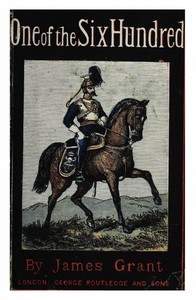
*ONE OF THE SIX HUNDRED*
*A Novel*
BY JAMES GRANT
AUTHOR OF "THE ROMANCE OF WAR."
"Half a league, half a league, Half a league, onward, Into the Valley of Death, Rode the Six Hundred!" TENNYSON.
LONDON: GEORGE ROUTLEDGE AND SONS THE BROADWAY, LUDGATE NEW YORK: 416 BROOME STREET
1875
*ONE OF THE SIX HUNDRED.*
*CHAPTER I.*
To be handsome, young, and twenty-two, With nothing else on earth to do; But all day long to bill and coo, It were a pleasant calling.--THACKERAY.
I was just in the act of humming the above verse, when the following announcement was put into my hand--
"Regimental Orders.--Head-quarters, Maidstone, December 31st.
"As the regiment is to be held in readiness for foreign service in spring, captains of troops will report to Lieutenant and Adjutant Studhome, for the information of the commanding officer, on the state of the saddlery, the holsters and lance-buckets; and the horses must be all re-shod under the immediate inspection of the veterinary surgeon and Farrier-Sergeant Snaffles.
"Leave of absence to the 31st proximo is granted to Lieutenant Newton Calderwood Norcliff, in consequence of his urgent private affairs."
"Hah! this is what most concerns _me_," I exclaimed, as I read the foregoing, and then handed the order-book, a squat vellum-bound quarto, to the orderly-serjeant who was in waiting.
"Any idea of where we are likely to go, sir?" he asked.
"The East, of course."
"So say the men in the barracks; for the present, good-bye, sir," said he, as he wheeled about on his spurred heel, and saluted; "I wish you a pleasant journey."
"Thanks, Stapylton," said I; "and now to be off by the night train for London and the north. Ugh! the last night of December; I shall have a cold journey of it."
Despatching my man, Willie Pitblado--of whom more hereafter--to the mess-house to report that I should not dine there that evening, I proposed at once to start for home, resolved to make the most of the favour granted me--leave between returns, as it is technically termed.
I propose to give the story of my own adventures, my experiences of life, or autobiography (what you will); and this I shall do, in the face of a certain writer, who asserts, with some truth, doubtless, that she does not "believe that there was, or could be in the world, a wholly true, candid, and unreserved biography, revealing all the dispositions, or even, without exception, _all the facts of any existence_. Indeed," she adds, "the thing is next to impossible; since, in that case, the subject of the biography must be a man or woman without reserve, without delicacy, and without _those secrets_ which are inevitable even to the most stainless spirit."
With all due deference to this fair writer, I beg to hope that such a candid spirit may exist; and that, without violating the delicacy of this somewhat (externally) fastidious age on the one hand, and without prudish or hypocritical reserve on the other, I, Mr. Newton Norcliff, will relate the plain, unvarnished story of a cavalry subaltern's life during the stirring events of the last ten years.
My regiment was a lancer one. I need not designate it further; though, by the way, it has always struck me as somewhat peculiar in our cavalry of the line, that while we have our Scottish corps, the famous old Greys, and no less than three Irish, we have not one English regiment, provincially designated as such.
I despatched a note of thanks to the colonel, handed over my cattle to the care of my friend Jack Studhome, the adjutant, and had a hasty interview with Saunders M'Goldrick, our Scots paymaster--not that I wish the reader to infer that he was my chief factor and reliance (heaven help those in a dragoon regiment who find him so!).
Glad to escape, even for the brief period of a month, from the monotony of routine parades, the stable duty, the barrack life, and useless hurly-burly of Maidstone--to be free from all bother, mess, band, and ball committees, courts-martial, and courts of inquiry; from having to remember when this parade took place, and when that particular drill, and all that sort of thing--glad, I say, to escape from being saluted by soldiers and sentinels at every turn and corner, and to be once again lord of my own proper person, I relinquished my gay lancer trappings, and resumed the less pretending mufti of the civilian--a suit of warm and strong heather-mixture tweed--and about nine o'clock P.M. found myself, with some light travelling baggage, my gun-case, railway rugs, &c. (in care of Willie Pitblado, who was attired in very orthodox livery--boots, belt, and cockade), awaiting the up train for London, at the Maidstone station, and enjoying a last friendly chat and a cigar with Studhome, as we promenaded to and fro on the platform, and talked of the different work that would soon be cut out for us, too probably, about the time my short leave expired.
The British fleet was already in the Bosphorus; the field of Oltenitza had seen the terrible defeat of the Russians by the troops of Omar Pasha, generalissimo of the Porte, avenge the recent naval massacre at Sinope. Ere long, the Turks were to be again victorious at Citate. General Luders was about to force his way into the Dobrudcha; Britain, France, Russia, Turkey, and Sardinia were gathering their hosts for the strife; and amid these serious events, that absurdity might not be wanting, the sly broad-brims and popularity-hunters of the Peace Society sent a deputation to the Emperor Nicholas, to expostulate with him on the wickedness of his ways.
"Egad! if the weather proves cold here, what will you find it at home, in Scotland?" said Studhome, as we trod to and fro; for there is no knocking the idea out of an Englishman's head that the distance of some four hundred miles or so must make a more than Muscovite difference in soil and temperature; but it was cold--intensely so.
The air was clear, and amid the blue ether the stars sparkled brightly. Snow, white and glistening, covered all the roofs of the houses and the line of the railway, and the Medway shone coldly, like polished silver, under the seven arches of its bridge, in the light of the rising moon; and now, with a shrill, vicious whistle, and many a rapidly iterated grunt and clank, came the iron horse that was to bear me on my way, as it tore into the station, with its mane of smoke, and its red bull's-eyes that shed two steady flakes of light along the snow-covered line of rails.
The passengers were all muffled to their noses, and their breath coated and obscured the glasses of the carefully-closed windows.
Pitblado brought me _Punch_, the _Times_, and "Bradshaw," and then rushed to secure his second-class seat; Studhome bade me farewell, and retired to join Wilford, Scriven, and some others of the corps, who usually met at a billiard-room, near the barracks, leaving me to arrange my several wrappers, and enjoy the society of one whom he laughingly termed my railway belle--a stout female with a squalling imp, whom, notwithstanding my secret and confidential tip of half-a-crown, the deceitful guard had thrust upon me; and then, with another shriek and a steady and monotonous clanking, the train swept out of the station. The town vanished with its county court house, barracks, river, and the fine tower of All Saints' Church; and in a twinkling I could survey the snow-covered country stretching for miles on each side of me, as we scoured along the branch line to the Paddock Wood, or Maidstone Road Junction, of the London and Dover Railway, where I got the up train from Canterbury.
Swiftly went the first-class express. The fifty-six miles were soon done, and in an hour I was amid the vast world, the human wilderness of London, even while worthy Jack Studhome's merry smile and hearty good-bye seemed to linger before me. How glorious it is to travel thus, with all the speed and luxury that money in these our days can command!
A hundred years hence how will they travel--our grandchildren? Heaven alone knows.
I was now four-and-twenty. I had been six years with the lancers, and already the novelty of the service--though loving it not the less--was gone; and I was glad, as I have said, to escape for a month from a life of enforced routine, and the nightly succession of balls, card and supper parties among the garrison hacks or _passe_ belles, whose names and flirtations are standing jokes at the messes of our ungrateful lancers, hussars, and dragoon guards, wherever they are stationed, from Calcutta to Colchester, and from Poonah to Piershill.
A day soon passed amid the whirl of London, and night saw me once more seated in the _coupe_ of a well-cushioned carriage for the north.
This time I was alone, and had the ample seat all to myself, thereon to lounge with all the ease of a sybarite; and with the aid of a brandy-flask, cigars, and warm wrappers and plaids, prepared for the dreary journey of a winter night.
On, on went the train!
Lights, crimson and green, flashed at times out of the darkness. Here and there the tall poplars of the midland counties stood up, like spectres in the moonlight, above the snow-clad meadows. Hollowly we rumbled through the subterranean blackness of a tunnel; out in the snow and moonlight again, amid other scenes and places. Anon, a hasty shout from some pointsman would make me start when just on the eve of dropping asleep; or it might be a sudden stoppage amid the lurid glare of furnaces, forges, and coalpits, where, night and day, by spells and gangs the ceaseless work went on. Then it was the shrill whistling and clanking of the train, the bustle, running to and fro of men with lanterns, the banging of doors, tramping, and voices, with the clink of hammers upon the iron wheels, as their soundness was tested, which announced that we were at Peterborough, at York, or Darlington.
But every station, whether we tarried or rushed past it, seemed wonderfully alike. There were always repetitions of the same glazed advertisements in gilt frames; the same huge purple mangold-wurzel, with its tuft of green leaves; the same man in the hat and surtout, with the alpaca umbrella, under the ceaseless shower of rain; Lea and Perrin's sauce-bottles; somebody else's patent shirt; the florid posters of _Punch_, the _Illustrated News_, and the _London Journal_; and the same parti-coloured volumes of railway literature.
Rapidly we rushed through England. Yorkshire and its Ridings were left behind, and now the Borders, the old land of a thousand battles and a thousand songs, drew near--the brave green Borders, with all their solemn hills, upheaved in the light of the faded stars.
Grey dawn of the coming day saw us traversing the fertile Merse, with glimpses of the gloomy German sea, tumbling its whitened waves upon bleak promontories of rock, such as Dunbar, Fastcastle, and the bare, black headland of St. Abb. Then, as I neared home, and saw the sun brightening on the snow-covered summits of Dirlton and Traprainlaw, many an old and long-forgotten idea, and many a sad and affectionate thought of the past years, came back to memory, in the dreary hour of the early winter morning.
I have said I was but four-and-twenty then. When I had last traversed that line of rail, it was in the sweet season of summer, when the heather was purple on the Lammermuirs; and a sea of golden grain clothed all the lovely valley of the Tyne. I was proceeding to join my regiment, a raw, heedless, and impulsive boy, with bright hope and vague ambition in his heart, and with a poor mother's tears yet wet upon his cheek.
I had been six years with the lancers, and four of these were spent in India. While there, my dear mother died; and the memory of the last time when I saw her kind and affectionate face, and heard her broken voice, as she prayed God to bless my departing steps, came vividly, powerfully, and painfully before me.
It was on the morning when I was to leave home and her to join the corps. Overnight, with all a boy's vanity and glowing satisfaction, I had contemplated my gay lancer trappings, had buckled on my sword, placed the gold cartouche-belt and glittering epaulettes on my shoulders.
At that moment I would not have exchanged my cornetcy for the kingdom of Scotland. These alluring trappings were the last things I thought of and looked on ere my eyes were closed by slumber, and the grey dawn of the next eventful day saw them still lying unpacked on the floor, when my poor mother, pale, anxious, unslept, and with her sad eyes full of tears, and her heart wrung with sorrow, stole softly into my room, to look for the last time upon her sleeping boy, and her mournful and earnest face was the first sight that met my waking eyes, when roused by a tear that dropped upon my cheek.
I started up, and all the consciousness of the great separation that was to ensue--the terrible wrench of heart from heart that was to come--burst upon me. Then sword and epaulettes, cap and plume, and the lancers, were forgotten; and throwing my arms around her neck, as I had done in the days of childish grief, I wept like the boy I was, rather than the man I had imagined myself to be.
I was going home now; but I should see that beloved face no more, and her voice was hushed for ever.
In that home were others, who were kind and gentle, and who loved me well, awaiting my arrival, and to welcome me. And there was my cousin Cora Calderwood--she was unmarried still.
Cora I was about to see again. It seemed long, long since we had last met, though we had frequently corresponded, for my uncle had a horror of letter-writing; and certain it was that she had inspired the first emotion of love in my schoolboy heart, and during my sojourn in India, and amid the whirl and gaiety of barrack-life at Bath, at Maidstone, at Canterbury and elsewhere, her image had lingered in my mind, more as a pleasing memory connected with ideas of Scotland and my home, rather than with those of a passionate or enduring attachment.
Indeed, I had just been on the point of forming that elsewhere; but now, having no immediate attraction beside me, I began to wonder whether Cora had grown up a beauty; how tall she was, whether she was engaged, and so forth; whether she still remembered with pleasure the young playmate who had left her sorely dissolved in tears, half lover and wholly friend.
As we progressed northward, and crossed the Firth of Forth, the snow almost entirely disappeared, save on the lofty summits of the Ochil mountains, whose slopes looked green and pleasant in the meridian sun; and my friend Studhome, had he been with me, might have been much surprised in finding the atmosphere warmer north of Stirling Bridge than we found it at Maidstone--so variable is our climate.
We changed carriages at Stirling, where I was to imbibe some hot coffee, while Pitblado looked after my baggage, and swore in no measured terms at the slowness of an old, cynical, and hard-visaged porter, on whose brass badge was engraved a wolf--the badge of Stirling.
"Now then, look alive, you old duffer!" I heard Willie shouting.
"Ou, aye!" replied the other slowly, with a grin on his weather-beaten and saturnine face; "ye think yoursel' a braw chiel in your mustaches and laced jacket--there was a time when I thocht mysel' one too."
"What do you mean?" asked Pitblado, whose dragoon air even his livery failed to conceal.
"Mean!" retorted the other; "why, I mean that at the point o' the bayonet I helped to carry Badajoz and Ciudad Rodrigo to boot; and now, for sax baubees, I'm thankfu' to carry your bag. Sae muckle for sodgerin'!"
"It is not very encouraging, certainly," said my man, with a smile.
"Ten years' service, two wounds, and a deferred pension of threepence per diem," growled the other, as he threw my traps, with an oath, on the roof of the carriage.
"What regiment, my friend?" I inquired.
"The old Scots brigade, second battalion, sir," he replied, with a salute, as I slipped a trifle into his hand.
"The weather seems open and fine here."
"Aye," said he, with another saturnine grin; "but a green yule maketh a fat kirkyard."
In five minutes more we were _en route_, sweeping along the little lonely branch line, that through grassy glens, where the half-frozen runnels oozed or gurgled among withered reeds and bracken bushes, led us into the heart of Fife--"the kingdom," as the Scots call it; not that it ever was so in any time of antiquity, but because the peninsular county contains within its compact and industrious self every means and requisite for the support of its inhabitants, independent of the produce of the whole external world--at least, such is their boast.
I was drawing nearer and nearer home; and now my heart beat high and happily. Every local feature and casual sound, the little thatched cottages, with rusty, antique risps on their doors,[*] and the clatter of the wooden looms within, were familiar to me. We swept past the quaint town, and the tall, gaunt castle of Clackmannan, where its aged chatelaine--the last of the old Bruce line--_knighted_ Robert Burns, with the sword of the victor of Bannockburn, saying, dryly, that she "had a better right to do it than _some people_," and ere long I saw the spires that overshadow the graves of Robert I. and many a Scottish monarch, as we glided past Dunfermline, old and grey, with its glorious ruined palace, where Malcolm drank the blood-red wine, and where Charles I. was born, and its steep, quaint streets covering the brow of a sloping ridge that ends abruptly in the wooded glen of Pittencrief.
[*] The old Scottish tirling-pin--to be found now nowhere save in Fife--in lieu of bells and knockers.
My delight was fully shared in by Willie Pitblado, my servant, the son of old Simon, my uncle's keeper. He was a lancer in my troop, for whom I had procured a month's furlough; thus the hedgerows where he had bird-nested, the fields where he had sung and whistled at the plough, the farm-gates on which he had swung for hours--a truant boy from school--the woods of Pitrearie and Pittencrief, the abbey's old grey walls, and the square tower that covers Bruce's grave, were all hailed by Willie as old friends; and strange to say, his Doric Scotch came back to his tongue with the air he breathed, though it had been nearly well-nigh quizzed out of him by our lancers, nearly all of whom were English.
He was a smart, handsome, and soldier-like fellow, who bade fair to be "the rage" among the servant-girls at the old house, the home-farm, and the adjacent village, and a source of vexation to their hobnailed country admirers.
A few miles beyond the old city I quitted the train, and leaving him to follow with my baggage in a dog-cart, I struck across the fields by a near path that I remembered well, and which I knew would bring me straight to Calderwood Glen, the residence of my uncle, Sir Nigel--save Cora, almost the last relation I had now on earth.
*CHAPTER II.*
Pure as the silver wreath of snow That lies on yonder wintry hill, Are all the thoughts that peaceful flow, And with pure joy my bosom fill.
Soft as the sweet spring's morning breath, Or summer's zephyr, forth they roam; Until my bosom grows more kind, And dreams of thee and all at home.
The winter day was cold and clear, but without frost, save on the mountain tops, where the snow was lying. Though vegetation should have been dormant, the swelling uplands, the pastoral hills and braes of Fife, looked green and fertile; and there was a premature budding of young shoots, which the bitter frost of to-morrow might totally destroy.
Fires glowed redly through the little square windows of the wayside cottages, and from their massive stone chimneys the smoke ascended into the thin air in heavy volumes, that told of warmth, of comfort, and industry within. Ere long I could see the woods, all bare and leafless, that covered the slopes of Calderwood Glen, and the vanes of the old house shining in the light of the setting sun, which streamed along the green slope of the western Lomond.
I passed unnoticed through the secluded village which stood, I knew, upon the verge of my good uncle's property, and where the old signboards of the smithy, the bakery, and alehouse were familiar to me. The clock of the old Gothic kirk struck the hour of three, slowly and deliberately, as only such clocks do in the country.
Many years ago, in boyhood, I remembered the familiar voice of that village monitor. What changes had taken place since then, in myself and others, and even in the scene around me! How many, whose daily routine, and whose labours--the heritage of toil--were timed by its bell and dial, were now in other lands, or sleeping in their humble graves beneath the shadow of the spire, and yet the old moss-grown clock ticked on!
Since then I had grown to manhood, had seen many of the dearest of my kindred die. Since then I had become a soldier, and had served in India, and on the staff in the late Burmese war. At the bombardment of Rangoon, I received a wound in the night attack made by the enemy on our camp at the heights of Prome.
Thousands of stirring scenes and strange faces had flitted before me. I had traversed twice the great Atlantic and Indian oceans, and had twice passed the Cape, on the first occasion looking with anxious eyes and envious heart at every homeward-bound sail; and now all these events seemed as a long dream, and as if it were but yesterday when last I heard the voice of the old village clock.
In that timeworn fane, Row, the Covenanter, had preached, and the great archbishop, too--Sharpe, the recreant, or the martyr (which you will), who died on Magus Muir; and, that the marvellous may not be wanting, there is a legend which tells us that, in the year before the Covenanters invaded England, and stormed Newcastle, thereby seriously injuring the London coal market, there used to issue from the empty loft where, in old Catholic times, the organ stood, the sound of such an instrument in full play, together with the voices of the choristers singing a grand old Gregorian chant. These sounds were only heard in the night, or at other times when Calderwood kirk was empty, for the moment any one entered they ceased, and all became still--still as the dead Calderwoods of the Glen and of Piteadie, stretched in effigy, each upon his pedestal of stone, in St. Margaret's aisle; but this marvel was universally believed to portend the ultimate return of prelacy.
So rapidly and totally does the speed of the railway annihilate alike the extent of time and space, that it seemed difficult to embody the fact that, but four-and-twenty hours ago, I had been in my quarters at Maidstone barracks, or amid the splendour of a fashionable hotel in London; and yet it was so.
Treading deep among the last year's crisp and withered leaves, I proceeded down the sombre and winding avenue, with a heart that beat quicker as I drew near a man, whose figure I remembered instantly, for he was my early friend, my second father, my maternal uncle, good old Sir Nigel Calderwood. Occupied with a weeder, which he always carried, and with which the ends of all his walking-sticks were furnished, he was intent on up-rooting some obnoxious weed; thus I could approach him unobserved. He seemed as stout and hale as when I saw him last. The grey hair, that was wont to escape under his well-worn wide-awake, was thinner and more silvery, perhaps; but the old hat had its usual row of flies and fishhooks, and his face was as ruddy as ever, and spoke of high health and spirits. He stooped a little more, certainly; but his figure was still sturdy, and clad, as usual, in a rough suit of grey tweed, with his stout legs encased in long brown leather leggings, that had seen much service in their time among the turnips and heather in the shooting season, and in the trouting streams that traverse the fertile Howe of Fife.
An old, half-blind, and wheezing otter terrier crept close to his heels as I came up. With a polite bow the worthy baronet surveyed, but failed to recognise me, and waited, with a glance of inquiry, until I should speak; for, sooth to say, in the tall, rather well-knit figure, bronzed face, and heavy moustaches I exhibited, he could scarcely be expected to recognise the slender and beardless lad, whose heart was so heavy when he was conveyed away from his mother's arms, to push his way in the world as a cornet of cavalry some six years before.
"Uncle--Sir Nigel!" said I, in a voice that became tremulous.
"Newton--my dear boy, Newton--am I blind that I did not recognise you?" he exclaimed, while he grasped my hand and threw an arm round me; "welcome back to Calderwood--welcome home--and on the second day of the New Year, too! may many many joyous returns of the season be yours, Newton! What a manly fellow you have become since I saw you last in London--quite a dragoon!"
"And how is Cora--she is with you, of course?"
"Cora is well; and though not a dashing girl, she has grown up an amiable and gentle little pet, who is worth her weight in gold; but you shall see--you shall see, and judge for yourself. The house is full of visitors just now--I have some nice people to present you to."
"Thanks, uncle; but you and Cora were all I cared to see."
"But how came you to be here alone, and on foot too?"
"I left the train at Calderwood station, and wished to come quietly back to the old house, without any fuss."
"To steal a march upon us, in fact?"
"Yes, uncle, you understand me," said I, looking into his clear dark eyes, which were regarding me with an expression of great affection, which recalled the memory of my mother, his youngest and favourite sister. "Pitblado will drive over with my traps before dinner."
"Ah, Willie, the old keeper's son?"
"Yes."
"And how is he?"
"Quite well, and become so smart a lancer, that I fear there will be a great pulling of caps among the housemaids. I am loth to keep him out of the ranks, but the worthy fellow won't leave me."
"Many a good bag of grouse from yonder fields and the Lomonds, and many a good basket of trout from the Eden, has poor Willie carried for me. But, come this way; we shall take the near cut by the keeper's lodge to the house; you have not forgotten the way?"
"I should think not, uncle; by the Adder's Craig and the old Battle Stone."
"Exactly. I am so glad you have come at this time; I have such news for you, Newton--such news, boy."
"Indeed, uncle?"
"Yes," he continued, laughing heartily.
"How?"
"Calderwood Glen is a mere man-trap at present."
"In what manner?"
"We have here old General Rammerscales, of the Bengal army, who has come home with the liver complaint, and a face as yellow as a buttercup, and his pale niece--a girl worth heaven knows how many sacks or lacs of rupees (though, for the life of me, I never knew what or how much a lac is.) We have also Spittal of Lickspittal and that Ilk, M.P. for the Liberal interest (and more particularly for his own), with his two daughters, rather pretty girls; and we have that beautiful blonde, Miss Wilford, who has a cousin in your regiment--a Yorkshire heiress, whom all the men agree would make such a wife! We have also the Countess of Chillingham, and her daughter, Lady Louisa Loftus, really a very charming girl; so, as I told you, Newton, the old house is baited like a regular man-trap for you."
Had my uncle's perception been clearer, or had he been less vigorously using his weeder, as he ran on thus, he could not have failed to observe how powerfully the last name he uttered affected me.
After a pause--"In none of your letters," said I, "did you mention that Lady Loftus was here."
"Did I not? But Cora is your chief correspondent, and no no doubt she did."
"On the contrary, my cousin never once referred to her."
"Strange! Lord Chillingham left us a week ago in haste to attend a meeting of the Cabinet; but his women folks have been rusticating here for nearly three months. Charming person the countess--charming, indeed; but the daughter is quite a Diana. You have met her before--she told us so, and I have made up my mind--ah, you know for what, you rogue--eh?"
What my uncle had made up his mind for was not very apparent; but he concluded his sentence by poking the weeder under my short ribs.
"To have me marry in haste and repent at leisure, eh, uncle--is it for this that your mind is made up?"
"I am a man of the old school, Newton; yet I hate proverbs, and everything old, except wine and good breeding."
"You are aware, uncle," said I, to change the subject, "that the lancers are under orders for Turkey?"
"Where women are kept under lock and key, bought, and secluded from society; just as in Britain they are thrust into it for sale."
"And so, my dear uncle, supposing that a lively young lancer will make a most excellent husband for your noble and beautiful _protegee_, you are resolved to make a victim of me, is it not so?"
"Precisely; but according to the old use and wont in drama and romance, you must not be a willing one; you must be prepared to hate her cordially at first sight, and to prefer some one else--of course, some amiable village damsel, of humble but respectable parentage," replied Sir Nigel, laughing.
"Hate _her_--prefer another!" I exclaimed; "on the contrary, I--I----"
I know not what I was about to say, or how far I might have betrayed myself. The blood rushed to my temples, and I felt giddy and confused, for the kind old baronet knew little of the hopeless passion with which the fair one of whom he spoke had inspired me already.
"You have met the Lady Lousia before, you say?"
"Nay, 'twas she who said she had met me," said I, glad to recall by this trifling remark that I was not forgotten by her.
"Ah, indeed--indeed; where?"
"Oh, at Canterbury, at Tunbridge Wells, Bath; all those places where people are to be met. In London, too, I saw her presented at Court."
"The deuce! You and she seem to have gone in a leash," said Sir Nigel, laughing, while the colour deepened on my cheek again; "but you must look sharp, for one of your fellows who is here is for ever dangling after her."
"One of _ours_?" I exclaimed, with astonishment.
"Yes; a solemn, dreary, dandified fellow, whom I met at Chillingham's shootings in the north, and invited to spend the last weeks of his leave of absence here, as we were to have you with us; and he spared no pains to impress upon me that he was a particular chum of yours."
"Is he Captain Travers--Vaughan Travers? He is on leave."
"No; he is Lieutenant De Warr Berkeley."
"Berkeley!" I repeated, with some disgust, and with an emotion of such inconceivable annoyance that I could scarcely conceal it; for decidedly he was the last man of ours whom I should have liked to find domesticated at Calderwood Glen.
Berkeley was well enough to meet with in men's society, at mess, on parade, on the turf, or in the hunting-field; but though handsome and perfectly well-bred, for his manners were generally unexceptionable, he was not a man for the drawing-room. He was master of a splendid fortune, which was left him by his father, a plain old Scotchman, who had begun life as a drayman, and whose patronymic was simply John Dewar Barclay. He became a wealthy brewer, and somehow his son like all such _parvenus_, despising his name, was gazetted to the lancers as De Warr Berkeley, and as such his name figured in the "Army List."
The carefully-acquired fortune of the plodding old brewer he spent freely, and without being lavish, though as an Eton boy, and afterwards as a gentleman commoner of Christchurch, he had plunged into dissipation that made his name proverbial. He was one of those systematic _roues_ whom prudent mothers would carefully exclude from the society of their daughters, nathless his commission, his cavalry uniform, his fortune, his decidedly handsome person and bearing, which had all the "tone of society"--whatever that may mean.
Hence I was rather provoked to find that the kind and well-meaning but blundering old baronet had, as a favour to me, installed him at Calderwood, as a friend for my pretty cousin Cora, and an admirer of Lady Louisa. As I thought over all this, her name must have escaped me, for my uncle roused me from a reverie by saying--
"Yes; she is a charming, a splendid girl, really! A little too stately, perhaps; but I would rather have my little rosebud, Cora, with her peculiar winning ways. Lady Louisa may be all head--as I believe she is; but our Cora is all heart, Newton--all heart!"
"And Lady Louisa is all head, you think, uncle?"
"I could see that at a glance--yes, with half an eye; and yet there are times when I wish Cora had been a boy----"
My uncle leaned on his stick, and sighed.
His eldest son had been killed in the 12th Lancers, at the battle of Goojerat; the other had died prematurely at College--a double loss, which had a most fatal effect on their delicate mother, then in the last stage of a mortal disease. Now the affection of the lonely Sir Nigel was centred in Cora, his only daughter, the child of his declining years; and thus he had a great regard for me as the son of his youngest sister; but he sorrowed in secret that his baronetcy--one of the oldest in Scotland, having been created in 1625 by Charles I.--should pass out of his family.
Sir Norman Calderwood of the Glen, who had attended the Scottish princess, Elizabeth Stuart, to Bohemia, was the first patented among the baronets of Nova Scotia; and was therefore styled _Primus Baronettorum Scotiae_, a prefix of which my uncle, as his ancestors had been, was not a little vain.
"The estates are entailed," said he, pursuing this line of thought; "they were among the first that were so, when the Scottish parliament passed the Entail Act in 1685; and though they go, as you know, to a remote collateral branch, the baronetcy ends with myself. Cora shall be well and handsomely left; for she shall have the Pitgavel property, which, with its coal and iron mines, yields two thousand per annum clear. And you, my boy, Newton, shall find that, tide what may, you are not forgotten."
"Uncle, you have already done so much for me----"
"Much, Newton?"
"Yes, my dear sir."
"Stuff! fitted you out for the lancers--that is all."
"You have done more than that, uncle----"
"I have lodged the purchase money for your troop with Messrs. Cox and Co.; but most of this money must, under other circumstances, have been spent on your cousins, had they lived. So, thank fate and the fortune of war, not me, boy, not me. But there are times, especially when I am alone, that it grieves me to think that instead of leaving an heir to the old title, one boy lies in his grave in the old kirk yonder; and the other, far, far away on the battle-field of Goojerat."
He shook his white head, and his voice became tremulous, his chin sank on his breast, and he added--
"My poor Nigel!--my bonnie Archie!"
The baronet was a handsome man, above six feet in height, and, though he stooped a little now, had been erect as a pike. He possessed fine aquiline features, a ruddy and healthy complexion; clear, and bright dark grey eyes; a well-shaped, though not very small, mouth; and a Scottish chin, of a curve that evinced perseverance and decision. His hair was nearly white, but there was plenty of it; his hands, though browned by exposure and seldom gloved--for the gun, the rod, the riding-whip, and the curling stone were ever in them by turns--were well shaped, and showed by their form and nails that he was a gentleman of good blood and breeding. His plain costume I have described, and he was without ornament, save a silver dog-whistle at his button-hole, and a large gold signet-ring, which belonged to his grandfather, Sir Alexander Calderwood, who commanded a frigate under Admiral Hawke, in the fleet which, in 1748, fought and vanquished the Spanish galleons between Tortuga and the Havannah.
A sturdy old Fifeshire laird, proud of a long line of warlike Scottish ancestors, uncrossed by any taint of foreign blood, he was fond of boasting that neither Dane nor Norman--the Englishman's strange vaunt and pride--could be found among them; but that he came of a race, which--as our Highlanders forcibly phrase it--had sprung from the soil, and were indigenous to it.
But, indeed, the alleged foreign descent of nearly the whole Scottish aristocracy is a silly sham, existing in their own imagination, having arisen from the ignorance of the monkish Latin writers, who in rolls and histories prefixed the Norman _de_ or _le_, in many instances, to the most common Celtic patronymics and surnames.
Sir Nigel had "paraded," to use a barrack phrase, more than one man in his youth, and enjoyed the reputation of being an unpleasantly good shot with his pistol. He could remember sharing in the rage of the high-flying Tory party among the Fife lairds, when Sir Alexander Boswell, of Auchinleck, was shot by James Stuart, of Dunearn, in a solemn duel, where personal and political rancour were combined, at Balmuto, for which the victor had to fly to England, and from thence to France.
"It seemed strange on reflection, Newton," I have frequently heard Sir Nigel, say, "that poor Boswell was the first to propose in Parliament the repeal of our old Scottish statutes anent duelling, and that, after all, he should fall by the pistol for a mere newspaper squib, in which Sir Walter Scott was, perhaps, as much to blame as he."
*CHAPTER III.*
Sing on, thou sweet mavis, thy song to the ev'ning, Thou'rt dear to the echoes of Calderwood Glen; Sae dear to this bosom, sae heartless and winning, Is charming young Jessie, the flower o' Dunblane. TANNAHILL.
"Here is the old house, and here we are at last, Newton," said my uncle, as an abrupt turn of the private path through the woodlands brought us suddenly in front of the ancient mansion, in which, after the early death of my father, I had spent my boyhood.
It stands in a well-wooded hollow, or glen, overlooked by the three Lomonds of Fife--a county which, though not renowned for its picturesque scenery, can show us many peaceful and beautiful landscapes.
Calderwood is simply an old manor-house, or fortalice, like some thousand others in Scotland, having a species of keep, with adjacent buildings, erected during quieter or more recent periods of Scottish history than the first dwelling, which had suffered severely during the wars between Mary of Guise and the Lords of the Congregation, when the soldiers of Desse d'Epainvilliers blew up a portion of it by gunpowder--an act terribly revenged by Sir John Calderwood of the Glen, who had been chamberlain of Fife and captain of the castle of St. Andrew's for Cardinal Beaton. Overtaking a party of the Bandes Francaises in Falkland Woods, he routed them with considerable slaughter, and hung at least a dozen of them on the oak trees in the park of the palace.
The latest additions had been made under the eye of Sir William Bruce of Kinross, the architect of Holyrood--the Scottish Inigo Jones--about a hundred and ninety years before the present period, and thus were somewhat florid and Palladian in their style, their fluted pilasters and Roman cornices and capitals contrasting singularly with the grim severity and strongly-grated windows of the old tower, which was founded on a mass of grey rock, round which a terraced garden lies.
Within this, the older portion, the rooms were strange and quaint in aspect, with arched roofs, wainscoted walls, and yawning fireplaces, damp, rusty, cold, and forlorn, where the atmosphere felt as if the dead Calderwoods of other times visited them, and lingered there apart from the fashionable friends of their descendants in the more modern mansion; and within the tower Sir Nigel treasured many old relics of the palace of Dunfermline, which, when its roof fell in, in 1708, was literally plundered by the people.
Thus, in one room, he had the cradle of James VI., and the bed in which his son, Charles I., had been born; in another, a cabinet of Anne of Denmark, a chair of Robert III., and a sword of the Regent Albany.
The demesne (Scotice, "policy") around this picturesque old house was amply studded with glorious old timber, under which browsed herds of deer, of a size, strength, and ferocity unknown in England. The stately entrance-gate, bearing the palm-tree of the Calderwoods, a crusading emblem, and the long avenue, of two Scottish miles, and the half-castellated mansion which terminated its leafy vista, well befitted the residence of one whose fathers had ridden forth to uphold Mary's banner at Langside, and that of James VIII. at the battle of Dunblane.
Here was the well where the huntsman and soldier, James V., had slaked his thirst in the forest; and there was the oak under which his father--who fell at Flodden--shot the monarch of the herd by a single bolt from his crossbow.
In short, Calderwood, with all its memories, was a complete epitome of the past.
The Eastern Lomond (so called, like its brothers, from Laomain, a Celtic hero), now reddened by the setting sun, seemed beautiful with the green verdure that at all seasons covers it to the summit, as we approached the house.
Ascending to the richly-carved entrance-door, where one, whilom of oak and iron, had given place to another of plate-glass, a footman, powdered, precise, liveried, and aiguilletted, with the usual amplitude of calf and acute facial angle of his remarkable fraternity, appeared; but ere he could touch the handle it was flung open, and a handsome young girl, with a blooming complexion, sparkling eyes, and a bright and joyous smile, rushed down the steps to meet us.
"Welcome to Calderwood, Newton," she exclaimed; "may our new year be a happy one."
"Many happy ones be yours, Cora," said I, kissing her cheek. "Though I am changed since we last met, your eyes have proved clearer than those of uncle, for, really, he did not know me."
"Oh, papa, was it so?" she asked, while her fine eyes swam with fun and pleasure.
"A fact, my dear girl."
"Ah! I could never be so dull, though you have those new dragoon appendages," said she, laughingly, as I drew her arm through mine, and we passed into a long and stately corridor, furnished with cabinets, busts, paintings, and suits of mail, towards the drawing-room; "and I am not married yet, Newton," she added, with another bright smile.
"But there must be some favoured man, eh, Cora?"
"No," she said, with a tinge of hauteur over her playfulness, "none."
"Time enough to think of marrying, Cora; why, you are only nineteen, and I hope to dance at your wedding when I return from Turkey."
"Turkey," she repeated, while a cloud came over her pure and happy face; "oh, don't talk of that, Newton; I had forgotten it!"
"Yes; does it seem a long, or a doubtful time to look forward to?"
"It seems both, Newton."
"Well, cousin, with those soft violet eyes of yours, and those black, shining braids (the tempting mistletoe is just over your head), and with loves of bonnets, well-fitting gloves and kid boots, dresses ever new and of every hue, you cannot fail to conquer, whenever you please."
She gave me a full, keen glance, that seemed expressive of annoyance, and said, with a little sigh--
"You don't understand me, Newton. We have been so long separated that I think you have forgotten all the peculiarities of my character now."
"What the deuce can she mean?" thought I.
My cousin Cora was in her fullest bloom. She was pretty, remarkably pretty, rather than beautiful; and by some women she was quite eclipsed, even when her cheek flushed and her eyes, a deep violet grey, were most lighted up.
She was fully of the middle height, and finely rounded, with exquisite shoulders, arms, and hands. Her features were small, and perhaps not quite regular. Her eyes were alternately timid, inquiring, and full of animation; but, in fact, their expression was ever varying. Her hair was black, thick, and wavy; and while I looked upon her, and thought of her present charms and of past times--and more than all of my uncle's fatherly regard for me--I felt that, though very fond of her, but for another I might have loved her more dearly and tenderly. And now, as if to interrupt, or rather to confirm the tenor of such thoughts as these, she said, as a lady suddenly approached the door of the drawing-room, which we were about to enter--
"Here is one, a friend, to whom I must introduce you."
"No introduction is necessary," said the other, presenting her hand. "I have had the pleasure of meeting Mr. Norcliff before."
"Lady Louisa!" I exclaimed, in a breathless voice, and a heart that trembled with sudden emotion, as I touched her hand.
"I am so glad you have come before we leave. I shall have so much to ask you about our mutual friends--who are engaged, and who have quarrelled; who have come home, and who gone abroad. We have been no less than four months in Scotland. Meantime," she added, glancing at her tiny watch, "we must dress for dinner. Come, Cora; we have barely half an hour, and old General Rammerscales is so impatient--he studies 'military time,' and with a 'military appetite.'"
And with a bow and smile of great brightness and sweetness she passed on, taking with her Cora, who playfully kissed her hand to me as they glided up the great staircase into which the long corridor opened.
Lady Louisa was taller and larger in person than Cora. Her features were singularly beautiful, and clearly cut; her forehead was low; and her nose had the gentlest approach to the aquiline. She was without colour, her complexion being pale, perhaps creamy; while in strange contrast to this aristocratic pallor of delicacy, her thick, wavy hair, her long double eyelashes, and her ever-sparkling eyes, were black as those of a Spanish gitano or a Welsh gipsy.
To this pale loveliness was added a bearing alternately haughty and playful, but at all times completely self-possessed; an exquisite taste in dress and jewellery; a very alluring voice; a power of investing even trifles with interest, and of conversing fluently and gracefully on any subject--whether she was mistress of it or not mattered little to Lady Louisa.
She was about my own age, perhaps a few months younger; but in experience of the fashionable world, and in knowledge of the manners and ideas of the upper ten thousand, she was a hundred years my senior.
Suffice it to say that I had lost my heart to her--that I thought she knew it well, but feared or disdained to acknowledge a triumph so small as the conquest of a lieutenant of lancers among the many others she had won. So thought I, in the angry humility and jealous bitterness of my heart.
For a minute I felt as one in a dream. I was sensible that my uncle had said something about changing his costume, and, suggesting some change in mine, had apologised, and left me to linger in the corridor, or in the drawing-room, as I chose; but now a personage, who had been lounging on a _fauteuil_ in the latter, intent on a volume of _Punch_, and the soles of whose glazed boots had been towards me, suddenly rose and approached, in full evening costume.
He proved to be no other than Berkeley of ours, who had been in the room alone, or, at least, alone with Lady Louisa Loftus. He came slowly forward, with his sauntering air, as if the exertion of walking was a bore, and with his eyeglass retained in its place by a muscular contraction of the right eyebrow. His whole air had the "used-up" bearing of those miserable Dundrearys who affect to act as if youth, wealth, and luxury were the greatest calamities that flesh is heir to, and that life itself was a bore.
"Ah, Norcliff--haw--glad to see you here, old fellow. Haw--heard you were coming. How goes it with you, and how are all at Maidstone?"
"Preparing for foreign service," said I, curtly, as the tip of his gloved hand touched mine.
"Horrid bore! Too late to send in one's papers now, or, by Jove, I'd hook the service. Don't think I was ever meant for it."
"Ere long many more will be of your way of thinking," said I, coolly.
Berkeley had a cold and cunning eye, which never smiled, whatever his mouth might do. His face was, nevertheless, decidedly handsome, and a thick, dark moustache concealed a form of lip which, if seen, would have indicated a thorough sensualist. His head was well shaped; but the accurate division of his well-oiled head over the centre of the caput gave him an air of intense insipidity. Mr. De Warr Berkeley never was a favourite of mine, though we had both joined the lancers on the same day, and it was with very ill-concealed annoyance I found myself compelled, with some apparent cordiality, to greet him as a brother officer and an inmate of my uncle's mansion.
"And--haw--what news from the regiment?" he resumed.
"I really have no news, Berkeley," said I.
"Indeed. You have got a month's leave?"
"Between returns, yes."
"Is the route come?"
"A strange question, when you and I are here."
"Haw--yes, of course--how devilish good."
"It has _not_," said I, coldly; "but we are under orders for foreign service, and may look to have our leaves cancelled by a telegram any day or hour."
"The devil--really!"
"Fact, though, however unpleasant it may be. So my uncle, Sir Nigel, met you at--where was it?"
"Chillingham's shooting-box, in the Highlands."
"I was not aware that you knew the earl."
"Losing my gillies--I think you call them in Scotland--one evening in the dark, I lost my way, and luckily stumbled on his lordship's shooting quarters, in a wild and savage place, with one of your infernally unpronounceable Scotch names."
"Oh, you think changes more euphonious at times; but I suppose your father, honest man, could have pronounced it with ease," said I, quietly, for Berkeley's, or Barclay's affectation of being an Englishman was to me always a source of amusement. "You have to learn Russ yet, and it will prove, doubtless, more unpalatable than the tongue your father spoke. In the north, did you appear _en montagnad_?"
"Hey--haw, the devil! no; as the Irish Gil Blas says, 'Every one's legs can't afford publicity,' and mine are among the number. Leather breeches, when I don the pink, must be all the length. I don't care about going, though Lady Louisa pressed me hard to join the Mac Quaig, the Laird of Mac Gooligan, and other natives in tartan at a gathering. I had a letter from Wilford yesterday. He writes of a famous match between Jack Studhome and Craven, on which the whole mess had a heavy book, that great stakes were pending, and that Craven won, scoring forty-two running off the red ball; and considering that the pockets of the table were not bigger than an egg-cup, I think Craven a trump."
"I heard something of this match at morning parade on the day I left; but being a bad stroke, you know, I seldom play billiards."
"Why was Howard's bay mare scratched at the last regimental race?"
"Don't know," said I, so dryly that he bit his nether lip.
"Some nice people visiting here," said he, staring at me steadily, so that his eyeglass glared in the light of the lustre, which was now lit; "and some very odd ones too. Lady Loftus is here, you see, in all her glory, and with her usual come-kiss-me-if-you-dare kind of look."
"Berkeley, how can you speak thus of one in her position?"
"Well, you-don't-dare-to-do-so-again sort of expression."
"She is my uncle's guest; not a girl in a cigar-shop or a casino!" said I, with growing _hauteur_.
"Sir Nigel's guest--haw--so am I, and I mean to make the best use of my time as such. Nice girl, Miss Wilford, from York--cousin of Wilford of ours--a doocid good style of girl; but have no intentions in that quarter--can't afford to chuck myself away, as I once heard my groom observe."
"You must learn to quote another style of people to make yourself understood here. You don't mean to infer that you have any intentions concerning Lady Louisa!" said I, with an air which was really impertinent.
"Why not?" he asked, failing completely to see it. "I have often such attacks, or affections of the heart, as she has given me."
"How?"
"Just as I had the measles or the chicken-pox in childhood--a little increase of the pulse, a little restlessness at night, and then one gets over it."
"Take care how you address her in this bantering fashion," said I, turning sharply away; "excuse me, but now I must dress for dinner."
And preceded by old Mr. Binns, the white-headed old butler, who many a time in days of yore had carried me on his back, and who now welcomed me home with a hearty shake of the hand, in which there was nothing derogatory to me, though Berkeley's eyes opened very wide when he saw our greeting, I was conducted to my old room in the north wing, where a cheerful fire was blazing, with two lights on each side of the toilette-table (the manor-house was amply lit with gas from the village), and there was Willie Pitblado arranging all my traps and clothes. But dismissing him to visit his family (to his no small joy), I was left to my own reflections and proceeded to dress. A subtle and subdued tone of insolence and jealousy that pervaded the few remarks made by Berkeley irritated and chafed me; yet he had said nothing with which I could grapple, or with which I could openly find fault. I was conscious, too, that my own bearing had been the reverse of courteous and friendly, and that, if I showed my hand thus, I might as well give up the cards. Suspicion of his native character, and a foreknowledge of the man, had doubtless much to do with all this; and while making my toilet with more than my usual care--conscious that Lady Louisa was making hers in the next room--I resolved to keep a lynx-like eye upon Mr. De Warr Berkeley during our short sojourn at Calderwood Glen. My irritation was no way soothed, or my pique lessened, by the information that for some time past, and quite unknown to me, he had been residing here with Lady Louisa, enjoying all the facilities afforded by hourly propinquity and the seclusion of a country house.
Had he already declared himself? Had he already proposed? The deuce! I thrust aside the thought, and angrily gave my hair a finishing rasp with a pair of huge ivory-handled hair-brushes.
*CHAPTER IV.*
And, oh! the memories that cling Around this old oak-panelled room! The pine logs flashing through the gloom, Sun sparkles from life's early spring.
After long years I rest again; This ancient home it seems to me, Wearied with travel o'er the sea. Holds anodyne for carking pain.
As I surveyed my old apartment the memories of other years stole over me with somewhat of a soothing influence, for when I thought of the past, the littleness of the present, the evanescent nature of all things could not fail to impress me.
It was in that room I had the last vivid recollection of my dear mother's face, on that farewell morning, when with early dawn she stole in on tiptoe to look for the last time upon her boy as he slept, and before he went forth into the world beyond her maternal care for ever.
The thunder of a gong in the corridor cut short further reflections, recalling me to the present; and giving a finishing touch to my costume, which was not the blue lancer uniform, faced with white, and laced with gold, but the solemn funereal suit and white necktie of civil life--a horrid costume that has crept among us, heaven knows how--I descended to the outer drawing-room, where I found my uncle and cousin marshalling their guests, of whom there appeared to be a goodly number.
Berkeley had already monopolized Lady Louisa, with whom he was conversing in a low tone, while busy stroking his moustaches, which were darkened by the "Guards' dye," and the pointing and twirling of which afforded him endless employment.
There was no denying that the fellow looked well, and that the result of riding, drilling, dancing, and fencing had been to impart to him much of that unmistakable air which, I may say without vanity, belongs particularly to the officers of our branch of the service.
The odd minutes which precede dinner are seldom very lively, and rather depress than raise the spirits. To Cora I was a species of "lion;" and as such underwent, through her, a process of introduction to several people I cared not a jot about, and never would.
I discussed the weather with General Rammerscales, as if I kept a rain-gauge and barometer, and was own brother to Admiral Fitzroy; touched on politics with the M.P., and on clerical innovations with a divine; kissed Cora's hand in play, and drew near to Lady Louisa, nearer still to her awful mother, whom I felt the necessity of conciliating to the utmost. Every one talked in a monotone, except jovial Sir Nigel, who was always cheery, brisk and bustling about from guest to guest.
With the Countess of Chillingham (who accorded me a calm, but courteous bow), my uncle, whose costume was a suit of accurate black, led the way past Binns and a line of liveried and powered gentlemen drawn up in the corridor.
She was a stately woman, of ample proportions, with a diamond tiara glittering on her grey hair.
Her face was fine in feature, and very noble in expression, showing that in youth she must have been beautiful. Her costume was magnificent, being maroon-coloured velvet over white satin, trimmed with the richest lace. I rather dreaded her.
She had all the peerage--"the Englishman's second Bible"--committed to memory; and, through the pages of Burke and Debrett, knew all the available and suitable heirs presumptive by rote--their ages, rank, title, and order of precedence; for it was among the strawberry leaves she chiefly expected to find a husband for her daughter--a marquis at least; and as she swept out of the room, with a velvet train like a coronation robe, she cast a backward glance to see to whose care that fair lady was confided.
Seeing Berkeley paired off with Miss Wilford, I hastened towards Lady Louisa. With her I was sufficiently intimate to have offered my arm.
As I have stated, we had met frequently before, at Canterbury, Bath, and elsewhere. Her society had been to me a source of greater pleasure and excitement than that of any other woman in whose way chance had thrown me.
Her rank, as the daughter of an earl, and her rare beauty had dazzled me, while her coquetry had piqued my vanity; though I imagined that, without discovering the deep interest she excited in my heart, I had taught her to view me as an object of more interest than other men.
I approached, and she received me calmly, placidly, with a bright but conventional smile, from which I could augur or gather nothing.
In her there was none of the clamorous tremor which I felt in my own breast, where something of annoyance at the coldness of her mother's bow was rankling.
"Lady Louisa--permit me," said I, proffering my arm.
"Too late, Mr. Norcliff. I am already engaged," she replied, rising, and placing her pretty gloved hand on the arm of old General Rammerscales, who, bowing and smiling with gratified vanity, remarked to me in passing--
"Been to India, I presume?"
"Yes, general, and Rangoon, too."
"Bah! 'tisn't what it used to be in my time--the Indian service is going to the deuce."
"But I belong to the Lancers."
"Ah!"
A daughter of the liberal M.P., Spittal, of Lickspittal, fell to my lot--a pretty piece of muslin and insipidity; but luckily we were seated not far from Lady Loftus. Near us were Miss Wilford and Berkeley, who proved less inattentive than I during the dinner, which proceeded with more joviality and laughter than is usual in such society; but the guests, twenty-four in number, were somewhat varied, for on this occasion the minister, doctor, and lawyer of the parish, the provost of a neighbouring burgh, and other persons out of the baronet's circle, were present.
In that old Scottish chateau, the mode of life was deprived of all ostentation, though luxurious and even fashionable.
The great oak table in the dining-room was covered with plenty, and with every delicacy of the season; but in its details it partook more of the baronial hall than such apartments usually do.
It was floored with encaustic tiles, amid the pattern of which the arms of the Calderwoods were reproduced again and again; and at each end sparkled and glowed a great fire of coals from the baronet's own pits, with the smouldering remains of a great yule log that had grown in his own woods, and had been perhaps a green sapling when James V. kept court in Falkland.
In the centre of this dining-hall lay a soft Turkey carpet for the feet of those who were seated at table.
The chairs were all square backed, well cushioned with green velvet, and dated from the time of James VII.; the walls were of dark varnished wainscot, decorated with old portraits and stags' antlers; for there was here a curious blending of old baronial state with the comforts and tastes of modern times and modern luxury.
Above each of the great fireplaces, carved in stone, were the arms of the Calderwoods of Calderwood and Piteadie; _argent_ a palm-tree growing out of a mount in base, surmounted by a saltire gules; on a chief azure, three mullets, the crest being a hand bearing a palm branch, with the motto, "_Veritas premitur non apprimitur_."
Amid the buzz of tongues around me--for, sooth to say, some of my uncle's country guests made noise enough--I looked from time to time beyond the great epergne to where Lady Louisa sat, evidently bored and amused by turns with the laboured conversation of the old sepoy general.
It was impossible to refrain from turning again and again to admire that pale and creamy complexion, those deep black eyes and eyelashes, the small rosy mouth, the thick dark hair that grew in a downward peak, the lovely little ears with their diamond pendants, those hands and arms, which were perfection in colour, delicacy, and symmetry.
Twice her eyes met mine, giving me each time a bright glance of intelligence, and making my heart beat happily.
I fear that the young lady by whose side I was seated must have found me anything but a satisfactory companion, and her simple remarks concerning the coming war, our chances of going abroad, the latest novelty in music or literature--Bulwer, Dickens, Thackeray, and so forth--fell on a dull or inattentive ear.
The dinner passed away as others do; the dessert was discussed. The fruit came, and now, as this was but the second eve of the new year, the old family wassail-bowl was placed before my uncle. Thanks to railway speed, I was enabled to partake of this old-fashioned libation. The great silver vessel in which it was compounded was the pride of Sir Nigel's heart, having been taken by an ancestor at the storming of Newcastle by the Scots in 1640, when the "Fife regiment entered by the great breach in the fore wall." It had four handles of chased silver, each representing a long, lanky hound, with his hind feet on the bulb of the cup, and his nose and fore paws on the upper rim.
It held four bottles of port, which were spiced with cloves, nutmeg, mace, and ginger; the whites of six eggs well whisked and sugared; and six roasted apples were swimming on the top.
To prepare this potent draught was the yearly task of old Mr. Binns, the butler, and my cousin Cora. Sir Nigel rose, and filling his glass from the gigantic tankard, exclaimed, ere he drained it--
"A happy new year to you all, my friends! May the year that is gone be the worst of our lives, and may the new one, that opens full of promise, give joy to all!"
"A happy new year to all, Sir Nigel," went round the table, as we emptied our glasses; and as Binns replenished them from the wassail-bowl, the conversation became more free and unrestrained, for the celebration of the new year is a festival which has not yet fallen into desuetude in Scotland, though it has nearly done so in the sister kingdom.
Wherever Scotchmen go, they never forget the associations or the customs of their fatherland; thus, in England and Ireland, and still more amid the goldfields of Australia, or the rice-swamps of Hong Kong, in the cities, camps, and barracks of India and America--ay, and in our ships far out upon the lonely sea, ten thousand miles, perhaps, from Forth, or Tay, or Clyde, on New Year's morning there are claspings of toil-hardened hands, good wishes exchanged, with the thoughts of home, its familiar faces, and its old fireside; the heather hills, and the deep grassy glens, that some may never see more; but still, amid joy and revelry, and, perhaps, the songs of Burns, the new year is ushered in.
On that morning, as soon as the clocks strike twelve, a cheer passes over all the towns and hamlets of Scotland, from the German to the Atlantic sea; many a bottle is broached, and many a bagpipe blown; and though the wild orgies and uproar, and sometimes the discharge of firearms, with which it used to be welcomed at every market-cross, are passing away, still the New Year's tide is a time of feasting, merry-making, and congratulations with all.
Even that solemn "Dundreary," my brother officer, Berkeley, thawed under the jovial influence of the society around him; but I was provoked to find that it led simply to very animated conversation between himself and Lady Louisa across the table. It referred to a past hunting affair, in which they had had some adventures together.
"We--haw--had not been there more than half an hour before there was a find," said he; "you remember, Lady Louisa?"
"How could I forget?" she responded, with charming animation. "The fox, a dull, reddish fawn one, with black back and shoulders, broke cover from among some gorse at the foot of the Mid Lomond."
"The hounds were instantly in full cry, and away we went. By Jove, it was beautiful! We cleared some garden-walls, where we left the general up to the chin in somebody's hothouse; and after that we took the lead of the entire field."
"We?" said I, inquiringly.
"Lady Louisa and myself," replied Berkeley, with one of his quiet, deep smiles; "we were better mounted, and in riding I--haw--flatter myself that few--few even of your Fifeshire hunt will surpass me."
"Well?" I said, impatiently, crushing a walnut to pieces.
"The meet was at the base of the Mid Lomond; the morning was everything that could be desired; the field was very small, but select; Sir Nigel, the general, Mr. Spittal, Lady Louisa, Miss Calderwood, Miss Wilford, and--haw--a few others. The pack was in a most workman-like condition, and, as Lady Louisa remembers, they soon proclaimed a find, with open mouth."
"Yes," said she, with her dark eyes lighting up; "away we went at racing speed, through the park of Falkland, a two miles open run at least, on, on, over 'bank, bush, and scaur----'"
"But the fox was evidently an old one. He tried some old coal mines, and then some field drains; but they had been carefully stopped by old Pitblado, the keeper. Yet we lost him at a deep pool on the banks of the Eden."
"But for a time only, Mr. Berkeley," resumed Lady Louisa. "You remember how oddly he was found in a cabbage-garden, and how we cleared the hedges at a flying leap, you and I going neck and neck; you must remember, too, how Sir Nigel's shout made all our hearts rebound!"
"Quitting the river-side, he broke southward for two fields, and ran straight through the home farm of Calderwood; on, on we rode, and drove him right in Kinross-shire; but doubling on the dogs, he led us back. Doubling again, we pursued him once more into Kinross; what did you think of that, general?"
"Left to my own reflections among the melon-beds, ten miles in your rear, I thought it devilish poor work when compared to tiger-hunting," growled the general.
"In and out of each county he went no less than three times in as many half-hours," said Lady Louisa; "and but for the darkness of the December evening, he would have been compelled to yield up his brush, had we not lost him in a thicket near Kinies Wood, at Loch Leven side."
"We lost more," said Miss Wilford, with a very decided expression of mischief in her very beautiful blue eyes; "for when the whole hunt assembled, Lady Louisa and Mr. Berkeley were nowhere to be found--the keepers shouted, and horns were blown in vain. Having taken the wrong road, they did not reach the Glen till half-past nine, when a storm of snow was falling."
"Which compelled us, Miss Wilford, to take shelter in wayside cottages at Balgedie and at Orphil," said Lady Louisa, with a tone of real annoyance, while her eye, like a gleam of light, dwelt for an instant on me; but the hunting anecdote and its conclusion piqued--cut me to the heart.
With such opportunities could Berkeley have failed to press his suit?
I glanced at him. His temporary animation had subsided; his pale and impassive face wore its usual quiet and cold expression; yet his eyes were keen, restless, and watchful, even cunning at times. He smiled seldom, and laughed--so to say--never.
Whether it was simply the memory of that winter day's sport, with all its excitement and concomitant danger, in counties so rough and hilly as Fife and Kinross, or whether it was some particular incident connected therewith that inspired her, I know not; but a flush on the usually pale cheek of Louisa Loftus made her look radiantly beautiful--like a dash of rouge, lending a glorious lustre to her deeply-lashed dark eyes. But now my Lady Chillingham, who evidently did not share her daughter's enthusiasm for field sports, exchanged an expressive glance with Cora, who, of course, occupied the head of the table, with the parish minister in the post of honour at her right hand.
Then we all rose like a covey of partridges, while the ladies retired in single file to the drawing-room, whither I longed to accompany them; but now the gentlemen drew their chairs closer together, side by side; Sir Nigel announced that "the business of the evening was only beginning;" the wine decanters and the claret jugs were replenished; Binns appeared with water steaming hot in an antique silver kettle, followed by a servant bearing liqueur-frames, filled with "mountain dew," for those who preferred toddy, the national beverage, to which fully half the company, including my jolly old kinsman, at once betook themselves.
Somehow those "trifles light as air," which are the torments of the jealous and the doubtful, were added to fears, to crush me now.
Even without the danger of a rival, I knew that "La Mere Chillingham," as the mess called her, would keep a sharp eye upon me, as the possessor of only my subaltern's commission in the lancers, with a couple of hundred or so per annum; for she believed that all men so circumstanced were little better than well-accredited sharpers, and, as such, certain to have nefarious designs upon her wealthy and beautiful daughter--designs which our plumes, epaulettes, and lancer trappings were every way calculated to render more dangerous.
I felt sure that, by such as she, even the wealthy parvenu, De Warr Berkeley, would be less dreaded than I; and as I looked round the old hall of Calderwood, and saw the grim portraits of those who had preceded me, looking disdainfully out of their stiff ruffs and long doublets, and thought of my rival's puerile character, and his father's beer vats, an emotion of real contempt for the cold-blooded and match-making countess stole into my heart.
Louisa Loftus was, indeed, a proud and glorious beauty. I knew not yet what were my chances of success with her, and, in short, I "had nothing for it but to wait and try my best to be sanguine."
The brave old axiom, that "no fortress is impregnable," is a valuable worldly lesson, and one ought never to forget that a storming party rarely fails.
There was some consolation in this reflection.
I took another glass of sparkling hock, another, and another, and somehow through their medium the world began to look more bright and cheering.
*CHAPTER V.*
Come, let us enjoy the fleeting day, And banish toil, and laugh at care, For who would grief and sorrow beat When he can throw his griefs away? Away, away! begone, I say! For mournful thought Will come unsought. BOWRING'S "POETRY OF SPAIN."
"Provost," said my uncle to the jovial and rubicund magistrate who sat on his left hand, now that he had taken Cora's place at the head of the table, "try the Johannisberg. It is some given to me by Prince Metternich when I was at Vienna, and is from grapes raised in his own vineyards. Rare stuff it is for those who like such light wines."
"Thank you, Sir Nigel; but Binns, I see, has brought the three elements, so I'll e'en brew some whisky-toddy," replied the magistrate.
The conversation now became more noisy and animated. The approaching war, the treaty of neutrality between the Scandinavian and the Western Powers, whether our fleet had yet entered the Euxine, or whether Luders had yet burst into the Dobrudscha, became the prevailing topics, and in interest seemed fully to rival that never-failing subject at a country table, fox-hunting.
The county pack, the meet of the Fifeshire hounds at the kennels, or on the green slopes of Largo; of the Buccleuch pack at Blacklaw, Ancrum, and so forth; their runs by wood and wold, loch and lee, rock and river, with many a perilous leap and wild adventure in the field, over a rough and hilly country, were narrated with animation, and descanted on with interest, though all such sank into insignificance beside the history of a hunt in Bengal, where General Rammerscales had figured in pursuit of a tiger (long the terror of the district), seated in a lofty _howdah_ of basket-work, strapped on the back of an elephant, twelve feet high to the shoulder, accompanied by the major of his regiment, each armed with two double-barrelled guns.
The tiger, which measured nine feet from his nose to the tip of his tail, and five in height, had been roused from among the jungle grass, and was a brute of the most ferocious kind, yellow in hide, and striped with beautiful transverse bars of black and brown. He was well-known in that district. With his tremendous jaws he had carried off many a foal and buffalo; by a single stroke of his claws he had disembowelled and rent open the body of more than one tall dark sowar of the 3rd Bengal Light Cavalry; and as for sheep and goats, he made no more account of them than if they had been so many shrimps.
With a shrill, short scream of rage, on finding that he was brought to bay at last, he threw himself in cat-fashion on his back, belly upwards, his small and quivering ears close on the back of his head, his dreadful claws thrust out, his eyes glaring like two gigantic carbuncles, his wide, red mouth distended, and every wiry whisker bristling with rage and fury.
The general fired both barrels of his first gun. One shot failed; but the other wounded the tiger in the shoulder, and only served to make him more savage; though, instead of springing upwards, he lay thus on the defensive, gathered up in a round ball.
The major, an enormously fat man, weighing more than twenty stone, now leant over the _howdah_ to take a cool and deliberate aim; but the elephant in the same moment happened to bend his fore-knees, for the claws of the tiger were inserted in his trunk.
Losing all balance by this unlucky motion, the poor major toppled headlong over the _howdah_, just as both barrels of his gun exploded harmlessly, amid a yell from the Indian hunters as they thought of his fate.
But, "with a mighty squelch," as the general phrased it, the major, with his twenty-two stone weight of flesh and bone, fell prone upon the fair, white, upturned belly of the tiger!
Terrified, breathless, and bewildered by an antagonist so ponderous, and by such an unexpected mode of attack, the tiger started up, and fled from the scene, leaving the major untouched and unharmed, but seated ruefully among the jungle grass, and with considerable doubts as to his safety and his own identity.
The parish minister fairly overmatched this story by the narrative of a fox which had been drowned by a mussel.
Prior to being appointed pastor of Calderwood Kirk, through the favour of its patron, Sir Nigel, he had been an assistant in a parish situated on the borders of one of the great salt lochs in the western highlands.
When riding one morning along the shore, opposite the Summer Isles, he was surprised to see a large grey fox busy among the basket-mussels, thick clusters of which were adhering to the dark whin rocks which the ebb tide had left dry. The sea was coming in fast; but, strange to say, Reynard seemed to be so much engaged in breakfasting on shell-fish that he was heedless of that important circumstance.
Dismounting, and tying his horse to a tree, the minister made a circuit to reach the place, and being armed with a heavy-handled riding-whip, he had no fear of the encounter; but by the time he arrived at the mussel-beds, the rapid tide had overflowed them, and the fox had disappeared. So, remounting, the minister pursued his way into the mountains.
Returning along the shore by the same path in the evening, when the tide had ebbed, he again saw Reynard in the same place, but lying quite dead, and, on examination, discovered that he was held fast by the tongue between the sharp shells of one of the basket-mussels, which are sometimes seven inches long, and adhere with intense strength to the rocks by the beard, known to the learned as a powerful _byssus_. Seized and retained thus, as if in the grasp of a steel vice, the fox, which had been in the habit of seeking the sea shore to feed on the mussels, had been held fast, until drowned by the advancing tide, which there flows rapidly in from the Atlantic.
This story elicited roars of laughter from the fox-hunters, who had never heard of a brush being taken in such a fashion; and Berkeley expressed astonishment that the anecdote had never found its way into the columns of _Bell's Life_, or other sporting journals.
The provost and minister gabbled about presbyteries and synods, the moderation of calls, elders, deacons, and overtures to the General Assembly, anent sundry ecclesiastical matters, particularly the adoption of organs, and other innovations that savoured of prelacy, making up a jargon which, to many present, and even to me, proved quite unintelligible; but now, as a military man, old Rammerscales seized me by a button, for there was no eluding being bored by him.
He had been so many years in India that he found a difficulty in assuring himself that he was not "up country" and in cantonments still.
Thus, if the rooms were warm, the general grumbled that there was no _punkah_ to swing over his head, the baldness of which he polished vigorously, and muttered about "tatties of iced water."
He calculated everything by its value in rupees, and talked much of compounds and cantonments; of _batta_ and marching money, of _chutney_ and _chunam_, and all manner of queer things, including sepoys and _sowars_, _subadars_, _havildars_, and _jemidars_; thus the most casual remark drew forth some Indian reference.
The cold of last night reminded him of what he had endured in the mountains of Affghanistan; and the dark clouds of this morning were exactly like some he had seen near Calcutta, when a sepoy was killed by his side by a stroke of lightning, which twisted up the barrel of his musket like a screw--"yes, sir, like a demmed corkscrew!"
Next, the gas offended his eyes, which had been so long accustomed to the oil lamps or oil-shades of his bungalow; and then he spoke to all the servants, even respectable old Mr. Binns (who had been for forty years like Sir Nigel's shadow) as if they had been so many _sycees_, grass-cutters, or tent-pitchers, making them start whenever he addressed them; for he seemed to bark or snap out his words and wishes at "the precious Griffs," as he termed them.
On the other hand, I was bored by the provost, who, like the M.P. (a peace-at-any-price man), by no means approved of the expected war, and informed Berkeley and myself that--
"Our trade--soldiering, to wit--was a deuced poor one--a speculation, a loss, and never profit to any one, individually or collectively."
Berkeley smiled superciliously, eyed the provost through his glass, and blandly asked him to repeat his remark twice over, professing that he did not understand the worthy man.
"If you mean that you disapprove of the intended war, my good friend," said he, "I--haw--quite agree with you, Why the deuce should I fight for the 'sick man' at Constantinople; or for the Turks or the Tartars of the Crimea? It's a horrid bore."
Amid all this uncongenial conversation, I longed for the time when the seniors would move towards the drawing-room, from whence the sounds of music and of voices sweetly attuned were heard to issue at times; for there my star was shining--Louisa Loftus, so beautiful to look upon, and yet whom it seemed so hopeless in me to love!
Lost in reverie, and full of her image, it was some time before I became aware that my distinguished brother in arms, Mr. De Warr Berkeley, was addressing me.
"I beg your pardon," said I, nervously; "did you speak?"
"I was remarking," he lisped, languidly, "that these good people here are--haw--very pleasant, and all that sort of thing; but have little of the--haw--the--haw----"
"What?"
"Oh--the _odeur de la bonne societe_ about them."
"The deuce!" said I, with some annoyance, for I was conscious that at our end of the table were really gathered the lions of my uncle's dinner party. "I hope you don't include our host in this--he represents the oldest line of baronets in Scotland."
"In Scotland--haw--very good," he drawled.
"Sir Nigel is my uncle," said I, pointedly.
"Yes, by the way, I crave pardon; so deuced stupid of me, when I know well that there are no such sticklers about precedence and dignity as your little baronets."
Coming from a conceited _parvenu_, the cool impudence of this remark was so amusing that I burst into a fit of laughter; and at that moment, by a singular coincidence, Sir Nigel, who had been engaged in an animated discussion, almost amounting to a dispute, with Spittal of Lickspittal, the M.P., now suddenly raised his voice, and without at all intending it, sent one random shot after another at my fashionable comrade.
"I can assure you, sir," he continued, "that such cosmopolitan views as yours, politically and socially, can never be endorsed by me. Thackeray says--and he says truly--that God has created no more offensive creature than a Scotch snob, and I quite agree with him. The chief aim of such is to be thought an Englishman (just as some Englishmen affect the foreigner), and a deplorable caricature he makes of the Englishman in language, bearing, and appearance. An English snob, in whatever his line may be, is, as Thackeray has shown us, a great and amusing original; but a Scotch snob is a poor and vile imitation, and like all counterfeits is easily discernible: Birmingham at once. I know no greater hot-bed of snobbery than our law-courts, sir, especially those of Edinburgh. Binns, pass the claret."
The M.P. bowed, and smiled deprecatingly, for he had long figured among the said courts as one who would joyfully have blacked the boots of the lord advocate or the ministry.
I felt almost sorry for Berkeley while my uncle spurred his hobby against the M.P.; the ugly cap fitted so exactly.
"I know," resumed Sir Nigel, "that in a nation of tuft-hunters like the British, whose Bible is the 'Peerage,' a man with a handle to his name, however small it may be, is a trump card indeed; hence the adoration of rank, which, as some one says, 'if folly in London, deepens into positive vice in the country.'"
"Then what do you say of your poor Scottish metropolis, whose aristocracy consists of a few psalm-singing--aw--bailies and young legal prigs of the bar, whose importance is only equalled by their necessities--boiled mutton and thin Cape Madeira?" said Berkeley, glad of an opportunity to sneer at something Scotch.
"I have known a few honest fellows--and men of first-rate ability, too--connected with the Scottish Parliament House," said Sir Nigel.
"But that, I suppose, was in the old Tory days, when all Edinburgh fell down in the mud to worship George IV., the first gentleman in Europe," said the M.P. as a retort, at which my uncle laughed loudly.
But thus, by his remarks at the fag end of some discussion, Sir Nigel had the effect of completely silencing, and unintentionally mortifying, Berkeley, who continued to sip his wine in silence, and with something of malevolence in his eye, till Binns announced coffee, and we repaired to the drawing-room.
*CHAPTER VI.*
No, tempt me not--love's sweetest flower Hath poison in its smile; Love only woos with dazzling power, To fetter hearts the while. I will not wear its rosy chain, Nor e'en its fragrance prove; I fear too much love's silent pain-- No, no! I will not love.
Through the cool and airy corridor, with its cabinets full of Sevres jars, Indian bowls, and sculptured marble busts--on one side the Marli horses in full career crowning a buhl pedestal; on the other a bronze Laocoon, with his two sons, in the coils of the brazen serpents--we proceeded to the drawing-room, a merry and laughing party, for it was impossible to resist the influence of a good dinner, good wines, and jovial company.
On entering we found the ladies variously engaged. A graceful group was about the piano; the Countess of Chillingham was half hidden in the soft arms of a vast velvet chair, where she was playing indolently with her fan, and watching her daughter; others were busy with books of engravings, and some were laughing at the pencil sketches of a local artist, who portrayed the wars of the Celts and Anglo-Saxons, and other nude barbarians, while old Binns and two powdered lacqueys served the tea and coffee on silver trays.
I had hoped to meet Lady Louisa's eye on entering, but the first smile that greeted me was the sweet one of Cora, who, approaching me, put her plump little arm through mine, and said, half reproachfully and half jestingly--
"How long you have lingered over that odious wine, and you have not been here for six years, Newton. Think of that--for six years."
"How many may elapse before I am here again? Do you reproach me, Cora?" I was beginning, for her voice and smile were very alluring.
"Yes, very much," she said, with playful severity.
"Your papa, my good uncle, is somewhat of a stickler for etiquette, consequently I could not rise before the seniors; and then this is the festive season of the year. But hush; Lady Louisa is about to sing, I think."
"A duet, too."
"With whom?"
"Mr. Berkeley. They are always practising duets."
"Always?"
"Yes; she dotes on music."
"Ah, and he pretends to do so, too."
Spreading her ample flounces over the carved walnut-wood piano stool, Lady Louisa ran her white fingers rapidly and with some brilliancy of execution--certainly with perfect confidence--over the keys of a sonorous grand piano; while Berkeley stood near, with an air of considerable affectation and satisfaction, to accompany her, his delicate hands being cased in the tightest of straw-coloured kid gloves; and all the room became hushed into well-bred silence, while they favoured us with the famous duet by _Leonora_ and the _Conde di Luna_, "Vivra! Contende il Guibilo."
Berkeley acquitted himself pretty well; so well, that I regretted my own _timbre_ tones. But I must confess to being enchanted while Louisa sang; her voice was very seductive, and she had been admirably trained by a good Italian master. I remained a silent listener, full of admiration for her performance, and not a little for the contour of her fine neck and snowy shoulders, from which her maize-coloured opera cloak had fallen.
"Lady Loftus," said Berkeley, "your touch upon the piano is like--like----"
"What, Mr. Berkeley? Now tax your imagination for a new compliment."
"The fingers--haw--of a tenth muse."
She uttered a merry laugh, and continued to run those fingers over the keys.
"Homely style of thing, the baronet's dinner," I heard him whisper, as he stooped over her, with a covert smile in his eyes.
"Ah, you prefer the continental mode we are adopting so successfully in England?"
"The dinner _a la Russe_; exactly."
"Ah, you will get dinners enough of that kind in the Crimea, more than you may have appetite for," she replied, with a manner so quiet, that it was difficult to detect a little satire.
"Most likely," drawled Berkeley, as he twirled his moustaches, without seeing the retort to his bad taste; and then, without invitation, the fair musician gave us a song or two from the "Trovatore;" till her watchful mother advancing, contrived to end her performance, and, greatly to my satisfaction, marched her into the outer drawing-room.
"Cora must sing something now," said I; "her voice has long been strange to me."
"I cannot sing after Lady Loftus's brilliant performance," she said, nervously and hurriedly. "Don't ask me, pray, Newton, dear."
"Nonsense! she shall sing us something. We were talking about snobbish people in the other room," said honest, old blundering Sir Nigel. "I have observed it is a peculiarity of that style of society in Scotland to banish alike national music and national songs. But such is not our _role_ in Calderwood Glen. A few of our girls certainly attempt with success such glorious airs as those we have just heard, or those from "Roberto il Diavolo" and "Lucia;" but I have heard men, who might sing a plain Scottish song fairly enough, and with credit, make absolute maniacs of themselves by attempting to howl like _Edgardo_ in the churchyard, or like _Manrico_ at the prison-gate--an affectation of operatic excellence with which I have no patience."
"To take out in fashion what we lose in genuine amusement and enthusiasm is an English habit becoming more common in Scotland every day," said the general.
"So, Cora, darling, sing us one of our songs. Give Newton the old ballad of 'The Thistle and the Rose.' I am sure he has not heard it for many a day."
"Not since I was last under this roof, dear uncle," said I.
This ballad was one of the memories of our childhood, and a great favourite with the old Tory baronet; so I led Cora to the piano.
"It will sound so odd--so primitive, in fact--to these people, especially after what we have heard, Newton," she urged, in a whisper; "but then papa is so obstinate."
"But to please me, Cora."
"To please you, Newton, I would do anything," she replied, with a blush and a happy smile.
I stood by her side while she sang a simple old ballad, that had been taught her by my mother. The air was plaintive, and the words were quaint. By whom they were written I know not, for they are neither to be found in Allan Ramsay's "Miscellany," or any other book of Scottish songs that I have seen. Cora sang with great sweetness, and her voice awakened a flood of old memories and forgotten hopes and fears, with many a boyish aspiration, for music, like perfume, can exert a wonderful effect upon the imagination and on the memory.
THE THISTLE AND THE ROSE.
It was in old times, When trees composed rhymes, And flowers did with elegy flow; In an old battle-field, That fair flowers did yield, A rose and a thistle did grow.
On a soft summer day, The rose chanced to say, "Friend thistle, I'll with you be plain; And if you'd simply be But united to me, You would ne'er be a thistle again."
The thistle said, "My spears Shield me from all fears, While you quite unguarded remain; And well, I suppose, Though I were a rose, I'd fain be a thistle again."
"Dearest friend," quoth the rose, "You falsely suppose-- Bear witness ye flowers of the plain!-- You'd take so much pleasure In beauty's vast treasure, You'd ne'er be a thistle again."
The thistle, by guile, Preferred the rose's smile To all the gay flowers of the plain; She threw off her sharp spears, Unarmed she appears-- And then were united the twain.
But one cold, stormy day, While helpless she lay, No longer could sorrow refrain; She gave a deep moan, And with many an "Ohone! Alas for the days when a Stuart filled the throne-- OH! WERE I A THISTLE AGAIN!"
Sir Nigel clapped his hands in applause, and said to the M.P.--
"Lickspittal, my boy, I consider that an anti-centralization song--but, of course, your sympathies and mine are widely apart."
"It is decidedly behind the age, at all events," said the member, laughing.
"You have a delightful voice, Cora--soft and sweet as ever," said I in her ear.
"Thanks, Cora," added Sir Nigel, patting her white shoulder with his strong embrowned hand. "Newton seems quite enchanted; but you must not seek to captivate our lancer."
"Why may I not, papa?"
"Because, as Thackeray says, 'A lady who sets her heart on a lad in uniform, must prepare to change lovers pretty quickly, or her life will be but a sad one.'"
"You are always quoting Thackeray," said Cora, with a little perceptible shrug of her plump shoulders.
"Is such really the case, Mr. Norcliff?" asked Lady Louisa, who had approached us; "are you gentlemen of the sword so heartless?"
"Nay, I trust that, in this instance, the author of 'Esmond' rather quizzes than libels the service," said I. "How beautiful the conservatory looks when lighted up," I added, drawing back the crimson velvet hangings that concealed the door, which stood invitingly open.
"Yes; there are some magnificent exotics here," said the tall, pale beauty, as she swept through, accompanied by Cora and myself.
I had hoped to have a single moment for a tete-a-tete with her; but in vain, for the pertinacious Berkeley, with his slow, invariable saunter, lounged in after us, and, with all the air of a privileged man, followed us from flower to flower as we passed critically along, displaying much vapid interest, and some ignorance alike of botany and floriculture. Without the conservatory, the clear, starry sky of a Scottish winter night arched its blue dome above the summits of the Lomonds; and within, thanks to skill and hot-water pipes, were the yellow flowering cactus, the golden Jobelia, the scarlet querena, the slender tendrils and blue flowers of the liana, the oranges and grapes of the sunny tropics.
"What is that dangling from the vine branch overhead?" asked Lady Louisa.
"Just above us?" said Cora, laughing, as she looked up with a charming smile on her bright girlish face.
"Haw--mistletoe, by Jove!" exclaimed Berkeley, looking up too, with his glass in his eye, and his hands in his pockets.
I am not usually a very timid fellow in matters appertaining to that peculiar parasite; yet I must own that when I saw Lady Loftus, in all the glory of her aristocratic loveliness, so pale and yet so dark, with cousin Cora standing coquettishly by her side, under the gifted branch, that my heart failed me, and its pulses fairly stood still.
"My privilege, cousin," said I, and kissed Cora, as I might have done a sister, ere she could draw back; and the usually laughing girl trembled, and grew so deadly pale, that I surveyed her with surprise.
Lady Louisa hastily drew aside, as I bent over her hand, and barely ventured to touch it with my lips; but judge of my rage and her hauteur when my cool and sarcastic brother officer, Mr. Berkeley, came languidly forward, and claiming what he termed "the privilege of the season," ere she could avoid it, somewhat brusquely pressed his well-moustached lip to her cheek.
Though affecting to smile, she drew haughtily back, with her nether lip quivering, and her black eyes sparkling dangerously.
"The season, as you term it, for these absurdities is over, Berkeley," said I, gravely. "Moreover, this house is not a casino, and that trophy should have been removed by the gardener long since."
I twitched down the branch, and tossed it into a corner. Berkeley only uttered one of his quiet, almost noiseless, laughs, and, without being in the least put out of countenance, made a species of pirouette on the brass heels of his glazed boots, which brought him face to face with the Countess, who at that moment came into the conservatory after her daughter, whom she rarely permitted to go far beyond the range of her eyeglass.
"Lady Chillingham," said he, resolved at once to launch into conversation, "have you heard the rumour that our friend, Lord Lucan, is to command a brigade in the Army of the East?"
"I have heard that he is to command a division, Mr. Berkeley, but Lord George Paget is to have a brigade," replied the Countess, coldly and precisely.
"Ah, Paget--haw--glad to hear it," said he, as he passed loungingly away; "he was an old chum of my father's--haw--doocid glad."
It was a weakness of Berkeley's to talk thus; indeed, it was a common mess-room joke with Wilford, Scriven, Studhome, and others of ours, to bring the peerage on the _tapis_, at a certain hour of the evening, and "trot him out;" but on hearing him speak thus of his father, who--honest man--began life as a drayman, it was too much for me, and I fairly laughed aloud.
The salute he had so daringly given Lady Loftus was to me a keen source of jealous anger and annoyance, which I could neither readily forgive nor forget, and had the old duelling fashion still been extant, the penalty might have proved a dear one. I had the bitter consciousness that she whose hand I had barely ventured to touch with a lip that trembled with suppressed emotion had been brusquely saluted---actually kissed before my face--by one for whom I had rather more, if possible, than a profound contempt.
What she thought of the episode I know not. A horror of what all well-bred people deem a scene no doubt prevailed, for she took her mother's arm, and passed away, while Cora and I followed them.
Jealousy suggested that much must have passed between them prior to my arrival, otherwise Berkeley, with all his assurance, dared not have acted as he did. This supposition was to me a source of real torture and mortification.
"When love steals into the nature," says a writer, "day by day infiltrating its sentiments, as it were, through every crevice of the being, it will enlist every selfish trait into the service, so that he who loves is half enamoured of himself; but where the passion comes with the overwhelming force of a sudden conviction, when the whole heart is captivated at once, self is forgotten, and the image of the loved one is all that presents itself."
Sleepless that night I lay, tormenting myself with the "trifles light as air," that to young men in my condition are "confirmations strong as proofs of Holy Writ."
At last I slept; but my dreams--those visions that come before the sleeping mind and eye towards the hours of morning--were not of her I loved, but of my pretty and playful cousin, fair-skinned and dark-haired Cora Calderwood.
*CHAPTER VII.*
What though our love was never told, Or breathed in sighs alone; By sighs that would not be controlled Its growing strength was shown. The touch that thrilled us with delight, The glance, by heart untamed, In one short moon, as brief as bright, That tender truth proclaimed. ALARIC WATTS.
Next morning I resolved that, if possible, it should not pass without some attempt being made to discover the state of Lady Louisa's heart--how she was affected towards me, and whether I had any chance, however remote, of reviving or securing the interest I trusted she had in me when last we met in England. But over night the snow had fallen heavily; it was six inches deep on the lawn, as Willie Pitblado told me. The Lomonds were clothed in ghastly white to their summits, and as we seemed fated to be caged up in doors all day, my chances of seeing Louisa alone would be remote indeed.
In the library and drawing-rooms I found all the guests of last night assembled, save the minister, doctor, and lawyer, who had ridden home, and save her I sought.
The snow caused universal regret, for various excursions had been in progress--some for visiting the ruined castle at Piteadie; some for riding as far as Lochleven; and others, farther still, to see the fragments that remain of the old abbey of Balmerino.
The Countess and her daughter, arrayed in a charming morning toilette, appeared just as the roar of the gong summoned us to a Scottish breakfast; and of the splendours of such a repast, what gourmand hath not heard?
There were venison, mutton, cold grouse, and ptarmigan, rizzard haddocks from the Firth of Forth, salmon from the Tay, and honey from the Lomond hills; a _liqueur_-stand, containing whisky and brandy, stood at Sir Nigel's right hand. At one end of the table was tea, presided over by Cora; at the other, where Miss Wilford officiated, was coffee.
Over the snowy landscape a glorious flood of sunshine was pouring through the stone mullions of the oriel windows, casting shadows of the old and leafless trees far across the waste of dazzling white.
I had the pleasure of being seated by the side of Lady Loftus, and we chatted away pleasantly of people whom we had met, and places where we had been. The links of the old chain were being rapidly taken up, and every time I looked into the quiet depths of her dark eyes I felt a strong emotion pass over mine.
Berkeley sat on her other side, but I could perceive that she was politely reserved with him; so the art of impudence, an art which he had studied carefully, had availed him but little after the use to which he had put it last night.
"And you go to the East with pleasure?" she asked, casually, after a pause.
"With pleasure, and yet with one great regret," said I, as I lightly touched her hand.
"And this regret, is it a secret?"
"It cannot be spoken of here; and yet a little explanation--one word, it may be--shall send me away the happiest fellow in the Crimean expedition."
"Take courage," she said, in a low voice, that made my heart leap with hope and anticipation.
"Newton, what are you and Lady Loftus talking about so impressively? But, perhaps, I should not inquire," said my uncle, as he carved the cold grouse, and a faint shade of annoyance flitted over the pale face of my companion.
"Well, Sir Nigel," I replied, "I was simply about to say that ere we see such a breakfast as this again, we shall have had a rough turn with the Russians, and talked polyglot-wise with fellows of all nations in the allied camp; have drunk sherbet, perhaps, with the Sultan, ogled his ladies at the gilded lattices, and smoked a _chibouque_ with Giafar, Mesrour, and other friends of the Commander of the Faithful."
The flow of my spirits contrasted somewhat with the ebb of Berkeley's. He sat silent, and pulled from time to time his long moustaches and whiskers, which were mingled together--the envy of our apple-cheeked cornets.
But now Mr. Binns came in with the household letter-bag--a leather case, which bore Sir Nigel's name and arms on a brass plate, and its contents (always so welcome at a country breakfast-table) were distributed amongst us.
There were newspapers and letters for all present but me, luckily. I say luckily, for I was hourly in fear of having my short leave cancelled, and receiving a summons from the colonel to head-quarters.
"Lord Slubber de Gullion expresses great surprise that we are staying so long in Scotland," said the Countess of Chillingham, as she rapidly read over a letter written in a large, round-text hand.
"An old bore, mamma."
"Don't say so, Louisa."
The name, which is as near the original as I dare give it, sounded oddly; but there came a time when it was to prove a sad name to me.
"You know Slubber?" said Berkeley, in a low voice, to me.
I shook my head. On which he resumed--
"He is an old peer of a good Anglo-Norman line, as the name imports; rich as a Jew, and sails one of the best yachts that ever loosed canvas at Cowes; a house in Piccadilly; a box at the opera; another of a different kind in the Highlands; a moor in Ireland--bog, some people call it; an excellent stud, and pack of hounds; a glorious cellar. Rich old fellow, indeed; a great chum of my father's. His dinners are said to be--haw--perfection, from the caviare on sliced bread, _a la Russe_, to the coffee and curacoa, the mocha and maraschino."
The ladies were all busy with their crossed and recrossed epistles from friends, gossips, and correspondents. My uncle was put in excellent humour by a missive from a meeting of the heritors and others interested in the county hunt, assigning to him the mastership of the hounds, with a couple of thousands per annum towards his expenses, and the defray of damages, if he undertook to hunt the country between the Firths of Forth and Tay.
"You have some jolly good hunters in the--haw--stables, Sir Nigel," said Berkeley, who was somewhat of a sporting man.
"Yes, fairish."
"Dunearn is a clean-limbed animal," said the general.
"Yes; but he was not improved by your gallop among the melon beds," replied Sir Nigel, laughing. "Cost me four hundred and fifty pounds, that horse did. Saline, the grey, with the dark fetlocks, is a better hunter for clearing fences, and crossing a stiff country, and yet cost me only two hundred and ten pounds."
After opening his third or fourth letter, Berkeley evidently received news that was not pleasant, for I heard him mutter almost an oath, as he said, uneasily--
"Jockeyed! Sold by the jockey, Trayner! A cheque on his bank for the amount; about as good as one on the Banks of Newfoundland."
"No bad news, Berkeley, I hope," said my uncle.
"Oh--haw--nothing, Sir Nigel," said he, and retiring into an oriel, he drew forth a memorandum book, and proceeded to consider the weights for a forthcoming race; and so absorbed was he that Cora laughed aloud on hearing him mutter in this fashion, pulling his long moustaches the while--
"Mail-train, five years, eight stone two pounds. Swish-tail, three years, six stone four pounds. Queen Victorina, aged, rather, six stone four pounds," and so on.
As we rose from the breakfast-table, and broke into groups, he dropped a letter in a female handwriting. I picked it up, and followed him. It was open, and the signature, "_Agnes Auriol_," caught my eye.
By that name I knew the writer, and could have crushed Berkeley's chances, perhaps, for ever; but as no such use could be honourably made of it, I touched him on the shoulder, simply saying--
"Pardon me, you have dropped this."
He changed colour painfully as he received the letter, walked to the fire, cast it in, and carefully waited until it was consumed.
I was not without hopes of luring Lady Louisa into the library, the conservatory, or some quiet nook, as a ride or a ramble out of doors was not to be thought of; but my uncle destroyed my chances, by suddenly announcing, with one of his loud and merry laughs, that the glass was rising, the day would yet be fine, and that gentlemen must kill their next day's dinner or go without. He was going to beat the thickets for a few birds, and he had guns for all the party.
The old general grumbled an unmistakable dissent, and Berkeley pocketed his betting-book, drawling out, as he looked at the snowy landscape and left the room--
"A horrid bore!"
"Come, general," said my hearty old uncle, who had not heard Berkeley's uncivil response, "don't think yet of substituting flannel bags for top-boots; Ascension turtle and pink champagne for patience and water gruel; hot fomentations for hot whisky-toddy! Come! put on your shot-belt; the gout is a long way off yet."
"Gad! I am not so sure of that, Sir Nigel; and then there is this cursed jungle-fever, which I got when up the country with the 3rd Bengal, and I have a horror of toast and water, even when flavoured with pale dry sherry."
"Where is Mr. Berkeley loitering; what is he about?"
"Making up his mind, papa, or what he considers to be such," said Cora.
"Fie, Cora," said the old baronet, "you should never quiz a guest."
Berkeley, re-entering, urged that he had letters to write, and so must remain behind; so said Mr. Spittal, the M.P. Thus the shooting party was reduced to Sir Nigel, the keeper, and myself.
Cora brought us each a flask of brandy, then a little packet of sandwiches cut by her own pretty hands in the housekeeper's pantry. These she stuffed into our pockets, and away we went to the keeper's lodge, I, for cogent reasons of my own, most unwillingly, though Lady Louisa smilingly kissed her hand twice to me from the drawing-room window; but as Cora and all the ladies did so at the same time, and waved their handkerchiefs, I could gather but little from that mark of her attention.
Pitblado's cottage was more than a mile distant. The snow was thawing fast, in the sunshine; but we were accoutred in stout leather leggings, and thick, warm shooting coats and caps.
My uncle's manner was fidgety, as we walked onward. He had evidently something on his mind, which he could not express in words, and I could give him no aid. After a pause--
"Newton, lad," said he, "I don't think that you take to your gun very willingly to-day."
"What leads you to think so, uncle?"
"You continued to look back at the house, as long as even the vanes of it were in view, as if the game there had more attractions than the birds out of doors."
"I merely looked back to bow to Lady Loftus and the others," said I, laughing.
"There it is! Why do you put Lady Loftus first?"
"Perhaps because her figure was tallest--I don't know--perhaps I should have named Cora, as the Lady of Calderwood," said I laughing, to hide my growing confusion.
"Newton Norcliff, you have a tenderness for Lady Chillingham's daughter," said Sir Nigel, gravely.
"Have I? Don't know that I have, sir," I repeated, actually flushing.
"Of course you have, and you know it," said he, emphatically.
"But who told you of this?"
"Cora."
"Cora?"
"Yes, with tears in her eyes, this morning."
"Tears! This is incomprehensible. I have only been a single night under the same roof with Lady Loftus."
"Yet Cora has discovered your secret. Girls are quick-sighted in such matters, I can tell you."
"But why had Cora tears?"
"Don't for the life of me know, unless it be that she fears your love will be but moonshine in the water. They are a cold, calculating, and ambitious family, Lord Chillingham's, and will fly their hawk at higher game than mere landed gentry."
"She is a good girl, Cora," said I, thoughtfully
"If you have any fancy for Louisa Loftus, I will back you to any amount," said my blunt uncle, stoutly; "but I don't think my lady mother would relish such a suitor as a lieutenant of cavalry. I have already heard her hint that Lord Slubber has made proposals, with offers of a brilliant settlement; but the man is older than I, and could no more hunt a country or march up a snow-covered brae, as we do now, than fly through the air. At all events, don't throw your heart away farther than is necessary, and what is more, in the meantime, look sharp, I say."
"Sharp!" I exclaimed, bewildered by this odd jumble of advice. "How--why?"
"Don't you perceive what is going on?"
"What, uncle?"
"That yaw-hawing donkey, Berkeley, is doing all he can to take the wind out of your sails."
"Uncle, I have indeed felt a dread of this. He has, you know, a handsome fortune."
"I would not let a fellow like that go neck and neck with me," said Sir Nigel. "I'd cut in and win at a hand gallop. It is your talking, pushing, forward men--seeming always confident of what they say, never acknowledging an error or confessing a defeat, that are too often allowed to take the lead in life. With average ability, and ten times the average amount of assurance, they often reach the goal that bashful merit never gets a sight of. So cut in, I say, and win, if you want her."
While he was running on thus, I could not but admire, at his years, the hale, sturdy figure, and bluff, hearty bearing of Sir Nigel, in his old shooting toggery. He was always a crack shot, and in youth and middle life had been one of the keenest curlers and golfers between the West and East Neuks of Fife.
It was his great boast that he could yet, if he chose, strike a golf ball from the street over each of the tallest spires of St. Andrew's. A fair hand, too, with the pistol, he had, as I have stated, winged more than one political antagonist, in squabbles about the old Reform Bill, in the days of Brougham, Grey, and Russell. Throw your glove in the air, and he would shoot any finger off it you named; and he would hit a cricket ball, were it cast ever so high, with a single rifle bullet. Thus in his hands I was sent to join the lancers somewhat of a master-of-arms, and certainly a complete horseman.
Sir Nigel, withal, had much the air of a Scotch man-about-town; in Edinburgh a different style of man from he of the same genus in London--he of the glazed boots and carefully-trimmed whiskers, exquisitely solemn and unimpressionable, as if he had seen all the world, and found there was nothing in it.
The "dandy" who hovers about the New Club in Princes-street is usually a six-foot man, bronzed and sunburnt (he has served somewhere--in India generally), and heavily moustached. He carries a huge stick; he wears rough Tweed suits, and double-soled brogues, with toe-pieces and rows of hobnails, as if ever ready for facing the hills and the frozen heather. He may be a snob, like his English brother Dundreary; but he has something rough and service-like in his bearing that is suggestive of climbing rocks, fishing, hunting, and shooting.
But now Sir Nigel's warning, Cora's sharp discovery of my secret, and the knowledge that Berkeley remained behind in full possession of the field, filled me with anxiety and annoyance. The shooting excursion bored me, and I looked for the end before we had well begun.
What might those hours of absence from her cost me?
We reached the gamekeeper's cottage, which was situated amid a dense copsewood, beside a wimpling burn, and near King James's Well. Moss of emerald hue covered all the thatched roof, and in summer green trailers and scarlet-runners made all the white-washed walls and little windows gay.
Now the former were ornamented by ghastly rows of half-decayed hawks, wild cats, fiumarts, and weasels, while the white, bare skull of a stag, with its gallant antlers outspread, was fixed above the door. Along the garden paling the dead hawks hung in dozens, as a regular war was waged between them and old Pitblado, who spent half his days in baiting traps; thus the breeze that passed his cottage was laden with odours, but not those of "a bank of violets."
He was a fine, hale old man, with a weather-beaten aspect, short, grizzled hair, and keen grey eyes, that glistened and grew moist as he warmly shook my hand, and welcomed me to the glen again.
Though respectful and kind, his bearing was not without a native dignity, for he was proud of considering himself the last representative of an old line of Fifeshire lairds, the Pitblados of Pitblado and that ilk, who had lost their land and position long ago; but in his old velveteen coat of no particular colour, his blue bonnet, network game-bag, and long, greasy overalls, Pitblado looked just as I had seen him last. Though "as soldiers in the march of life, we may never learn to mark time, time never fails to mark us."
"It was kind ond thochtfu' o' you, Maister Newton, to bring my laddie, Willie, hame to see me ere ye baith gaed to the wars; and when there, I hope you ond he will tak' a' the care o' ilk ither ye can, for I could as ill spare him as Sir Nigel could spare you; and gang where ye may, Maister Newton, ye'll ne'er ha'e a truer or a sibber friend than Willie Pitblado."
While the old man ran on thus, the dogs came bounding forth.
"Here," said my uncle, "is your old favourite pointer, the white and tan, alive yet."
"But he's a _dis_-appointer noo, Maister Newton, being blind, or bleared a bit; yet I ha'e na the heart, or rather want o' heart, to put the puir beast awa'."
"And here is Keeper, too--brave old Keeper, that I played with when a boy," I exclaimed, as a grand old mastiff, which knew my voice, sprang upon me with joy, whining and barking the while--a dog that was always gentle with children; that wagged his aristocratic tail at all ladies and gentlemen, but howled and growled fearfully at all beggars and poorly-clad folks.
There in that cottage old Willie now lived alone with his dogs and a tame otter. This was a somewhat remarkable animal. He had found it as a cub in a pond near Calderwood Glen, and gradually made it so domesticated that it responded to his voice, followed him about, and employed its talents in fishing for him, bringing each fish regularly to his feet, and at a signal diving in for more; and, strange enough, the terriers that hunted other otters never molested this one.
A pair of brisk young pointers were selected. We loaded, capped, shouldered our guns, and set forth. This was but the beginning of the day's sport, and I sighed with impatience for the end.
"Shall we try the belt of pines on the Standing Stane Rig?" said I.
"It used to be a braw cover for patricks (partridges), and in my father's day for grouse," said Pitblado; "but those Roosians, the weasels, the piots, the hawks, and the shepherd's collies, ha'e played the de'il wi' it. At yon belt o' neeps, where ye see the shaws aboon the snaw, the deer often come out o' the pine wood to ha'e a feed, so that we may chance to get a pot shot at one to-day."
"Come on, then," said Sir Nigel, impatiently. "Blaze away while you can, Newton. In the first week of next month partridge and pheasant shooting ends."
"By that time, uncle, in these swift days of steam, I may be sabreing or potting the Russians."
"Then sabre and pot with a will, boy."
It was from old Pitblado I had received all my early lessons in shooting and fishing, in the art of casting bullets and making flies; and I remember one special piece of advice he always gave me concerning salmon.
"Aye _droon_ your salmon before ye land it, Maister Newton, for the dunt on the heid spyles the quality o' the fish; ond if ye hook a grilse, keep its tail up and well in the water till it's clean deid."
We saw no deer that day, and I shot so wildly and queerly, and generally bang into the centre of every covey, without selecting or covering the outside birds, that Sir Nigel was bewildered, and old Pitblado lost all patience with me.
I traversed the snow-covered fields with them as one might do in a dream. I heard an occasional shot from my uncle's gun, the birds rose whirring in the air, and then one or two came tumbling down, to beat the snow with their wings, and stain it with their blood, ere Pitblado thrust them into his ample bag.
I heard his deep impressive voice saying from time to time, "Mark!" when the coveys rose, and to watch where they alighted; then "Seek dead" to the pointers usually followed the bang! bang! of Sir Nigel's barrels; but my mind was completely absorbed in reverie. I saw only the face of Louisa Loftus, with Berkeley hovering about her.
I imagined him having achieved the tete-a-tete I had failed to procure. I imagined him opening the trenches by apologies, in set phraseology, for the offence he had perpetrated in the conservatory; and if he succeeded with such a basis for his operations, where might the matter end? Heavens! for all I knew to the contrary, in a solemn engagement, pending mamma Chillingham's consent, for his lordship, the earl, was somewhat of a cypher in these matters, and in his own house generally. How ingeniously one can torment oneself when afflicted by jealousy! and thus much real misery was mine during that day's weary shooting, and right glad was I when the sun of January, declining beyond the western Lomond, warned my indefatigable uncle that it was time for us to return homeward, after having traversed in our peregrinations some fifteen miles of country.
He had shot four hares, and eighteen brace of birds, four of which were beautiful golden pheasants; while I had knocked over only two partridges--a result at which Cora and Lady Louisa laughed excessively, and each declared they would have the said birds specially cooked for themselves.
*CHAPTER VIII.*
The heavens were marked by many a filmy streak E'en in the Orient, and the sun shone through Those lines, as Hope upon a mourner's cheek Sheds, meekly chastened, her delightful hue. From groves and meadows, all empearled with dew, Rose silvery mist, no eddying wind swept by; The cottage chimneys, half concealed from view By their embowering foliage, sent on high Their pallid wreaths of smoke unruffled to the sky. BARTON.
Next day the snow had entirely disappeared; the country again looked fresh and green; and when we met for breakfast, and while the ladies were exchanging their morning kisses lightly on each cheek--a la Francaise, rather than a l'Ecossaise--various excursions were again projected.
Among others, Cora urged that we should visit the ruined Castle of Piteadie, which belonged of old to a branch of my uncle's family now extinct.
It stands on the slope of a gentle eminence, some distance westward of the famous "long town" of Kirkaldy, a pleasant ride of ten miles or so from the glen; and was a place we frequently rode to in the days of my boyhood, when my feats in the saddle were performed on a shaggy, barrel-bellied Shetland pony; so I longed to see the old ruin again.
A message was sent to the stable-yard after luncheon, and horses were ordered for the party, which was to consist of Lady Louisa, Cora, Miss Wilford, Berkeley, the M.P., and myself.
The ladies soon appeared in their riding-habits; and, to my perhaps partial fancy, there seemed something matchless in the grace with which Louisa Loftus held, or draped up, the gathered folds of her ample dark blue skirt in her tightly gloved left hand.
There was the faintest flush on her usually pale cheek, a furtive glancing in her long-lashed dark eyes, as she threw her veil over her shoulder, gave a last smoothing to the braids of her black hair, and tripped down the front steps, leaning on the arm of her courteous old host, to where our cavalry stood, pawing the gravel impatiently, arching their necks, and champing their bright steel bits.
We were soon mounted and _en route_. Cora and Lady Louisa, who were resolved on having a little private gossip, after merrily quizzing me about my dragoon seat on the saddle, rode at first together; and, as we paired off down the avenue, followed by my man, Willie Pitblado, and another well-mounted groom, I found myself alongside of Berkeley, after Sir Nigel, who had a county meeting to attend at Cupar, left us.
"Your uncle's stables make a good turn-out of cavalry," said Berkeley; "this grey is a good bit of horseflesh."
"'Treads well above his pasterns,' is rather a favourite with Sir Nigel," said I, coldly, for he had a patronizing tone about him that I did not relish. I could laugh with Lady Louisa when she spoke of Sir Nigel as "a queer old droll," or "a dear old thing;" but I could ill tolerate Berkeley, when he ran on in the following fashion--
"He is certainly a trump, Sir Nigel, but droll, as Lady Loftus says--exquisitely droll! If he--haw--spills salt, no doubt he remembers Judas, and throws a pinch over his left shoulder; knocks the bottoms out of his eggs, lest the fairies make tugs of'em; and--haw, haw--would faint, I suppose, if he dined one of thirteen."
"I am not aware that Sir Nigel has any of the proclivities that you mention," said I; but, heedless that I was staring at him, Berkeley, with his bland, insipid smile, continued his impertinence.
"Things have--haw--changed so much within the last few years, that these old fellows are actually ignorant of the world they live in; and the--haw, haw--world goes so fast, that in three years _we_ learn more of it, and of life (Gad! they know nothing of real life), than they did in thirty. As a young man, Sir Nigel was, I have no doubt, a buck in leather breeches and hair powder--haw--drove a Stanhope, perhaps, and wore a Spenser, _ultimus Romanorum_; paid his first visit to London in the old mail coach, with a brace of pistols in his pocket, and the thorough conviction that every second Englishman was a thief."
I listened with growing indignation, for on this man, who quizzed him thus, my poor uncle was lavishing his genuine, old-fashioned Scottish hospitality. I had every disposition to quarrel with Berkeley, and had we been with the regiment, or elsewhere, would undoubtedly have done so; but in my uncle's house, a _fracas_ with a guest, more especially a brother officer, was the last thing to be thought of.
"You are somewhat unfriendly in your remarks, Mr. Berkeley," said I, haughtily.
"I am--haw--not much of a reader, Norcliff; but I greatly admire a certain writer, who says that 'Friendship means the habit of meeting at dinner--the highest nobility of the soul being his who pays the reckoning!'" replied Berkeley.
"And you always thought that axiom----"
"To be doocid good! Slubber is the only old fellow I ever knew who kept pace with the times."
"Indeed!" said I, with an affected air of perfect unconcern. "I have heard of him--he is said to have proposed to our fair friend in front."
"Ah, may I ask which of them?"
"For Lady Louisa."
"It is very likely--the families are extremely intimate, and I know that she has gone twice to the Continent in Slubber's yacht."
Berkeley said this with a bearing cooler even than mine; but I was aware that the fellow was scanning me closely through his confounded eyeglass.
"His fortune is, I believe, handsome?"
"Magnificent! Sixty thousand a year, at least--haw! His father was a reckless fellow in the days of the Regency, going double-quick to the dogs; but luckily died in time to let the estates go to nurse during the present man's minority. I have heard a good story told of the late Lord Slubber de Gullion, who, having lost a vast sum on the Derby, applied to a well-known broker in town to give him five thousand pounds on my Lady Slubber's jewels.
"'Number the brilliants,' said he, 'and put false stones in their places; she will never know the difference.'
"'You are mosh too late, my lord,' replied he of the three six-pounders, with a grin.
"'Too late! What the devil do you mean, Abraham?'
"'My Lady Slubbersh shold the diamonds to me three years ago, and these stones are all falsh!'
"So my lord retired, collapsed with rage, to find that a march had been stolen upon him--doocid good, that!"
The snow, I have said, had entirely disappeared, save on the summits of the hills; but, swollen by its melting, the wayside runnels bubbled merrily along under the black whins and withered ferns, reflecting the pure blue of the sky overhead. At a place where the road became wider, by a dexterous use of the spurs, I contrived to get my horse between the pads of Cora and Lady Louisa, and so rid myself of Berkeley.
We chatted away pleasantly as we rode on at an easy pace, and ere long, on ascending the higher ground, saw the wide expanse of the Firth of Forth shining with all its ripples under the clear winter sun, with the hills of the Lothians opposite, half shrouded in white vapour.
I would have given all I possessed to have been alone for half an hour with Louisa Loftus, but no such chance or fortune was given me; and though our ride to the ruined castle was, in itself, of small importance, it proved ultimately the means towards an end.
One old woman, wearing one of those peculiar caps which Mary of Gueldres introduced in Scotland, with a black band--the badge of widowhood--over it, appeared at the door of a little thatched cottage, and directed us by a near bridle-path to the ruin, smiling pleasantly as she did so.
"Newton," said Cora, "you remember old Kirsty Jack?"
"Perfectly," said I; "many a luggie of milk I have had from her in past years."
Cora always wondered why people loved her, and why all ranks were so kind to her; but the good little soul was all unaware that her girlish simplicity of manner, her softness of complexion and feature, her winning sweetness of expression and modulation of voice, were so alluring. Had she been so, the charm had, perhaps, vanished, or had become more dangerous by the exercise of coquetry. Often when I looked at her, the idea occurred to me that if I had not been dazzled by Lady Louisa, I should certainly have loved Cora.
The cottage bore a signboard inscribed, "_Christian Jack--a callender[*] by the hour or piece_," an announcement which caused some speculation among our English friends; and ignorant alike of its origin and meaning, or what is more probable, affecting to be so, Berkeley laughed immoderately at the word, simply because it was not English.
[*] Literally a mangle, from _calandre_, the French. The term has been common all over Scotland for centuries. In Paris there is a street named Rue de la Calandre.
"Christian Jack--Presbyterian John, I should suggest," said he, as we cantered along the bridle-path, in Indian file, Cora at our head, with a firm little hand on her reins, her blue veil and her skirt, and two long black ringlets, floating behind her.
Lady Louisa followed close, her jet hair gathered up in thick and elaborate rolls by the artful fingers of her French _soubrette_; her larger and more voluptuous figure displayed to the utmost advantage by her tight riding-habit; and now, in a few minutes, the old ruin, with all its gaping windows, loomed in sight.
It was not an object of much interest, save to Cora and myself, for it had been the scene of many a picnic and visit in childhood, and had been long the seat of a branch of the Calderwoods now extinct and passed away.
Some strange and quaint legends were connected with it; and Willie Pitblado, old Kirsty at the Loanend, and Cora's nurse, had told us tales of the old lairds of Piteadie, and their "clenched hand," which was carved above the gate, that made us feel far from comfortable in the gloomy winter nights, when the vanes creaked overhead, and when the wind that howled down the wooded glen shook the cawing rooks in their nests and made the windows of old Calderwood House rattle in their sockets.
The little castle of Piteadie stands on the face of a sloping bank to the westward of Kirkaldy, and a little to the north of Grange, the old barony of the last champion of Mary Queen of Scots; and no doubt it is founded on the basement of a more ancient structure, for in 1530, during the reign of James V., John Wallanche, Laird of Piteadie, was slain near it, in a feudal quarrel, by Sir John Thomson and John Melville of the House of Raith.
The present edifice belongs to the next century, and is a high, narrow, and turreted pile. The windows are small, and have all been thickly grated, and access is given to the various stories by a narrow circular stair.
Within a pediment, half covered with moss, above the arched gateway in the eastern wall, is a mouldered escutcheon of the Calderwoods, bearing a saltire, with three mullets in chief; and a helmet surmounted by a clenched hand--the initials "W.C." and the date 1686.
Pit is a common prefix to Fifeshire localities. By some antiquarians it is thought to mean Pict; by others a grave.
Cora drew our attention to the clenched hand, and assured us that it grasped something that was meant to represent a lock or ringlet of hair.
Whether this was the case or not, it was impossible for us to say, so much was it covered by the green moss and russet-hued lichens; but she added that "it embodied a quaint little legend, which she would relate to us after dinner."
"And why not now, dear Cora?" said Lady Loftus. "If it is a legend, where so fitting a place as this old ruin, with its roofless walls and shattered windows?"
"We have not time to linger, Louisa," said Cora, pointing with her whip to the great hill of Largo, the cone of which was rapidly becoming hidden by a grey cloud; while another mass of vapour, dense and gloomy, laden with hail or snow, came heavily up from the German Sea, and began to obscure the sun. "See, a wintry blast is coming on, and the sooner we get back to the glen the better. Lead the way, Newton, and we shall follow."
"With pleasure," said I; and giving a farewell glance at the old ruin I might never see again, I turned my horse's head northward, and led the way homeward at a smart canter; but we had barely entered Calderwood avenue when the storm of hail and sleet came down in all its fury.
Dinner over, I joined the ladies early in the drawing-room, leaving the M.P. to take the place of Sir Nigel, who was still absent. The heavy curtains, drawn closely over all the oriels, rendered us heedless of the state of the weather without; and while Binns traversed the room with his coffee-trays, a group was gathered in a corner round Cora, from whom we claimed her story of the old castle we had just visited, and she related it somewhat in the following manner.
*CHAPTER IX.*
"Is there any room at your head, Emma? Is there any room at your feet? Is there any room at your side, Emma, Where I may sleep so sweet?
"There is no room at my side, Robin; There is no room at my feet. My bed is dark and narrow now; But, oh! my sleep is sweet." OLD BALLAD.
During the time of King Charles I. and the wars of the great Marquis of Montrose, his captain-general in Scotland--that terrible period when the civil war was waged in England, and Scotland was rent in twain between the armies of the Covenant and of the Cavaliers--William Calderwood of Piteadie was the lover of Annora Moultray,[*] daughter of Symon, the Laird of Seafield; a tower which stands upon the seashore, not far from Kinghorn.
[*] Pronounced "Moutrie" in Scotland.
Both were young and handsome; both were the pride of the district at kirk, market, and merry-meeting; and a time had been fixed for their marriage when the troubles of the Covenant came. Calderwood adhered to the king, and the father of his bride to Cromwell, and the Puritan English.
So the poor lovers were separated; their engagement deemed broken by the parents of Annora, who were dark, gloomy, and stern religionists--true old Whigs of Fife; but on the day before William Calderwood departed to join the great Marquis, who was advancing from the north at the head of his victorious Highlanders, he contrived to have a farewell interview with his mistress at the little ruined chapel of Eglise Marie, which stood, within a few years ago, at Tyrie, in the fields near Grange.
In those days of ecclesiastical tyranny and social espionage, little could escape the parish minister; so the Reverend Elijah Howler promptly apprised Symon of Moultray of his daughter's "foregathering" with the ungodly one at that relic of Popery, the chapel of Mary. They were surprised by the furious father, who exclaimed--
"Sackcloth and ashes! ye graceless limmer, begone to your spindle, and thou, mansworn loon, draw!"
Unsheathing his sword, he rushed upon Calderwood, and would have slain him, notwithstanding the sanctity of the place, but for the interference of his youngest son, Philip, who accompanied him, and parried the threatening sword.
He hurled, however, the deepest and most bitter reproaches upon Calderwood, as "an apostate from the kirk of God; the adherent of a king who had broken the Covenant; a leaguer with the mansworn and God-forsaken James Grahame of Montrose, and his murdering gang of Highland Philistines; the representative of a false brood, among whom no daughter of his should ever mate without a father's curse resting on her bridal-bed," with much more to the same purpose.
The young gentleman strove to deprecate his anger; but, "Away!" the fiery old man resumed; "hence, ye troubler o' Israel, who hast hearkened unto the devil and his prelates; and beware how ye cross the purpose o' Symon o' Seafield, for all the powers o' hell may fail to balk my vengeance!"
Under his shaggy brows his eyes glared at Calderwood as he spoke; and fiercely he drew his blue bonnet over them, as he hurled his broadsword into its scabbard, struck its basket-hilt significantly, and, grasping his terrified daughter by the wrist, dragged her rudely away. A farewell glance, mute and despairing, was all that the parted lovers could exchange. As for the injurious reproaches of the irate old man, Willie Calderwood heeded them not. He only mourned in his heart this civil and religious war, that had engendered hate and rancour in the breasts of those at whose board he had long been a welcome guest, and who certainly, at one time, loved him well.
If Symon of Seafield was rancorous in his animosity, his wife, the Lady Grizel Kirkaldie of Abden, was doubly so. Thus the poor Annora, as she sat by her side, guiding the whirling spindle, or spinning monotonously at her wheel, was compelled, in the intervals of prayer, bible reading, catechizing, and mortification of the body and spirit, to hear the most insulting epithets heaped upon the name of her young and handsome lover, whose figure, as she saw him last at Eglise Marie, with his long, black cavalier plume shading his saddened face, and his scarlet mantle muffling the hilt of the rapier he dared not to draw on _her_ father, seemed ever before her.
To prevent their meeting again, Annora was secluded and carefully watched in the upper storey of Seafield Tower; and by her brothers' fowling-pieces many a stray pigeon was shot, lest a note might be tied under its wing. The tower forms a striking feature on the sea-beaten shore, midway between the Kirkcaldy and Kinghorn-ness. It rests on one side on a mass of red sandstone rock; on the other it was guarded by a fosse and bridge, the remains of which can yet be traced. To the seaward lie the Vows--some dangerous rocks, on which, on a terrific night in the December of 1800, a great ship of Elbing perished with all her crew.
A roofless and open ruin now, exposed to the blasts which sweep up the Firth from the German Sea, it has long been abandoned to the seamew, the bat, and the owl, or the ugla, as it was named of old in Fifeshire.
But the seclusion of Annora was not required; for, on the very day after the interview which was so roughly interrupted at Eglise Marie, Willie Calderwood, at the head of sixteen troopers, all sturdy "Kailsuppers of Fife," well mounted and accoutred in half armour--_i.e._, back, breast, and pot, with sword, pistol, and musketoon--had departed for the king's host, and joined the Marquis of Montrose, whose troops, flushed with their victorious battles at Tippermuir, Alford, Aldearn, and the Brig o' Dee, came pouring over the Ochil mountains, to sack and burn the Castle of Gloom.
Tidings of this advance spread rapidly from the West to the East Neuk of Fife. Great numbers of the Whig lairds repaired to the standard of Baillie, the covenanting general; and among others who drew their swords under him at the battle of Kilsythe, were Symon of Seafield and his three sons.
The latter, fiery and determined youths, had but one object or idea--to single out and slay without mercy William Calderwood, on the first field where swords were crossed.
The parting injunction of their father to Dame Grizel was to leave nothing undone to urge on the marriage of Annora with the Reverend Elijah Howler, a sour-visaged saint, in Geneva cloak and starched bands, with the lappets of a calotte cap covering his grizzled hair and cadaverous cheeks, who, during the troubles that seemed to draw nearer, had taken up his residence in that gloomy tower, which was half surrounded by the waves.
At another time, had she dared, Annora, who was really a merry-hearted girl, with curling chestnut hair and clear bright hazel eyes, might have laughed at such a lover as this "lean and slippered pantaloon," who now, in scriptural phraseology, culled chiefly out of the Old Testament, besought her to share his heart and fortunes; but the dangers that overhung her affianced husband and her father's household, whichever side conquered in the great battle that was impending, and the monotony of her own existence, which was varied only by the long nasal prayers and quavering psalmody in which the inhabitants of the tower (chiefly old women now) lamented the iniquity of mankind, and "warsled wi' the Lord"--prayers and psalms that mingled with the cries of the sea-birds, and the boom of the ocean on the rocks around the tower, all tended to crush her naturally joyous spirit, and corrode her young heart with artificial gloom.
She was frequently discovered in tears by Dame Grizel; and then sharp, indeed, was the rebuke that fell upon her.
"Oh, mother dear," she would exclaim, "pity me!"
"Silence! bairn, and greet nae mair," the lady would reply, sharply. "Hearken to the voice of ane that loves ye; but not after the fashion of this miserable world--the Reverend Elijah. Bethink ye on whom your hellicate cavalier may e'en the now be showering his ungodly kisses. Bethink ye--
That auld love is cauld love, But new love is true love.
Elijah loves ye weel, and, though the man be auld, his love is new and true."
Annora shuddered with anger and grief; while her stern mother, giving additional impetus to her spinning-wheel, as she sat in the ingle by the hall fire, eyed her grimly askance, and muttered--
"Calderwood, forsooth! There never cam' faith or truth frae one o' the line o' Piteadie since the cardinal was stickit by Norman Leslie, a hundred years ago. Are ye a daughter o' mine and o' Symon Moultray, and yet are hen-hearted enough to renounce God and his covenanted kirk, and adhere to bishops and curates?--to seek the fushionless milk that cometh frae a yeld bosom, sic as the kirk o' prelacy hath? Fie! and awa' wi' ye!"
"I forsake nae kirk, mother," urged the poor lassie; "but I will adhere to my Willie. Falsehood never came o' his line, and the Calderwoods are auld as the three trees o' Dysart."
"And shall be shunned like the de'il o' Dysart," replied her mother, beating the hearthstone with the high heel of her red shoe.
The cornfields were yellowing in the fertile Howe of Fife, and the woods were still green in all their summer beauty, when, about Old Lammas-day, in the year 1645, there went a vague whisper through the land--none knew how--that a bloody battle had been fought somewhere about the Fells of Campsie; that many a helmet had been cloven, many a blue-bonneted head lay on the purple heather; and that many a Whig Fife laird had perished with his followers.
Sorely troubled in spirit, the Reverend Elijah Howler took his ivory-handled staff, adjusted his bands and his beaver above his calotte cap, and, in quest of sure tidings, set forth to Kinghorn, at the market-cross of which he had heard the terrible intelligence, that the sword of the ungodly had triumphed--that Montrose had burst into the lowlands like a roaring lion, seeking whom he might devour; and all along the Burntisland Road Elijah saw the Fife troopers come spurring, with buff-coats slashed, and harness battered, bloody, dusty, and having all the signs of discomfiture and fear.
Ere long he learned that Symon of Seafield and his three sons were in safety (thanks to their horses' heels); but that the Marquis of Montrose had encountered the army of the covenant on the field of Kilsythe, where he had gained a great and terrible victory, slaying, by the edge of the sword, six thousand soldiers; that the killing covered fourteen miles Scottish--_i.e._, twenty-five miles English--and that on the men of the Fifeshire regiments had fallen the most serious slaughter.
In fact, very few of them ever returned, for nearly all perished, and the terror of that day is still a tradition in many a hamlet of Fife.
Annora felt joy in her heart when her father and brothers returned; yet it was not without alloy, for where was he whom she had sworn to love, and a lock of whose dark brown hair she wore in secret next her heart?
Lying cold and mangled, perhaps, on the field of Kilsythe!
There one of her father's men, Roger of Tyrie, had found a relic of terrible import. It was a kilmaur's whittle; the blade was of fine steel, hafted with tortoiseshell, adorned with silver circlets. It was graven with the Calderwood arms, and spotted with blood; but whose blood?
Symon and his sons came home to the tower crestfallen, and with hearts full of bitterness. Symon's steel cap, with its triple bars, had been struck from his head by the marquis's own sword, and now he wore a broad bonnet, with the blue cockade of the Covenant streaming from it, over his left ear.
Long, lank, and grizzled, his hair flowed over his shoulders upon his gorget and cuirass. His complexion was sallow, his expression fierce, as he trod, spurred and jack-booted, into the vaulted hall of the tower, and grimly kissed Dame Grizel on the forehead.
"The godless Philistines have been victorious, and yet ye have a' come back to me without scratch or scar," she exclaimed, with Spartan bitterness.
"Even sae, gudewife--even sae; but for that day at Kilsythe vengeance shall yet be ours!"
"Yea, verily," groaned Elijah Howler; "for it was a day of woe, a day of 'wailing and of loud lamentation,' as the weeping of Jazer, when the lords of the heathen had broken down her principal plants; and as the mourning of Rachel, who wept for her children, and would not be comforted."
"Get me a stoup o' ale," said Symon, with something like an oath, as he flung aside his sword and gauntlets. "And thou, minion, after that day o' bluid, will ye cling yet to that son o' Belial, Willie Calderwood?" asked Symon, sternly, of his shrinking daughter. "Thrice I saw him in the charge, and covered him ilk time wi' my petronel; but lead availed not, and I hadna about me a siller coin that fitted the muzzle of my weapon, else he had been i' the mools this nicht. But horse and spear lads!" he added, turning to his sons. "Ere we sleep, we shall ride by Grange, and rook out Calderwood Glen wi' a flaming lunt!"
So Symon and his sons had a deep carouse in the old hall with their troopers, all sturdy "Kailsuppers of Fife," drinking confusion to their enemies.
Now it is an open ruin; then it was crossed by a great oak beam, whereon hung spears and bows. On the walls were the horns of many a buck from Falkland Woods.
Many an oak almerie and meal-girnel stood round; and rows of pots and pans, pell-mell among helmets and corslets, swords and bucklers, spits and branders, made up the decorations and the furniture; while a great fire of wood and coal from "my Lord Sinclair's heughs" blazed day and night on the stone hearth, making the hall to seem in some places all red and quivering in red light, or sunk in sable shadow elsewhere.
It had but two chairs--one for the laird, and one for the lady--for such was then the etiquette in Scotland; thus even the Reverend Elijah had to accommodate his lean shanks on a three-legged creepie.
Dogs of various kinds were always basking before the fire on dun deer-skins; but the chief of them was Symon's great Scottish staghound, which was exactly of the breed and appearance described in the old rhyme--
Headed lyke a snake, Necked lyke a drake. Footed lyke a catte, Tayled lyke a ratte, Syded lyke a team, Chyned lyke a beam.
On that night Symon and his sons, with Roger of Tyrie, and other followers, crossed the hill to Piteadie, and sacked and set on fire the dwelling of the Calderwoods, who, as adherents of the king, were deemed beyond the pale of the law by the Scottish government.
In the murk midnight, from the tower head of Seafield, the heart-sticken Annora could see the red flames of rapine wavering in the sky, beyond the woods of Grange, in the direction where she knew so well her absent lover's dwelling stood; and when her father and brothers came galloping down the brae, and clattering over the drawbridge of the tower, they laughingly boasted that, in passing Eglise Marie, they had defaced the family tomb of the Calderwoods, and overthrown the throchstone that marked where Willie's mother lay, under the shadow of an old yew tree.
"The nest is gane, Grizy," said Symon, grimly, as he unclasped his corslet, and hung his sword on the wall; "the nest is scouthered weel, and the black rooks can return to it nae mair."
"Would that we could lure the tassel to the gosshawk again," said Lady Grizel, with a dark glance at her daughter.
"For what end, gudewife?" asked Symon, with surprise.
"To make him a tassel on the dule-tree there without," was the cruel response.
Annora felt as if her heart was bursting; it seemed so strange and unnatural that all this savage hate should exist because her poor Willie adhered to the king rather than to the kirk.
A few weeks passed, and there was loud revelry, and many a stoup and black-jack of ale and usquebaugh drained joyfully in Seafield, for tidings came of the total rout of the Scottish Cavaliers at Philiphaugh, and of the flight of the great marquis and all his followers none knew whither; but rumour said to High Germanie.
Had Willie Calderwood escaped? asked Annora, in her trembling heart; or had he fallen at the Slainmanslee, where the Covenanters butchered all who fell into their hands, even mothers with their babes that hung at their breasts?
And these acts, and many other such, did her new lover justify by many a savage quotation from the wars of the Jews in the days of old. Now the kirk was triumphant, and, Judas-like, had sold its king, as old Peter Heylin said, even as it would have sold its Saviour could it have found a purchaser.
Winter came on--a cold and bitter one--the soft spray of the sea froze on the tower windows of Seafield, while the moss and the grass grew together on the hearthstones of Piteadie, and the crows had built their nests in the old chimneys and nooks of the ruined castle.
Hard strove father and mother with Annora; but--
If a lass won't change her mind, Nobody can make her.
The Reverend Elijah Howler was a happy man in one sense; the cause of his beloved kirk was triumphant, though Cromwell's Puritans, who had succeeded the Cavaliers of Montrose as antagonists, bade fair to become sore troublers of Israel; and loud were the lamentations when, by sound of trumpet, the English sectaries warned the General Assembly to begone from Edinburgh, and to assemble no more. Yet the Reverend Elijah was unhappy in another sense. Annora heard his pious love-making with averted ear, and he might as well have poured forth his texts, his dreary talk, and intoned homilies, to the waves that beat at the rocky basement of the tower--at once Annora's prison and her home.
Meanwhile, she grew pale, and thin, and sickly. Her younger brother, Philip, pitied her in his heart, and, after making inquiries, learned that Willie Calderwood was now in France, where he had been wounded in a duel by the Abbe Gondy, but had become his friend, and now adhered to him when he had become famous as the Cardinal de Retz; and, as such, served and defended him in the wars of the Fronde, with a hundred other cavaliers of Montrose.
"Oh, waly, waly, my mother dear!" she exclaimed, using the bitterest old Scottish exclamation of grief, as she threw herself on the bosom of the unflinching Lady Grizel. "Pity me--pity me, for none love me here, and Willie is far far awa' in France owre the sea."
"A' the better, bairn--a' the better."
"But I may never see him mair!"
"A' the better still, bairn."
"Oh, mother dear," urged the weeping girl, "dinna say sae; ye'll rive my puir heart in twain amang ye. And this Fronde, and these Frondeurs, what is _it_, what are _they_?"
"What would it be but some Papist devilry, or a Calderwood wadna be in the middle o't?" was the angry response.
Poor Annora knew not what to think, for there were no newspapers in those days, and rumours of events in distant lands came vaguely by chance travellers, and at long intervals. Lothian and Fife were almost farther apart in those days than Scotland and France are now, in the matters of news and travel.
She felt like Juliet in the feud between the families--
"Tis but thy _name_ that is my enemy;-- Though art thyself though, not a Montague. What's Montague? It is not hand or foot, Nor arm, nor face, nor any other part Belonging to a man. O, be some other name! What's in a name? That which we call a rose By any other name would smell as sweet. ----Doff thy name; And for that name, which is no part of thee, Take all myself.
Even as water dropping on a granite rock will wear that rock away in course of time, so, by the systematic tyranny of her parents, and by their reiterated assurances, and even forged proofs, that Willie Calderwood had fallen, sword in hand, at the battle of the Barricades, was Annora worn and wearied into a state of acquiescence, in which she accepted Mr. Elijah Howler as her husband.
This was the climax of years of a gloomy, sabbatical life, during which the Judaical rigidity of religious observance made Sunday a periodical horror, and Seafield Tower a daily hell.
So they were married, and he removed her from the tower to the adjacent manse, from the more cheerful and ungrated windows of which she could see in the distance the roofless turrets and open walls of Piteadie, where the crows clustered and flapped their black wings, for the ruin had become a veritable rookery.
The king was dead; he had perished on the scaffold, and Scotland, under Cromwell and the false Argyle, was quiet, as we are told in that poetical romance by Macaulay, entitled "The History of England."
On a Sunday in summer, in the year of Glencairn's rising in the north for King Charles II., Annora sat in the Kirk of Calderwood about the beginning of sermon. The reverend Elijah, with straight, lank hair, and upturned eyes, Geneva bands and gown, after a glance at the dark oak pew where his young bride and victim sat, like the spectre of her former self, so pale, so crushed and heartbroken, twice repeated, in a dreary and quavering tone, the text upon which he was about to preach, with special reference to the rising in the north, inviting all sons of the Kirk to arm against the loyal Highlanders--
"_He saith among the trumpets, Ha! ha! and he smelleth the battle afar off, the thunder of the captains and the shouting! He is not affrighted, neither turneth he back from the sword; he goeth forth to meet the armed men._"--Job xxxix.
Having given this warlike text, he adjusted his cloak, and turned the sand-glass, which, according to the fashion of those days, stood on the reading-desk. The rustle of Bible leaves, as of those that lie strewn in autumn, when gently stirred by the wind, passed through all the church; but from Annora's trembling and wan fingers, her Bible fell heavily to the ground.
At that moment a gaily-dressed young man, with the white rose in his plumed hat and on his laced mantle, with slashed doublet and boots, as he passed slowly up the aisle--the observed of all observers--as such cavalier fripperies were supposed to have passed away with Montrose and the king, stooped, and presented her with the fallen book.
Their haggard eyes met. He was pale even as death. A great wound, a sword-cut that traversed his face like a livid streak, in healing, had distorted the features; but like a glance of lightning that flashed into her soul, she recognized Willie Calderwood!
She would have shrieked, but lacked the power; a little sigh could only escape her, and so she swooned away.
There was a great commotion in the village kirk. She was borne forth into the air, and laid for a time upon a throchstane, or altar tomb, and was then conveyed to the manse, where she remained long as one on the verge of madness or the grave. The face of Willie, so sweet, so sad and earnest, but, alas! so sorely distorted, seemed ever before her, together with his gallant air and courtly bearing, all of which were so different from those of the sour-featured Whigs by whom she was surrounded.
But she was informed by her younger brother, Philip, that she should never see that face or bearing more, as her lover had come home, sorely wounded and broken in health, not to seek vengeance on her or hers, but only to die among his kinsmen, the Calderwoods of the Glen; and that he had died there, three days after their meeting in the kirk; and was buried at Eglise Marie, in the tomb of the lairds of Piteadie.
It was in one of the last evenings of autumn, when after hearing this sorrowful narrative, and with it the knowledge that the only heart that ever truly loved her was cold in the grave, that Annora--in the craving for solitude and to be alone, left the old ivy-covered manse, and passing through the garden, issued into the glebe--a spacious park, surrounded by venerable trees--and seating herself upon a moss-grown stile, strove to think calmly, if possible, and pray.
Resplendent in gold and purple, the sky threw out in strong contour the summits of the Lomonds, from which the last rays of sunset had faded; and where she sat alone. The darkness had almost set in, the woods were so leafy and dense; yet in some places the twilight was liquid and clear. The trees were already yellowing fast, and the sear and russet leaves that had fallen before the strong gales that swept through the Howe, or great midland valley of Fife, were whirling about the place where she sat, as if to remind her that the year was dying.
Often in happier times had she wandered here with Willie, and the bark of more than one tree there bore their names and initials cut by his knife or dagger. The woodcock was seeking his nest in the hedges, and the snipe and the wild coot were among the reeds and rushes of the loch and burn; and Annora, as she gazed around her, thought sadly that it was the autumn of a year of married misery, and the winter of her aching heart.
Suddenly some mysterious impulse--for there was no sound but the sense of something being nigh, made her look round, and then a start, a shudder, convulsed her, rooting her to the spot; for there by the stile whereon she sat was Willie Calderwood, looking just as she had seen him last, in his cavalier dress, with plumed beaver and white cockade, long rapier and short velvet mantle: but his features, when viewed by the calm, clear twilight, seemed paler, his eyes sadder, and the sword wound on his cheek more livid and dark.
He was not dead--he lived yet, and her brother Philip had deceived her!
She made a start forward, and then drew back, withheld by an impulse of terror, and holding up her poor thin hands deprecatingly, faltered out--
"Oh! come not nigh me, Willie. I am a wedded wife."
"And false to me, Annora. Is it not so?" he asked, with a voice that thrilled through her.
She wept, and laid her hands upon her crushed heart, while Willie's sad eyes, that had a glare in them, caused doubtless by his wound, seemed to pierce her soul; they seemed so bright, so earnest, and beseeching in the autumn twilight.
"They told you I was false to you, or slain in France, and you believed them?"
"I did, Willie," she sobbed, as she covered her face.
"I have lain on many a field, lassie, where the rain of heaven and the wind of night swept over me--fields where the living could scarce be kenned frae the dead, yet I was never slain."
"But, oh," she urged, "Willie, never, never will ye ken----"
"I ken a'! They told you that I was dead, too, and graved in yonder kirk."
"They did, Willie dear--they did."
"Yet I am here before you. I came home to wed you, lassie, and to join my Lord Glencairn in the north, and to fight against this accursed Cromwell and his Puritans, but it maunna be," he added, sadly, in a hollow tone.
"Oh, leave me, Willie, leave me. If you should be seen wi' me----"
"Seen!" he exclaimed, with a bitter laugh.
"Oh, leave me; for what seek ye here?"
"But a lock o' your bonnie hair, lassie--a lock to lay beside my heart."
Her scissors were at the chatelaine that dangled from her girdle; she glanced fearfully at the windows of the manse, where lights were beginning to glimmer; but undoing her hair, she cut a long and ripply tress, and handed it to Willie. As she drew near, the expression of his eyes again froze her blood, they seemed so sadly earnest and glazed; and as his fingers closed upon the coveted tress, and touched hers, they felt icy cold and clammy, like those of a corpse.
Then a shriek of terror burst from her, and falling on the grass, she became senseless, and oblivious of everything.
For days after this she raved of her meeting with Willie Calderwood, and of the lock of hair she had given him. Some thought her mind wandered; but others pointed significantly to the facts that her scissors had been found by her side, and to where a large tress had been certainly cut from her left temple.
The young laird of Piteadie was assuredly dead, and buried among his kindred in St. Mary's Chapel; but the age was one of superstition, of wraiths, and omens; and people whispered, and shook their heads, and knew not what to think, save that she must have seen a spectre.
Ere a week elapsed, Annora died quietly in her mother's arms, forgiving and blessing her; but adhering to the story of the gift to her dead lover. So strong at last grew the excitement in the neighbourhood that some began to aver that he was not dead at all, but was leading a troop of horse, under Glencairn, in the north.
Even those who had seen the funeral cortege issue from the House of the Glen were so sceptical on the subject, that the tomb was opened by order of the next heir, and there, sure enough, was the body of Willie Calderwood; but the leaden cerements were rent from top to bottom, the grave-clothes were all in disorder, and in the right hand was clenched a long and silky tress of Annora's hair![*]
[*] The plough has recently uprooted the last stone of this old chapel; but its name, corrupted into "Legsmalie," is borne by the field where it stood.
How it came there none could say, though many averred it had been buried with him at his own request, and was the gift of other years; but the next heir, his nephew, William Calderwood, whose initials we may see above the eastern gate of the old fortalice, when he repaired it in 1686, in lieu of the palm branch of his name, placed above the helmet an arm and clenched hand, which holds a lock of hair--the same crest we all saw this morning.
From that time the Moultrays of Seafield never prospered. The last of the family was killed during the insurrection of 1715. Their line passed away. It was long represented by the Moultrays of Rescobie, also now extinct, and their tower is a crumbling ruin by the sea-shore.
* * * * *
Such was Cora's strange story, to which we all, myself included, listened with attention, though, sooth to say, I had heard it frequently before. Berkeley declared it to be "doocid good, but doocid queer."
In another land I was yet to hear a story still more gloomy and improbable than this--a story to be related in its place, and in some points not unlike the legend of the clenched hand.
While Cora had been rehearsing her gloomy story of the two ruined towers, my eyes had scarcely ever wandered from Louisa Loftus, who, with Miss Wilford and I, was seated in the same flirting, or tete-a-tete chair, and who, on this night, was in all the pride of her calm, pale, aristocratic beauty.
She was in the zenith of her charms; her figure, finely rounded, was full--almost voluptuous; her features were remarkably expressive to be so regular; and her eyes and glorious hair were wondrously dark when contrasted with the pure whiteness of her skin.
Seated under the brilliant crystal gaselier, the fine contour of her head, and the exquisite proportions of her bare shoulders and neck, on which a circlet of brilliants sparkled, were seen to perfection, and I felt bewildered while I watched her. Thus, I fear, Miss Wilford, in whose blue eyes a mischievous expression was twinkling, did not find me very entertaining company.
Down that fair neck a long black ringlet wandered, as if to allure, and at times it almost touched, my hand. Intoxicated by her beauty and close vicinity, I determined to do something to express my passion, even if I should do it--miserable timidity and subterfuge--under cover of a jest--a mockery.
Tremulously, between my fingers, unnoticed by others, I took the stray ringlet, and whispered in her ears--
"A strange story, that of my cousin's, Lady Louisa."
"And the lock of hair! such a terrible idea!" said she, shuddering, while her white shoulders and brilliants shone in the light together.
"Does it terrify you?"
"More than it gratifies me."
"As the chances are that I may be killed and buried in the East, will--will you give me _this_ to lie in the trenches with me?" said I, curling the soft ringlet round my finger, with mock gallantry, while my heart beat wildly with hope and expectation.
She turned her dark, full eyes to mine, with an expression of mingled surprise and sweetness.
"Take it _now_, Mr. Norcliff, for heaven's sake, rather than come for it, as William Calderwood came," said the sprightly Miss Wilford, taking a pair of scissors from a gueridon table that stood close by; and ere Lady Loftus could speak, the dark ringlet was cut off, and consigned to my pocket-book, while my lips trembled as I whispered my thanks, and laughingly said--
"What says Pope?
'The meeting points the sacred hair dissever, From the fair head for ever, and for ever.'"
"This is all very well, Mr. Norcliff," said she, laughing behind her fan; "but I cannot submit to be shorn in jest, and shall insist on having that lock of hair from you to-morrow."
She had a lovely smile in her dark eyes, and a half-pout on her beautiful lip; but Cora--I know not why--looked on me sadly, and shook her pretty head with an air of warning, that seemed as much as to say I had erred in my gallantry, if not in my generalship.
That night my heart beat happily; I went to sleep with that jetty tress beneath my pillow; thus, for me, Cousin Cora had not in vain told her quaint old legend of "The Clenched Hand."
*CHAPTER X.*
I loved--yes. Ah, let me tell The fatal charms by which I fell! Her form the tam'risk's waving shoot, Her breast the cocoa's youngling fruit.
Her eyes were jetty, jet her hair, O'ershadowing face like lotus fair; Her lips were rubies, guarding flowers Of jasmine, dimned with vernal showers. STONE TALK.
The next day was to see a crisis in my fate which I could not have anticipated, combined with the narrow escape from mutilation or death of more than one of our pleasant party assembled at the Glen.
With all the intensity of my soul, I wished to learn my chances of success with the brilliant Lady Louisa, yet trembled to make the essay.
Why, or how was this?
Timid and irresolute, fearing to know the best or the worst from the lips of a mere girl, I asked myself was it I--I, who, at the bombardment of Rangoon, at the storm of the Dagon Pagoda, and in the night attack on Frome, had feared neither the bullets nor poisoned arrows of the two-sworded barbarians whom it was our ill-luck to encounter in those tropical regions; I, who, without fear or flinching, was now ready to meet the Russians in Turkey, or anywhere else; was it I that could not muster hardihood to reveal the emotions, the honourable love, of an honest heart? It was; and, at times, I felt inclined to utter a malison on that which General Napier so truly and happily termed, "the cold shade of aristocracy;" for that it was which chilled and baffled me.
In the drawing-room the first who met me was my Cousin Cora, looking pale, but bright-eyed, with her pure complexion, and in all her morning prettiness.
"Lady Loftus, I presume, has not appeared yet?" said I.
"It is always Lady Loftus with you, Cousin Newton," said she, pettishly, "though you came here to see papa and me. What have you done with that celebrated lock of hair? Put it in the fire, eh?"
"In the fire, Cora! It is here, in my pocket-book."
"Doubtless you are very proud of it?"
"I cannot but be, Cora," said I, taking her hands in mine, and drawing her into the recess of an oriel window; "and she is herself so proud and reserved. I am sure that she knows what you have seen, Cora; at least, what my uncle says you have detected,--that--that----"
"What, Newton? How rambling and mysterious you are!"
"That I love her."
"You are sure she knows this?" asked Cora.
"Yes, my dear cousin; it is impossible that the regard with which she has inspired me could fail to be known, seen, or felt by her--I mean that it must have been apparent to her, by a thousand mute indications, since we first met in England. It is so to you, is it not?"
"Ye--yes," replied Cora, with her face averted, for no doubt she was smiling at my earnest simplicity.
"Do you think she would tolerate attentions that were valueless, or would trifle with me?"
"I cannot say."
"But you are her particular friend. Oh, Cora, be mine too!"
"What on earth do you mean?" asked Cora, showing me still only her pretty profile; "you cannot wish _me_ to propose to her for you?"
"No; but you hide your sweet face, Cora. You are laughing at me!"
"Oh, no, I am not laughing," replied Cora, in a rich, low tremulous voice. "Heaven knows, Newton, how far my thoughts are removed from laughter."
"And--what is this, Cora dear? Your eyes are full of tears!"
"Are they?" she exclaimed angrily, as she withdrew her hands from mine.
"Yes--ah, I see it all," said I, bitterly; "you know Lady Louisa's heart better than I do, and deem my love for her a hopeless one."
"It is not so," replied Cora, while her cheek flushed, and, though her long lashes drooped, an air of hauteur stole over her usually gentle and lovable bearing. "I know nothing of the matter. Search her heart for yourself; assist you I cannot; and what is more, Newton Norcliff," she added haughtily, "I will not!"
"Cora!" I exclaimed, with surprise; "but be it so. Myself then must be my own advocate, and if my love for Lady Louisa----"
What I was about to add, or how I meant to finish the sentence, I know not, for at that moment she approached, with her calm, somewhat conventional, but beautiful smile, to kiss Cora, and present her hand to me. The rest of our party rapidly assembled.
Had she heard the _last_ words of my interrupted speech? I almost feared, or rather hoped, that she had.
"This, I find, is to be the day of another expedition, Mr. Norcliff," she observed.
"So it appears. We are to see the Fifeshire hounds throw off at Largo House; and afterwards we are to drive home by a circuit, through half the country, to let Lady Chillingham see the scenery."
"In a January day!" drawled Berkeley. "Do we--aw--start before tiffin?"
"If by that you mean luncheon, I say after it, decidedly," said Lady Chillingham, in her cool, determined manner, which few--the earl, her husband, especially--could gainsay. "I have to write to my Lord Slubber and others."
"Pardon me, my dear Lady Chillingham, but this arrangement is impossible," said my uncle; "we must leave this in time to see the hounds throw off."
"And the hour, Sir Nigel?"
"Sharp twelve. Binns will take luncheon for us in the boot of the drag. Berkeley, you, I believe, are to don the pink, and ride with me. I shall cross the country to-night, but not in my official capacity, as I have not yet assumed all the duties appertaining to the honourable office of the master of the Fifeshire hounds. And now to breakfast. Lady Chillingham, permit me--your hand, and we shall lead the way."
"When I do take the hunting of the country into my own care," resumed my uncle, "I shall show you as noble a pack as ever drew cover; ay, dogs as smart as ever had their tails running after them, even before cub-hunting begins next season; and so compactly shall they go, that a tablecloth might cover them all when in full cry."
"By that time, uncle, I shall be testing the mettle of the Russian cavalry; but my heart will be with you all here in Calderwood Glen."
Lady Louisa's eyes were upon me as I said this; their expression was unfathomable, so I was fain to construe it into something sympathetic or of interest in my fate.
The day was clear and beautiful; the air serene, though cold, and the swelling outlines of the green and verdant hills were sharply defined against the blue of the sky, where a few fleecy clouds were floating on the west wind.
Our party lost no time in preparing for the expedition of the day, and, ere long, the vehicles, the horses, and even the ladies, were all in marching order. I had too much tact to attempt to engross Lady Loftus at the beginning of the day; but resolved, as she was to be with "mamma" in the drag, to become one of its occupants when returning home, if I could achieve nothing better.
My man Pitblado, and other grooms, brought forth the saddled horses, and my uncle appeared in a red hunting-coat, boots and tops, with whip and cap complete, his cheek glowing with health and pleasure, and his eyes sparkling as if he were again sixteen.
"By the way, Newton," said he, slapping his boot-tops, "that lancer fellow of yours----"
"Willie Pitblado, my servant?"
"Yes, well, he has tumbled Lady Chillingham's French soubrette about, as if he had known her from infancy; and what suits the meridian of Maidstone barracks won't do at Calderwood Glen, so tell him. And now, Mr. Berkeley, here are Dunearn, Saline, and Splinter-bar. You can have your choice of cavalry; but shorten your stirrups. I always take the leathers up two holes for hunting."
"Aw--haw, thanks," drawled this Dundreary (whose fashionable hunting suit, in cut and brilliancy of colour, quite eclipsed the well-worn costume of the jolly old baronet), as he proceeded leisurely to examine the bridle and girths, observing the while to me--
"Louisa looks well this morning."
"Louisa!" I repeated, with astonishment: "is it the mare--her name is Saline, so called from some hills in Fife--or whom on earth do you mean?"
"Why, Lady Loftus, to be sure."
"And you speak of her thus freely or familiarly?"
"Ya--haw--yes."
"By Jove, you surprise me!"
"By what, eh?"
"Your perfect assurance, to be plain with you, my friend."
"Don't deem it such, my dear fellaw, though it is doocid dangerous when one comes to speak of so charming a girl by her Christian name; it shows how a fellaw thinks or _feels_, and all that sort of thing; do you understand?"
"Not very clearly; but consider, Berkeley, what you are about, and don't make a deucid fool of yourself," said I, with undisguised anger.
"No danger of that; but--haw--surely you are not spooney in that quarter yourself? Eh--haw--if I thought so, curse me if I wouldn't draw stakes, and hedge. You know that I like you, Newton; and your old uncle, Sir Nigel, is a doocid good kind of fellaw--a trump, in fact," he added, while lightly vaulting into his saddle, and gathering up his reins, but eying me like a lynx, through his glass, as if to read my most secret thoughts.
Disdaining to reply, I drew haughtily back.
"So-oh," said my uncle, who was now mounted. "I know that grey mare, Saline, well; so, Mr. Berkeley, by gently feeling her mouth, and grinding her up to the requisite pitch of speed, she'll soon leave the whole field behind her."
Our party was numerous; including my uncle's guests, some thirty ladies and gentlemen were about to start from the Glen. We were well off in conveyances. There was the great old family carriage, cosily stuffed, easily hung, pannelled and escutcheoned, with rumble and hammercloth; there was a stately drag of a dark chocolate colour, with red wheels, and a glorious team of greys; a dashing waggonette and tandem, with two brilliant bays, that, in the shafts, were well worth three hundred pounds each; and there was a dainty little phaeton, in which the general was to drive Cora and Miss Wilford, drawn by two of the sleekest, roundest, and sauciest little ponies that ever came out of Ultima Thule.
I was to drive the drag to the meet; and, after the hunt, Berkeley was to meet us at a certain point on the Cupar Road, and drive the vehicle home, if I felt disposed to yield the ribbons to him, which I had quite resolved to do.
Of the noise and excitement, the spurring, yelping, and hallooing, sounding of horns, and cracking of whips; the greetings of rough and boisterous country friends; the criticisms that ensued on dogs, horses, and harness; of how the cover was drawn, and the fox broke away; how huntsmen and hounds followed "owre bank, bush, and scaur," as if the devil had got loose, and life depended on his instant re-capture, and of all the incidents of the hunt, I need give no relation here.
The afternoon was well-nigh spent before we saw the last of my uncle's companions; and to the luncheon provided by Mr. Binns we had done full justice, the roof of the drag being covered by a white cloth, and improvised as a dining-table, whereon was spread a _dejeuner_ service of splendid Wedgwood ware, the champagne sparkling in the sun, and the long glasses of potash and Beaujolais foaming up for the thirsty; and Largo Law, a green and conical hill, verdant to its summit a thousand feet above the waters of the bay, was throwing its shadow to the eastward, when we made arrangements for our return; and, thanks to dear Cora's tact and management, rather than my own--for timidity and doubt embarrassed me--I contrived to get Lady Louisa into the tandem. After which, by giving a hint to Willie Pitblado, he managed to set the horses kicking and plunging in such an alarming fashion that it was necessary to give them their heads for a little way, as if to soothe their ruffled tempers, just as he adroitly had got into the back seat.
Lady Chillingham, the M.P., the Misses Spittal, and Rammerscales were all bundled into the drag; others were on the roof, great-coated or well-shawled, for a cool drive home, and the whole party set out for the Glen, _via_ Clatto and Collessie, a twenty-five miles' drive.
It was past the hour of three before all was packed up and we were all ready to leave Largo. The grave old butler, Binns, looked at his watch, and said--
"Mr. Newton, you know the route we go by."
"Yes; round by Dunnikier Law."
"That is the road Sir Nigel wished us to drive; but you'll require to use your whip if we are to be home before dark."
"Never fear for that, Binns," said I, while leading the way in the tandem with Lady Louisa beside me, and no attendant or other companion, save Willie Pitblado, who had or had not ears and eyes just as occasion required, Mamma Chillingham believing the while that she was with other ladies in the close carriage.
"Keep a tight hand on the leader, sir," whispered Pitblado; "she's a blood mare, rather fresh from the stall, and overcorned a bit."
"She is hard-mouthed," said I, "and pulls like the devil."
"As for the wheeler, I think the splinter-bar is too low, and she kicks and shies at it; but the breeching is as short as we could make it. Keep a sharp look out on both, sir," said he, warningly, and then relapsed into apparent immobility.
For the _first_ time since our introduction had I been alone with Lady Louisa--I say alone, for I did not count on my servant, who seemed wholly intent on looking anywhere but at us, and chiefly behind, as if to see how soon we could distance the four-in-hand drag and the rest of our party.
The vehicle we occupied was a hybrid affair, which my uncle frequently used, half gig and half dog-cart, four-wheeled, with Collinge's patent axles, lever drag, and silver lamps, smart, strong, light, and decidedly "bang up."
We went along at a spanking pace. My fair companion was chatty and delightfully gay; her dark eyes were unusually bright, for the whole events of the day, and the lunch _al fresco_, had all tended to exhilaration of spirits.
She forgot what her rigid, aristocratic, and match-making mamma might think of her being alone thus with a young subaltern of lancers; but though her white ermine boa was not paler than her complexion usually was, she had now a tinge, almost a flush, on her soft, rounded cheek that made her radiantly beautiful, and I felt that now or never was the time to address her in the language of love.
I knew that the crisis had come; but how was I to approach it?
*CHAPTER XI.*
The rocky guardians of the clime Frown on me, as they menaced death; While echoing still in measured time The gallop of my courser's hoof, They hoarsely bid me stand aloof. Where goest thou, madman? Where no shade Of tree or tent shall screen thy head. Still on--still on; I turn my eyes-- The cliffs no longer mock the skies: The peaks shrink back, and hide their brow, Each other's lofty peaks below. FROM THE POETRY OF MICKIEWICZ.
As if inspired by fortune, or my good genius, Lady Louisa began thus, in a low voice--
"By the way, Mr. Norcliff, you were to have shown me the house in which Alexander Selkirk--or Robinson Crusoe--was born in 1676, I think you said?"
"Oh; it is only a cottage, consisting of one storey and a garret; but the next time we come to Largo, I shall show you his flip-can, musket, and a lock of his hair."
"Ah, that reminds me, Mr. Norcliff, that you must return to me the lock of hair which you obtained when inspired with romance by Miss Calderwood's legend last night."
"Lady Louisa, I implore your permission to retain it," said I, in a low voice.
"To what end, or for what reason?" she asked, with a furtive smile.
"I am going far, far away, and it will serve as a memento of many happy days, and of one whom I shall never cease to remember, but with----"
"Why, you don't mean to say that--that you are serious?" she asked, in a voice that betrayed emotion, while my heart rose to my trembling lips, and I turned to gaze upon her with an unmistakable expression of love and tenderness, which made her colour come and go visibly.
Reassuring herself, she began to smile.
"Perhaps your creed is a soldier's one?" said she, with a little convulsive laugh, as she tied her veil under her chin.
"A soldier's! I hope so; but in what sense do you mean?"
"'To love all that is lovely, and all that you can,' as the song has it."
I laid a hand lightly on her soft arm, and was about to say something there could be no misconstruing, while a film seemed to pass over my eyes, and my soul rose to my lips; but Pitblado, who, whether he was listening or not, had a sharp eye on the cattle, now said--
"Beg your pardon, sir, but I don't like the look of that leader."
"The blood mare with the white star on her forehead," said I, touching her lightly on the flank with the whip, and making her curvet; "she is usually very quiet."
"Perhaps so, sir; but she's always clapping her ears close down--throwing her eyes backward, and showing the whites. She's up to mischief, I'm certain."
"Jump down, then," said I, "shorten the curb, and lengthen the traces by a hole or two."
This was done in a trice; Willie sprang into his seat like a harlequin, and away we went from the Kirktoun of Largo at a rasping pace.
"She's a lovely animal, with pasterns like a girl's ankles; but she's clapping her tail a little too close in for my taste, sir, and she's up to some devilry," persisted Pitblado, and ere long his surmises proved correct.
"We've left the drag behind; distanced it clean already," said I.
"It's a heavier drag than the regimental one at head-quarters, sir," said Willie, taking the hint to look back now; but the sound of hoofs or wheels could no longer be detected in the still evening air behind.
Full of blood and ill-natured, over-corned, and anxious to get back to their stables, the speed of the animals increased to a pace that soon became alarming, and the light vehicle to which they were harnessed, as I have said, a tandem, swept along like a toy at their heels, while we flew eastward by Halhill; and, ere we reached the woods of Balcarris, where the road turns due north, and round by the base of Dunnikier Law, it was evident that they were fairly and undoubtedly off!
The leader had got the bit between her teeth, and, when descending a hill-side, the splinter-bar goaded the wheeler to madness. All my strength, together with Pitblado's, failed to arrest their mad career, and, while imploring Lady Louisa, who clung to me, "to hold fast, to sit still," and so forth, I bent all my energies rather to guide them along, and avoid collisions, than to attempt to stop them; and, to add to our troubles, the patent drag gave way.
Luckily, the road was smooth, and free from all obstruction.
"To the left, sir--to the left," shouted Pitblado, as we came to a place where two roads branched off; "that is Drumhead. Our way lies due west."
Pitblado might as well have shouted to the wind; the infuriated brutes took their own way, and tore at an awful pace due north. Horses pasturing by the wayside trotted to the rear, and sheep browsing in the fields fled at our approach; cattle kicked up their heels, and scampered away in herds. House-dogs barked, terriers yelled, and pursued us open-mouthed; children, ducks, cocks, and hens fled from the village gutters; peasants, at their cottage doors, held up their hands, with shouts of fear, while broad fields and lines of leafless trees, turf dykes, and hedges, drains, and thatched dwellings seemed all to fly past with railway speed, or to be revolving in a circle round us.
A shriek of commiseration burst from my affrighted companion, when, just as we swept past the base of Drumcarra Craig, in the cold, bleak, and elevated district of Cameron, poor Willie Pitblado, who had risen to give me the assistance of his hands in bearing on the reins, or for the last time to try and let down the faulty drag, fell out behind, and vanished in a moment. And now before us spread Magus Muir, where the graves of Archbishop Sharpe's murderers lie in a field that has never been ploughed even unto this day.
Twilight had come on, and a brilliant aurora, forming great pillars of variegated light, that shot upward and downward from the horizon to the dome of heaven, filled all the northern quarter of the sky with singular but many masses of streamers. Thus, the brilliance of the atmosphere cast forward in strong and black outline the range of hills that bound the Howe of Fife, and terminate the valley through which the Ceres flows to join the Eden; and all this, I think, conduced to add to the terror of the horses.
Pitblado's fate greatly alarmed and concerned me, for he was a brave, handsome, and faithful fellow, and an old acquaintance; but I had another--a nearer, dearer--and more intense source of anxiety. If she who sat beside me, clinging to me, and embracing my left arm with all her energy--she whom I loved so deeply, and whom I had lured into the tandem, when she might have been safely in the drag or carriage, should lose her life that night, of what value would my future existence be, embittered with such a terrible reflection?
"If a linchpin comes loose, or a trace gives way," thought I, "all will be over with us both."
"Oh, Mr. Norcliff, Mr. Norcliff!" she exclaimed, while the tears, which she had no means of wiping away, streamed over her pale and beautiful face, and while her head half-reclined on my shoulder. "Heaven help us, this is terrible--most terrible! We shall certainly be killed!"
"Then I hope it shall be _together_," I exclaimed. "Lady Loftus--dear Lady Loftus--dearest Louisa (here was a jump) trust to me, and me only! (what stuff men will talk; who else could she trust to?) and if it is in the power of humanity to save you, you shall be saved, or I shall die with you. Louisa, oh, Louisa, hear me. I would not--I could not survive you; but--but sit still, sit close, grasp me and hold on for Heaven's sake. (D--n that leader!) Oh, Louisa, I love you, love you dearly and devotedly. You must believe me when I say it at a time like this; when death, perhaps, is staring us face to face. Speak to me, dearest!"
I felt that the day, the hour, the moment of destiny had come; that time of joy or sorrow forever, and casting all upon it, committing the reins to my right hand, I threw my left arm round her, and pressing her to my breast, told her again and again how fondly I loved her, while still our mad steeds tore on.
"I know that you love me, Mr. Norcliff," she said, in a low and agitated voice, as her constitutional self-possession returned. "I have long seen it--felt it."
"My adorable Louisa!"
"And I will not--will not----"
She paused, painfully.
"What? Oh, speak."
"Deny that I love you in return."
"Heaven bless you, my darling, for saying so; for lifting a load of anxiety from my heart, and for making me so happy," I whispered, making an effectual effort to kiss her forehead.
"But then, Mr. Norcliff----"
"Alas! yes; but what?"
"There is mamma; you know, perhaps, her views concerning me--ambitious views; but we must take another time, if Heaven spares, to talk of that matter."
"What time so good as this?" I exclaimed impetuously, as we tore along, and Magus Muir, the Bishop's Wood, and Gullane's gravestone were left behind. "Poor me, a lieutenant of the lancers; and the earl, your father."
"Oh, dear papa--good, easy man--I don't think he troubles his head much in the affair; but if mamma knew all this, such a violation of her standing orders, heaven help us!"
She could almost have laughed but for the peril on which we were rushing, and a shrill little cry escaped her, as the leader suddenly quitted the hard highway, and, followed by the wheeler, passed throughan open field gate, and continued at the same frightful speed across a large space of pasture land that sloped steeply down to where my forebodings told me the Eden lay, and there, sure enough, in less than a minute, we could see the river rolling among the copsewood, with its waters swollen by the snows that had recently melted among the Lomond hills.
Though a placid stream usually, and having a pretty level course, in that quarter the banks were rugged, and the bed full of fallen larches and large boulder stones. If the vehicle overturned, what might be the fate of her who had just acknowledged that she loved me?
A prayer--almost a solemn invocation--rose to my lips, when, with the rapidity of light, the thought occurred to me of heading the leader towards a little stone bridge that spanned the stream. It was a mere narrow footway for shepherds, sheep, and cattle, and not of sufficient breadth to permit the passage of a four-wheeled gig; but I knew that if the latter could be successfully jammed between the walls, the course of the runaways would be arrested.
There was no alternative between attempting this and risking death from drowning or mutilation in the rugged bed of the swollen stream.
Down the steep grassy slope our foam-covered cattle rushed straight for the narrow bridge; I grasped the rail of the seat with one hand and arm; the other was round Louisa, lest the coming shock might throw us off. In an instant we felt it, and she clung to me, half-fainting, as there was a terrible crash, a ripping and splitting sound, as wood was smashed and harness rent. Our course was arrested--the wheels and axle of the fore-carriage wedged between the stone walls of the narrow bridge, the wheeler kicking furiously at the splinter-bar and splash-board, and the leader, the blood mare, the source of all the mischief, hanging over the parapet in the stream, snorting, half-swimming, and for ought I cared, wholly hanging.
My first thought was my companion. We both trembled in every limb as I lifted her gently to the ground, and placed the seat-cushions on a stone, where she might sit and compose herself till I considered what we should do next, and where we were.
She was greatly agitated, but passively permitted me to encircle her with my arms, to assure her that she was safe, to press her hands, and to wipe away her tears caressingly. I forgot all about poor Pitblado, "spilt" on the road, all about my uncle's best blood mare hanging in the traces, and all about the half-ruined gig.
In short, I felt only the most exquisite joy that I had gained, as it were, life and Louisa together. It was that moment of intense rapture, when, combined with the natural revulsion of feeling consequent to escape from a deadly peril, I enjoyed that emotion which a man feels once, and once only, in a lifetime, when the first woman he loves confesses to a mutual regard; and, half-kneeling, I stooped over her, kissing her again and again, assuring her--of I know not what.
From one of her fingers I transferred to mine a ring of small value--a pearl set in blue enamel, leaving in its place a rose diamond. It was a beautiful stone, of the purest water, which I had found when our troops sacked the great pagoda at Rangoon, and I had it set at Calcutta by a jeweller, who assured me that it was worth nine hundred rupees, or ninety pounds, and I only regretted now that it was not worth ten times as much, to be truly worthy of the slender finger on which I placed it.
She regarded me with a loving smile on her pale face, and in the quiet depths of her soft dark eyes, as she reclined in my arms. I gazed on her with emotions of the purest rapture. She was now humbled, gentle and loving--this brilliant beauty, this proud earl's daughter--mine, indeed--all that a man could dream of as perfection in a woman or as a wife; at least, I thought so then; and I was not a little proud of the idea of what our mess would say--the colonel, Studhome, Scriven, Wilford, Berkeley, and the rest--of a marriage that would certainly be creditable to the regiment, though we had titles and honourables enough in the lancers; and already, in fancy, I saw myself "tooling" into Maidstone barrack-square in a dashing phaeton, with a pair of cream-coloured ponies, with Norcliff and Loftus quartered on the panels, and silver harness, and Louisa by my side, in one of the most perfect of morning toilettes and of marriage bonnets that London millinery could produce.
Poor devil! with only two hundred per annum besides my pay, and the war before me, I was thus acquiring castles in Airshire, and estates in the Isle of Sky.
Oblivious of time, while the woods and hills of Dairsie were darkening against the sky, while the murmuring Eden flowed past towards the Tay, and the ever-changing spears and streamers of the northern aurora were growing brighter and more bright, I remained by the side of Louisa, wholly entranced, and only half-conscious that something should be done to enable us to return home; for night was coming on--the early night of the last days of January, when the sober sun must set at half-past four--and I knew not how far we were from Calderwood Glen.
Suddenly a shout startled us; the hoofs of horses were heard coming rapidly along the highway, and then three mounted men wheeled into the field and rode straight towards us. To my great satisfaction, one proved to be my faithful fellow, Willie Pitblado, who, not a wit the worse for his capsize on the road, had procured horses and assistance at the place called Drumhead, and tracked us to where we lay, wrecked by the old bridge of the Eden.
"Poor Willie," said Louisa, "I thought you were killed."
"No, my lady," said he, touching his hat; "it's lang or the de'il dees by the dykeside."
Of this answer she could make nothing.
The gig was now released and run back, and though scratched, splintered, and started in many places by the shock to which it had been subjected, it was still quite serviceable. The wheeler was traced to it again, the leader, her ardour completely cooled now, was fished out of the stream, and harnessed again, and in less than half an hour, so able had been the assistance rendered us, we were bowling along the highway towards my uncle's house.
An hour's rapid driving soon brought us in sight of the long avenue, the lighted windows, and quaint facade of the old mansion, at the door of which I drew up; and as I threw the whip and reins to Willie Pitblado, and, fearless now even of Mamma Chillingham, handed my companion down, tenderly and caressingly, I found myself an engaged man, and the _fiance_ of one of the fairest women in Britain--the brilliant Louisa Loftus!
*CHAPTER XII.*
It passed--and never marble looked more pale Than Lucy, while she listened to his tale. He marked her not; his eye was cold and clear, Fixed on a bed of withering roses there; He marked her not, for different thoughts possessed His anxious mind, and laboured in his breast. ELLIS.
Notwithstanding all that had passed, and that we had been carried so far in the wrong direction, we were not long behind the rest of our party in reaching Calderwood, where the history of our disaster fully eclipsed for the evening all the exciting details of the fox-hunters, though many gentlemen in scarlet, with spattered tops and tights, whom Sir Nigel had brought, made the drawing-room look unusually gay.
Lady Louisa remained long in her own apartment; the time seemed an age to me; yet I was happy--supremely happy. I had a vague idea of the new emotions that served, perhaps, to detain her there; but an air of cold reserve and unmistakable displeasure hovered on the forehead of her haughty mother.
When Louisa joined us, she had perfectly recovered her usual equanimity and presence of mind--her calm, pale, and placid aspect. She was somewhat silent and reserved; this passed for her natural terror of the late accident, and though we remained some distance apart, her fine dark eyes sought mine, ever and anon, and were full of intelligent glances, that made my heart leap with joy.
Cora, who shrewdly suspected that there had been more in the affair than what Berkeley called "a doocid spill," regarded us with interest, and with a tearful earnestness that surprised us, after our return, and during the explanation which we were pleased to make. But whatever tales my face told, Louisa's was unfathomable, so from its expression suspicious little Cora could gather nothing; though, had she carried her scrutiny a little further, she might have detected my famous Rangoon diamond sparkling on the engaged finger of her friend's left hand.
Cora was on this night, to me, an enigma!
What had gone wrong with her? When she smiled, it seemed to several--to me especially--that the kind little heart from whence these smiles were wrung was sick. Why was this, and what or who was the source of her taciturnity and secret sorrow?--not Berkeley, surely--they had come home in the drag together--she could never love such an ass as Berkeley; and if the fellow dared to trifle with her--but I thrust the thought aside, and resolved to trust the affair to her friend and gossip, the Lady Loftus.
A few more days glided swiftly and joyously past at Calderwood Glen; we had no more riding and driving; but, as the weather was singularly open and balmy for the season, we actually had more than one picnic in the leafless woods, and I betook me to the study of botany and arboriculture with the ladies.
I enjoyed all the delicious charm of a successful first love! The last thought on going to repose; the first on waking in the morning; and the source of many a soft and happy dream between.
The peculiarity, or partial disparity, of our positions in life caused secrecy. Denied, by the presence of others, the pleasure of openly conversing of our love, at times we had recourse to furtive glances, or a secret and thrilling pressure of the hand or arm was all we could achieve.
Then there were sighs the deeper for suppression, And stolen glances sweeter for the theft; And burning blushes, though for no transgression, Tremblings when met, and restlessness when left.
Small and trivial though these may seem, they proved the sum of our existence, and even of mighty interest, lighting up the eye and causing the pulses of the heart to quicken.
We became full of petty and lover-like stratagems, and of enigmatical phrases, all the result of the difficulties that surrounded our intercourse when others were present--especially Lady Chillingham, who was by nature cold, haughty, and suspicious, with, I think, a natural born antipathy to subalterns of cavalry in particular. Cora saw through our little artifices, and Berkeley, that Anglo-Scotch snob of the nineteenth century, had ever his eyes remarkably wide open to all that was going on around him, and thus the perils of discovery and instant separation were great, while our happy love was in the flush.
This danger gave us a common sympathy, a united object, a delicious union of thought and impulse. Nor was romance wanting to add zest to the secrecy of our passion. Ah, were I to live a thousand years, never should I forget the days of happiness I spent in Calderwood Glen with Louisa Loftus.
Our interviews had all the mystery of a conspiracy, though, save Cora, none as yet suspected our love; and there was a part of the garden, between two old yew hedges--so old that they had seen the Calderwoods of past ages cooing and billing, in powdered wigs and coats of mail, with dames in Scottish farthingales and red-heeled shoes--where, at certain hours, by a tacit understanding, we were sure of meeting; but with all the appearance of chance, though occasionally for a time so brief, that we could but exchange a pressure of the hand, or snatch a caress, perhaps a kiss, and then separate in opposite directions.
Those were blessed and joyous interviews; memories to treasure and brood over with delight when alone. In the society of our friends, my heart throbbed wildly, when by a glance, a smile, a stolen touch of the hand, Louisa reminded me of what none else could perceive, the secret understanding that existed between us.
And yet all this happiness was clouded by a sense of its brevity, and by our fears for the future; the obstacles that rank and great fortune on her side, the lack of both on mine, raised between us; and then there was the certain prospect of a long and dangerous--alas! it might prove, a final separation.
"They who love," writes an anonymous author, "must ever drink deeply of the cup of trembling; but, at times, there will arise in their hearts a nameless terror, a sickening anxiety for the future, whose brightness all depends upon this one cherished treasure, which often proves a foreboding of some real anguish looming in the distant hours."
"Where is all this to end?" I asked of myself, as the conviction that something must be done forced itself upon me, for the happy days were passing, and my short leave of absence was drawing to a close.
One day, by the absence of some of our friends, and by the occupation of others, we found ourselves alone, and permitted to have a longer interview than usual, in our yew-hedge walk, and we were conversing of the future.
"I have two hundred a year besides my pay, Louisa." (She smiled sadly at this, and the smile went doubly to my heart.) "The money has been lodged for my troop with Cox and Co., and my good uncle means well concerning me; yet, I feel all these as being so small, that were I to address the Earl of Chillingham on the subject of our engagement, it would seem that I had little to offer, and little to urge, save that which is, perhaps, valueless in his aristocratic eyes----"
"And that is?"
"My love for you."
"Don't think of addressing him," said she, weeping on my shoulder; "he has already views for me in another quarter."
"Views, Louisa!"
"Yes; pardon me for paining you, dearest, by saying so; but it is nevertheless true."
"And these views?" I asked, impetuously.
"Are an offer made for my hand by Lord Slubber de Gullion."
My heart died within me on hearing this name, which, as I once before stated, comes as near the original as possible.
"Hence you see, dearest Newton," she resumed, in a mournful and sweetly-modulated voice, "were you to address my father, it would only rouse mamma, and have the effect of interrupting our correspondence for ever."
"Good heavens! what then are we to do?'
"Wait in hope."
"How long?"
"Alas! I know not; but for the present at least our engagement, like our meetings and our letters, if we can correspond, must be secret--secret all. Were the earl, my father, to know that I loved you, Newton (how sweetly those words sounded), he and mamma would urge on Lord Slubber's suit, and, on finding that I refused, there would be no bounds to mamma's wrath. You remember Cora's story of the 'Clenched Hand;' you remember the 'Bride of Lammermoor,' and must see what a determined mother and long domestic tyranny may do."
I clasped my hands, for my heart was wrung; but she regarded me kindly and lovingly.
"On your return home, as colonel of your regiment, perhaps, we shall then, at all hazards, bring the matter before him, and treat Slubber's offer with contempt, as the senile folly of an old man in his dotage. You, at least, shall propose for me in form----"
"And if Lord Chillingham refuse?"
"Though we English people can't make Scotch marriages now, I shall be yours, dearest Newton, as I am now, only that it shall be irrevocably and for ever."
A close and mute embrace followed, and then I left her in a paroxysm of grief, while my head whirled with the combined effects of love and joy, and of sorrow, not unmixed with anger.
"I wonder what the subjects are that lovers talk of in their tete-a-tetes," says my brother of the pen and sword, W. H. Maxwell, and the same surmise frequently occurred to myself, before I met or knew Louisa Loftus.
We never lacked a subject now. The peculiarities of our relative positions, our caution for the present, and our natural anxieties for the future, afforded us full topics for conversation or surmise; but the few remaining days of my leave "between returns" glided away at Calderwood Glen; the time for my departure drew nigh; already had Pitblado divided a sixpence with my lady's soubrette, and packed up all my superfluous traps, and within six and thirty hours Berkeley and I would have to report ourselves in uniform at head-quarters, or be returned absent without leave.
It was in the evening, when I had gone as usual to meet Louisa at the seat where the close-clipped yew hedges formed a pleasant screen, that, to my surprise, and by the merest chance, I found it occupied by my cousin Cora.
The January sunset was beautiful; the purple flush of evening covered all the western sky, and bathed in warm tints the slopes of the Lomond hills. The air was still, and we heard only the cawing of the venerable rooks that perched among the woods of the old manor, or swung to and fro on its many gilt vanes.
Cora was somewhat silent, and I, being thoroughly disappointed by finding her there in lieu of Louisa Loftus, was somewhat taciturn, if not almost sulky.
Somehow--but how, I know not--Cora led me to talk insensibly of our early days, and as we did so, I could perceive that she regarded me earnestly from time to time, after I simply remarked that ere long I should be far, far away from her, and among other scenes. Her dovelike, dark eye became suffused, and the tinge on her rounded cheek died away when I laughingly referred to the days when we had been little lovers, and when Fred Wilford and I--he was now a captain of ours--used to punch each other's heads in pure spite and jealousy about her; but this youthful jealousy once took a more dangerous turn.
Among the rocks in the glen an adder of vast size took up its residence, and had bitten several persons. It had been seen by some to leap more than seven yards high, and was a source of such terror to the whole parish, that my uncle, and even the provost of Dunfermline, had offered rewards for its destruction.
On this I boldly dared my boy-rival to face it; but Fred Wilford, who was on a visit to us from Rugby, had more prudence, or less love for little Cora, and so declined the attempt.
Flushed with boyish pride and recklessness, I climbed the steep face of the rock, stirred up the adder with a long stick, flung it to the ground, and killed it by repeated blows of an axe, a feat of which my uncle never grew tired of telling, and the reptile was now in the library, sealed up in a glass case, being deemed a family trophy, and, as Binns said, always kept in the best of spirits.
I sat with Cora's white and slender hand in mine, gazing at her soft and piquant features, her pouting lips and dimpled chin, and the dark hair so smoothly braided under her little hat, and over each pretty and delicate ear. Cora was very gentle and very charming; she had ever been to me a kind little playmate, a loving sister, and she sighed deeply when I spoke of my approaching departure.
"You go by sea?" she asked.
"If we go to Turkey--of course."
"Embarking at Southampton?"
"Embarking at Southampton--exactly, and sailing directly for the East, I suppose," said I, while leisurely lighting a cigar; "I shall soon learn all the details and probabilities at head-quarters; but the route may not come for two months yet, as red-tape goes."
"You will think of us sometimes, Newton, in those strange and dangerous lands? Of your poor uncle, who loves you so well, and--and of me?"
"Of course, and of Louisa Loftus. Don't you think her very handsome?"
"I think her lovely."
"My cigar annoys you?"
"Not at all, Newton."
"But it makes you turn your face away."
"You met often, I believe, before you came here?"
"Oh, very often. I used to see her at the cathedral every Sunday in Canterbury; at the balls at Rochester and Maidstone----"
"And in London?"
"Repeatedly! I saw her at her first presentation at Court, when the colonel presented me, on obtaining my lieutenancy, and returning from foreign service. She created quite a sensation!"
I spoke in such glowing terms of my admiration for Louisa Loftus, that some time elapsed before I detected the extreme pallor of Cora's cheek, and a peculiar quivering of her under lip.
"Good heavens, my dear girl, you are ill! It is this confounded cigar--one of a box that Willie got me in Dunfermline," I exclaimed, throwing it away. "Your hand is trembling, too."
"Is it? Oh, no! Stay! I am only a little faint," she murmured.
"Faint! Why the deuce should you be faint, Cora?"
"This bower of yew hedges is close; the atmosphere is still, or chill, or something," she said, in a low voice, while pressing a lovely little hand on her bosom; "and it seems to me that I felt a pang here."
"A pang, Cora?"
"Yes, I feel it sometimes."
"You, one of the best waltzers in the county! You have no affection of the heart, or any of that sort of thing?"
She smiled sadly, even bitterly, and rose, saying--
"Here comes Lady Louisa. Say nothing of this."
Her dark eyes were swimming; but not a tear fell from their long, black, silky lashes, that lent such softness to her sweet and feminine face. She abruptly withdrew her tremulous hands from mine, and just as Louisa approached, hurriedly left me.
What did all this emotion mean? What did it display or conceal? I was thoroughly bewildered.
A sudden light began to break upon me.
"What is this?" thought I. "Can Cora be in love with me herself? Oh, nonsense! she has known me from boyhood. The idea is absurd! Yet her manner----. This will never do. I must avoid her, and to-morrow I leave for England!"
Louisa sat beside me, and, save her, Cora and all the world were alike forgotten.
*CHAPTER XIII.*
Forget thee? If to dream by night, and muse on thee by day; If all the worship, deep and wild, a poet's heart can pay; If prayers in absence, breathed for thee to Heaven's protecting power; If winged thoughts that flit to thee, a thousand in an hour; If busy Fancy, blending thee with all my future lot; If this thou call'st forgetting, thou, indeed, shall be forgot. MOULTRIE.
I had but one, only one, meeting more with Lady Louisa, and it was, indeed, a sad one. We could but hope to meet again--near Canterbury, perhaps--at some vague period before my regiment marched; and prior to that I was to write to her, on some polite pretence, under cover to Cora.
This was certainly somewhat undefined and unsatisfactory for two engaged lovers, especially for two so ardent as we were, and in the first flush of a grand passion; but we had no other arrangement to make; and never shall I forget our last, long, mute embrace on the last evening, when, scared by footsteps on the garden walk, we literally tore ourselves away, and separated to meet at the dinner-table, and act as those who were almost strangers to each other, and to perform the mere formalities, the politenesses, and cold ceremonies of well-bred life.
I could not help telling my good uncle of my success; but under a solemn promise of secrecy, for a time at least.
"All right, boy," said he, clapping me on the shoulder. "Keep her well in hand, and I'll back you against the field to any amount that is possible; but that gouty old peer, my Lord Slubber, is richer than I am; and then Lady Chillingham has the pride of Lucifer. Draw on me whenever you want money, Newton. Since Archie died at college, and poor Nigel at the battle of Goojerat, I have no boy to look after but you."
The last hour came inexorably. We shook hands with all. When that solemn snob, my brother officer, Mr. de Warr Berkeley, and I entered the carriage which was to take us to the nearest railway station, there were symptoms of considerable emotion in the faces of the kind circle we were leaving, for the clouds of war had darkened fast in the East during the month we had spent so pleasantly; and the ladies--the poor girls especially--half viewed us as foredoomed men.
Louisa was as pale as death; she trembled with suppressed emotion, and her eyes were full of tears. Even her cold and stately mother kissed me lightly on the cheek; and at that moment, for Louisa's sake, I felt my heart swell with sudden emotion of regard for her.
My uncle's hard but manly, hand gave mine a hearty pressure, and he kindly shook the hand of Willie Pitblado, who was bidding adieu to his father, the old keeper, and slipped a couple of sovereigns into it.
Sir Nigel's voice was quite broken; but there was no tear in the hot, dry eyes of poor Cora. Her charming face was very pale, and she bit her pouting nether lip, to conceal, or to prevent, its nervous quivering.
"An odd girl," thought I, as I kissed her twice, whispering, "Give the last one to Louisa."
But, ah! how little could I read the secret of the dear little heart of Cora, which was beating wildly and convulsively beneath that apparently calm and unmoved exterior! But a time came when I was to learn it all.
"Good-bye to Calderwood Glen," cried I, leaping into the carriage. "A good-bye to all, and hey for pipeclay again!"
"Pipeclay and gunpowder too, lad," said my uncle. "Every ten years or so the atmosphere of Europe requires to be fumigated with it somewhere. Adieu, Mr. Berkeley. God bless you, Newton!"
"Crack went the whip, round went the wheels;" the group of pale and tearful faces, the ivy-clad porch, and the turreted facade of the old house vanished, and then the trees of the avenue appeared to be careering past the carriage windows in the twilight, as we sped along at a rapid trot.
For mental worry or depression there is no more certain and rapid cure than quick travelling and transition from place to place; and assuredly that luxury is fully afforded by the locomotive appliances of the present age.
Within an hour after leaving Calderwood, we occupied a first-class carriage, and were flying by the night express, _en route_ for London, muffled to the eyes in warm railway-rugs and border plaids, and each puffing a cigar in silence, gazing listlessly out of the windows, or doing his best to court sleep, to wile the dreary hours away.
Pitblado was fraternising with the guard in the luggage-van, doubtless enjoying a quiet "weed" the while.
Berkeley soon slept; but I prayed for the celebrated "forty winks" in vain; and thus, wakeful and full of exciting thoughts, I pictured in reverie all that had occurred during the past month.
Gradually the unwilling, but startling, conviction forced itself upon my mind that my cousin. Cora loved me! This dear and affectionate girl, from whom I had parted with such a frigid salute as that which Sir Charles Grandison gave Miss Byron at the end of their dreary seven years' courtship, loved me; and yet, blinded by my absorbing passion for the brilliant Louisa Loftus, I had neither known, seen, or felt it.
Her frequent coldnesses to me, and her ill-concealed irritation at the cool insolence of Berkeley's languid bearing, on more than one occasion, were all explained to me now.
Dear, affectionate, and single-hearted Cora! A hundred instances of her self-denial now crowded on my memory. I remembered now, at the meet of the Fifeshire fox-hounds at Largo, that it was she who, by a little delicate tact and foresight, contrived to give me that which she knew I so greatly coveted--the drive home in the tandem with Lady Louisa.
What must that act of self-sacrifice have cost her heart, if indeed she loved me? I could not write to her on such a subject, or even approach an idea that might, after all, be based on supposition, if not on vanity. More than this--I felt that the suspicion of having excited this secret passion must preclude my writing to Louisa under cover to Cora. Common delicacy and kindness suggested that I should not, by doing so, further lacerate a good little heart that loved me well.
But the next thought was how to communicate with Louisa, Cora being our only medium. Nor could I forget that when I was up the Rangoon river, and when my dear mother died at Calderwood, that it was Cora's kiss that was last upon her cold forehead, and Cora's little hand that closed her eyes for me.
Swiftly sped the express train while these thoughts passed through my mind, and agitated me greatly. To sleep was impossible, and ere midnight I heard the bells of Berwick-upon-Tweed announce that we had left the stout old kingdom of Scotland far behind us, and were flying at the rate of fifty miles an hour by Bedford, Alnwick, and Morpeth, towards the Tyne, and the land of coal and fire.
Every instant bore me farther from Louisa; and I had but one comfort, that ere long she would be pursuing the same route--perhaps seated in the same carriage--as she sped to her home in the south of England.
I dearly loved this proud and beautiful girl; and if human language has a meaning, and if the human eye has an expression, she loved me truly in return; but though the conviction of this made my heart brim with happiness, it was a happiness not untinged with fears--fears that her love was, perhaps, the fancy of the hour, developed by propinquity and the social circle of a quiet country house; fears that my joy and success were too bright to last; and that, after a time, she might see her engagement with a nameless subaltern of cavalry in the light of a mesalliance, and be dazzled by some more brilliant offer, for the heiress and only child of the Earl of Chillingham could command many.
War and separation were before us; and if I survived to return, would she love me still, and still indeed be mine?
Her father's consent was yet to be obtained. In my impatience to know the best or the worst, I frequently resolved to break the matter by letter to his lordship; but, remembering the tears and entreaties of Louisa, I shrank from the grave responsibility of tampering with our mutual happiness.
At other times I thought of confiding the management of the affair entirely to my uncle; but abandoned the idea almost as soon as I conceived it: knowing that the fox-hunting old baronet was more hot-headed, proud, and abrupt than politic. In conclusion, I thought it might be better done by a letter from the East, when the earl might politely half entertain an engagement which a bullet might dissolve; or, should I leave the affair over till I returned?
Oh! might I ever return--and if so, how mutilated? And if I died before the enemy, in imagination I saw, in the long, long years that were to follow, myself perhaps forgotten, and Louisa, my affianced bride, the wife of--_another_.
*CHAPTER XIV.*
And why not death, rather than live in torment? To die is to be banished from myself; And Sylvia is myself: banished from her Is self from self; a deadly banishment! What light is light, if Sylvia be not seen? What joy is joy, if Sylvia be not by? Unless it be to think that she is by, And feed upon the shadow of perfection. SHAKSPEARE.
While yet half-slept, and wholly unrefreshed, after our long and rapid journey by train, we donned our uniforms, with sword-belt and sabretashe, duly reported ourselves to the colonel, who welcomed us back, and within an hour I found myself established in my old quarters, and once more falling into the every-day routine of barrack-life, just as if I had never left Maidstone, and as if my visit to Calderwood and my engagement with Louisa were all a dream. But I had her pearl ring, and the lock of jetty hair, which I had cut from her beautiful head in jest--a gift in solemn earnest now--and I lost no time in procuring a locket suitable for it, and which I might wear at my neck.
Again I had parades to attend, troop, guard, and stable duties to perform; but amid these, and all the bustle of Maidstone, the most tiresome and bustling cavalry barrack in the British empire, my heart and thoughts were ever with Louisa Loftus, amid the old woods of Calderwood Glen.
"War is not yet declared against Russia," said the colonel, the first evening parade after we joined; "but I have it in confidence from head-quarters that it will be ere long, and that we shall form part of the army of the East."
"Ah, and are there--haw--any infantry to accompany us?" asked Berkeley.
"I should think so," replied the colonel, laughing at so odd a question, which, as Berkeley asked it elsewhere, caused some amusement at Maidstone, as showing either his ideas of war, or of the strange individualism of the two branches of the service.
"The guards are already under orders, and embark at Southampton in a few weeks," resumed the colonel; "and we shall have tough work in getting ready for departure by the time our turn comes--though I am glad to say the lancers are in high order and discipline, and fit for anything."
Our colonel spoke with pride and confidence; and under his orders, I felt that, with equal confidence, I could really go anywhere or face anything. I had served under him in India, and he had ever been in my eyes the model of a British cavalry officer, and of an English gentleman.
"There is no example of human beauty more perfectly picturesque than a very handsome man of middle age; not even the same man in his youth," writes one of the most graceful female pens of the present day. Most soothing this to all good-looking fellows, who approach that grand climacteric; and the idea that she is correct always occurred to me when I saw Colonel Beverley, for a handsomer man, though his moustache was becomingly grizzled, never drew a sword, and all the regiment admired and esteemed him.
In addition to sword and pistols, our corps was armed with the lance, which the famous Count de Montecuculi of old declared to be "la Reine des armes pour la cavalerie," and the adoption of which was vainly urged by the great Marechal Saxe in his "Reveries;" but it was introduced into the British army after the peace of 1815. The only regiment armed in this fashion which previously existed in our service was the British Uhlans, composed of French emigrants, formed out of the remains of the lancers of the French Royalist army. They were all destroyed in the ill-fated expedition to Quiberon, in 1796.
When charging cavalry the bannerofes attached to our lances are extremely useful in scaring the horses--after which the rider becomes an easy prey; and the extreme length of the weapon renders it more effective than the sword when charging a square of infantry; while, in addition to this, it is a weapon of great show, as all must admit who have seen a lancer corps, some six hundred strong, riding with all their red and white swallow-tailed banneroles fluttering in the wind.
We had in our ranks more G. C.[*] men, perhaps, than any other corps in the service; and, with the exception of one or two of those wealthy parvenus, like Berkeley, who are to be found in many regiments, but more especially in the cavalry, and whom I shall simply describe as yaw-yawing, cold, but fashionable, solemn and unimpressionable military snobs, the officers of the lancers were unquestionably gentlemen by birth, breeding, and education, and formed altogether, at mess, on parade, in the ball-room, or on duty, a class of society far superior in tone and bearing to any I have ever had the fortune to be among; and unless it be those of whom I have hinted, every face and name come pleasantly back to memory now, when I think of my fine regiment as it prepared for the army of the East.
[*]Good Conduct Ring. We have four regiments of lancers--the 9th, 12th, 16th, and 17th.
We practised daily with our pistols and six-barrelled revolvers; the sword-blades and lance-heads were pointed and edged anew. Some of our mess actually tried bivouacking in the fields at night, to test their hardihood; but, as they were invariably taken for gipsies or housebreakers by the rural police, laughter on the one hand, and useless discomfort on the other, cured them of these pranks.
To be ready for anything and everything, and to make his lancers more active horsemen, Colonel Beverley had us all drilled to dismounting on the off-side, a practice which increases the skill of the men, and the steadiness of the horses, and which is simply done by reversing all the motions of dismounting, after the rider has well secured the lance, the reins, and mane in the right hand, while the left grasps the sword, and lays it across the front of the saddle, with the point to the right. He then dismounts on the off-side, with his lance at the carry in the right hand.
I remember, too, that he was careful in having the men cautioned against giving way to the weight of the lance when mounted, as this occasions bad consequences on long marches; hence it is very requisite to measure the stirrup leathers frequently, and let the men ride with the lance slung on the left arm. These items may seem trivial; but a day came when his instructions and precautions proved of inestimable value, and that was when we--_the Six Hundred_--made our ever-memorable charge into the Valley of Death!
A cheque for a handsome sum came from my good old uncle, Sir Nigel, and it proved most seasonable, as we were beset by London Jews and army contractors, and I had, as the phrase goes, "no end" of unexpected things to provide--a few to wit:--
A brace of revolving six-chambered pistols, with spring ramrods, as the papers said, "the most complete and effective ever offered to the British public." A full Crimean outfit, comprising a waterproof cape and hood, camp-boots, ground-sheet, folding bedstead, mattress, and pair of blankets, a canteen for self and a friend, sponging-bath, bucket, and basin, brush-case, lantern, and havresack, all dog-cheap at thirty guineas, with a pair of bullock-trunks and slings at eight guineas more. Then there was a portable patent tent, weighing only ten pounds; an india-rubber boat, and heaven only knows how much more rubbish, all of which made a terrible hole in my cheque, and all of which were left behind at Varna, where, doubtless, some enterprising follower of the Prophet would make them his lawful spoil.
Amid those prosy preparations the month of February slipped away, and the twenty-eight days of that month seemed like so many years to me, as I never heard of Louisa Loftus; but, on the first of March, Pitblado handed me a little packet which had come by the mail from London.
It contained a morocco case with a coloured photograph--a photograph of Louisa!
It was done in the best style of a good London artist, and my heart bounded with joy as I gazed on it, studying every feature. The reader would deem me mad, perhaps, maudlin certainly, if I related all the extravagances of which I was guilty on receipt of this souvenir, this minor work of art, with which I was forced to content me, until a miniature--one of Thorburn's best--which I was resolved to procure, should follow.
Was she in London, or had she merely written to the artist (whose name was on the case) to send me a copy of her miniature, which she knew well I would prize, even as I prized life or health?
On the same day that this dear memorial came I was gazetted to my troop in the regiment, by purchase, Captain B----, whose ill health rendered him totally unfit for foreign service, retiring by the sale of his commission; and though my heart was full of gratitude to my uncle, I verily believe that I thought more of Louisa's miniature than of my promotion. Both, however, seemed ominous of a happy future. They made a fortunate coincidence. The same mail had brought them from London, and I seemed to tread on air, and committed so many extravagances, and played so many pranks that night at mess, that my old friends, Jack Studhome and Fred Wilford, had to take what they termed "the strong hand" with me, and march me off to my quarters.
In answer to my letter of thanks, I received a long and rambling one from Sir Nigel, whose literary efforts were frequently a curious medley.
The hunt, the county pack, the next meets were, of course, referred to first, and then came his private troubles. The black-faced sheep had been leaping the fences and eating in the stackyard of the home-farm; the Highland goats had been eating the yews in the avenue, and poisoning themselves; the deer had been overthrowing the beescaps on the lawn, and the patent powder to fatten the pheasants had been mislaid by old Pitblado, and was eaten by the rooks instead. Lieutenant James's famous horse-blister had been applied without effect to his favourite hunter, Dunearn, and my old friend Splinterbar had gone dead lame--L300 gone to the dogs!
He had just had a notice of "augmentation, modification, and locality of stipend (whatever the deuce it might all mean) before the Tiend Court," served on him by a ---- Edinburgh writer to the signet, at the instance of the parish minister, whom he disliked as a sour Sabbatarian, and whom he had advised in his next sermon to expound and explain how "Jeshurun waxed fat and kicked."
Not a word about Louisa! I read on with growing impatience:--
"I have just procured a lot of that stuff the English call mangel-wurzel, consisting of white globes and long yellows, to plant in belts about the thickets where the deer are; they are better for feeding at this time than the best of Swedish turnips, and for drawing the deer from the cover, for a quiet shot.
"Cora is working all kinds of comforters, cuffs, and muffetees for you to wear in the Crimea. I asked her to write for me; but she excused herself, so I have to act as my own secretary. I don't know what has come over the girl of late.
"General Rammerscales, the gouty old tiger-hunter, has gone to his place at the Bridge-of-Allan; and our friend the M.P., like a true Scottish one, is shieing at his Parliamentary duties, when he can't get upon a committee that pays, and takes especial good care never to be in the House when Scottish interests are on the tapis, unless whipped in when the Lord Advocate has some party or private end in view.
"Old Binns and Pitblado send you their remembrance. Why did your man Willie give the two sovereigns I gave him to his father? The old fellow is well enough off in his cottage, and lives like the son of an Irish king. He shot a magnificent silver pheasant before the Chillingham party left (they are gone then!) and Lady Louisa got the wings for her pork-pie hat.
"Cora seems pining to join the Chillinghams, who, as you, of course, know, have been for a month past at their place near Canterbury. She is in low spirits, poor girl, and goes south in a week, when I shall, perhaps, accompany her. Lady Louisa has written to her thrice since they left. She says that Mr. Berkeley has been frequently visiting them; but never mentions you. What is the meaning of that?"
I paused on reading this, for it embodied a vast deal for reflection! That the Loftuses should be at Chillingham Park unknown to me was not strange; neither was it strange that, situated as we were, poor Louisa should not mention me in her letters to Cora; but that Berkeley should be their frequent visitor, and omit to mention, or conceal that circumstance from me, was certainly startling!
Berkeley! So this accounted for what the mess had remarked--his frequent absences from that agreeable board, from parades, and the used-up condition of his private horses. Was there any sly game afoot? So far as he was concerned, could I doubt it? His reserve to me declared that there was; and this game had been played for a month, with or without success, how was I to learn? Ha! thought I, if they knew about Miss Auriol, his unfortunate mistress! But noble morality is frequently very opaque--and my pay and expectations were but moonshine, when opposed to his solid thousands per annum.
I was sorry to hear that Cora was coming so far south as Canterbury; for much as I loved and esteemed my cousin, I felt that I should rather avoid her now. I resume the letter.
"How does your affair with la belle Louisa progress--eh? Well, I hope; though I think, with Thackeray, that 'every man ought to be in love a few times in his life, and have a smart attack of the fever. You are the better after it is over.'
"So we are to have hostilities at last! I was in Edinburgh yesterday, anent the programme of the spring meeting at Musselburgh, and heard war declared by Britain against Russia. It was proclaimed at the market cross by the Rothesay, Albany, and Islay heralds, attended by the Kintyre, Unicorn, and Ormond pursuivants, all in their tabards, and a strong guard of Highlanders, with bayonets fixed, and colours flying. It was a quaint and picturesque sight, that did your old uncle's heart good, and set him thinking; for the same trumpets had many a time in the same place proclaimed war against England in the days of old."
So ended my uncle's rambling letter, which certainly had the effect of setting me to think too, and with a heart full of sudden trouble, anxiety, and irritation.
*CHAPTER XV.*
In aught that tries the heart, how few withstand the proof. * * * * * What is the worst of woes that wait on age? What stamps the wrinkle deeper on the brow? To view each loved one blotted from life's page, And be alone on earth as I am now? BYRON.
If Lady Louisa had not mentioned me in her letter to Cora, there was doubtless a secret and very good reason for the omission; but I thought it cold, and certainly uncourteous, that the countess, fresh from a long visit at Calderwood, should omit to invite me to her house; and that the earl should not have left his card for me at the barracks.
So Cora was going to Chillingham Park! Well, at all events, I would visit my cousin Cora, were it but to evince my regard for Sir Nigel. But to know that Louisa was now, and had been for a month past, within a few miles of me, and that I had neither seen nor heard from her, while Berkeley was a frequent visitor at her father's house, filled me with such mortification that I could barely control my emotion when in his presence. His silence on the subject, too, added to my suspicions, and inflamed my smothered wrath; yet it was a matter on which I had no right to question him.
Wounded vanity and self-esteem also sealed my tongue; and I actually despised myself when discovering that I could not help remarking his absence or his presence in quarters, and his going from the barracks to and fro.
In the old duelling days--ay, had we been so circumstanced only some ten years before, and ere so decided a change came over public opinion--I should have made short work of it with my esteemed brother officer, and unmasked his duplicity. He might be a suitor to whose suit no response was made, even though Lady Chillingham seconded his intentions; but then she had, I knew, views regarding Lord Slubber. Louisa, however, could not have changed; or, if so, why send me the pretty miniature?
Vainly I strove to busy myself with the interior economy of my troop, its management and discipline. Vainly I sought to kill time by attending closely to the men's messes and equipment, their pay-books, accoutrements, and horses, counting the days as they passed; but no letters came. I frequently absented myself from the barracks between the parades, with that strange superstition and hope which many persons have, that if they go away for a little time they will find the longed-for answer when they return. But save tradesmen's bills--missives which became more urgent as the rumoured day of departure drew nearer--no enclosures ever came to me.
At last, finding suspense intolerable, one evening--I remember that it was the last of March--Beverley gave me leave from parades for two days. I mounted, and took the way by Sittingbourne--a quaint old Kentish town, which consists of one wide street bordering the highway, and by the village of Ospringe, to Canterbury, where I put up at the Royal Hotel; and, after having my horse corned, trotted him along the Margate Road, till I came to the well-known gate of Chillingham Park.
The lodge--a mimic castle in the Tudor style--was pretty, and already covered with green climbers; through the bars of the iron gate, which was surmounted by a gilded earl's coronet, I could see the carefully-gravelled avenue winding away with great sweeps between the stately old trees, and bordered by the smooth, velvet-like lawn of emerald green, towards the house, a small glimpse of the Grecian peristyle and the white walls of which were just visible. There she dwelt; and I gazed wistfully at the white patch that shone in the sunshine between the gnarled stems of her old ancestral trees. On hearing a horse reined up without, the lodge-keeper came forth, key in hand, and politely touched his hat, as if waiting my pleasure; but I waved my hand, and with a flushing cheek and an anxious heart, let the reins of my nag drop on his neck, and rode slowly and heedlessly on.
Unvisited and uninvited, I felt that to have left a card at Chillingham Park would have been an intrusion unwarranted by the rules of good society--rules which I warmly bequeathed to the infernal gods. I had come to Canterbury; but to what end?--unless I met Louisa on the road, or in the city, and such wished-for chances seldom fall to the lot of lovers.
There was the cathedral, where, doubtless, she and her family would be on a Sunday, in their luxuriously-cushioned pew, attended by a tall "Jeames" in plush, carrying a great Bible, a nosegay, and gold-headed cane; but to thrust myself upon her there was too humble a proceeding for my then mood of mind.
I longed with all my soul to see her, were it but for a moment; and yet I also longed for the route to the East, as a relief from my present torture; and come it soon would now. There was some consolation in that conviction.
War had already been declared against Russia by the Western Powers of Europe. On the 23rd of the last month the brigade of guards had departed from London, after taking farewell of the Queen at Buckingham Palace; the Baltic fleet had sailed from Spithead; many of our troops were already embarked; and the French fleet for the North Sea had sailed from Brest. All betokened earnest and rapid preparations for a protracted contest; so I felt assured that our days in Maidstone were numbered now.
How long, or how far I wandered on that evening, full of vague and most dispiriting thoughts, I know not--near to Margate certainly; and the sun was setting as I returned, keeping near the sea-shore, and in sight of the countless white sails and smoky funnels of the craft that were standing outward or inward about the mouths of the Thames and Medway.
The sun sunk beyond the horizon; but the twilight was strong and clear. The place was lonely and still; and, save the chafing of the sea on the rocks at the Reculvers, not a sound came on the calm atmosphere of the soft spring evening. I was there alone, with my own thoughts for company, and found it difficult to realise the idea that the roar of London, with all its mingled myriads of the human race, was but sixty miles distant from where my horse nibbled the grass that grew by the sequestered wayside.
The whole scenery was intensely English. Against the rosy flush of the sunset sky, that old landmark for mariners, the Sisters, as the two spires of the ancient church are named, stood up sharply and darkly defined about a mile distant; near me spread an English park, studded with fine old timber, a model of beauty and fertility, the sward of the most brilliant green, and closely mown, as if shaved with a huge razor. The smoke of the quaint old Saxon village curled upwards far into the still air, and all seemed peaceful and quiet as the shades of evening deepened--quiet as the dead of ages in the graves that lie about the basement of the old church that marks the spot where St. Augustine--sent by Pope Gregory on the errand of conversion--first put his foot upon the Saxon shore; and as if further to remind me that I was in England, and not in my native country, the curfew bell now rang out upon the stilly air, tolling "the knell of parting day," for, as the Norman power stopped on the banks of the Tweed, the curfew is, of course, unknown in Scotland.
I had been lost in reverie for some time--how long I know not, while my horse shook his bridle and ears ever and anon at the evening flies, and cropped the herbage that grew under a thick old hedge, which bordered the flinty and chalky way--when the sound of voices roused me; and close by a rustic wooden stile, that afforded a passage through the hedge in question, I suddenly beheld a man and woman in parley--conversation it could not be termed, as the former was evidently confronting, and rudely barring, the progress of the latter.
On the summit of the stile her figure was distinctly seen in dark outline against the twilight sky.
She seemed young and handsome, with a smart little black-velvet hat and feather. Her small hands were well-gloved; one firmly grasped her folded parasol and handkerchief, and the other held up her skirt prettily as she sought to descend the stile, showing more than no doubt was generally revealed of a well-rounded leg, a taper ankle, and tiny foot, encased in a fashionable kid boot.
Young and perfectly ladylike, her whole toilette was in keeping with her lithe and graceful figure; but her face was turned from me.
He who confronted her was a burly, surly, beetle-browed, and rough-visaged fellow, like a costermonger, with a slouched, broken hat, which he touched, half ironically, from time to time; a black beard of a week's growth bristled on his chin; a patch covered one of his discoloured eyes; he had a great cudgel under his arm, and an ugly bull-terrier, with a huge head and close-shorn ears, was close to his heels. His hand was held forth for charity, and he was fully prepared to enforce that good quality.
Alarmed by the appearance of the fellow, who might very well have passed for a twin brother of Bill Sykes, the young lady hovered with irresolution on the upper step of the stile, and said, timidly--
"Permit me to pass, if you please, sir."
"Not without giving me summut, marm; and I tell yer I ain't neither sir nor mister, but just Bill Potkins," growled the fellow. "I've a darned good mind to set this ere dog at your ankles!"
"But I repeat to you that I have left my purse at home," she urged.
"You have left it at whoam have yer; that is all gammon, for I knows yer, for all yer dainty airs, and the captain too, for the matter o' that. Shall I tell his name?" he asked with a scowl, while he surveyed her all over, as if looking for something to snatch ar wrench away; but she seemed destitute of ornaments.
"Yes, I have indeed left it; but for pity sake allow me to pass," she said, faintly, and then, gathering strength, added, "Moreover, fellow, you must."
"Criky; that's a good 'un--must I really now?"
"Yes, please," returned the young girl, in tears.
"Well, I sha'n't then--not till I've overhauled your pockets, and rummaged yer a bit, and that's all about it."
In a moment his ruffianly hands were upon her; the girl uttered a shrill scream and he a ferocious oath. I spurred forward my horse, reined him in with dragoon-like precision, and with the butt-end of my riding-whip dealt the would-be thief a blow which tumbled him in a heap at the foot of the stile.
With a terrible malediction, while the blood poured over his face, he staggered up, stooped his head, and thrusting his hat well over his eyes, was rushing on with uplifted cudgel, when I dexterously dealt him cut "one" full on the face, and made my horse rear for the purpose of riding him down. On this he uttered a yell, forced his way through the hedge, and taking to flight, disappeared, with his bull terrier barking furiously at his heels.
The young lady whom I had saved by such timely succour was still standing, pale and trembling, on the summit of the stile, irresolute which way to turn, when I dismounted, and throwing the reins over my arm, lifted my hat, and expressing the great satisfaction it afforded me to have been of such timely service, I offered my hand and assisted her to descend.
She thanked me in an agitated voice, and with a hurried manner, in language which was well chosen, but seemed perfectly natural to her.
I now perceived that she was older than her slender figure at first suggested. She seemed to be about five-and-twenty years of age, with a softly feminine and purely English face, long, tremulous eyelashes, and a perfect nose and chin. She was almost beautiful; but with an air of sadness in her charming little features, which, when her alarm subsided, was too apparent to fail to interest me.
"If you will not deem me intrusive," said I, lifting my hat again, and drawing back respectfully one pace, "I shall be most happy to escort you home."
"I thank you, sir."
"It is almost dark now, and your friends may be anxious about you."
"Friends?" she repeated, inquiringly, in a strange voice, while a cough of a most consumptive sound seemed to rack her slender form.
"Or permit me to escort you to where you were going. It was in this direction luckily, or I could only have taken my horse over the stile by a flying leap."
"But, sir----" she began, and paused.
"Consider, that fellow may be within ear-shot, and he may return again."
"True, sir. I do thank you very much. There was a time when I was not wont to be so unprotected; but I am so loth--"
"To incommode me; is it not so?"
"Yes, sir."
"Oh, do not say so. I am from the barracks at Maidstone, though in mufti, as you see, and trust you will permit me to be your escort. My time at present is completely at your disposal."
"I live about half-a-mile on this side of the village; and if you will be so very kind----"
"I shall have much pleasure," I replied, with a respectful bow; and leading my horse by the bridle, I walked onward by her side.
She conversed with me easily and gracefully on many subjects--of the oddness of her being abroad at such an hour alone; but in the country folks thought nothing of it. She had been visiting a sick fisherman's wife, or child, or something, at Herne Bay, and been detained; the roads were not unsafe thereabouts in general; but she must be careful for the future.
Then we remarked, of course, the beauty of the evening, the romance of the scenery along the coast, and its associations, by Herne Bay, the Reculvers, and Birchington; and my fair companion seemed well read, for she knew all about the old kings of Kent, and, pointing seaward, showed me that, where now the ocean rolled, there stood in other times a goodly Saxon town, with something about a king named Ethelbert, whose palace was close by the Reculvers; and so, chatting away pleasantly in a tone of voice that was very alluring, for there was a musical chord in it, we proceeded along the highway, until she suddenly paused at the iron gate of a pretty little rustic cottage that stood within a garden plot, back some fifty paces or so from the highway.
"Here, sir," said she, "is the gate of my home; at least, that which is now so; and, with my best thanks, I must bid you adieu."
The girl's voice, air, and manner were certainly charming, and there was a plaintive sadness about her that was decidedly interesting; but my mind was too full of a pure passion, an exalted love for Louisa Loftus, to have much enthusiasm about pretty girls then, or to have any taste for running after them, as in the days when I first donned my lancer trappings. Thus, quite careless of cultivating her acquaintance, I was about to withdraw with a polite bow, when she added--
"After the great service you have rendered, and so bravely too, I hope you do not deem me uncourteous in not inviting you to rest for a few minutes; but--but----"
"Papa might frown, and mamma have some fears of a light dragoon," said I, laughing. "Is it not so?"
"My papa!" she replied in a voice that was extremely touching. "Sir, of course you cannot know; but he is dead, and my dear mamma has lain by his side these seven years."
"Pardon me," said I, "if by a heedless speech I have probed a hidden wound--a sorrow so deep. But your friends, perhaps, might wish to discover the sturdy beggar from whom I saved you, and if I can be of any service, by sending a note to Maidstone barracks, addressed----"
At that moment the door of the cottage opened, and a comely old woman, dressed in good matronly taste, appeared with a lighted candle in her hand, and with an expression of alarm in her good-humoured face, as she exclaimed--
"La, miss! how late you are! I was quite alarmed for fear you had returned, as you often do, by the sea-shore, and met with an accident among the rocks."
"No, my dear friend, I am here in safety, thanks to this kind gentleman; but for whose fortunate intervention I might have had a very different thing to say."
And in a few words she related all that had taken place, caressing my horse the while kindly and gracefully with her pretty hands, and even without fear, kissing his nose, for although sad-eyed, the girl seemed naturally playful.
The woman she addressed had all the appearance of a matronly servant or elderly nurse; she took the young lady in her arms kindly, kissed her, and thanked me very earnestly for my service. She then proposed that I should enter the cottage, and have at least a glass of cowslip or elder-flower wine, or some such distillation; but the girl looked rather alarmed. She did not second the invitation, and, finding that I was becoming _de trop_, I put my foot in the stirrup, and mounted.
"Do not deem us lacking either in courtesy or gratitude, sir," said she, presenting her hand, and looking up with her sad, earnest eyes, which were now full of tears; "but you do not know the--the peculiarity of my position here."
I bowed; but of course remained silent.
"She is, perhaps, a governess--some useful young person, some victim of a stepmother," thought I.
"I perceived that you were an officer, though out of uniform, and--and----"
"You don't take every officer for a sad rake, I hope?" said I, laughing.
"Nay, nay, sir; the scarlet coat is very dear to me!"
"Your father, perhaps, was in the army?"
"My poor father was a man of peace, and a man after God's own heart, sir. No, no; you mistake me," she replied, with an air of annoyance and wounded pride; "but you belong, I presume, to the cavalry?"
"Yes," said I, as her manner puzzled me more and more.
"The lancers?" she asked, impetuously.
"Yes, the lancers."
I could see, even in the twilight, that her colour deepened, while a painful sigh escaped her.
"Do you know any one in my corps?"
"Yes--no; that is, I never saw it; but I did know a--a----"
Who, or what she knew, I was not destined to learn, for, just at that moment, the postman passed with a lantern glimmering in his hand, a bag slung over his back.
"A letter. You have one for me, have you not?" she asked, in a clear and piercing voice, while holding forth her hands.
"No, miss, I am sorry to say," stammered the man, touching his cap, and passing abruptly on; "better luck in the morning, I hope."
"No letter, Nurse Goldsworthy, no letter yet," she muttered. "How cruel, how very cruel! or, nursie dear, is this but the way of the world--the world that he has lived in? Oh, it is cold--cold and selfish!" and, pressing her hands upon her breast, she tottered against the iron gate, and then a violent fit of coughing ensued.
"My good woman," said I, "the chill evening air is unsuited to such a cough as your young lady seems afflicted with."
"Yes, sir, yes, I know it," replied the nurse, while supporting the girl with one hand, she closed and locked the iron gate with the other; and, kissing her forehead the while, said, "Patience, my poor suffering angel, thou wilt get a letter in the morning I tell thee."
"Pray tell me if I can assist you. I am Captain Norcliff, of the --th Lancers; do please say if I can be of service?" I urged.
"Oh, no, sir, you cannot serve me in that which afflicts me most," replied the girl, weeping; "but a thousand thanks to you; and now, good evening."
"Good evening," I replied, and rode away, feeling strangely puzzled and interested in this girl, by her beauty, grace, and singular manner.
At the village inn, the signboard of which, I may mention by the way, actually bears the head of King Ethelbert, whose spirit seems somehow to hover still about his Anglo-Saxon _ham_ of the Reculvers, I drew up on pretence of obtaining a light for my cigar, but in reality to make some inquiry concerning the pretty enigma who dwelt in the cottage on the Margate-road.
Just as I reined in, a man on horseback passed me at full speed, and from his figure, seat, and dress, I could have sworn that he was--Berkeley! And he was riding in the direction of Chillingham Park, too.
From two to three Kentish yokels, in hobnailed shoes and canvas frocks, I endeavoured, after the distribution of a few shillings for beer, to extract some information, and it was yielded cunningly and grudgingly, and after much leering, grinning, and scratching of uncombed heads.
One informed me that she was "thowt to be, somehow, the wife o' vun o' them calavary chaps at Maidstone;" another "thowt as she was the vidder of a sea hossifer;" and a third, who thrust his tongue into his fat cheek, remarked "that as I had paid my money I might take my choice," on which I gave him a cut over the head with my whip, and rode away, followed by a shout of derisive laughter from these Anglo-Saxon chawbacons, who, as far as civilization was concerned, were pretty much as if his Majesty King Ethelbert were still upon his throne.
It seemed to me also that I heard among their voices that of the fellow Potkins, whom I had so recently thrashed at the stile.
*CHAPTER XVI.*
Still as a moonlight ruin is thy power, Or meekness of carved marble, that hath prayed For ages on a tomb; serenely laid As some fair vessel that hath braved the storm, And passed into her haven, when the noise That cheered her home hath all to silence died, Her crew have shoreward parted, and no voice Troubles her sleeping image in the tide. ALFORD.
My mind was a prey to great inquietude--shall I term it undefined jealousy?--as I galloped back to my hotel. I had left directions with Pitblado that, if any letters came for me during the two days I was to be absent from barracks, he was to mount my spare horse, and bring them on the spur direct to Canterbury; but none had come, for he had not appeared.
I lingered over my wine alone, in my solitary room at the Royal, reflecting on the evening's adventures.
Was the horseman who had passed me really Berkeley?
If so, he was riding to Chillingham Park, and would just be in time for dinner--a fact that, if he was uninvited, argued considerable familiarity with that proud and exclusive family.
Then there was the girl whom I had rescued at the stile. What a puzzle she was! I reviewed all her conversation with me, and her strange bearing. Her literary information and education seemed to be of a very superior kind, and her manner was unexceptionable. She seemed gentle, too, and to have been on an errand of charity or mercy. Why was she so agitated when our corps was mentioned! Her love for a red coat might be natural enough; but who was "the captain" to whom the ruffian referred when threatening her? Then there was undisguised anxiety for a letter. That was natural also; and it was an emotion in which I could fully share.
Those yokels in frocks and hobnailed shoes had called her wife, and even widow; but the servant, or nurse, only named her as "miss."
What if she and her nurse, the old spider-brusher, were but a delusion and a snare? What if her modesty and trepidation, and the old woman's love and anxiety, were but a specious piece of acting!
Prudence suggested that such things were not uncommon in this good land of Britain.
Next morning I was up and breakfasted betimes, and the sunny hours of the forenoon saw me mounted, and, after passing the gate of Chillingham Park at a quick canter, I know not why, unless to soothe my mental irritation, slowly walking my horse in the neighbourhood of the Reculvers, and inhaling the pleasant breeze that came from the sea, whilom, as my companion of last night said, ploughed by the galleys of Caesar, and along the same shore where the Kentish barbarians gathered, in their war paint, to oppose him.
The sunshine fell redly on the quaint spires of the old church and picturesque cottages of the secluded village. I passed the sign of King Ethelbert, and hovered for a moment at the gate of the cottage ornee, where I had been overnight. Its blinds were closely drawn; but a bird was singing gayly in a gilt wire cage that hung in the porch, which was covered with climbing trailers, already in full flower.
I passed on, and soon reached the rustic stile--the scene of last night's encounter with that interesting individual who had solicited alms with the aid of a black beard and a cudgel. It led to a narrow pathway through the fields and coppice to the sea. The birds were chirping, and some of the trees were already budding. The yellow blaze of noon streamed between their stems upon the green grass, and I could see the blue waves of the sea glittering in the glory of the sunshine far away.
On the summit of the moss-grown stile fancy conjured up the figure of the young girl; and I had a vague, undefined longing to meet her again, and learn something of her history, if she had one.
What was this girl to me, or I to her? Yet I had the desire to see her once more, and, as luck or fate would have it, something glittering among the grass caught my eye, and, on dismounting, I found it to be a little gold locket, containing a lock of brown hair, attached to a black velvet ribbon. It bore the initials "J.D.B." and the date, "1st June."
It had, no doubt, fallen, or been torn from the young lady's neck in the struggle of the night before. I resolved at once to restore it, and turned my horse's head towards the cottage, not without the unpleasant reflection that this was the 1st of April--All Fools' Day--and I might simply be courting a scrape of some kind.
Leaving my horse at the gate, I rang the bell, and the door was promptly opened by the old woman (whose face expressed such evident disappointment that I saw some one else had been expected), and whom I may as well introduce by name as Mrs. Goldsworthy.
She curtseyed very low, and eyed me doubtfully, as if the words of the mess-room song occurred to her--
The scarlet coats! the scarlet coats! They are a graceless set, From shoulder-strap of worsted lace To bullion epaulette.
The deuce is in those soldiers' tongues; What specious fibs they tell! And what is worse, 'tis so perverse, The women list as well.
If such were her speculations, I remembered that the lancers wore blue, and the alleged seductions of the scarlet were inapplicable to one who was in mufti.
"My dear madam," said I, in my most insinuating tone, "passing by the stile this morning, where, last night, I had the pleasure of rescuing your young lady, I found this trinket, which, perhaps, belongs to her?"
"It do, indeed, sir, it do. Lawkamercy! she has well nigh cried her poor eyes out about it, the dear soul! Ah, me, don't you hear her a coughing now?" said the worthy woman, sinking her voice. "'Ow 'appy she will be to get it back again! ay, main 'appy! For whether it was lost by the seashore, or in the fields, or whether the thief had taken it, she never could ha' guessed by no means. Oh, sir, 'ow she would be a thankin' you!"
"I hope she has not suffered from her alarm last night?"
"No, sir," said the woman, eyeing me earnestly through a great pair of spectacles, which she carefully wiped with her apron, and put on for that purpose; "but she do have such a terrible cough, poor thing! Please, sir, just to wait a minute."
She hurried away, and returning almost immediately, invited me to enter, saying--
"My young missus will see you, Mr. Hossifer."
I was ushered into a prettily-papered and airy little parlour, the open windows of which looked seaward over the green fields. Another bird in a gilt wire cage hung chirping at the open sash, where the spotless white muslin blinds swayed to and fro in the soft breeze of the April morning.
Everything was scrupulously neat and clean, though plain. There were a number of books, chiefly novels, on the side-table; a few landscapes in water-colour, in gilt frames, evinced the taste of the proprietor; an open workbox of elegant design stood on the centre table; and very tiny kid gloves with a few shreds of ribbon, showed that a worker had recently been busy there.
On the wall a garland of artificial flowers encircled the miniature of a lovely little golden-haired boy, whose face, somehow, seemed familiar to me.
On a small pianette, which was open, lay a pile of music. The two upper pieces were "La Forza del Destine," and "La Pluie de Perles," which were inscribed "To Agnes. From her dear Papa."
Everything bespoke the presence of a neat, brisk, and tidy female resident of elegant tastes; but in one corner I detected a cavalry forage cap, pretty well worn, and on the end of the mantelpiece, where it had evidently eluded Mrs. Goldsworthy's duster, the fag-end of a cigar.
I had just made this alarming discovery, when my friend of the last evening entered, and frankly presented me with her hand, half-smiling, and thanking me for the locket, which she at once proceeded to suspend at her neck, saying, as she kissed and hid it in her bosom, that for worlds she would not have lost it!
Ungloved now, I could perceive the delicate beauty of her small hands, and, moreover, that on the third finger of the left there was no marriage ring. Her face was very pale, but singularly beautiful, and her tightly-fitting dress revealed the full symmetry of her arms, waist, and bosom. Her eyes expressed extreme gentleness and sadness, and consorted well with the delicacy of her pure complexion. The extreme redness of her lips seemed rather unnatural, or at least unhealthy; but she coughed frequently, and the consumption, under which I greatly feared she was labouring, made her delicate loveliness still more alluring, and the earnest and searching gaze of her dark blue eyes more interesting and touching.
The common phrases incident to first introductions and everyday conversations were rapidly despatched, and, while I lingered, hat and whip in hand, I repeated that, but for the purpose of returning her locket, I, as a total stranger, would not have ventured to intrude upon a lady. I begged her to be assured of that.
"Be certain, sir," said she, nervously smoothing the braids of her rich, thick hair, and adjusting the neat white collar that encircled her delicate throat, and edged the neck of her plain grey dress; "be certain that it is no intrusion, but a great kindness, though I do live here almost alone, and--and----"
She paused, and coloured deeply.
"You were anxious about letters last night. I hope this morning has relieved your mind?"
"Alas, no, sir," said she, shaking her pretty head sadly. "The postman has always letters for every one but me. I have been forgotten by those who should have remembered me."
"I can fully share your feelings," said I, with a made-up smile. "I, too, am most anxious for letters that seem never likely to come."
"I am sorry to hear this; but I thought that you gay young men of the world had no sorrows--no troubles, save your debts, and your occasional headaches in the morning; the first to be cured by post-obits, and the second by brandy and seltzer-water."
"Is such your idea?" said I, smiling.
"Yes."
"Well, I have other and more heartfelt sorrows than these."
"How often have I wished that I were a man--a strong one, to fight with the world in all its wiles and strength; to wrestle and grapple with it, and to feel that I was powerful, great--greater than even destiny--instead of being the poor and feeble thing I am! Then could I show mankind----"
What she was about to say I know not. Her eyes were sparkling, and her cheek flushing, as she spoke; but a violent fit of coughing came on. She put her handkerchief to her lips, and when she took it away it was stained with blood.
"Permit me," said I, with kindness, and handed her to a chair.
This access of coughing so promptly brought Mrs. Goldsworthy in that I think she must have been listening outside the door. Her caresses and care soothed the young lady, though she lapsed into a flood of nervous tears, and, for a minute or so, withdrew.
"Your mistress seems extremely delicate?" I observed.
"Yes, poor thing! She will never again be the girl she was."
"Are you, may I ask, her mother?"
"Her mother? Lawkamercy, no! I ain't worthy to be more than what I am."
"And what is that, my friend?"
"Her servant, poor angel! Her mother is, I am sure, in Heaven."
"Pardon me. I remember that she told me last night that she was an orphan."
"Ay, poor child, a orphan indeed--a orphan of the 'eart," she added, shaking her head, as she became unintentionally poetic.
"I fear my visit excites you," said I, moving towards the door, as the young girl reappeared, and seemed to have quite recovered her composure. "Your cough requires the greatest care, and those open windows----"
"Oh, I should die without air," she exclaimed, while her eyes sparkled; "for there are times when even my own thoughts seem to stifle me."
"La, miss!" said her attendant, warningly, and glancing impatiently at me.
"A strange girl," thought I; "but can she be subject to flights of fancy--insane?"
"If I can at any time be of service, pray command me, though we shall not be long in Britain now, as we soon start for the Crimea."
"Very soon?" she asked, with her eyes and voice full of earnest inquiry.
"I cannot say exactly when; but soon, certainly."
She pressed her left hand upon her breast, as if to restrain her cough, and cast down her eyelashes. At that moment she seemed remarkably bewitching, soft, modest, and Madonna-like.
I was again about to go, and yet stayed, for I longed to learn, at least, her name.
"And you go cheerfully forth to face danger and death?" she asked, looking up with a mournful smile in her pleading eyes.
"Not cheerfully, for my path is not without its thorns; but for all that I don't dread death, I hope."
"Death!" she said, musingly, as if to herself, while looking at the blood spot on her handkerchief. "Daily I feel myself face to face with him, and shall bid him welcome when he comes nearer, for death has no terrors for me."
"Don't 'ee talk so, darling," said her follower, with a mixture of sorrow and irritation in her manner; "though he you weeps for is a bad 'un at 'art, and I knows it."
"Oh, don't break mine by saying so, nurse."
"I trust that you only fancy yourself worse than you really are," said I, with genuine sympathy in my tone and manner. "Remember, the long and sweet season of summer is before us. You are so young, and life must still be full of hope to you."
"Hope! oh, no, not of hope! My destiny has already been fulfilled!" she replied, with a strong bitterness of manner; "so hope has done with me."
"Pardon me; but may I ask your name--I told you mine," said I, laying my hand on hers.
She coloured deeply, almost painfully. It was but the hectic flush of a moment, and when it passed away she became pale as marble.
"Captain Norcliff, I think you said?"
"Yes; Newton Calderwood Norcliff--and yours?"
"Agnes Auriol."
"Good heavens!" I almost exclaimed, as the whole mystery of her life and manner burst with a new light upon me.
So my mysterious incognita was that poor girl of whom the mess had whispered. Berkeley's mistress--Agnes Auriol--the girl whose letter--a heart-breaking one, likely--he had dropped at Calderwood, and which he had burned so carefully when I restored it to him. So _his_ were the initials that were on the gold locket at her neck, and _his_ were the forage cap and cigar which had attracted my attention on first entering the cottage parlour.
It was certainly an awkward situation for me, this self-introduction and visit. If discovered there, I knew not how far it might compromise me with him, and still more with others whose opinion I valued.
And as thoughts of the Chillinghams and of the mess flashed upon me, I felt that I would gladly have changed places with Sinbad on the whale's back, or Daniel in the lion's den.
*CHAPTER XVII.*
Oh, for the wings we used to wear, When the heart was like a bird, And floated through the summer air, And painted all it looked on fair, And sung to all it heard! When fancy put the seal of truth On all the promises of youth! HERVEY.
To have introduced myself abruptly to Mr. De Warr Berkeley's wedded wife, if he had one, might be explained away satisfactorily enough; but to present myself to Miss Auriol, related as she was to him, there could be no palliation whatever, and in duelling days could have led to but one result--the pistol!
Something of what passed in my mind, together with an air of bewilderment, must have been apparent in my face, for the young lady, after gazing at me earnestly, as if her clear and bright, but dark blue eyes would read my very soul, looked suddenly down, and said, while her colour came and went, and her bosom heaved painfully--
"I can perceive, Captain Norcliff, that my name explains much to you; but not all--oh no! not all. There are secrets in my short but wretched life that you can never learn--secrets known to God and to myself alone!"
"It really explains nothing to me, Miss Auriol," I replied with a smile, being willing to relieve her embarrassment, by affecting ignorance of that which the whole mess knew--her ambiguous position; "for I am not aware that--that we ever met before."
"But you have heard, perhaps--you know Mr. Berkeley?"
"Of ours--yes; he was in Scotland with me a few weeks ago."
"That I know too well for my own peace," said the girl, coughing spasmodically, and applying her handkerchief to her mouth.
"He is frequently in this quarter, is he not?"
"Yes."
"At this pretty cottage, perhaps?"
"No, sir."
"Where then--the Reculvers?"
"At Chillingham Park. Since he has begun to visit there he scarcely ever comes here. Have you not heard--have you not heard," she repeated, making a fearful effort at articulation, "that he is to be married to the only daughter and heiress of Lord Chillingham?"
I felt that I became nearly as pale as herself, while replying--
"I certainly have not heard of such an alliance; it is probably the silly humour of a gossiping neighbourhood."
She shook her head sadly, and seated herself with an air of lassitude.
"Are you sure that Mr. Berkeley was not here after I escorted you home last night?"
"I am, unfortunately, but too sure. Why do you ask?" she inquired, looking up, while her eyes dilated.
"Because I could have sworn that I passed him on horseback in the dusk."
"Riding in this direction?"
"No, towards Canterbury."
"Ah, towards Chillingham Park, no doubt--there shines his loadstar now!"
"And mine too," thought I, bitterly.
This girl's intelligence, whether false or true, crushed my heart more than I can describe.
Aware, however, of the imperative necessity for retiring, I took up my hat and bade her adieu; but for the purpose of learning more of Berkeley's movements, I promised, when riding that way, to call again, and inquire for her health.
"The locket you have just restored was Mr. Berkeley's gift to me upon a fatal day," said she; "and, believe me, sir, that--that, whatever you may have heard of me, or whatever you may think, I have been 'more sinned against that sinning.'"
In another minute I was in the saddle, and on my way back to Canterbury.
Though she did not know it, nor could she know it, this unfortunate girl had been planting thorns in my breast. I could not believe in the reality of such perfidy on the part of Louisa--of such facility on the part of the haughty Countess, her mother--or of such rapid progress on the part of Berkeley with all his wealth, the hard-won thousands of the late departed brewer.
How I longed now for the arrival of Cora, who might solve or explain away some of the doubts that surrounded me!
My heart swelled with rage; and yet I felt that I loved Louisa with a passion that bade fair to turn my brain!
As Miss Auriol would be certain to know something of Berkeley's movements and as she and her faithful follower, old Mrs. Goldsworthy, might prove invaluable in acquainting me with what passed at Chillingham Park, for they had jealousy to spur on their espionage, I resolved to visit once or twice again the cottage at the Reculvers, when I could do so unseen. This I did, little knowing how greatly the poor girl would interest me in her sad fate, and still less foreseeing that the course I pursued was a perilous one. But the agony of my anxiety, the bitterness of my suspicions, and my love for Louisa, overcame every scruple, and blinded me to everything else.
She, on the other hand, was naturally anxious to learn the movements of Berkeley, whom, notwithstanding his cold desertion, she loved blindly and desperately. Thus we could be useful to each other.
My heart recoiled at times from such a mode of working; but I could have no other recourse till my cousin Cora came.
As I rode up to the door of the hotel, my heart leaped on seeing Willie Pitblado awaiting me there.
"A letter at last!" I exclaimed, as he came forward.
"From the colonel, sir," said he, touching his cockaded hat.
"The colonel?" I repeated in disappointment and surprise, as I tore open the note, the contents of which ran briefly thus:--
"MY DEAR NORCLIFF,--As the barracks here are becoming uncomfortably crowded, by the Indian depots and so forth, your troop is detached to Canterbury for a week or two, to share the quarters of the hussars. You will remain there, probably, till the route comes. You need not return to head-quarters, unless you choose; but may report yourself to the lieutenant-colonel commanding the consolidated cavalry depot at Canterbury. This is a stranger-day at mess. We are to have an unusual number of guests, and the band. Wish you were with us.
Believe me, &c., &c., LIONEL BEVERLEY, Lieut.-Col.
"P.S.--You will drill the troop once daily to the sword and lance exercise on horseback."
"How lucky!" thought I. "I shall have Canterbury for the basis of my operations, and the Reculvers for an advanced post; quartered here, and Chillingham close by!--When does the troop march in, Willie."
"To-morrow forenoon, sir, under Mr. Jocelyn."
"Good. You will take my card to the barrack-master, and my horses to the stables, and receive over my quarters. I shall remain at the hotel until the troop comes in."
I did not ride to the Reculvers on that afternoon, though I scoured every road in the vicinity of the city, by Sturry, Bramling, and Horton.
Next morning I went for a mile or two in the direction of Ospringe, and soon saw the troop advancing leisurely, with their horses at a walk, along the dusty Kentish highway, their keen lance-heads glittering with all their bright appointments in the sunshine, their scarlet and white banneroles, and the long plumes in the men's square-topped caps dancing in the wind, as I trotted up and joined them, though in mufti.
My lieutenant, Frank Jocelyn, and the cornet, Sir Harry Scarlett, were both pleasant and gentlemanly young men, and would have been a most welcome addition to my residence in Canterbury, but for the hopes, the fears, and plans which occupied me. They asked me how I liked the cathedral city, and there was a smile on their faces, which, when taken in conjunction with my secret thoughts, galled and fretted me. Yet I could not notice it.
Accompanied by a multitude of the great "unwashed," we proceeded straight to those spacious barracks which are erected for cavalry, artillery, and infantry, on the road that leads to the Isle of Thanet, and there the lancers were rapidly "told off" to their quarters, the horses stabled, corned, and watered.
We dined that evening with a hussar corps, of whose mess we were made honorary members while we remained in Canterbury, and from Jocelyn I learned incidentally that for the last three days Berkeley had scarcely been in barracks. The hope that I had harrassed myself in vain passed away now, and fear alone remained.
While the first set of decanters were traversing the table, I slipped away unnoticed, and without changing my uniform, took the road at a rasping pace direct for the Reculvers. The moon was just rising from the sea, and the last notes of the curfew were dying away, as I drew up at the door of Miss Auriol's cottage.
She was alone, and sitting at tea, to which she bade me welcome, in a manner that showed she half doubted the honesty of my visit, and betrayed such emotions of shame, confusion, and awkwardness, I felt myself quite an intruder. But I simply asked if she had heard more of Berkeley.
She admitted that she had, and stated mournfully that for the last three days he had been constantly at the park, thus confirming what Frank Jocelyn had told me.
In the course of another visit or two, I gradually learned piecemeal all the poor girl's unhappy history, and how she became the victim, first of evil fortune, and afterwards of a cold-blooded man of the world like De Warr Berkeley.
*CHAPTER XVIII.*
Where are the illusions bright and vain That fancy boded forth? Sunk to their silent caves again, Aurorae of the north!
Oh! who would live those visions o'er, All brilliant though they seem, Since earth is but a desert shore, And life a weary dream! MOIR.
She was the orphan daughter of the poor curate of a secluded village on the borders of Wales. Her mother, also the daughter of a curate, had died when Agnes was very young. She was thus left to be the sole prop and comfort of the old man's declining years, and he loved her dearly--all the more dearly that, with a little brother, a beautiful, golden-haired boy (the same whose miniature I remarked), she alone survived of all their children, ten in number.
The rest had perished early; for all possessed that terrible heritage, the seeds of which Agnes was now maturing in her own bosom--consumption.
One by one the old clergyman had seen them borne forth from his little thatched parsonage, under the ivy-clad lyke-gate of the village church, and laid by their mother's side, a row of little grassy graves, where the purple and golden crocuses grew in spring, and the white-eyed marguerites in summer, all as gaily as if the last hopes of a broken heart were not buried beneath them.
In the fulness of time the shadow of death again fell on the old parsonage, and the curate's white hairs were laid in the dust, close by the quiet little Saxon church in which he had ministered so long; and now the ten graves of the once loving household lay side by side, without a stone to mark them.
"In the days before this last calamity befel me, Captain Norcliff," said Miss Auriol, "when my poor father was wont to take my face caressingly between his tremulous old hands, and kissing my forehead, and smoothing my hair, would tell me that my name, Agnes, signified gentleness--a lamb, in fact--that it came from the Latin word _Agnus_; and when he would bless me with a heart as pure as ever offered up a prayer to God, how little could I foresee the creature I was to become! Oh, my father--oh, my mother! what a life mine has been; and after my father died, what a youth!
"I have often thought of the words of Mademoiselle de Enclos, when, in the flush of her beauty, she exclaimed to the Prince of Conde, 'Had any one proposed such a life to me at one time, I should have died of grief and fright!'
"So my father passed away; the new incumbent came to take our mansion, with its humble furniture at a valuation. After paying a few debts, with a small sum, I found myself with my little brother, who was sickly and ailing, in London, seeking subsistence by exerting the talents I possessed--music, chiefly, for I am pretty well accomplished as a musician."
She continued to tell me of all her heart-breaking struggles, her perils and bitter mortifications, and of the acute sufferings of that little fair-headed brother, on whom all her love and hope were centred; and how, daily, in the fetid atmosphere of a humble lodging, far away from the green fields, the bright sunshine and the rustling woods of that dear old parsonage on the slope of the Denbigh hills, the poor child grew worse and more feeble; and how her crushed heart was wrung as her little store of money melted away like snow in spring; her few ornaments went next, and no employment came.
How misery depressed, and horrible forebodings of the future haunted her; how she remembered all the harrowing tales she had read--and such as we may daily read--of the poor in London, and how they perish under the feet of the vast multitude who rush onward in the race for existence, or in the pursuit of pleasure; and how thoughts and doubts of God himself, and of His mercy and justice, at times came over her, even as they came at times now, when the man she loved and trusted most on earth had deceived her.
Employed at last as a hired musician, she was out frequently to play the piano at balls and evening parties, for half a guinea per night, in London, and thus made a slender subsistence for the suffering child and for herself.
After receiving her fee from the hand of some sleepy butler or supercilious upper-servant, as she nightly wrapped her scanty cloak about her, and, quitting the heated and crowded rooms, hurried through the dark, wet, and snowy streets, to an almost squalid lodging, which even her native neatness failed to brighten, and to the couch where the poor, thin, wakeful boy, with his great, sad, earnest eyes, awaited her; ere long she began to find a cold and cough settling upon her delicate chest; and then the terror seized her that if she became seriously ill, and failed to obey her patrons at the nearest music-shop, where would the boy get food? And if she died--in a hospital, perhaps--what would be his fate, his end, in other and less tender hands than hers?
Then, as she wept over him in the silence of the night, and remembered the prayers her old father had taught her, she would strive to become more composed, and to sleep like that child that lay hushed in her bosom; but her dreams, if not full of terrors for the present, were ever haunted by the sad memories of the past; for the kind faces and sweet smiles of the dead came vividly before her, and the familiar sound of their voices seemed to mingle in the drowsy hum of the London streets without, or with the murmur of her native Dee, and the pleasant rustle of the summer leaves in the woods of the old parsonage she would never see again, or the green hills of Denbigh that overshadowed it.
Foreseeing and fearing that the child would be taken from her, she assumed her pencil, in the use of which she was very skilful and accomplished, and thus produced the likeness that hung in her little parlour. In this labour of love I was struck by the close resemblance it bore to herself.
On one occasion, at some West-end party, she remembered having seen me. On beholding me in uniform now the recollection came fully upon her; and it would seem that, on the night in question, when all else had forgotten the pale and weary musician amid the crush and merriment of the supper-room, I had sent her cake and wine, and the former she had secretly pocketed for her little brother; but of this casual rencontre I had no recollection whatever.
On another occasion, it happened that the neglected and lonely, but useful "young person," past whom youth, beauty, and merriment whirled in white satin and diamonds, lace and flowers, attracted the attention of Mr. De Warr Berkeley. Her soft and wistful glances at her former equals caught his watchful eye; and the graceful politeness with which she acceded to their contrary suggestions to play quicker or slower, together with the great brilliance of her execution, were all remarked by him.
It was on one of those nights, like some others, when old companions passed her by in the waltz and galop, and former friends too, without a smile or glance of recognition; yet, as she thought of the child at home, with a crushed and swollen heart she played on and on mechanically.
Some unusual slight had been put upon her, and while she played, in the bitterness of her soul, her hot tears fell upon the keys of the piano. At that moment for Berkeley to introduce himself was an easy matter. He did it so quietly, so respectfully, that the poor girl felt soothed. She never mistrusted him, and, as her evil fortune would have it, he met her three nights, almost consecutively, at three different places. An intimacy was thus established.
On the third, the rain was pouring through the desolate streets of a suburban district in torrents. The soaked shrubbery and the railings of the garden shone flickering through the lamp-light, and the dark clouds swept past in gloomy masses overhead. It was a wild night, or morning rather, and not even a policeman, in his oilskin cape, seemed to be abroad.
Gathering her threadbare shawl tightly round her, Agnes, terrified and bewildered, was setting forth afoot, timid and shivering, on her way home, having some miles of London to traverse, when Berkeley, who had artfully lingered to the last, respectfully offered her a seat in his cabriolet, and by setting her down where she mentioned, discovered her residence, and marked her for his prey.
Berkeley's attentions filled the girl with gratitude instead of alarm, and he soon inspired her with a passion for him. "The more a young girl believes in purity," says a writer, "the more readily she abandons herself, if not to her lover, at least to her love; because, being without distrust, she is without strength; and, to make himself beloved by such a one, is a triumph which any man of five-and-twenty may secure himself whenever he pleases. And this is true, though young girls are surrounded by extreme vigilance and every possible rampart."
To trace the gradual and downward course she trod, and how artfully Berkeley gained an ascendancy over her by the interest he affected to feel in her little ailing brother, and how lavishly he supplied the means of such comforts as the poor child had never possessed even in his father's homely parsonage, can neither be for me to describe, nor my reader to know.
Suffice that the gentle Agnes fell into the snare, as our common ancestress did before, and became what I now found her to be.
* * * * *
From that hour she had never known real peace, and the memory of her parents, blended with the agonies of remorse, haunted her day and night. As a drowning wretch will cling to straws, so clung she to the desperate hope that Berkeley would love her while life lasted, and that he would redeem his promise by marrying her, for she loved him blindly and devotedly, with all the strength of her young heart, and of a first and only passion.
The change now, from work all day and music all night, with trudging to and fro, through rain or sleet, was doubtless great; but the change brought with it no joy, no peace of mind.
Had she a thousand caprices, in the first flush of her amour, her roue lover would have gratified them all; but, luckily, her tastes were simple, and she shrank from proffered boxes at the play or opera, from rural parties, and everything that made her public.
But retribution was coming now; her tears and sorrow fretted him, and he began to absent himself. The luxuries with which he surrounded her brought to her no happiness, and to her little brother no health, for the child died, passing peacefully away one night in his sleep, and was buried--not in the pleasant green village burying-ground where his kindred lay--but in a horrid fetid London churchyard, amid the human loam of ages; and when the little silver-mounted coffin was carried away, Agnes Auriol, as she cast a bouquet of lily-of-the-valley on it, felt that now she had no real tie on earth, unless it was her lover, and from him even she shrank at such a time as this.
She stood alone by the little grave, the only mourner there. She had thought of asking Berkeley to accompany her; but, somehow, his presence would seem a species of pollution by the grave of the pure and sinless little boy, and the face of her father seemed ever before her.
Her unwelcome repentance fretted him, and without compunction he saw the agony of her spirit, and how the lustre faded from her eye, and the roses died in her cheek. Sedulously she endeavoured to conceal the sorrow that embittered her existence, as she perceived that it only served to disgust him. And as this sorrow grew, so did her strength diminish, and the hectic flush of consumption and premature decline spread over her delicate little face.
He was frequently absent from her now for weeks, and those periods seemed insupportable, for the love of him had become a habit; and to break that habit seemed as if it would snap the feeble tenure of her life.
He ceased, too, to supply her with money. Her former musical connections were completely broken. She was frequently without the means of subsistence save by the sale of her ornaments; and at last she had parted with all save her mother's wedding ring, which she wished to be buried with her.
In January last she discovered that Berkeley was at Calderwood Glen in Scotland. She wrote to him a most piteous letter, to which, however, he accorded no reply; and at that time she must have died, had her nurse, Goldsworthy--an old and faithful servant of her father's, not discovered and brought her to this cottage near the Reculvers.
When the lancers were at Maidstone, Berkeley had visited her from time to time, and pretended still his old views of marriage to amuse her, but trammelled with secrecy; and latterly he had derided her letters entirely. Moreover, she had come to the bitter and stinging conclusion that he hated her, as she possessed letters of his which legally compromised him.
He who does another person an injury never forgives him for what he has endured. He alike hates and fears him; and in this spirit did Berkeley fear and hate the poor girl whom he had wronged.
Such was the plain, unvarnished story of Agnes Auriol, which she related in the intervals that were unbroken by a hard, consumptive, and undoubtedly, "churchyard cough."
"I have but one wish now," she added, as she lay back exhausted; "and that I cannot gratify."
"Is it so difficult to achieve?" I asked, in a low voice.
"There are insuperable difficulties."
"And this desire?"
"Is to leave this place for ever," she said, almost in a whisper, while the hot tears ran unheeded down her pale cheeks; "and--and----"
"Go where?"
"To look on poor papa's grave, and on dear mamma's, and then die."
"No, no, do not speak in this hopeless manner," I urged, feeling that I, a young officer of cavalry, was a very unfitting comforter or adviser at such a time; and I rose to retire, for the evening was now far advanced.
"This craving is so strong in the poor lamb's heart, sir, that she will be a dyin' as sure as we look on her, unless it be gratified, and athout a angel comes from heaven; I don't know how it is to be done," said Mrs. Goldsworthy, weeping noisily, like all people of her class, as she ushered me to the door, and to my horse, which was pawing the ground impatiently, with the dew on his coat and saddle.
"Take her there without loss of time, my good friend," said I.
"She divided her last crown with a poor fisherman yesterday, to get some comforts for his sick wife."
"Good heavens! Is she then without means?"
"Quite, sir; and if Mr. Berkeley----"
I struck my spurred heels into the gravel at the sound of his name, and exclaimed----
"Poor girl, I shall give her the means."
"You, sir?"
"Yes."
"Oh, sir--sir--but she'll never take it from you," said Mrs. Goldsworthy, sobbing into her apron with great vociferation.
"She must; and let her remember me in her prayers when I am far away. At eight to-morrow evening I shall be here again for the last time, my worthy friend, and will supply her with what she requires."
Before the nurse could reply I was in my saddle, and had closed the iron gate; but just as I rode off, I nearly trod down a man who was muffled in a poncho cloak, and who leant against the gate pillar--whether listening or asleep, I knew not; yet, had I looked more closely, I might have detected the moustached face of my quondam friend, Mr. De Warr Berkeley. For this loiterer, or eavesdropper, proved in the sequel to be no other than he.
To outflank me, and to place himself, his fortune (and his debts), at the complete disposal of Lady Louisa Loftus, was now the plan--the game--of my friendly brother officer; and with what success we shall see ere long.
I was full of thought while riding slowly home to the barracks on the Thanet Road; I longed for Cora's coming to unravel the mystery of Louisa's conduct, and yet dreaded to face my cousin or broach the matter to her. I was inspired with sympathy for the poor lost creature I had just quitted, and full of indulgence for her mode of life, and excuses for her fate and fall. Her singular beauty greatly aided emotions such as these, for the morbid state of her health lent a wondrous lustre to her dark blue eyes, and marvellous transparency to her lovely complexion; and I felt extreme satisfaction that it was in my power to gratify a wish that was, perhaps, her last one--to pay a pilgrimage to the resting-place of her parents.
The sweet verse of honest Goldsmith occurred to me--
The only art her guilt to cover, To hide her shame from every eye, To give repentance to her lover, And wring his bosom is--to die!
At the same time I thought it very doubtful whether any such catastrophe would wring the padded bosom of Berkeley.
Had Agnes Auriol been a wrinkled crone, it may be a matter for consideration whether I--a young officer of lancers--would have been so exceedingly philanthropic in her cause. I hope I should.
On arriving at the barracks, my first task was to despatch Pitblado by the night train to head-quarters, with a note to M'Goldrick, the paymaster, for at least fifty pounds, saying I wanted the money, and must have it by noon to-morrow.
*CHAPTER XIX.*
But the spite on't is, no praise Is due at all to me; Love with me hath made mad no staies Had it any been but she.
Had it any been but she, And that very face, There had been at least ere this Twelve dozen in her place. SIR JOHN SUCKLING.
Promptly, by an early train, Willie Pitblado arrived with the cash from M'Goldrick, and with that which alike puzzled and provoked me--a brief note from my friend, Jack Studhome, the adjutant, advising me that, from rumours he, Scriven, and Wilford had heard--rumours circulated insidiously, he knew not how or by whom, in the billiard-rooms we frequented, and indeed about Maidstone barracks generally--my visits to a certain romantic cottage near the Reculvers were well known. I might mean no wrong, certainly; but was it judicious or wise to get myself into a scrape with a brother officer?
There was no mistaking the object of this friendly epistle of Jack's, and it filled me with fresh anger against Berkeley. Who but he could insidiously spread those reports concerning what he alone knew or could affect an interest in! I knew his subtle and crooked mode of working; and his ultimate object was undoubtedly that this rumour against me should ere long reach Chillingham Park.
Yet, removed as I was from head-quarters, I could do nothing in the matter, and for the present had only "to grin and bear it."
Morning parade over, in obedience to Colonel Beverley's order, I was putting the troop through a course of sword and lance exercise personally, and was so earnestly engaged in the work of the moment, that I did not perceive a dashing phaeton, drawn by a pair of spanking grey ponies, attended by an outrider in livery, on a showy bay horse, that entered the barrack-yard, and drew up close by, as if its occupants wished to observe the progress of the drill.
After the lapse of a few minutes, Troop Sergeant-Major Stapylton trotted his horse forward, and said--
"Beg pardon, Captain Norcliff, but some friends of yours are waiting for you, sir."
Turning in my saddle, how great was my surprise to see Lady Louisa and Cora in the phaeton, which was driven by Berkeley, who was attired in a very accurate suit of forenoon mufti. Dismounting, I sheathed my sword, threw my reins to Stapylton, and saying to my lieutenant, Jocelyn--
"Frank, like a good fellow, finish off this piece of drill for me, please," advanced at once to greet my fair friends, whose visit, I felt, was due to Cora.
"How interesting this is!" said Lady Louisa, presenting her carefully-gloved little hand, with a brilliant smile, as she proceeded to imitate my last order, "Prepare to dismount! one; the lance to be raised out of the bucket, by the right hand sliding down to the extent of the arm; two--ah, I forget two; you are quite an enthusiast."
Under this banter I detected, or thought so, a deep glance of anxiety and hidden meaning, more especially as she added, "You evidently think more of this drill-sergeant's work than of me."
My heart was so filled with sudden joy that I knew not what I said; but I kissed Cora's hand to conceal my confusion.
"And what of good Sir Nigel, Cora?" I asked.
"Papa comes to England to see you go away, and to take me home," replied my cousin, in a calm voice; "home to Calderwood, when all is over."
"All is over?"
"I mean when the army departs."
"And you are on leave, I perceive, Berkeley?"
"Aw--haw--yes, for a day or so. Doocid bore the work at Maidstone," he drawled out.
I was obliged as yet to dissemble, though there was an ill-concealed air of smiling triumph about my comrade that gave me considerable uneasiness.
"And now, sir, what have you to say for yourself?" said Lady Louisa, tapping me on the epaulette with her parasol, and speaking with an air of mock severity. "So the rules of society are to be inverted to suit your lancer tastes; the ladies are to wait upon the gentlemen? Quartered actually in Canterbury, and yet you never came near us."
"Lady Louisa," I was beginning, yet not knowing what to say, as I could never imagine that she doubted the reason of my non-appearance at Chillingham.
"What am I to think of it?" she continued, smiling.
Berkeley laughed. I believe the fellow thought we were on the eve of a coolness.
"Remember my constitutional timidity," I urged.
"Timidity in a captain of lancers!" she exclaimed, laughing.
"I ventured to hope that the earl, at least, might have remembered me."
"You knew that I was at Chillingham Park, it appears?" she observed, with a pretty air of pique.
"Yes," said I, soothed by her glance of fond reproach; "Sir Nigel's letter told me so."
"Yet you never came even once to visit us, and I longed so much to see you, for I had a good deal to gossip about concerning our residence at Calderwood."
"But the earl omitted to leave a card, and your mamma never wrote; and then the rules of society!" I urged, still harping on my grievance.
"The rules of fiddlesticks! When did lovers ever heed them?" she asked, in a rapid whisper, while Berkeley addressed a few words to Jocelyn, and while her dark and sparkling eyes flashed a glance that made me forget all. "Well, here are the cards of papa and mamma, with an express invitation to Chillingham. You will dine with us this evening, won't you?"
"With pleasure."
"Papa and mamma are to dine at the Priory, but on another day you shall see them."
"And the hour?"
"Eight."
"Eight!" I repeated, for that was the very hour of my appointment with Agnes Auriol, and the park lay in an opposite direction from the barracks. Here was a dilemma! But I resolved, if possible, to keep faith with both, and said--
"Excuse me, pray; but on reflection I find it impossible to be present at that hour."
"Indeed!"
"But I shall present myself soon after in the drawing-room."
"What prevents you?" she asked, raising her dark eyebrows.
"Duty, unfortunately."
"In that case I must excuse you. Allegiance to me should not precede that which you owe to the Queen. Till this evening, then, adieu."
She presented her hand, and bowed with inimitable grace. I took it in mine, and lingering, would, I am sure, have kissed it, but for the troop close by, and dozens of idlers who were lolling at the barrack windows in their shell-jackets or shirt-sleeves. There was a glorious smile on her bright face that contrasted strongly with the sad and wistful glance of Cora's soft dark eyes; and, as the phaeton swept away from the barrack-square, I forgot to bid adieu to Berkeley, though I wished him in very warm quarters indeed. I forgot even to address Cora, or rejoin the troop. I forgot all about Studhome's letter and its import; and, leaving Jocelyn to finish the drill as he pleased, walked mechanically to my quarters, filled by a great revulsion of feeling, and remembering only that Louisa loved me--loved me still! Of that day's close could I have foreseen the end! I counted the hours that intervened between the time that I should be at the park. I resolved, if possible, to leave nothing undone to gain the good opinion of the earl and countess; and, on after thought, I regretted that I had excused my appearance at dinner, and believed that I might have paid my last visit to the cottage at the Reculvers an hour or so earlier, and performed my task of philanthropy, even at the risk of being seen; though, sooth to say, I rather dreaded that event, circumstanced as I was with Louisa; and since the clouds that lowered upon my horizon were dispersed now, the unfortunate victim of Berkeley could be of no further use to me.
Berkeley had been watching my interview with Louisa narrowly, and took in our whole situation at a glance, or thought he did so.
He feared that Lady Louisa's gaiety was a little too spasmodic to be real, in one who was usually calm and reserved; and, hence, that it cloaked some deeper emotion than met the eye. My sensation at her appearance, and during the whole interview, must have been apparent even to a less interested spectator than Berkeley, and his whole soul became stirred by emotions of jealousy, rivalry, and revenge!
Having had the full entree of Chillingham Park for the last month and more, he had, as he conceived, made a fair lodgment, to use a military phrase, in the body of the place--that he had the cards in his own hands, and should lose no time in discovering how Lady Louisa was affected towards him.
Cool, vain, insolent, and unimpassioned, this blase parvenu thought over his plans while the phaeton rolled along the Canterbury Road; and the aristocratic aspect of the coroneted gate and castellated lodge, the far extent of green sward stretching under the stately elms, closely shorn and carefully rolled--sward that had never been ploughed since the days, perhaps, when the Scot and Englishman measured their swords at Flodden and Pinkey, kindled brighter the fire of ambition with him, and made him resolve at all hazards to supplant me.
One fact he had resolved on--that, though the days of bodily assassination had gone out of English society, or existed only in the pages of sensational romance, if he failed to obtain Louisa Loftus, that I should never succeed.
*CHAPTER XX.*
Not thus the shade may pass, That is upon thy heart, There is no sun in earthly skies Can bid its gloom depart;
For falsehood's stain is on it, And cruelty and guile-- And these are stains that never pass, And shades that never smile. MISS LANDON.
The mansion of Chillingham is one of the stateliest in that part of England.
It consists of a great central block and peristyle, with two wings coming forward, forming a species of quadrangle. Detailed in the taste that existed about 1680, and erected by the second peer of the house, who had been created an earl at the Restoration, it was built entirely of red brick, save the eight Corinthian columns of the peristyle, the great flight of steps that ascended thereto, the elaborate cornices, corners, balustrades, and vases, which were all of white freestone, and in the style that is denominated Palladian.
Elaborately carved within the central pediment are the arms of the Loftus family--a chevron engrailed between three trefoils, supported by two eagles; the crest a hand grasping a battle-axe, with the motto, "_Prend mot tel que je suis_," or "Take me as I am."
It occupies a gentle eminence in the centre of the spacious park, and every embellishment has been added around to make the natural beauties of the somewhat flat and peaceful scene to harmonize. Though equally aristocratic in tone, it is very different in aspect from the bold and quaint, gloomy, embattled, and romantic mansion of Calderwood, with its turrets and loopholes for bullet or arrow; and is, in fact, a style of edifice almost entirely peculiar to England and Holland.
Cora and Berkeley were as yet the only guests at the park, and on handing the ladies from the phaeton, he begged a few minutes' interview with Lady Louisa, in the library or the conservatory, whichever she pleased, after luncheon.
She coloured deeply, almost with annoyance, at a request so odd, and looking at her watch, said--
"We lunch at two. Papa and mamma are in Canterbury; I have letters to write, but shall be in the library at six--that is, two hours before dinner."
"Thanks; after we have tiffed then," said he, lifting his hat, and passing after her and Cora into the marble vestibule, with a self-satisfied smile.
"What on earth can the man have to say in such a solemn fashion, Cora?" whispered Louisa.
"I cannot conceive," replied my cousin, thinking of something else.
The luncheon, at which those three were present, with a great whiteheaded and white-waistcoated butler, and three powdered and liveried servants in attendance, passed over almost in irksome silence, for all were fully occupied by their own thoughts or plans.
Berkeley, who gazed at Louisa from time to time with ill-concealed admiration and gratified vanity, felt that the absence of the earl and countess at this interesting juncture boded well for his success, opportunities for a tete-a-tete in that usually numerous and always aristocratic household being few and far between.
Lady Louisa, who more than half divined her admirer's hopes, was full of her brief and hurried interview with me, and, in anticipation of a scene, felt bored and worried; while poor Cora's thoughts were all her own; a little--no, it was a great sorrow, which none could know or sympathize with, filled her heart in secret, for she was not communicative, and thus, while she shared all the confidences and gossip of my Lady Louisa, gave but little of her own in return.
So the progress of tiffin was "dooced slow," as Berkeley thought it, and he felt somewhat relieved when Lady Louisa rose, and, with a smile, said to Cora--
"Excuse me, I am now going to write my letters;" adding to him, "I shall not forget," with another smile that, could he have read it aright, boded but little success to his cherished plans.
Punctually to the time, Lady Louisa sailed into the library, where Berkeley, whose courage had been alternately ebbing and flowing, was in waiting. He handed her a seat, and, after a few deprecatory remarks, by way of preface, took her right hand between his own, and, as she did not immediately withdraw it, he assumed fresh courage, and made a formal declaration of his love and admiration of her, and then, before she could speak, he rambled on about his finances, his social habits, his income--some six thousand per annum--his further expectations, and a great deal more to the same purpose.
Lady Louisa remained perfectly silent, and this silence, as he had nothing more to say, caused him infinite confusion.
"You do not speak--you do not answer, dear Lady Louisa. Do you not understand me? I tell you that I love you with all the devotion of which the human heart is capable, and I pray you to pardon the--aw, aw--presumption of one in every respect so unworthy of you, in venturing to address you in the language of love; but who can control the--aw--emotions of the heart!"
Still she did not speak.
"Say that you pity--say that you--aw--understand me!" he urged.
"I understand, but cannot pity you," replied Louisa, calmly and without betraying the slightest flutter or embarrassment. "And I beg to assure you that--that, in this matter, you must----"
"Address the earl, your father, dearest Lady Louisa--aw, aw--in writing, or verbally?" was the cool and rapid question.
"Neither verbally nor in writing," said she, rising, and assuming a dignity of bearing that made Berkeley feel himself intolerably little.
"Aw, aw--the dooce! Then how?" he asked, having recourse to his eyeglass.
"I was about to say that I thank you, Mr. Berkeley--thank you very much indeed--for the great honour you do me in addressing me thus, and in making me such an offer; but you must strive to dismiss all such thoughts from your breast in future, as I could never, never love you! Pardon me an avowal so very painful, and permit me to leave you."
Her coolness, and almost unmoved bearing, piqued Berkeley, and wounded his self-esteem, which was inordinate.
"Your bridal flowers," said he, with a bitter smile, "must be blended with the faded strawberry leaves of some Anglo-Norman line, I presume?"
"Not so, sir. I have hopes, I admit, but they are not quite so high," she replied, with a calm and steady glance, though her short upper lip quivered with suppressed pride and anger.
"In--deed!" sneered Berkeley, as his habitual insolence came now thoroughly to his aid; "and so you once and for all actually refuse me, Lady Loftus?"
"I grieve to say, sir, that I do--once and for ever. Let us endeavour to forget this very unpleasant scene, and, if possible, be as before--friends."
"And for whom do you refuse me?" he demanded, as pride and jealousy rendered him blind to all future consequences.
"For whom, sir, matters not to you."
"I think it matters very much to me."
"Perhaps; but permit me to remind you, Mr. Berkeley, that I am unused to be questioned thus."
"Oh," said he, bowing low, "doocid good. I--aw--crave your pardon; but if you will not tell me your preference, Lady Louisa, shall I have the honour of telling you?"
"If you please," she replied, turning half away, and shrugging her shoulders, while her colour deepened, and her dark eyes gleamed with sudden anger.
"It is for one who is even now, perhaps, with a worthless creature, whose society he prefers to yours--haw! haw! the cast-off mistress of a brother officer!"
"It is false, sir!" she exclaimed, in an agitated voice, as she turned her flashing eyes full upon him, and drew her tall and glorious figure up like a tragedy queen; "it is false, and cannot be."
"Oh, no, it is not false, my dear madam; but unfortunately, is--aw--too true."
There was a pause, during which they regarded each other steadily.
"Why could he not dine here at eight this evening?" asked Berkeley.
"Because duty required his attendance elsewhere, if it is Captain Norcliff to whom you refer, sir; but I shall no longer bandy words here with you."
"Duty--doocid good! At that very hour this evening--eight--we shall find them together, if you choose to accompany me."
"I, sir, accompany you?" she repeated, disdainfully.
"Yes."
"To where he is--with her?"
"Yes."
"Dare you make such a proposition to me?"
"I do dare," he replied, with blind fury; "and I tell you further, Lady Louisa Loftus, that this fine and moral young gentleman, Captain Norcliff, has an affair with a girl well known to all our mess; as the French, happily would term her, _une femme entretenue_, of a brother officer--one who has a doocid flaw in her fair fame, and most decided kick in her gallop," he added, coarsely and maliciously, determined at all hazards to ruin me with Louisa, and even with my uncle and cousin, though he could gain nothing thereby.
"And you, his friend, tell me of this!" exclaimed Louisa, with withering scorn in her manner, as she played nervously with the rose diamond ring I had given her.
"Will you and Miss Calderwood accompany me this evening to the cottage near the Reculvers, and I shall have the pleasure of showing you how our modern Captain Bailey solaces himself in 'country quarters.'"
At the mention of this cottage Lady Louisa started, and changed colour visibly, and it was then Berkeley's turn to smile, for certain odd rumours concerning it and its beautiful occupant had reached her through the servants at the park, and more particularly her own attendant; but recollecting her position, she said, loftily and decidedly, while cresting up her haughty head--
"'Tis false, sir! I am indisposed to act the spy, and he will not be there."
"Oh, yes, he will be there, be true as a turtle-dove--exact as--haw--the clock at the Horse Guards. We shall find him mingling his tears with those of the Traviata; a philanthropic Howard in a lancer uniform--a very Joseph--haw--haw--'a man of snow?'"
"Sir!" exclaimed Lady Loftus, stamping her little foot.
"He's been devilish hard up of late--got fifty pounds this morning from the paymaster--so his man told mine; the girl's a dancer, and every one knows they are doocid expensive cattle to keep and shoe."
"Sir, you forget yourself!" exclaimed Lady Louisa, while her eyes flashed with an expression of rage, which even her long lashes failed to soften. "Papa and mamma are to dine at the Priory--so this evening I am free, and you shall drive us, that is, Miss Calderwood and me--to that odious cottage, and with my own eyes I shall prove who is false, you or he!"
"Agreed, I am quite at your disposal," said he, bowing low.
And so ended this singular interview. So ended Berkeley's hopes of all but gratified malice, and they separated, each with anger against the other sparkling in their eyes, and burning in their hearts.
* * * * *
Louisa at once sought Cora, and related all that had passed--the abrupt proposal and its singular sequel--little knowing that the latter portion of her narrative, like a double-edged sword, cut two ways at once, and how her words stabbed poor Cora to the heart; for the good girl would rather have heard that I was steady and faithful in my regard for her brilliant rival than that I was the creature Berkeley had striven to make me appear.
"I have loved your cousin Newton too much to cease doing so now, unless I find him unworthy, when I shall thrust his image from my heart as if I had never seen or known him! and I feel, Cora Calderwood, that I must either love or hate him!" exclaimed Louisa, with a strange energy that quite startled the quiet Scottish girl. "I have a craving to learn his truth or his falsehood, personally and undoubtedly. So you shall come with me, Cora. 'Tis only your cousin you seek!"
"Louisa Loftus," she exclaimed. "I cannot, and will not, believe, in this duplicity or depravity of my cousin Newton."
"We shall go to this vile woman's cottage, dear, in secret, and learn the truth for ourselves."
"Even at the risk of appearing guilty of espionage?"
"At all risks!" was the impetuous reply. "That cottage by the Reculvers! Aha! I remember that mamma's _soubrette_ said something about the young person who resides there with an old woman, her mother, or aunt, or something equally veritable and creditable; and added that no one was ever known to visit her, save a gentleman like an officer--mark that, like an officer--who usually came on horseback, and at night."
"Oh, Louisa, you do not--you cannot--you shall not believe all those slanders about dear Newton," said Cora, vehemently, in a passion of tears, as she threw herself on the heaving bosom of her more fiery and energetic friend, who, however, wept also. "Did you not remark how pale, almost haggard, poor Newton looked when we saw him with his troop to-day?"
"Well, perhaps nocturnal rambles and late rides from the Reculvers----"
"Now peace, Lady Loftus, if you would not break my heart," exclaimed Cora, arresting a cutting remark by a kiss on her rosy and tremulous lips.
About twilight the pony phaeton again set forth from Chillingham Park with the two young ladies. There was no outrider in attendance on this occasion; and their well-cloaked charioteer was Mr. De Warr Berkeley, who was very silent, to whom they never spoke, and who, to tell the truth, felt somewhat ill at ease now, and scarcely knew where the whole affair would end.
One fact he was certain of. He knew, from past experience, and my general character when serving in India, that I was not to be trifled with.
He would, perhaps, have backed out of the whole matter, could he have seen how to do so. Then Louisa was inflexible, though Cora was almost passive.
The ladies felt that, even were the information true, they should not the less hate and despise the informant, who gratified his spite and malice at the expense of a friend on the one hand, and of their peace on the other.
"We are doing wrong, dearest Louisa," Cora whispered, as the ponderous park gates clanked heavily behind them, and they bowled along the darkening road, towards where the spires of Canterbury were visible against the flush that lingered in the sky to the westward.
"I know that in one sense we are so," replied Lady Louisa, through her clenched teeth and closely-drawn veil; "but I am not the less determined to solve this matter, to probe it to the utmost, and to convict Captain Norcliff or Mr. Berkeley of perfidy. So take courage, and _allons_, my love!"
As they proceeded the April twilight deepened. Once or twice Cora spoke of returning; and then it was Berkeley who urged them to proceed.
"Aw--haw, doocid absurd--don't hang fire now, ladies, please," said he. "We shall draw the cover directly."
Yet he was not without unpleasant misgiving as to how he might figure after "the cover" was drawn, unless he could convey the ladies away instantly, before explanations took place, and this was a part of his intended programme.
"After having convincing proof that Captain Norcliff is here, you will, of course, not remain--aw--to upbraid, and all that sort of thing, Lady Louisa?" he asked, rather nervously.
"Proceed, sir, but do not question me," was the haughty response, which made his cheek flush with rage in the shade. For now Lady Loftus remembered, and felt fully, that in her anger and confusion she had been completely thrown off her guard; and that she had revealed and acknowledged our mutual engagement, and her passion for me, to Cora Calderwood (who had always suspected it), and, worse than all, to Berkeley, whom she heartily despised, and who, she feared, might make a dangerous use of the information he had won.
She had also been lured into committing an act of espionage, far from proper or becoming. But, nevertheless, she resolved to go through it now, and to probe the ugly affair to the end at all hazards--even to facing the fiery anger of her mother, the lofty indignation of the earl, and the vacant and senile astonishment of my Lord Slubber.
"How strange it is, Cora," she whispered, as they sat hand in hand, "that one impulse leads me still to love Newton, and yet another impulse lures me to hate him! Where is my constitutional, and where are my family pride and womanly modesty, when I stoop to an act like this, and drag you, poor child, into it, too? Oh, I must love him very much surely--and you, Cora--you----"
"I love him, too," was the calm and breathless response, under the closely-drawn veil.
"Of course you do--he is your cousin, and your old playmate."
Cora assented only by a little sigh.
They both, it appeared afterwards, hoped desperately that Berkeley might yet be mistaken in the whole affair, so far as I was concerned, for they felt bitterly the truth of the maxim, that "faith once destroyed is destroyed for ever, unless in a heart which is in itself intrinsically faithless."
In the dusk tears rolled unseen down the gentle face of Cora; but Louisa suppressed all appearance of emotion by biting her nether lip, and clenching her little white teeth, like the heroine of a French melodrama.
"Here we are at last! Hush! let us approach softly," said Berkeley, as they drew near the little cottage where Miss Auriol resided; and he turned the phaeton into a grassy lane, and between high hedges close by; threw open a private wicket, and assisted Cora to alight; but disdaining the assistance of his proffered arm, Lady Louisa sprang to the ground alone.
"This way--follow me, and softly, if you please," said Berkeley, as he drew forth a private latch-key for the back door--a means of entrance possessed by himself alone--and they traversed the little flower-garden which lay around the cottage.
My horse stood at the front door, with his bridle fastened to the porch; and to this circumstance he took care to draw their attention.
"It is Norcliff's black nag--his cover hack with the white star on the counter. You--aw--recognise it, ladies?" he whispered.
"A present to him from my poor papa," said Cora, reproachfully, as her heart beat painfully, and Louisa bit her lips as the agony of conviction stole upon her.
"Proceed, sir," said she, haughtily; "what next?"
"Voices in the parlour--it is there our birds must be; this way," said Berkeley, who, after a rapid inspection of the interior, between the green trailers, scarlet-runners, and white muslin curtains, had satisfied himself as to who were within, and felt assured that if he lost Lady Louisa, I, at least, should never win her, and that if, on one hand, he made me an enemy, on the other, he got handsomely rid of the unhappy girl of whose caresses he had long since grown weary, and whose importunities and reproaches bored and fretted him now.
Between him and me there would be no friendship wasted, no love lost; so he consoled himself by the dangerous maxim, "that all is fair in love or war," as he opened the door softly with his latch-key, and led his now agitated companions into the interior of the cottage.
*CHAPTER XXI.*
Such men are always the most unscrupulous in revenge. I have seen murder in his eyes a score of times in the last fortnight. If our lines had fallen in the pleasant Italian places, he would have invested twenty scudi long ago in hiring a dagger. As it is, civilization and the rural police stand our friends.--GUY LIVINGSTONE.
The day wore away, the shadows of evening came, and all unaware of the rod that was in pickle for me, and the awkward surprise that was preparing, after making a most careful toilet at the barracks, that I might keep my cherished appointment at the park, I stuffed Mr. Goldrick's remittance into my porte-monnaie, and set out in mufti for the cottage near the Reculvers. As I cantered along, anxious to perform my duty there, and without loss of time to turn my bridle towards Chillingham Park, I contrasted the happiness and the hopefulness of Louisa's love and mine with the futile passion which the poor lost Agnes Auriol cherished for the worthless Berkeley; and while my heart, inspired by new and joyous impulses since the morning interview, sincerely mourned for her, it was at the same time soothed by the conviction that I could enable her to depart on that melancholy and filial pilgrimage to which she had dedicated her failing--it too surely seemed her last--energies.
I half hoped, too, that I might hear no more of her and her sorrows, and with the varied contingencies of foreign service in the field before me, there were ten chances to one against my ever doing so.
I had more than once asked of myself why this unfortunate young lady so deeply interested me; and with what object, if not pure benevolence, and to learn something of Berkeley's movements, I sought or continued her acquaintance.
To Louisa my love and constancy remained unshaken; and fanned anew by the morning's interview, they were stronger now than ever. Yet, to-night, some strange impulse urged me on this secret visit--one that I had already resolved should be the last---when prudence should have made me pause, and even at the hazard of wounding Miss Auriol's feelings, have sent by the hand of Willie Pitblado the promised money to Mrs. Goldsworthy.
Berkeley, from the first hour we met together at the mess of the lancers, I had ever disliked, and I scarcely knew why; but, like the Chevalier Achille, I felt that, "if I had a star of destiny, and that man another, my star grew livid and pale when his crossed it." It was the old adage of Dr. Fell, and I had a conviction that he was predestined to work me mischief in some way, or in some fashion, and now the time had come.
I reached the cottage, left my horse at the little green trellis-work porch, and was duly ushered into the presence of Miss Auriol by her anxious and motherly old attendant. She was seated in an easy-chair, half propped up by pillows, and so great was the languor oppressing her, that on this evening (for the air was remarkably close) she could scarcely rise to greet me.
A small scarlet shawl was spread over her head; and its bright hue, when taken in concert with the extreme pallor and purity of her complexion, and the blackness of her smoothly banded hair, made the girl's strange beauty more fascinating and piquante than ever.
There was a charm in her half blush, her smiling bow, and the timid grace with which she received me, which made me feel that, with all the faults of the past, there was a great degree of worth and sincerity in Agnes Auriol still, and that she merited a very different fate in life; but, anxious to keep my appointment at the park, I at once handed her the porte-monnaie containing the money, and without accepting the chair proffered to me by Mrs. Goldsworthy, or even laying aside my hat, I said--
"Miss Auriol, I have come in great haste, and am required elsewhere, almost at this moment. There you will find what you require for your purpose and immediate necessities."
"Captain Norcliff, this kindness is too much--too much. Nurse Goldsworthy told me that you had promised this gift; but I--I know not if I should accept--if I dare accept it from you----"
Tears choked her utterance, and then came on a paroxysm of her hard, dry, and racking cough.
I placed a hand caressingly on her head, and advised her to be careful of her health, for that terrible cough----"Is all the hope I have now of ultimate relief," said she, looking up, with her dark eyes swimming in tears, and with a sublime brightness in them. "My dear mamma died of consumption, and with just such a cough; so did all my little brothers and sisters; and the presentiment is strong within me that I shall join them ere long--hence my wish, to die near the place where they lie."
"You must not talk in this mournful way, Miss Auriol--you are too beautiful and too young to court such an early fate," said I.
"Yet my little golden-haired brother, for whom I toiled and starved myself amid the vast and selfish wilderness of London, died earlier. Oh, Captain Norcliff, I would that he and I had passed away together, and now one grave might have held us; but then I had Berkeley to live for--he had not as yet deceived me. Love gave me hope, and I had my father's fair name to redeem. I shall die soon--I know and feel it. Consumption was my only inheritance, and the agony of mind I have so long endured, since my days of toil and sin, has but served to encourage and develop that terrible disease."
As she said this, her teeth chattered, as if with cold, and I turned her chair nearer to the scanty fire that burned in the little grate.
"And this money, which you, sir, so kindly give me; I know not, as I said before, whether I should accept it--indeed, I should not----"
"Nay, don't offend me by a refusal," said I, taking her cold and slender fingers in mine, and closing them over the packet of notes.
"But, sir--sir," she urged plaintively, "even if I am spared to live a few years, I shall never be able to return it."
"Heed not that, Miss Auriol--you may outlive me; the end of this month will see me far away from Britain."
She gazed at me earnestly and wistfully, and said--
"Heaven bless and protect you, sir! My last prayers shall be for you and for your safety," and bowing her face upon my hand, she kissed it and wept, while I strove in vain to withdraw it; but at the same time placed the other kindly on her head, to soothe and reassure her.
At that moment the door of the little parlour was thrown violently open, and a cry of terror escaped Mrs. Goldsworthy. I looked up, and felt as if I had been thunderstruck.
There stood Lady Louisa Loftus, and Cora, and Berkeley. Those three here! I mentally wondered who the deuce would come next.
I drew hurriedly back from Miss Auriol, who looked up in alarm, and then her eyes wandered in bewilderment from the faces of her fair visitors, till they settled with a sad, haggard, and beseeching stare, upon the well-moustached face of Berkeley, who stood there with his usual unmeaning smile.
"Doocid good tableau--haw!" he muttered.
"So--so this is the duty which prevented us from having the pleasure of your company at dinner, Captain Norcliff?" said Lady Louisa.
"A pressing duty, doubtless," added Berkeley.
"Whence this intrusion?" I demanded, perceiving the whole network of treachery at a glance. "Whence this intrusion, Mr. Berkeley?" I fiercely reiterated, while my heart swelled with passion at my equivocal position, and I felt that my life, certainly the loss of Louisa's love, might pay the penalty of my supposed, and, for aught I knew, alleged intrigue with a poor creature whom I simply pitied.
I felt that I was outwitted and overmatched by a cold-blooded, cunning, and sarcastic parvenu; one of those padded and perfumed military snobs, who are among her Majesty's worst bargains, and who excite alike the contempt of the soldier and the ridicule of the civilian. I felt, too, all the peril of my position, and almost quailed before the strange, wild glitter of Louisa's eyes, as she surveyed me. They wore such a smile as might have lit up those of Judith, when she writhed her white fingers in the curly pate of the sleeping Holofernes.
"Did you hear me speak, Mr. Berkeley?" I thundered out.
"Aw--aw----" he was beginning.
"He will absolutely fight for this creature!" said Louisa, "Poor Cora, I am sorry that you have to blush for your worthy cousin."
Instead of blushing, poor gentle Cora wept profusely, and knew not what to think; terror seemed to be her prevailing emotion.
"What am I to understand by all this?" I resumed. "You here, Lady Loftus, and you, Cora? Mr. Berkeley's visit I might expect; but your appearance here, ladies, and at this hour, is not involuntary. Speak--explain--or rather, sir, I shall seek another place and time, and if--as I too surely believe--this scene has been planned and developed by you, Mr. Berkeley, woe to you, for your life shall pay the penalty."
He grew pale, and winced a little, and then resumed his eternal smile.
"Such a scene to figure in!" said Louisa, with lofty scorn; "but this cottage shall be pulled down--it stands on papa's land; and the steward should be careful whom he permits as tenants in the vicinity of Chillingham Park."
Crushed to the dust by shame, humiliation, and illness, poor Agnes Auriol covered her face with her handkerchief, on which the blood-spots increased with every fresh fit of coughing, and her old nurse, oblivious of us all, spread her fat arms caressingly and protectingly round her; but the hateful Berkeley looked coldly and pitilessly on.
"Hear me, Lady Louisa," said I; "and a few words will serve to explain why I am here."
"Oh, your purse in that creature's hand explains all, sir!" she replied, with a cutting smile.
"Oh, Newton, Newton!" sobbed Cora; "it seems all too true--why should you give that girl money?"
Berkeley was the object on which I should have turned; but Lady Louisa fascinated me, and her presence and Cora's alone prevented me from knocking him down, or giving him a cut across the face with my riding-whip. Louisa was, indeed, a picture!
Drawn up to the fullest extent of her tall figure, she stood with her stately head thrown well back, and her rounded form half turned away, as if in disdain. An ample Indian shawl of alternate black, gold, and scarlet stripes had half fallen from her shoulder; her dress--she had been preparing for dinner when she started on this unlucky and unseemly errand--a bright, maize-coloured silk, with trimmings and flounces of rich black lace, displayed the magnificent development of her bust and lithe waist, and accorded well with her complexion. Her haughty nose, with its slender pink nostrils, seemed to curl with anger, and her forehead appeared lower than usual, so heavily fell the rippling masses of dark hair over her face, which was paler than ever, though the blood did flow furiously under that transparent skin as her anger gathered.
Her lips, usually scarlet as the petals of the fuschia, were now colourless; the short upper one was defined and stern; the lower, full and pouting, trembled with the emotion which she strove to repress; and her glorious black eyes had in them a mingled expression of fierce anger, deep reproach, sorrowing love for me, and shame for the whole affair--such an expression as I hoped never to see in them again.
When her anger prevailed, it was no summer lightning that flashed from the dark eyes of Louisa--for even her great Saxon ancestor, Lofthus, who held that thanedom in Yorkshire, before England's conqueror came over at the head of his high-born housebreakers, had not a prouder or more fiery temper.
She gave me a deep, earnest, silent, and tearful glance, that said more than a thousand words, and, taking Cora by the hand, turned and retired from the cottage before I could speak--turned with the air of one alike convinced and resolved.
Berkeley, usually so cool and blase, had also a strange light in his eyes; but it was such a glitter as one might expect to see in the carbuncly orbs of the hooded snake; and having, evidently, no desire to be left with me alone, he turned rather precipitately and followed the ladies.
Just as he was leaving the cottage, however, I made a spring after him, and grasping his shoulder, wheeled him fiercely round until he faced me.
"Mr. Berkeley," said I, in the hoarse, low voice of concentrated passion, "to-night, at head-quarters, this matter shall be arranged for a meeting to-morrow. Your life or mine must be the penalty of this little sensation scene, which your infernal malice has so skilfully contrived!"
"Aw--aw--don't understand, unless you mean----"
"That you must meet me, sir," said I, as with my leather riding-glove I struck him full across the face; "meet me on other ground than this."
His eyes flashed now, and he grew very pale, while his fingers twitched convulsively; but, resuming his smile, he said--
"You are warm, Captain Norcliff--out of temper, and rude, in fact; but--aw--bah! people don't fight duels nowadays, in our service, at least. Since Munro of the Horse Guards fought that doocid duel with Fawcett of the 55th, a hostile meeting has become a hanging affair--a little matter for a coroner's jury and Calcraft's consideration. So--aw--keep your temper, and _au revoir_."
Lady Loftus and Cora, who had already sprung unaided into the phaeton, were calling upon him--upon him, and not upon me!--so he lifted his hat, with a bow of ironical politeness, and joined them, after which I soon heard the sound of the wheels die away in the distance.
For a moment I remained as if stunned by the suddenness and peculiarity of the whole affair; the next moment all my resolutions were taken.
I returned to the parlour, where Miss Auriol was still sobbing, but not violently--she was too weak for that.
"Mrs. Goldsworthy," said I, "you must have perceived the false position in which we have been placed to-night, and must be aware that I can return no more. Keep for Miss Auriol the money I have given her, and be as you have hitherto been, loving and faithful. So now good-bye."
I felt the impropriety and indelicacy of further protracting so unpleasant an interview, and, lightly pressing the passive hands of the girl and of her nurse, before either could speak I had left the cottage, and was in my saddle, spurring like a madman along the highway towards the barracks on the Thanet road, intent only on exposing Berkeley and avenging myself.
My subalterns, Frank Jocelyn and Sir Harry Scarlett, were too young and inexperienced to be consulted in the matter, so I resolved to start by the night train for Maidstone, and lay it before my older friends at head-quarters.
I gave my horse to my groom, Lanty O'Regan, and hurried to my rooms, and took out my pistol-case, as my only luggage. I felt hot, feverish, mad almost, and a goblet of well-iced champagne failed to soothe me. I heard the laughter, the clinking of glasses, and the joviality of the hussar mess ringing through the open windows as I crossed the dark barrack square on my way to the railway station; but when I was about to issue from the main-guard gate Pitblado placed in my hand a little packet, which a mounted servant had just brought for me, and which seemed to contain a little box.
Trembling, I opened it by the light of the main-guard lantern, and found it to contain my ring--my famous Rangoon ring--_returned_.
I placed it quietly on the finger from whence I had drawn it when at Calderwood Glen, and thanking the sentry who held the lantern with some smiling remark, continued my way to the train, which soon bore me to Maidstone.
Though I knew it not, Berkeley was in another compartment of the carriage I occupied.
*CHAPTER XXII.*
Your words have took such pains, as if they laboured To bring manslaughter into form, set quarrelling Upon the head of valour:-- He's truly valiant that can wisely suffer The worst that man can breathe, and make his wrongs His outsides; wear them like his raiment carelessly, And ne'er prefer his injuries to his heart, To bring it into danger. If wrongs be evils, and enforce us kill, What folly 'tis to hazard life for ill! TIMON OF ATHENS.
To write to Lady Louisa a full explanation of the affair was among the first of my resolutions; but would she believe me?--one against whom appearances, already, no doubt, coloured, distorted, and elaborated by Berkeley's cunning insinuations, were so strong?
Without a word of inquiry, or hearing any exculpation, she and Cora had retired together, and with him, under his requested escort. What fatal use would he not make of the time thus given him! On, on went the swift train; but to me even the express seemed a laggard to-night!
Alas! that she I loved so deeply should think so meanly of me, as she undoubtedly did now.
If I called Berkeley out, and shot him, risking and breaking alike the civil and military laws of the land, I knew that my uncle would forgive, and that Cora would weep for me; I knew how Louisa would nervously shrink from the publicity of such an affair; but I knew also that none of them would forgive me for an alleged liaison with a creature apparently so worthless as the cast-off mistress of another--a liaison by which I lost the love of one so brilliant as the heiress of Chillingham. Of all such transactions, the old fox-hunting baronet, the mirror of honour, had a great horror, and within the seas that wash our shores there was no nobler heart than his. As yet, I could not see the end of the affair; my heart was swollen, and my head giddy, with rage; I longed only for friendly advice, and swift vengeance! If the story reached the ears of Sir Nigel, and he cut off my allowance, my pay as a captain of cavalry of the line--to wit, fourteen shillings and seven pence per diem--even with the contingent allowance of seventy or eighty pounds per annum (for burials and repair of arms, &c.), would never support me, even on service, in such an expensive corps as ours; thus, if I was a ruined man, it was all through the wiles of Berkeley! Pecuniarily I could not remain, and to retire, sell, resign, or exchange for India at such a crisis, when war was already declared in Europe, would be only to court disgrace and destruction.
Under any circumstances, to "send in my papers" was social ruin. I would sell my troop, and follow the regiment as a volunteer lancer, rather than not go to the seat of war in the East; and all this dilemma, this vortex of tormenting thought, this agony of anticipated shame, united with the loss of Louisa Loftus, I owed to the machinations, the hatred, and the jealousy of the only man I really disliked or despised in the whole regiment. At last I reached the barracks (where the last trumpet of tattoo had long since sounded), and sought the quarters of Jack Studhome, whom, to my confusion, and somewhat to my annoyance, I found engaged with the colonel on military business. In fact, with the aid of a couple of decanters of very unexceptionable mess port, and a box of cigars, they were going over the "Description Book," which, for the information of readers not in the cavalry, I may mention is one of the sixteen ledgers kept by the regimental staff, being a register of the age, size, and description of the horses in each troop; the names and residence of the persons from whom they were bought, with the date of their purchase, and so forth, a column being appropriated for remarks, to show the manner in which each horse is disposed of.
"You here, Norcliff?" exclaimed Colonel Beverley, with surprise, as he closed the volume.
"Excuse me, colonel, I know that I should be at Canterbury; but I have ventured to head-quarters on a matter so very particular----"
"Now, Norcliff, what the devil is up?" interrupted Studhome, getting fresh glasses the while, and pushing the cigar-box towards me.
"Nothing wrong with your troop, eh?" said our lieutenant-colonel, lowering his eyebrows.
"No, colonel--a personal matter has brought me here," I replied, while they, perceiving that I was pale and agitated, exchanged glances of inquiry.
"We shall soon be off, Norcliff," said the colonel; "Travers and others have disposed of their spare horses; Scriven has sent his stud to Tattersall's; the drag we shall leave here with the depot. Wilford's yacht rides at Cowes with the symbolical broom at her masthead. I have been changing the dismounted men every three days, so that, come what may, all shall be perfect lancers when the complete mount arrives; and we have had the horses inspected once in each week by the veterinary surgeon, to ascertain whether there is among them any contagious disease, as that, you know, would play the deuce with us on service. Dragoons without horses (poor Beverley foresaw not the horrors awaiting the cavalry before Sebastopol) would be like rifles without locks. I also wish the corps to be supplied with water-decks,[*] but cannot get them; and now, Norcliff, that you have drawn breath, empty your glass, and say in what manner we can assist you."
[*] A piece of painted canvas, to cover the saddle, bridle, and girths of a cavalry horse, and sometimes pegged to the ground. The name of the corps was usually painted on the outside; and when the trooper was mounted for service, the deck was strapped over his portmanteau.
"You shall hear, colonel," said I, taking his proffered hand; "I sought Studhome to obtain his advice, as my oldest and one of my most valued friends in the regiment, and I shall gladly avail myself of yours, under the pledge of secrecy, as the name of a lady is concerned in what I shall have the honour to relate to you."
"Ah," said the colonel, throwing open his frogged surtout, and half closing his eyes, as he lounged on two chairs, with the air of one who waits and listens, "this prologue bodes something unpleasant."
Beverley's voice and manner were slightly affected, but withal were very pleasing. He was, as I have said elsewhere, a very handsome man, of middle age, with a keen dark grey eye, and close crisp hair, somewhat of a drawler in speech, but well and powerfully built, broad-shouldered, lean-flanked, and a good average dragoon officer. Under excitement his features and bearing changed; he became brief and rapid; his lips became decided, though his very black moustache concealed them.
I related succinctly the story of Miss Auriol, and the slanders concerning me circulated in Maidstone--slanders of which Studhome was quite cognizant; I adverted to my engagement with Lady Louisa, and detailed the trap I had fallen into, and the use Berkeley had made of it, adding that I had resolved to parade him--to call him out, and had told him so, face to face.
"Ah, and what did he say?" asked the colonel, knocking the ashes from his cigar with a jewelled finger.
"If you lived till the age of Methusaleh, Colonel Beverley, you would never guess."
"Well?"
"Putting his glass in his eye, he lisped out coolly, 'Bah! people don't fight duels now. In our service at least, since Munro's fatal affair with Fawcett,[*] hostile meetings have been hanging matters.'"
[*] The disastrous and reckless duel referred to--the last, I think, fought in our service--occurred in 1844, between the husbands of two sisters, in a quarrel about monetary matters--Lieutenant-Colonel David L. Fawcett, C.B., of the 55th Regiment, and Lieutenant and Adjutant Alexander T. Monro, of the Royal Horse Guards. The former was killed, and the latter, after suffering a short imprisonment, was restored to the service, but not to his regiment. The circumstances must be fresh in the memory of some of my readers.
"The greater pity, say I," continued Beverley.
"And he actually replied to you thus?" said Studhome.
"These were his words, or nearly so."
Beverley's brow knit, and a contemptuous smile curled his proud lip.
"Such cool impudence is delicious," said he, laughing.
"But the matter cannot end thus!" I exclaimed, impetuously.
"Of course not, my dear fellow--of course not. Yet if the affair comes before the mess or the public, how are we to keep the name of Lady Loftus out of it? Though he might relish the eclat of having his trumpery cognomen jingled with that of Lord Chillingham's daughter, and with yours, it is a very different matter for Lady Louisa. We must be cautious and circumspect, or we shall land you between the horns of a dilemma. Women make men's quarrels infernally complicated."
"I shall gladly avail myself of your advice, colonel, and Studhome shall act as my friend."
Jack summoned his servant by a rapid process peculiar to barracks, and despatched him to the main guard to inquire whether Mr. Berkeley had passed in.
The answer came promptly that he was in his quarters.
"How long has he been there?"
"About half an hour, sir."
"Egad, Norcliff, you have come by the same train from Canterbury," said the colonel, after the servant had withdrawn. "How if you had been in the same compartment?"
"I might have been tempted to throw him out of the window."
"Studhome, see Berkeley, and arrange this matter; but remember the honour of the regiment," said the colonel, "as well as that of your friend, for at all risks and hazards I will have no public scandal about us--no handle given to the wretched whipsters of the newspaper press, when we are on the eve of departure for the seat of war."
"Trust me, colonel," said Jack, as he lit a fresh cigar, donned his gold-laced forage cap very much over the right ear, took up his riding-whip from force of habit, and hurried away.
The time of his absence passed slowly. I was in a dilemma, out of which I did not clearly see my way; and the colonel continued to punish Jack's port, to smoke in silence, and peruse the "Description Book."
Deeply in my heart I cursed alike the amenities of civilized life and the laws of modern society, which deprived me of the means of swift and certain retribution, even at the risk of my own life and limbs. Such trammels, in these days of well-ordered police, luckily, perhaps, compel us to conceal our hates and animosities; to submit quietly to wrong, insult, and obloquy, for which the very laws that pretend to protect and guide us afford no due reparation; trammels that avail greatly the coarse, the cowardly, and the mean, who may thus sneer or insult with impunity, when in the old pistol days their lives would have paid the forfeit; and whatever may have been the folly, error, or wickedness of duelling as a system, there can be no doubt that, when men had the test of moral courage as a last resort, the tone of society was higher, healthier, and better, especially in the army. Then practical jokes, rudeness, and quizzing were unknown at a mess-table; while an open wrong or insult bore with it the terrible penalty of a human life.
By the rules of the service I knew that no officer or soldier could send a challenge to any other officer or soldier to fight a duel, lest, if a commissioned officer, under the pain of being cashiered; if a non-commissioned officer or soldier, of suffering corporal punishment, or such other award as a court-martial might inflict.
The penalties of the civil law I knew to be still more severe; and yet John Selden, one of England's most able, learned, and patriotic lawyers, says that "a duel may still be granted by the law of England, and only then. That the Church allowed it once appears by this: in their public liturgies there were prayers appointed for the duellists to say; the judge used to bid them to go to such a church and pray, &c. But whether this is lawful? If you make war lawful, I make no doubt to convince you of it. War is lawful because God is the only judge between two that are supreme. Now, if a difference happen between two subjects, and it cannot be decided by human testimony, why may they not put it to God to judge between them, with the permission of the prince? Nay; what if we should bring it down--for argument's sake--to the sword. One gives me the lie: it is a great disgrace to take it; the law has made no provision to give remedy for the injury (if you can suppose anything an injury for which the law gives no remedy), why am not I, in this case, supreme, and may, therefore, right myself?"
While Beverley and I began to talk over such things, Studhome was, as he phrased it, "bringing Berkeley to book" in the affair.
He found that gentleman in rather a perturbed state of mind, soothing himself with a cigar, as he lounged in his vest and trousers on a luxurious sofa, in his elegantly-furnished room, the walls of which were covered with coloured engravings of horses and ballet-girls. A tall crystal goblet on the table bore evident traces of brandy and seltzer-water having been recently imbibed therefrom.
"So, after all that has occurred, you won't meet Norcliff, as he wishes?" asked Jack, after the matter had been thoroughly gone into.
"Aw--decidedly not," said he, emitting his words and a slender volume of smoke slowly together.
"In Britain, at least, as the law stands now, I can scarcely blame you, Mr. Berkeley," said Studhome, stiffly; "but as the orders from London stand, we are soon to leave, and something must be done in the matter; for, as it is at present, you cannot both remain in the same regiment."
"Aw--doocid good that," replied Berkeley, twirling up his moustache; "but--aw--who is the muff that is to quit it, now that we have orders of readiness?"
"You, sir," said Jack, rather perplexed.
"Thank you; but--aw--beg to decline. And this mysterious something which must be done--aw--eh?"
"I would recommend a candid confession on your part; such an explanation, in writing, as my friend, Captain Norcliff, may show to Lady Loftus and then commit to the flames, or return it to you."
"The deuce!" drawled Berkeley, holding his cigar at arm's length, and wheeling the sofa half round, to have a better view of our adjutant. "Is there any other little thing you would like?"
"I think not, sir."
"My good friend, Studhome, you are, I have not a doubt, a very excellent adjutant, well up in lance, sword, and pistol exercise--knowing how to 'set a squadron in the field,' like the amiable Othello; but you--aw--aw--must really permit me to be the best judge of my own affairs."
Studhome bowed haughtily, and then stood, cap and whip in hand, erect; so Berkeley resumed--
"You are aware of the whispers concerning Norcliff and that girl, Agnes Auriol--isn't that her name?"
"Yes, sir; I am aware there have been malicious whispers, and I have my eyes now on the circulator of them."
"Very good," said Berkeley, colouring slightly; "they are very current among the 16th Lancers and 8th Hussars. I have known a little of the girl; but have--aw--tired of her now. We all tire, my dear fellow, of such affairs in time. Take a cigar--aw--you won't--what a bore! well, so my advice to your irritated Scotch friend would be that, as she is at perfect liberty to leave my protection, she may enter quietly upon his; so there is an end to the doocid affair."
"So you may affect to think," said Studhome, eyeing the lounger with angry scorn.
"What could be more equivocal, as Lady Loftus admitted, than the circumstances under which we found them? He was supporting--actually caressing her; and then there was his proffered fifty-pound note. My dear fellow, people are not such devilish fools as--aw--to give fifty pounds to such girls for--aw--nothing!"
"Whatever you may pretend to think, or affect to say, of that affair, of my friend's ultimate intentions, as a man of spirit, you cannot be unaware."
"Aw--I don't choose to speculate upon them."
"This trifling, sir, is insufferable! He may lash you in the face with his whip before the whole regiment, when Beverley wheels it into line to-morrow, and so make you a scandal to us, to Maidstone, and the entire British Army, from the Life Guards to the Cape Rifles."
"Lash me?"
"Yes; and soundly too!"
"I don't think he will."
"Why?"
"For then the whole story would come out, there would be an arrest--aw--and court of inquiry, and my Lady Louisa Loftus would have her august name paragraphed in every paper, from the _Morning Post_ downwards."
"And under this belief in his forbearance, which pays my friend a high compliment, you actually shelter yourself?" said worthy Jack Studhome, with intense scorn.
"I shall take my chance."
"Then, sir, cunning as you are, and though believing that my friend must submit to lie under a vile imputation, and, if it so happen, be ruined with Lady Louisa Loftus and his friends, you cannot expect to get off scot free. The devil! we live in strange times. Are we sunk so low that officers and gentlemen, that honourable and gallant members, that noble lords, that counsellors learned in the law, and even jolly students, are to settle their disputes in pothouse fashion, by womanly vituperation or vulgar fisticuffs, without ever dreaming of a recourse to the pistol? Men of all ranks, from the premier peer down to the anonymous scribblers of the daily press--
Those grovelling, trodden, whipt, stript, turncoat things, Made up of volumes, venom, stains, and stings,--
may now brand each other as liars, cowards, and ruffians, with perfect impunity. Do you understand me, sir?"
"Not quite."
"How so? I speak plain enough!"
"Such fellows are--aw--out of my way."
"Then you will understand this, sir," said Studhome, grasping him fiercely by the shoulder, and with an expression in his eye which made even the insouciance of Berkeley to evaporate, "a few weeks must see us in the Levant, on the shores of Turkey, and before the enemy. A duel shall come off there, and to evade alike the laws of Britain and the rules of the service, the seconds shall bind themselves by a solemn promise to declare that he who may be wounded, or he who may be killed, was struck by a chance shot from the enemy. You comprehend this arrangement, sir?"
"Perfectly."
"And your friend--who is he to be?"
"Captain Scriven, of ours."
"Good--I shall see him instantly."
"So that was your arrangement, Studhome?" asked Beverley.
"Yes; there was no other way. Scriven promises and agrees, and has passed his word for secrecy. Do you approve, colonel?"
"Why, I suppose that I must; and you, Norcliff?" he inquired.
"Wish to Heaven that I saw Malta, or even Gibraltar, sinking into the sea upon our lee quarter!" said I, with fierce fervour, as I shook Studhome's hand, and for that night, at least, was obliged to content me, and return to my troop at Canterbury.
"If one in our ranks shows the white feather before the Russians, I believe Berkeley will be the man," said Beverley, as he and Studhome smoked a last cigar with me on the platform before the down-train started.
*CHAPTER XXIII.*
Since there's no help, come let us kisse and part. Nay, I have done; you get no more of me; And I am glad--yea, glad with all my heart-- That thus so clearly I myself can free; Shake hands for ever. DRAYTON, 1612.
Unslept and unrefreshed, after returning to Canterbury, I found myself next day at morning parade, and undergoing all the routine of regimental drill, by troop and squadron, with the hussar corps to which we were attached, while my thoughts and wishes were apparently a thousand miles away from the present time and circumstances.
The prospect of "satisfaction," as it is termed, even in the unusual mode in which it was to be obtained, and though deferred, soothed me; but how was I circumstanced with Louisa? She believed me untrue to her! I was still under the false colours in which the artful Berkeley had contrived to show me.
My ring was returned, and though I still wore hers, our engagement seemed to be silently, tacitly broken; her miniature I would look upon no more--its features filled me with rage and torture.
Over the day which followed my last unlucky visit to the cottage near the Reculvers I shall gladly hurry. Ordering my horse--the black cover-hack with the white star on its counter--I was about to start for a ride, before mess, towards Ashford, when Pitblado placed in my hand two notes, which had just come by post. On one I recognised the handwriting of Cora; on the other the coronet and monogram of the Countess of Chillingham! My heart leaped to my head, and I tore open the latter first.
It was simply a card of invitation in the usual form--the Earl and Countess of Chillingham requested the honour of Captain Norcliff's company at a friendly dinner, at eight o'clock on the evening of the 20th inst.--only three days hence, so the time was brief; but then we were under orders of readiness, and everywhere troops--horse, foot, and artillery--were pouring towards Southampton and other places for embarkation. The note concluded by mentioning that Sir Nigel Calderwood was expected from Scotland.
The invitation was perplexing; but I reflected that the earl and Countess were alike ignorant of the relations that had existed between their daughter and me, and the sharp wrench by which those tender relations had been so suddenly broken.
I could not refuse; and if I accepted, how was I to meet Louisa? And now, what said Cora?
Her dear little note was brief and rapid, but explained all, and more than I could have hoped for. Miss Agnes Auriol, on seeing the false position in which Berkeley had contrived to place me, had generously transmitted, last night, by her old nurse, all the letters she possessed of Mr. Berkeley, and these had served completely to explain her relations with him, and to exonerate me, affording a complete clue to what had already excited their suspicion and surprise--Berkeley's intimate knowledge of the cottage, and the strange fact of his possessing a latch-key for it.
"Louisa knows everything, and now believes that she has been too precipitate;" so ran the note. "Restore her ring when you meet, and I shall tell you a great deal when we see you here. It is Louisa's request that you meet her as if nothing had taken place. Will you believe it, that yesterday morning, before that horrid scene occurred, Berkeley had actually proposed to her in form, and been rejected--rejected, dear Newton, and for you? (This part of the note was singularly blurred, blotted, and ill-expressed for Cora.) I need not tell you to make yourself pleasant, for papa is expected, and Lord Slubber is to be here."
A postscript added that the packet of letters had been returned to the cottage that morning by a servant--but he found the place locked up, and the inmates gone, none could tell him whither; so, in this dilemma, they had been posted to Berkeley himself, at Maidstone barracks.[*]
[*] When serving in the East, a paragraph in a Welsh newspaper recorded the death of Agnes Auriol in the parish where her father had been incumbent. She was found dead at the stile which led to the village burying-ground; and the verdict of the jury was "Death by the visitation of God."
I answered the notes, gave them to Pitblado to post, and turned along the Ashford Road like one in a dream, letting the reins drop on my horse's neck, and having ample food for serious reflection and mature consideration; for all these meetings, communications, and passages so momentous to me had been crammed into the short space of barely two days.
There were yet three days to pass before I should again see Louisa, hear her voice, and be gladdened by her smile.
Three days were a short invitation to a fashionable household, even to an officer in country quarters, but they seemed three centuries to me.
I felt, too, that I never enjoyed Louisa's society less than amid her own family circle. True, my name was not recorded in Douglas, Debrett, or any other _libre d'or_ of Scottish or English nobility, but I was not the less a gentleman, and my whole soul fired up--almost with red republicanism--at the cool bearing usually assumed towards me by my Lady Chillingham.
A few hours since, the idea of being made a mark for a Muscovite bullet, or a Cossack lance, had not been a matter of much moment; now that the cloud had dispersed, that I knew Louisa loved me still--now that I felt once more all the witchery with which the love of such a girl can enhance existence--now that the sweet dream was no longer, as it had been at Calderwood, a mere dream, but a delicious reality--I came to the conclusion that war was an impertinent bore, glory a delusion and a snare, Mars and Bellona a couple of humbugs--the former a rowdy, and the latter no better than she should be.
I can really assure the reader that I would have borne the intelligence of a sudden peace with great Christian fortitude and perfect equanimity of mind; and had it pleased the Emperor Nicholas and the Western Powers to shake hands, and leave unmolested the Crimea and the "sick man" at Stamboul, certainly none would have blessed their quiet intentions more than I, Newton Norcliff.
But fate had ordained it otherwise; and, like the Roman senator, their "voice was still for war!"
The eventful evening of the "20th instant" saw me ushered into the drawing-room at Chillingham Park, and on this occasion I went in full uniform, knowing well that it enhances the interest with which one is viewed, in times when the atmosphere is so redolent of gunpowder, as it certainly was at this period of my story; and when one is made up--
By youth, by love, and by an army tailor,
the impression is generally favourable.
Circumstances fluttered me, and it was not without an unwonted emotion of confusion I made my way among ottomans, buhl tables, and glass-shades, and seeming to see in the reflecting mirrors at least one hundred figures in lancer uniform traversing the vast perspectives.
Even the usual cold and haughty countess received me with cordiality (she was soon to be rid of me for ever, perhaps). Lord Chillingham, a dignified old peer, whom it is difficult to describe, as there was an absence of characteristics, and nothing remarkable about him, save the extreme length of his white waistcoat, met me with the polite and pleasing warmth he accorded to all whom he cared nothing about.
Cora hurried forward to meet me, looking, I thought, very pale, and not very becomingly dressed--in deep dark blue silk, with black lace flounces--and beyond her I saw Lady Louisa. When I approached the latter, my temples throbbed painfully, and I played nervously with the tassels of my gold sash, like a raw boy who had just reported his having joined.
She was calm, collected, and grave--fashionably, painfully so--but then your well-bred Britons do so hate a scene that they have learned the art of keeping every emotion under the most complete control, relaxing the curb only when it suits themselves.
Save Cora, who witnessed our smiling and pleasant meeting, our suave exchange of bows, and a slight pressure of the hand, none could have read the thoughts that filled our eyes and hearts, and still less could they have imagined the stormy adieux of the other evening. The diamond drops that glittered in Louisa's eyes as she met me did not run over; but were absorbed by her thick dark lashes, as she closed them for an instant, and then looked down. She was simply dressed in white silk, with diamond ornaments, and strings of pearls among the braids of her magnificent black hair.
"I invited your friend, Mr. De Warr Berkeley, for the evening," said the countess, "but the invitation, I fear, was too short, and unfortunately, he pleaded a pre-engagement."
At that moment a bright and intelligent smile flashed in Louisa's eye. In fact, the whole of the late affair was known only to the actors therein--unless I included Beverley and Studhome.
"Captain Calderwood Norcliff--my Lord Slubber," said the earl, as he led me forward to an old gentleman, who was stooping over the chair of the countess, with whom he was smiling and conversing in a polite monotone.
"Ah--indeed--have much pleasure," said this personage, bowing, with a broad conventional smile, and giving two of his withered fingers; "any relation of Sir Nigel Calderwood?"
"His nephew."
"De-lighted to see you, my dear sir. Sir Nigel is here--arrived this morning."
"We but wait his appearance for dinner; our party is small, as you see, Captain Norcliff," said the countess, who was certainly still beautiful, being a larger, older, and more stately version of Louisa, and a powdered toupee would well have suited her face and stature.
Amid vapid discussions or desultory remarks about the probabilities of the war, the weather, and the crops, with my Lord Aberdeen's suspicious policy--ante-dinner remarks--while my eyes from time to time sought those of Louisa, I studied the aspect of my wealthy rival, who, little suspecting the secret of my heart, had immediately engaged me in conversation.
Lord Slubber was not so tall as he had been; his features, though finely cut, were somewhat flabby now, and had become a mass of undoubted wrinkles, yet he had been deemed "the handsomest man of his day," a period on which we shall not venture to speculate. The veteran roue considered himself "a lively dog" yet, and hoped to achieve conquests. Thus his teeth were a brilliant triumph of art over nature, and though his head was bare and smooth as a billiard-ball, his pendulous cheeks wore a delicate little pink hue there could be no doubt about.
His face, with its long, aristocratic nose, somewhat prominent chin, and receding forehead, and his perpetual simpering smile, reminded one of the portraits of Beau Nash, and made one fancy how well he would have suited the powder and ruffles, the bagwig and small-sword of the early days of George III., rather than the odious black swallow-tail and waiter-like costume of the present age.
And this garrulous old beau--this "lean and slippered pantaloon"--was the descendant and representative of the great Norman line of Slobar de Gullion, who had hamstrung the Saxon Kerne in the New Forest, extracted the grinders of the sons of Judah; who had made their mark (as an Irish navvy might do) at Magna Charta, and ridden in all their ironmongery in Edward's ranks at Bannockburn, and in Henry's at Agincourt.
My satisfaction in finding myself still the lover of Louisa, and again the guest of her father, was somewhat dashed by the presence of this, in some respects, formidable rival, who, as the countess informed me in a whisper, was about to be created a marquis for his zealous support of Lord Aberdeen's administration, and was to be decorated with the Garter, of which the Emperor Nicholas had just been deprived.
I muttered something by way of reply, and Lady Louisa, who was seated near us on an ottoman, said, laughingly, behind her fan--
"A marquis and K.G. Oh, mamma, such an old quiz it is! But, only imagine, he has been proposing to take us all, and Cora, too, in his yacht to Constantinople--or even to the Black Sea, if we wish it."
"How kind of him."
"She carries brass guns, and he believes he may assist Admiral Lyons, if necessary."
"Remember that he is a devoted admirer of yours," I heard Lady Chillingham whisper, with a glance which repressed her daughter's desire to laugh outright.
"Hush, mamma," she replied, shutting her fan sharply; "confidences are unusual in you; and as for he you speak of, his appearance is quite enough to make one grow old."
Whether the countess would have checked this unseemly remark, which I could not help overhearing with joy, I know not, for at that moment the roar of the dinner-gong was heard in the vestibule, and my uncle, Sir Nigel, looking hale, hearty, and ruddy, with his silver hair all shining and waving, entered, and shook hands with all, but with none so warmly as me. He wore a dark grey riding-coat, top-boots, and white corded breeches, a costume for which he apologized to the countess, and then turned again to me.
"Egad, Newton, glad to see you, my dear boy--in uniform, too--how well the fellow looks in his sash and epaulettes! Your pardon for being so late, Lady Chillingham; but I rode over to the barracks, thinking to accompany Newton here. How glad Willie, my old keeper's son, was to see me! Returning, I lost my way among a network of green lanes and hedgerows; but as your Kent here is as flat as a billiard-table, when compared with Fife and Kinross, the slopes of the Lomonds, and the Saline hills, I rode straight for Chillingham, rushing my horse at hedges, sunk fences, and everything that came in its way, in defiance of threats against trespassers, and so forth, and I am here!"
"Coming as became the master of the Fife hounds, eh, Sir Nigel?" said the countess; "but now I shall take your arm."
The earl led Cora, Slubber gave his arm to Lady Louisa; and I thought of honest Chaucer's "January and May," as I brought up the rear, solus, playing with the tassels of my sash, and gnawing my moustache, as we marched through a double line of liveried servants to the dining-room, where I contrived to seat myself on her other side.
There was an air of propriety about old Slubber, which, though it made Louisa laugh, was intensely provoking to me, who had to keep my conventional distance. However, I could cross a country with her when riding to hounds, and claim her lithe waist for a waltz when occasion offered; thank heaven! our senile Anglo-Norman was beyond these, and a few other things now; and she gave me many a bright and intelligent glance from under her long black eyelashes, which were almost curled at the tips--recognitions of which his self-satisfied lordship was in blissful ignorance.
I had the engagement ring to restore; but in the meantime our conversation was confined to dinner-table twaddle, and as the dinner was served up _a la Russe_, and all the carving done aside, even its courtesies were abolished: so we confabulated with much hollow earnestness on the prevalent rumour that all the cavalry, light and heavy, were to march through France to Marseilles, the last batch of novels from Mudie's, the race meetings, the future Derby, and other topics equally far from our hearts; and then we had to laugh at old Lord Slubber, when he perpetrated the joke that every small wit did at that time.
"Turkey, my lord?" said a servant.
"Thanks--a slice--just what Nicholas wants."
"And what you, Newton, and other fellows, must prevent him from getting, eh?" said Sir Nigel.
To return our engagement ring was the chief object that agitated me during dinner; and, on perceiving that Louisa had drawn the glove off her lovely left hand, I almost thought the return was thereby invited; and as we dawdled over the dessert, which was served up on the earl's favourite Rose du Barri service of Sevres china, and while Slubber waxed eloquent on his friend Lord Aberdeen's doubtful policy, which my uncle tore all to fritters, I contrived, unseen, to place my Rangoon diamond in her hand, which closed upon it and mine, with a rapid, but nervous pressure, which sent a thrill to my heart, and a flush to my cheek.
It was done!
Recovering--if, indeed, she ever lost it--her complete composure, she asked me, with a smile, as if casually, how I liked the family motto, which was graven round the champagne goblets.
"_Prends moi tel que je suis_," she added, reading it.
"I understand it with delight," said I.
"Take me such as I am," she translated, with a glance which filled me with joy.
Poor old Slubber knew nothing of the little enigma that was being acted almost under his aristocratic nose, and amid such trivial remarks as these--
"What bin is this port from, Mr. ----?" naming the butler.
"Good, remarkable port, my Lord--bin ten--vintage, 1820; it is the finest old wine in the county of Kent."
"Don't taste so," said Lord Chillingham; in fact, it had been voted out of the servants' hall as intolerable. "And the sherry--eh?"
"Pale, my lord," whispered the butler; "you paid three hundred a butt for it--from the small bin."
"Good--uncork some of the Moselle."
In the calm, inscrutable face, and tutored bearing of Louisa Loftus, no one could have read the deep secret we had just shared in--the reconciliation of two ardent and anxious hearts--the bond of love and trust renewed; but this strange power of veiling all agitation at times is incident alike to birth and training, and to the local influences of these in the present time, when in modern society the human face is too often a mere mask which conceals every emotion, exhibiting a calm exterior, however at variance with the mind or disposition of the person; thus, though her pride and self-esteem had been recently stung to madness, and her heart had been crushed within her, now, under the revulsion incident to a great joy, and reunion with me, Louisa was able to wreathe her sweet face with a quiet and well-bred smile, while she listened to the senile gabble of my Lord Slubber.
Great emotions, like those excited by the affair of Agnes Auriol, seldom can remain long, and must subside; Louisa was quite subdued, and sunk in softness and love to-night. She was all that I could desire--my own Louisa.
The gentlemen soon joined the ladies in the drawing-room, and I drew at once near Louisa, who was again seated on the same ottoman with Cora. Lady Chillingham was idling in an easy-chair, half asleep, near the fire, with her feet placed on the velvet fender-stool, and a silky lapdog on her knee; but she roused herself on the approach of Lord Slubber to whisper one of his old-fashioned compliments, coined in the age when gallantry was a study.
"And you think the cavalry will not go through France?" said Louisa, taking up, after a time, the thread of some of her former remarks, while Cora fixed her tender and beautiful eyes kindly on my face.
"It is extremely doubtful," said I.
"And why so, Newton?" asked Cora.
"Because, cousin, it is feared that the red coats will not be popular in France; and then there are the Scots Greys, who are literally covered with trophies of Waterloo;[*] they especially would prove a very unpalatable spectacle to the men of the Second Empire."
[*] This circumstance delayed for a time the appearance of the Greys in the ranks of the allied army. They departed from Nottingham in July, 1854, with their band playing "Scots wha hae," &c.
"Your route will be a long but very pleasant one, by classic seas and classic shores," said Louisa. "Shall we trace it on the map of the Mediterranean, in the library? Come, Cora."
There was a tremulous change in her voice, and a glance in her eye that I could not mistake.
Quitting the drawing-room unnoticed by our seniors, we stepped into the library, the oak shelves of which were loaded with books of all sizes in glittering bindings, more seemingly for show than use, and approaching the large stand of maps on horizontal rollers, we drew down that of the Mediterranean, while Cora, whose good little heart forboded that we needed not her geographical aid, eyed us wistfully for a second, and passed out by a door beyond.
The library had green-shaded lamps, which were half lighted; thus we were almost concealed in shadow, and the huge cloth-mounted map we affected to examine hung before us like a friendly screen. We had but a few stolen moments for conversation, and one impulse animated us.
I turned to Louisa; her face drew closer to mine, and our lips met in one long, long passionate kiss--such a kiss as if our souls were there.
"You understand all, now, Louisa?" said I.
"All," she said, in the same breathless voice.
"And forgive all--about that poor girl, I mean. How appearances were against me!"
"Oh yes, dear, dear Newton."
"And you love me?"
"Oh, Newton!"
"You love me still?"
"Can you ask me while petting me thus? You have felt our separation since those few happy days at Calderwood?"
"As a living death, Louisa. Worse than anticipations of the greater separation that is to come."
"With all its dangers!" she said, with her eyes now full of tears.
"Yes; for whatever happens I shall feel assured----"
"That your poor Louisa loves you still--loves you dearly, Newton; and ere you go to-night you must give me a lock of your hair."
Her head on my shoulder; her pale brow against my cheek, her lips were close to mine.
"Till we are both in our graves, dear Newton, you can never, never know how much I love you, and the agony that Berkeley's cunning cost me."
These were blessed words to hear--blessed words to treasure in the distant land to which I was going; and in a silence more eloquent than words, I could but press her to my heart.
This was indeed a moment of reunion, never to be forgotten, but to be treasured in the secret recesses of the soul, and recalled only at times; and times there were when I recalled it, when far, far away, in the lonely watches of those dark nights, when the chafing of the Black Sea was heard afar off on the rocks of Fort Constantine, and the thunder of Sebastopol was close and nigh; and then the vague, undefined memory of the place, the time, her voice, her eyes, and her kiss, would come gradually back, filling my heart with intense melancholy, and my eyes with tears.
In my doubt of the future, in my fear of ensnarements, and the exercise of parental authority (a power of which we stand in such awe in Scotland), and lest, by an unforeseen chance or circumstance, I should lose her, I actually besought her, in what terms it is impossible to remember now, to consent to a private marriage; and strange ideas of written promises and protestations, of blood mingled with wine, and many other melodramatic absurdities, occurred to me.
"Ah, no, no," said she, rousing herself to the occasion. "There will be time enough when you return."
"If I ever do return," said I, impetuously, thinking of the chances of war, and my certain hostile meeting with Berkeley.
"You must return, dear Newton--you shall, and I feel it in my heart."
"And there will be time----"
"For me," she interrupted, "to be cried, as Lydia Languish says, 'three times in a parish church', and have an enormously fat parish clerk ask the consent of every butcher in the parish to join in lawful wedlock Newton Calderwood Norcliff, bachelor, and Louisa Loftus, spinster; unless we have a special licence, St. George's, Hanover Square, and the Bishop of London in his lawn sleeves, and so forth."
This sudden change of manner at such a time startled and distressed me.
"It is her way--a mistaken lightness of manner," thought I.
But, alas! I was yet to learn some terrible lessons in the treachery of the human heart!
Another brief and mute embrace, and we had just time to veil our mutual agitation and turn our attention to the outspread map of the Mediterranean, affecting to trace the distance from Cagliari to Malta, when we heard the voice of Lord Chillingham saying to Sir Nigel--
"Here they are, reviving their geography apparently. Captain Norcliff," he added, "here is a note for you which has just been brought by an orderly dragoon."
"Thanks, my lord. Is he waiting?"
"No, sir," said the servant, who presented it to me on a chased silver salver; "he immediately wheeled round his horse and galloped off."
"Permit me," said I, tearing it open.
It had been hurriedly pencilled by Frank Jocelyn, and ran thus:--
"MY DEAR NORCLIFF,--The lieutenant-colonel in command of the consolidated depots here informs me that the route for ours is at Maidstone, for which place the troop must march by daybreak to-morrow. Sorry to disturb your dinner-party; but now the word is 'Eastward ho!'"
I handed it first to Louisa, and for a moment my voice failed me; but rallying, I said--"I have to apologize for a hasty departure, and shall thank you, my lord, to order my horse."
Much that followed was confusion. I can remember my good uncle shaking me repeatedly by the hand, and patting me on the epaulettes (we were like officers then, and had epaulettes on our shoulders). Cora wept a great deal; Louisa was quite silent and very pale. Our parting scene passed away like a dissolving view; but the bitterness was somewhat taken from it by the whole party promising to "drive or ride over to Maidstone and see us march out;" and so, with a kind adieu from all, I sprang on my horse, quitted Chillingham Park, and soon reached the barracks, where I found Jocelyn in my quarters awaiting me, and Willie Pitblado, who had already relinquished his livery for his lancer uniform, whistling vigorously as he packed and buckled up my traps.
Away from Louisa, I had no relief now for my mind but intense activity.
In the dull grey light of the next morning I quitted Canterbury with my troop for Maidstone, into which we were played by our own band, which came a mile or two on the Rochester Road to meet us.
There I learned from Colonel Beverley that, on the following day, we should march to join the expedition destined for the defence of Turkey.
*CHAPTER XXIV.*
Now, brave boys, we're bound for marchin', Both to Portingale and Spain; Drums are batin', colours flyin', And the divil a back we'll come again. So, love, farewell, we're all for marchin'!
Eighty-eighth and Inniskillin', Boys that's able, boys that's willin'; Faugh-a-ballagh and County Down, Stand by the harp, and stand by the crown. So, love, farewell, we're all for marchin'!
The colonel cries, "Boys, are yee's ready?" "We're at your back, sir, firm and steady; Our pouches filled with balls and poulther, And a firelock sloped on every shoulther." So, love, farewell, we're all for marchin'!
Such was the doggrel ditty--some camp song of the brave old Peninsular days--with which I heard my Irish groom, Larity O'Regan, solacing himself in the grey light of the early morning, as he rubbed down my charger, and buckled his gay trappings, in the dawn of the, to me, eventful 22nd of April. How I envied that man's lightness of heart! Perhaps he had a mother in a thatched cabin in some brown Irish bog far away; sisters, too; it might be a sweetheart--some grey-eyed and black-haired Biddy, or Nora. If so, they occasioned him but little regret then; and light-hearted Lanty's queer song and jovial bearing went far to rouse my own spirit as I mounted the gallant dark horse that was to bear me in the fields of the future.
The regiment, mustering about three hundred men of all ranks, came rapidly from the stables, under the eye of Studhome, and that ubiquitous and indefatigable non-commissioned officer, Sergeant-Major Drillem. The sun had not yet risen, but the barrack windows were crowded by the men of other corps to witness our departure. Their own turn would soon arrive.
Wilford informed me that the route[*] had come suddenly, when the regiment was in church, and it was first announced by the chaplain from the pulpit. The sanctity of the place alone restrained the cheers of the lancers, but not the sobs of the women; and he added, that by a singular coincidence, the text the chaplain had chosen for his sermon was from Proverbs xxvii. 1--"Boast not thyself of to-morrow, for thou knowest not what a day may bring forth."
[*] Order for marching.
As the trumpets blew the assembly on this auspicious morning, their sound seemed different--more warlike in fact than usual--a portion of the great movement in which the fate of Europe, and certainly of many a poor human being, was involved.
As yet Lionel Beverley, our lieutenant-colonel, who wore his Cross of the Bath, was the only decorated man among us (save a few Indian medals); but a rich crop of such tributes was to be reaped in the land to which we were going.
Our plumes had been laid aside, glazed covers were on our square-crowned caps, and officers and privates alike had canvas havresacks and wooden canteens slung over the right shoulder; some of the former had telescopes and courier-bags; but all betokened coming service and preparation for it.
Our horses were nearly all of a deep dark bay colour, save those of the band and trumpeters, many of which were white, or spotted grey. The guidons were all uncased; each was of white silk (the colour of our facings), embroidered with gold, measuring three feet long by twenty-one inches on the lance, which was ten feet in length--the regulation for light cavalry. On the flank of its troop each standard was now flying in the morning wind.
On this occasion there were, as usual at such times, many of the fair sex interested in our departure. There was much weeping among many wives, and certainly among a great number of "very foolish virgins," as Studhome designated them. Many of the soldiers' wives were mingling in the ranks, and, fearless of the horses' hoofs, were holding up their infants for the last kiss of many a poor father who was to find his grave in the land to which we were departing; and there were many painful separations among those who were destined never to meet again.
I remember a sergeant of Wilford's troop, whose wife had recently presented him with a baby. The latter died suddenly on the night before we were to march, and, by a singular coincidence, the little thing's cradle and coffin were brought into barracks together next morning, but poor Sergeant Dashwood had to mount and leave his weeping wife and unburied little one behind him.
He was one of the first who fell at the passage of the Alma.
There was, on the other hand, much heedless jesting and idle levity.
"This time," said Wilford, to the group of officers who were gathered round Beverley, "we shall do a portion of the Mediterranean, the entire Levant, and Dardanelles, at her Majesty's expense, and without the aid of Bradshaw or John Murray."
"So we are actually going at last," lisped Jocelyn, while playing with his horse's mane.
"Ah! but we leave our representatives behind."
"How, Travers?"
"In a squad of light infantry in arms, no doubt," replied Travers, a handsome fellow, with a clear blue eye and long fair moustache. He had the reputation of being the most rakish fellow in the regiment, and could not resist perpetrating the old dragoon joke.
"How clumsily we English show grief," I heard Berkeley say, as he witnessed a very affecting parting between a mother and her son. "Hear how that old--aw--woman is permitting herself to howl."
"Anything is better than having every natural emotion subdued and snubbed from childhood, as among us in Scotland," thought I.
Soldiers muster and march at all times merrily. Care cumbers them but little and briefly, for "with them the present is everything, the past a point, the future a blank. The greeting of surviving friends is seldom embittered by the recollection of those who are no more, and in a life of danger and casualty this is natural."
Already the advanced guard had been detailed and thrown out, under young Sir Henry Scarlett. The crowd in and about the barracks was great. Many carriages full of fashionables from Canterbury, Tunbridge, and elsewhere, were arriving, for the double purpose of getting up an appetite for breakfast and seeing us depart; but I saw nothing of my friends, for whom I was looking anxiously--so much so that Studhome said, laughingly, as he rode past--
"Come, look alive, Norcliff, and get your troop into shape. There is no such spoon in the service, or out of it, as an 'engaged man.'"
At another time I might have resented Jack's banter, but Beverley wheeled the regiment from open column into line, and opened the ranks, as the commandant of Maidstone cantered in, with his staff, their plumes waving and epaulettes glittering. Then, from line, we were formed in close column in rear of the leading troop, for the delivery of an address, of which I did not hear one word, for just as the commandant took off his cocked hat and began his oration Lord Chillingham's carriage, preceded by two outriders, drove in, I perceived that it was occupied by Cora, Lord Chillingham, and Lord Slubber. My uncle and Lady Louisa, who were on horseback, came at once close up to me.
My pale love looked tenderly at me, and her dark eyes bore unmistakable traces of recent tears, or was it the long ride in the morning wind which had inflamed them? All emotion, however, was subdued now, which was well, as her rare beauty, her bearing and seat in the saddle, attracted the eyes of half the regiment, seriously damaging the interest of the old commandant's address; and my uncle, after warmly shaking my hand, proceeded to examine, with a critical eye, the mount of our men.
The party in the carriage alighted, so Louisa dismounted and gave her bridle to her groom.
Our eyes seldom wandered from each other, but we had little to say beyond a few commonplaces, yet at that bitter hour of parting our hearts were very full, and she stroked and petted my horse, saying almost to it the caressing things she dared not address to me.
At last the final moment of departure came, and her eyes filled with irrepressible tears. Lord Slubber hurried forward to assist her to remount; but his tremulous hands failed him, or Louisa proved too large and ample; so I leaped from my horse, and took the office upon myself.
Louisa bit her lip, and smiled at Slubber, with mingled sorrow and disdain in her expressive eye, as I put one arm caressingly around her, and swung her up, arranging to her complete satisfaction the ample skirt and padded stirrup for the prettiest foot and ankle that England ever produced, and they are better there than in boasted Andalusia.
At that instant a hot tear from under her veil fell on my upturned face; and then it was that I contrived, unseen, to give her the lock of hair. It was in a tiny locket, the counterpart of that which I wore at my own neck. She just touched it with her lips, and slipped it into her bosom. Save Cora and myself, I think no one noticed the little action.
Another moment, and I found the whole regiment in motion, and, preceded by the band of a dragoon guard corps, departing from the barrack square. Many of our men now unslung their lances, and brandished them, while chorusing, "Cheer, boys, cheer"--a song, the patriotism of which is somewhat equivocal, though the air is fine and stirring.
Louisa accompanied me, riding by my side, to the gate. What we were saying, I know not now; but my heart was beating painfully. The scene around me seemed all confusion and phantasmagoria; the tramp of the horses, the crash of the band, with cymbals and kettledrums, the cheers of the soldiers and of the people, seemed faint and far away. I heard Louisa's voice alone.
But now a loud and reiterated hurrah--the full, deep, hearty cheer of warmth and welcome, of joy or triumph, which comes best from English throats, and from English throats alone--rose from the multitudes without, as the head of the column defiled slowly through the street; and I must own that three hundred mounted lancers--all handsome young men, well horsed, and in gay uniform, blue faced with white, and with all their swallow-tailed red and white banneroles fluttering in the wind--presented a magnificent spectacle.
Thousands of handkerchiefs were waved from the windows, and many laurel branches and flowers were flung among us. Other troops, both horse and foot, were on the march that morning, and the crash of other bands, heard at a distance, came over the sprouting cornfields and hop-gardens of beautiful Kent. I had pressed Louisa's hand for the last time, and she had returned to her friends. We had separated at last, and with all the love that welled up in our hearts, we had parted, as some one says, "without the last seal upon the ceremony of good-bye, which it is unlawful to administer in public to any but juvenile recipients."
I was alone now, and yet not quite alone, for my uncle, though his military career had been confined to the ranks of the Kirkaldy troop of Yeomanry, accompanied me for some miles, mounted on a stout cover-hack, though sorely tempted to spur after some Highland regiment, whose bagpipes we heard ringing on some parallel road, as we marched along the highway to Tunbridge, _en route_ for Portsmouth, where our transports lay.
Sir Nigel bade me farewell at Tunbridge, and turned to ride back to Chillingham Park, whither my heart went with him. The fine old man's voice faltered and his eyes grew very moist, as he pressed my hand for the last time, and reined aside his horse, looking among the troop for Willie Pitplado, whom he had known from infancy, and with whom he also shook hands.
"Good-bye, Willie," said he. "Remember you are your father's son. Dinna forget Calderwood Glen, and to stick to my nephew."
Willie's heart was full, and as he gnawed his chin-strap to hide his emotion, I heard him send a farewell message to his father, the old keeper.
And then, as the sturdy baronet rode slowly to the rear, adopting at once the old hunting seat, several of our lancers cheered him, for he was the last specimen of his class they would probably see for many a day to come.
I now remembered, with keen reproach, that in the fulness of my emotion at parting from Louisa--in fact, the selfishness of my love--I had forgotten to bid adieu to Cora and to Lord Chillingham. About the latter omission I cared little; but to leave Cora--kind, affectionate Cora--whose sad and earnest face I seemed still to see, as she gazed so wistfully from the carriage window, and to leave her, it might be for ever, without a word of farewell, was a fault almost without remedy now.
However, I lost no time in writing my excuses from our first halting-place, which was at Mayfield, though some of our troops remained at Tunbridge Wells, and others had to ride to the market town of Cranbrook for quarters and stabling. Proceeding through the great hop-growing district of England, we frequently marched between gardens, where the little plants were beginning to creep up those tall and slender poles of ash or chestnut, which (before the hops gain their full growth, in September) present so singular an appearance to a stranger's eye. When those green hops were gathered, and when the hop-queen was decorated in honour of the harvest home, we were moving towards the passage of the Alma. Kent was wearing its loveliest aspect now, in the full glory of hedgerows, copse, and meadows, in the last days of spring, under a clear blue sunlit sky. The birds, in myriads, filled the hedges with melody; the purple and white lilacs were already in full bloom, and the grass was spotted with snow-white daisies and golden buttercups, while primroses and violets grew wild by the side of the chalky and flinty roads.
The quaint, tumble-down cottages, covered to their chimney tops with ivy, woodbine, and wild hop-leaves; the fair, smiling faces that peeped at us from their lozenged lattices; the sturdy fellows who lounged and smoked at the turnpike; the red wheeled waggons on the road; the laden wains, and the canvas-frocked yokels far a-field; the lowing cattle that browsed on the upland slope; the square white tower of the little village church on one side; the red-brick manor-house on the other, with all its gables and oriels peeping above the woodlands; the whistle of the distant railway train, and its white smoke curling up in the sunshine, were all indicative of happy, peaceful, and prosperous England, and of a soil long untrodden by a hostile foot. From every port in the United Kingdom; between Portsmouth and Aberdeen, troops were quickly departing now. Being cavalry, on our route through Kent, Sussex, and a little part of Hampshire, we overtook and passed several corps of infantry and artillery, which were marching by the same roads for the same place of embarkation, and stirring were the cheers with which we greeted each other.
We remarked that the bands of the Scottish and Irish regiments were almost invariably playing the national quick marches peculiar to their own countries, while those of English corps played German, and even Yankee music.
The Black Watch, the Cameron Highlanders, the Scotch Fusiliers, &c., stirred each other's hearts by such airs as "Scots wha hae," "Lochaber no more," and so forth; the Connaught Rangers and the 97th made the welkin ring to "Garryowen," and similar airs, which are more inspiring to the British soldier than those of Prussia or Austria can ever be; and, as our colonel remarked it, it would have been better taste had the English bands played the quicksteps of the sister countries than foreign airs, with which an Englishman can have no sympathy whatever.[*]
[*] The same defect was observed on that great day when Her Majesty distributed the Victoria Cross. The bands of the Guards played Scottish airs for the Highlanders, and "Rule Britannia" for the Marines; but otherwise "favoured the troops and the people with a great deal of German music, to which no attention was paid. National airs would have gratified both, and stirred up the patriotism of the people. The Enniskilling Dragoons and Rifles were chiefly composed of Irishmen; but the bands did not venture upon a single air peculiar to Ireland."--_Nolan's History of the War_, p. 770.
I remembered a pleasant little incident during our march through Sussex. As we passed a village parsonage--a quaint old gable-ended house, secluded among moss-grown trees--the sound of our kettledrums and trumpets, the tramp of the horses, and the clatter of the chain bridles and steel scabbards, drew forth the inmates--an aged clergyman and his two daughters--to a green wicket in the close-clipped holly-hedge, where the group stood, as in a green frame of leaves, looking with deep interest at the passing lancers, who were riding in what was then the order--sections of three. White-haired and reverend, with his thin locks shining in the sun, the curate took off his hat, and lifted up his hands and eyes in a manner there could be no mistaking. The old man was evidently praying for us. His face was expressive of the finest emotion; he felt that he was looking on many a man he would never see again. Perhaps he had a son a soldier, or was himself a soldier's son; or he felt that he, though old and stricken with years, was destined to survive many of the young, the hale and hearty in our ranks, who were still "on life's morning march." Some of our officers lifted their caps and bowed to the little group, and I am sure that Frank Jocelyn kissed his hands to the girls, who were waving their handkerchiefs, while more than one of ours cried, "God bless you, old boy!" and frequently, long after, in the snows of Sebastopol and the terrors of the valley of death, the face and form of that good old man, and the kindness of his mute prayer, came to the memory of some of us. It formed one of our last and most pleasing incidents connected with England.
In four days we reached Portsmouth, which presented a scene of indescribable bustle and activity; and the fifth day saw my troop, consisting of fifty men, with sixty horses, and with the colonel, Studhome, M'Goldrick, one surgeon, the sergeant-major, and rest of the staff, embarked from the dockyard jetty at eleven A.M., on board a splendid clipper ship, the _Pride of the Ocean_, Captain Robert Binnacle, bound for Turkey. The other five troops of the corps were embarked on board the transports _Ganges_, _Bannockburn_, and other vessels.
We had not been without hope of going in the _Himalaya_, which would have taken the entire regiment in her capacious womb, and which, moreover, is our only cavalry ship; but the authorities had declared otherwise.
The morning of our embarkation was beautiful; the scene animated, picturesque, and bustling, such as Portsmouth alone could exhibit at such a time; but we were sorely troubled by our horses. Some were conveyed on board in stall-boxes, others were lowered down the hatches by bellybands and slings, in which, being spirited and young, they were very restive, lashing out, to the imminent danger of the brains and bones of those in their vicinity, until they found themselves in the tow-padded stalls below the maindeck.
Adding to the bustle and interest of the scene, several ships of war were taking in stores and preparing for sea; boats, manned by seamen and marines in white jackets, were shooting to and fro between Portsmouth on one side and Gosport on the other. A strong detachment of the 19th (1st Yorkshire) Regiment was embarking on board the _Melita_, a Cunard steamer; the _Euxine_, a Peninsular and Oriental liner, was receiving many of the staff, a number of horses, and nearly twenty tons of ball cartridges. A squadron of the 8th, or Royal Irish Hussars, under Major de Salis, were stowing themselves on board of the _Mary Anne_ transport; and a great body of Woolwich Pensioners, a numerous staff of veterinary surgeons, members of the ambulance, ordnance, and transport corps, were all embarking at the same time. Thus the hurly-burly was prodigious, and the whole of the quays were encumbered by baggage, stores, field-pieces, mortars, shot and shell, chests of arms, tents and camp equipage, guarded by marines with fixed bayonets, or seamen with drawn cutlasses. With all this apparent activity there was, of course, the counteracting influence of that red-tapism which is the curse of the British service. When war was declared the Royal Arsenal did not contain a sufficient quantity of shells to furnish the first battering train that went to Turkey, and the fuses then issued had been in store ever since the battle of Waterloo! Even the mattocks and shovels issued to the troops had been sent home from the Peninsula by the Duke of Wellington as worthless!
Here at Portsmouth we saw many a bitter--also to too many it proved a final--adieu. With all my soul I loved Louisa; and yet, when, standing on the dockyard jetty there, I saw the partings of husbands from their wives, and fathers from their children, I thanked Heaven in my heart that in this, to them, most bitter hour, I had only my good black charger to care for.
Midday was past ere all the passengers for the _Pride of the Ocean_, with their baggage, &c., were on board. I had personally to see the cattle stabled below; the men told off to their messes and watches; the lances, swords, and other arms stowed away in racks; the valises and hammocks slung to their cleats, and so forth. In the stables one stall on each side was left vacant, with spare slings, in case of accidents at sea.
Fortunately, I was spared the annoyance of Berkeley's society on the voyage out, as there was not space for more than one troop on board the clipper; so he was with Wilford's on board the _Ganges_. He was not exactly "in Coventry," but somehow our mess disliked him, and could not exactly comprehend, as they phrased it, "what was up" between him and me.
Now that I was again in favour with Louisa Loftus; now that the untoward affair at the Reculvers had been completely explained, and that the victory was mine, and his the shame, defeat, and rejection--nearly all emotion of hostility against him had died away, or been replaced by settled contempt. Yet the hostile meeting was still looming in the future, and would have to ensue on the first suitable opportunity.
I was not sorry when the bustle of embarkation was over, and the clipper was towed out to the famous reach or roadstead at Spithead, where she came to anchor for a time, under the shelter of the high lands of the Isle of Wight.
The noblest army that ever left the shores of the British Isles was, undoubtedly, that which departed under Lord Raglan's orders for the East.
It was the carefully-developed army of forty years of peace, during which the world had made a mighty stride in art, in science, and in civilization--greater than it had done, perhaps, between the days of the Twelfth Crusade and the last day of Waterloo.
"War," says Napier, in his "Peninsular History," "war tries the military framework; but it is in peace that the framework itself must be formed--otherwise barbarians would be the leading soldiers of the world. A perfect army can only be made by civil institutions."
The same magnificent writer says elsewhere, with terrible truth, "In the beginning of each war England has to seek in blood the knowledge necessary to insure success; and like the fiend's progress towards Eden, her conquering course is through chaos, followed by Death!" and that such was her course in the Crimea, let the errors of general routine, the trenches of Sebastopol, and the criminal red-tapism at home bear witness.
Of the morale of that army there can be no higher evidence than the voices that came from the poor fellows in our ranks--the letters with which they filled the newspapers of the day, detailing with spirit, simplicity, and pathos their humble experiences in the great events of the war.
All our men loved Beverley, who was a model commanding officer, and my troop deemed themselves (as I did) peculiarly lucky in being with him and the head-quarters staff. He took great care of his regiment, and a strict supervision of the horses.
He had left nothing undone while at home, by the establishment and encouragement of a school, a library, and so forth, to raise the moral tone of the lancers, their wives and families; hence some of the contributions of our privates to the newspapers were fully equal to any that emanated from Sir Colin's famous Highland Brigade. Beverley regularly visited the sick in hospital, and cheered them by his kindly manner; and all the little ones who played in the barrack square smiled and welcomed the approach of the colonel, who was seldom without a few small coins to scatter among them, and cause a scramble; yet, as I have said, he was somewhat of a dandy, and not without a tinge of affectation in his tone and manner.
Next evening saw us at sea.
The Nab Light had sunk far astern, and the pale cliffs of the Isle of Wight had melted into the world of waters.
Old Jack Bloater, the pilot from Selsey, had drunk his last horn of grog at the binnacle, and left us with every wish for "an 'appy journey--a bong woyage, as the monseers called it, and that we would soon give them Roosians a skewerin'."
And now I knew that many a day, and week, and month, it might be years, filled up by the perils and stormy passages of a life of campaigning, must inevitably pass ere I should again hear Louisa's voice, before I had her hand in mine, and looked into her tender eyes again--if I was kindly permitted by Heaven to return at all. But little knew our departing army of the suffering and horrors that were before it--horrors and sufferings to which the bayonets and bullets of the Russians were but child's play.
I was now away from her finally, and without the least arrangement having been made for that which alone can soothe the agony and anxiety of such a separation--correspondence! I clung to the hope that she might write to me; if not, I could only hear of her from Cora, or perhaps when Miss Wilford wrote to her brother Fred; and, it might be, from some stray paragraph in the _Court Journal_ or _Morning Post_, if either ever found its way beyond the Dardanelles, which seemed doubtful.
I had her treasured lock of hair and the miniature, on which I was never tired of gazing, especially when I could do so unseen in my swinging cot, for a crowded transport is the last place in the world for indulging in lover's dreams or reveries. It was a poor, feeble daguerreotype, yet there were times when, by force of imagination, the pictured face seemed to light up with Louisa's smile, and when the fine feminine features became filled by a blaze of light and life, so like the original that they became perfectly lovely.
Then I would think of Cora, too, and when I reflected over all her bearing towards me, the light which broke upon me at first became clearer.
Her tears when she first told Sir Nigel of her suspicion that I loved Louisa; her sudden changes of colour, from pallor to ruddy suffusion of the cheek; her hesitation in addressing me at times, her abruptness at others, or her silence; her vehemence in defending me against the accusations of Berkeley, and her joy at my victory; her occasional coldness to Louisa and her silent sorrow at my departure; all that had at any time puzzled me was explained now.
Cora loved me with a love beyond that of cousin, and I must often have stabbed her good little heart by my impertinent confidences regarding my passion for another.
Well, well, Cora's love and my regrets were alike vain now, for the swift clipper ship was running on a taut bowline by the skirts of Biscay's stormy bay, as she bore us on "to glory" and Gallipoli.
*CHAPTER XXV.*
A wet sheet and a flowing sea, A wind that follows fast, And fills the white and rustling sail, And bends the gallant mast. And bends the gallant mast, my boys. While, like the eagle free, Away the good ship flies, and leaves Old England on the lee.
The cabin was spacious and comfortable. Binnacle, the skipper, was a short, thick-set little stump of a fellow, with a round, good-humoured face, which had become browned by exposure in every climate and on every sea under the sun. He was very anecdotical, perpetually joking and laughing, and had one peculiarity, that he never in conversation inter-larded his remarks with nautical phraseology, like the conventional or orthodox sailor of romance and the stage.
He had never sailed before with a horse on board, and now that he had actually one hundred of those useful quadrupeds under his hatches, he spent a great deal of his spare time among them, tickling their ears and noses--more, perhaps, than some of them quite relished, if one might judge of the manner in which they occasionally showed the whites of their eyes, and lashed out at the rear end of their stall-boxes.
On board we smoked, of course, played chess, loo (_rouge-et-noir_, a little), and daily watched with interest the steamers which passed us, full of troops, British or French, all on their way to the East. Some of us kept diaries and made memoranda for friends at home: but some grew tired of doing so, or reflected that they might not live to record that, on such a day, the white cliffs of old England were again in sight.
We had quite a bale of the "Railway Library" on board; but to reading we preferred telling stories, to kill time, or watching, telescope in hand, for bits of continental scenery, as we ran along the coast of Portugal, spanned the Gulf of Cadiz, and hauled up for the Straits of Gibraltar, after passing the rocky promontory of Cape St. Vincent, which we saw rising from the sea north-north-east of us, about ten miles distant, on the fifth day after we sailed from Spithead.
During the day we had not many leisure hours, as there is no situation in which troops more urgently require the personal superintendence of their officers than when on board ship.
All the lancers were supplied with white canvas frocks, to save their uniforms, and were divided into three watches, each of which in turn was on deck, with at least one officer. We had an officer of the day and guard, who posted sentinels, armed with the sword, at the breaks of the poop and forecastle, to maintain order, and, when the weather permitted, we had an hour of carbine and sword exercise, to the great edification of Captain Binnacle and his crew. Every morning the bedding was brought on deck and triced in nettings alongside; no smoking was permitted in the stables or between decks.
The cattle were of course our chief care, and Beverley was always particular about his mounts. Experience and theory had long convinced him that the sire dominated in the breed of chargers; thus he ever eschewed the produce of half-bred stallions and stud horses. We gave them mashes dashed with nitre, and mixed bran with their corn; daily we had their hoofs and fetlocks washed in clean salt water, their eyes and noses sponged, and when at times the windsails failed to act, and the hold became close, we washed the mangers with vinegar and water, and sponged the horses' nostrils with the same refreshing dilution.
Notwithstanding all our care, however, before we sighted Malta we lost three--one of which was my uncle's present, the black cover-hack with the white star on her counter. It became glandered.
Pitblado, who had seen the nag foaled, and had many a day taken it to graze in Falkland Park, and on the green slopes of the Mid Lomond, flatly refused to shoot it when I ordered him to do so, but gave his loaded carbine to Lanty O'Regan, who had fewer scruples on the subject.
When this episode occurred, Cape Espartel was bearing south-east of us, about twelve miles distant; and by our glasses we could distinctly see the features of that remarkable headland of Morocco, the north-western extremity of the mighty continent of Africa, with its range of basaltic columns, which nearly rival in magnificence those of Fingal's Cave at Staffa; and the noon of the following day, as we bore into the Mediterranean, saw the great peak of Gibraltar rising from the horizon like a couchant lion, with its tail turned to Spain.
When my poor nag, previous to its slaughter, was being slung up from the hold, Beverley was much impressed by the real grief of honest Pitblado for its loss; and told me an interesting Indian anecdote of a pet horse that belonged to the 8th Royal Irish Hussars.
Beverley seldom spoke of India, for it was a land that was not without sorrowful recollections to him; and we all knew that he wore at his neck a large gold locket, containing a braid of the hair of his intended bride--a lovely girl, who was shot in his arms, and when seated on his saddle, as he was spurring with his troop through the horrors and the carnage of the Khyber Pass--on that day when nearly our whole 44th Regiment perished--and poor Beverley, with her dead body, fell into the hands of the Afghans.
"When we last went out to India," said he, "that was when I was but a cornet of sixteen, and several years before you joined us, we relieved the 8th Royal Irish, who had been there long--I know not how many years, but time enough to gain on their colours _Pristinae virtutis memores_, with 'Leswaree,' and 'Hindostan'--honours which they shared with the old 25th Light Dragoons,[*] for five-and-twenty years was then the common term of Indian expatriation.
[*] A corps disbanded in 1818; and formerly the 29th Light Dragoons, were raised in 1795.
"The 8th had been at the storming of Kalunga, where their old and beloved colonel--then General Sir Robert Rollo Gillespie--was killed at their head, and fell with that splendid sword, inscribed 'The gift of the Royal Irish,' clenched in his hand. His horse was a remarkably noble animal, which had been foaled of an Irish mare at the Cape of Good Hope; but he had the beautiful Arabian head, the finely-arched neck, long oblique shoulders, ample quarters, well-bent legs, and long elastic pastern of his sire--a splendid Godolphin barb. Black Bob was indeed a beauty!
"After the affair at Kalunga he was put up for sale, with his saddle and housings still spotted with the blood of the gallant Gillespie, who was so greatly beloved by the brave Irish fellows of the 8th that they resolved to keep his horse as a memorial of him; but, unfortunately, the upset price was three hundred guineas.
"Two officers of the 25th Light Dragoons raised it speedily to a hundred more. But not to be baffled, the poor fellows subscribed among themselves, and actually raised five hundred guineas, for which the beautiful black horse, with his housings, was sold to them.
"Black Bob thus became their property, and always preceded the regiment on the march. He knew the trumpets of the 8th better than those of any other regiment. The men were wont to affirm that he had a taste for the Irish brogue, too, and that he pricked his ears always highest at 'Garryowen,' in regard that his mother was a mare from the Wicklow Hills.
"Bob was fed, caressed, petted, and stroked as no horse ever had been before; and always when in barracks, as the corps proceeded from station to station where he had been with his old rider, he took the accustomed position at the saluting base when the troops marched past, just as if old Rollo Gillespie was still in the saddle, watching the squadrons or companies defile in succession, and was not lying in his grave, far away beneath the ramparts of Kalunga, among the Himalaya mountains in Nepaul.
"Well, as I have said, at last we came to relieve the 8th, who were dismounted, and had their horses turned over to us. They were to go home, as we had come out, by sea. The funds of the hussars were low now; pay was spent and prize-money gone. They were in despair at the prospect of losing their pet horse; but no such passengers ever went round the Cape, so they had to part with Bob at last.
"A civilian at Cawnpore bought him, and the hussars gave him back more than half the price, on receiving a solemn promise that Bob was to have a good stable and snug paddock wherein he was to pass the remainder of his days in comfort; and this pledge the new proprietor kept faithfully. But Bob had only been three days in his new quarters, when he heard the trumpets of the 8th waking the echoes of the compound, as they marched, dismounted, before daybreak, to embark on the _Ganges_, for Calcutta.
"It was the old air of the regiment, 'Garryowen.' Then Bob became frantic. He bit and tore his manger to pieces; he lashed out with his hoofs and kicked the heel-posts and treviss boards to pieces. He destroyed his whole stall, and sunk among the straw, bleeding, cut, and half strangled in his stall collar.
"After a time, when day by day passed, and he saw no more the once familiar uniforms, and heard no more the voices or the trumpets of his old friends, he pined away, refused his corn, and even the most tempting mashes, totally declining all food. So he was turned into the paddock; but then he leaped the bamboo fence, and with all his remaining speed rushed direct to the barracks at Cawnpore.
"There he made straight for the cantonment of the European cavalry, and came whinneying up to the saluting post, where he had so often borne old Gillespie and seen the squadrons of the 8th defiling past, and there, on that very spot, the horse fell down and died!"[*]
[*] There was another pet of the 8th Hussars, which met with a different fate. The jet-black horse, on whose back their colonel, T. P. Vandeleur, was killed at the battle of Leswaree "long kept his place with the regiment, and afterwards became the property of Cornet Burrowes, who took great care of him until the corps left India, when he was shot, that he might not fall into unworthy hands."--_Narrative of Leswaree_. By Dr. Ore.
"I have often heard similar stories of dogs--but never such a yarn of a horse," said Captain Binnacle, who was greatly impressed by this anecdote, and smoked a long time thoughtfully and in silence after it.
"Fact though!" said Beverley, curtly, and rather haughtily, as he tipped the ashes off his cigar.
"That horse had the heart of a man. But I could spin you a yarn, colonel, of a man that had the heart of a beast--ay, of a wild wolf; and it all occurred under my own eye--for I had to shed human blood in the matter; though I doubt not God above will acquit me therefor, seeing as how my own conscience acquits me."
The impressive manner so suddenly adopted by our worthy little skipper attracted the attention of Beverley, Studhome, and M'Goldrick, and all the listening group.
Even Jocelyn--a gay fellow, who had more _affaires de fantaisie_ than _affaires de coeur_, and who never permitted the impulses of that useful utensil, his heart, to go further than proved convenient or comfortable--felt himself interested by the gloomy and stern expression that came into the face of Captain Binnacle.
"Would you like to hear my yarn, gentlemen?" said the latter.
"With pleasure--certainly--by all means--if you please," said we, alternately, and all together, for Binnacle was evidently anxious to spin it.
He gave a glance aloft, and another at the sky. The evening was fine and clear. The mate had charge of the deck, the ship was running under her head-sails, courses, top-sails, and topgallant sails before a fine strong breeze, which, as she rolled from side to side, made our horses reel and oscillate in their padded stalls below. The watch of lancers were all smoking or chatting on the port side; the sail-makers, squatted under the break of the forecastle, were busy on a set of new studding-sails; the carpenters were at work repairing the headrails forward.
The result of Binnacle's glances was satisfactory; and, descending to the cabin, whither we all followed, he ordered glasses and decanters, with a case of four square bottles that held something stronger than decanters usually do. We all betook us to brandy-and-water, except Frank Jocelyn, who imbibed noyeau and lemonade, a decoction which Binnacle viewed with sublime contempt; but Frank wore his hair, divided in the middle, and invariably used _w_ for _r_, so we excused him, as one might do a young lady.
After a few preliminary coughs and hems, Binnacle told us the following story, which is so horrible that it fully requires--let us hope deserves--an entire chapter to itself.
*CHAPTER XXVI.*
At length one whispered his companion, who Whispered another, and thus it went round, And then into a hoarser murmur grew, An ominous, and wild, and desperate sound; And when his comrade's thought each sufferer knew, 'Twas but his own, suppressed till now, he found, And out they spoke of lots for flesh and blood, And who should die to be his fellows' food.--BYRON.
"You must know, gentlemen, that five years ago, come December next, I was first mate of the _Favourite_, a brig of London, registered at Lloyd's as being two hundred tons burden, John Benson, master, with a crew consisting only of nine men and a boy. We had run, late in the year, to Newfoundland for a cargo of salted cod, and sailing later still, lost a topmast, and had to run up Conception Bay to refit at the town of Harbour Grace.
"Winter was close at hand now, so we lost no time in getting our gear ready; but the field ice came down swiftly from the north, and for the distance of two hundred miles from the mouth of the bay--that is, from Baccalieu and Cape St. Francis--away towards the Great Bank of Newfoundland, it covered all the sea, hard and fast, with hundreds of icebergs wedged amid it; so there was nothing for us now but patience and flannel, to strip the ship of her canvas and running rigging, to stow away everything till the spring, to muffle ourselves to the nose, and try to keep our blood from freezing by sitting close to wood-fires, and drinking red Jamaica rum mixed with snow-water, or that of the mineral springs on the hill of Lookout.
"A winter in Harbour Grace is not quite so lovely as one would be in London, as it is a poor little wooden town, with a few thousand miserable inhabitants, and a port that is difficult of entrance, though safe enough when one is fairly in. Well, everything passes away in time; so the winter passed, and the spring came; but, as usual in that imaginary season there, the snow fell heavier, till it was fathoms deep in the gulleys and flat places; the weather became more wintry than ever, and though the fierce black frost relaxes a little, it will still freeze half and half grog as hard as rock crystal.
"Some of our crew bemoaned this unlooked for detention bitterly, especially the captain, Tom Dacres, and one or two married men, whose wives, they feared, would deem them lost; but none were more impatient than the boy I have named. We called him Scotch Willy, for his name was William Ormiston, from the village of Gourock, on the Clyde. Well educated, with a smattering of Latin and other things, a passion for wild adventure, and chiefly for the sea--a passion fed by the perusal of Robinson Crusoe and other romances--made him run from home and ship for North America, where we picked him up; and often, in the watches of the night, poor Willy confided to me his remorse and repentance, and wept for his mother, whose heart he feared he had broken. Then he used to show me an advertisement cut from a Glasgow paper, that fell into his hands in New York:--
"Left his home, ten days ago, a boy fifteen years of age, named William Ormiston; dressed in a blue jacket and trowsers, with a Glengarry bonnet; has dark eyes and brown hair. Any information regarding him will be most thankfully received by his widowed and afflicted mother, at the Quayside, Gourock."
"'Such was the notice that caught my eye when I was more than two thousand miles away from her--with my heart as full of remorse as my pocket was empty,' Willy would say, in a voice broken by sobs; but he hoped yet to get home and cast himself into her arms.
"In his tribulation Willy always thought his mother would be praying for him, and that her prayers would be more efficacious than his own, and this conviction always consoled and strengthened him. He was a handsome boy, this Willy, with eyes so dark that he might have passed for a grandson of 'Black-eyed Susan,' only that she was an English girl, and our Willy was Scotch to the backbone--he was.
"In March we began to get ready for sea, as there is usually a partial breaking up of the ice about the middle of that month, so we resolved to get away if we could, and stand across for Cadiz, if once clear of that dreary and snow-covered land and the field ice. In Spain we were to exchange the salted cod for wine and fruit, and then return to London.
"A Russian whaler, which had been frozen in the same bight, but nearer the sea, was working out ahead of us some three miles or so, through the blue water and between the white floating floes, and we gave the greasy beggar a cheer as he passed out of the bay, made a good offing, and bore away, east by north, round Baccalieu Island.
"Conception Bay, I should tell you, gentlemen, is a large inlet of the Newfoundland coast, about fifty-three miles long, by some twenty or so broad; thus there is plenty of elbow-room for working out, even against a head-wind. Its coast is very bold and precipitous, especially about Point de Grates and Cape St. Francis. Harbour Grace and Carboniere on its shore were settlements of the old French times.
"As we followed in the Russian's wake, Bob Jenner, a fine, handsome young seaman, from Bristol, had the wheel, steering, with a steady hand, between the floes of broken ice that were drifting dangerously about the bay. We had the brig under easy sail; her fore and main courses, topsails, jib, and forestay-sail.
"Amid the quiet that prevailed on board, and the satisfaction we felt in having the blue water rippling alongside again, we were surprised by hearing a voice hailing us, as it were, from the sea.
"'A man in the water, sir; just abeam of us, to port,' shouted Scotch Willy, as he sprang into the main chains.
"And there, sure enough, in the sea, some twenty yards or so from us, we saw a man's head bobbing up and down like a fisherman's float, just as we neared the mouth of the inlet, where, beyond the headlands, that were covered with snow, and shining in the sea, we could see the waters of the Atlantic stretching far away.
"'Rope--a rope!--man overboard, Captain Benson; lay the maincourse to the wind!' were now the shouts.
"'Bear a hand--quick--diable!' cried the man in the water. 'Are you fellows fit for nothing, in heaven or hell, that you will let me drown before your eyes, d--n them?'
"Ere this remarkable speech reached us, the sheet was let fly to starboard, hauled into port, the brig lay to the wind, and the line was hove to this ill-bred personage in the water. He caught the bight of it with difficulty, for he was sorely benumbed, and actually sunk out of sight as he tied it under his armpits. However, up he came again, and we gently hauled him on board, where he fainted for a few minutes; but recovered when we poured some warm brandy-and-water down his throat, stripped off his wet clothes, and put him in a cosy spare hammock in the forecastle.
"By the time all this was done, we had cleared Conception Bay, and, with flocks of the Baccalieu birds screaming about us, were heading east by north, to keep clear of the floes, which the current was throwing in towards the land again, so rapidly, that many of them, like the links of an icy chain, were already drifting between us and the Russian, who was hoisting out his studding-sails on both sides, to make as good an offing as possible, before the sun set upon that frozen shore and tideless sea.
"By midday she was well-nigh hull down; but standing to the southward, having cleared the outer angle of the ice, while we were standing east and by north, to turn the end of a long mass, which we hoped to do ere night fell. In fact, the Russian had glided through some opening, which had closed again, for we could see only a line of ice, now stretching to the northern horizon, shutting us in towards the land.
"By midday our new hand was so far recovered as to be able to tell us that he was by name Urbain Gautier, a French Canadian, and that he had been a seaman on board the Russian whaler; that he had resented some ill-usage, been flogged, and thrown overboard. In proof of this summary procedure he showed us his back, which was covered with livid marks, evidently produced by the hearty application of a cat or knotted rope's end, but Scotch Willy lessened the general sympathy by informing me and Tom Dacres, in a whisper, that when the Canadian's knife fell from its sheath as we dragged him on board there was blood on its blade.
"Blood!
"This circumstance was whispered among the crew from ear to ear, and gave rise to many suspicions in no way favourable to our new acquisition, whom, however, they cared not to question, as he was a man singularly repulsive and brutal in aspect, and having a something in his expression of eye which made all on board shrink from him.
"Urbain Gautier was Herculean in stature and proportion, and most saturnine and satanic in visage. His eyes were too near each other, and too deeply set on each side of his long hooked nose, over which his two eye-brows met in a straight and black unbroken line. His mouth, with its thin lips and serrated fangs, suggested cruelty, and altogether there was a general and terrible aspect of evil about him. He spoke English, but when excited resorted to Canadian-French oaths and interjections.
"If 'twas he brought us ill-luck we got our first instalment of it that very night.
"The morning broke cold, grey, and cheerless, amid a storm of snow and wind, through which, to reduce the ship's speed, for we could see but little ahead, we drove under our fore-course and topsails all close-reefed now, and bitterly did we all regret the impatience which made us leave our snug moorings in Harbour Grace.
"Now and then the black scud would lift a little, but only to show the ice-fields drawing nearer and nearer, so, lest we should be crushed or enclosed amid them hopelessly, and then, it might be, starved to death when the last of our beef, biscuits, and water were gone, we steered in for the land, with the wild Arctic tempest--for such it was--increasing every moment.
"We tried sounding to leeward, but the lead always slipped from my benumbed hands, and in the end we lost the frozen line, as it parted in the iron block which was seized to the rigging by a tail-rope. Ere long we struck soundings with the hand lead, for the water was beginning to shoal!
"The brig's tops and the bellies of the close-reefed topsails became filled with snow, and now we began to look gloomily at each other, fearing rather than doubting the end.
"For most of that weary day we held on thus, running alternately west and north--sea-room was all we wanted till a safe harbourage opened; but ere long we knew it would be hopeless to look for either if the gale continued, and the briskest exercise could scarcely keep us from being frozen.
"We had been driven nor'-west I know not how many miles--for, perhaps, more than six-and-thirty--when a heavier sea than usual struck the brig on her starboard side, throwing her over on her beam ends to port, carrying away the bulwarks, tearing the long-boat from its chocks and lashings amidships, and making a clean sweep of everything on deck, buckets, loose spars, and handspikes; and with these went one of our men, who was never seen again.
"The brig righted, for she was a brave little craft, but with the loss of her topmasts and jib-boom, all of which, with yards and gearing, were broken off at the caps, and with hatchets and knives we worked amid the blinding and benumbing haze of drift and spray, snow, and the darkness of the coming night, to clear the wreck away--and away it all went astern with a crash, leaving the _Favourite_ now under only her forecourse and staysail.
"I shall never forget that night, if I live for a thousand years.
"The pumps were frozen; the boxes a mass of ice; the brakes refused to work; but I knew there was more water in the hold than was healthy for us. We could get no tea, coffee, nor any warm food, for the cook's galley had been swept overboard, and the tots of grog, which I served out from time to time, conduced, I think, rather to stupefy than to comfort the poor fellows, who were beginning to lose all heart, and to huddle together for warmth in the forecastle.
"Lightning, green and ghastly, glared forth at times, revealing the weird aspect of the crippled and snow-covered brig; yet it had the effect of clearing the atmosphere and enabling us to see the stars; but still the wind blew fierce and biting over the vast ice-fields, and still the fated craft flew on--we scarcely knew whither--but as the event proved, between the headland of Buenovista and the enclosing ice.
"We had the utmost difficulty in keeping a lamp in the binnacle, and by its light, amid the storm, Urbain Gautier, the French-Canadian, who had the wheel, was steering; no other man on board but he could have handled it singly and kept the brig to her course, for he had the strength of three of us, and seemed alike impervious to cold and to suffering.
"I think I can see him now as he stood then, with his feet firmly planted on the quarterdeck grating, his hands on the spokes of the wheel, and the livid lightning seeming to play about him, as the brig flew on through the storm and the darkness, and with every varying flash his features changed in hue. Now they were green, and anon red or blue; now purple, and then ghastly white; ever and again, as the lightning flashed forth, this infernal face came out of the gloom with a diabolical grotesqueness, and a strange smile on it that appalled us all; and now another day began to break.
"'Mate, that fellow is more like a devil than a human being,' whispered Bob Jenner to me, echoing my own thoughts, as we clung together to the belaying pins abaft the mainmast.
"He spoke in a low whisper; but in an instant the eyes of Urbain were on him.
"'Ah!' said he, showing his serrated teeth, 'a _maladroit_ speech, messmate.'
"'No messmate of yours,' growled Bob, unwisely.
"'Shipmate, then,' suggested the other, with a strange glance, between a grin and a scowl, for his black, glittering eyes wore one expression, and his cruel mouth another.
"'Well, mayhap, for so it must be,' said Bob, bluntly.
"'Ah,' said Urbain, with his horrible smile, as he held the wheel with one hand, and--even at that terrible time--felt for his sheath-knife with the other; 'ah! you think me a _mauvais sujet_, do you?"
"'I doesn't know what "mavy suggey" may be, and I doesn't care if I never does,' replied Bob, sturdily; 'but once I catches you ashore, mounseer, I'll teach you not to grip your knife when speaking to me.'
"'No quarrelling, lads,' said I, while my teeth chattered in the cold of that awful morning atmosphere. 'I only wish we were ashore.'
"'Then have your wish. Land ho!' sung out Urbain; and at that moment the grey wrack around us parted like a curtain; there was a dreadful crash, which tumbled us all right and left; the breakers which he had seen ahead were now boiling around us; and the brig lay bulged and broken-backed upon a reef, close to a lofty line of rocky coast, a helpless wreck, with the ice closing round her; and with a sound between an oath and a laugh, Urbain quitted the now useless wheel, which oscillated, as if in mockery, to and fro.
"Captain Benson, who, worn out by toil, had been snatching a few minutes' repose under the hood of the companionway, now sprang on deck, to find the brig totally lost, and that for us there was no resource, if we would save our lives, but to abandon her and get on shore.
"Broken and bulged, she was too firmly wedged on the reef for us ever to have the slightest hope of getting her off, save to sink her in deep water. As yet she might hold together for some hours, if the fury of the storm abated, and there were evident signs of such being the case.
"As each successive blast grew less in fury, and as the force and sound of the sea went down, we heard the wild streaming of the Baccalieu birds; and now, ere the water, which was rising fast in hold and cabin, destroyed everything, we procured charts and telescopes, to discover on what part of that barren, bleak, and most desolate of all the American shores, our fate had cast us.
"On comparing the outline of the snow-clad coast with the diagrams on the chart, we found we were stranded somewhere between the Bloody Bay and the Bay of Fair and False, about one hundred and twenty miles to the north-westward of the point from whence we had sailed.
"Few or no settlers, even of the most hardy and desperate description, are to be found thereabout, as the inhabitants between that place and the Bay of Notre Dame, about one hundred and fifty in number, are poor wretches who fish for cod and salmon in what they call summer, and for seals and the walrus in winter, and usually retire for the latter purpose to St. John's, or bury themselves in the woods till the snow disappears, about the month of June.
"We had but a sorry prospect before us; every instant the brig was going more and more to pieces beneath our feet, and our glasses swept the far extent of the snow-clad coast in vain, for not a vestige of a human habitation, or any sign of a human being, could be seen. No living thing was there save the Baccalieu birds, which screamed and wheeled in flocks above the seething breakers.
"Captain Benson's resolutions were taken at once. He resolved to abandon the wreck, and make his way by land at once for Trinity, a little town on the western side of the great bay that divides Avalon from the mainland of the island, or for Buenoventura, another settlement twelve miles to the southward.
"By circumnavigating the numerous bights, bays, and other inlets that lay between us and Buenoventura--especially the long, narrow, and provoking reach of Clode Sound--provided we failed to cross it on the ice, we should have at least a hundred miles to travel over a desolate and snow-covered waste, without a pathway, and without other guide than a pocket-compass.
"We set about our preparations at once. Every man put on his warmest clothing, and Tom Dacres lent a cosy Petersham jacket to the Canadian, Gautier. We greased our boots well, that they might exclude the wet, and made us long leggings to wear over our trousers by tying pieces of tarpaulin from the ankle to the knee, and lashing them well round with spun-yarn.
"For many hours we had been without food, and now examination proved that, save a few biscuits in the cabin locker, all the bread on board had been destroyed by the salt water; yet Urbain Gautier was able to make a meal of it. We were forced to content ourselves with a half biscuit each, to be eaten at our first halting place on shore. Beef or other provision we had none, and not a drop of rum or any other liquid could be had, for the brig was going fast to pieces, as the breakers surged up under her weather-counter, and all the hull abaft the mainmast was settling rapidly down in the water.
"Luckily we got up six muskets and some dry ammunition through the skylight. I say luckily, as we would have to hunt our way to Buenoventura; and these, with two tin pannikins, wherewith to cook and melt the snow for water, and a box of lucifer matches for lighting fires when we squatted in the bush for the night, we made our way ashore in the quarter-boat, and landed a chilled, wan, haggard, and miserable little band, consisting of eleven persons in all, including the captain, Bob Jenner, Tom Dacres, Willy Ormiston, the boy, myself, and five others.
"We were not without some fears of the Red Indians, though few or none, I believe, are now to be found on the island. Thus our first proceeding was to load and cap our muskets carefully.[*]
[*] It was a tradition, when the author was there, that in 1810 an exploring party, under Lieutenant Buchan, R.N., was sent to cultivate friendship with the Red Indians, and left with them, as hostages, two marines. Returning to the Bay of Exploits (about seventy miles westward from Bloody Bay) next summer, he found the savages gone, and the headless remains of his two marines lying in the bush.
"Captain Benson proceeded in front, with a fowling-piece on his shoulder, steering the way, with the aid of his pocket compass and a fragment of a chart; and he, too, was custodian of our box of lucifer matches. Just as we reached the top of the cliffs, by a slippery and dangerous ascent, we heard a sound, which made us all pause and look back towards the wreck. The field ice had already closed in upon the reef; but the last vestiges of the brig had disappeared where the Baccalieu birds were whirling thickest and screaming loudest.
"From the cliff that overlooked the sea, which was covered to the horizon with a myriad hummocks of field ice, diversified here and there by a great iceberg, the view landward differed but little in aspect. The whole dreary expanse was covered with snow--snow that made the frozen lakes and bays so blend with the land, that save for the dark groves of stunted firs and dwarf brushwood that grew in the arid soil, it was difficult to know where one ended and the other began. The hills were low, monotonous, and unpleasantly resembled icebergs, without possessing the altitude, the sharp peaks, and abrupt outlines of the latter.
"In all that wintry waste the most awful silence prevailed, and not a sound was stirring in the clear blue air, for now the snow-storm had ceased, the wind had died away, and the sky was all of the purest, deepest, most intense, and unclouded blue. Amid it shone the dazzling sun, causing a reflection from the snow that served partly to blind or bewilder us; but now, after sharing our tobacco--all save Urbain--for a friendly whiff, we set resolutely forth upon our journey, in a direction at first due south-west from Bloody Bay, towards the upper angle of the long and winding shores of Newman's Sound.
"Three days we travelled laboriously, each helping his shipmates on, for our strength was failing fast, and sleeping in the scrubby bush at night was perilous work, for the cold was beyond all description intense; but we selected places where the snow was arched and massed over the low fir-trees, and there we crept in for shelter, running only the risk of being completely snowed up. Three days we travelled thus, without a path, over the white waste, where, in some places, the snow was frozen hard as flinty rock, and where, in others, we sank to our knees at every step; and during those three days, save the half biscuit per man which we had on quitting the wreck, no food passed our lips, and no other fluid than melted snow; and when the damp destroyed our tiny store of matches, we had no other means of allaying the agony of our thirst than by sucking a piece of ice or a handful of snow, and these were sure to produce bleeding lips and swollen tongues, as they burnt like fire.
"On the third morning, as we turned out, a seaman, whose name I forget, did not stir; we shook and called him, but there was no response; the poor fellow had passed away in his sleep, and so we left him there.
"Our fingers and noses were frequently frost-bitten; but when they were well rubbed in snow, animation returned. Those who had whiskers, found them more a nuisance than a source of warmth, as they generally became clogged by heavy masses of ice. Dread of snow-blindness, after the glare of the past winter, came on us, too; for each day the sun was bright and cloudless--a shining globe overhead; but a globe that gave no heat.
"We met no traces of Red, or of Micmac Indians, or of the wild cariboo deer; the black bear, the red fox, the broad-tailed musquash, the white hare, and other game of the country, were nowhere to be seen either, or else we were not trappers enough to know their lairs or trail.
"Snow-birds, and all other fowl seemed equally scarce: in fact, the severity of the weather had destroyed, or driven them elsewhere, and with our hollow and blood-shot eyes we scanned the white wastes in vain for a shot at anything.
"To add to our troubles, little Scotch Willy fairly broke down, unable to proceed; and as the boy could not be left to perish, we carried him by turns--all, save the great and muscular Urbain Gautier, who told us plainly that he would see the boy and the crew in a very warm climate indeed before he would add to his own sufferings by becoming a beast of burden.
"'A beast you will ever be, whether of burden or not,' said Captain Benson, as he took the first spell of carrying poor Willy, who like a child as he was, wept sorely for his mother now.
"'_Tonnerre de Dieu!_' growled the savage, grinding his teeth and cocking his musket; but as three of us did the same, he gave one of his queer grins, and resumed his journey; but kept more aloof from us, for which we were not sorry.
"By contrast to the icy horrors around us, memory tormented us with ideas and pictures of blazing fires and festive hearths; of happy homes, of warm dinners and jugs of hot punch; of steaming coffee and rich cream; of mulled wines; of chestnuts sputtering amid the embers; of carpeted rooms and close-drawn curtains, glowing redly in the warm blaze of a sea-coal fire; of warm feather-beds and cosy English blankets; of every distant comfort that we had not, and never more might see.
"On the fourth day there was no alleviation to our sufferings; no change in the weather, save a sharp fall of snow, against which we were sullenly and blindly staggering on, when a cry of despair escaped from the blistered lips of Captain Benson.
"The fly and needle of the pocket-compass had given way, and we had no longer a guide!
"Indeed, we knew not where, or in what direction, we might have been proceeding with this faulty index since we left the ship. Long ere the noon of the fourth day we should have turned the inner angle of Clode Sound; but now we saw only masses of slaty rocks on every hand, rising from the snow, with snow on their summits, save towards the west, where the vast and flat expanse of a frozen and snow-covered sheet of water spread in distance far away.
"We thought that it was the sea, but it proved eventually to be the great Unexplored Lake, which is more than fifty miles long, by about twenty miles broad.
"In this awful condition we found ourselves, while our little strength was now failing so fast that we could scarcely carry our hitherto useless muskets; and now another night was closing in.
"Urbain, who was near me, uttered a savage laugh.
"'What are you thinking of?' I asked with surprise.
"'Of what, eh?'
"'Yes.'
"'_Tres bien!_ very good; I was thinking over which is likely to be the best part of a man.'
"'For what purpose?'
"'_Cordieu!_ for eating,' said he, with a fiendish grimace.
"After this the imprecations of Urbain, chiefly against the captain, became loud, deep, and horrible; but luckily for us most of them were uttered in French. Ere long the savage fellow's mood seemed to change; he wept, and to our surprise offered to carry Willy, on one condition, that one of us carried his musket; and then once more, guided now by the direction in which the sun had set, we continued our pilgrimage towards the south.
"Urbain's vast strength seemed to have departed now; he was incapable of keeping up with us, and began to lag more and more behind, so that we had frequently to wait for him, as we were too feeble to call, and Willy, who feared him greatly, implored us not to leave them.
"On these occasions Urbain's old devilish temper became roused, and he broke forth into oaths, and even threats; so, ultimately, we left him to proceed at his own slow pace as we struggled towards a wood, dragging with us a seaman named Tom Dacres, who had been no longer able to abstain from swallowing snow, by which his mouth was almost immediately swollen, while he became speechless and all but paralysed.
"Yet on and on we toiled, dragging him by turns, our weary limbs sinking deep at every step. When I look back to those sufferings, I frequently think that I must have been partially insane; but it would seem that, like one in a dream, I went through all the formula of life like a sane person.
"On reaching the thicket, it proved to be one of old and half-decayed firs; then we proceeded to suck portions of the bark greedily. After this we became aware, for the first time, of the absence of Urbain Gautier and little Willy.
"They had disappeared in the twilight!"
Here Captain Binnacle interrupted his narrative by expressing a fear that he wearied us; but we begged of him to proceed, as we were anxious to know how those adventures ended by the shore of the Unexplored Lake.
*CHAPTER XXVII.*
A still small voice spoke unto me, "Thou art so full of misery, Were it not better not to be!"
Then to the still small voice I said, "Let me not cast in endless shade What is so wonderfully made." TENNYSON.
"Nestling close to a rock, from the side of which the snow formed an arch, we found some moss, which we ate with avidity, and then some sprigs of savine, which generally grows in the clefts of the rocks all over the island and the Labrador coast, yielding the berry from which the spruce beer is made. With tears of thankfulness we devoured them, and were surmising what had become of Urbain, when about nine o'clock by the captain's watch he appeared, but without Scotch Willy, who had, he said, died about an hour ago, and been buried by him among the snow.
"'Where?' asked the captain, in a low voice, for Dacres, and two others of our famine-stricken band, were in a dying condition.
"'Did you observe an old peeled trunk of a tree about a mile distant?'
"'Yes.'
"'_Tres bien_--I buried him there,' replied Urbain, whose voice sounded strong and full compared with what it was some hours ago. Captain Benson remarked this, and said--
"'You have hunted and found something to eat?'
"'_Tonnerre de ciel_! Beelzebub--no. I left my gun with you.'
"True; did poor little Willy die easily?" I asked.
"'I wish we may all die so easily,' replied Urbain, with an impatient oath, as he crept close to me for warmth, causing me, I know not why, to shudder.
"I scarcely slept that night, though our snow cell was not destitute of heat; but vague suspicions and solid terrors kept me wakeful. Willy's sudden death appalled me; and something in the bearing and aspect of Urbain filled me with dreadful conjectures, which, in the morning, I communicated only to Bob Jenner.
"At dawn we found Tom Dacres dead, and two others dying; to leave the latter would have been inhuman; the poor fellows were quite collected, shook hands with us all round, shared their tobacco among us equally, and while we all smoked for warmth, the captain repeated the Lord's Prayer. After which, Jenner and I took our guns and went forth to explore. With tacit but silent consent, we went straight to the old bare skeleton tree. The snow around it was frozen hard, and was pure, spotless, and untrodden, as when it fell some days before; so Urbain had told a falsehood, and little Willy was not buried there. For a little sustenance we now sucked the rags with which we oiled our guns, and looked about us, tracing back our trail of the preceding evening a little way.
"Suddenly we came upon the footmarks of Urbain, which diverged at an acute angle from our several tracks, and those we followed for about three hundred yards, to where a great rock rose abruptly from the snow, which was all disturbed and discoloured about its base--discoloured, and by--blood.
"Bob Jenner and I looked blankly at each other, and cold as our own blood was, it seemed to grow colder still. There, in that awful solitude of vast and snowy prairies, dwarf forests, unexplored lakes, and untrodden land, a terrible tragedy had too surely been acted. He had killed the boy--but why? Removing the snow with the butts of our guns, a white man's hand appeared, an arm, and then we drew forth the dead body of little Willy Ormiston. It had a strange and unnaturally emaciated aspect. A livid bruise was on the right temple, and there was a wound, a singular perforation under the right ear. These were all we could discover at first; but there was much blood upon the snow around, and on the poor boy's tattered clothing. Then a groan escaped us both, when we found that his left sleeve had been ripped up, and that a great piece of the arm was wanting, from the elbow to the shoulder, having been sliced off literally and close to the bone.
"'A strange mutilation!' said I, while my teeth chattered with dismay, and I evaded putting my thoughts in words. 'If wolves----'
"'Wolves never did this,' replied Jenner in a husky voice; 'but a knife has been used.'
"'You mean--you mean----'
"'Look ye, shipmate, at that round wound in the neck.'
"'Well?'
"'After stunning him by a blow, Urbain Gautier has punctured the boy's throat, and sucked his blood, like a weazel or a vampire, or some such thing, and ended actually by cutting a slice from his arm!'
"The whole details of this act of horror seemed but too complete, and gradually we were compelled to accept the fact, the more so when I recalled his strange remark of the preceding evening. We became sick and giddy; the white landscape swam round and round us, and while covering up the remains with snow we fell repeatedly with excess of weakness, and then returned to the little thicket--returned slowly, to find that our band was lessened by three, for in addition to Tom Dacres, two other poor fellows had just breathed their last. Urbain's fierce black eyes questioned us in stern silence as we approached.
"'Did you find the boy?' asked Captain Benson, who had been singeing the hair off a fur cap of Dacres, and cutting it into strips for us to chew, which we did thankfully.
"'Yes, he is dead. Let us think no more of it at present,' said I.
"Black fury gathered in Urbain's sombre visage as we came close to him, and he growled out--'I buried him at the foot of the old tree, shipmate; so, _diable!_ say what you like, or that which is safer, think what you like.'
"I was too weak to resent this, or to confront him, and so turned away. The captain divided some of the dead men's clothes among us, but these Urbain declined to share, or in the strips of scorched fur, for his strength seemed to have been completely renovated during the night; and after covering our poor companions with snow, we again set forth wearily towards the south-east, and, weak though, we were, we cast many a backward glance to the thicket where our three dead shipmates lay side by side. About noon a covey of white winter grouse were near us; we all fired at once. Whether it was that we were bad shots, that our hands were weak, that our eyes miscalculated the distance, or our aim wavered, I know not, but every bird escaped, and with moans of despair we reloaded. Then, to add to our troubles, it was found that only three of us, to wit, the captain, Urbain, and myself, had dry powder left. On and on yet to the south-east, through the blinding and trackless waste of snow!
"In a place where a grey scalp of rock was almost bare of drifted snow we found the skeleton of a cariboo deer. It was pure white, and coated with crystal frost. Wolfishly we eyed it, as if we would have sucked the dry bones that several winters, perhaps, had bleached, for not a vestige even of skin remained on them. Those whose ammunition failed them, now cast away their guns and powder-horns as useless incumbrances. We were all reduced to shadows, and two had to support their bending forms on walking-sticks. Even our jolly captain was becoming quite feeble, and the despondency of settled despair was creeping over us all.
"Urbain alone seemed hale, and stepped steadily, when others fell ever and anon in utter weakness. There were times when I surveyed his vast bulk, which loomed greater to my diseased eyesight, and I thought we had the foul fiend himself journeying with us in the form of a man.
"What if all should perish--all but he and me? On we toiled towards another thicket, where we proposed to search for roots or moss, on which to make a meal, and to light a fire, for evening was approaching; and now it was that Urbain seated himself on a piece of rock, swearing that he would proceed no farther then, but would rejoin us in the thicket. Captain Benson was too weak, or cared too little about him, to remonstrate, so we passed on in silence to our halting place, where, most providentially, we found some juniper bushes, which the snow had preserved, and some soft fir bark, which we devoured greedily. Refreshed by this, we lighted a fire by means of some gunpowder and a percussion cap, and heaped the branches on it. A bird or two twittered past; I fired mechanically--almost without aim--and was lucky enough to knock over a large-sized pigeon-eagle, which was speedily divided and devoured, half broiled, ere we thought that the feathers only had been left for Urbain, of whose guilt Bob and I had informed our shipmates, that all might be on their guard, and our narrative added to their sufferings, for now we all feared to sleep, and had to cast lots for a watcher.
"About dawn he returned, and when we all set forth again, though we had been renovated by the heat of our fire and by the savage meal we had made, he seemed, as usual, the freshest among us, and on this day we observed, in whispers to each other, that he wore round his neck a red-spotted handkerchief which we had left tied over the face of Tom Dacres!
"He must have gone back to the thicket where the three dead men lay, but for what purpose?
"About noon on this day we found ourselves on the summit of a mountainous ridge of bare rock; it was without snow, which, however, lay drifted deep around. It commanded an extensive view so far as from the borders of the great Unexplored Lake on our right, to the head of Smith's Sound on our left.
"There was no sign of a human habitation to be seen, and our eyes swept in vain the horizon, where the white snow and blue sky met, for a smoke-wreath indicating where a squatter's cabin stood.
"'Malediction!' said Urbain, hoarsely, 'if this continues I shall have something to eat, _bon gre malgre!_--if it should be the flesh of a man. You seem shocked mate,' said he to me, as I shrank back.
"'I am shocked,' said, I, quietly.
"'Well--_diable!_ don't be so,' he replied, mockingly, 'because it is wonderful truly what you may bring your mind to, if you put your courage to the test, and place yourself _en visage_ with your fate like a man.'
"'Or a devil--eh, Urbain Gautier?' said Captain Benson; 'but no more of this, or----'
"'Don't threaten me, _mon petit capitaine_--my nice little man,' interrupted the giant, with a horrible grimace, 'or----' and pausing, he laid his hand significantly on his knife.
"Urbain now became surly, insolent, and ferocious; but knowing his singular strength, which failed less than ours, and knowing the secret, the loathsome and terrible means by which he maintained it--aware also that he had plenty of ammunition--we dissembled alike our fears, our suspicions, and our abhorrence of him.
"After we had toiled on for two hours in silence, he suddenly stopped us all by an oath.
"'_Nombril de Belzebub!_' he exclaimed to Captain Benson, 'what is the use of looking for food or game in these infernal wastes, into which your stupidity has led us? Let us cast lots, and find out who shall be shot for the food of the rest!'
"'Silence, wretch,' said Captain Benson.
"'To that it will come at last,' said Urbain, grinning.
"'Perhaps it has come to it already,' said Bob Jenner, unwisely.
"'Ah, _sacre_! You think I murdered that boy, do you? And you think so, too?' he added to me.
"'I have not said so,' I replied, evasively.
"'You had better not, or by ----, if you thought me capable of committing such an act, or if you said it----' and so on he rambled incoherently, threatening and bullying; but all the while most surely confirming our just suspicions.
"'Let us cut him adrift; leave him behind; if we can do so, to-night,' whispered Jenner to me.
"Low though the whisper was, it caught the huge ears of Urbain, even while muffled by the lappets of a sealskin cap.
"'Leave me behind, will you? Well, you may do so; but, diable! I shall not be left without food.'
"About an hour after this we met with a terrible but significant catastrophe. While we were all proceeding in Indian file behind the captain, Urbain stumbled on a piece of slippery ice; he fell, and in doing so, his musket exploded, lodging its contents right in the back of the head of my poor messmate, Bob Jenner, who fell back, and expired without a groan.
"We were appalled by the suddenness of this calamity; all, save Urbain, who rubbed his knees, muttered an oath, and reloaded with all the rapidity of alarm; while each of us read in his neighbour's face the conviction that there was more of design than accident in what had taken place, though it had all the appearance of a casualty.
"Dissembling still, and having but little time for grief, we covered poor Bob's remains with snow, and resumed our melancholy march.
"We were but six now, and five of those were famished scarecrows.
"A mile farther on, we found the ruins of a deserted log hut, which we hailed with extravagant joy, as our first approach to civilization, and the abode of human beings. There we resolved to pass the night, which was approaching, and there we kindled a fire, and with blocks of snow filled up the doorway, while the smoke escaped by an aperture in the roof.
"Oh, how genial was the warmth we felt; and though we had only a few fragments of moist bark to chew, we would have felt almost happy, but for the recent catastrophe, and for our dread of Urbain Gautier, who as soon as twilight fell said he would go in search of a shot, and taking his gun went away.
"We breathed more freely when he left us; but we shuddered with intense loathing when we knew that he was returning to the place where our dead companion--too surely murdered by his hand--lay uncoffined in the snow.
"We felt that we were no longer safe with him, and all were conscious that he should die, as a judicial retribution.
"Lots were cast for the dangerous office of executioner, and the fate fell on me.
"Instead of alarm or compunction, I felt as one who had a terrible duty to perform. I became conscious that justice to the dead and to the living, if not my own personal safety, demanded the fulfilment of the terrible task which had become mine, and with the most perfect coolness and deliberation I overhauled my gun, examined the charge, carefully capped it anew, and sleeplessly awaited him I was to destroy--this wretch--this ghoul or vampire, on his return from his horrid repast amid the snow--a repast which his own treachery and cruelty had provided; and as I waited thus the face of poor Willy Ormiston, and the cheery voice of poor Bob Jenner, as I had often heard it, when he sang at the wheel, or when sharing the night-watch, came powerfully and distinctly to memory.
"I threw more dry branches on the fire, and bidding my shipmates sleep, addressed myself to the task of watching, and half dozing, with my weapon beside me.
"I felt sure that Urbain hated me; that he knew I suspected him, and would too probably be his next victim, especially if my shot missed him, as he might then legally slay me, and would do so by a single blow.
"Already I felt my flesh creep at the idea of its furnishing a collop for him, perhaps to-morrow night, when he stole back from the next halting place.
"I shall never forget the weary moments of that exciting night. I have somewhere read that 'it is one of the strange instincts of half slumber to be often more alive to the influence of subdued and stealthy sounds than of louder noises. The slightest whisperings, the low murmurings of a human voice, the creaking of a chair, the cautious drawing back of a curtain, will jar upon and rouse the faculties that have been insensible to the rushing flow of a cataract, or the dull booming of the sea.'
"I must have been asleep, however, when a sound startled me, and I could hear footsteps treading softly over the crisp and frozen snow. Rousing myself, I started to the aperture which passed for a doorway, and which, as I have stated, we had partially blocked up by snow; and through it, about fifty paces distant, I saw the tall dark form of Urbain towering between me and the ghastly white waste beyond. He loomed like a giant in the bright but waning moon, that was sinking behind the hills that are as yet unnamed, while a blood-red streak to the westward showed where the morning was about to break.
"My heart beat fast, every pulse was quickened, and every fibre tingled, as I raised the musket to my shoulder, took a deliberate aim, and, when he was within twenty paces of me, fired, and shot him dead!
"The bullet entered his mouth, and passed out of the base of the skull behind, injuring the brain in its passage, and destroying him instantly.
"So Captain Benson told me, for I never looked on his face again, though I have often seen it since in my dreams.
"About two hours after this summary act of justice we were found and relieved by a travelling party of Indians, Micmacs, who come from the continent of America at times, and domicile themselves chiefly along the western shore of the island, to hunt the beaver by the banks of the Serpentine Lake.
"They conveyed us through the fur country of the Buenoventura people to the miserable little settlement of that name, where we remained till the ice broke up, when we were taken to St. John's in a seal-fisher.
"There our perils and suffering ended. We had shipped on board different crafts for different countries, and the next year saw me appointed captain of this clipper-ship, the _Pride of the Ocean_."[*]
[*] A character not unlike Urbain Gautier figures in the account of the first or second expedition of Sir John Franklin.
*CHAPTER XXVIII.*
Pass we the long, unvarying course, the track Oft trod, that never leaves a trace behind; Pass we the calm, the gale, the change, the tack, And each well-known caprice of wave and wind, Cooped in their winged sea-girt citadel; The foul, the fair, the contrary, the kind, As breezes rise and fall, and billows swell, Till on some jocund morn--lo, land! and all is well. BYRON.
Pleasantly we traversed the almost tideless waters of the Mediterranean, the great inland sea of Europe.
We generally had a fair wind; but in our tacks southward and northward more than once we sighted the shores of Europe on one side, and those of Africa on the other.
The routine of transport life varied but little, so every passing sail became an object of speculation and interest. Day by day, and frequently night after night, we walked with the same person on the same side of the quarter-deck, turning short round at the taffrail aft, and at the break forward, to resume the same pace, without making a remark, for all our mutual ideas had been interchanged over and over again, and no tie remained, save that of being comrades, weary and worn alike, though each had his own thoughts, the mental orbit in which his soul revolved, and these were, perhaps, three thousand leagues astern.
Every probable and possible phase of the war we had dissected and discussed, and the future excitement that was to come we contrasted impatiently with the quiet, inglorious monotony of the present, while the swift clipper cleft the classic waters of the Mediterranean.
The monotony on board was once varied by a trivial practical joke played by M'Goldrick, the paymaster, on the colonel and some of the English officers, who had been deriding Scottish cookery. He produced at dinner a valuable preserve, which he had previously had carefully soldered up in a tin case, by the armourer's aid, and which he had compounded with the joint assistance of the ship's cook and my man, Pitblado.
It was duly boiled, and produced at table in its tin case as a scarce and rare Parisian decoction--_Farina d'avoine au fromage_, or some such name; and after being partaken of by Beverley, Studhome, and the rest, was pronounced excellent, though it proved, after all, to be only a very ill-made Scotch haggis.
In the Mediterranean we were frequently impressed by the extreme blueness of the water. It seemed to have a purer and deeper tint than we had ever seen it wear even in higher latitudes, especially when the weather was fine, and light scattered clouds were floating through the sky.
About a fortnight after passing "old Gib," the outline of Malta and its sister isle, the abode of Calypso, rose from the morning sea on our lee bow; and during the whole of a lovely day our eyes were strained in that direction, watching that rocky shore of so many great and glorious memories--the last stronghold of Christian chivalry--the link between Britain and her Indian empire--our "halfway house" to the Bosphorus--with all its cannon bristling as the mistress of the Mediterranean and Levant.
As we drew nearer, our field-glasses enabled us to trace the rocky outline of the greater isle--the hilly range of which is only about a hundred feet higher than the dome of St. Paul's--and the steep, rugged coast to the north-east, beyond which lie the _casals_, or villages of the lank, yellow-visaged, black-bearded, and malicious-looking Maltese, concerning whom I do not mean to afflict my reader with either a description or a dissertation.
The evening gun flashed redly from the Castle of St. Elmo, and the harbour lights of Valetta were sparkling brightly amid the golden evening haze, as we ran into the harbour, round which a thousand or more pieces of cannon were bristling on battery and platform, and on coming to anchor found that we were only a pistol-shot astern of the _Ganges_, which had on board Wilford's troop of ours, and which had come in two days before us.
We were only to wait the refilling of our tank with fresh water, of which, being a horse transport, we required an unusual quantity; and now our poor nags were neighing in concert in the hold, for, as Captain Binnacle termed it, "they smelt the land."
No officer or soldier was permitted to go on shore, unless on duty, for already Malta was crowded with troops, so much so that the 93rd Highlanders were actually bivouacking in a burying-ground. But these orders did not prevent us from visiting our comrades in the _Ganges_; so Binnacle sent off his gig, with the colonel, Studhome, Sir Harry Scarlett, and me.
We found that all were well on board, and had suffered no casualties, save the loss of four horses by disease. Unlike us, however, they had been favoured by that remarkable illumination known in those waters as St. Elmo's light, which had shone on their main-topgallant mast for a space of three feet below the truck in the night, when they were off the volcanic isle of Pantalaria.
My old friend Fred Wilford received us with warmth and welcome. Thus far our voyages had been equally unmarked by danger or adventure.
In the cabin we found Berkeley, reading one of the London morning papers, which was only a week or so old. It had come by the steam packet from Marseilles. He addressed a few remarks, in his usual languid way, to the colonel and to Scarlett, made a pencil-mark on his paper, as if half casually, and tossing it on the cabin table, retired, with his strange smile and lounging gait, on deck.
Under other circumstances I should most probably have been awaiting him at the hotel of M. Dessin, at Calais, for the purpose of giving him a morning airing on the beach, with the chance of myself being carried back on a shutter, perhaps, to that famous room, in which, as all the travelling world know, Lawrence Sterne and Walter Scott have slept. But fate or duty had arranged it otherwise; so here we were, quietly smoking cheroots in the harbour of Valetta. But his voice and presence recalled all the baseness of his conduct at the Reculvers, and the bitterness of the time when he involved me in disgrace with Louisa Loftus--a double piece of treachery for which I had yet to demand satisfaction.
Curious to see the paragraph which had such interest for him, I took up his paper, and my eye fell at once upon the following paragraph:--
"THE NEW PEERAGE.--Our readers will be glad to perceive that, by last night's _London Gazette_, a right honourable lord, long known in the world of fashion, and latterly in political circles, has been raised to a marquisate, by the title of Marquis of Slubber de Gullion and Viscount Gabey of Slubberleigh. Rumour adds that, lest the newly-won honours perish, the noble marquis is about to lead to the altar the only daughter and heiress of one of the greatest of our English families--the fair maid of Kent."
I knew well that the closing words could only refer to Louisa Loftus. I had seen her but a few days before this piece of impertinent twaddle had been penned, and the memory of our parting hour, and the expression of her eyes, came vividly before me; but we were far separated now, and it is difficult to describe how deeply the tenor of that paragraph stung me.
The drums were beating in barrack and citadel, and the trumpets were sounding tattoo in the transports, as we were rowed back to our vessel. Studhome and the colonel were chatting gaily, and Scarlett was humming a waltz, as he pulled the stroke-oar and thought of past days at Oxford.
I alone was silent and sad.
From violet and purple, the tints of the later evening--the gloaming, as we call it in Scotland--passed into blue and amber, and the lights of Valetta rose over each other, glittering in tiers along the slope on which the city is built, with all its "streets of stairs," which Byron anathematized.
The band of an infantry regiment was playing in Citta Nuova, and softly the strains of the music came across the rippling water, over which the blue and amber tints were swiftly spreading, while in its depths the stars were shining, and all the shipping were reflected downwards.
Lights glittered gaily all round the harbour; the ramparts of St. Elmo and of Ricazoli, with the mass of the cathedral, where the knights of the Seven Nations sleep in their marble tombs, and where hung of old the silver keys of Acre, Rhodes, and Jerusalem, stood in bold outline against the ruddy, but deepening, twilight sky.
The scene was lovely and stirring withal; but my heart and thoughts were far away from Malta, as we were rowed back between crowded transports, and huge, silent frigates and line-of battle ships, to the _Pride of the Ocean_.
My good friend, Jack Studhome, who knew the cause of my too apparent depression, made light of the matter, and endeavoured, in his own fashion, to soothe and console me while we took a whiff together on deck, before turning in for the night.
"Consider, Norcliff," said he; "Lady Louisa Loftus, sole heiress of Chillingham Park!"
"Ay, there's the rub, Jack--sole heiress. I would rather that she had not a shilling in the world."
"Indeed! Why?"
"Our chances were more equal then."
"Hear me out. Sole heiress of Lord Chillingham--all save his titles! What should, what could, tempt her--already too, in the face of her engagement with you--to throw herself away on old Slubber, who might be her grandfather? Where would be her gain?"
"The title of marchioness, with vast estates," said I bitterly. "In my case, my dear fellow, she would only be Lady Louisa Loftus, wife of a very poor captain of lancers."
"But those newspaper rumours are frequently such impertinent falsehoods. Remember that, if their authors get their columns filled, they care little with what it may be, for a newspaper must contain daily the same amount of words, whether it give news or not. So with messieurs the editors, it is anything for the nonce. Their best productions are in the press to-day, and too often, perhaps, we don't know where to-morrow; so put not your trust in this, Norcliff. And now to bed. We have stable duty at seven, A.M., to-morrow," concluded Studhome.
Next morning, Captain Binnacle, who had been on shore at Valetta, brought off with him the mail, which came from London _via_ Marseilles, and by it I received a welcome letter from Sir Nigel.
It was long and hurried; but was filled chiefly with hunting intelligence. Had Cora written--and why did she not?--I might have had more interesting tidings.
He had bought a couple of hunters from Lord Chillingham but feared they wouldn't do in such a stone-wall county as Fife; and he had secured a new huntsman--such a tip-top fellow! He had hunted all the counties on the Welsh border--could tell the pedigree of a hound at a glance--was perfect in his work, and rode under ten stone. Sir Hubert himself was but a sham when compared to him, and he was sure to figure some day in the columns of _Bell's Life_.
I had full permission to draw for whatever I required; but I scanned the letter in vain for the name of Louisa. Slubber's was spoken of only twice. Indeed, my hearty old uncle viewed that noble peer of the realm with no small contempt.
"I am still at Chillingham Park, with our kind friends; but I must be home in Scotland for the Lanarkshire steeple-chase on Beltane day. There will be some queer jockeyship in the mounts, I fear. Four miles distance will be the run, including thirteen stone walls, four rough burns, two water leaps, and six-and-twenty most infernal fences. I know the course well--by Gryffwraes and Waterlee. (All this stuff, thought I, and not one word of Louisa!) Old Slubber is to be made a marquis, it seems, so the countess talks nothing but 'peerage'--Douglas and Debrett, Lodge, and Sir Bernard Burke. It is all noble 'shop,' and we poor commoners have not the shadow of a chance!
"Slubber is an old humbug; I am as old as he is, perhaps; but I don't wear my hat in the nape of my neck, or use goloshes and an umbrella--never had one in all my life. I don't mount my horse with the aid of a groom, and ride him as if I was afraid he'd take it into his head to run up a tree. I don't take dinner pills and Seltzer water on the sly from the butler; and my stomach, thank God, is not like his--a more delicate piece of machinery than Cora's French watch; for I can take a jolly curler's dinner of salt beef and greens, and can rush my horse at a six-foot wall neck and neck with the lightest lad in your troop.
"So why he's made a marquis, the devil, and that Scoto-Russian, Lord Aberdeen, on whose policy he always gobbles like a turkey-cock, only know."
Sir Nigel's ridicule of Slubber consoled me a little for his omitting the dear name of Louisa. I knew that it was my regard for her that inspired his chief dislike for the lord. But why was the good-hearted baronet so vituperative? Was the senile peer really likely to become a successful lover? Save by the side of his mistress, a lover is never content.
*CHAPTER XXIX.*
We pass the scattered isles of Cyclades, That, scarce distinguished seemed to stud the seas. The shouts of sailors double near the shores, They stretch their canvas, and they ply their oars. Full on the promised land at length we bore, With joy descending on the Cretan shore. DRYDEN.--_Translation of AEn._ iii.
We were favoured by AEolus. One might have supposed that Captain Robert Binnacle had succeeded to the bag of wind which that airy monarch gave to the wise and gentle king of Ithaca. Thus a few days more saw our transport amid the Isles of Greece as she bore through the Archipelago.
One day it was Milo, with Elijah's lofty peak, its smoky spring, and hollow, sea-soaked rocks, that rose upon our lee; the next it was Siphanto's marble shore, where ireful Apollo flooded the golden mines; rugged Chios--in pagan times the land of purity, in later days the land of slaughter; then Mytilene, the most fertile of all the AEgean Isles, where "burning Sappho loved and sung," and where Terpander strung the lyre anew. Now it was Lemnos, where Vulcan fell from heaven, and where his forges blazed; and the next tack brought us to Tenedos, whose name has never changed since Priam reigned in Troy--all names that recalled alike our schoolboy labours, and the departed glories of the Grecian name.
Off Tenedos the _Himalaya_ steamed past us, with two thousand two hundred souls in her capacious womb. Soon after we entered the Hellespont, between the famous castles of the Dardanelles, where Sestos and Abydos stood of old, and the cannon of Kelidbahar (the lock of the sea) on the European side saluted us, while the Turkish sentinels yelled and brandished their muskets; and amid the haze of a summer evening we saw the harbour lights of Gallipoli rise twinkling from the waters of the strait; and when the anchor was let go, the courses were hauled up, and the transport swung at her moorings, we knew that we were hard by the shores of Thrace.
"And where the blazes is this same Seblastherpoll?" asked Lanty O'Regan, my Irish groom, who was taking a survey of the waters where Leander took his nightly bath.
"That place we sha'n't see, Lanty, for many a long and weary day," said his Scotch companion, Pitblado, with more foresight than some of us then possessed.
Few of us slept that night, and all were busy with preparations for landing; for, with all its varieties, we were weary of the voyage, the confinement of the transport, impatient for shore and for action. So vague were the ideas our soldiers had of distance and locality, that most of them expected to find themselves face to face with the Russians at once.
Beverley and Studhome prepared their "disembarkation returns" for the information of the adjutant-general; and these were so elaborate that one might have supposed the worthy man's peace of mind depended entirely on their literary productions. The whole troop had their traps packed, and were ready to start with the first boat, when the order came to land; and almost with dawn next morning an aide-de-camp, sent by Lieutenant-General the Earl of Lucan, commanding the cavalry division, arrived with orders for our immediate disembarkation, as we were to be posted in the Light Brigade, which already consisted of the 8th and 11th Hussars, and the 4th and 13th Light Dragoons.
The news spread through the ship like wildfire, and the cheer which rose above and below almost drowned the welcome notes of the warning trumpet, as it blew "boot and saddle"--a sound we had not heard since the day we marched from Maidstone.
"Gentlemen, welcome to Gallipoli!" said the staff officer, as he clattered into the cabin, with his steel scabbard and spurs, and proceeded forthwith to regale himself with a long glass of Seltzer, dashed with brandy, for the morning breeze was chilly as it swept across the Hellespont.
"It's a queer-looking place, this Gallipoli," said Beverley.
"And a queer-looking place you'll find it, colonel," added the aide-de-camp, as we gathered round him. "You will be more given to airing your clothes than your classics, and won't be much enchanted with your quarters in Roumania. In lack of space and cleanliness, and in the liberal allowance of gnats and fleas, they are all up to Turkish regulation."
"Any society here?" asked Jocelyn, with his little affected lisp, as he caressed his incipient moustache.
The aide burst into a hearty fit of laughter, and then replied--
"Plenty, and of the most varied and original character."
"And how about the ladies?"
"Is it true that the Turks still regulate their establishments of womenkind according to the Koran?" asked the paymaster, with a grin on his long, thin Scotch face.
"Upon the system of the 4th Veteran Battalion rather," replied the aide-de-camp.
"Ah, and that----"
"Gave a wife to every private, and three to the adjutant."
"Good Lord deliver us!" exclaimed Studhome, as he doubled his dose of cognac and Seltzer.
"Is it a good country for hunting hereabouts?" asked Sir Harry Scarlett.
"Can't say much for that," replied our visitor, shrugging his shoulders. "Besides, the Earl of Lucan will probably cut out other work for you than riding across country; but for sportsmen there are plenty of hares, partridges, and wild duck to keep one's hand in till we see the Russians, which I hope will not be long, for we are already all bored and sick to death of Gallipoli."
"How long have you been here?" asked Beverley.
"A month, colonel. Another troop has just been signalled off the mouth of the Dardanelles."
"The _Ganges_, with more of ours, perhaps.
"Likely enough; but they come in here every hour."
"Any word yet of moving to the front--of taking the field?" asked Beverley.
"No, nothing seems decided on yet. There are a thousand idle rumours; but we are all in the dark as to the future--French and British alike."
"A deuced bore!" exclaimed two or three together.
"Ah, you'll find it when you have been a month or so under canvas at Gallipoli. And now, Colonel Beverley, I need not suggest to so experienced a cavalry officer how the horses are to be got on shore, but for the time shall take my leave. Some of the cavalry divisional staff have established a kind of clubhouse in a deserted khan, opposite the old palace of the Bashaw, or Capudan Pacha, where we shall be glad to see you, till we can make other arrangements; and so adieu. Should you look us up, ask for Captain Bolton, of the 1st Dragoon Guards."
In another minute the officer--a purpose-like fellow, in a well-worn blue surtout, his steel scabbard and spurs already rusted--was down the ship's side, and being rowed ashore by eight marines in a man-of-war boat.
We experienced some difficulties in getting our horses slung up and landed, as, to plunge them into the sea, after being so long in the close and confined atmosphere of the hold, was not advisable; and after they were all disembarked (with the assistance of some merry and singing Zouaves of the 2nd Regiment, while a horde of lazy Turks of the Hadjee Mehmet's corps looked idly on), we had to give them a cooling regimen and gentle exercise, as the best means of restoring them to their wonted vigour, and preparing them for the strife and service that were to come. The vessel that was reported as being in sight, proved really to be the _Ganges_. We were at last on foreign soil, and Studhome, by a word and a glance, reminded me that he had not forgotten what was to take place between me and Berkeley; but immediately after landing, that personage was reported on the doctor's list, so we had to let the matter lie over for a time. Troop after troop of ours arrived; and gradually Colonel Beverley had again the whole regiment under his kindly and skilful command.
Studhome and I, who had frequently chummed together, when in India, had the good luck to be quartered in the quiet and snug house of Demetrius Steriopoli, the well-known and industrious miller, at a short distance from the town. Eighteen thousand British troops were now in Gallipoli, which, from being a quiet little den of Oriental dirt and Oriental indolence, Moslem filth and fatuity, became instinct with European life and bustle, by the presence of the soldiers of the allied armies. Those who landed with no other ideas of the Orient than such as were inspired by the "Arabian Nights," and Byron's poetry, were somewhat disappointed on beholding the dingy rows of queer and quaint wooden, rickety and dilapidated booths which composed the streets of this ancient Greek episcopal city of Gallipoli.
Narrow, dirty, and tortuous, they were scattered without order on the slope of a round stony hill; the thoroughfares were made of large round pebbles, from which the foot slipped ever and anon into the mud, or those stagnant pools whence the hordes of lean and houseless dogs--houseless, because declared unclean by the Prophet--slaked their thirst in the sunshine. Over these brown, discoloured hovels rose the tall white minarets of a few crumbling mosques, with cone-shaped roofs and open galleries, where the muezzin's shrill voice summons the faithful to prayer. A leaden-covered dome of the great bazaar, and the old square fortress of Badjazet I., with a number of windmills on every available eminence, were the most prominent features of the view, which could never have been enchanting, even in its most palmy days--even when the vaults of Justinian were teeming with wine and oil; for the Emperor John Palaeologus consoled himself for the capture of Gallipoli by the Turks with saying, "I have only lost a jar of wine and a nasty sty for hogs."
But now its muddy streets of hovels were swarming with redcoats: the Scottish bagpipe, the long Zouave trumpet, and the British bugle-horn, rang there for parade and drill at every hour--even those when the followers of the Prophet bent their swarthy foreheads on the mosaic pavement of their mosques; and daily we, the light troops of the cavalry division, were exercised by squadrons, regiments, and brigades, near those green and grassy tumuli which lie on the southern side of the city, and cover the remains of the ancient kings of Thrace. Now the waters of the Hellespont were literally alive with war vessels and transports, belonging to all the allied powers. They were of every size, under sail or steam; and amid them, with white pinions outspread, the swift Greek polaccas sped up or down the strait, which always presented a lively and stirring scene, with the hills of Asia Minor, toned down by distance, seeming faint and blue, and far away. Parade over, it often amused me to watch the varied groups which gathered about the doors of the bazaar, the wine and coffee-houses. There were the grave Armenian of Turcomania, with his black fur cap, and long, flowing robe; the black-eyed Greek, in scarlet tarboosh and ample blue breeches; t