E-text prepared by Chris Whitehead, Demian Katz, and the Online Distributed Proofreading Team (http://www.pgdp.net) from page images generously made available by Villanova University Digital Library (http://digital.library.villanova.edu)
Note: Images of the original pages are available through Villanova University Digital Library. See https://digital.library.villanova.edu/Item/vudl:428408#
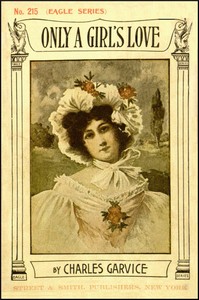
No. 215 (Eagle Series)
ONLY A GIRL'S LOVE
[Illustration]
by
CHARLES GARVICE
STREET & SMITH. PUBLISHERS. NEW YORK
* * * * * *
_Copyright Fiction by the Best Authors_
NEW EAGLE SERIES
A Big New Book Issued Weekly in this Line.
An Unequaled Collection of Modern Romances.
The books in this line comprise an unrivaled collection of copyrighted novels by authors who have won fame wherever the English language is spoken. Foremost among these is Mrs. Georgie Sheldon, whose works are contained in this line exclusively. Every book in the New Eagle Series is of generous length, of attractive appearance, and of undoubted merit. No better literature can be had at any price. Beware of imitations of the S. & S. novels, which are sold cheap because their publishers were put to no expense in the matter of purchasing manuscripts and making plates.
ALL TITLES ALWAYS IN PRINT
TO THE PUBLIC:--These books are sold by news dealers everywhere. If your dealer does not keep them, and will not get them for you, send direct to the publishers, in which case four cents must be added to the price per copy to cover postage.
1--Queen Bess By Mrs. Georgie Sheldon 2--Ruby's Reward By Mrs. Georgie Sheldon 7--Two Keys By Mrs. Georgie Sheldon 12--Edrie's Legacy By Mrs. Georgie Sheldon 44--That Dowdy By Mrs. Georgie Sheldon 55--Thrice Wedded By Mrs. Georgie Sheldon 66--Witch Hazel By Mrs. Georgie Sheldon 77--Tina By Mrs. Georgie Sheldon 88--Virgie's Inheritance By Mrs. Georgie Sheldon 99--Audrey's Recompense By Mrs. Georgie Sheldon 111--Faithful Shirley By Mrs. Georgie Sheldon 122--Grazia's Mistake By Mrs. Georgie Sheldon 133--Max By Mrs. Georgie Sheldon 144--Dorothy's Jewels By Mrs. Georgie Sheldon 155--Nameless Dell By Mrs. Georgie Sheldon 166--The Masked Bridal By Mrs. Georgie Sheldon 177--A True Aristocrat By Mrs. Georgie Sheldon 188--Dorothy Arnold's Escape By Mrs. Georgie Sheldon 199--Geoffrey's Victory By Mrs. Georgie Sheldon 210--Wild Oats By Mrs. Georgie Sheldon 219--Lost, A Pearle By Mrs. Georgie Sheldon 222--The Lily of Mordaunt By Mrs. Georgie Sheldon 233--Nora By Mrs. Georgie Sheldon 244--A Hoiden's Conquest By Mrs. Georgie Sheldon 255--The Little Marplot By Mrs. Georgie Sheldon 266--The Welfleet Mystery By Mrs. Georgie Sheldon 277--Brownie's Triumph By Mrs. Georgie Sheldon 282--The Forsaken Bride By Mrs. Georgie Sheldon 288--Sibyl's Influence By Mrs. Georgie Sheldon 291--A Mysterious Wedding Ring By Mrs. Georgie Sheldon 299--Little Miss Whirlwind By Mrs. Georgie Sheldon 311--Wedded by Fate By Mrs. Georgie Sheldon 339--His Heart's Queen By Mrs. Georgie Sheldon 351--The Churchyard Betrothal By Mrs. Georgie Sheldon 362--Stella Rosevelt By Mrs. Georgie Sheldon 372--A Girl in a Thousand By Mrs. Georgie Sheldon 373--A Thorn Among Roses By Mrs. Georgie Sheldon Sequel to "A Girl in a Thousand" 382--Mona By Mrs. Georgie Sheldon 391--Marguerite's Heritage By Mrs. Georgie Sheldon 399--Betsey's Transformation By Mrs. Georgie Sheldon 407--Esther, the Fright By Mrs. Georgie Sheldon 415--Trixy By Mrs. Georgie Sheldon 419--The Other Woman By Charles Garvice 433--Winifred's Sacrifice By Mrs. Georgie Sheldon 440--Edna's Secret Marriage By Charles Garvice 451--Helen's Victory By Mrs. Georgie Sheldon 458--When Love Meets Love By Charles Garvice 476--Earle Wayne's Nobility By Mrs. Georgie Sheldon 511--The Golden Key By Mrs. Georgie Sheldon 512--A Heritage of Love By Mrs. Georgie Sheldon Sequel to "The Golden Key" 519--The Magic Cameo By Mrs. Georgie Sheldon 520--The Heatherford Fortune By Mrs. Georgie Sheldon Sequel to "The Magic Cameo" 531--Better Than Life By Charles Garvice 537--A Life's Mistake By Charles Garvice 542--Once in a Life By Charles Garvice 548--'Twas Love's Fault By Charles Garvice 553--Queen Kate By Charles Garvice 554--Step by Step By Mrs. Georgie Sheldon 555--Put to the Test By Ida Reade Allen 556--With Love's Aid By Wenona Gilman 557--In Cupid's Chains By Charles Garvice 558--A Plunge Into the Unknown By Richard Marsh 559--The Love That Was Cursed By Geraldine Fleming 560--The Thorns of Regret By Mrs. Alex. McVeigh Miller 561--The Outcast of the Family By Charles Garvice 562--A Forced Promise By Ida Reade Allen 563--The Old Homestead By Denman Thompson 564--Love's First Kiss By Emma Garrison Jones 565--Just a Girl By Charles Garvice 566--In Love's Springtime By Laura Jean Libbey 567--Trixie's Honor By Geraldine Fleming 568--Hearts and Dollars By Ida Reade Allen 569--By Devious Ways By Charles Garvice 570--Her Heart's Unbidden Guest By Mrs. Alex. McVeigh Miller 571--Two Wild Girls By Mrs. Charlotte May Kingsley 572--Amid Scarlet Roses By Emma Garrison Jones 573--Heart for Heart By Charles Garvice 574--The Fugitive Bride By Mary E. Bryan 575--A Blue Grass Heroine By Ida Reade Allen 576--The Yellow Face By Fred M. White 577--The Story of a Passion By Charles Garvice 579--The Curse of Beauty By Geraldine Fleming 580--The Great Awakening By E. Phillips Oppenheim 581--A Modern Juliet By Charles Garvice 582--Virgie Talcott's Mission By Lucy M. Russell 583--His Greatest Sacrifice; or, Manch By Mary E. Bryan 584--Mabel's Fate By Mrs. Alex. McVeigh Miller 585--The Ape and the Diamond By Richard Marsh 586--Nell, of Shorne Mills By Charles Garvice 587--Katherine's Two Suitors By Geraldine Fleming 588--The Crime of Love By Barbara Howard 589--His Father's Crime By E. Phillips Oppenheim 590--What Was She to Him? By Mrs. Alex. McVeigh Miller 591--A Heritage of Hate By Charles Garvice 592--Ida Chaloner's Heart By Lucy Randall Comfort 593--Love Will Find the Way By Wenona Gilman 594--A Case of Identity By Richard Marsh 595--The Shadow of Her Life By Charles Garvice 596--Slighted Love By Mrs. Alex. McVeigh Miller 597--Her Fatal Gift By Geraldine Fleming 598--His Wife's Friend By Mary E. Bryan 599--At Love's Cost By Charles Garvice 600--St. Elmo By Augusta J. Evans 601--The Fate of the Plotter By Louis Tracy 602--Married in Error By Mrs. Alex. McVeigh Miller 603--Love and Jealousy By Lucy Randall Comfort 604--Only a Working Girl By Geraldine Fleming 605--Love, the Tyrant By Charles Garvice 606--Mabel's Sacrifice By Charlotte M. Stanley 607--Sybilla, the Siren By Ida Reade Allen 608--Love is Love Forevermore By Mrs. Alex. McVeigh Miller 609--John Elliott's Flirtation By Lucy May Russell 610--With All Her Heart By Charles Garvice 611--Is Love Worth While? By Geraldine Fleming 612--Her Husband's Other Wife By Emma Garrison Jones 613--Philip Bennion's Death By Richard Marsh 614--Little Phillis' Lover By Mrs. Alex. McVeigh Miller 615--Maida By Charles Garvice 617--As a Man Lives By E. Phillips Oppenheim 618--The Tide of Fate By Wenona Gilman 619--The Cardinal Moth By Fred M. White 620--Marcia Drayton By Charles Garvice 621--Lynette's Wedding By Mrs. Alex. McVeigh Miller 622--His Madcap Sweetheart By Emma Garrison Jones 623--Love at the Loom By Geraldine Fleming 624--A Bachelor Girl By Lucy May Russell 625--Kyra's Fate By Charles Garvice 626--The Joss By Richard Marsh 627--My Little Love By Mrs. Alex. McVeigh Miller 628--A Daughter of the Marionis By E. Phillips Oppenheim 629--The Lady of Beaufort Park By Wenona Gilman 630--The Verdict of the Heart By Charles Garvice 631--A Love Concealed By Emma Garrison Jones 632--Cruelly Divided By Mrs. Alex. McVeigh Miller 633--The Strange Disappearance of Lady Delia By Louis Tracy 634--Love's Golden Spell By Geraldine Fleming 635--A Coronet of Shame By Charles Garvice 636--Sinned Against By Mary E. Bryan 637--If It Were True! By Wenona Gilman 638--A Golden Barrier By Mrs. Alex. McVeigh Miller 639--A Hateful Bondage By Barbara Howard 640--A Girl of Spirit By Charles Garvice 641--Master of Men By E. Phillips Oppenheim 642--A Fair Enchantress By Ida Reade Allen 643--The Power of Love By Geraldine Fleming 644--No Time for Penitence By Wenona Gilman 645--A Jest of Fate By Charles Garvice 646--Her Sister's Secret By Mrs. Alex. McVeigh Miller 647--Bitterly Atoned By Mrs. E. Burke Collins 648--Gertrude Elliott's Crucible By Mrs. Georgie Sheldon 649--The Corner House By Fred M. White 650--Diana's Destiny By Charles Garvice 651--Love's Clouded Dawn By Wenona Gilman 652--Little Vixen By Mrs. Alex McVeigh Miller 653--Her Heart's Challenge By Barbara Howard 654--Vivian's Love Story By Mrs. E. Burke Collins 655--Linked by Fate By Charles Garvice 656--Hearts of Stone By Geraldine Fleming 657--In the Service of Love By Richard Marsh 658--Love's Devious Course By Mrs. Alex. McVeigh Miller 659--Told in the Twilight By Ida Reade Allen 660--The Mills of the Gods By Wenona Gilman 661--The Man of the Hour By Sir William Magnay 662--A Little Barbarian By Charlotte Kingsley 663--Creatures of Destiny By Charles Garvice 664--A Southern Princess By Emma Garrison Jones 666--A Fateful Promise By Effie Adelaide Rowlands 667--The Goddess--A Demon By Richard Marsh 668--From Tears to Smiles By Ida Reade Allen 669--Tempted by Gold By Mrs. Alex. McVeigh Miller 670--Better Than Riches By Wenona Gilman 671--When Love Is Young By Charles Garvice 672--Craven Fortune By Fred M. White 673--Her Life's Burden By Mrs. Alex. McVeigh Miller 674--The Heart of Hetta By Effie Adelaide Rowlands 675--The Breath of Slander By Ida Reade Allen 676--My Lady Beth By Mrs. Georgie Sheldon 677--The Wooing of Esther Gray By Louis Tracy 678--The Shadow Between Them By Mrs. Alex. McVeigh Miller 679--Gold in the Gutter By Charles Garvice 680--Master of Her Fate By Geraldine Fleming 681--In Full Cry By Richard Marsh 682--My Pretty Maid By Mrs. Alex. McVeigh Miller 683--An Unhappy Bargain By Effie Adelaide Rowlands 684--True Love Endures By Ida Reade Allen 685--India's Punishment By Laura Jean Libbey 686--The Castle of the Shadows By Mrs. C. N. Williamson 687--My Own Sweetheart By Wenona Gilman 688--Only a Kiss By Mrs. Alex. McVeigh Miller 689--Lola Dunbar's Crime By Barbara Howard 690--Ruth, the Outcast By Mrs. Mary E. Bryan 691--Her Dearest Love By Geraldine Fleming 692--The Man of Millions By Ida Reade Allen 693--For Another's Fault By Charlotte M. Stanley 694--The Belle of Saratoga By Lucy Randall Comfort 695--The Mystery of the Unicorn By Sir William Magnay 696--The Bride's Opals By Emma Garrison Jones 697--One of Life's Roses By Effie Adelaide Rowlands 698--The Battle of Hearts By Geraldine Fleming 700--In Wolf's Clothing By Charles Garvice 701--A Lost Sweetheart By Ida Reade Allen 702--The Stronger Passion By Mrs. Lillian R. Drayton 703--Mr. Marx's Secret By E. Phillips Oppenheim 704--Had She Loved Him Less! By Laura Jean Libbey 705--The Adventure of Princess Sylvia By Mrs. C. N. Williamson 706--In Love's Paradise By Charlotte M. Stanley 707--At Another's Bidding By Ida Reade Allen 708--Sold for Gold By Geraldine Fleming 710--Ridgeway of Montana By William MacLeod Raine 711--Taken by Storm By Emma Garrison Jones 712--Love and a Lie By Charles Garvice 713--Barriers of Stone By Wenona Gilman 714--Ethel's Secret By Charlotte M. Stanley 715--Amber, the Adopted By Mrs. Harriet Lewis 716--No Man's Wife By Ida Reade Allen 717--Wild and Willful By Lucy Randall Comfort 718--When We Two Parted By Mrs. Alex. McVeigh Miller 719--Love's Earnest Prayer By Geraldine Fleming 720--The Price of a Kiss By Laura Jean Libbey 721--A Girl from the South By Charles Garvice 722--A Freak of Fate By Emma Garrison Jones 723--A Golden Sorrow By Charlotte M. Stanley 724--Norma's Black Fortune By Ida Reade Allen 725--The Thoroughbred By Edith MacVane 726--Diana's Peril By Dorothy Hall 727--His Willing Slave By Lillian R. Drayton 728--Her Share of Sorrow By Wenona Gilman 729--Loved at Last By Geraldine Fleming 730--John Hungerford's Redemption By Mrs. Georgie Sheldon 731--His Two Loves By Ida Reade Allen 732--Eric Braddon's Love By Mrs. Alex. McVeigh Miller 733--Garrison's Finish By W. B. M. Ferguson 734--Sylvia, the Forsaken By Charlotte M. Stanley 735--Married for Money By Lucy Randall Comfort 736--Married in Haste By Wenona Gilman 737--At Her Father's Bidding By Geraldine Fleming 738--The Power of Gold By Ida Reade Allen 739--The Strength of Love By Mrs. Alex. McVeigh Miller 740--A Soul Laid Bare By J. K. Egerton 741--The Fatal Ruby By Charles Garvice 742--A Strange Wooing By Richard Marsh 743--A Lost Love By Wenona Gilman 744--A Useless Sacrifice By Emma Garrison Jones 745--A Will of Her Own By Ida Reade Allen 746--That Girl Named Hazel By Mrs. Alex. McVeigh Miller 747--For a Flirt's Love By Geraldine Fleming 748--The World's Great Snare By E. Phillips Oppenheim 749--The Heart of a Maid By Charles Garvice 750--Driven from Home By Wenona Gilman 751--The Gypsy's Warning By Emma Garrison Jones 752--Without Name or Wealth By Ida Reade Allen 753--Loyal Unto Death By Mrs. Alex. McVeigh Miller 754--His Lost Heritage By Effie Adelaide Rowlands 755--Her Priceless Love By Geraldine Fleming 756--Leola's Heart By Charlotte M. Stanley 757--Dare-devil Betty By Evelyn Malcolm 758--The Woman in It By Charles Garvice 759--They Met by Chance By Ida Reade Allen 760--Love Conquers Pride By Mrs. Alex. McVeigh Miller 761--A Reckless Promise By Emma Garrison Jones 762--The Rose of Yesterday By Effie Adelaide Rowlands 763--The Other Girl's Lover By Lillian R. Drayton 764--His Unbounded Faith By Charlotte M. Stanley 765--When Love Speaks By Evelyn Malcolm 766--The Man She Hated By Mrs. Alex. McVeigh Miller 767--No One to Help Her By Ida Reade Allen 768--Claire's Love-Life By Lucy Randall Comfort 769--Love's Harvest By Adelaide Fox Robinson 770--A Queen of Song By Geraldine Fleming 771--Nan Haggard's Confession By Mary E. Bryan 772--A Married Flirt By Mrs. Alex. McVeigh Miller 773--The Thorns of Love By Evelyn Malcolm 774--Love in a Snare By Charles Garvice 775--My Love Kitty By Charles Garvice 776--That Strange Girl By Charles Garvice 777--Nellie By Charles Garvice 778--Miss Estcourt; or, Olive By Charles Garvice 779--A Virginia Goddess By Ida Reade Allen 780--The Love He Sought By Lillian R. Drayton 781--Falsely Accused By Geraldine Fleming 782--His First Sweetheart By Lucy Randall Comfort 783--All for Love By Mrs. Alex. McVeigh Miller 784--What Love Can Cost By Evelyn Malcolm 785--Lady Gay's Martyrdom By Charlotte May Kingsley 786--His Good Angel By Emma Garrison Jones 787--A Bartered Soul By Adelaide Fox Robinson 788--In Love's Shadows By Ida Reade Allen 789--A Love Worth Winning By Geraldine Fleming 790--The Fatal Kiss By Mrs. Alex. McVeigh Miller 791--A Lover Scorned By Lucy Randall Comfort 792--After Many Days By Effie Adelaide Rowlands 793--An Innocent Outlaw By William Wallace Cook 794--The Arm of the Law By Evelyn Malcolm 795--The Reluctant Queen By J. Kenilworth Egerton 796--The Cost of Pride By Lillian R. Drayton 797--What Love Made Her By Geraldine Fleming 798--Brave Heart By Effie Adelaide Rowlands 799--Between Good and Evil By Charlotte M. Stanley 800--Caught in Love's Net By Ida Reade Allen 801--Love is a Mystery By Adelaide Fox Robinson 802--The Glitter of Jewels By J. Kenilworth Egerton 803--The Game of Life By Effie Adelaide Rowlands 804--A Dreadful Legacy By Geraldine Fleming 805--Rogers, of Butte By William Wallace Cook 806--The Haunting Past By Evelyn Malcolm 807--The Love That Would Not Die By Ida Reade Allen 808--The Serpent and the Dove By Charlotte May Kingsley 809--Through the Shadows By Adelaide Fox Robinson 810--Her Kingdom By Effie Adelaide Rowlands 811--When Dark Clouds Gather By Geraldine Fleming 812--Her Fateful Choice By Charlotte M. Stanley 813--Sorely Tried By Emma Garrison Jones
To be published during January, 1913.
814--Far Above Price By Evelyn Malcolm 815--Bitter Sweet By Effie Adelaide Rowlands 816--A Clouded Life By Ida Reade Allen 817--When Fate Decrees By Adelaide Fox Robinson 818--The Girl Who Was True By Charles Garvice
To be published during February, 1913.
819--Where Love is Sent By Mrs. E. Burke Collins 820--The Pride of My Heart By Laura Jean Libbey 821--The Girl in Red By Evelyn Malcolm 822--Why Did She Shun Him? By Effie Adelaide Rowlands
To be published during March, 1913.
823--Between Love and Conscience By Charlotte M. Stanley 824--Spectres of the Past By Ida Reade Allen 825--The Hearts of the Mighty By Adelaide Fox Robinson 826--The Irony of Love By Charles Garvice
To be published during April, 1913.
827--At Arms With Fate By Charlotte May Kingsley 828--Love's Young Dream By Laura Jean Libbey 829--Her Golden Secret By Effie Adelaide Rowlands 830--The Stolen Bride By Evelyn Malcolm 831--Love's Rugged Pathway By Ida Reade Allen
To be published during May, 1913.
832--A Love Rejected--A Love Won By Geraldine Fleming 833--Her Life's Dark Cloud By Lillian R. Drayton 834--A Hero for Love's Sake By Effie Adelaide Rowlands 835--When the Heart Hungers By Charlotte M. Stanley
To be published during June, 1913.
836--Love Given in Vain By Adelaide Fox Robinson 837--The Web of Life By Ida Reade Allen 838--Love Surely Triumphs By Charlotte May Kingsley 839--The Lovely Constance By Laura Jean Libbey
To be published during July, 1913.
840--On a Sea of Sorrow By Effie Adelaide Rowlands 841--Her Hated Husband By Evelyn Malcolm 842--When Hearts Beat True By Geraldine Fleming 843--Too Quickly Judged By Ida Reade Allen
In order that there may be no confusion, we desire to say that the books listed above will be issued, during the respective months, in New York City and vicinity. They may not reach the readers, at a distance, promptly, on account of delays in transportation.
THE EAGLE SERIES
Principally Copyrights Elegant Colored Covers
"THE RIGHT BOOKS AT THE RIGHT PRICE"
While the books in the New Eagle Series are undoubtedly better value, being bigger books, the stories offered to the public in this line must not be underestimated. There are over four hundred copyrighted books by famous authors, which cannot be had in any other line. No other publisher in the world has a line that contains so many different titles, nor can any publisher ever hope to secure books that will match those in the Eagle Series in quality.
This is the pioneer line of copyrighted novels, and that it has struck popular fancy just right is proven by the fact that for fifteen years it has been the first choice of American readers. The only reason that we can afford to give such excellent reading at such a low price is that our unlimited capital and great organization enable us to manufacture books more cheaply and to sell more of them without expensive advertising, than any other publishers.
ALL TITLES ALWAYS IN PRINT
TO THE PUBLIC:--These books are sold by news dealers everywhere. If your dealer does not keep them, and will not get them for you, send direct to the publishers, in which case four cents must be added to the price per copy to cover postage.
3--The Love of Violet Lee By Julia Edwards 4--For a Woman's Honor By Bertha M. Clay 5--The Senator's Favorite By Mrs. Alex. McVeigh Miller 6--The Midnight Marriage By A. M. Douglas 8--Beautiful But Poor By Julia Edwards 9--The Virginia Heiress By May Agnes Fleming 10--Little Sunshine By Francis S. Smith 11--The Gipsy's Daughter By Bertha M. Clay 13--The Little Widow By Julia Edwards 14--Violet Lisle By Bertha M. Clay 15--Dr. Jack By St. George Rathborne 16--The Fatal Card By Haddon Chambers and B. C. Stephenson 17--Leslie's Loyalty By Charles Garvice (His Love So True) 18--Dr. Jack's Wife By St. George Rathborne 19--Mr. Lake of Chicago By Harry DuBois Milman 21--A Heart's Idol By Bertha M. Clay 22--Elaine By Charles Garvice 23--Miss Pauline of New York By St. George Rathborne 24--A Wasted Love By Charles Garvice (On Love's Altar) 25--Little Southern Beauty By Mrs. Alex. McVeigh Miller 26--Captain Tom By St. George Rathborne 27--Estelle's Millionaire Lover By Julia Edwards 28--Miss Caprice By St. George Rathborne 29--Theodora By Victorien Sardou 30--Baron Sam By St. George Rathborne 31--A Siren's Love By Robert Lee Tyler 32--The Blockade Runner By J. Perkins Tracy 33--Mrs. Bob By St. George Rathborne 34--Pretty Geraldine By Mrs. Alex. McVeigh Miller 35--The Great Mogul By St. George Rathborne 36--Fedora By Victorien Sardou 37--The Heart of Virginia By J. Perkins Tracy 38--The Nabob of Singapore By St. George Rathborne 39--The Colonel's Wife By Warren Edwards 40--Monsieur Bob By St. George Rathborne 41--Her Hearts Desire By Charles Garvice (An Innocent Girl) 42--Another Woman's Husband By Bertha M. Clay 43--Little Coquette Bonnie By Mrs. Alex. McVeigh Miller 45--A Yale Man By Robert Lee Tyler 46--Off with the Old Love By Mrs. M. V. Victor 47--The Colonel by Brevet By St. George Rathborne 48--Another Man's Wife By Bertha M. Clay 49--None But the Brave By Robert Lee Tyler 50--Her Ransom (Paid For) By Charles Garvice 51--The Price He Paid By E. Werner 52--Woman Against Woman By Effie Adelaide Rowlands 54--Cleopatra By Victorien Sardou 56--The Dispatch Bearer By Warren Edwards 58--Major Matterson of Kentucky By St. George Rathborne 59--Gladys Greye By Bertha M. Clay 61--La Tosca By Victorien Sardou 62--Stella Stirling By Julia Edwards 63--Lawyer Bell from Boston By Robert Lee Tyler 64--Dora Tenney By Mrs. Alex. McVeigh Miller 65--Won by the Sword By J. Perkins Tracy 67--Gismonda By Victorien Sardou 68--The Little Cuban Rebel By Edna Winfield 69--His Perfect Trust By Bertha M. Clay 70--Sydney (A Wilful Young Woman) By Charles Garvice 71--The Spider's Web By St. George Rathborne 72--Wilful Winnie By Harriet Sherburne 73--The Marquis By Charles Garvice 74--The Cotton King By Sutton Vane 75--Under Fire By T. P. James 76--Mavourneen From the celebrated play 78--The Yankee Champion By Sylvanus Cobb, Jr. 79--Out of the Past (Marjorie) By Charles Garvice 80--The Fair Maid of Fez By St. George Rathborne 81--Wedded for an Hour By Emma Garrison Jones 82--Captain Impudence By Edwin Milton Royle 83--The Locksmith of Lyons By Prof. Wm. Henry Peck 84--Imogene By Charles Garvice (Dumaresq's Temptation) 85--Lorrie; or, Hollow Gold By Charles Garvice 86--A Widowed Bride By Lucy Randall Comfort 87--Shenandoah By J. Perkins Tracy 89--A Gentleman from Gascony By Bicknell Dudley 90--For Fair Virginia By Russ Whytal 91--Sweet Violet By Mrs. Alex. McVeigh Miller 92--Humanity By Sutton Vane 94--Darkest Russia By H. Grattan Donnelly 95--A Wilful Maid (Philippa) By Charles Garvice 96--The Little Minister By J. M. Barrie 97--The War Reporter By Warren Edwards 98--Claire By Charles Garvice (The Mistress of Court Regna) 100--Alice Blake By Francis S. Smith 101--A Goddess of Africa By St. George Rathborne 102--Sweet Cymbeline (Bellmaire) By Charles Garvice 103--The Span of Life By Sutton Vane 104--A Proud Dishonor By Genie Holzmeyer 105--When London Sleeps By Chas. Darrell 106--Lillian, My Lillian By Mrs. Alex. McVeigh Miller 107--Carla; or, Married at Sight By Effie Adelaide Rowlands 108--A Son of Mars By St. George Rathborne 109--Signa's Sweetheart By Charles Garvice (Lord Delamere's Bride) 110--Whose Wife is She? By Annie Lisle 112--The Cattle King By A. D. Hall 113--A Crushed Lily By Mrs. Alex. McVeigh Miller 114--Half a Truth By Dora Delmar 115--A Fair Revolutionist By St. George Rathborne 116--The Daughter of the Regiment By Mary A. Denison 117--She Loved Him By Charles Garvice 118--Saved from the Sea By Richard Duffy 119--'Twixt Smile and Tear (Dulcie) By Charles Garvice 120--The White Squadron By T. C. Harbaugh 121--Cecile's Marriage By Lucy Randall Comfort 123--Northern Lights By A. D. Hall 124--Prettiest of All By Julia Edwards 125--Devil's Island By A. D. Hall 126--The Girl from Hong Kong By St. George Rathborne 127--Nobody's Daughter By Clara Augusta 128--The Scent of the Roses By Dora Delmar 129--In Sight of St. Paul's By Sutton Vane 130--A Passion Flower (Madge) By Charles Garvice 131--Nerine's Second Choice By Adelaide Stirling 132--Whose Was the Crime? By Gertrude Warden 134--Squire John By St. George Rathborne 135--Cast Up by the Tide By Dora Delmar 136--The Unseen Bridegroom By May Agnes Fleming 138--A Fatal Wooing By Laura Jean Libbey 139--Little Lady Charles By Effie Adelaide Rowlands 140--That Girl of Johnson's By Jean Kate Ludlum 141--Lady Evelyn By May Agnes Fleming 142--Her Rescue from the Turks By St. George Rathborne 143--A Charity Girl By Effie Adelaide Rowlands 145--Country Lanes and City Pavements By Maurice M. Minton 146--Magdalen's Vow By May Agnes Fleming 147--Under Egyptian Skies By St. George Rathborne 148--Will She Win? By Emma Garrison Jones 149--The Man She Loved By Effie Adelaide Rowlands 150--Sunset Pass By General Charles King 151--The Heiress of Glen Gower By May Agnes Fleming 152--A Mute Confessor By Will M. Harben 153--Her Son's Wife By Hazel Wood 154--Husband and Foe By Effie Adelaide Rowlands 156--A Soldier Lover By Edward S. Brooks 157--Who Wins? By May Agnes Fleming 158--Stella, the Star By Wenona Gilman 159--Out of Eden By Dora Russell 160--His Way and Her Will By Frances Aymar Mathews 161--Miss Fairfax of Virginia By St. George Rathborne 162--A Man of the Name of John By Florence King 163--A Splendid Egotist By Mrs. J. H. Walworth 164--Couldn't Say No By John Habberton 165--The Road of the Rough By Maurice M. Minton 167--The Manhattaners By Edward S. Van Zile 168--Thrice Lost, Thrice Won By May Agnes Fleming 169--The Trials of an Actress By Wenona Gilman 170--A Little Radical By Mrs. J. H. Walworth 171--That Dakota Girl By Stella Gilman 172--A King and a Coward By Effie Adelaide Rowlands 173--A Bar Sinister By St. George Rathborne 174--His Guardian Angel By Charles Garvice 175--For Honor's Sake By Laura C. Ford 176--Jack Gordon, Knight Errant By Barclay North 178--A Slave of Circumstances By Ernest De Lancey Pierson 179--One Man's Evil By Effie Adelaide Rowlands 180--A Lazy Man's Work By Frances Campbell Sparhawk 181--The Baronet's Bride By May Agnes Fleming 182--A Legal Wreck By William Gillette 183--Quo Vadis By Henryk Sienkiewicz 184--Sunlight and Gloom By Geraldine Fleming 185--The Adventures of Miss Volney By Ella Wheeler Wilcox 186--Beneath a Spell By Effie Adelaide Rowlands 187--The Black Ball By Ernest De Lancey Pierson 189--Berris By Katharine S. MacQuoid 190--A Captain of the Kaiser By St. George Rathborne 191--A Harvest of Thorns By Mrs. H. C. Hoffman 193--A Vagabond's Honor By Ernest De Lancey Pierson 194--A Sinless Crime By Geraldine Fleming 195--Her Faithful Knight By Gertrude Warden 196--A Sailor's Sweetheart By St. George Rathborne 197--A Woman Scorned By Effie Adelaide Rowlands 200--In God's Country By D. Higbee 201--Blind Elsie's Crime By Mary Grace Halpine 202--Marjorie By Katharine S. MacQuoid 203--Only One Love By Charles Garvice 204--With Heart So True By Effie Adelaide Rowlands 205--If Love Be Love By D. Cecil Gibbs 206--A Daughter of Maryland By G. Waldo Browne 208--A Chase for a Bride By St. George Rathborne 209--She Loved But Left Him By Julia Edwards 211--As We Forgive By Lurana W. Sheldon 212--Doubly Wronged By Adah M. Howard 213--The Heiress of Egremont By Mrs. Harriet Lewis 214--Olga's Crime By Frank Barrett 215--Only a Girl's Love By Charles Garvice 216--The Lost Bride By Clara Augusta 217--His Noble Wife By George Manville Fenn 218--A Life for a Love By Mrs. L. T. Meade 220--A Fatal Past By Dora Russell 221--The Honorable Jane By Annie Thomas 223--Leola Dale's Fortune By Charles Garvice 224--A Sister's Sacrifice By Geraldine Fleming 225--A Miserable Woman By Mrs. H. C. Hoffman 226--The Roll of Honor By Annie Thomas 227--For Love and Honor By Effie Adelaide Rowlands 228--His Brother's Widow By Mary Grace Halpine 229--For the Sake of the Family By May Crommelin 230--A Woman's Atonement, and A Mother's Mistake By Adah M. Howard 231--The Earl's Heir (Lady Norah) By Charles Garvice 232--A Debt of Honor By Mabel Collins 234--His Mother's Sin By Adeline Sergeant 235--Love at Saratoga By Lucy Randall Comfort 236--Her Humble Lover By Charles Garvice (The Usurper; or, The Gipsy Peer) 237--Woman or Witch? By Dora Delmar 238--That Other Woman By Annie Thomas 239--Don Cæsar De Bazan By Victor Hugo 240--Saved by the Sword By St. George Rathborne 241--Her Love and Trust By Adeline Sergeant 242--A Wounded Heart (Sweet as a Rose) By Charles Garvice 243--His Double Self By Scott Campbell 245--A Modern Marriage By Clara Lanza 246--True to Herself By Mrs. J. H. Walworth 247--Within Love's Portals By Frank Barrett 248--Jeanne, Countess Du Barry By H. L. Williams 249--What Love Will Do By Geraldine Fleming 250--A Woman's Soul By Charles Garvice (Doris; Behind the Footlights) 251--When Love is True By Mabel Collins 252--A Handsome Sinner By Dora Delmar 253--A Fashionable Marriage By Mrs. Alex Frazer 254--Little Miss Millions By St. George Rathborne 256--Thy Name is Woman By F. H. Howe 257--A Martyred Love By Charles Garvice (Iris; or, Under the Shadow) 258--An Amazing Marriage By Mrs. Sumner Hayden 259--By a Golden Cord By Dora Delmar 260--At a Girl's Mercy By Jean Kate Ludlum 261--A Siren's Heart By Effie Adelaide Rowlands 262--A Woman's Faith By Henry Wallace 263--An American Nabob By St. George Rathborne 264--For Gold or Soul By Lurana W. Sheldon 265--First Love is Best By S. K. Hocking 267--Jeanne (Barriers Between) By Charles Garvice 268--Olivia; or, It Was for Her Sake By Charles Garvice 270--Had She Foreseen By Dora Delmar 271--With Love's Laurel Crowned By W. C. Stiles 272--So Fair, So False By Charles Garvice (The Beauty of the Season) 273--At Swords Points By St. George Rathborne 274--A Romantic Girl By Evelyn E. Green 275--Love's Cruel Whim By Effie Adelaide Rowlands 276--So Nearly Lost By Charles Garvice (The Springtime of Love) 278--Laura Brayton By Julia Edwards 279--Nina's Peril By Mrs. Alex. McVeigh Miller 280--Love's Dilemma By Charles Garvice (For an Earldom) 281--For Love Alone By Wenona Gilman 283--My Lady Pride (Floris) By Charles Garvice 284--Dr. Jack's Widow By St. George Rathborne 285--Born to Betray By Mrs. M. V. Victor 287--The Lady of Darracourt By Charles Garvice 289--Married in Mask By Mansfield T. Walworth 290--A Change of Heart By Effie Adelaide Rowlands 292--For Her Only (Diana) By Charles Garvice 294--A Warrior Bold By St. George Rathborne 295--A Terrible Secret and Countess Isabel By Geraldine Fleming 296--The Heir of Vering By Charles Garvice 297--That Girl from Texas By Mrs. J. H. Walworth 298--Should She Have Left Him? By Barclay North 300--The Spider and the Fly By Charles Garvice (Violet) 301--The False and the True By Effie Adelaide Rowlands 302--When Man's Love Fades By Hazel Wood 303--The Queen of the Isle By May Agnes Fleming 304--Stanch as a Woman By Charles Garvice (A Maiden's Sacrifice) 305--Led by Love Sequel to By Charles Garvice "Stanch as a Woman" 306--Love's Golden Rule By Geraldine Fleming 307--The Winning of Isolde By St. George Rathborne 308--Lady Ryhope's Lover By Emma Garrison Jones 309--The Heiress of Castle Cliffe By May Agnes Fleming 310--A Late Repentance By Mary A. Denison 312--Woven on Fate's Loom and The By Charles Garvice Snowdrift 313--A Kinsman's Sin By Effie Adelaide Rowlands 314--A Maid's Fatal Love By Helen Corwin Pierce 315--The Dark Secret By May Agnes Fleming 316--Edith Lyle's Secret By Mrs. Mary J. Holmes 317--Ione By Laura Jean Libbey 318--Stanch of Heart By Charles Garvice (Adrien Le Roy) 319--Millbank By Mrs. Mary J. Holmes 320--Mynheer Joe By St. George Rathborne 321--Neva's Three Lovers By Mrs. Harriet Lewis 322--Mildred By Mrs. Mary J. Holmes 323--The Little Countess By S. E. Boggs 324--A Love Match By Sylvanus Cobb, Jr. 325--The Leighton Homestead By Mrs. Mary J. Holmes 326--Parted by Fate By Laura Jean Libbey 327--Was She Wife or Widow? By Malcolm Bell 328--He Loves Me, He Loves Me Not By Charles Garvice (Valeria) 329--My Hildegarde By St. George Rathborne 330--Aikenside By Mrs. Mary J. Holmes 331--Christine By Adeline Sergeant 332--Darkness and Daylight By Mrs. Mary J. Holmes 333--Stella's Fortune By Charles Garvice (The Sculptor's Wooing) 334--Miss McDonald By Mrs. Mary J. Holmes 335--We Parted at the Altar By Laura Jean Libbey 336--Rose Mather By Mrs. Mary J. Holmes 337--Dear Elsie By Mary J. Safford 338--A Daughter of Russia By St. George Rathborne 340--Bad Hugh. Vol. I By Mrs. Mary J. Holmes 341--Bad Hugh. Vol. II By Mrs. Mary J. Holmes 342--Her Little Highness By Nataly Von Eschstruth 343--Little Sunshine By Adah M. Howard 344--Leah's Mistake By Mrs. H. C. Hoffman 345--Tresillian Court By Mrs. Harriet Lewis 346--Guy Tresillian's Fate By Mrs. Harriet Lewis Sequel to "Tresillian Court" 347--The Eyes of Love By Charles Garvice 348--My Florida Sweetheart By St. George Rathborne 349--Marion Grey By Mary J. Holmes 350--A Wronged Wife By Mary Grace Halpine 352--Family Pride. Vol. I By Mary J. Holmes 353--Family Pride. Vol. II By Mary J. Holmes 354--A Love Comedy By Charles Garvice 355--Wife and Woman By Mary J. Safford 356--Little Kit By Effie Adelaide Rowlands 357--Montezuma's Mines By St. George Rathborne 358--Beryl's Husband By Mrs. Harriet Lewis 359--The Spectre's Secret By Sylvanus Cobb, Jr. 360--An Only Daughter By Hazel Wood 361--The Ashes of Love By Charles Garvice 363--The Opposite House By Nataly Von Eschstruth 364--A Fool's Paradise By Mary Grace Halpine 365--Under a Cloud By Jean Kate Ludlum 366--Comrades in Exile By St. George Rathborne 367--Hearts and Coronets By Jane G. Fuller 368--The Pride of Her Life By Charles Garvice 369--At a Great Cost By Effie Adelaide Rowlands 370--Edith Trevor's Secret By Mrs. Harriet Lewis 371--Cecil Rosse By Mrs. Harriet Lewis Sequel to "Edith Trevor's Secret" 374--True Daughter of Hartenstein By Mary J. Safford 375--Transgressing the Law By Capt. Fred'k Whittaker 376--The Red Slipper By St. George Rathborne 377--Forever True By Effie Adelaide Rowlands 378--John Winthrop's Defeat By Jean Kate Ludlum 379--Blinded by Love By Nataly Von Eschstruth 380--Her Double Life By Mrs. Harriet Lewis 381--The Sunshine of Love By Mrs. Harriet Lewis Sequel to "Her Double Life" 383--A Lover from Across the Sea By Mary J. Safford 384--Yet She Loved Him By Mrs. Kate Vaughn 385--A Woman Against Her By Effie Adelaide Rowlands 386--Teddy's Enchantress By St. George Rathborne 387--A Heroine's Plot By Katherine S. MacQuoid 388--Two Wives By Hazel Wood 389--Sundered Hearts By Mrs. Harriet Lewis 390--A Mutual Vow By Harold Payne 392--A Resurrected Love By Seward W. Hopkins 393--On the Wings of Fate By Effie Adelaide Rowlands 394--A Drama of a Life By Jean Kate Ludlum 395--Wooing a Widow By E. A. King 396--Back to Old Kentucky By St. George Rathborne 397--A Gilded Promise By Walter Bloomfield 398--Cupid's Disguise By Fanny Lewald 400--For Another's Wrong By W. Heimburg 401--The Woman Who Came Between By Effie Adelaide Rowlands 402--A Silent Heroine By Mrs. D. M. Lowrey 403--The Rival Suitors By J. H. Connelly 404--The Captive Bride By Capt. Fred'k Whittaker 405--The Haunted Husband By Mrs. Harriet Lewis 406--Felipe's Pretty Sister By St. George Rathborne 408--On a False Charge By Seward W. Hopkins 409--A Girl's Kingdom By Effie Adelaide Rowlands 410--Miss Mischief By W. Heimburg 411--Fettered and Freed By Eugene Charvette 412--The Love that Lives By Capt. Frederick Whittaker 413--Were They Married? By Hazel Wood 414--A Girl's First Love By Elizabeth C. Winter 416--Down in Dixie By St. George Rathborne 417--Brave Barbara By Effie Adelaide Rowlands 418--An Insignificant Woman By W. Heimburg 420--A Sweet Little Lady By Gertrude Warden 421--Her Sweet Reward By Barbara Kent 422--Lady Kildare By Mrs. Harriet Lewis 423--A Woman's Way By Capt. Frederick Whittaker 424--A Splendid Man By Effie Adelaide Rowlands 425--A College Widow By Frank H. Howe 427--A Wizard of the Moors By St. George Rathborne 428--A Tramp's Daughter By Hazel Wood 429--A Fair Fraud By Emily Lovett Cameron 430--The Honor of a Heart By Mary J. Safford 431--Her Husband and Her Love By Effie Adelaide Rowlands 432--Breta's Double By Helen V. Greyson 435--Under Oath By Jean Kate Ludlum 436--The Rival Toreadors By St. George Rathborne 437--The Breach of Custom By Mrs. D. M. Lowrey 438--So Like a Man By Effie Adelaide Rowlands 439--Little Nan By Mary A. Denison 441--A Princess of the Stage By Nataly Von Eschstruth 442--Love Before Duty By Mrs. L. T. Meade 443--In Spite of Proof By Gertrude Warden 444--Love's Trials By Alfred R. Calhoun 445--An Angel of Evil By Effie Adelaide Rowlands 446--Bound with Love's Fetters By Mary Grace Halpine 447--A Favorite of Fortune By St. George Rathborne 448--When Love Dawns By Adelaide Stirling 449--The Bailiff's Scheme By Mrs. Harriet Lewis 450--Rosamond's Love By Mrs. Harriet Lewis Sequel to "The Bailiff's Scheme" 452--The Last of the Van Slacks By Edward S. Van Zile 453--A Poor Girl's Passion By Gertrude Warden 454--Love's Probation By Elizabeth Olmis 455--Love's Greatest Gift By Effie Adelaide Rowlands 456--A Vixen's Treachery By Mrs. Harriet Lewis 457--Adrift in the World By Mrs. Harriet Lewis Sequel to "A Vixen's Treachery" 459--A Golden Mask By Charlotte M. Stanley 460--Dr. Jack's Talisman By St. George Rathborne 461--Above All Things By Adelaide Stirling 462--A Stormy Wedding By Mary E. Bryan 463--A Wife's Triumph By Effie Adelaide Rowlands 464--The Old Life's Shadows By Mrs. Harriet Lewis 465--Outside Her Eden By Mrs. Harriet Lewis Sequel to "The Old Life's Shadows" 466--Love, the Victor By a Popular Southern Author 467--Zina's Awaking By Mrs. J. K. Spender 468--The Wooing of a Fairy By Gertrude Warden 469--A Soldier and a Gentleman By J. M. Cobban 470--A Strange Wedding By Mary Hartwell Catherwood 471--A Shadowed Happiness By Effie Adelaide Rowlands 472--Dr. Jack and Company By St. George Rathborne 473--A Sacrifice to Love By Adelaide Stirling 474--The Belle of the Season By Mrs. Harriet Lewis 475--Love Before Pride By Mrs. Harriet Lewis Sequel to "The Belle of the Season" 477--The Siberian Exiles By Col. Thomas Knox 478--For Love of Sigrid By Effie Adelaide Rowlands 479--Mysterious Mr. Sabin By E. Phillips Oppenheim 480--A Perfect Fool By Florence Warden 481--Wedded, Yet No Wife By May Agnes Fleming 482--A Little Worldling By L. C. Ellsworth 483--Miss Marston's Heart By L. H. Bickford 484--The Whistle of Fate By Richard Marsh 485--The End Crowns All By Effie Adelaide Rowlands 486--Divided Lives By Edgar Fawcett 487--A Wonderful Woman By May Agnes Fleming 488--The French Witch By Gertrude Warden 489--Lucy Harding By Mrs. Mary J. Holmes 490--The Price of Jealousy By Maud Howe 491--My Lady of Dreadwood By Effie Adelaide Rowlands 492--A Speedy Wooing By the Author of "As Common Mortals" 493--The Girl He Loved By Adelaide Stirling 494--Voyagers of Fortune By St. George Rathborne 495--Norine's Revenge By May Agnes Fleming 496--The Missing Heiress By C. H. Montague 497--A Chase for Love By Seward W. Hopkins 498--Andrew Leicester's Love By Effie Adelaide Rowlands 499--My Lady Cinderella By Mrs. C. N. Williamson 500--Love and Spite By Adelaide Stirling 501--Her Husband's Secret By Mrs. Alex. McVeigh Miller 502--Fair Maid Marian By Mrs. Emma Garrison Jones 503--A Lady in Black By Florence Warden 504--Evelyn, the Actress By Wenona Gilman 505--Selina's Love-story By Effie Adelaide Rowlands 506--A Secret Foe By Gertrude Warden 507--A Mad Betrothal By Laura Jean Libbey 508--Lottie and Victorine By Lucy Randall Comfort 509--A Penniless Princess By Emma Garrison Jones 510--Doctor Jack's Paradise Mine By St. George Rathborne 513--A Sensational Case By Florence Warden 514--The Temptation of Mary Barr By Effie Adelaide Rowlands 515--Tiny Luttrell By E. W. Hornung (Author of "Raffles, the Amateur Cracksman") 516--Florabel's Lover By Laura Jean Libbey 517--They Looked and Loved By Mrs. Alex. McVeigh Miller 518--The Secret of a Letter By Gertrude Warden 521--The Witch from India By St. George Rathborne 522--A Spurned Proposal By Effie Adelaide Rowlands 523--A Banker of Bankersville By Maurice Thompson 524--A Sacrifice of Pride By Mrs. Louisa Parr 525--Sweet Kitty Clover By Laura Jean Libbey 526--Love and Hate By Morley Roberts 527--For Love and Glory By St. George Rathborne 528--Adela's Ordeal By Florence Warden 529--Hearts Aflame By Louise Winter 530--The Wiles of a Siren By Effie Adelaide Rowlands 532--True to His Bride By Emma Garrison Jones 533--A Forgotten Love By Adelaide Stirling 534--Lotta, the Cloak Model By Laura Jean Libbey 535--The Trifler By Archibald Eyre 536--Companions in Arms By St. George Rathborne 538--The Fighting Chance By Gertrude Lynch 539--A Heart's Triumph By Effie Adelaide Rowlands 540--A Daughter of Darkness By Ida Reade Allen 541--Her Evil Genius By Adelaide Stirling 543--The Veiled Bride By Laura Jean Libbey 544--In Love's Name By Emma Garrison Jones 545--Well Worth Winning By St. George Rathborne 546--The Career of Mrs. Osborne By Helen Milecete 549--Tempted by Love By Effie Adelaide Rowlands 550--Saved from Herself By Adelaide Stirling 551--Pity--Not Love By Laura Jean Libbey 552--At the Court of the Maharaja By Louis Tracy
_The Best of Everything!_
Our experience with the American reading public has taught us that it expects better reading than readers of any other nationality. Why? Because Americans, as a rule, are better educated and more intelligent. We make it a point to cater to all classes of readers with our paper-covered novels. If a man likes adventure or detective stories, he can find more and better ones in the S. & S. novel list than he can among the cloth books. If a woman wants love, society, or mystery stories, the S. & S. catalogue again contains just what she wants at the lowest possible price. If a boy wants up-to-date baseball, athletic, or treasure-hunt stories, he cannot get anything that will please him so much as the books in the MEDAL and NEW MEDAL LIBRARIES, no matter how much he has to spend for his reading matter.
Here are a few suggestions:
BOOKS FOR MEN.
The Nick Carter stories in the NEW MAGNET LIBRARY.
The Howard W. Erwin stories in the FAR WEST LIBRARY.
The William Wallace Cook stories in the NEW FICTION LIBRARY.
The Dumas stories in the SELECT LIBRARY.
BOOKS FOR WOMEN.
The Mrs. Georgie Sheldon stories in the NEW EAGLE SERIES.
The Charles Garvice stories in the NEW EAGLE SERIES.
The Bertha Clay stories in the BERTHA CLAY LIBRARY.
The Southworth stories in the SOUTHWORTH LIBRARY.
The Mrs. Mary J. Holmes stories in the EAGLE and SELECT LIBRARIES.
BOOKS FOR BOYS.
The Burt L. Standish stories in the NEW MEDAL LIBRARY.
The Horatio Alger stories in the MEDAL and NEW MEDAL LIBRARIES.
The Oliver Optic stories in the MEDAL and NEW MEDAL LIBRARIES.
The Edward C. Taylor stories in the NEW MEDAL LIBRARY.
Send for our complete catalogue and look these stories up. It will pay you.
STREET & SMITH, _Publishers_, NEW YORK
* * * * * *
ONLY A GIRL'S LOVE
by
CHARLES GARVICE
[Illustration]
New York Street & Smith, Publishers
Why Take a Chance?
Most everybody thinks that the public library is a mighty fine institution--teaches people to read, and all that. Well, so it does, but does any one ever think of the great risk that a person, who takes a book out of a public library, runs of catching some contagious disease?
Every time a bacteriological examination is made of the public-library book, germs of every known disease are found among its pages. Probably, from your own experience, you know that lots of people never think of taking a book from the public library, until some one in their family is sick and wants something to read.
As records prove that ninety per cent of the demand for books at the public libraries is for works of fiction, it strikes us that the reading public would do better to patronize the S. & S. novel list which contains hundreds of books to be found in the public libraries, and many hundreds of others just as good and interesting.
The price of the S. & S. novels is a low one indeed to pay for protection from disease-laden literature. Why run the risk, then, when you can get a fresh, clean book for little money and thus insure your health?
STREET & SMITH, _Publishers_ NEW YORK
The S. & S. Novels Have No Rivals
Our books have a field entirely their own. They are the only novels to which new, first-class titles are being added every week.
No news dealer's stock is complete without them. That's why every up-to-date dealer carries a good assortment of them on his shelves.
STREET & SMITH, _Publishers_ NEW YORK
ONLY A GIRL'S LOVE.
CHAPTER I.
It is a warm evening in early Summer; the sun is setting behind a long range of fir and yew-clad hills, at the feet of which twists in and out, as it follows their curves, a placid, peaceful river. Opposite these hills, and running beside the river, are long-stretching meadows, brilliantly green with fresh-springing grass, and gorgeously yellow with newly-opened buttercups. Above, the sunset sky gleams and glows with fiery red and rich deep chromes. And London is almost within sight.
It is a beautiful scene, such as one sees only in this England of ours--a scene that defies poet and painter. At this very moment it is defying one of the latter genus; for in a room of a low-browed, thatched-roofed cottage which stood on the margin of the meadow, James Etheridge sat beside his easel, his eyes fixed on the picture framed in the open window, his brush and mahl-stick drooping in his idle hand.
Unconsciously he, the painter, made a picture worthy of study. Tall, thin, delicately made, with pale face crowned and set in softly-flowing white hair, with gentle, dreamy eyes ever seeking the infinite and unknown, he looked like one of those figures which the old Florentine artists used to love to put upon their canvases, and which when one sees even now makes one strangely sad and thoughtful.
The room was a fitting frame for the human subject; it was a true painter's studio--untidy, disordered, and picturesque. Finished and unfinished pictures hung or leant against the walls, suits of armor, antique weapons, strange costumes littered the floor or hung limply over mediæval chairs; books, some in bindings which would have made the mouth of a connoisseur water, lay open upon the table or were piled in a distant corner. And over all silence--unbroken save by the sound of the water rushing over the weir, or the birds which flitted by the open window--reigned supreme.
The old man sat for some time listening to Nature's music, and lost in dreamy admiration of her loveliness, until the striking of the church clock floated from the village behind the house; then, with a start, he rose, took up his brushes, and turned again to the easel. An hour passed, and still he worked, the picture growing beneath the thin, skillful hand; the birds sank into silence, the red faded slowly from the sky, and night unfolded its dark mantle ready to let it fall upon the workaday world.
Silence so profound took to itself the likeness of loneliness; perhaps the old man felt it so, for as he glanced at the waning light and lay his brush down, he put his hand to his brow and sighed. Then he turned the picture on the easel, made his way with some little difficulty, owing to the litter, across the room, found and lit an old briar-wood pipe, and dropping into the chair again, fixed his eyes upon the scene, and fell into the dreamy state which was habitual with him.
So lost in purposeless memory was he, that the opening of the door failed to rouse him.
It was opened very gently and slowly, and as slowly and noiselessly a young girl, after pausing a moment at the threshold, stepped into the room, and stood looking round her and at the motionless figure in the chair by the window.
She stood for full a minute, her hand still holding the handle of the door, as if she were not certain of her welcome--as if the room were strange to her, then, with a little hurried pressure of her hand to her bosom, she moved toward the window.
As she did so her foot struck against a piece of armor, and the noise aroused the old man and caused him to look round.
With a start he gazed at the girl as if impressed with the idea that she must be something unsubstantial and visionary--some embodiment of his evening dreams, and so he sat looking at her, his artist eye taking in the lithe, graceful figure, the beautiful face, with its dark eyes and long, sweeping lashes, its clearly penciled brows, and soft, mobile lips, in rapt absorption.
It is possible that if she had turned and left him, never to have crossed into his life again, he would have sunk back into dreamland, and to the end of his days have regarded her as unreal and visionary; but, with a subtle, graceful movement, the girl threaded the maze of litter and disorder and stood beside him.
He, still looking up, saw that the beautiful eyes were dim, that the exquisitely curved lips were quivering with some intense emotion, and suddenly there broke upon the silence a low, sweet voice:
"Are you James Etheridge?"
The artist started. It was not the words, but the tone--the voice that startled him, and for a brief second he was still dumb, then he rose, and looking at her with faint, trembling questioning, he answered:
"Yes, that is my name. I am James Etheridge."
Her lips quivered again, but still, quietly and simply, she said:
"You do not know me? I am Stella--your niece, Stella."
The old man threw up his head and stared at her, and she saw that he trembled.
"Stella--my niece--Harold's child!"
"Yes," she said, in a low voice, "I am Stella."
"But, merciful Heaven!" he exclaimed, with agitation, "how did you come here? Why--I thought you were at the school there in Florence--why--have you come here alone?"
Her eyes wandered from his face to the exquisite scene beyond, and at that moment her look was strangely like his own.
"Yes, I came alone, uncle," she said.
"Merciful Heaven!" he murmured again, sinking into his chair. "But why--why?"
The question is not unkindly put, full, rather, of a troubled perplexity and bewilderment.
Stella's eyes returned to his face.
"I was unhappy, uncle," she said, simply.
"Unhappy!" he echoed, gently--"unhappy! My child, you are too young to know what the word means. Tell me"--and he put his long white hand on her arm.
The touch was the one thing needed to draw them together. With a sudden, yet not abrupt movement, she slid down at his side and leant her head on his arm.
"Yes, I was very unhappy, uncle. They were hard and unkind. They meant well perhaps, but it was not to be borne. And then--then, after papa died, it was so lonely, so lonely. There was no one--no one to care for me--to care whether one lived or died. Uncle, I bore it as long as I could, and then I--came."
The old man's eyes grew dim, and his hand rose gently to her head, and smoothed the rich, silky hair.
"Poor child! poor child!" he murmured, dreamily, looking not at her, but at the gloaming outside.
"As long as I could, uncle, until I felt that I must run away, or go mad, or die. Then I remembered you, I had never seen you, but I remembered that you were papa's brother, and that, being of the same blood, you must be good, and kind, and true; and so I resolved to come to you."
His hand trembled on her head, but he was silent for a moment; then he said, in a low voice:
"Why did you not write?"
A smile crossed the girl's face.
"Because they would not permit us to write, excepting under their dictation."
He started, and a fiery light flashed from the gentle, dreamy eyes.
"No letters were allowed to leave the school unless the principals had read them. We were never out alone, or I would have posted a letter unknown to them. No, I could not write, or I would have done so, and--and--waited."
"You would not have waited long, my child," he murmured.
She threw back her head and kissed his hand. It was a strange gesture, more foreign than English, full of the impulsive gracefulness of the passionate South in which she had been born and bred; it moved the old man strangely, and he drew her still closer to him as he whispered--
"Go on!--go on!"
"Well I made up my mind to run away," she continued. "It was a dreadful thing to do, because if I had been caught and brought back, they would have----"
"Stop, stop!" he broke in with passionate dread. "Why did I not know of this? How did Harold come to send you there? Great Heaven! a young tender girl! Can Heaven permit it?"
"Heaven permits strange things, uncle," said the girl, gravely. "Papa did not know, just as you did not know. It was an English school, and all was fair and pleasant outside--outside! Well the night just after I had received the money you used to send me each quarter, I bribed one of the servants to leave the door open and ran away. I knew the road to the coast and knew what day and time the boat started. I caught it and reached London. There was just enough money to pay the fare down here, and I--I--that is all, uncle."
"All?" he murmured. "A young, tender child!"
"And are you not angry?" she asked, looking up into his face. "You will not send me back?"
"Angry! Send you back! My child, do you think if I had known, if I could have imagined that you were not well treated, that you were not happy, that I would have permitted you to remain a day, an hour longer than I could have helped? Your letters always spoke of your contentment and happiness."
She smiled.
"Remember, they were written with someone looking over my shoulder."
Something like an imprecation, surely the first that he had uttered for many a long year, was smothered on the gentle lips.
"I could not know that--I could not know that, Stella! Your father thought it best--I have his last letter. My child, do not cry----"
She raised her face.
"I am not crying; I never cry when I think of papa, uncle, Why should I? I loved him too well to wish him back from Heaven."
The old man looked down at her with a touch of awe in his eyes.
"Yes, yes," he murmured; "it was his wish that you should remain there at school. He knew what I was, an aimless dreamer, a man living out of the world, and no fit guardian for a young girl. Oh, yes, Harold knew. He acted for the best, and I was content. My life was too lonely, and quiet, and lifeless for a young girl, and I thought that all was right, while those fiends----"
She put her hand on his arm.
"Do not let us speak of them, or think of them any more, uncle. You will let me stay with you, will you not? I shall not think your life lonely; it will be a Paradise after that which I have left--Paradise. And, see, I will strive to make it less lonely; but"--and she turned suddenly with a look of troubled fear--"but perhaps I shall be in your way?" and she looked round.
"No, no," he said, and he put his hand to his brow. "It is strange! I never felt my loneliness till now! and I would not have you go for all the world!"
She wound her arms round him, and nestled closer, and there was silence for a space; then he said:
"How old are you, Stella?"
She thought a moment.
"Nineteen, uncle."
"Nineteen--a child!" he murmured; then he looked at her, and his lips moved inaudibly as he thought, "Beautiful as an angel," but she heard him, and her face flushed, but the next moment she looked up frankly and simply.
"You would not say that much if you had seen my mamma. _She_ was beautiful as an angel. Papa used to say that he wished you could have seen her; that you would have liked to paint her. Yes, she was beautiful."
The artist nodded.
"Poor, motherless child!" he murmured.
"Yes, she was beautiful," continued the girl, softly. "I can just remember her, uncle. Papa never recovered from her death. He always said that he counted the days till he should meet her again. He loved her so, you see."
There was silence again; then the artist spoke:
"You speak English with scarcely an accent, Stella."
The girl laughed; it was the first time she had laughed, and it caused the uncle to start. It was not only because it was unexpected, but because of its exquisite music. It was like the trill of a bird. In an instant he felt that her childish sorrow had not imbittered her life or broken her spirit. He found himself almost unconsciously laughing in harmony.
"What a strange observation, uncle!" she said, when the laugh had died away. "Why I am English! right to the backbone, as papa used to say. Often and often he used to look at me and say: 'Italy has no part and parcel in you beyond your birth, Stella; you belong to that little island which floats on the Atlantic and rules the world.' Oh, yes, I am English. I should be sorry to be anything else, notwithstanding mamma was an Italian."
He nodded.
"Yes, I remember Harold--your father--always said you were an English girl. I am glad of that."
"So am I," said the girl, naively.
Then he relapsed into one of his dreamy silences, and she waited silent and motionless. Suddenly he felt her quiver under his arm, and heave a long, deep sigh.
With a start he looked down; her face had gone wofully pale to the very lips.
"Stella!" he cried, "what is it? Are you ill? Great Heaven!"
She smiled up at him.
"No, no, only a little tired; and," with naive simplicity, "I think I am a little hungry. You see, I only had enough for the fare."
"Heaven forgive me!" he cried, starting up so suddenly as almost to upset her. "Here have I been dreaming and mooning while the child was starving. What a brainless idiot I am!"
And in his excitement he hurried up and down the room, knocking over a painting here and a lay figure there, and looking aimlessly about as if he expected to see something in the shape of food floating in the air.
At last with his hand to his brow he bethought him of the bell, and rang it until the little cottage resounded as if it were a fire-engine station. There was a hurried patter of footsteps outside, the door was suddenly opened, and a middle-aged woman ran in, with a cap very much awry and a face startled and flushed.
"Gracious me, sir, what's the matter?" she exclaimed.
Mr. Etheridge dropped the bell, and without a word of explanation, exclaimed--"Bring something to eat at once, Mrs. Penfold, and some wine, at once, please. The poor child is starving."
The woman looked at him with amazement, that increased as glancing round the room she failed to see any poor child, Stella being hidden behind the antique high-backed chair.
"Poor child, what poor child! You've been dreaming, Mr. Etheridge!"
"No, no!" he said, meekly; "it's all true, Mrs. Penfold. She has come all the way from Florence without a morsel to eat."
Stella rose from her ambush.
"Not all the way from Florence, uncle," she said.
Mrs. Penfold started and stared at the visitor.
"Good gracious me!" she exclaimed; "who is it?"
Mr. Etheridge rubbed his brow.
"Did I not tell you? It is my niece--my niece Stella. She has come from Italy, and--I wish you'd bring some food. Bring a bottle of the old wine. Sit down and rest, Stella. This is Mrs. Penfold--she is my housekeeper, and a good woman, but,"--he added, without lowering his tone in the slightest, though he was evidently under the idea that he was inaudible--"but rather slow in comprehension."
Mrs. Penfold came forward, still flushed and excited, and with a smile.
"Your niece, sir! Not Mr. Harold's daughter that you so often have spoken of! Why, how did you come in, miss?"
"I found the door open," said Stella.
"Good gracious me! And dropped from the clouds! And that must have been an hour ago! And you, sir," looking at the bewildered artist reproachfully, "you let the dear young thing sit here with her hat and jacket on all that time, after coming all that way, without sending for me."
"We didn't want you," said the old man, calmly.
"Want me! No! But the dear child wanted something to eat, and to rest, and to take her things off. Oh, come with me, miss! All the way from Florence, and Mr. Harold's daughter!"
"Go with her, Stella," said the old man, "and--and," he added, gently, "don't let her keep you long."
The infinite tenderness of the last words caused Stella to stop on her way to the door; she came back, and, putting her arms around his neck, kissed him.
Then she followed Mrs. Penfold up-stairs to her room, the good woman talking the whole while in exclamatory sentences of astonishment.
"And you are Mr. Harold's daughter. Did you see his portrait over the mantel-shelf, miss? I should have known you by that, now I come to look at you," and she looked with affectionate interest into the beautiful face, as she helped Stella to take off her hat. "Yes, I should have known you, miss, in a moment? And you have come all the way from Italy? Dear me, it is wonderful. And I'm very glad you have, it won't be so lonely for Mr. Etheridge. And is there anything else you want, miss? You must excuse me for bringing you into my own room; I'll have a room ready for you to-night, your own room, and the luggage, miss----"
Stella smiled and blushed faintly.
"I have none, Mrs. Penfold. I ran--I left quite suddenly."
"Dearie me!" murmured Mrs. Penfold, puzzled and sympathetic. "Well, now, it doesn't matter so long as you are here, safe, and sound. And now I'll go and get you something to eat! You can find your way down?"
"Yes," Stella said. She could find her way down. She stood for a moment looking through the window, her long hair falling in a silky stream down her white shoulders, and the soft, dreamy look came into her eyes.
"Is it true?" she murmured. "Am I really here at home with someone to love me--someone whom I can love? Or is it only a dream, and shall I wake in the cold bare room and find that I have still to endure the old life? No! It is no dream, it is true!"
She wound up the long hair and went down to find that Mrs. Penfold had already prepared the table, her uncle standing beside and waiting with gentle impatience for her appearance.
He started as she entered, with a distinct feeling of renewed surprise; the relief from uncertainty as to her welcome, the kindness of her reception had already refreshed her, and her beauty shone out unclouded by doubt or nervousness.
The old man's eyes wandered with artistic approval over the graceful form and lovely face, and he was almost in the land of dreams again when Mrs. Penfold roused him by setting a chair at the table, and handing him a cobwebbed bottle and a corkscrew.
"Miss Stella must be starving, sir!" she said, suggestively.
"Yes, yes," he assented, and both of them set to work exhorting and encouraging her to eat, as if they feared she might drop under the table with exhaustion unless she could be persuaded to eat of everything on the table.
Mr. Etheridge seemed to place great faith in the old port as a restorative, and had some difficulty in concealing his disappointment when Stella, after sipping the first glass, declined any more on the score that it was strong.
At last, but with visible reluctance, he accepted her assertion that she was rescued from any chance of starvation, and Mrs. Penfold cleared the table and left them alone.
A lamp stood on the table, but the moonbeams poured in through the window, and instinctively Stella drew near the window.
"What a lovely place it is, uncle!" she said.
He did not answer, he was watching her musingly, as she leant against the edge of the wall.
"You must be very happy here."
"Yes," he murmured, dreamily. "Yes, and you think you will be, Stella."
"Ah, yes," she answered, in a low voice, and with a low sigh. "Happier than I can say."
"You will not feel it lonely, shut up with an old man, a dreamer, who has parted with the world and almost forgotten it?"
"No, no! a thousand times no!" was the reply.
He wandered to the fireplace and took up his pipe, but with a sudden glance at her laid it down again. Slight as was the action she saw it, and with the graceful, lithe movement which he had noticed, she glided across the room and took up the pipe.
"You were going to smoke, uncle."
"No, no," he said, eagerly. "No, a mere habit----"
She interrupted him with a smile, and filled the pipe for him with her taper little fingers, and gave it to him.
"You do not want me to wish that I had not come to you uncle?"
"Heaven forbid!" he said, simply.
"Then you must not alter anything in your life; you must go on as if I had never dropped from the clouds to be a burden upon you."
"My child!" he murmured, reproachfully.
"Or to make you uncomfortable. I could not bear that, uncle."
"No, no!" he said, "I will alter nothing, Stella; we will be happy, you and I."
"Very happy," she murmured, softly.
He wandered to the window, and stood looking out; and, unseen by him, she drew a chair up and cleared it of the litter, and unconsciously he sat down.
Then she glided to and fro, wandering round the room noiselessly, looking at the curious lumber, and instinctively picking up the books and putting them in something like order on the almost empty shelves.
Every now and then she took up one of the pictures which stood with their faces to the wall, and her gaze would wander from it to the painter sitting in the moonlight, his white hair falling on his shoulders, his thin, nervous hands clasped on his knee.
She, who had spent her life in the most artistic city of the world, knew that he was a great painter, and, child-woman as she was, wondered why the world permitted him to remain unknown and unnoticed. She had yet to learn that he cared as little for fame as he did for wealth, and to be allowed to live for his art and dream in peace was all he asked from the world in which he lived but in which he took no part. Presently she came back to the window, and stood beside him; he started slightly and put out his hand, and she put her thin white one into it. The moon rose higher in the heavens, and the old man raised his other hand and pointed to it in silence.
As he did so, Stella saw glide into the scene--as it was touched by the moonbeams--a large white building rearing above the trees on the hill-top, and she uttered an exclamation of surprise.
"What house is that, uncle? I had no idea one was there until this moment!"
"That is Wyndward Hall, Stella," he replied, dreamily; "it was hidden by the shadow and the clouds."
"What a grand place!" she murmured. "Who lives there uncle?"
"The Wyndwards," he answered, in the same musing tone, "the Wyndwards. They have lived there for hundreds of years, Stella. Yes, it is a grand place."
"We should call it a palace in Italy, uncle."
"It is a palace in England, but we are more modest. They are contented to call it the Hall. An old place and an old race."
"Tell me about them," she said, quietly. "Do you know them--are they friends of yours?"
"I know them. Yes, they are friends, as far as there be any friendship between a poor painter and the Lord of Wyndward. Yes, we are friends; they call them proud, but they are not too proud to ask James Etheridge to dinner occasionally; and they accuse him of pride because he declines to break the stillness of his life by accepting their hospitality. Look to the left there, Stella. As far as you can see stretch the lands of Wyndward--they run for miles between the hills there."
"They have some reason to be proud," she murmured, with a smile. "But I like them because they are kind to you."
He nodded.
"Yes, the earl would be more than kind, I think----"
"The earl?"
"Yes, Lord Wyndward, the head of the family; the Lord of Wyndward they call him. They have all been called Lords of Wyndward by the people here, who look up to them as if they were something more than human."
"And does he live there alone?" she asked, gazing at the gray stone mansion glistening in the moonlight.
"No, there is a Lady Wyndward, and a daughter--poor girl."
"Why do you say poor girl?" asked Stella.
"Because all the wealth of the race would not make her otherwise than an object of tender pity. She is an invalid; you see that window--the one with the light in it?"
"Yes," Stella said.
"That is the window of her room; she lies there on a sofa, looking down the valley all the day!"
CHAPTER II.
"Poor girl!" murmured Stella. There was silence for a moment. "And those three live there all alone?" she said.
"Not always," he replied, musingly. "Sometimes, not often, the son Leycester comes down. He is Viscount Trevor."
"The son," said Stella. "And what is he like?"
The question seemed to set some train of thought in action; the old man relapsed into silence for a few minutes. Then suddenly but gently he rose, and going to the other end of the room, fetched a picture from amongst several standing against the wall, and held it toward her.
"That is Lord Leycester," he said.
Stella took the canvas in her hand, and held it to the light, and an exclamation broke involuntarily from her lips.
"How beautiful he is!"
The old man took the picture from her, and resting it on his knees, gazed at it musingly.
"Yes," he said, "it is a grand face; one does not see such a face often."
Stella leant over the chair and looked at it with a strange feeling of interest and curiosity, such as no simply beautiful picture would have aroused.
It was not the regularity of the face, with its clear-cut features and its rippling chestnut hair, that, had it been worn by a Wyndward of a hundred years ago, would have fallen in rich curls upon the square, well-formed shoulders. It was not the beauty of the face, but a something indefinable in the carriage of the head and the expression of the full, dark eyes that attracted, almost fascinated, her.
It was in a voice almost hushed by the indescribable effect produced by the face, that she said:
"And he is like that?"
"It is lifelike," he answered. "I, who painted it, should not say it, but it is like him nevertheless--that is Leycester Wyndward. Why did you ask?"
Stella hesitated.
"Because--I scarcely know. It is such a strange face, uncle. The eyes--what is it in the eyes that makes me almost unable to look away from them?"
"The reflection of a man's soul, Stella," he said.
It was a strange answer, and the girl looked down at the strange face interrogatively.
"The reflection of a man's soul, Stella. The Wyndwards have always been a wild, reckless, passionate race; here, in this village, they have innumerable legends of the daring deeds of the lords of Wyndward. Murder, rapine, and high-handed tyranny in the olden times, wild license and desperate profligacy in these modern ones; but of all the race this Leycester Wyndward is the wildest and most heedless. Look at him, Stella, you see him here in his loose shooting-jacket, built by Poole; with the diamond pin in his irreproachable scarf, with his hair cut to the regulation length: I see him in armor with his sword upraised to watch the passionate fire of his eyes. There is a picture in the great gallery up yonder of one of the Wyndwards clad just so, in armor of glittering steel, with one foot on the body of a prostrate foe, one hand upraised to strike the death-dealing blow of his battle-ax. Yes, Leycester Wyndward should have lived four centuries back."
Stella smiled.
"Has he committed many murders, uncle, burnt down many villages?"
The old man started and looked up at the exquisite face, with its arch smile beaming in the dark eyes and curving the red, ripe lips, and smiled in response.
"I was dreaming, Stella; an odd trick of mine. No, men of his stamp are sadly circumscribed nowadays. We have left them no vent for their natures now, excepting the gambling-table, the turf, and----" he roused suddenly. "Yes, it's a beautiful face, Stella, but it belongs to a man who has done more harm in his day than all his forefathers did before him. It is rather a good thing that Wyndward Hall stands so firmly, or else Leycester would have melted it at ecarte and baccarat long ago."
"Is he so bad then?" murmured Stella.
Her uncle smiled.
"Bad is a mild word, Stella; and yet--look at the face again. I have seen it softened by a smile such as might have been worn by an innocent child; I have heard those lips laugh as--as women are supposed to laugh before this world has driven all laughter out of them; and when those eyes smile there is no resisting them for man or woman."
He stopped suddenly and looked up.
"I am wandering on like an old mill. Put the picture away, Stella."
She took it from him and carried it across the room, but stood for a moment silently regarding it by the lamp light. As she did so, a strange fancy made her start and set the picture on the table suddenly. It seemed to her as if the dark eyes had suddenly softened in their intense fixed gaze and smiled at her.
It was the trick of a warm, imaginative temperament, and it took possession of her so completely that with a swift gesture she laid her hand over the dark eyes and so hid them.
Then, with a laugh at her own folly, she put the picture against the wall and went back to the window and sat beside the old man.
"Tell me about your past life, Stella," he said, in a low voice.
"It seems to me as if you had always been here. You have a quiet way of speaking and moving about, child."
"I learnt that while papa was ill," she said, simply. "Sometimes he would sit for hours playing softly, and I did not wish to disturb him."
"I remember, I remember," he murmured. "Stella, the world should have known something of him; he was a born musician."
"He used to say the same of you, uncle; you should have been a famous artist."
The old man looked up with a smile.
"My child, there are many men whom the world knows nothing of--luckily for them. Your father and I were dreamers, both; the world likes men of action. Can you play?"
She rose and stood for a moment hesitating. In the corner of the room there was a small chamber organ--one of those wonderful instruments which in a small space combine the grand tones of a cathedral organ with the melodious softness of a flute. It was one of the few luxuries which the artist had permitted himself, and he was in the habit of playing snatches of Verdi and Rossini, of Schubert and Mozart, when the fading light compelled him to lay the brush aside.
Stella went up to it softly and seated herself, and presently began to play. She attempted no difficult fugue or brilliant march, but played a simple Florentine vesper hymn, which she had heard floating from the devout lips of the women kneeling before the altar of the great church in Florence, and presently began to sing it.
The old man started as the first clear bird-like notes rose softly upon the evening air, and then covering his face with his hands went straight to dreamland.
The vesper hymn died softly, slowly out, and she rose, but with a gesture of his hand he motioned her to remain at the organ.
"You have your father's voice, Stella; sing again."
She sang a pleasant ditty this time, with a touch of pathos in the refrain, and hearing a slight noise as she finished, looked round, and saw the old man rise, and with quivering lips turn toward the door.
The young girl's sweet voice had brought back the past and its dead too plainly, and he had gone out lest she should see his emotion.
Stella rose and went to the window, and stood looking into the night. The moonlight was glinting the river in the distance, and falling in great masses upon the lawn at her feet. Half unconsciously she opened the window, and stepping out, found herself in a small garden, beautifully kept and fragrant with violets; her love for flowers was a passion, and she stepped on to the path in search of them. The path led in zigzag fashion to a little wooden gate, by which the garden was entered from the lane. Stella found some violets, and looking about in search of further treasure store, saw a bunch of lilac blossom growing in the lane side.
To open the gate and run lightly up the side of the bank was the impulse of the moment, and she obeyed it; there were still deeper masses of flowers a little further down, and she was walking toward them when she heard the sound of a horse galloping toward her.
For a moment she was so startled by the unexpected sound that she stood looking toward the direction whence it came, and in that moment a horse and rider turned the corner and made full pelt for the spot where she was standing. Stella glanced back toward the little white gate to discover that it was not in sight, and that she had gone further than she intended. It was of no use to attempt to get back before the horseman reached her, there was only time to get out of the way. Lightly springing up the bank, she stood under the lilac tree and waited.
As she did so, the horse and man came out of the shadow into the moonlight. To Stella, both looked tremendously big and tall in the deceptive light, but it was not the size, but the attitude of the rider which struck her and chained her attention.
She could not see his face, but the figure was that of a young man, tall and stalwart, and full of a strange, masterful grace which displayed itself in the easy, reckless way in which he sat the great animal, and in the poise of the head which, slightly thrown back, seemed in its very attitude eloquent of pride and defiance. There was something strange and unusual about the whole bearing that struck Stella, unused as she was to meeting horsemen in an English country lane.
As he came a little nearer she noticed that he was dressed in evening dress, excepting his coat, which was of velvet, and sat loosely, yet gracefully, upon the stalwart frame. In simple truth the rider had thrown off his dress coat for a smoking jacket, and still wore his dress boots. Stella saw the moonlight shining upon them and upon a ruby, which blazed sullenly upon the white hand which held the whip.
As if rider and horse were one, they came up the lane, and were abreast of her, the man all unconscious of her presence. But not so the horse; his quick, restless eye had caught sight of the shimmer of Stella's dress, and with a toss of the head he swerved aside and stood still. The rider brought his eyes from the sky, and raising his whip, cut the horse across the flank, with a gesture of impatient anger; but the horse--a splendid, huge-boned Irish mare, as fiery and obstinate as a lion--rose on its hind legs instantly, and the whip came down again.
"Confound you! what is the matter?" exclaimed its master. "Go on, you idiot!"
The horse pricked its ears at the sound of the familiar voice, but stood stock still, quivering in every limb.
Stella saw the whip raised again, and instinctively, before she was aware of it, her womanly protest sprang from her lips.
"No! no!"
At the sound of the eager, imploring voice, the rider kept his whip poised in the air, then let his arm fall, and dragging rather than guiding the horse, forced it near the hedge.
"Who is it? Who are you?" he demanded, angrily. "What the----"
Then he stopped suddenly, and stared speechlessly, motionless, and transfixed--horse and rider, as it were, turned to stone.
Tall and graceful, with that grace which belongs to the girlhood which stands on the threshold of womanhood, with her exquisite face fixed in an expression of mingled fear and pity, and a shyness struggling with maidenly pride, she made a picture which was lovely enough to satisfy the requirements of the most critical and artistic mind--a picture which he who looked upon it carried with him till the day he died.
For a moment he sat motionless, and as he sat the moon fell full upon his face, and Stella saw the face of the portrait whose eyes she had but a few minutes since hidden from her sight.
A lifetime of emotion may pass in a minute; a life's fate hangs upon the balance of a stroke of time. It was only for a moment that they looked into each other's eyes in silence, but that moment meant so much to each of them! It was the horse that broke the spell by attempting to rise again. With a slight movement of the hand Leycester Wyndward forced him down, and then slid from the saddle and stood at Stella's feet, hat in hand.
Even then he paused as if afraid, lest a word should cause the vision to vanish into thin air; but at last he opened his lips.
"I beg your pardon."
That was all. Four words only, and words that one hears daily; words that have almost lost their import from too familiar commonplace, and yet, as he said them, they sounded so entirely, so earnestly, so intensely significant and full of meaning that all the commonplace drifted from them, and they conveyed to the listener's ear a real and eager prayer for forgiveness; so real and earnest that to have passed them by with the conventional smile and bow would have been an insult, and impossible.
But it was not only the words and the tone, but the voice that thrilled through Stella's soul, and seemed to wake an echoing chord. The picture which had so awed her had been dumb and voiceless; but now it seemed as if it had spoken even as it had smiled, and for a moment she felt a woman's desire to shut out the sound, as she had shut out the smiling eyes.
It was the maidenly impulse of self-protection, against what evil she did not know or dream.
"I beg your pardon," he said again, his voice deep and musical, his eyes raised to hers. "I am afraid I frightened you. I thought I was alone here. Will you forgive me?"
Stella looked down at him, and a faint color stole into her cheeks.
"It is I who should beg pardon; I am not frightened, but your horse was--and by me?"
He half glanced at the horse standing quiet enough now, with its bridle over his arm.
"He is an idiot!" he said, quickly; "an obstinate idiot, and incapable of fear. It was mere pretense."
"For which you punished him," said Stella, with a quick smile.
He looked up at her, and slowly there came into his eyes and his lips that smile of which Mr. Etheridge had spoken, and which Stella had foreseen.
"You are afraid I am going to whip him again?"
"Yes," she said, with simple directness.
He looked at her with a curious smile.
"You are right," he said; "I was. There are times when he requires a little correction; to-night is one of them. We have not seen each other for some little time, and he has forgotten who is master. But I shall not forget your 'No,' and will spare the whip; are you satisfied?"
It was a strange speech, closing with a strangely abrupt question. It was characteristic of the speaker, who never in all his life probably had known for a moment what nervousness or embarrassment meant. Judging by his tone, the easy flow of the musical voice, the frank, open manner, one would have imagined that this meeting with a strange and beautiful girl was the most matter-of-fact affair.
"Are you satisfied?" he repeated, as Stella remained silent, trying to fight against the charm of his simple and direct manner. "If not, perhaps that will do it?" and taking the whip, a strong hunter's crop, in both his white hands, he broke it in two as easily as if it were a reed, and flung it over his shoulder.
Stella flushed, but she laughed, and her dark eyes beamed down upon him with serious archness.
"Does not that look as if you were afraid you should not keep your promise?"
He smiled up at her.
"It does," he said--"you are right; I may have been tempted beyond my strength. He is a bad-tempered beast, and I am another. Why do you laugh----?"
He broke off, his voice changing as subtly as some musical instrument.
Stella hesitated a moment.
"I beg you will tell me--I shall not be offended."
She laughed, and clung with one hand to the lilac, looking down on him.
"I was thinking how fortunate it was that he could not whip you. It is not fair, as you are both so bad-tempered, that one only should get punished."
He did not laugh, as another man would have done; but there came into the dark eyes a flash of surprised amusement, such as might have shone in those of the giant Gulliver when some Liliputian struck him with a pin-sized stick; and his lips parted with a smile.
"It was a natural reflection," he said, after a pause. "Will you let me help you down?"
Stella shook her head. Somehow she felt safe up there above him, where but the dark eyes could reach her.
"Thank you, no; I am gathering some lilac. Do not trouble."
And she turned slightly from him, and stretched up her hand for a branch above her head. The next moment he sprang up the bank lightly, and stood beside her.
"Permit me," he said. And with one sweep he drew the fragrant branch within her reach.
"And now will you come down?" he asked, as if she were some willful child. Stella smiled, and he held out his hand. She put hers into it, and his fingers closed over it with a grasp firm as steel, but as smooth as a woman's. As the warm fingers closed over hers, which were cold with her long grasp of the branch above her head, a thrill ran through her and caused her to shudder slightly.
"You are cold," he said, instantly. "The Spring evenings are treacherous. Have you far to go?"
"I am not cold, thanks," she said, with quick alarm, for there was a look in his eyes and a movement of his hand which seemed to give warning that he was about to take his coat off.
"I am not at all cold!"
"Have you far to go?" he repeated, with the air, gentle as it was, of a man who was accustomed to have his questions answered.
"Not far; to the little white gate there," she answered.
"The little white gate--to Etheridge's, the artist's?" he said gently, with a tone of surprise.
Stella bent her head; his eyes scanned her face.
"You live there--are staying there?"
"Yes."
"I never saw you in Wyndward before."
"No, I was never here till to-night."
"Till to-night?" he echoed. "I knew that I had not seen you before."
There was something in the tone, wholly unlike commonplace flattery, that brought the color to Stella's face.
They had reached the gate by this time, he walking by her side, the bridle thrown over his arm, the great horse pacing quiet and lamb-like, and Stella stopped.
"Good-night," she said.
He stopped short and looked at her, his head thrown back, as she had seen it as he rode toward her, his eyes fixed intently on her face, and seeming to sink through her downcast eyes into her soul.
"Good-night," he replied. "Wait."
It was a word of command, for all its musical gentleness, and Stella, woman-like, stopped.
"I am going away," he said, not abruptly, but with calm directness. "If you have only come to-night I shall not be able to learn your name; before I go, will you tell it me?"
Stella smiled.
"Why not?" he said, as she hesitated.
"My name is Stella Etheridge, I am Mr. Etheridge's niece."
"Stella!" he repeated. "Stella! Thank you. I shall not forget. My name," and he raised his hat with a simple gesture of proud humility, "is Wyndward--Leycester Wyndward."
"I know it," said Stella, and the next moment she could have called the impulsive words back again.
"You know it!" he said; "and came here only to-night! How is that?"
Stella's brows contracted, dark and full they met across her brow in true southern fashion, and lent a significant eloquence to her face; she would have given much to avoid answering.
"How is that?" he asked, his eyes fixed on hers.
"It is very simple," she said, as if vexed at her hesitation. "I saw your portrait and--knew you."
He smiled a curious smile.
"Knew me before we met! I wonder----" he paused and his eyes seemed to read her thoughts. "I wonder whether you were prejudiced by what you saw by that forshadowing of me? Is that a fair question?"
"It is a strange one," said Stella.
"Is it? I will not press it. Good-night!" and he raised his hat.
"Good-night, and good-bye," she said, and impulsively again she held out her hand.
His eyes showed no surprise, whatever he may have felt, as he took her hand and held it.
"No," he said, as he let her draw it away. "Not good-bye. I have changed my mind. I shall not go. It is only good-night," and with a smile flashing out of his eyes, he leapt upon his horse and was gone.
CHAPTER III.
Stella stood watching until the big chestnut had borne its master out of sight, and down the lane, across the meadow; she caught one more glimpse of them as he rode through the ford, the water dashing up a silver shower of spray as high as the horse's head; then they vanished in the shadow of the woods which engirdled Wyndward Hall.
But she still stood, lost in a dreamy reverie that was not thought, until her uncle's voice came floating down the garden, and with a start she ran up the path and stood breathless before him.
The old man's placid face wore a slight look of anxiety, which faded instantly as he said:
"Where have you been, Stella? I thought you had changed your mind, and flown back to Italy again. Mrs. Penfold is searching the meadows wildly."
Stella laughed, as she put her arm round his neck.
"You will not get rid of me so easily, uncle. No, I have only been down the pretty lane at the end of the garden. See, here are some flowers; are they not sweet? You shall have them for your table, and they shall stand within sight while you are at work." And she filled a vase with water, and arranged them. "But the flowers are not all the fruits of my wandering, uncle," she went on; "I have had an adventure."
He was strolling up and down with his pipe in his mouth, his hands folded behind him.
"An adventure!"
"Yes," she nodded. "I have met--can you guess whom?"
He smiled.
"Mr. Fielding, the clergyman? It is his usual evening stroll."
"No."
"Perhaps an old lady in a lace shawl, with a fat pug by her side. If so, you have made an acquaintance with the great Mrs. Hamilton, the doctor's wife."
"No, it was not anybody's wife, uncle--it was a man. You shan't guess any more; but what do you say to Lord Leycester?"
"Lord Leycester!" said Mr. Etheridge. "I did not even know he was at home. Lord Leycester! And does my picture do him justice?" he asked, turning to her with a smile.
She bent over the flowers, ashamed of the meaningless blush which rose to her face.
"Yes, uncle, it is like him; but I could not see very distinctly you know. It was moonlight. He was riding a great, huge chestnut horse."
"I know," he murmured, "and tearing along like a lost spirit. He flashed past like a meteor, I expect. No, you could not see him, and cannot judge of my portrait."
"But he didn't flash past. He would have done, no doubt, but the chestnut declined. I think it was frightened by me, for I was standing on the bank."
"And he stopped?" asked Mr. Etheridge. "It was a wonder; such a little thing even as the shying of his horse was sufficient to rouse the devil in him! He stopped!"
"Because he was obliged," said Stella, in a low voice, a deep blush of maidenly shame rising to her face, as she remembers that it was she who had really stopped him.
"And was he very furious?"
"No; the proverbial lamb could not have been more quiet," said Stella, with a musical laugh.
Mr. Etheridge laughed.
"He must have been in a good humor. It was strange his being out to-night. The Hall is full of people from town; but it would not matter to him if he wanted to ride, though the prince himself were there; he would go. And my picture?"
"Did him justice, uncle. Yes, he is very handsome; he wore a loose velvet coat to-night of a dark purple; I did not know gentlemen wore such colors now."
"A smoking coat," he explained. "I think I can see him. No doubt he had obeyed the impulse of the moment--had jumped up and left them there at the Hall--saddled his own horse and tore away across the river. Well, you have probably seen the last of him for some time, Stella. He rarely stays at the Hall more than a day or two. Town has too great a charm for him."
Stella's lips opened, and she was about to reply that he had suddenly resolved to stay, but something stopped the words on her lips.
Presently there was a knock at the door, and Mrs. Penfold came in with the candles.
"You have given me quite a turn, Miss Stella," she said, with a smile of reproach; "I thought you were lost. Your room is quite ready now, miss."
Stella went up to the old man and kissed him.
"Good-night, uncle," she murmured.
"Good-night, my child," he said, his eyes dwelling on her tenderly, but with something of the bewildered look clouding them; "Good-night, and happy dreams for this, your first night at home."
"At home!" murmured Stella; "at home! You are very good to me, uncle," and she kissed him again.
Mrs. Penfold had done wonders in so short a time permitted her, and Stella found herself standing alone in a tiny room, modestly but comfortably--oh, so comfortably!--furnished, with its white bed and its old-fashioned dimity curtains framing the lattice window. As her gaze wandered round the room, her glorious eyes grew moist. It was all so sudden, so sweet a contrast to the gaunt, bare room, which, for a weary year she had shared with a score of girls as miserable as herself; so sudden that she could scarcely believe it was real.
But youth is ever ready to accept the surprises of life, and she fell asleep--fell asleep to dream that she was back in the wretched school in Italy, and chained to a stone wall from which all her efforts to free herself were unavailing, but presently she thought that a tall, stalwart figure came riding down on a big chestnut horse, and that with one sweep of his strong hand he broke her chains asunder, and, lifting her into his saddle, bore her away. Then the scene changed; she seemed to be following her rescuer who, with his handsome face turned over his shoulder, drew her on continually with a strange fascinating smile. All through her dreams the smiling eyes haunted her, and once she stretched out her hands to keep it from her, but even in the action the gesture of repulse turned in a strange, subtle manner to one of entreaty and welcome, and she drew the smile, as it were, to her bosom, and folded her hands over it. A girlish fancy, perhaps, but such fancies influence a life for good or ill, for joy or misery.
Lord Leycester Wyndward, of whose smile Stella was dreaming, had ridden up the hills, the great chestnut scarcely breaking his pace, but breathing hard and defiantly from its wide, red nostrils--had ridden up the hills and through the woods, and reached the open plateau lying round the Hall.
A noble park occupied the plateau--a park of chestnuts and oaks, which were the pride of the county. Through the park wound the road, gleaming white in the moonlight, to the front gates of Wyndward. The lodge-keeper heard the beat of the chestnut's feet, for which he had been listening intently, and threw open the gates, and Lord Leycester entered the grounds. They were vast in extent and exquisitely laid out, the road winding between a noble avenue of trees that arched overhead. The present earl's grandfather had gone in for arboriculture, and the way was lined for fifty feet back with rare shrubs and conifers.
So serpentine was the road that the great gray mansion broke upon the gaze suddenly, mentally startling him who approached it for the first time.
To Lord Leycester it was a familiar sight, but familiar as it was he glanced up at it with what was almost a nod of approval. Like most men of his nature, he possessed a passionate love and appreciation for the beautiful, and there was to-night a strange, indefinable fire in his hot blood which made him more than usually susceptible to the influence of the scene. A sweeping curve of the road led to the terrace which stretched along the whole front of the house, and by which the principal entrance was gained.
Lord Leycester struck off to the right, and entered a modern courtyard, three sides of which were occupied by the admirable stables. A couple of grooms had been listening as intently as the lodge-keeper, and as he entered the yard they hurried forward silently and took the chestnut. Lord Leycester dropped to the ground, patted the horse, which made a playfully-affectionate snap at his arm, and, ascending a flight of steps, entered the lower end of the long hall, which stretched through the building.
The hall was softly but sufficiently lighted by shaded lamps, supported by huge figures in bronze, which diffused a charming glow upon the innumerable pictures upon the panels of dark oak. From the vaulted roof hung tattered flags, most of them borne by the earlier Wyndwards, some of them bestowed by the graceful hands of dead and gone princes; the somewhat gloomy aspect of the place was lightened by the gleaming armor of the knightly effigies which stood at regular intervals upon the tesselated floor, and by the deep crimson of the curtains which screened the heavy doors and tall windows. The whole scene, the very atmosphere, as it seemed, was characteristic of an ancient and powerful race. Notwithstanding that the house was full of guests, and that a brilliant party was at that moment in the drawing-room, not a sound penetrated the vast hall. The two or three servants who were standing by the doors or sitting on the benches, talking in hushed voices, were silent the moment he entered, and one came forward to receive any commands.
Notwithstanding the brusqueness which is the salient characteristic of our present life, the old world state and formality still existed at Wyndward. Be as exacting and capricious as you might, you had no fear of meeting with inattention or disrespect from the army of servants, whose one aim and purpose in life seemed to be to minister to the wants and moods of their superiors.
It was a princely house, conducted in stately fashion, without regard to cost or trouble, and the servants, from the pages to the countess's own maid, were as proud of their position, in its degree, as the Lord of Wyndward of his.
"Send Oliver to me," said Lord Wyndward, as he passed the man. "I am going to my room."
He went up the stairs, and passing along the principal corridor, entered a room fronting the park. It was one of a suite which consisted of a sort of sitting-room, a dressing-room, and beyond a bedroom.
The sitting-room gave pretty plain indications of the owner's tastes and dispositions.
It was a medley of objects connected with sport and art. Here a set of boxing-gloves and foils; a gun-rack, well stocked; fishing-rods and whips hung over the antique fireplace with the wide open hearth and dog-irons. On one side of the room hung a collection of etchings, unique and priceless; on another half a dozen gems in oil, while against the third stood a piano, and an easel upon which rested a canvas displaying a half-finished Venus rising from her cradle of sea foam; for upon this, the only son of the house, the partial gods had bestowed many gifts; any one of which, had he been a poor man, would have made the world regard him as one of its masters. But as it was, he painted and played for amusement only, and there were only a few of his friends, and only those who were most intimate, who suspected that the wild, reckless Leycester could do more than ride like a centaur and shoot like a North American Indian. How were they to know, seeing that he rarely spoke of art, and never of his own passionate love of it? Had they known, it would have given them a key to much in his character which puzzled and bewildered them; they would have been nearer understanding how it was that in one man could be combined the soft tenderness of a southern nature with the resolute, defiant recklessness of the northern.
He entered the room and went to the fireplace in which a log was burning brightly, to guard against the too frequent treachery of an early summer evening, and flinging his hat on to a chair, passed his hand through his hair with a thoughtful yet restless smile.
"Stella!" he murmured. "Stella! That was wrong. A star should be fair and golden, all light and sunshine, while she--great Heaven! what eyes! It was surely the sweetest, loveliest face that a man ever looked upon. No wonder that coming upon it so suddenly--with my thoughts a hundred miles away, coming upon it suddenly as it shone up above me--that I should think it only a vision! If that face as I saw it could smile out from the Academy next Spring, what crowds of fools would gather round to gape and stare at it? If--yes, but who could do it? No one! No one! As well try and catch the sunlight on a brush and paint it on the canvas--as well try----" he broke off suddenly, his eye caught by the Venus Aphrodite smiling from the easel, and going across to it, stood and contemplated it.
"Venus with a pale pink face and meaningless blue eyes, with insipid yellow hair and simpering smile! Never more will Venus take that semblance for me. No, she will be as I saw her to-night, with dark silken hair, and sweeping lashes shading the dark brown eyes, in which one sees the soul peering from their depths. That is Venus, not this," and with a smile of derision he took up a brush and drew a dark, broad effacing line across the fair face.
"So departs forever all my former dreams of womanly loveliness. Loveliness! I have never seen it until to-night. Stella! A star! Yes, she is rightly named, after all. She shone down on me like a star, and I--great Heaven!--was like one bewitched! While she--she made a laughing-stock of me. Compared me with the nag, and treated me like a school-boy too big to be whipped but not too large to be laughed at.
"By Jove it is not a thing to be proud of; called to task by a girl--a little slip of a girl not yet a woman! and yet I would not have missed that laugh and the light scorn of those dark eyes, though they lighted up at my expense. Stella----"
There was a knock at the door, and his valet, Oliver, entered.
Lord Leycester stared at him a moment abstractedly, then roused himself from his reverie.
"What is it, Oliver?"
"You sent for me, my lord."
"Oh, yes! I had forgotten. I will wash and get into my other coat."
Oliver passed noiselessly into the other room and assisted his master to change the velvet smoking-jacket for the dress coat, brushed the thick, short-cut chestnut hair into order, and opened the door.
"Where are they all?" he asked. "Are any of them in the smoking-room?"
"Yes, my lord, Lord Barton and Captain Halliday; the Marquis of Sandford and Sir William are in the billiard-room."
Lord Leycester nodded, and went down the stairs across the hall; a servant drew a curtain aside and opened a door, and Lord Leycester entered a small ante-room, one side of which opened into a long-stretching fernery, from which came the soft trip trip of fountains, and the breath which filled the whole atmosphere with a tropical perfume.
A couple of footmen in gorgeous livery were standing beside a double curtain, and at a sign from Lord Leycester they drew it apart. Lord Leycester passed through and down a small corridor lined with statuary, at the end of which was another curtain. No passage, or door, or ante-room but was thus masked, to shut out the two things which the earl held as abominations--draught and noise.
With the opening of these curtains the large saloon was revealed like the scene on the stage of a theater. It was a magnificent room in keeping with the rest of the place, richly but not gorgeously decorated, and lighted by wax candles shining through faintly hued globes. At one end stood a grand piano in white and ormolu, and a lady was playing and singing, while others were standing round with tea-cups in their hands. Near the fireplace was a table, upon which stood a silver tea equipage, with which the countess was busied.
Lady Wyndward was still in her prime, notwithstanding that Lord Leycester was twenty-three; she had been married at eighteen, and was now in the perfection of matronly beauty; one had only to glance at her to learn from whence Leycester had got his strange beauty. Near her stood a tall, thin gentleman with proud, haughty, clean-cut face, and iron gray hair, worn rather long and brushed back from a white, lofty brow. It was the earl. His dark piercing eyes were bent upon the ground as he stood listening to the music, but he saw Leycester enter, and raised his head as a slight frown crossed his face. Lady Wyndward saw the frown and sought the cause, but her face showed no signs of surprise or displeasure. It was calm and impassive at all times, as if its owner disdained the weakness of ordinary mortals. Leycester paused a moment, taking in the scene; then he crossed the room, and went up to the table.
Lady Wyndward looked up with her serene, imperial smile.
"Will you have some tea, Leycester?"
"Thanks," he said.
She gave him his cup, and as he took it a young man left the group at the piano, and came up to him laughing.
"Where have you been, Leycester?" he asked, putting his hand on the broad shoulder. It was Lord Charles Guildford, Leycester's most intimate friend.
Between these two existed an affection which was almost, say rather more than fraternal. They had been together at Eton, where Leycester, the great, stalwart lad, had fought the slight frail boy's battles; they had lived in the same rooms at Oxford, had been comrades in all the wild escapades which made their term at college a notorious one, and they were inseparable. Leycester had grown from a tall lad into a stalwart man; Lord Charles--or Charlie, as he was called--had fulfilled the promise of his frail boyhood, and developed into a slight, thin, fair-haired youth, with the indolent grace which sometimes accompanies weakness, and the gentle nature of a woman.
Leycester turned to him with a smile, and the earl looked up to hear the answer; the countess busied herself with the teapot, as if she were not listening as intently.
"I went for a galop, Charlie," said Leycester. "You fellows were half asleep in the smoking-room, and I had listened to Barton's Indian story for the hundredth time, and it got rather slow; then I remembered that the chestnut had been eating his head off for the last five weeks, and thought I would give him a turn."
The earl frowned and turned away; Lord Charles laughed.
"Pretty behavior!" he exclaimed; "and here were we hunting all over the place for you."
"Why didn't you come into the drawing-room to us, Lord Leycester?" said a beautiful girl who was sitting near; "we should not have bored you with any Indian stories."
"But, you see, I should have bored you, Lady Constance," he said.
The girl smiled up into his face.
"Perhaps you would," she said. "You are more considerate than I thought."
"I never venture into the ladies' sanctum after dinner till the tea is announced," he retorted. "I have an idea, shared by my sex generally, that it is not safe--that, in short, you are too ferocious."
"And you prefer riding about the country till we quiet down. Are we quiet now, or do we look ferocious?"
And she smiled up at him from behind her fan with a plain invitation.
He sat down beside her and began to talk the infinite nothings which came to his lips so easily, the trivial small change which his musical voice and rare smile seemed to transform to true coin; but while he talked his thoughts were wandering to the dark-haired girl who had shone down upon him from her green and fragrant bower in the lane, and he found himself picturing her in the little room at the cottage in the meadows, amongst the curious litter of the old artist's studio; and gradually his answers grew disjointed and inconsequential.
He got up presently, got up abruptly, and wandered across the room stopping to exchange a word or two with one and the other, his tall, graceful figure towering above those of the other men, his handsome head thrown back musingly. Many an admiring and wistful glance followed him from among the women, and not a few would have exerted all their fascinations to keep him by their side, had they not known by experience, that when he was in his present mood he was deaf to the voice and smile of the charmer, charmed she never so wisely.
CHAPTER IV.
The countess watched him from her table, and, looking up at the earl, murmured:
"Leycester is in one of his restless moods to-night."
"Yes," he said, with a sigh. "What is it?--do you know?"
"No," she said, calmly. "He was all right at dinner."
"Why can he not behave like other people?" said the earl, sadly. "Can you fancy any other man leaving his father's guests and riding about the country?"
"Leycester never was like any other," she said, not without a touch of pride. "He is as he is, and nothing can alter him."
The earl was silent for a moment, his long white hands folded behind his back, his dark eyes fixed on the floor.
"Has he told you of his last escapade--his last mad freak?" he said, in a low voice.
"Yes," she answered, calmly. "He has never concealed anything from me."
"It is nearly twenty thousand pounds. Even Wyndward must feel such strains as this."
The countess raised her head.
"I know," she said; "he has told me everything. It was a point of honor. I did not quite understand; horse-racing is a pastime with which I have little sympathy, though we have always owned race-horses. It was a point of honor. Some one had been taking advantage of his name to act dishonestly, and he withdrew the horse. He could take no other course," he says.
The earl sighed.
"No doubt. But it is mad folly, and there is no end to it--if he could see some limit! Why does he not marry?"
The countess glanced at the handsome face.
"He will not marry until he meets with some one he can love."
The earl looked round the room at the many beautiful graceful women who adorned it, and sighed impatiently.
"He is hard to please."
"He is," assented the countess, with the same touch of pride.
"It is time he married and settled," continued the earl. "For most men a year or two would not matter, but with him--I do not like to think that the title rests only on our two lives, as mine must be near its close."
"Algernon!"
"And on his, which is risked daily."
He stooped, silenced by the sudden look of pain in the beautiful eyes.
"Why do you not speak to him? He will do anything for you."
The countess smiled.
"Everything but that. No, I cannot speak to him; it would be useless. I do not wish to weaken my influence."
"Get Lilian to speak to him," he said.
The countess sighed.
"Lilian!" she murmured; "she would not do it. She thinks him something more than human, and that no woman in the world can be good enough to--to hold his stirrup or fill his wineglass."
The earl frowned.
"Between you," he said, "you have spoiled him."
The countess shook her head gently.
"No, we have not. He is now as a man what he was as a boy. Do you remember what Nelson said, when Hardy asked him why he did nothing while one of their ships was fighting two of the enemy's? 'I am doing all I can--watching.'"
Before the earl could reply, a cabinet minister came up and engaged him in conversation, and the countess rose and crossed the room to where an elderly lady sat with a portfolio of engravings before her. It was the Dowager Countess of Longford, a tiny little woman with a thin wrinkled face, and keen but kindly gray eyes that lit up her white face and made it remarkable.
She was dressed as simply as a quakeress, excepting for some old and priceless lace which softened the rigor of her plainly made gray satin dress. She looked up as the younger countess approached, and made room for her on the sofa.
Lady Wyndward sat down in silence, which was unbroken for a minute. Then the old countess said without looking at her--
"The boy grows handsomer every day, Ethel!"
Lady Wyndward sighed.
"What is the matter?" asked the other, with a keen smile. "What has he been doing now, burning a church or running off with a Lord Mayor's daughter?"
"He has not been doing anything very much," answered Lady Wyndward. "Except losing some money."
The old countess raised her eyebrows lightly.
"That does not matter."
"Not much. No, he has not been doing anything; I wish he would. That's what is the matter."
"I understand," retorted the other. "He is most dangerous when quiet; you are always afraid he is preparing for some piece of madness beyond the ordinary. Well, my dear, if you will give the world such a creature you must put up with the consequences--be prepared to pay the penalty. I should be quite content to do so."
"Ah, you don't know," said the countess, with a smile that had something pathetic in it.
"Yes, I do," retorted the old lady, curtly. "And I envy you still. I love the boy, Ethel. There is not a woman of us in the room, from the youngest to the oldest, who does not love him. You cannot expect one whom the gods have so favored to behave like an ordinary mortal."
"Why not? It is just what Algernon has said to me."
"I thought as much. I was watching you two. Of all things, beware of this: don't let Algernon interfere with him. It is a strange thing to say, but his father is the worst man in all the world to attempt to put the bridle on Leycester. It is we women who alone have the power to guide him."
"That is where my fear lies," said the countess. "It is the thought of what may happen in that quarter which fills me with daily dread."
"There is only one safeguard--marry him," remarked the old countess, but with a comical smile.
The countess sighed.
"Again, that is what Algernon says. You both say it as calmly as if you told me to give him a cup of tea."
The old countess was silent for a moment, then she said--
"Where is Lenore Beauchamp?"
Lady Wyndward was almost guilty of a start.
"You read my thoughts," she said.
The old lady nodded.
"She is the only woman who can really touch him. Ask her here; let them be together. She will be glad to come."
"I am not sure, Lenore is proud; she might guess why we wanted her."
The old lady drew up her head as haughtily as if she was Leycester's mother.
"And then? Is there any girl among them who would not jump at the chance? I don't mean because he is the heir to Wyndward; he is enough in himself without that."
"It is well you are not his mother; you would have made him what he is not now--vain."
The old lady sighed.
"I know it. But you are wrong about Lenore. If she ever cared for anyone, it is Leycester. She is proud, but love levels pride, and she may put forth her power. If she should, not even Leycester can withstand her. Ask her down, and leave the rest to her--and Providence."
The countess sat for a moment in silence, then she put her hand upon the thin, wrinkled hand, unadorned by a single gem.
"I have always you to come to. I think you understand him better than his own mother."
"No," said the old lady, "but I love him nearly as well."
"I will write at once," said the countess. And she rose and crossed to the ante-room.
There was a writing-table amongst the furniture; the servants saw her go to it, and noiselessly left the room.
She took up the pen and thought a moment, then wrote:
"MY DEAR LENORE,--Will you come down and spend a week with us? We have a few friends with us, but we are not complete without you. Do not say 'No,' but come. I do not name any day, so that you may be free to fix your own."
"Yours affectionately,
"ETHEL WYNDWARD."
"P.S.--Leycester is with us."
As she wrote the signature she heard a step behind her, which she knew was Leycester's.
He stopped short as he saw her, and coming up to her, put his hand on her white shoulder.
"Writing, mother?" he said.
The countess folded her letter.
"Yes. Where are you going?"
He pointed to the Louis Quatorze clock that ticked solemnly on a bracket.
"Ten o'clock, mother," he said, with a smile.
"Oh, yes; I see," she assented.
He stood for a moment looking down at her with all a young man's filial pride in a mother's beauty, and, bending down, touched her cheek with his lips, then passed out.
The countess looked after him with softened eyes.
"Who could help loving him?" she murmured.
Humming an air from the last opera bouffe, he ran lightly up the staircase and passed along the corridor, but as he reached the further end and knocked at a door, the light air died upon his lips.
A low voice murmured, "Come in;" and opening the door gently, he entered.
The room was a small one, and luxuriously furnished in a rather strange style. On the first entrance, a stranger would have been struck by the soft and delicate tints which pervaded throughout. There was not a brilliant color in the apartment; the carpet and hangings, the furniture, the pictures themselves were all of a reposeful tint, which could not tire the eye or weary the sense. The carpet was a thick Persian rug, which deadened the sound of footsteps, costly hangings of a cool and restful gray covered the walls, save at intervals; the fire itself was screened by a semi-transparent screen, and the only light in the room came from a lamp which was suspended by a silver chain from the ceiling, and was covered by a thick shade.
On a couch placed by the window reclined a young girl. As Leycester entered, she half rose and turned a pale, but beautiful face toward him with an expectant smile.
Beautiful is a word that is easily written, and written so often that its significance has got dulled: it fails to convey any idea of the ethereal loveliness of Lilian Wyndward. Had Mr. Etheridge painted a face with Leycester's eyes, and given it the delicately-cut lips and spiritual expression of one of Raphael's angels, it would have been a fair representation of Lilian Wyndward.
"It is you Leycester," she said. "I knew you would come," and she pointed to a small traveling clock that stood on a table near her.
He went up to her and kissed her, and she put her arms round his neck and laid her face against his, her eyes looking into his with rapt devotion.
"How hot you are, dear. Is it hot down there?"
"Awfully," he said, seating himself beside her, and thrusting his hands into his pockets. "There is not a breath of air moving, and if there were the governor would take care to shut it out. This room is deliriously cool, Lil; it is a treat to come into it."
"Is it?" she said, with a glad eagerness. "You really think it is. I like to hear you say that."
"Yes, it's the prettiest room in the house. What is it smells so sweet?"
"Lilac," she said, and she pointed to a bunch on the table.
He started slightly, and, stretching out his hand, took a spray out of the epergne.
"I thought it was lilac," he said, quietly. "I noticed it when I came in."
She took the spray from him and fastened it in his coat, against which her hands looked white as the driven snow.
"You shall take it to your own room, Ley," she said. "You shall take them all."
"Not for worlds, Lil," he said. "This will do."
"And what are they doing?" she asked.
"The usual thing," he replied; "playing, singing, rubber at whist, and boring each other to death generally."
She smiled.
"And what have you been doing?"
"Assisting in the latter amusement," he answered, lightly.
"They told me you had gone out," she said.
He nodded.
"Yes, I took the chestnut for a spin."
She laughed, a soft, hushed laugh.
"And left them the first night! That was like you, Ley!"
"What was the use of staying? It was wrong, I suppose. I am unfortunate! Yes, I went for a ride."
"It was a lovely evening. I watched the sunset," and she looked at the window. "If I had known you were going, I would have looked for you. I like to see you riding that big chestnut. You went across the meadows?"
"Yes," he said, "across the meadows."
He was silent for a minute, then he said, suddenly, "Lil, I have seen a vision to-night."
"A vision, Ley!" she repeated, looking up at him eagerly.
He nodded.
"A vision. The most beautiful girl I have ever seen, excepting you, Lil!"
She made no protest, but smiled.
"Ley! A girl! What was she like?"
"I can't tell you," he said. "I came upon her in a moment. The chestnut saw her first, and was human enough to be struck motionless. I was struck too!"
"And you can't tell me what she was like?"
"No; if I were to describe her with usual phrases you would smile. You women always do. You can't help being a woman, Lil!"
"Was she dark or fair?"
"Dark," he replied. "I did not know it at the time; it was impossible to think whether she was dark or fair while one looked at her, but I remembered afterward. Lil, you remember that picture I sent you from Paris--the picture of the girl with the dark eyes and long, silky hair--not black, but brown in the sunlight, with long lashes shading the eyes, and the lips curved in a half-serious smile as she looks down at the dog fawning at her feet?"
"I remember, Ley. Was she like that?"
"Yes; only alive. Fancy the girl in the picture alive. Fancy yourself the dog she was smiling at! I was the dog!"
"Ley!"
"And she spoke as well as smiled. You can imagine the voice that girl in the picture would have. Soft and musical, but clear as a bell and full of a subtle kind of witchery, half serious, half mockery. It was the voice of the girl I met in the lane this evening."
"Ley! Ley, you have come to make poetry to me to-night. I am very grateful."
"Poetry! It is truth. But you are right; such a face, such a voice would make a poet of the hardest man that lives."
"And you are not hard, Ley! But the girl! Who is she? What is her name?"
"Her name"--he hesitated a moment, and his voice unconsciously grew wonderfully musical--"is Stella--Stella."
"Stella!" she repeated. "It is a beautiful name."
"Is it not? Stella!"
"And she is--who?"
"The niece of old Etheridge, the artist, at the cottage."
Lilian's eyes opened wide.
"Really, Ley, I must see her!"
His face flushed, and he looked at her.
She caught the eager look, and her own paled suddenly.
"No," she said, gravely. "I will not see her. Ley--you will forget her by to-morrow."
He smiled.
"You will forget her by to-morrow. Ley, let me look at you!"
He turned his face to her, and she looked straight into his eyes, then she put her arm round his neck.
"Oh, Ley! has it come at last?"
"What do you mean?" he asked, not angrily, but with a touch of grimness, as if he were afraid of the answer.
"Ley," she said, "you must not see her again. Ley, you will go to-morrow, will you not?"
"Why?" he asked. "It is not like you to send me away, Lil."
"No, but I do. I who look forward to seeing you as the sweetest thing in my life--I who would rather have you near me than be--other than I am--I who lie and wait and listen for your footsteps--I send you, Ley. Think! You must go, Ley. Go at once, for your own sake and for hers."
He rose, and smiled down at her.
"For my sake, perhaps, but not for hers. You foolish girl, do you think all your sex is as partial as you are? You did not see her as I saw her to-night--did not hear her ready wit at my expense. For her sake! You make me smile, Lil."
"I cannot smile, Ley. You will not stay! What good can come of it? I know you so well. You will not be content until you have seen your Venus again, and then--ah, Ley, what can she do but love you, and love you but to lose you? Ley, all that has gone before has made me smile, because with them I knew you were heart-whole; I could look into your eyes and see the light of laughter in their depths; but not this time, Ley--not this time. You must go. Promise me!"
His face went pale under her gaze, and the defiant look, which so rarely shone out in her presence, came into his eyes, and about his lips.
"I cannot promise, Lil," he said.
CHAPTER V.
For love lay lurking in the clouds and mist, I heard him singing sweetly on the mountain side: "'Tis all in vain you fly, for everywhere am I-- In every quiet valley, on every mountain side!"
In the clear, bird-like tones of Stella's voice the musical words floated from the open window of her room above and through the open French windows of the old man's studio.
With a little start he turned his head away from the easel and looked toward the door.
Stella had only been in the house three days, but he had already learned something of her habits, and knew that when he heard the beautiful voice singing at the window in the early morning, he might expect to see the owner of the voice enter shortly.
His expectation was not doomed to disappointment. The voice sounded on the stairs, in the hall, and a moment afterward the door opened and Stella stood looking smilingly into the room.
If he had thought her beautiful and winsome on that first evening of her coming, when she was weary with anxiety and traveling, and dressed in dust-stained clothes, be sure he thought her more beautiful still, now that the light heart felt free to reveal itself, and the shabby dress had given place to the white and simple but still graceful morning gown.
Mrs. Penfold had worked hard during those three days, and with the aid of the Dulverfield milliner had succeeded in filling a small wardrobe for "her young lady," as she had learned to call her. The old artist, ignorant of the power of women in such direction, had watched the transformation with inward amazement and delight, and was never tired of hearing about dresses, and hats, jackets, and capes, and was rather disappointed than otherwise when he found that the grand transformation had been effected at a very small cost.
Bright and beautiful she stood, like a vision of youth and health in the doorway, her dark eyes laughingly contemplating the old man's gentle stare of wonder,--the look which always came into his eyes when she appeared.
"Did I disturb you by my piping, uncle?" she asked as she kissed him.
"Oh no, my dear," he answered, "I like to hear you,--I like to hear you."
She leant against his shoulder, and looked at his work.
"How beautiful it is!" she murmured. "How quickly it grows. I heard you come down this morning, and I meant to get up, but I was so tired--lazy, wasn't I?"
"No, no!" he said, eagerly. "I am sorry I disturbed you. I came down as quietly as I could. I knew you would be tired after your dissipation. You must tell me all about it."
"Yes, come to breakfast and I will tell you."
"Must I?" he said, glancing at his picture reluctantly.
He had been in the habit of eating his breakfast by installments, painting while he ate a mouthful and drank his cup of coffee, but Stella insisted upon his changing what she called a very wicked habit.
"Yes, of course! See how nice it looks," and she drew him gently to the table and forced him into a chair.
The old man submitted with a sigh that was not altogether one of regret, and still humming she sat opposite the urn and began to fill the cups.
"And did you enjoy yourself?" he asked, gazing at her dreamily.
"Oh, very much; they were so kind. Mrs. Hamilton is the dearest old lady; and the doctor--what makes him smile so much, uncle?"
"I don't know. I think doctors generally do."
"Oh, very well. Well, he was very kind too, and so were the Miss Hamiltons. It was very nice indeed, and they took so much notice of me--asked me all sorts of questions. Sometimes I scarcely knew what to answer. I think they thought because I had been brought up in Italy, I ought to have spoken with a strong accent, and looked utterly different to themselves. I think they were a little disappointed, uncle."
"Oh," he said, "and who else was there?"
"Oh, the clergyman, Mr. Fielding--a very solemn gentleman indeed. He said he didn't see much of you, and hoped he should see me in church."
Mr. Etheridge rubbed his head and looked rather guilty.
"I expect that was a back-handed knock for me, Stella," he said rather ruefully. "You see I don't go to church often. I always mean to go, but I generally forget the time, or I wander into the fields, or up into the woods, and forget all about the church till it's too late."
"But that's very wicked, abominably so," said Stella, gravely, but with a twinkle in her dark eyes. "I must look after your morals as well as your meals, I see, uncle."
"Yes," he assented, meekly--"do, do."
"Well, then there was a Mr. Adelstone, a young gentleman from London. He was quite the lion of the evening. I think he was a nephew of Mr. Fielding's."
The old man nodded.
"Yes; and did you like him?"
Stella thought a moment, holding the cream-jug critically over the coffee-cup.
"Not much, uncle. It was very wrong, and very bad taste, I am afraid, for they all seemed to admire him immensely, and so did he himself."
Mr. Etheridge looked at her rather alarmed.
"I must say, Stella, you get too critical. I don't think we are quite used to it."
She laughed.
"I don't fancy Mr. Adelstone was at all conscious of adverse criticism; he seemed quite satisfied with everybody, himself in particular. He certainly was beautifully dressed, and he had the dearest little hands and feet in the world; and his hair was parted to a hair, and as smooth as a black-and-tan terrier's; so that he had some grounds for satisfaction."
"What did he do to offend you, Stella?" asked the old man, rather shrewdly.
She laughed again, and a little touch of color came into her face, but she answered quite frankly:
"He paid me compliments, uncle."
"That doesn't offend your sex generally, Stella."
"It offends me," said Stella, quickly. "I--I detest them! especially when the man who pays them does it with a self-satisfied smile which shows that he is thinking more of his own eloquence and gallantry than of the person he is flattering."
The old man looked at her.
"Will you oblige me by telling me your age again?" he said.
She laughed.
"Am I too wise, uncle? Well, never mind--I'll promise to be good and stupid, if you like. But you are not eating any breakfast; and you must not keep looking at that odious easel all the time, as if you were longing to get back to it. Did you ever see a jealous woman?"
"No, never."
"Well, if you don't want to, you must not confine all your attention to your work."
"I don't think there is much fear of that when you are near," he said, meekly.
She laughed, and jumped up to kiss him with delight.
"Now that was a splendid compliment, sir! You are improving rapidly--Mr. Adelstone himself couldn't have done it more neatly."
Scarcely had the words left her lips than the door opened.
"Mr. Adelstone," said Mrs. Penfold.
A young man, tall and dark, and faultlessly dressed, stood in the doorway, his hat in one hand, a bouquet of flowers in the other. He was undeniably good-looking, and as he stood with a smile upon his face, looked at his best. A severe critic might have found fault with his eyes, and said that they were a little too small and a little too near together, might also have added that they were rather shifty, and that there was something approaching the sinister in the curves of the thin lips; but he was undeniably good-looking, and notwithstanding his well cut clothes and spotless boots with their gray gaiters, his white hands with the choice selection of rings, there was an indication of power about him; no one could have suspected him of being a fool, or lacking the power of observation; for instance, as he stood now, smiling and waiting for a welcome, his dark eyes took in every detail of the room without appearing to leave Stella's face.
Mr. Etheridge looked up with the usual confused air with which he always received his rare visitors, but Stella held out her hand with a smile calm and self-possessed. There is a great deal of the woman even about a girl of nineteen.
"Good-morning, Mr. Adelstone," she said. "You have come just in time for a cup of coffee."
"I ought to apologize for intruding at such an unseasonable hour," he said, as he bent over her hand, "but your good housekeeper would not hear of my going without paying my respects. I am afraid I'm intruding."
"Not at all, not at all," murmured the artist. "Here's a chair," and he rose and cleared a chair of its litter by the simple process of sweeping it on to the floor.
Mr. Adelstone sat down.
"I hope you are not tired after your mild dissipation last night?" he asked of Stella.
She laughed.
"Not at all. I was telling uncle how nice it was. It was my first party in England, you know."
"Oh, you musn't call it a party," he said. "But I am very glad you enjoyed it."
"What beautiful flowers," said Stella, glancing at the bouquet.
He handed them to her.
"Will you be so kind as to accept them?" he said. "I heard you admire them in the conservatory last night and I brought them for you from the rectory green-house."
"For me?" exclaimed Stella, open-eyed. "Oh, I didn't know! I am so sorry you should have troubled. It was very kind. You must have robbed the poor plants terribly."
"They would be quite consoled if they could know for whom their blossoms were intended," he said, with a low bow.
Stella looked at him with a smile, and glanced half archly at her uncle.
"That was very nice," she said. "Poor flowers! it is a pity they can't know! Can't you tell them? There is a language of flowers, you know!"
Mr. Adelstone smiled. He was not accustomed to have his compliments met with such ready wit, and was nonplussed for a moment, while his eyes dropped from her face with a little shifty look.
Mr. Etheridge broke the rather embarrassing pause.
"Put them in the vase for her, Mr. Adelstone, will you, please, and come and have some breakfast. You can't have had any."
He waited until Stella echoed the invitation, then drew up to the table.
Stella rang for cup and saucer and plates, and poured him out some coffee; and he plunged into small talk with the greatest ease, his keen eyes watching every graceful turn of Stella's arm, and glancing now and again at the beautiful face.
It was very good small talk, and amusing. Mr. Adelstone was one of those men who had seen everything. He talked of the London season that was just coming on, to Stella, who sat and listened, half amused, half puzzled, for London was an unknown land to her, and the string of names, noble and fashionable, which fell from his ready tongue, was entirely strange to her.
Then he talked of the coming Academy to Mr. Etheridge, and seemed to know all about the pictures that were going to be exhibited, and which ones would make a stir, and which would fail. Then he addressed himself to Stella again.
"You must pay London a visit, Miss Etheridge; there is no place like it the whole world through--not even Paris or Rome."
Stella smiled.
"It is not very likely that I shall see London for a long time. My uncle does not often go, although it is so near, do you?"
"No, no," he assented, "not often."
"Perhaps you are to be congratulated," said Mr. Adelstone. "With all its charms, I am glad to get away from it."
"You live there?" said Stella.
"Yes," he said, quietly, welcoming the faint look of interest in her eyes. "Yes; I live in chambers, as it is called, in one of the old law inns. I am a lawyer!"
Stella nodded.
"I know. You wear a long black gown and a wig."
He smiled.
"And address a jury; and do you say 'm'lud' instead of 'my lord,' as people in novels always make barristers say?"
"I don't know; perhaps I do," he answered, with a smile; "but I don't address a jury, or have an opportunity of calling a judge 'my lud,' or 'my lord,' often. Most of my work is done at my chambers. I am very glad to get down into the country for a holiday."
"Are you going to stay long?" asked Mr. Etheridge, with polite interest.
Mr. Adelstone paused a moment, and glanced at Stella before answering.
"I don't know," he said. "I meant going back to-day, but--I think I have changed my mind."
Stella was only half listening, but the words caused her to start. They were the same as those which Lord Leycester had uttered three nights ago.
Mr. Adelstone's keen eyes saw the start, and he made a mental note of it.
"Ah! it is beautiful weather," said Mr. Etheridge. "It would be a pity to leave Wyndward for London now."
"Yes: I shall be more than ever sorry to go now," said Mr. Adelstone, and his glance rested for a moment on Stella's face, but it was quite lost, for Stella's eyes were fixed on the scene beyond the window dreamily.
With almost a start she turned to him.
"Let me give you some more coffee!"
"No, thanks," he said; then, as Stella rose and rang the bell, he walked to the easel. "That will be a beautiful picture, Mr. Etheridge," he said, viewing it with a critical air.
"I don't know," said the artist, simply.
"You will exhibit it?"
"I never exhibit anything," was the quiet reply.
"No! I am surprised!" exclaimed the young man, but there was something in the quiet manner of the old man that stopped any further questions.
"No," said Mr. Etheridge; "why should I? I have"--and he smiled--"no ambition. Besides I am an old man, I have had my chance; let the young ones take theirs, I leave them room. You are fond of art?"
"Very," said Mr. Adelstone. "May I look round?"
The old man waved his hand, and took up his brush.
Jasper Adelstone wandered round the room, taking up the canvases and examining them; Stella stood at the window humming softly.
Suddenly she heard him utter an involuntary exclamation, and turning round saw that he had the portrait of Lord Leycester in his hand.
His face was turned toward her, and as she turned quickly, he was in time to catch a sinister frown of dislike, which rested for a moment on his face, but vanished as he raised his eyes and met hers.
"Lord Leycester," he said, with a smile and an uprising of the eyebrows. "A remarkable instance of an artist's power."
"What do you mean?" asked Stella, quietly, but with lowered eyes.
"I mean that it is a fair example of ideality. Mr. Etheridge has painted a likeness of Lord Leycester, and added an ideal poetry of his own."
"You mean that it is not like him?" she said.
Mr. Etheridge painted on, deaf to both of them.
"No," he said, looking at the picture with a cold smile. "It is like him, but it--honors him. It endows him with a poetry which he does not possess."
"You know him?" said Stella.
"Who does not?" he answered, and his thin lips curled with a smiling sneer.
A faint color came into Stella's face, and she raised her eyes for a moment.
"What do you mean?"
"I mean that Lord Leycester has made himself too famous--I was going to say infamous--"
A vivid crimson rushed to her face, and left it pale again the next instant.
"Do not," she said, then added quickly, "I mean do not forget that he is not here to defend himself."
He looked at her with a sinister scrutiny.
"I beg your pardon. I did not know he was a friend of yours," he said.
She raised her eyes and looked at him steadily.
"Lord Leycester is no friend of mine," she said, quietly.
"I am glad of it," he responded.
Stella's eyes darkened and deepened in a way peculiar to her, and her color came. It was true that Lord Leycester was no friend of hers, she had but seen and spoken with him by chance, and for a few moments; but who was this Mr. Adelstone that he should presume to be glad or sorry on her account?
He was quick to see that he had made a slip, and quick to recover himself.
"Pray forgive me if I have presumed too far upon our slight acquaintance, but I was only thinking at that moment that you had been so short a time in England as to be ignorant of people who are well known to us with whom they have lived, and that you would not know Lord Leycester's real character."
Stella inclined her head gravely. Something within her stirred her to take up arms in the absent man's defense; the one word "infamous," stuck and rankled in her mind.
"You said that Lord Leycester was 'infamous,'" she said, with a grave smile. "Surely that is too strong a word."
He thought a moment, his eyes resting on her face keenly.
"Perhaps, but I am not sure. I certainly used it as a play upon the word 'famous,' but I don't think even then that I did him an injustice. A man whose name is known all over the country--whose name is familiar as a household word--must be notorious either for good or evil, for wisdom or folly. Lord Leycester is not famous for virtue or wisdom. I cannot say any more."
Stella turned aside, a faint crimson dyeing her face, a strange thrill of pity, ay, and of impatience, at her heart. Why should he be so wicked, so mad and reckless--so notorious that even this self-satisfied young gentleman could safely moralize about him and warn her against making his acquaintance! "Oh, the pity of it--the pity of it!" as Shakespeare has it--that one with such a beautiful, god-look face, should be so bad.
There was a few moments' silence. Jasper Adelstone still stood with the picture in his hand, but glancing at Stella's face with covert watchfulness. For all his outward calmness, his heart was beating quickly. Stella's was the sort of beauty to make a man's heart beat quickly, or not at all; those who came to offer at her shrine would offer no half-measured oblations. As he watched her his heart beat wildly, and his small, bright eyes glittered. He had thought her beautiful at the party last night, where she had outshone all the other girls of the village as a star outshines a rushlight; but this morning her loveliness revealed itself in all its fresh purity, and he--Jasper Adelstone, the critical man of the world, the man whose opinion about women was looked upon by his companions in Lincoln's-inn and the bachelors' haunts at the West-end as worth having--felt his heart slipping from him. He put the picture down and approached her.
"You have no idea how beautiful and fresh the meadows are. Will you stroll down to the river with me?" he said, resolving to take her by surprise and capture her.
But he did not know Stella. She was only a school-girl--innocent and ignorant of the ways of men and the world; but, perhaps, because of that--because she had not learnt the usual hackneyed words of evasion--the ordinary elementary tactics of flirtation, she was not to be taken by surprise.
With a smile she turned her eyes upon him and shook her head.
"Thank you; no, that is impossible. I have all my household duties to perform, and that"--pointing to the sun with her white slim hand--"reminds me that it is time I set about them."
He took up his hat instantly, turning to hide the frown that knitted his brow and spoiled his face, and went up to the painter to say "good-morning."
Mr. Etheridge started and stared at him; he had quite forgotten his presence.
"Good-morning, good-morning--going? I beg your pardon. Won't you stop and take some tea with us?"
"Mr. Adelstone would like some dinner first, uncle," said Stella.
Then she gave him her hand.
"Good-morning," she said, "and thank you very much for the flowers."
He held her hand as long as he dared, then passed out.
Stella, perhaps unconsciously, gave a sigh of relief.
"Very nice young fellow, my dear," said Mr. Etheridge, without taking his eyes from the canvas. "Very clever, too. I remember him quite a little boy, and always said he would make his way. They say that he has done so. I am not surprised. Jasper----"
"Jasper!" said Stella. "What a horrible name."
"Eh? Horrible? I don't know--I don't know."
"But I do," said Stella, laughing. "Well, what were you going to say?"
"That Jasper Adelstone is the sort of man to insist upon having anything he sets his heart upon."
"I am glad to hear it," said Stella, as she opened the door, "for his sake; and I hope, also for his sake, that he won't set his mind upon the sun or the moon!" and with a laugh she ran away.
In the kitchen Mrs. Penford was awaiting her with unconcealed impatience. Upon the white scrubbed table stood the preparations for the making of pastry, an art which Stella, who had insisted upon making herself useful, had coaxed Mrs. Penfold into teaching her. At first that good woman had insisted that Stella should do nothing in the little household. She had announced with terrible gravity that such things weren't becoming to a young lady like Miss Stella, and that she had always done for Mr. Etheridge, and she always would; but before the second day had passed Stella had won the battle. As Mrs. Penfold said, there was no resisting the girl, who mingled willfulness with bewitching firmness and persuasion, and Mrs. Penfold had given in. "You'll cover yourself with flour, Miss Stella, and give your uncle the indigestion, miss, that you will," she remonstrated.
"But the flour will brush off, and uncle needn't eat pies and puddings for a little while; I'll eat them, I don't mind indigestion," Stella declared, and she made a delightfully piquant little apron, which completed Mrs. Penfold's conquest.
With a song upon her lips she burst into the kitchen and caught up the rolling pin.
"Am I not awfully late?" she exclaimed. "I was afraid you would have done it all before I came, but you wouldn't be so mean as to take an advantage, would you?"
Mrs. Penfold grunted.
"It's all nonsense, Miss Stella, there's no occasion for it."
Stella, with her hand in the flour, elevated the rolling-pin in heroic style.
"Mrs. Penfold!" she exclaimed, with the air of a princess, "the woman, be her station what it may, who cannot make a jam roley-poley or an apple tart is unworthy the name of an Englishwoman. Give me the jam; stop though, don't you think rhubarb would be very nice for a change?"
"I wish you'd go and play the organ, Miss Stella, and leave the rhubarb alone."
"Man cannot live on music," retorted Stella; "his soul craves for puddings. I wonder whether uncle's soul craves for jam or rhubarb. I think I'll go and ask him," and dropping the rolling-pin--which Mrs. Penfold succeeded in catching before it fell on the floor--she wiped her hand of a fifteenth part of the floor and ran into the studio.
"Uncle! I have come to lay before you the rival claims of rhubarb and strawberry jam. The one is sweet and luscious to the taste, but somewhat cloying; the other is fresh and young, but somewhat sour----"
"Good Heavens! What are you talking about?" exclaimed the bewildered painter, staring at her.
"Rhubarb or jam. Now, noble Roman, speak or die!" she exclaimed with upraised arm, her eyes dancing, her lips apart with rippling laughter.
Mr. Etheridge stared at her with all an artist's admiration in his eyes.
"Oh! the pudding," he said, then he suddenly stopped, and stared beyond her.
CHAPTER VI.
Stella heard a step on the threshold of the window, and turning to follow the direction of his eyes, saw the stalwart form of Lord Leycester standing in the window.
He was dressed in a suit of brown velveteen, with tight-fitting breeches and stockings, and carried a whip in his hand with which he barred the entrance against a couple of colleys, a huge mastiff, and a Skye terrier, the last barking with furious indignation at being kept outside.
Even at the moment of surprise, Stella was conscious of a sudden reluctant thrill of admiration for the graceful figure in the close-fitting velvet, and the handsome face with its dark eyes regarding her with a grave, respectful intenseness.
"Back dogs!" he said. "Go back, Vix!" then as they drew back, the big ones throwing themselves down on the path with patient obedience, he came into the room.
"I beg your pardon," he said, standing before Stella, his head bent. "I thought Mr. Etheridge was alone, or I should not have entered in this rough fashion."
As he spoke in the lane, so now it was no meaningless excuse, but with a tone of most reverential respect and proud humility, Stella, girl-like, noticed that he did not even venture to hold out his hand, and certainly Mr. Adelstone's self-satisfied smile and assured manner rose in her mind to contrast with this stately, high-bred humility.
"Do not apologize; it does not matter," she said, conscious that her face had grown crimson and that her eyes were downcast.
"Does it not? I am forgiven," and he held out his hand.
Stella had crossed her hands behind her as he entered with an instinctive desire to hide her bare arms and the flour, now she put out her hand a few inches and held it up with a smile.
"I can't," she said.
He looked at the white hand--at the white arm so beautifully molded that a sculptor would have sighed over it in despair at his inability to imitate it, and he still held out his hand.
"I do not mind the flour," he said, not as Mr. Adelstone would have said it, but simply, naturally.
Stella gave him one small taper finger and he took it and held it for a moment, his eyes smiling into hers; then he relinquished it, with not a word of commonplace compliment, but in silence, and turned to Mr. Etheridge.
"It is quite hopeless to ask you to forgive me for interrupting you I know, so I won't ask," he said, and there was in his voice, Stella noticed, a frank candor that was almost boyish but full of respect. At once it seemed to intimate that he had known and honored the old man since he, Leycester, was a boy.
"How are you, my lord?" said Mr. Etheridge, giving him his long, thin hand, but still keeping a hold, as it were, on his beloved easel. "Taking the dogs for a walk? Are they safe? Take care, Stella!"
For Stella was kneeling down in the midst of them, making friends with the huge mastiff, much to the jealous disgust of the others, who were literally crowding and pushing round her.
Lord Leycester looked round and was silent for a moment; his eyes fixed on the kneeling girl rather than on the dogs. Then he said, suddenly:
"They are quite safe," and then he added, for Stella's behalf, "they are quite safe, Miss Etheridge."
Stella turned her face toward him.
"I am not afraid. I should as soon think of biting them as they would dream of biting me, wouldn't you?" and she drew the mastiffs great head on to her lap, where it lay with his big eyes looking up at her piteously, as he licked her hand.
"Great Heavens, what a herd of them!" said Mr. Etheridge, who loved dogs--on canvas.
"I ought not to have brought them," said Lord Leycester, "but they will be quite quiet, and will do no harm, I assure you."
"I don't care if they don't bite my niece," said Mr. Etheridge.
"There is no fear of that," he said, quietly, "or I should not allow her to go near them. Please go on with your work, or I shall think I am a nuisance."
Mr. Etheridge waved him to a chair.
"Won't you sit down?" he said.
Lord Leycester shook his head.
"I have come to ask you a favor," he said.
Mr. Etheridge nodded.
"What is it?"
Lord Leycester laughed his rare laugh.
"I am trembling in my shoes," he said. "My tongue cleaves to my mouth with nervousness----"
The old painter glanced round at him, and his face relaxed into a smile as his eyes rested on the bold, handsome face and easy grace of the speaker.
"Yes, you look excessively frightened," he said. "What is it?"
It was noticeable that, excepting in his first greeting, the old man had not given him the benefit of his title; he had known him when Leycester had been a boy, running in and out of the cottage, always followed by a pack of dogs, and generally doing some mischief.
"I want you to do a little scene for me."
The old man groaned and looked at his picture firmly.
"You know the glade in the woods opening out opposite the small island. I want you to paint it."
"I am sorry," began the old man.
Lord Leycester went on, interrupting him gently:
"Have you seen it lately?" he said, and as he spoke Stella came into the room enticing the mastiff after her, with a handful of biscuits she had taken from the cheffonier. "It is very beautiful. It is the loveliest bit on the whole river. Right up from the stream it stretches green, with the young Spring leaves, to the sky above the hill. In the open space between the trees the primroses have made a golden carpet. I saw two kingfishers sailing up it as I stood and looked this morning, and as I looked I thought how well, how delightfully you would put it on canvas. Think! The bright green, the golden foreground, the early Summer sky to crown the whole, and reflected in the river running below."
Mr. Etheridge paused in his work and listened, and Stella, kneeling over the dog, listened too, with down-bent face, and wondered how the painter could stand so firm and obstinate.
To her the voice sounded like the sweetest music set to some poem. She saw the picture as he drew it, and in her heart the music of the words and voice found an echoing harmony.
Forgotten was the other man's warning; vain it would have been if he had repeated it at that moment. As well associate the darkness of a Winter's night with the bright gladness of a Summer's morning, as think of evil in connection with that noble face and musical voice.
Mr. Etheridge paused, but he shook his head.
"Very fine, very temptingly put; you are a master of words, Leycester; but I am immovable as a rock. Indeed your eloquence is wasted; it is not an impressionable man whom you address. I, James Etheridge, am on this picture. I am lost in my work, Lord Leycester."
"You will not do it?"
The old man smiled.
"I will not. To another man I should present an excuse, and mask my refusal. With you anything but a simple 'no' is of no avail."
Lord Leycester smiled and turned away.
"I am sorry," he said. "I meant it for a present to my sister Lilian."
Again Stella's eyes turned toward him. This man--infamous!
The old man put down his brush and turned upon him.
"Why didn't you say so at first?" he said.
Lord Leycester smiled.
"I wanted to see if you would do something for me--for myself," he said, with infinite _naivete_.
"You want it for Lady Lilian," said Mr. Etheridge. "I will do it, of course."
"I shan't say thank you," said Lord Leycester. "I have nothing to thank you for. She shall do that. When will you come----"
"Next week--next month----"
"Now at once," said Lord Leycester, stretching out his hand with a peculiar gesture which struck Stella by its infinite grace.
The old man groaned.
"I thought so! I thought so! It would always be now at once with you."
"The Spring won't wait for you! The green of those leaves is changing now, very slowly, but surely, as we speak; in a week it will be gone, and with it half--all the beauty will go too. You will come now, will you not?"
Mr. Etheridge looked round with comical dismay, then he laughed.
Lord Leycester's laugh chimed in, and he turned to Stella with the air of a man who has conquered and needs no more words.
"You see," said Mr. Etheridge, "that is the way I am led, like a pig to market, will I or will I not! And the sketch will take me, how long?"
"A few hours!"
"And there will be all the things to drag down----"
Lord Leicester strode to an old-fashioned cabinet.
"I will carry them, and yourself into the bargain if you like."
Then, with his hand upon the cabinet, he stopped short and turned to Stella.
"I beg your pardon!--I am always sinning. I forgot that there was now a presiding spirit. I am so used to taking liberties with your uncle's belongings; I know where all his paraphernalia is so well, that----"
Stella rose and smiled at them.
"Your knowledge is deeper than my uncle's, then," she said. "Do not beg pardon of me."
"May I?" he said, and he opened the cabinet and took out the sketching-pad and color-box; then, with some difficulty, he disentangled a folding camp-stool from a mass of artistic litter in a corner, and then prepared to depart.
Mr. Etheridge watched these proceedings with a rueful countenance, but seeing that resistance had long passed out of his power, he said:
"Where is my hat, Stella? I must go, I suppose."
Lord Leycester opened the door for her, and she went out, followed by all the dogs, and fetched the soft felt hat, holding it by the very tips of her fingers.
With a sigh, Mr. Etheridge dropped it on his head.
"Give me some of the things," he said; but Lord Leycester declined.
"Not one," he said, laughing. And Mr. Etheridge, without another word, walked out.
Lord Leycester stood looking at Stella, a wistful eagerness in his eyes.
"I have gone so far," he said, "that I am emboldened to venture still further. Will you come too?"
Stella started, and an eager light flashed for a moment in her eyes; then she held out her hands and laughed.
"I have to make a pudding," she said.
He looked at the white arms, and then at her, with an intensified eagerness.
"If you knew how beautiful the morning is--how grand the river looks--you would let the pudding go."
Stella shook her head.
He inclined his head, too highly bred to persist.
"I am so sorry," he said, simply. "I am sorry now that I have gained my way. I thought that you would have come."
Stella stood silent, and, with something like a sigh, put down the things and held out her hand; but as he took the finger which she gave him, his face brightened, and a light came into his eyes.
"Are you still firm?"
"I would not desert the pudding for anything, my lord," said Stella, naively.
At the "my lord," a slight shade covered his face, but it went again instantly, as he said:
"Well, then, will you come when the inevitable pudding is made? There," he said, eagerly, and still holding her hand he drew her to the window and pointed with his whip, "there's the place! It is not far--just across the meadows, and through the first gate. Do you see it?"
"Yes," said Stella, gently withdrawing her hand.
"And you will come?" he asked, his eyes fixed on hers with their intent earnestness.
At that instant the word--the odious word--"infamous" rang in her ears, and her face paled. He noticed the sudden pallor, and his eyes grew dark with earnest questioning.
"I see," he said, quietly, "you will not come!"
What was it that moved her? With a sudden impulse she raised her eyes and looked at him steadily.
"Yes, I will come!" she said.
He inclined his head without a word, called to the dogs, and passed out.
Stella stood for a moment looking after them; then she went into the kitchen--not laughing nor singing, but with a strange gravity; a strange feeling had got possession of her.
She felt as if she was laboring under some spell. "Charmed" is an often misused word, but it is the right word to describe the sensation. Was it his face or his voice that haunted her? As she stood absently looking down at the table, simple words, short and commonplace, which he had used rang in her ears with a new meaning.
Mrs. Penfold stood and regarded her in curious astonishment. She was getting used to Stella's quickly changing moods, but the sudden change bewildered her.
"Let me do it, Miss Stella," she pleaded, but Stella shook her head firmly; not by one inch would she swerve from her cause for all the beautiful voice and noble face.
In rapt silence she finished her work, then she went up-stairs and put on her hat and came down. As she passed out of the house and down the path, the mastiff leaped the gate and bounded toward her, and the next moment she saw Lord Leycester seated on a stile.
He dropped down and came toward her.
"How quick you have been," he said, "I thought a pudding was a mystery which demanded an immensity of time."
Stella looked up at him, her dark brows drawn to a straight line.
"You waited for me?" she said.
"No," he said, simply, "I came back. I did not like to think that you should come alone."
Stella was silent.
"Are you angry?" he asked, in a low voice.
Stella was silent for a moment, then she looked at him frankly.
"No," she said.
If she had but said "yes," and turned back! But the path, all beautiful with the bright coloring of Spring stretched before her, and she had no thought of turning back, no thought or suspicion of the dark and perilous land toward which she was traveling by his side.
Already the glamour of love was falling upon her like the soft mist of a Summer evening; blindly, passively she was moving toward the fate which the gods had prepared for her.
CHAPTER VII.
Side by side they walked across the meadows; the larks rising before them and soaring up to the heavens with a burst of song; the river running in silvery silence to the sea; the green trees waving gently in the Summer breeze; and above them the long stretching gray masonry of Wyndward Hall.
Lord Leycester was strangely silent for some minutes since that "Are you angry?" and Stella, as she walked by his side, stooping now and again to gather a cowslip, glanced up at his face and wondered whether her uncle could be mistaken, whether they were not all deceived in thinking the quiet, graceful creature with the beautiful face and dreamy, almost womanly, soft eyes, wild and reckless, and desperate and altogether bad. She almost forgot how she had seen him on that first night of their meeting, with his whip upraised and the sudden fire of anger in his eyes.
Presently he spoke, so suddenly that Stella, who had been lost in her speculations respecting him, started guiltily:
"I have been wondering," he said, "how Mr. Etheridge takes the change which your presence must make in the cottage."
Stella looked up with surprise, then she smiled.
"He bears it with admirable resignation," she said, with that air of meek archness which her uncle found so amusing.
Lord Leycester looked down at her.
"That is a rebuke for the presumption of my remark?" he said.
"No," said Stella.
"I did not mean to be presumptuous. Think. Your uncle has lived the whole of his life alone, the life of a solitary, a hermit; suddenly there enters into that life a young and beau--a young girl, full of the spirit of youth and its aspirations. It must make a great change."
"As I said," says Stella, "he bears it with pious fortitude." Then she added, in a lower voice, "He is very good to me."
"He could not be otherwise," was the quiet response. "I mean that he could not be anything but good, gentle, and loving with any living thing. I have known him since I was a boy," he added. "He was always the same, always living a life of dreams. I wonder whether he takes you as a dream?"
"A very substantial and responsible one, then," said Stella, with her little laugh. "One that lasts through the daytime."
He looked at her with that strange intent look which she had learned that she could not meet.
"And you?" he said.
"I?" said Stella, though she knew what he meant.
He nodded.
"How do you like the change?--this still, quiet life in the Thames valley. Are you tired of it already? Will you pine for all the gayeties you have left?"
Stella looked up at him--his eyes were still fixed on hers.
"I have left no gayeties," she said. "I left a bare and horrid school that was as unlike home as the desert of Sahara is like this lovely meadow. How do I feel? As if I had been translated to Paradise--as if I, who was beginning to think that I was alone in the world I had no business to be in, had found some one friend to love----"
She paused, and he, glancing at the black waistband to her white dress, said, with the tenderest, most humble voice:
"I beg your pardon. Will you forgive me?--I did not know----"
And his voice broke.
Stella looked up at him with a smile shining through the unshed tears.
"How--why should you know? Yes, I was quite alone in the world. My father died a year ago."
"Forgive me," he murmured; and he laid his hand with a feather's weight on her arm. "I implore you to forgive me. It was cruel and thoughtless."
"No," said Stella. "How should you know?"
"If I had been anything better than an unthinking brute, I might have guessed."
There was a moment's pause, then Stella spoke.
"Yes, it is Paradise. I had no idea England was like this, they called it the land of fogs."
"You have not seen London on a November evening," he said, with a laugh. "Most foreigners come over to England and put up at some hotel at the west-end, and judge the whole land by the London sample--very few come even so far as this. You have not been to London?"
"I passed through it," said Stella, "that is all. But I heard a great deal about it last night," she added, with a smile.
"Yes!" he said, with great interest--"last night?"
"Yes, at Mrs. Hamilton's. She was kind enough to ask me to an evening party, and one of the guests took great pains to impress me with the importance and magnificence of London."
He looked at her.
"May I ask who she was?" he said.
"It was not a she, but a gentleman. It was Mr. Adelstone."
Lord Leycester thought a moment.
"Adelstone. Adelstone. I don't know him."
Before she was quite aware of it the retort slipped from her lips.
"He knows you."
He looked at her with a thoughtful smile.
"Does he? I don't remember him. Stay, yes, isn't he a relation of Mr. Fielding's?"
"His nephew," said Stella, and feeling the dark, penetrating eyes on her she blushed faintly. It annoyed her, and she struggled to suppress it, but the blush came and he saw it.
"I remember him now," he said; "a tall, thin dark man. A lawyer, I believe. Yes, I remember him. And he told you about London?"
"Yes," said Stella, and as she remembered the conversation of a few hours ago, her color deepened. "He is very amusing and well-informed, and he took pity on my ignorance in the kindest way. I was very grateful."
There was something in her tone that made him look at her questioningly.
"I think," he said, "your gratitude is easily earned."
"Oh, no," she retorted; "I am the most ungrateful of beings. Isn't that uncle sitting there?" she added, quickly, to change the subject.
He looked up.
"Yes, he is hard at work. I did not think I should have won him. It was my sister's name that worked the magic charm."
"He is fond of your sister," said Stella, thoughtfully.
His eyes were on her in an instant.
"He has spoken of her?" he said.
Stella could have bitten her tongue out for the slip.
"Yes," she said. "He--he told me about her--I asked him whose house it was upon the hills."
"Meaning the Hall?" he said, pointing with his whip.
"Yes, and he told me. I knew by the way he spoke of your sister that he was fond of her. Her name is Lilian, is it not?"
"Yes," he said, "Lilian," and the name left his lips with soft tenderness. "I think every one who knows her loves her. This picture is for her."
Stella glanced up at his face; anything less imperious at that moment it would be impossible to imagine.
"Lady Lilian is fond of pictures?" she said.
"Yes," he said; "she is devoted to art in all its forms. Yes, that little sketch will give her more pleasure than--than--I scarcely know what to say. What are women most fond of?"
Stella laughed.
"Diamonds, are they not?"
"Are you fond of them?" he said. "I think not."
"Why not?" she retorted. "Why should I not have the attributes of my sex? Yes, I am fond of diamonds. I am fond of everything that is beautiful and costly and rare. I remember once going to a ball at Florence."
He looked at her.
"Only to see it!" she exclaimed. "I was too young to be seen, and they took me in a gallery overlooking the great salon; and I watched the great ladies in their beautiful dresses and shining gems, and I thought that I would give all the world to be like one of them; and the thought spoiled my enjoyment. I remember coming away crying; you see it was so dark and solitary in the great gallery, and I felt so mean and insignificant." And she laughed.
He was listening with earnest interest. Every word she said had a charm for him; he had never met any girl--any woman--like her, so frank and open-minded. Listening to her was like looking into a crystal lake, in which everything is revealed and all is bright and pure.
"And are you wiser now?" he asked.
"Not one whit!" she replied. "I should like now, less than then, to be shut up in a dark gallery and look on at others enjoying themselves. Isn't that a confession of an envious and altogether wicked disposition?"
"Yes," he assented, with a strange smile barely escaping from under his tawny mustache. "I should be right in prophesying all sorts of bad endings to you."
As he spoke he opened the gate for her, driving the dogs back with a crack of his whip so that she might pass first--a small thing, but characteristic of him.
The painter looked up.
"Keep those dogs off my back, Leycester," he said. "Well, Stella, have you concocted your poison?"
Stella went and looked over his shoulder.
"Yes, uncle," she said.
"You have been long enough to make twenty indigestible compounds," he said, gazing at the view he was sketching.
Stella bent her head, to hide the blush which rose as she remembered how slowly they had walked across the meadows.
"How are you getting on?" said Lord Leycester.
The old man grunted.
"Pretty well; better than I shall now you have come to fidget about."
Lord Leycester laughed.
"A pretty plain hint that our room is desired more than our company, Miss Etheridge. Can we not vanish into space?"
Stella laughed and sank down on the grass.
"It is uncle's way of begging us to stay," she said.
Lord Leycester laughed, and sending the dogs off, flung himself down almost at her feet.
"Did I exaggerate?" he said, pointing his whip at the view.
"Not an atom," replied Stella. "It is beautiful--beautiful, and that is all that one can find to say."
"I wish you would be content to say it and not insist upon my painting it," replied Mr. Etheridge.
Lord Leycester sprang to his feet.
"That is the last straw. We will not remain to be abused, Miss Etheridge," he said.
Stella remained immovable. He came and stood over her, looking down at her with wistful eagerness in silence.
"What lovely woods," she said. "You were right; they are carpeted with primroses. We have none in our meadow."
"Would you like to go and get some?" he asked.
Stella turned her face up to him.
"Yes, but I don't care to swim across."
He smiled, and went down to the bank, unfastened a boat, and leaping into it, called to her.
Stella sprang to her feet with the impulsive delight of a girl at the sight of a boat, when she had expected nothing better than rushes.
"Is it a boat--really?" she exclaimed.
"Come and see," he said.
She went down to the water's edge and looked at it.
"How did it come there?" she asked.
"I pay a fairy to drop a boat from the skies whenever I want it."
"I see," said Stella, gravely.
He laughed.
"How did you think I came across? Did you think I swam?" and he arranged a cushion.
She laughed.
"I forgot that; how stupid of me."
"Will you step in?" he said.
Stella looked back at her uncle, and hesitated a moment.
"He will assure you that I shall not drown you," he said.
"I am not afraid--do you think I am afraid?" she said, scornfully.
"Yes, I think that at this moment you are trembling with nervousness and dread."
She put her foot--he could not help seeing how small and shapely it was--on the gunwale, and he held out his hand and took hers; it was well he did so, for the boat was only a small, lightly built gig, and her sudden movement had made it rock.
As it was, she staggered slightly, and he had to take her by the arm. So, with one hand grasping her hand and the other her arm, he held her for a moment--for longer than a moment. Then he placed her on the cushion, and seating himself, took up the sculls and pushed off.
Stella leant back, and of course dropped one hand in the water. Not one woman out of twenty who ever sat in a boat can resist that impulse to have closer communion with the water; and he pulled slowly across the stream.
The sun shone full upon them, making their way a path of rippling gold, and turning Stella's hair into a rich brown.
Little wonder that, as he sat opposite her, his eyes should rest on her face, and less that, thus resting, its exquisite beauty and freshness and purity should sink into the soul of him to whom beauty was the one thing worth living for.
Unconscious of his rapt gaze, Stella leant back, her eyes fixed on the water, her whole attention absorbed by its musical ripple as it ran through her fingers.
In silence he pulled the sculls, slowly and noiselessly; he would not have spoken and broken the spell for worlds. Before him, as he looked upon her, rose the picture of which he had spoken to his sister last night.
"But more beautiful," he mused--"more beautiful! How lost she is! She has forgotten me--forgotten everything. Oh, Heaven! if one were to waken her into love!"
For an instant, at the thought, the color came into his face and the fire to his eyes; then a half guilty, half repentful feeling struck through him.
"No, it would be cruel--cruel: and yet to see the azure light shining in those eyes--to see those lips half parted with the breath of a great passion, would be worth--what? It would make amends for all that a man might suffer, though he died the next moment, if those eyes smiled, if those lips were upturned, for love of him!"
So lost were they that the touching of the boat and the bank made them start.
"So soon," murmured Stella. "How beautiful it is! I think I was dreaming."
"And I know that I was," he said, with a subtle significance, as he rose and held out his hand. But Stella sprang lightly on shore without accepting it. He tied up the boat and followed her; she was already on her knee, picking the yellow primroses.
Without a word, he followed her example. Sometimes they were so near together that she could feel his breath stirring her hair--so near that their hands almost met.
At last she sank on to the mossy ground with a laugh, and, pointing to her hat, which was full of the spring earth-stars, said laughingly:
"What ruthless pillage! Do not pick any more; it is wanton waste!"
"Are you sure you have plenty?" he said. "Why hesitate when there are such millions?"
"No, no more!" she said. "I feel guilty already!"
He glanced at the handful he had gathered, and she saw the glance and laughed.
"You do not know what to do with those you have, and still want more. See, you must tie them in bundles.
"Show me," he said, and he threw himself down beside her.
She gathered them up into bundles, and tied them with a long stem of fern, and he tried to do the same, but his hands, white and slender as they were, were not so deft as hers, and he held the huge bundle to her.
"You must tie it," he said.
She laughed and put the fern round, but it broke, and the primroses fell in a golden shower over their hands. They both made a grasp at them, and their hands met.
For a moment Stella laughed, then the laugh died away, for he still held her hand, and the warmth of his grasp seemed stealing upward to her heart. With something like an effort she drew her hand away, and sprang to her feet.
"I--I must go," she said. "Uncle will wonder where I have gone," and she looked down at the water with almost frightened eagerness.
"He will know you are here, quite safe," he said. "Wait, do not go this moment. Up there, above our heads, we can see the river stretching away for miles. It is not a step; will you come?"
She hesitated a moment, then she turned and walked beside him between the trees.
A step or two, as he said, and they reached a sort of plateau, crowned by a moss-grown rock, in which some rough steps were hewn. He sprang up the steps and reached the top, then bent down and held out his hand.
Stella hesitated a moment.
"It will repay your trouble; come," he said, and she put her hand in his and her foot on the first step, and he drew her up beside him.
"Look!" he said.
An exclamation of delight broke from Stella's lips.
"You are not sorry you came?"
"I did not think it would be so lovely," she said.
He stood beside her, not looking at the view, but at her dark eyes dilating with dreamy rapture--at her half-parted lips, and the sweet, clear-cut profile presented to him.
She turned suddenly, and to hide the look of admiration he raised his hand and pointed out the objects in the view.
"And what is that little house there?" asked Stella.
"That is one of the lodges," he said.
"One of the lodges--one of your own lodges, you mean?" she asked.
He nodded lightly, "Yes."
"And all this between here and that lodge belongs to you?"
"No, not an inch," he said, laughing. "To my father."
"It is a great deal," she said.
"Too much for one man, you think?" he said, with a smile. "A great many other people think so too. I don't know what you would think if you knew how much we Wyndwards have managed at one time or the other to lay our acquiring grasp on. This is one of our smallest estates," he said, simply.
Stella looked at the view dreamily.
"One of the smallest? Yes, I have heard that you are very rich. It must be very nice."
"I don't know," he said. "You see one cannot tell until one has been poor. I don't think there is anything in it. I don't think one is any the happier. There is always something left to long for."
She turned her dark eyes on him with a smile of incredulity.
"What can you possibly have to long for?" she said.
He looked at her with a strange smile; then suddenly his face grew grave and wistful--almost sad, as it seemed to her.
"You cannot guess, and I cannot tell you; but believe me that, as I stand here, there is an aching void in my heart, and I do long for something very earnestly."
The voice was like music, deep and thrilling; she listened and wondered.
"And you should be so happy," she said, almost unconsciously.
"Happy!" he echoed, and his dark eyes rested on hers with a strange expression that was half-mocking, half-sad. "Do you know what the poets say?"
"'Count no man happy till he dies,' do you mean?" said Stella.
"Yes," he said. "I do not think I know what happiness means. I have been pursuing it all my life; sometimes have been within reach of it but it has always evaded me--always slipped from my grasp. Sometimes I have resolved to let it go--to pursue it no longer; but fate has decreed that man shall always be seeking for the unattainable--that he who once looks upon happiness with the eyes of desire, who stretches out his hands toward her, shall pursue her to the end."
"And--but surely some get their desire."
"Some," he said, "to find that the prize is not worth the race they have run for it; to find that they have wearied of it when it is gained; to find that it is no prize at all, but a delusive blank; all dead sea fruit that turns to dust upon the lips."
"Not all; surely not all!" she murmured, strangely moved by his words.
"No; not all," he said, with a hidden light in his eyes that she did not see. "To some there comes a moment when they know that happiness--real true happiness--lies just beyond their grasp. And the case of rich men is more to be pitied than all others. What would you say if I told you that it was mine?"
She looked up at him with a gentle smile, not on her lips but in her eyes.
"I should say that I was very sorry," she murmured. "I should say that you deserved----" she stopped short, smitten by sudden remembrance of all she had heard of him.
He filled up the pause with a laugh: a laugh such as she had not heard upon his lips till now.
"You were right to stop," he said. "If I get all the happiness I deserve--well, no man will envy me."
"Let us go down now," said Stella, gently; "my uncle----"
He leapt down, and held up his hand.
CHAPTER VIII.
Stella put hers into it, but reluctantly, and tried to spring, but her dress caught and she slipped forward.
She would have fallen but that he was on the alert to save her. Quite simply and naturally he put his arms round her and lifted her down.
Only for a moment he held her in his embrace, her panting form close to his, her face almost resting on his shoulders, but that moment roused the blood in his fiery heart, and her face went pale.
"Are you hurt?" he murmured.
"No, no!" she said, and she slipped out of his arms and stood a little away from him, the color coming and going in her face; it was the first time that any man's arms, save her father's, had ever encircled her.
"Are you quite sure?" he repeated.
"Quite," she said, then she laughed. "What would have happened if I had slipped?"
"You would have sprained your ankle," he said.
"Sprained my ankle, really?" she repeated, with open eyes.
"Yes, and I should have had to carry you down to the boat," he said, slowly.
She looked away from him.
"I am glad I did not slip."
"And I," he said, "am--glad also."
She stooped and picked up the primroses and ran down the slope, her cheeks aflame, a feeling that was something like shame, and yet too full of a strange, indefinable joy to be sullen shame, took possession of her.
With light feet, her hat swinging in her hand, she threaded her way between the trees and sprang on to the grassy road beside the river bank.
He did not follow so quickly, but stood for a moment looking at her, his face pale, his eyes full of a strange, wistful restlessness.
Then Stella heard his step, firm and masterful, behind her. A sudden impulse tempted her sorely to jump into the boat and push off--she could pull a pair of sculls--and her hand was on the edge of the boat, when she heard the sound of bells, and paused with astonishment. Looking up she saw a tiny phæton drawn by a pair of cream-white ponies coming along the road; it was the bells on their harness that she had heard.
They came along at a fair pace, and Stella saw that the phæton was being driven by a coachman in dark-brown livery, but the next moment all her attention was absorbed by the young girl who sat beside him.
She was so fair, so lovely, so ethereal looking, that Stella was spellbound.
A book was in her hand--ungloved and small and white as a child's--but she was not reading. She held it so loosely that as the phæton came along the top of the bank which hid Stella, the book dropped from the lax grasp of the white fingers.
The girl uttered an exclamation, and Stella, obeying one of her sudden impulses, sprang lightly up the bank, and picking up the book, held it toward her.
Her appearance was so sudden that Lady Lilian was startled and for a moment the pale face was dyed with a faint color; even after the moment had passed she sat speechless, and the surprise in her eyes gave place to a frank, generous admiration.
"Oh, thank you--thank you!" she said. "How kind of you. It was so stupid of me to drop it. But where did you come from--the clouds?" And there was a delicious hint of flattery in the look that accompanied the words.
"Quite the reverse," said Stella, with her open smile. "I was standing below there, by the boat."
And she pointed.
"Oh?" said Lady Lilian. "I did not see you."
"You were looking the other way," said Stella, drawing back to allow the carriage to proceed; but Lady Lilian seemed reluctant to go, and made no sign to the coachman, who sat holding the reins like an image of stone, apparently deaf and dumb.
For a few strokes of Time's scythe the two girls looked at each other--the one with the pale face and the blue eyes regarding the fresh, healthful beauty of the other with sad, wistful gaze. Then Lady Lilian spoke.
"What beautiful primroses! You have been gathering them on the slopes?" with a suggestion of a sigh.
"Yes," said Stella. "Will you take them?"
"Oh, no, no; I could not think of robbing you."
Stella smiled with her characteristic archness.
"It is I who have been the thief. I have been taking what did not belong to me. You will take these?"
Lady Lilian was too well bred to refuse; besides, she thirsted for them.
"If you will give them to me, and will not mind picking some more," she said.
Stella laid the bunch on the costly sables which wrapped the frail figure.
Lady Lilian put them to her face with a caressing gesture. "You are, like me, fond of flowers?" she said.
Stella nodded. "Yes."
Then there was a pause. Above them, unseen by Lilian, forgotten by Stella, stood Lord Leycester.
He was watching and waiting with a strange smile. He could read the meaning in his sister's eyes; she was longing to know more of the beautiful girl who had sprang like a fairy to her side.
With a faint flush, Lady Lilian said:
"You--you are a stranger, are you not? I mean you do not live here?"
"Yes," said Stella; "I live"--and she smiled and pointed to the cottage across the meadow--"there."
Lady Lilian started, and Lord Leycester seized the moment, and coming down, quietly stood by Stella's side.
"Leycester!" exclaimed Lilian, with a start of surprise.
He smiled into her eyes, his strange, masterful, irresistible smile. It was as if he had said, "Did I not tell you? Can you withstand her?"
But aloud he said:
"Let me make the introduction in due form. This is Miss Etheridge, Lilian. Miss Etheridge, this is my sister. As the French philosopher said, 'Know each other.'"
Lady Lilian held out her hand.
"I am very glad," she said.
Stella took the thin, white hand, and held it for a moment; then Lady Lilian looked from one to the other.
Lord Leycester interpreted the glance at once.
"Miss Etheridge has intrusted herself on the watery deep with me," he said. "We came across to gather flowers, leaving Mr. Etheridge to paint there."
And he waved his hand across the river.
Lady Lilian looked.
"I see," she said--"I see. And he is painting. Is he not clever? How proud you must be of him!"
Stella's eyes grew dark. It was the one word wanting to draw them together. She said not a word.
"Your uncle and I are old friends," Lady Lilian continued. "Sometime when--when I am stronger, I am coming to see him--when the weather gets warmer--" Stella glanced at the frail form clad in sables, with a moistened eye--"I am going to spend a long afternoon among the pictures. He is always so kind and patient, and explains them all to me. But, as I am not able to come to you, you will come and see me, will you not?"
There was a moment's silence. Lord Leycester stood looking over the river as if waiting for Stella's reply.
Stella looked up.
"I shall be very glad," she said, and Lord Leycester drew a breath, almost of relief.
"You will, will you not?" said Lady Lilian, with a sweet smile.
"Yes, I will come," said Stella, almost solemnly.
"You will find me poor company," said the daughter of the great earl, with meek humility. "I see so little of the world that I grow dull and ignorant; but I shall be so glad to see you," and she held out her hand.
Stella took it in her warm, soft fingers.
"I will come," she said.
Lady Lilian looked at the coachman, who, though his eyes were fixed in quite another direction, seemed to see the glance, for he touched the horses with the whip.
"Good-bye," she said, "good-bye."
Then, as the phæton moved on, she called out, in her low, musical voice, that was a low echo of her brother's:
"Oh, Leycester, Lenore has come!"
Leycester raised his hat.
"Very well," he said. "Good-bye."
Stella stood a moment looking after her. Strangely enough the last words rang in her ears with a senseless kind of insistence and emphasis. "Lenore has come!" She found herself repeating them mentally.
Recalling herself she turned swiftly to Lord Leycester.
"How beautiful she is!" she said, almost in a whisper.
He looked at her with gratitude in his eloquent eyes.
"Yes."
"So beautiful and so kind!" Stella murmured, and the tears sprang to her eyes. "I can see her face now. I can hear her voice. I do not wonder that you love her as you do."
"How do you know that I love her?" he said. "Brothers, generally----"
Stella stopped him with a gesture.
"No man with a heart warmer than a stone could help loving her."
"And so you agree that my heart is warmer than a stone. Thank you for that, at least," he said, with a smile that was not at all unselfish.
Stella looked at him.
"Let us go now," she said. "See, uncle is getting his things together."
"Not without the primroses," he said; "Lilian will break her heart if you go without any. Let me get some," and he went up the slope.
Stella stood in thought. The sudden meeting with the fairy-like creatures, had filled her with strange thoughts. She understood now that rank and money are not all that is wanted for earthly happiness.
So lost in thought was she that she did not hear the sound of a horse coming along the mossy road, though the animal was coming at a great pace.
Lord Leycester's ears were freer or quicker however, for he caught the sound and turned round.
Turned round in time to see a huge bay horse ridden by a tall, thin, dark young man, almost upon the slim form, standing with its back to it.
With something like an oath on his lips, he dropped the flowers and with one spring stood between her and the horse, and seizing the bridle with both hands threw the beast, with sheer force, on to its haunches.
The rider had been staring at the river, and was taken by surprise so complete, that, as the horse rose on its legs, he was thrown from the saddle.
Stella, alarmed by the noise, turned and swerved out of the path. And so they were grouped. Lord Leycester, pale with furious passion, still holding the reins and forcing the horse in an iron grip, and the erstwhile rider lying huddled up on the mossy road.
He lay still, only for a moment, however; the next he was on his feet and advancing toward Lord Leycester. It was Jasper Adelstone.
His face was deadly pale, making, by contrast, his small eyes black as coals.
"What do you mean?" he exclaimed, furiously, and half-unconsciously he raised his whip.
It was an unlucky gesture, for it was all that was needed to rouse the devil in Lord Leycester's breast.
With one little irresistible gesture he seized the whip arm and the whip, and flinging the owner to the ground again with one movement, broke the whip, and flung it on the top of him with the other.
It was all done in a second. With all the will in the world, Stella had no time to interpose before the rash act was accomplished; but now she sprang between them.
"Lord Leycester," she cried, pale and horror-stricken, as she gazed into his face, white and working with passion; all its beauty gone, and with the mask of a fury in its place. "Lord Leycester!"
At the sound of her voice--pleading, expostulating, rebuking--a shiver ran through him, his hand fell to his side, and still holding the now plunging and furious horse with a grip of steel, he stood humbly before her.
Not so Jasper Adelstone. With a slow, sinuous movement he rose and shook himself, and glared at him. Speechless from the sheer breathlessness of furious hate he stood and looked at the tall, velvet-clad figure.
Stella was the first to break the silence.
"Oh, my lord!" she said.
At the sound of her reproachful voice, Lord Leycester's face paled.
"Forgive me," he said, humbly. "I beg--I crave your forgiveness; but I thought you were in danger, you were--you were!" Then, at the thought, his fiery passion broke out again, and he turned to the silent, white-faced Jasper. "What the devil do you mean by riding in that fashion?"
Jasper Adelstone's lips moved, and at last speech came.
"You shall answer for this, Lord Leycester."
It was the worst word he could have said.
In an instant all Lord Leycester's repentances fled.
With a smothered oath on his lips, he advanced toward him.
"What! Is that all you have to say? Do you know, you miserable wretch, that you nearly rode over this lady--yes, rode over her? Answer for it! Confound you----" and he raised his arm.
But Stella, all her wits on the _qui vive_, was in time, and her own arms were wound about his, on which the muscles stood thick and prominent--like iron bands.
With a gesture he became calm again, and there was a mute prayer for pardon in his eyes as he looked at her.
"Do not be afraid," he murmured, between his lips; "I will not hurt him. No, no."
Then he pointed to the horse.
"Mount, sir, and get out of my sight. Stop!" and the fiery passion broke out again. "No, by Heaven, you shall not, until you have begged the lady's pardon."
"No, no!" said Stella.
"But I say 'Yes!'" said Lord Leycester, his eyes blazing. "Is every tailor to ride through the Chase and knock down whom he will? Ask for pardon, sir, or----"
Jasper stood looking from one to the other.
"No, no!" said Stella. "It was all an accident. Please, pray do not say another word. Mr. Adelstone, I beg you will go without another word."
Jasper Adelstone hesitated for a moment.
"Miss Stella," he said, hoarsely.
Alas! it was oil on the smoldering fire.
"Miss Stella!" exclaimed Lord Leycester. "Who gave you the right to address this lady by her Christian name, sir?"
Jasper bit his lip.
"Miss Etheridge, you cannot doubt that I am heartily sorry that this unpleasant contretemps should have been caused by my carelessness. I was riding carelessly----"
"Like an idiot!" broke in Lord Leycester.
"And did not see you. No harm would have resulted, however, if this man--if Lord Leycester Wyndward had not, with brutal force, thrown me from the saddle. I should have seen you in time, and, as I say, no harm would have been done. All that has occurred is this man--Lord Leycester Wyndward's--fault. Again I beg your pardon."
And he bent his head before her. But as he did so a malignant gleam shot out of his eyes in the direction of the tall, stalwart figure and white, passionate face.
"No, no, there is no occasion!" said Stella, trembling. "I do not want you to beg my pardon. It was only an accident. You did not expect to see anyone here--I--I--oh, I wish I had not come."
Lord Leycester started.
"Do not say that," he murmured.
Then aloud:
"Here is your horse, sir; mount him and go home, and thank your stars the lady has escaped without a broken limb."
Jasper stood a moment looking at him, then, with another inclination of the head, he slowly mounted the horse.
Lord Leycester, his passion gone, stood calm and motionless for a moment, then raised his hat with an old-world gesture.
"Good-day to you, and remember to ride more carefully in future."
Jasper Adelstone looked down at him with a malignant smile on his thin lips.
"Good-day, my lord. I shall remember. I am not one to forget. No, I am not one to forget," and striking spurs into the horse, he rode off.
CHAPTER IX.
"Who is 'Lenore,' uncle?"
It was the evening of the same day--a day never to be forgotten by Stella, a day marked with a white stone in her mental calendar. Never would she be able to look upon a field of primroses, never hear the music of the river running over the weir, without remembering this morning the first she had spent with Lord Leycester.
It was evening now, and the two--the painter and the girl--were sitting by the open window, looking out into the gloaming, he lost in memory, she going over and over again the incidents of the morning, from the visit of Mr. Jasper Adelstone to his encounter with Lord Leycester.
It was strange, it was almost phenomenal--for Stella was frankness and candor itself--that she had said nothing of the encounter to her uncle; once or twice she had opened her lips--once at dinner, and once again as she sat beside him, leaning her arm on his chair while he smoked his pipe--she had opened her lips to tell him of that sudden outburst of fury on the part of Lord Leycester--that passionate rage which proved all that the painter had said of his hot temper to be true, but she had found some difficulty in the recital which had kept her silent.
She had told him of her walk in the woods, had told him of her meeting with Lady Lilian, but of that passionate encounter between the two men she said nothing.
When Jasper had ridden on, pale and livid with suppressed passion, Lord Leycester had stood looking at her in silence. Now, as she sat looking into the gloaming, she saw him in her mind's eye still, his beautiful eyes eloquent with remorse and humility, his clear-cut lip quivering with the sense of his weakness.
"Will you forgive me?" he said, at last, and that was all. Without another word, he had offered to help her into the boat, help which Stella had disregarded, and had rowed her across to her uncle. Without a word, but with the same penitent, imploring look in his eyes, he raised his hat and left her--had gone home to the Hall, to his sister Lady Lilian, and to Lenore.
Ever since she had heard the name drop softly from Lady Lilian's lips it had rung in her ears. There was a subtle kind of charm about it that half fascinated, half annoyed her.
And now, leaning her head on her arm, and with her dark eyes fixed on the stars which glittered merrily in the sky, she put the question:
"Who is Lenore, uncle?"
He stirred in his chair and looked at her absently.
"Lenore, Lenore? I don't know, Stella, and yet the name sounds familiar. Where did you hear it? It's scarcely fair to spring a question like that on me; you might ask me who is Julia, Louisa, Anna Maria----"
Stella laughed softly.
"I heard it this morning, uncle. Lady Lilian told her brother as she left us that 'Lenore had come.'"
"Ah, yes," he said. "Now I know. So she has come, has she? Who is Lenore?" and he smiled. "There is scarcely another woman in England who would need to ask that question, Stella."
"No?" she said, turning her eyes upon him with surprise. "Why? Is she so famous?"
"Exactly, yes; that is just the word. She is famous."
"For what, uncle? Is she a great actress, painter, musician--what?"
"She is something that the world, nowadays, reckons far above any of the classes you have named, Stella--she is a great beauty."
"Oh, is that all!" said Stella, curtly.
"All!" he echoed, amused.
"Yes," and she nodded. "It seems so easy."
"So easy!" and he laughed.
"Yes," she continued; "so very easy, if you happen to be born so. There is no merit in it. And is that all she is?"
He was staggered by her _sang froid_ for a moment.
"Well, I was scarcely fair, perhaps. As you say, it is very easy to be a great beauty--if you are one--but it is rather difficult if you are not; but Lenore is something more than that--she is an enchantress."
"That's better," remarked Stella. "I like that. And how does she enchant? Does she keep tame snakes, and play music to them, or mesmerize people, or what?"
The painter laughed again with great enjoyment at her _naivete_.
"You are quite a cynic, Stella. Where did you learn the trick; from your father, or is it a natural gift? No, she does not keep tame snakes, and I don't know that she has acquired the art of mesmerism; but she can charm for all that. First, she is, really and truly, very beautiful----"
"Tell me what she is like?" interrupted Stella, softly.
The old man paused a moment to light his pipe.
"She is very fair," he said.
"I know," said Stella, dreamily, and with a little smile; "with yellow hair and blue eyes, and a pink and white complexion, and blue veins and a tiny mouth."
"All wrong," he said, with, a laugh. "You have, woman-like, pictured a china doll. Lenore is as unlike a china doll as it is possible to imagine. She has golden hair it is true--but golden hair, not yellow; there is a difference. Then her eyes are not blue; they are violet."
"Violet!"
"Violet!" he repeated, gravely. "I have seen them as violet as the flowers that grow on the bank over there. Her mouth is not small; there was never yet a woman worth a fig who had a small mouth. It is rather large than otherwise, but then it is--a mouth."
"Expressive?" said Stella, quietly.
"Eloquent," he corrected. "The sort of mouth that can speak volumes with a curve of the lip. You think I exaggerate? Wait until you see her."
"I don't think," said Stella, slowly, "that I am particularly desirous of seeing her, uncle. It reminds me of what they say of Naples--see Naples and die! See Lenore and die!"
He laughed.
"Well, it is not altogether false; many have seen her--many men, and been ready to die for love of her."
Stella laughed, softly.
"She must be very beautiful for you to talk like this, uncle. She is charming too?"
"Yes, she is charming," he said, low; "with a charm that one is bound to admit at once and unreservedly."
"But what does she do?" asked Stella, with a touch of feminine impatience.
"What does she not?" he answered. "There is scarcely an accomplishment under the sun or moon that she has not at her command. In a word, Stella, Lenore is the outcome of the higher civilization; she is the type of our latest requirement, which demands more than mere beauty, and will not be satisfied with mere cleverness; she rides beautifully and fearlessly; she plays and sings better than one-half the women one hears at concerts; they tell me that no woman in London can dance with greater grace, and I have seen her land a salmon of twenty pounds with all the skill of a Scotch gillie."
Stella was silent a moment.
"You have described a paragon, uncle. How all her women friends must detest her."
He laughed.
"I think you are wrong. I never knew a woman more popular with her sex."
"How proud her husband must be of her," murmured Stella.
"Her husband! What husband? She is not married."
Stella laughed.
"Not married! Such a perfection unmarried! Is it possible that mankind can permit such a paragon to remain single. Uncle, they must be afraid of her!"
"Well, perhaps they are--some of them," he assented, smiling. "No," he continued, musingly; "she is not married. Lenore might have been married long before this: she has had many chances, and some of them great ones. She might have been a duchess by this time if she had chosen."
"And why did she not?" said Stella. "Such a woman should be nothing less than a duchess. It is a duchess whom you have described, uncle."
"I don't know," he said, simply. "I don't think anyone knows; perhaps she does not know herself."
Stella was silent for a moment; her imagination was hard at work.
"Is she rich, poor--what, uncle?"
"I don't know. Rich, I should think," he answered.
"And what is her other name, or has she only one name, like a princess or a church dignitary?"
"Her name is Beauchamp--Lady Lenore Beauchamp."
"Lady!" repeated Stella, surprised. "She has a title, then; it was all that was wanted."
"Yes, she is the daughter of a peer."
"What a happy woman she must be;--is she a woman or a girl, though. I have imagined her a woman of thirty."
He laughed.
"Lady Lenore is--is"--he thought a moment--"just twenty-three."
"That's a woman," said Stella, decidedly. "And this wonderful creature is at the Hall, within sight of us. Tell me, uncle, do they keep her in a glass case, and only permit her to be seen as a curiosity at so much a head? They ought to do so, you know."
He laughed, and his hand stroked her hair.
"What is it Voltaire says, Stella," he remarked. "'If you want a woman to hate another, praise her to the first one.'"
Stella's face flushed hotly, and she laughed with just a touch of scorn.
"Hate! I don't hate her, uncle--I admire her; I should like to see her, to touch her--to feel for myself the wonderful charm of which you speak. I should like to see how she bears it; it must be strange, you know, to be superior to all one's kind."
"If she feels strange," he said, thoughtfully, "she does not show it. I never saw more perfect grace and ease than hers. I do not think anything in the world would ruffle her. I think if she were on board a ship that was going down inch by inch, and she knew that she was within, say, five minutes of death, she would not flinch, or drop for a moment the smile which usually rests upon her lips. That is her charm, Stella--the perfect ease and perfect grace which spring from a consciousness of her power."
There was silence for a moment. The painter had spoken in his usual dreamy fashion, more like communion with his own thoughts than a direct address to his hearer, and Stella, listening, allowed every word to sink into her mind.
His description impressed her strongly, more than she cared to admit. Already, so it seemed to her, she felt fascinated by this beautiful creature, who appeared as perfect and faultless as one of the heathen goddesses--say Diana.
"Where does she live?" she asked, dreamily.
He smoked in silence for a moment.
"Live? I scarcely know; she is everywhere. In London in the season, visiting in country houses at other times. There is not a house in England where she would not be received with a welcome accorded to princes. It is rather strange that she should be down here just now; the season has commenced, most of the visitors have left the Hall, some of them to be in their places in Parliament. It is rather strange that she should have come down at this time."
Stella colored, and a feeling of vague irritation took possession of her--why, she scarcely knew.
"I should think that everyone would be glad to come to Wyndward Hall at any time--even Lady Lenore Beauchamp," she said, in a low voice.
He nodded.
"Wyndward Hall is a fine place," he said, slowly, "but Lady Lenore is accustomed to--well, to palaces. There is not a ball-room in London where her absence will not be noticed. It is strange. Perhaps"--and he smiled--"Lady Wyndward has some motive."
"Some motive?" repeated Stella, turning her eyes toward him. "What motive can she have?"
"There is Leycester," he said, musingly.
"Leycester?"
The word was out of her lips before she was aware of it, and a vivid crimson dyed her face.
"Lord Leycester, I mean."
"Yes," he answered. "Nothing would please his mother more than to see him marry, and he could not marry a more suitable person than Lenore. Yes, that must be it, of course. Well, he could not do better, and as for her, though she has refused greater chances, there is a charm in being the future Countess of Wyndward, which is not to be despised. I wonder whether he will fall into the trap--if trap it is intended to be."
Stella sat silent, her head thrown back, her eyes fixed on the stars. He saw she was very pale, and there was a strange, intent look in her eyes. There was also a dull aching in her heart which was scarcely distinct enough for pain, but which annoyed and shamed her. What could it matter to her--to her, Stella Etheridge, the niece of a poor painter--whom Lord Leycester, future Earl of Wyndward, married? Nothing, less than nothing. But still the dull aching throbbed in her heart, and his face floated between her and the stars, his voice rang in her ears.
How fortunate, how blessed, some women were! Here, for instance, was this girl of twenty-three, beautiful, famously beautiful, noble, and reigning like a queen in the great world, and yet the gods were not satisfied, but they must give her Leycester Wyndward! For of course it was impossible that he should resist her if she chose to put forth her charm. Had not her uncle just said that she could fascinate?--had she not even evidently fascinated him, the dreamer, the artist, the man who had seen and who knew the world so well?
For a moment she gave herself up to this reflection and to the dull aching, then with a gesture of impatience she rose, so suddenly as to startle the old man.
"What is the matter, Stella?" he asked.
"Nothing, nothing," she said. "Shall we have lights? The room is so dark and still, and----" her voice broke for a moment.
She went to the mantel-shelf and lit a candle, and as she did so she looked up and saw her face reflected in the antique mirror and started.
Was that her face?--that pale, half-startled visage looking at her so sadly. With a laugh she put the dark hair from her brow, and gliding to the organ began to play; feverishly, restlessly at first, but presently the music worked its charm and soothed her savage breast.
Yes, she was savage, she knew it, she felt it! This woman had everything, while she----
The door opened and a stream of light broke in from the lamp carried by Mrs. Penfold.
"Are you there, Miss Stella? Oh, yes, there you are! I thought it was Mr. Etheridge playing; you don't often play like that. There's a note for you."
"A note! For me!" exclaimed Stella, turning on her stool with amazement.
Mrs. Penfold smiled and nodded.
"Yes, miss; and there's an answer, please."
Stella took the note hesitatingly, as if she half expected it to contain a charge of explosive dynamite; the envelope was addressed in a thin, beautiful hand to Miss Stella Etheridge. Stella turned the envelope over and started as she saw the arms stamped upon it. She knew it, it was the Wyndward crest.
For a moment she sat looking down at it without offering to open it, then with an effort she tore it open, slowly, and read the note enclosed.
"DEAR MISS ETHERIDGE:--Will you redeem the promise you made me this afternoon and come and see me? Will you ask Mr. Etheridge to bring you to dine with them to-morrow at eight o'clock? I say 'them' because I dine always alone; but perhaps you will not mind coming to me after dinner for a little while. Do not let Mr. Etheridge refuse as he generally does, but tell him to bring you for my sake."
"Yours very truly,
"LILIAN WYNDWARD."
Stella read it and re-read it as if she could not believe her senses. Lady Lilian's invitation had sounded so vague that she had scarcely remembered it, and now here was a direct invitation to Wyndham Hall, and to dinner.
"Well, miss?" said Mrs. Penfold.
Stella started.
"I will give you the answer directly," she said.
Then she went across to her uncle and stood beside him, the letter in her hand. He was lost in thought, and quite unsuspicious of the thunder-clap preparing for him.
"Uncle, I have just got a letter."
"Eh? Where from, Stella?"
"From Lady Lilian."
He looked up quickly.
"She has asked me to dinner to-morrow."
"No!" he said. She put the letter in his hand. "Read it, will you, my dear?" he said.
And she read it, conscious that her voice trembled.
"Well?" he said.
"Well?" she repeated, with a smile.
He put his hand to his brow.
"To dinner--to-morrow? Oh, dear me! Well, well! You would like to go?" and he looked up at her. "Of course you would like to go."
She looked down, her face was delicately flushed--her eyes shone.
"Of course," he said. "Well, say 'Yes.' It is very kind. You see, Stella, your wish is gratified almost as soon as you utter it. You will see your paragon--Lady Lenore."
She started, and her face went pale.
"I have changed my mind," she said, in a low voice. "I find I don't want to see her so badly as I thought. I think I don't care to go, uncle."
He stared at her. She was still an enigma to him.
"Nonsense, child! Not care to see Wyndward Hall! Nonsense! Besides, it's Lady Lilian; we must go, Stella."
She still stood with the letter in her hand.
"But--but, uncle--I have nothing to wear."
"Nothing to wear!" And he looked at her up and down.
"Nothing fit for Wyndward Hall," she said. "Uncle, I don't think I care to go."
He laughed gently.
"You will find something to wear between now and half-past seven to-morrow," he said, "or my faith in Mrs. Penfold's resources will be shaken. Accept, my dear."
She went slowly to the table and wrote two lines--two lines only.
"DEAR LADY LILIAN.--We shall be very glad indeed to come and see you to-morrow. Yours very truly,"
"STELLA ETHERIDGE."
Then she rang the bell and gave the note to Mrs. Penfold.
"I am going to Wyndward Hall to-morrow," she said, with a smile, "and I have got nothing to wear, Mrs. Penfold!" and she laughed.
Mrs. Penfold threw up her hands after the manner of her kind.
"To the Hall, Miss Stella, to-morrow! Oh, dear, what shall we do?" Then she glanced at the arm-chair, and beckoned Stella out of the room.
"Come up-stairs, then, and let us see what we can manage. To the Hall! Think of that!" and she threw up her head proudly.
Stella sat on a chair, looking on with a smile, while the scanty wardrobe was overhauled.
Scanty as it was it contained everything that was needful for such use as Stella might ordinarily require, but a dinner at the Hall was quite out of the ordinary. At last, after holding up dress after dress, and dropping it with a shake of the head, Mrs. Penfold took up a cream sateen.
"That's very pretty," said Stella.
"But it's only sateen!" exclaimed Mrs. Penfold.
"It looks like satin--a little," said Stella "by candlelight, at least."
"And they have real satin, and silks, and velvets," deplored Mrs. Penfold, eagerly.
"Nobody will notice me," said Stella, consolingly. "It doesn't matter."
Mrs. Penfold glanced at her with a curious smile.
"Will they not, Miss Stella? I don't know, I think they will; but it must be this dress or nothing; you can't go in a cotton, or the black merino, and the muslin you wore the other night----"
"Wouldn't do at all," said Stella. "We'll make this sateen do, Mrs. Penfold. I think it looks very nice; the lace is good, isn't it?"
"The lace?" said Mrs. Penfold, thoughtfully, then her face brightened. "Wait a moment," she said, and she dropped the dress and hurried from the room, returning in a few moments with a small box. "Speaking of lace just reminded me, Miss Stella, that I had some by me. It was made by my mother--I don't know whether it's good," and as she spoke she opened the box and lifted some lace from the interior.
"Why it's point!"
"Point, is it, miss? I didn't know. Then it is good."
"Good!" exclaimed Stella--"it's beautiful, delicious, heavenly. And will you lend it to me?"
"No, I'll give it to you if you will take it, Miss Stella," said the good woman, with a proud smile.
"No, no, not for worlds, but I will wear it if you'll let me?" said Stella, and she took a long strip and put it round her throat. "Oh, it is beautiful, beautiful! It would make the poorest dress look handsome! I will take great care of it, indeed I will."
"What nonsense, dear Miss Stella! How glad I am I thought of it. And it does look pretty now you wear it," and she looked at the beautiful face admiringly. "And you'll want gloves--let me see--yes, you have got some cream gloves; they'll go with the dress, won't they? Now, you go down-stairs, and I'll look the things out and tack the lace on. Going to the Hall? I'm so glad, Miss Stella."
"Are you?" said Stella, softly, as she went down-stairs, "I don't know whether I'm glad or sorry!"
CHAPTER X.
The great clock in the Hall stables chimed the half-hour--half-past seven, and the sound came floating down the valley.
Mr. Etheridge stood at the door clad in evening dress, which, old-fashioned and well-worn as it was, sat upon him with a gracious air, and made him look more distinguished than ever. The fly was waiting at the door, and he glanced at his watch and took a step toward the stairs, when a light appeared above, and a light step sounded over his head. The next moment a vision, as it seemed to him, floated into sight, and came down upon him.
Stella was in the cream sateen dress--the exquisite lace was clinging round her slender, graceful throat--there was a red rose in her hair; but it was not the dress, nor the lace, nor the rose even, which chained the painter's eye--it was the lovely girlish face. The excitement had brought a dash of warm color in the clear olive cheeks and a bright light into the dark eyes; the lips were half-apart with a smile, and the whole face was eloquent of youth's fresh tide of life and spirits. If they had had all Howell and James' stock to choose from, they could not have chosen a more suitable dress--a more becoming color; the whole made a fitting frame for the girlish beauty.
"Well, uncle!" she said, with a little blush.
"What have you done to yourself, my child?" he said, with simple open-eyed wonder.
"Isn't she--isn't it beautiful?" murmured Mrs. Penfold, in an ecstasy. "But then, if it had been a morning cotton, it would have been all the same." And she proceeded to wrap a woolen shawl round her so carefully as if she was something that might be destroyed at too hard a touch. "Mind she has this wound round her like this when she comes out, sir, and be sure and keep the window up."
"And don't let the air breathe on me, or I shall melt, uncle," laughed Stella.
"Upon my word, I'm half disposed to think so," he muttered.
Then they entered the fly--Mrs. Penfold disposing the short train of the despised sateen with gingerly care--and started.
"How have you managed it all?" asked the old man, quite bewildered. "I feel quite strange conveying a brilliant young lady."
"And I feel--frightened out of my life," said Stella, with a little breath and a laugh.
"Then you conceal your alarm with infinite art," he retorted.
"That's just it," she assented. "My heart is beating like a steam hammer, but, like an Indian at the stake, I am determined to smile to the end. They will be very terrible, uncle, will they not?"
"Who?" he asked.
"The countess and the paragon--I mean Lady Lenore Beauchamp. I shall have to be careful, or I shall be calling her the paragon to her face. What would she do, uncle?"
"Smile and pass it by with a gracious air," he said, laughing. "You are a clever and a bold girl, Stella, but even you could not take 'a rise,' as we used to say in my school-days, out of Lady Lenore."
"I am not clever, and I am trembling like a mouse," said Stella, with a piteous little pout. "You'll stand by me, uncle, won't you?"
He laughed.
"I think you are quite able to defend yourself, my dear," he said. "Never knew one of your sex who was not."
The fly rumbled over the bridge and entered the long avenue, and Stella, looking out, saw the lights of the house shining at the end of the vista.
"What a grand place it is," she murmured, almost to herself. "Uncle, I feel as if I were about to enter another world; and I am, I think. I have never seen a countess in my life before; have been shut up within the four walls of a school. If she says one word to me I shall expire."
He laughed, and began to feel for the sketch which he had brought with him.
"You will not find her so very terrible," he said.
The fly got to the end of the avenue at last, and wound round the broad drive to the front entrance.
It loomed so large and awe-inspiring above them, that Stella's heart seemed to sink; but her color came again as two tall footmen, in grand, but not gorgeous, livery, came down the broad steps and opened the fly door. She would not let them see that she was--afraid. Afraid; yes that was the word which described her feelings as she was ushered into the hall, and she looked round at its vastness.
There were several other footmen standing about with solemn faces, and a maid dressed in black, with a spotless muslin cap, came forward with what seemed to Stella solemn and stately steps, and asked her, in almost a reverential whisper, whether she would come up-stairs; but Stella shook her head, and was about to unwind the shawl, when the maid, with a quick but respectful movement, undertook the task, going through it with the greatest care and attention.
Then her uncle held his arm and she put her hand upon it, and in the instant, as if they had been waiting and watching, though their eyes had been fixed on the ground, two footmen drew aside the curtains shutting off the corridor to the drawing-room, and another footman paced slowly and with head erect before them.
It was all so solemn, the dim yet sufficient light, the towering hall, with its flags and armor, the endless curtains, with their gold fringe, that Stella was reminded of some gothic cathedral. The white gleaming statues seemed to look down at her, as she passed between them, with a frown of astonishment at her audacity in entering their solemn presence, the very silence seemed to reproach her light footsteps on the thickly-carpeted mosaic floor.
She began to be overpowered, but suddenly she remembered that she too was of ancient birth, that she was an Etheridge, and that the man whose arm she was leaning upon was an artist, and a great one, and she held her head erect and called the color to her face.
It was not a moment too soon, for another pair of curtains were drawn aside, and the next instant she stood on the threshold of the drawing-room, and she heard a low but distinct voice say--
"Mr. and Miss Etheridge."
She had not time to look round; she saw, as in a flash, the exquisite room, with its shaded candles and softly-gleaming mirrors, saw several tall, black-coated, white-chested forms of gentlemen, and richly-dressed ladies; then she was conscious that a tall, beautiful, and stately lady was gliding across the room toward them, and knew it was the countess.
Lady Wyndward had heard the announcement and had risen from where she was sitting with the Countess of Longford to welcome the guests. The painter was a favorite of hers, and if she could have had her will he would have been a frequent visitor at the hall.
When Lilian had told her of her meeting with Mr. Etheridge's niece and asked permission to invite her, she had assented at once, expecting to see some well-subdued middle-aged woman. Why she should have thus pictured her she could not have told; perhaps because Mr. Etheridge was old and so subdued himself. She had scarcely listened to Lilian's description, and Leycester had said no word.
But now as she came forward and saw a young and beautiful girl, graceful and self-possessed, dressed with perfect taste, and looking as distinguished as if she had gone through a couple of London seasons, when the vision of Stella, in all her fresh young loveliness, broke upon her suddenly and unexpectedly, an infinite surprise took possession of her, and for a moment she half paused, but it was only for a moment, and by no change in her face, however slight, was her surprise revealed.
"How do you do, Mr. Etheridge? It was so kind of you to come. I know how great an honor this is, and I am grateful."
This is what Stella heard in the softest, most dulcet of voices--"Kind, grateful!" This was how a countess welcomed a poor painter. A glow of light seemed to illumine Stella's mind. She had expected to see a tall stately woman dressed in satin and diamonds, and with a courtly severe manner, and instead here was a lady with a small gentle voice and a face all softness and kindness. In an instant she had learned her first lesson--that a mark of high rank and breeding is pure gentleness and humility. The queen sits beside the bed of a sick peasant; the peer thanks the waiter who hands him his umbrella.
"Yes, it was very good of you to come. And this is your niece? How do you do, Miss Etheridge? I am very glad to see you."
Stella took her gloved hand, her courage came instantly, and she raised her eyes to the beautiful, serene face, little guessing that as she did so, the countess was filled with surprise and admiration as the dark orbs raised.
"We are quite a small party," said the countess. "Nearly all our friends have left us. We should have been in town before this, but Lord Wyndward is detained by business."
As she spoke the earl approached them, and Stella saw a tall, thin, noble-looking man bending before her as if he were expecting a touch of her hand.
"How do you do, Mr. Etheridge? We have managed to entice you from your hermitage at last, eh? How do you do, Miss Etheridge? I hope you didn't feel the cold driving."
Stella smiled, and she knew why every approach was screened by curtains.
The earl drew the painter aside, and the countess, just laying her fingers on Stella's arm, guided her to the old countess of Longford.
"Mr. Etheridge's niece," she said; then, to Stella, "This is Lady Longford."
Stella was conscious of a pair of keen gray eyes fixed on her face.
"Glad to know you, my dear," said the old lady. "Come and sit beside me, and tell me about your uncle; he is a wonderful man, but a very wicked one."
"Wicked!" said Stella.
"Yes, wicked," repeated the old lady, with a smile on her wrinkled face. "All obstinate people are wicked; and he is obstinate because he persists in hiding himself away instead of coming into the world and consenting to be famous, as he should be."
Stella's heart warmed directly.
"But perhaps now that you have come, you will persuade him to leave his shell."
"Do you mean the cottage? I don't think anything would persuade him to leave that. Why should he? He is quite happy."
The countess looked at her.
"That's a sensible retort," she said. "Why should he? I don't know--I don't know what to answer. But I owe him a grudge. Do you know that he has persistently refused to come and see me, though I have almost gone on my knees to him?"
Stella smiled.
"He does not care to go anywhere," she said. "If he went anywhere, I am sure he would come to you."
The old countess glanced at her approvingly.
"That was nicely said," she murmured. "How old are you?"
"Nineteen," said Stella, simply.
"Then you have inherited your uncle's brains," the old lady replied, curtly. "It is not given to every girl to say the right thing at nineteen."
Stella blushed, and looked round the room.
There were ten or twelve persons standing and sitting about, some of them beautiful women, exquisitely dressed, talking to some gentlemen; but Lord Leycester was not amongst the latter. She was conscious of that, although she scarcely knew that she was looking for him. She wondered which was Lady Lenore. There was a tall, fair girl leaning against the piano, but somehow Stella did not think it was the famous beauty.
The clock on the bracket struck eight, and she saw the earl take out his watch and glance at it mechanically; and as he did so, a voice behind her said:
"Dinner is served, my lady."
Nobody took any notice however, and the countess did not show by sign or look that she heard. Suddenly the curtains at the other end of the room were swung apart, and a tall form entered.
Though her eyes were fixed on another part of the room, she knew who it was, and for a moment she would not look that way, then she directed her eyes slowly, and saw that her instinct had not misled her.
It was Leycester!
For a moment she was conscious of a feeling of surprise. She thought she knew him well, but in that instant he looked so different that he seemed almost a stranger.
She had not seen him before in evening dress, and the change from the velvet coat and knickerbockers to the severe, but aristocratic, black suit struck her.
Like all well-made, high-bred men he looked at his best in the dress which fashion has decreed shall be the evening costume of gentlemen. She had thought him handsome, noble, in the easy, careless suit of velvet, she knew that he was distinguished looking in his suit of evening sables.
With his hand upon the curtain he stood, his head erect, his eyes not eagerly, but commandingly, scanning the room.
She could not tell why or how she knew, but she knew that he was looking for her.
Presently he sees her, and a subtle change came over his face, it was not a smile so much as a look of satisfaction, and she knew again that a frown would have settled on his white brow if she whom he sought had not been there.
With a high but firm step he came across the room and stood before her, holding out his hand.
"You have come," he said; "I thought you would not come. It is very kind of Mr. Etheridge."
She gave him her hand without a word. She knew that the keen gray eyes of the old lady beside her were fixed on her face. He seemed to remember too, for in a quieter, more commonplace, tone, he added:
"I am late; it is an habitual fault of mine."
"It is," said the old countess.
He turned his smile upon her.
"Are you going to scold me?"
"I am not fond of wasting my time," she said. "Come and sit down for a minute if you can."
He glanced at the clock.
"Am I not keeping you all waiting?" he said.
Lady Longford shook her head.
"No; we are waiting for Lenore."
"Then she is not here!" thought Stella.
"Oh, Lenore!" he said, with a smile. "Well, no one will dare to scold her."
As he spoke the curtain parted, and someone entered.
Framed by the curtain that fell behind her in crimson folds stood a girl--not yet a woman, for all her twenty-three years--of wonderful beauty, with deep golden hair and violet eyes.
Stella knew her at once from her uncle's description, but it was not the beauty that surprised her and made her start; it was something more than that. It was the nameless, indescribable charm which surrounded her; it was the grace which distinguished her figure, her very attitude.
She stood a moment, with a faint half-smile upon her lips, looking round; then she glided with a peculiar movement, that struck Stella as grace itself, to Lady Wyndward, and bent her head down to the countess.
Stella could not hear what she said, but she knew that she was apologizing for her tardiness by the way the earl, who was standing by, smiled at her. Yes, evidently Lady Lenore would not be scolded for keeping dinner waiting.
Stella sat watching her; she felt her eyes riveted to her in fact, and suddenly she was aware that the violet eyes were fixed on hers.
She saw the beautiful lips move, saw the earl make answer, and then watched them move together across the room.
Whither were they going? To her surprise they came toward her and stopped in front of her.
"Miss Etheridge," said the earl, in his low, subdued voice, "let me introduce Lady Lenore Beauchamp to you."
Stella looked up, and met the violet eyes fixed on her.
For a moment she was speechless; the eyes, so serene and full and commanding, seemed to seek out her soul and to read every thought it held; to read it so closely and clearly that her own eyes dropped; then with an effort she held out her hand, and as the great beauty's closed softly over it she raised her lids again, and so they stood looking at each other, and Lord Leycester stood beside with the characteristic smile on his face.
CHAPTER XI.
As Stella looked up at the great beauty, she felt for the first time that her own dress, pretty as it was, was only sateen. She had not been conscious of it before, but she felt it now in the presence of this exquisitely-dressed woman. In very truth, Lady Lenore was well-dressed; it was not only that her costumes came from Redfern's or Worth's, and her millinery from Louise, but Lenore had acquired the art of wearing the productions of these artistes. When looking at her, one was forcibly reminded of the Frenchman's saying, that the world was divided into two classes--the people who were clothed and the people who wore their clothes. Lady Lenore belonged to those who wear their clothes; the beautiful dress sat upon her as if she had been made to it, instead of it to her; not a piece of lace, not a single article of jewelry, but sat in its place gracefully and artistically.
To-night she wore a dress composed of some soft and readily-draping material, neither cashmere nor satin--some one of the new materials which have come over from the far east, and of which we scarcely yet know the names. It was of the most delicate shade of grayish-blue, which was brought out and accentuated by the single camellia resting amidst the soft lace on her bosom. The arms were bare from the elbows, exquisitely, warmly white and beautifully formed; one heavy bracelet, set with huge Indian pearls, lined the wrist; there were similar huge pearls in the rings on her fingers, and in the pendant which hung by a seed-pearl necklace.
Imagine a beautiful, an almost faultlessly-beautiful face, rising from the delicate harmony of color--imagine a pair of dark eyes, now blue, now violet, as she stood in repose or smiled, and fringed, by long, silken lashes--and you may imagine the bare material outward beauty of Lenore Beauchamp, but no words can describe what really was the charm of the face--its wonderful power of expression, its eloquent mobility, which, even when the eyes and lips were in repose, drew you to watching and waiting for them to speak.
Stella, though she had scarcely heard those lips utter a word knew what her uncle meant when he said that there was a peculiar fascination about her which went beyond her mere beauty; and, as she looked, a strange feeling crossed Stella's mind. She remembered an old story which she had heard years ago, when she was sitting on the lap of her Italian nurse--the story of the strange and beautiful Indian serpent which sits beneath the tree, and fixing its eyes upon the bird overhead, draws and charms it with its spell, until the bird drops senseless and helpless to its fate.
But even as she thought of this she was ashamed of the idea, for there is nothing serpent-like in Lenore's beauty; only this Stella thought, that if ever those eyes and lips smiled and murmured to a man "I love you," that man must drop; resistance would be vain and useless.
All this takes long to write; it flashed across Stella's mind in a moment, even as they looked at each other in silence; then at last Lady Lenore spoke.
"Have you been gathering primroses to-day?" she said, with a smile.
It was a strange way of beginning an acquaintance, and Stella felt the color mount to her face; the words recalled the whole of the scene of yesterday morning. The speaker intended that they should.
"No," she said, "not to-day."
"Miss Etheridge gathered enough yesterday for a week, did you not?" said Lord Leycester, and the voice sounded to Stella like an assistance. She half glanced at him gratefully, and met his eyes fixed on her with a strange light in them that caused hers to drop again.
"I must find this wonderful flower-land," said Lady Lenore. "Lilian was quite eloquent about it last night."
"We shall be happy to act as pioneers in the discovery," he said, and Stella could not help noticing the "we." Did he mean she and he?
At that moment Lady Wyndward came toward them, and murmured something to him, and he left them and offered his arm to a lady at the other end of the room; then Lady Wyndward waved her fan slightly and smiled, and a tall, thin, fair-haired man came up.
"Lord Charles, will you take charge of Miss Etheridge?"
Lord Guildford bowed and offered his arm.
"I shall be delighted," he said, and he smiled down at Stella in his frank way.
There was a general movement, ladies and gentlemen were pairing off and moving toward the door, beside which stood the two footmen, with the solemn air of soldiers attending an execution.
"Seven minutes late," said Lord Charles, glancing up at the clock as they passed. "We must chalk that up to Lady Lenore. I admire and envy her courage, don't you, Miss Etheridge? I should no more dare to be late for dinner at Wyndward than--than--what's the most audacious thing you can think of?"
Stella smiled; there was something catching in the light-hearted, frank, and free tones of the young viscount.
"Standing on a sofa in muddy boots has always been my idea of a great social crime," she said.
He laughed approvingly, and his laugh seemed to float lightly through the quiet room.
"That's good--that's awfully good!" he said, with intense enjoyment. "Standing on a sofa--that's awfully good! Must tell Leycester that! Did you ever do it, by the way?"
"Never," said Stella, gravely, but with a smile.
"No!" he said. "Do you know I think you are capable of it if you were provoked?"
"Provoked?" said Stella.
"Dared, I mean," he explained. "You know we used to have a game at school called 'Dare him?' I expect all fellows have played it. One fellow does the most extraordinary things and dares the other fellows to do it. Leycester used to play it best. He was a regular good hand at it. The worst of it was that we all used to get thrashed; the masters didn't care about half-a-dozen fellows flinging stones at the windows and climbing on to the roof at the dead of night."
"Poor masters!" said Stella.
He laughed.
"Yes, they didn't have a particularly fine time of it when Leycester was at school."
As he spoke, he glanced at the tall figure of Lord Leycester in front of them with an admiring air such as a school-boy might wear.
"There isn't much that Leycester wouldn't dare," he said.
They entered the dining-room, a large room lined with oak and magnificently furnished, in which the long table with its snowy cloth, and glittering plate and glass, shone out conspicuously.
Lord Guildford found no difficulty in discovering their seats, each place being distinguished by a small tablet bearing the name of the intended occupant. As Stella took her seat, she noticed a beautiful bouquet beside her serviette, and saw that one was placed for every lady in the room.
A solemn, stately butler, who looked like a bishop, stood beside the earl's chair, and with a glance and a slight movement of his hand directed the noiseless footmen.
A clergyman said grace, and the dinner commenced. Stella, looking round, saw that her uncle was seated near Lady Wyndward, and that Lady Lenore was opposite herself. She looked round for Lord Leycester, and was startled to hear his voice at her left. He was speaking to Lady Longford. As she turned to look at him she happened to catch Lady Wyndward's eye also fixed upon him with a strange expression, and wondered what it meant; the next moment she knew, for, bending his head and looking straight before him, he said--
"Do you like your flowers?"
Stella took up the bouquet; it was composed almost entirely of white blossoms, and smelt divinely.
"They are beautiful," she said. "Heliotrope and camellias--my favorite flowers."
"It must have been instinct," he said.
"What do you mean?" she asked.
"I chose them," he said, in the same low voice.
"Chose them?" she retorted.
"Yes," and he smiled. "That was what made me late. I came in here first and had a grand review of the bouquets. I was curious to know if I could guess your favorite flowers."
"You--you--changed them!" said Stella, with a feeling of mild horror. "Lord Guildford asked me just now what I considered the most audacious act a man would commit. I know now."
He smiled.
"I changed something else," he said.
Stella looked at him inquiringly. There was a bold smile in his dark eyes.
He pointed to the little tablet bearing his name.
"This. I found it over the way there, next to that old lady in the emeralds. She is a dreadful old lady--beware of her. She is a politician, and she always asks everybody who comes near her what they think of the present Parliament. I thought it would be nicer to come over here."
The color crept slowly into Stella's face, and her eyes dropped.
"It was very wrong," she said. "I am sure Lady Wyndward will be angry. How could you interfere with the arrangements? They all seem so solemn and grand to me."
He laughed softly.
"They are. We always eat our meals as if they were the last we could expect to have--as if the executioner was waiting outside and feeling the edge of the ax impatiently. There is only one man here who dares to laugh outright."
"Who is that?" asked Stella.
He nodded to Lord Guildford, who was actively engaged in bending his head over his soup with the air of a hungry man. "Charlie," he said--"Lord Guildford, I mean. He laughs everywhere, don't you, Charlie?"
"Eh? Yes, oh, yes. What is he telling you about me, Miss Etheridge? Don't believe a word he says. I mean to have him up for libel some day."
"He says you laugh everywhere," said Stella.
Lord Charles laughed at once, and Stella looked round half alarmed, but nobody seemed to faint or show any particular horror.
"Nobody minds him," said Lord Leycester, balancing his spoon. "He is like the King's Jester, licensed to play wheresoever he pleases."
"I'm fearfully hungry," said Lord Charles. "I've been in the saddle since three o'clock--is that the _menu_, Miss Etheridge? Let us mark our favorite dishes," and he offered her a half-hold of the porcelain tablet on which was written the items of the various courses.
Stella looked down the long list with something like amused dismay.
"It's dreadfully long," she said. "I don't think I have any favorite dishes."
"No; not really!" he demanded. "What a treat! Will you really let me advise you?"
"I shall be most grateful," said Stella.
"Oh, this is charming," said Lord Guildford. "Next to choosing one's own dinner, there is nothing better than choosing one for someone else. Let me see;" and thereupon he made a careful selection, which Stella broke into with an amused laugh.
"I could not possibly eat all these things," she said.
"Oh, but you must," he said. "Why, I have been most careful to pick out only those dishes suitable for a lady's delicate appetite; you can't leave one of them out, you can't, indeed, without spoiling your dinner."
"My dear," said the countess, bending forward, "don't let him teach you anything, except to take warning by his epicureanism; he is only anxious that you should be too occupied to disturb him."
Lord Charles laughed.
"That is cruel," he said. "You take my advice, Miss Etheridge; there are only two things I understand, and those are a horse and a good dinner."
Meanwhile the dinner was proceeding, and to Stella it seemed that "good" scarcely adequately described it. One elaborate course after another followed in slow succession, borne in by the richly-liveried footmen on the massive plate for which Wyndward Hall was famous. Dishes which she had never heard of seemed to make their appearance only to pass out again untouched, excepting by the clergyman, Lord Guildford, and one or two other gentlemen. She noticed that the earl scarcely touched anything beyond a tiny piece of fish and a mutton cutlet; and Lord Guildford, who seemed to take an interest in anything connected with the dinner, remarked, as he glanced at the stately head of the house--
"There is one other person present who is of your way of thinking, Miss Etheridge--I mean the earl. He doesn't know what a good dinner means. I don't suppose he will taste anything more than the fish and a piece of Cheshire. When he is in town and at work----"
"At work? said Stella.
"In the House of Lords, you know; he is a member of the Cabinet."
Stella nodded.
"He is a statesman?"
"Exactly. He generally dines off a mutton chop served in the library. I've seen him lunching off a penny biscuit and a glass of water. Terrible, isn't it?"
Stella laughed.
"Perhaps he finds he can work better on a chop and a glass of water," she said.
"Don't believe it!" retorted Lord Guildford. "No man can work well unless he is well-fed."
"Guildford ought to know," said Lord Leycester, audibly. "He does so much work."
"So I do," retorts Lord Charles. "Stay and keep you in order, and if that isn't hard work I don't know what is!"
This was very amusing for Stella; it was all so strange, too, and so little what she imagined; here were two peers talking like school-boys for her amusement, as if they were mere nobodies and she were somebody worth amusing.
Every now and then she could hear Lady Lenore's voice, musical and soft, yet full and distinct; she was talking of the coming season, and Stella heard her speak of great people--persons' names which she had read of, but never expected to hear spoken of so familiarly. It seemed to her that she had got into some charmed circle; it scarcely seemed real. Then occasionally, but very seldom, the earl's thin, clear, high-bred voice would be heard, and once he looked across at Stella herself, and said:
"Will you not try some of those rissoles, Miss Etheridge? They are generally very good."
"And he never touches them," murmured Lord Charles, with a mock groan.
She could hear her uncle talking also--talking more fluently than was his wont--to Lady Wyndward, who was speaking about the pictures, and once Stella saw her glance in her direction as if they had been speaking of her. The dinner seemed very long, but it came to an end at last, and the countess rose. As Stella rose with the rest of the ladies, the old Countess of Longford locked her arm in hers.
"I am not so old that I can't walk, and I am not lame, my dear," she said, "but I like something young and strong to lean upon; you are both. You don't mind?"
"No!" said Stella. "Yes, I am strong."
The old countess looked up at her with a glance of admiration in her gray eyes.
"And young," she said significantly.
They passed into a drawing-room--not the one they had entered first, but a smaller room which bore the name of "my lady's." It was exquisitely furnished in the modern antique style. There were some beautiful hangings that covered the walls, and served as background for costly cabinets and brackets, upon which was arranged a collection of ancient china second to none in the kingdom. The end of the room opened into a fernery, in which were growing tall palms and whole miniature forests of maidenhair, kept moist by sparkling fountains that fell with a plash, plash, into marble basins. Birds were twitting and flitting about behind a wire netting, so slight and carefully concealed as to be scarcely perceptible.
No footman was allowed to enter this ladies' paradise; two maids, in their soft black dresses and snowy caps, were moving about arranging a table for the countess to serve tea upon.
It was like a scene from the "Arabian Nights," only more beautiful and luxurious than anything Stella had imagined even when reading that wonderful book of fairy-tales.
The countess went straight to her table and took off her gray-white gloves, some of the ladies settled themselves in the most indolent of attitudes on the couches and chairs, and others strolled into the fern house. The old countess made herself comfortable on a low divan, and made room for Stella beside her.
"And this is your first visit to Wyndward Hall, my dear?" she said.
"Yes," answered Stella, her eyes still wandering round the room.
"And you live in that little village on the other side of the river?"
"Yes," said Stella, again. "It is very pretty, is it not?"
"It is, as pretty as anything in one of your uncle's pictures. And are you quite happy?"
Stella brought her eyes upon the pale, wrinkled face.
"Happy! Oh, yes, quite," she said.
"Yes, I think you are," said the old lady with a keen glance at the beautiful face and bright, pure eyes. "Then you must keep so, my dear," she said.
"But isn't that rather difficult?" said Stella, with a smile.
Lady Longford looked at her.
"That serves me right for meddling," she said. "Yes, it is difficult, very difficult, and yet the art is easy enough; it contains only one rule, and that is 'to be content.'"
"Then I shall continue to be happy," said Stella; "for I am very content."
"For the present," said the old lady. "Take care, my dear!"
Stella smiled; it was a strange sort of conversation, and there was a suggestion of something that did not appear on the surface.
"Do you think that I look very discontented, then?" she asked.
"No," said the old lady, eying her again. "No, you look very contented--at present. Isn't that a beautiful forest?"
It was an abrupt change of the subject, but Stella was equal to it.
"I have been admiring it since I came in," she said; "it is like fairy land."
"Go and enter it," said the old countess--"I am going to sleep for exactly ten minutes. Will you come back to me then? You see, I am very frank and rude; but I am very old indeed."
Stella rose with a smile.
"I think you are very kind to me," she said.
The old countess looked up at the beautiful face with the dark, soft eyes bent down on her; and something like a sigh of regret came into her old, keen eyes.
"You know how to make pretty speeches, my dear," she said. "You learnt that in Italy, I expect. Mind you come back to me."
Then, as Stella moved away, the old lady looked after her.
"Poor child!" she murmured--"poor child! she is but a child; but he won't care. Is it too late, I wonder? But why should I worry about it?"
But it seemed as if she must worry about it, whatever it was, for after a few minutes' effort to sleep, she rose and went across to the tea-table.
Lady Wyndward was making tea, but looked up and pushed a chair close beside her.
"What is it?" she asked, with a smile.
"Who is she?" asked the countess, taking a cup and stirring the tea round and round, very much as Betty the washerwoman does--very much indeed.
Lady Wyndward did not ask "Who?" but replied in her serene, placid voice directly:
"I don't know. Of course, I know that she is Mr. Etheridge's niece, but I don't know anything about her, except that she has just come here from Italy. She said that she was not happy there."
"She is very beautiful," murmured the countess.
"She is--very," assented Lady Wyndward.
"And something more than distinguished. I never saw a more graceful girl. She is only a child, of course."
"Quite a child," assented Lady Wyndward again.
There was a pause, then the old countess said, almost abruptly:
"Why is she here?"
Lady Wyndward filled a cup carefully before replying.
"She is a friend of Lilian's," she said; "at least she invited her."
"I thought she was rather a friend of Leycester's," said the old lady, dryly.
Lady Wyndward looked at her, and a faint, a very faint color came into her aristocratic face.
"You mean that he has noticed her?" she said.
"Very much! I sat next to him at dinner. Was it wise to put him next to her? A child's head is quickly turned."
"I did not arrange it so," replied Lady Wyndward. "I put his tablet next to Lenore's, as usual; but it got moved. I don't know who could have done it."
"I do," said the old lady. "It was Leycester himself. I am sure of it by the way he looked."
Lady Wyndward's white brow contracted for a moment.
"It is like him. He will do or dare anything for an hour's amusement. I ought to be angry with him!"
"Be as angry as you like, but don't let him know that you are," said the old lady, shrewdly.
Lady Wyndward understood.
"How beautiful Lenore looks to-night," she said, looking across the room where Lady Lenore stood fanning herself, her head thrown back, her eyes fixed on a picture.
"Yes," assented the old countess. "If I were a man I should not rest until I had won her; if I were a man--but then men are so different to what we imagine them. They turn aside from a garden lily to pluck a wayside flower----"
"But they come back to the lily," said Lady Wyndward, with a smile.
"Yes," muttered the old countess, suavely; "after they have grown tired of the wild flower and thrown it aside."
As she spoke the curtains were withdrawn and the gentlemen came sauntering in.
No one rests long over the wine, nowadays; the earl scarcely drank a glass after the ladies left; he would fill his glass--fill two perhaps, but rarely did more than sip them. Lord Leycester would take a bumper of claret--the cellars were celebrated for the Chateau Margaux. To-night it seemed as if he had taken an additional one, for there was a deeper color on his face, and a brighter light in his eyes than usual; the light which used to shine there in his school-days, when there was some piece of wildness on, more mad than usual. Lord Guildford came in leaning lightly upon his arm, and he was talking to him in a low voice.
"One of the most beautiful faces I have ever seen, Ley: not your regular cut-out-to-pattern kind of face, but fresh and--and--natural. The sort of face Venus might have had when she rose from the sea that fine morning----"
"Hush!" said Lord Leycester, with a slight start, and he thought of the picture in his room, the picture of the Venus with the pale, fair face, across which he had drawn the defacing brush that night he had come home from his meeting with Stella. "Hush! they will hear you! Yes, she is beautiful."
"Yes, beautiful! Take care, take care, Ley!" muttered Lord Charles.
Leycester put his hand from him with a smile.
"You talk in parables to-night, Charlie, and don't provide the key. Go and get some tea."
He went himself toward the table and got a cup, but his eyes wandered round the room, and the old countess and Lady Wyndward noticed the searching glance.
"Leycester," said his mother, "will you ask Lenore to sing for us?"
He put down his cup and went down the room to where she was sitting beside the earl.
"My mother has sent me as one of her ambassadors to the queen of music," he said. "Will your majesty deign to sing for us?"
She looked up at him with a smile, then gave her cup to one of the maids, and put her hand upon his arm.
"Do you know that this is the first time you have spoken to me since--since--I cannot remember?"
"One does not dare intrude upon royalty too frequently; it would be presumptuous," he said.
"In what am I royal?" she asked.
"In your beauty!" he said, and he was the only man in the room who would have dared so pointed a reply.
"Thanks," she said, with a calm smile; "you are very frank to-night."
"Am I? And why not? We do not hesitate to call the summer sky blue or the ocean vast. There are some things so palpable and generally acknowledged that to be reserved about them would be absurd."
"That will do," she said. "Since when have you learnt such eloquent phrases? What shall I sing, or shall I sing at all?"
"To please me you have but to sing to please yourself!" he said.
"Find me something then," she said, and sat down with her hands folded, looking a very queen indeed.
He knelt down beside the canterbury, and, as at a signal, there was a general gathering round the piano, but she still sat calm and unconscious, very queen-like indeed.
Leycester found a song, and set it up for her, opened the piano, took her bouquet from her lap, and waited for her gloves, the rest looking on as if interference were quite out of the question.
Slowly she removed her gloves and gave them to him, touched the piano with her jeweled fingers, and began to sing.
At this moment Stella, who had been wandering round the fernery, came back to the entrance, and stood listening and absorbed.
She had never heard so beautiful a voice, not even in Italy. But presently, even while a thrill of admiration was running through her, she became conscious that there was something wanting. Her musical sense was unsatisfied. The notes were clear, bell-like, and as harmonious as a thrush's, the modulation perfect; but there was something wanting. Was it heart? From where she stood she could see the lovely face, with its dark violet eyes upturned, its eloquent mouth curved to allow the music vent, and the loveliness held her inthralled, though the voice did not move her.
The song came to an end, and the singer sat with a calm smile receiving the murmurs of gratitude and appreciation, but she declined to sing again, and Stella saw Lord Leycester hand her her gloves and bouquet and stand ready to conduct her whither she would.
"He stands like her slave, to obey her slightest wish," she thought. "Ah! how happy she must be," and with a something that was almost a sigh, she turned back into the dim calm of the fernery; she felt strangely alone and solitary at that moment.
Suddenly there was a step behind her, and looking up she saw Lord Leycester.
"I have found you!" he said, and there was a ring of satisfaction and pleasure in his voice that went straight to her heart. "Where have you been hiding?"
She looked up at the handsome face full of life and strong manhood, and her eyes fell.
"I have not been hiding," she said. "I have been here."
"You are right," he said, seating himself beside her; "this is the best place; it is cool and quiet here; it is more like our woods, is it not, with the ferns and the primroses?" and at the "our" he smiled into her eyes.
"It is very lovely here," she said. "It's all lovely. How beautifully she sings!" she added, rather irrelevantly.
"Sings?" he said. "Oh, Lenore! Yes, she sings well, perfectly. And that reminds me. I have been sent to ask you to make music for us."
Stella shrank back with a glance of alarm.
"I? Oh, no, no! I could not."
He smiled at her.
"But your uncle----"
"He should not!" said Stella, with a touch of crimson. "I could not sing. I am afraid."
"Afraid! You?" he said. "Of what?"
"Of--of--everything," she said, with a little laugh. "I could not sing before all these people. I have never done so. Besides, to sing after Lady Lenore would be like dancing a hornpipe."
"I should be content if you would dance a hornpipe," he said. "I should think it good and wise."
"Are you laughing at me?" she said, looking up at the dark eyes. "Why?"
"Laughing at you?" he repeated. "I! I could not. It is you who laugh at me; I think you are laughing at me most times. You will not sing, then?"
"I cannot," she said.
"Then you shall not," he responded; "you shall not do anything you do not like. But some time you will sing for us, will you not? Your uncle has been telling us about your voice, and how you came by it," and his own voice grew wonderfully gentle.
"My father, he meant," said Stella, simply. "Yes; he could sing. He was a great musician, and when I think of that, I am inclined to resolve never to open my lips again."
There was a moment's pause. Stella sat pulling a piece of maidenhair apart, her eyes downcast; his eyes were reading her beautiful face, and noting the graceful turns of the white neck. Someone was playing the grand piano, and the music floated in and about the tall palms. It was an intoxicating moment for him! The air was balmy with perfumes from the exotics, the warm blood was running freely in his veins, the beauty of the girl beside him seemed to entrance him. Instinctively his hand, being idly near her, went toward hers, and would have touched it, but suddenly one of the maids entered, and with a slow, respectful air approached them. She held a silver salver, on which lay a small note, folded in a lover's knot.
Lord Leycester looked up; the interruption came just in time.
"For me?" he said.
"For Miss Etheridge, my lord," replied the maid, with a courtesy.
"For me?" echoed Stella, taking the note.
"I can guess who it is from," he said, with a smile. "Lilian is growing impatient--if she is ever that."
Stella unfolded the note. This was it: "Will you come to me now, if you care to?"
"Oh, yes, I will go at once," she said, standing up.
He rose with a sigh.
"It is the first time I have envied Lilian anything," he said, in a low voice.
"This way, if you please, miss," said the maid.
"A moment--a moment only," said Lord Leycester, and as Stella stopped, he gathered a few sprays of maidenhair from the margin of the fountain.
"It is a peace-offering. Will you take it to her? I promised that I would ask you to go directly after dinner," he said, softly.
"Yes," said Stella, and as she took it there rose once more in her mind the word Jasper Adelstone had spoken--"infamous." This man who sent his sister such a message in such a voice!
"Thanks," he said. "But it was scarcely necessary. I have sent her something more beautiful, more precious."
Stella did not understand far a moment, then as her eyes met his, she knew that he meant herself, and the color flooded her face.
"You should not say that," she said, gravely, and before he could answer she moved away, and followed the maid.
The maid led her through the hall and up the broad stairs, across the corridor and knocked at Lady Lilian's door.
Stella entered, and a grave peace seemed to fall upon her.
Lady Lilian was lying on the couch by the window, and raised herself to hold out her hand.
"How good of you to come!" she said, eagerly, and as the voice broke on Stella's ear, she knew what Lady Lenore's voice wanted. "You think me very selfish to bring you away from them all do you not?" she added, still holding Stella's hand in her white, cool one.
"No," said Stella, "I am very glad to come. I would have come before, but I did not know whether I might."
"I have been waiting, and did not like to send for you," said Lady Lilian, "and have you had a pleasant evening?"
Stella sank into a low seat beside the couch, and looked up into the lovely face with a smile.
"I have had a wonderful evening!" she said.
Lady Lilian looked at her inquiringly.
"Wonderful," said Stella, frankly. "You see I have never been in such a place as this before; it all seems so grand and beautiful--more beautiful than grand indeed, that I can scarcely believe it is real."
"It is real--too real," said Lady Lilian, with a smile and a little sigh. "I daresay you think it is very nice, and I--do you know what I think?"
Stella shook her head.
"I think, as I look down at your little cottage, how beautiful, how nice your life must be."
"Mine!" said Stella. "Well, yes, it is very nice. But this is wonderful."
"Because you are not used to it," said Lady Lilian. "Ah! you would soon get tired of it, believe me."
"Never," breathed Stella, looking down; as she did so she saw the maidenhair, and held it up.
"Lord Leycester sent these to you," she said.
A loving light came into Lady Lilian's eyes as she took the green, fragrant sprays.
"Leycester?" she said, touching her cheek with them. "That is like him--he is too good to me."
Stella looked across the room at a picture of the Madonna rising from the earth, with upturned, glorious eyes.
"Is he?" she murmured.
"Oh, yes, yes, there never was a brother like him in all the wide world," said Lady Lilian, in a rapt voice. "I cannot tell you how good he is to me; he is always thinking of me--he who has so much to think of. I fancy sometimes that people are apt to deem him selfish and--and--thoughtless, but they do not know----"
"No," said Stella again. The voice sounded like music in her ears--she could have listened forever while it sung his song; and yet that word suddenly rang out in discord, and she smiled. "He seems very kind," she said--"he is very kind to me."
Lady Lilian looked at her suddenly, and an anxious expression came into her eyes. It was not many nights ago that she had implored Leycester to see no more of the girl with the dark eyes and silky hair; and here was the girl sitting at her feet, and it was her doing! She had not thought of that before; she had been so fascinated by the fresh young beauty, by the pure, frank eyes, that she had actually acted against her own instincts, and brought her into Leycester's path!
"Yes, he is very kind to everybody," she said. "And you have enjoyed yourself? Have they been singing?"
"Yes, Lady Beauchamp."
"Lenore," said Lilian, eagerly. "Ah, yes; does she not sing beautifully, and is she not lovely?"
"She sings beautifully, and she is very lovely," said Stella, still looking at the Madonna.
Lady Lilian laughed softly.
"I am very fond of Lenore. You will like her very much when you know her better. She is--I was going to say--very imperial."
"That would be right," said Stella; "she is like a queen, only more beautiful than most queens have been."
"I am so glad you admire her," said Lady Lilian; then she paused a moment, and her white hand fell like a thistle down on the dark head beside her. "Shall I tell you a secret?"
Stella looked up, with a smile.
"Yes; I will promise to keep it."
Lilian smiled down at her.
"How strangely you said that--so gravely. Yes, I think you would keep a secret to the death. But this is not one of that sort; it is only this--that we hope, all of us, that Lenore will become my sister."
Stella did not start; did not remove her eyes from the pale, lovely face, but into those eyes a something came that was not wonder nor pain, but a strong, indefinable expression, as if she were holding her breath in the effort to suppress any sign of feeling.
"Do you mean that Lord Leycester will marry her?" she said, distinctly.
Lady Lilian nodded.
"Yes, that is it. Would it not be nice?"
Stella smiled.
"For Lord Leycester?"
Lady Lilian laughed her soft laugh.
"What a strange girl you are," she said, smoothing the silky hair. "What am I to say to that? Well--yes, of course. And for Lenore, too," she added, with a touch of pride.
"Yes, for Lady Lenore also," said Stella, and her eyes went back to the Madonna.
"We are all so anxious to see Leycester married," went on Lady Lilian, with a smile. "They say he is--so wild, I think it is, they say! Ah, they do not see him as I see him. Do you think he is wild?"
Stella paled. The strain was great, her heart was beating with suppressed throbs. The gentle girl did not know how she was torturing her with such questions.
"I?" she murmured. "I do not know. I cannot tell. How should I? I scarcely know your brother."
"Ah, no, I forget," said Lady Lilian. "To me it seems as if we had known each other so long, and we only met the other morning for a few minutes. How is it? Do you possess some charm, and did you conceal it in the flowers you gave me, so that I am under a spell, Stella? That is your name, isn't it? It is a beautiful name; are you angry with me for calling you by it?"
"Angry! No!" said Stella, putting up her warm, firm hand, and touching the thin white one resting on her hair. "No, I like you to call me by it."
"And you will call me by mine--Lilian?"
"If you wish it," said Stella. "Yes, I will."
"And we shall be great friends. See, I have kept your flowers quite cool and fresh," and she pointed to a vase in which the primroses stood at the other end of the room. "I love wild flowers. They are Heaven's very own, are they not? No human hand does anything for them, or helps them to grow."
Stella listened to the low, beautiful voice with a rapt awe.
Lady Lilian looked down at her with a smile.
"I wonder whether you would grant me a favor if I asked it?" she said.
"I would do anything for you," said Stella, looking up at her.
"Will you go and play for me?" she said. "I know that you can play and sing because I have looked into your eyes."
"Suppose I say that I cannot," said Stella, laughing softly.
"You cannot!" said Lady Lilian. "I am never mistaken. Leycester says that I am a witch in such matters."
"Well, I will try," said Stella, and she crossed the room and opened the tiny piano, and began to play a sonata by Schubert.
"I cannot play like Lady Lenore," she said, almost to herself, but Lady Lilian heard her.
"You play exquisitely," she said.
"No, I can't play," repeated Stella, with almost a touch of impatience; then she looked up and saw the Madonna, and on the impulse of the moment began to sing Gounod's "Ave Maria." There is no more exquisite piece of devotional music in the world, and it was Stella's favorite. She had sung it often and often in the dreary school-days, with all her longing heart in her voice; she had sung it in solemn aisled cathedrals, while the incense rose to the vaulted roof; but she had never sung it as she sang it now--now that the strange, indefinable pain was filling her heart with wistful vague longing. Lady Lilian leant forward--her lips parted, her eyes filling with tears--so rapt that she did not notice that the door had opened, and that Lord Leycester stood in the room. When she did see him he held up his hand to silence any word of greeting, and stood with his head lowered, his eyes fixed on Stella's face, upturned, white, and rapt. As he listened, his handsome face grew pale, his dark eyes deepened with intense emotion; he had stood beside the piano down-stairs while Lady Lenore had been singing, with a calm, polite attention; here and at this moment his heart beat and throbbed with an intense longing to bend and kiss the upturned face--with an intense longing to draw the eyes toward his--to silence the exquisite voice--to change its imploring prayer into a song of love.
All unconsciously Stella sang on till the end, that last, lingering, exquisite, long-drawn sigh; then she turned and saw him, but she did not move--only turned pale, her eyes fixed on his. And so they looked at each other.
With an effort he broke the spell, and moved. But he did not speak to her at once, but to Lilian.
"I have brought you something," he said, in a low voice, and he held up the sketch.
Lady Lilian uttered a cry of delight.
"And it is for me! Oh, Leycester, that is nice! It is beautiful! I know who painted it--it was your uncle, Stella! Oh, yes, I know!"
"You are right," said Leycester, then he went toward Stella.
"How can I thank you?" he said, in a low voice. "I know now why you would not sing to to us down-stairs! You were quite right. I would not have you sing to a mob in a drawing-room after dinner. What shall I say?--what can I say?"
Stella looked up pale and almost breathless beneath the passionate fire that burned in his eyes.
"I did not know you were here," she said, at last.
"Or you would not have sung. I am glad I came--I cannot say how glad! You will not sing again?"
"No, no," she said.
"No," he said. "I did not think you would, and yet I would give something to hear you once--only once more."
"No," said Stella, and she rose and went back to her seat.
"Isn't it beautiful?" said Lady Lilian, in a murmur. "I have been richly endowed to-night. Your song and this picture. How exquisite it was! Where did you learn to sing like that?"
"Nowhere," said Leycester. "That cannot be learnt!"
Lilian looked at him; he was still pale, and his eyes seemed to burn with suppressed eagerness.
"Go and thank Mr. Etheridge," she said.
"Presently," he said, and he came and put his hand on her arm. "Presently! let me rest here a little while. It is Paradise after----" he paused.
"You shall not rest," she said. "Go and sing something, Ley."
Then, as Stella looked up, she laughed softly.
"Did you not know he could sing? He is a bad, wicked, indolent boy. He can do all sorts of things when he likes, but he never will exert himself. He will not sing, now will you?"
He stood looking at Stella, and as if constrained to speak and look at him, Stella raised her eyes.
"Will you sing?" she said, almost inaudibly.
As if waiting for her command, he bent his head and went to the piano.
His fingers strayed over the notes slowly for a moment or two, then he said, without turning his head:
"Have you seen these flowers?"
Stella did not wish to move; but the voice seemed to draw her, and she rose and crossed to the piano.
He looked up.
"Stay," he murmured.
She hesitated a second, then stood with downcast eyes, which, hidden as they were, seemed to feel his ardent gaze fixed upon her.
He still touched the keys gently, and then, without further prelude, he began in a low voice:
"I wandered down the valley in the eventide, The birds were singing sweetly in the summer air, The river glided murm'ring to the ocean wide, But still no peace was there; For love lay lurking in the ferny brake; I saw him lying with his bow beside; He cried, 'Sweetheart, we will never, never part!' By the river in the valley at the eventide.
"I fled to the mountains, to the clouds and mist, Where the eagle and the hawk share their solitary throne; 'Here at least,' I cried, 'wicked love I can deride, He will leave me here at peace alone.' But love lay lurking in the clouds and mist; I heard him singing sweetly on the mountain side, ''Tis all in vain you fly, for everywhere am I, In every quiet valley, on every mountain side.'"
With his eyes fixed on hers, he sang as if every word were addressed to her; his voice was like a flute, mellow and clear, and musical, but it was not the voice but the words that seemed to sink into Stella's heart as she listened. It seemed to her as if he dared her to fly, to seek safety from him--his love, he seemed to say, would pursue her in every quiet valley, on every mountain side.
For a moment she forgot Lady Lenore, forgot everything; she felt helpless beneath the spell of those dark eyes, the musical voice; her head drooped, her eyes closed.
"'Tis all in vain you fly, for everywhere am I, in every quiet valley, on every mountain side."
Was it to be so with her? Would his presence haunt her ever and everywhere?
With a start she turned from him and glided swiftly to the couch as if seeking protection.
Lady Lilian looked at her.
"You are tired," she said.
"I think I am," said Stella.
"Leycester take her away; I will not have her wearied, or she will not come again. You will come again, will you not?"
"Yes," said Stella, "I will come again."
Lord Leycester stood beside the open door, but Lilian still clung to her hand.
"Good-night," she said, and she put up her face.
Stella bent and kissed her.
"Good-night," she answered, and passed out.
They went down the stairs in silence, and reached the fernery; then he stopped short.
"Will you not wait a moment here?" he said.
Stella shook her head.
"It must be late," she said.
"A moment only," he said. "Let me feel that I have you to myself for a moment before you go--you have belonged to others until now."
"No, no," she said--"I must go."
And she moved on; but he put out his hand, and stopped her.
"Stella!"
She turned, and looked at him most piteously; but he saw only her loveliness before him like a flower.
"Stella," he repeated, and he drew her nearer, "I must speak--I must tell you--I love you!"
CHAPTER XII.
"I love you," he said.
Only three words, but only a woman can understand what those three words meant to Stella.
She was a girl--a mere child, as Lady Wyndward had said; never, save from her father's lips, had she heard those words before.
Even now she scarcely realized their full meaning. She only knew that his hand was upon her arm; that his eyes were fixed on hers with a passionate, pleading entreaty, combined with a masterful power which she felt unable to resist.
White and almost breathless she stood, not downcast, for her eyes felt drawn to his, all her maidenly nature roused and excited by this first declaration of a man's love.
"Stella, I love you!" he repeated, and his voice sounded like some low, subtle music, which rang through her ears even after the words had died from his lips.
Pale and trembling she looked at him, and put her hand to gently force his grasp from her arm.
"No, no!" she panted.
"But it is 'yes,'" he said, and he took her other hand and held her a close prisoner, looking into the depths of the dark, wondering, troubled eyes. "I love you, Stella."
"No," she repeated again, almost inaudibly. "It is impossible!"
"Impossible!" he echoed, and a faint smile flitted across the eager face--a smile that seemed to intensify the passion in his eyes. "It seems to me impossible not to love you. Stella, are you angry with me--offended? I have been too sudden, too rude and rough."
At his tender pleading her eyes drooped for the first time.
Too rough, too rude! He, who seemed to her the type of knightly chivalry and courtesy.
"I should have remembered how pure and delicate a flower my beautiful love was," he murmured. "I should have remembered that my love was a star, to be approached with reverence and awe, not taken by storm. I have been too presumptuous; but, oh, Stella, you do not know what such love as mine is! It is like a mountain torrent hard to stem; it sweeps all before it. That is my love for you, Stella. And now, what will you say to me?"
As he spoke he drew her still nearer to him; she could feel his breath stirring her hair, could almost hear the passionate beating of his heart.
What should she say to him? If she allowed her heart to speak she would hide her face upon his breast and whisper--"Take me." But, girl as she was, she had some idea of all that divided them; the very place in which they stood was eloquent of the difference between them; between him, the future lord of Wyndward, and she, the poor painter's niece.
"Will you not speak to me?" he murmured. "Have you not a single word for me? Stella, if you knew how I long to hear those beautiful lips answer me with the words I have spoken. Stella, I would give all I possess in the world to hear you say, 'I love you!'"
"No, no," she said, again, almost pantingly. "Do not ask me--do not say any more. I--I cannot bear it!"
His face flushed hotly for a moment, but he held her tightly, and his eyes searched hers for the truth.
"Does it pain you to hear that I love you?" he whispered. "Are you angry, sorry? Can you not love me, Stella? Oh, my darling!--let me call you my darling, mine, if only for once, for one short minute! See, you are mine, I hold you in both hands! Be mine for a short minute at least, while you answer me. Are you sorry? Can you not give me a little love in return for all the love I bear you? Cannot you, Stella?"
Panting now, and with the rich color coming and going on her face, she looks this way and that like some wild, timid animal seeking to escape.
"Do not press me, do not force me to speak," she almost moans. "Let me go now."
"No, by Heaven!" he says, almost fiercely. "You shall not, must not go, until you have answered me. Tell me, Stella, is it because I am nothing to you, and you do not like to tell me so? Ah! better the truth at once, hard as it may be to bear, than suspense. Tell me, Stella."
"It--it--is not that," she says, with drooping head.
"What is it, then?" he whispers, and he bends his head to catch her faintly whispered words, so that his lips almost touch her face.
From the drawing-room comes the sound of some one playing; it recalls all the grandeur of the scene, all the high mightiness of the house to which he belongs--of which he is so nearly the head, and it gives her strength.
Slowly she raises her head and looks at him.
There is infinite tenderness, infinite yearning, and suppressed maidenly passion in her eyes.
"It is not that," she says. "But--do you forget?"
"Forget!" he asks, patiently, gently, though his eyes are burning with impetuous eagerness.
"Do you forget who I am--who you are?" she says, faintly.
"I forget everything except that you are to me the most lovely and precious of creatures on God's earth," he says, passionately. Then, with a touch of his characteristic pride, "What need have I to remember anything else, Stella?"
"But I have," she said. "Oh yes, it is for me to remember. I cannot--I ought not to forget. It is for me to remember. I am only Stella Etheridge, an artist's niece, a nobody--an insignificant girl, and you--oh, Lord Leycester!"
"And I?" he says, as if ready to meet her fairly at every point.
"And you!"--she looks around--"you are a nobleman; will be the lord of all this beautiful place--of all that you were showing me the other day. You should not, ought not to tell me that--that--what you have told me."
He bent over her, and his hand closed on her arm with a masterful caressing touch.
"You mean that because I am what I am--that because I am rich I am to be made poor; because I have so much--too much, that the one thing on earth which would make the rest worth having is to be denied me."
He laughed almost fiercely.
"Better to be the poorest son of the soil than lord of many acres, if that were true, Stella. But it is not. I do not care whether I am rich or poor, noble or nameless--yes, I do! I am glad for your sake. I have never cared before. I have never realized it before, but I do now. I am glad now. Do you know why?"
She shook her head, her eyes downcast.
"Because I can lay them all at your feet," and as he speaks he bends on one knee beside her and draws her hand with trembling hands to his heart.
"See, Stella, I lay them at your feet. I say take them, if you think them worth--take them, and make them worth having; no, I say rather, share them with me? Set against your love, my darling, title, lands, wealth--are all worthless dross to me. Give me your love, Stella; I must, I will have it!" and he presses a passionate clinging kiss on her hand.
Frightened by his vehemence, Stella draws her hand away and shrinks back.
He rises and draws her to a seat, standing beside her calm and penitent.
"Forgive me, Stella! I frighten you! See, I will be quite gentle and quiet--only listen to me!"
"No, no," she murmurs, trembling, "I must not. Think--if--if--I said what you wish me to say, how could I meet the countess? What would they say to me? They would blame me for stealing your love."
"You have not stolen; no nun from a convent could have been more free from artifice than you, Stella. You have stolen nothing; it is I who have _given_--GIVEN you all."
She shook her head.
"It is the same," she murmured. "They would be so displeased. Oh, it cannot be."
"It cannot be?" he repeated, with a smile. "But it has already come to pass. Am I one to love and unlove in a breath, Stella? Look at me!"
She raises her eyes, and meets his eager, passionate gaze.
"Do I look like one to be swayed as a reed by any passing wind, gentle or rough? No, Stella, such love as I feel for you is not to be turned aside. Even if you were to tell me that you do not, cannot love me, my love would not die; it has taken root in my heart--it has become part of myself. There is not one hour since I saw you that I have not thought about you. Stella, you have come to me even in my sleep; I have dreamed that you whispered to me, 'I love you.' Let the dream be a true one. Oh, my life, my darling, let your heart speak, if it is to say that it loves me. See, Stella, you are all the world to me--do not rob me of happiness. You do not doubt my love?"
Doubt his love! That was not possible for her to do, since every word, every look, bore the impress of truth.
But still she would not yield. Even as he spoke, she fancied she could see the stern face of the earl looking at her with hard condemnation--could see the beautiful eyes of the countess looking down at her with cold displeasure and wondering, amazed scorn.
Footsteps were approaching, and she rose hurriedly, to fly from him if need be. But Lord Leycester was not a man to be turned aside. As she rose he took her arm gently, tenderly, with loving persuasion, and drew her near to him.
"Come with me," he said. "Do not leave me for a moment. See, the door is open--it is quite warm. We shall be alone here. Oh, my darling, do not leave me in suspense."
She was powerless to resist, and he led her on to the terrace outside.
Out into the dusky night, odorous with the breath of the flowers, and mystical in the dim light of the stars. A gentle summer, zephyr-like air stirred the trees; the sound of the water falling over the weir came like music up the hillside. A nightingale sang in the woods below them; all the night seemed full of slumberous passion and unspoken love.
"We are alone here, Stella," he murmured. "Now answer me. Listen once more, darling! I am not tired of telling you; I shall never tire of it. Listen! I love you--I love you!"
The stars grew dull and misty before her eyes, the charm of his voice, of his presence, was stealing over her; the passionate love which burnt in her heart for him was finding its way through cool prudence, her lips were tremulous. A sigh, long and deep, broke from them.
"I love you!" he replied, as if the words were a spell, as indeed they were--a spell not to be resisted. "Give me your answer, Stella. Come close to me. Whisper it! whisper 'I love you,' or send me away. But you will not do that; no, you shall not do that!" and forgetful of his vow to be gentle with her, he put his arm round her, drew her to him and--kissed her.
It was the first kiss. A thrill ran through her, the sky seemed to sink, the whole night to pause as if it were waiting. With a little shudder of exquisite pleasure, mingled with that subtle pain which ecstasy always brings in its train, she laid her head upon his breast, and hiding her eyes, murmured--
"I love you!"
If the words meant much to him--to him the man of the world before whom many a beautiful woman had been ready to bow with complaisant homage--if they meant much to him, how much more did they mean to her?
All her young maiden faith spoke in those three words. With them she surrendered her young, pure life, her unstained, unsullied heart to him. With a passion as intense as his own, she repaid him tenfold. For a moment he was silent, his eyes fixed on the stars, his whole being thrilling under the music--the joy of this simple avowal. Then he pressed her to him, and poured a shower of kisses upon her hair and upon her arm which lay across his breast.
"My darling, my darling!" he murmured. "Is it really true? Can I--dare I believe it: you love me? Oh, my darling, the whole world seems changed to me. You love me! See, Stella, it seems so wonderful that I cannot realize it. Let me see your eyes, I shall find the truth there."
She pressed still closer to him, but he raised her head gently--in his very touch was a caress, and it was as if his hands kissed her--and looked long into the rapt, upturned eyes. Then he bent his head slowly, and kissed her once--hungrily, clingingly.
Stella's eyes closed and her face paled under that passionate caress, then slowly and with a little sigh she raised her head and kissed him back again, kiss for kiss.
No word was spoken; side by side, with her head upon his breast, they stood in silence. For them Time had vanished, the whole world seemed to stand still.
Half amazed, with a dim wonder at this new delight which had entered her life, Stella watched the stars and listened to the music of the river. Something had happened to change her whole existence, it was as if the old Stella whom she knew so well had gone, and a new being, wonderfully blessed, wonderfully happy, had taken her place.
And as for him, for the man of the world, he too stood amazed, overwhelmed by the new-born joy. If any one had told him that life held such a moment for him, he would not have believed it; he who had, as he thought, drained the cup of earthly pleasure to the dregs. His blood ran wildly through his veins, his heart beat madly.
"At last," he murmured; "this is love."
But suddenly the awakening came. With a start she looked up at him and strove to free herself, vainly, from his embrace.
"What have I done?" she whispered, with awe-subdued voice.
"Done!" he murmured, with a rapt smile. "Made one man happier than he ever dreamed it possible for mortal to be. That is all."
"Ah, no!" she said; "I have done wrong! I am afraid!--afraid!"
"Afraid of what? There is nothing to make you afraid. Can you speak of fear while you are in my arms--with your head on my breast? Lean back, my darling; now speak of fear."
"Yes, even now," she whispered. "Now--and I am so happy!" she broke off to herself, but he heard her. "So happy! Is it all a dream? Tell me."
He bent and kissed her.
"Is it a dream, do you think?" he answered.
The crimson dyed her face and neck, and her eyes drooped.
"And you are happy?" he said. "Think what I must be. For a man's love is deeper, more passionate than a woman's, Stella. Think what I must be!"
She sighed and looked up at him.
"But still it is wrong! I fear that. All the world will say that."
"All the world!" he echoed, with smiling scorn. "What have we to do with the world? We two stand outside, beyond it. Our world is love--is our two selves, my darling."
"All the world," she said. "Ah! what will they say?" and instinctively she glanced over her shoulder at the great house with the glow of light streaming from its many windows. "Even now--now they are wondering where you are, expecting, waiting for you. What would they say if they knew you were here with me--and--and all that has happened?"
His eyes darkened. He knew better than she, with all her fears, what they would say, and already he was braving himself to meet the storm, but he smiled to re-assure her.
"They will say that I am the most fortunate of men. They will say that the gods have lavished their good gifts with both hands--they have given me all the things that you make so much of, and the greatest of all things--the true sole love of a pure, beautiful angel."
"Oh, hush, hush!" she murmured.
"You are an angel to me," he said, simply. "I am not worthy to touch the hem of your dress! If I could but live my worthless, sinful life over again, for your sake, my darling, it should be purer and a little less unworthy of you."
"Oh, hush!" she murmured. "You unworthy of me! You are my king!"
Strong man as he was he was stirred and moved to the depths of his being at the simple words, eloquent of her absolute trust and devotion.
"My Stella," he murmured, "if you knew all; but see, my life is yours from henceforth. I place it in your hands, mold it as you will. It is yours henceforth."
She was looking at him, all her soul in her eyes, and at his words of passionate protestation, a sudden thrill ran through her, then as instantly, as if a sudden cold hand had come between them, she shivered.
"Mine," she breathed, fearfully, "until they snatch it from me."
CHAPTER XIII.
He started. The words had almost the solemnity of a prophesy.
"Who will dare?" he said; then he laughed. "My little, fearsome, trembling darling!" he murmured, "fear nothing or rather, tell me what you fear, and whom."
She glanced toward the windows.
"I fear them all!" she said, quietly and simply.
"My father?"
She inclined her head and let her head fall upon his shoulder.
"The countess, all of them. Lord Leycester----"
He put his hand upon her lips softly.
"What was that I heard?" he said, with tender reproach.
She looked up.
"Leycester," she whispered.
He nodded.
"Would to Heaven the name stood alone," he said, almost bitterly. "The barrier you fancy stands between us would vanish and fade away then. Never, even in sport, call me by my title again, my darling, or I shall hate it!"
She smiled.
"I shall never forget it," she said. "They will not let me. I am not Lady Lenore."
He started slightly, then looked down at her.
"Thank Heaven, no!" he said, with a smile.
Stella smiled almost sadly.
"She might forget; she is noble too. How beautiful she is!"
"Is she?" he said, smiling down at her. "To me there is only one beautiful face in the world, and--it is here," and he touched it with his finger--"here--my very own. But what is Lenore to us to-night, my darling? Why do you speak of her?"
"Because--shall I tell you?"
He nodded, looking down at her.
"Because they said--Lady Lilian said, that----" she stopped.
"Well?"
"That they wished you to marry her," she whispered.
He laughed, his short laugh.
"She might say the same of several young ladies," he said. "My mother is very anxious on the point. Yes, but wishes are not horses, or one could probably be persuaded to mount and ride as their parents wish them--don't that sound wise and profound? I shall not ride to Lady Lenore; I have ridden to your feet, my darling!"
"And you will never ride away again," she murmured.
"Never," he said. "Here, by your side, I shall remain while life lasts!"
"While life lasts!" she repeated, as if the words were music. "I shall have you near me always. Ah, it sounds too beautiful! too beautiful!"
"But it will be true," he said.
The clock chimed the hour. Stella started.
"So late!" she said, with a little sigh. "I must go!" and she glanced at the windows with a little shudder. "If I could but steal away without seeing them--without being seen! I feel--" she paused, and the crimson covered her face and neck--"as if they had but to glance at me to know--to know what has happened," and she trembled.
"Are you so afraid?" he said. "Really so afraid? Well, why should they know?"
She looked up eagerly.
"Oh, no, do not let them know! Why should we tell them; it--it is like letting them share in our happiness; it is our secret, is it not?"
"Let us keep it," he said, quietly, musingly. "Why should they know, indeed! Let us keep the world outside, for a while at least. You and I alone in our love, my darling."
With his arm round her they went back to the fernery, and here she drew away from him, but not until he had taken another kiss.
"It is our real 'good night,' you know," he said; "the 'good-night' we shall say presently will mean nothing. This is our 'good-night.' Happy dreams, my angel, my star!"
Stella clung to him for a moment with a little reluctant sigh, then she looked up at him with a smile.
"I am afraid I am awfully tumbled and tangled," she said, putting her hand to her hair.
He smoothed the silken threads with his hand, and as he did so drew the rose from her hair.
"This is mine," he murmured, and he put it in his coat.
"Oh, no!" she exclaimed. "And this is how you keep our secret! Do you not think every eye would notice that great rose, and know whence it came?"
"Yes, yes, I see," he said. "After all, a woman is the one for a secret--the man is not in the field; but then it will be safe here," and he put the rose inside the breast of his coat.
Then trying to look as if nothing had happened, trying to look as if the whole world had not become changed for her, Stella sauntered into the drawing-room by his side.
And it really seemed as if no one had noticed their entrance. Stella felt inclined to congratulate herself, not taking into consideration the usages of high breeding, which enable so many people to look as if they were unaware of an entrance which they had been expecting for an hour since.
"No one seems to notice," she whispered behind her fan, but Lord Leycester smiled--he knew better.
She walked up the room, and Lord Leycester stopped before a picture and pointed to it; but he did not speak of the picture--instead, he murmured:
"Will you meet me by the stile by the river to-morrow evening, Stella?"
"Yes," she murmured.
"I will bring the boat, and we will row down the stream. Will you come at six o'clock?"
"Yes," she said again.
If he asked her to meet him on the banks of the Styx, she would have answered as obediently.
Then Mr. Etheridge approached with the countess, and before he could speak Lord Leycester took the bull by the horns, as it were.
"Lilian is delighted with the sketch," he said. "We left her filled with gratitude, did we not Miss Etheridge?"
Stella inclined her head. The large, serene eyes of the countess seemed to penetrate to the bottom of her heart and read her--their--secret already.
"I think we must be going, Stella; the fly has been waiting some time," said her uncle in his quiet fashion.
"So soon!" murmured the countess.
But Mr. Etheridge glanced at the clock with a smile, and Stella held out her hand.
As she did so, she felt rather than saw the graceful form of Lady Lenore coming toward them.
"Are you going, Miss Etheridge?" she said, her clear voice full of regret. "We have seen so little of you; and I meant to ask you so much about Italy. I am so sorry."
And as she spoke, she looked full into poor Stella's eyes.
For a moment Stella was silent and downcast, then she raised her eyes and held out her hand.
"It is late," she murmured. "Yes, we must go."
As she looked up, she met the gaze of the violet eyes, and almost started, for there seemed to be shining in them a significant smile of mocking scorn and contemptuous amusement; they seemed to say, quite plainly:
"You think that no one knows your secret. You think that you have triumphed, that you have won him. Poor simple child, poor fool. Wait and see!"
If ever eyes spoke, this is what Lady Lenore's seemed to say in that momentary glance, and as Stella turned aside, her face paled slightly.
"You must come and see us again, Miss Etheridge," said the countess, graciously.
"Lilian has extorted a solemn promise to that effect," said Leycester, as he shook hands with Mr. Etheridge.
Then he held out his hand to Stella, but in spite of prudence he could not part from her till the last moment.
"Let me take you to your carriage," he said, "and see that you are well wrapped up."
The countess's eyes grew cold, and she looked beyond them rather than at them, and Stella murmured something about trouble, but he laughed softly, and drawing her hand on his arm led her away.
All the room saw it, and a sort of thrill ran through them; it was an attention he paid only to such old and honored friends as the old countess and Lenore.
"Oh, why did you come?" whispered Stella, as they reached the hall. "The countess looked so angry."
He smiled.
"I could not help it. There, not a word more. Now let me wrap this round you;" and, of course, as he wrapped it round her, he managed to convey a caress in the touch of his hand.
"Remember, my darling," he murmured, almost dangerously loud, as he put her into the fly. "To-morrow at six."
Then he stood bareheaded, and the last Stella saw was the light of tender, passionate love burning in his dark eyes.
She sank back in the furthermost corner of the fly in silent, rapt reflection. Was it all a dream? Was it only a trick of fancy, or did she feel his passionate kisses on her lips and face entangled in her hair. Had she really heard Lord Leycester Wyndward declare that he loved her?
"Are you asleep, Stella?" said her uncle, and she started.
"No, not asleep, dear," she said. "But--but tired and so happy!" The word slipped out before she was aware of it.
But the unsuspecting recluse did not notice the thrill of joy in the tone of her reply.
"Ah, yes, just so, I daresay. It was something new and strange to you. It is a beautiful place. By the way, what do you think of Lady Lenore?"
Stella started.
"Oh, she is very beautiful, and as wonderful as you said, dear," she murmured.
"Yes, isn't she. She will make a grand countess, will she not?"
"What!" said Stella.
He smiled.
"Wonderful creatures women are, to be sure. For the life of me I could not tell in exact words how the countess managed to give me the impression, but she did give it me, and unmistakably."
"What impression!" said Stella.
He laughed.
"That matters were settled between Lord Leycester and Lady Lenore, and that they were to be married. They will make a fine match, will they not?"
"Yes--no--I mean yes," said Stella, and a happy smile came into her eyes as she leant back.
No, it was not Lady Lenore he was going to marry--not the great beauty with the golden hair and violet eyes, but a little mere nobody, called Stella Etheridge. She leant back and hugged her secret to her bosom and caressed it. The fly trundled along after the manner of flys, and stopped at last at the white gate in the lane.
Mr. Etheridge got out and held his hand for Stella, and she leapt out. As she did so, she uttered a slight cry, for a tall figure was standing beside the gate in the light by the lamps.
"Bless my soul, what's the matter?" exclaimed Mr. Etheridge, turning round. "Oh, it's you, Mr. Adelstone."
"I am very sorry to have startled you, Miss Stella," said Jasper Adelstone, and he came forward with his hat raised by his left hand; his right was in a sling. Stella's gentle eyes saw it, and her face paled.
"I was taking a stroll through the meadows and looked in. Mrs. Penfold said that you had gone to the Hall. Coming back from the river I heard the fly, and waited to say 'good-night.'"
"It is very kind," murmured Stella, her eyes still fixed on the useless arm with a kind of fascination.
"Come in and have a cigar," said Mr. Etheridge. "Ah! what is the matter with your arm, man?"
Jasper looked at him, then turned his small keen eyes on Stella's face.
"A mere trifle," he said. "I--met with an accident the other day and sprained it. It is a mere nothing. No, I won't come in, thanks. By-the-way, I'm nearly forgetting a most important matter," and he put his left hand in his pocket and drew something out. "I met the post-office boy in the lane, and he gave me this to save his legs," and he held out a telegram envelope.
"A telegram for me!" exclaimed Mr. Etheridge. "Wonders will never cease. Come inside, Mr. Adelstone."
But Jasper shook his head.
"I will wish you good-night, now," he said. "Will you excuse my left hand, Miss Stella?" he added, as he extended it.
Stella took it; it was burning, hot, and dry.
"I am so sorry," she said, in a low voice. "I cannot tell how sorry I am!"
"Do not think of it," he said. "Pray forget it, as--I do," he added, with hidden irony. "It is a mere nothing."
Stella looked down.
"And I am sure that--Lord Leycester is sorry."
"No doubt," he said. "I am quite sure Lord Leycester did not want to break my arm. But, indeed, I was rightly punished for my carelessness, though, I assure you, that I should have pulled up in time."
"Yes, yes; I am sure of that. I am sure I was in no danger," said Stella, earnestly.
"Yes," he said, in a low voice. "There was really no necessity for Lord Leycester to throw me off my horse, or even to insult me. But Lord Leycester is a privileged person, is he not?"
"I--I don't know what you mean!" said Stella, faintly.
"I mean that Lord Leycester may do things with impunity which others cannot even think of," and his sharp eyes grew to her face, which Stella felt was growing crimson.
"I--I am sure he will be very sorry," she said, "when he knows how much you are hurt, and he will apologize most sincerely."
"I have no doubt," he said, lightly, "and, after all, it is something to have one's arm sprained by Lord Leycester Wyndward, is it not? It is better than a broken heart."
"A broken heart! What do you mean?" said Stella, her face flushed, her eyes challenging his with a touch of indignation.
He smiled.
"I meant that Lord Leycester is as skilled in breaking hearts as limbs. But I forgot I must not say anything against the heir to Wyndward in your hearing. Pray forgive me. Good-night."
And, with a bow and a keen look from his small eyes, he moved away.
Stella stood looking after him for a moment, and a shiver ran through her as if from a cold wind.
Breaking hearts! What did he mean?
An exclamation from her uncle caused her to turn suddenly.
He was standing in the light of the window, with the open telegram in his hand, his face pale and anxious.
"Great Heaven!" he muttered, "what am I to do?"
CHAPTER XIV.
"What shall I do?" exclaimed Mr. Etheridge.
Stella came to him quickly, with a little cry of dismay.
"What is it, uncle? Are you ill--is it bad news? Oh, what is the matter?"
And she looked up into his pale and agitated face with anxious concern.
His gaze was fixed on vacancy, but there was more than abstraction in his eyes--there was acute pain and anguish.
"What is it, dear?" she asked, laying her hand on his arm. "Pray tell me."
At the words he started slightly, and crushed the telegram in his hand.
"No, no!" he said--"anything but that." Then, composing himself with an effort, he pressed her hand and smiled faintly. "Yes, it is bad news, Stella; it is always bad news that a telegram brings."
Stella led him in; his hands were trembling, and the dumb look of pain still clouded his eyes.
"Will you not tell me what it is?" she murmured, as he sank into his accustomed chair and leant his white head on his hand. "Tell me what it is, and let me help you to bear it by sharing it with you."
And she wound her arm around his neck.
"Don't ask me, Stella. I can't tell you--I cannot. The shame would kill me. No! No!"
"Shame!" murmured Stella, her proud, lovely face paling, as she shrank back a little; but the next moment she pressed closer to him, with a sad smile.
"Not shame for you, dear; shame and you were never meant to come together."
He started, and raised his head.
"Yes, shame!" he repeated, almost fiercely, his hands clinched--"such bitter, debasing shame and disgrace. For the first time the name we have held for so many years will be stained and dragged in the dirt. What shall I do?" And he hid his face in his hands.
Then, with a sudden start, he rose, and looked round with trembling eagerness.
"I--I must go to London," he said, brokenly. "What is the time? So late! Is there no train? Stella, run and ask Mrs. Penfold. I must go at once--at once; every moment is of consequence."
"Go to London--to-night--so late? Oh, you cannot!" exclaimed Stella, aghast.
"My dear, I must," he said more calmly. "It is urgent, most urgent business that calls for me, and I must go."
Stella stole out of the room, and was about to wake Mrs. Penfold, when she remembered having seen a time-table in the kitchen, and stealing down-stairs again, hunted until she found it.
When she took it into the studio, she found her uncle standing with his hat on and his coat buttoned.
"Give it to me," he said. "There is a train, an early market train that I can catch if I start at once," and with trembling fingers he turned over the pages of the time-book. "Yes, I must go, Stella."
"But not alone, uncle!" she implored. "Not alone, surely. You will let me come with you."
He put his hand upon her arm and kissed her, his eyes moist.
"Stella, I must go alone; no one can help me in this matter. There are some troubles that we must meet unaided except by a Higher Power; this is one of them. Heaven bless you, my dear; you help me to bear it with your loving sympathy. I wish I could tell you, but I cannot, Stella--I cannot."
"Do not then, dear," she whispered. "You will not be away long?"
"Not longer than I can help," he sighed. "You will be quite safe, Stella?"
"Safe!" and she smiled sadly.
"Mrs. Penfold must take care of you. I don't like leaving you, but it cannot be helped! Child, I did not think to have a secret from you so soon!"
At the words Stella started, and a red flush came over her face.
She, too, had a secret, and as it flashed into her mind, from whence the sudden trouble had momentarily banished it, her heart beat fast and her eyes drooped.
"There should be no secrets between us two," he said. "But--there--there--don't look so troubled, my dear. I shall not be long gone."
She clung to him to the last, until indeed the little white gate had closed behind him, then she went back to the house and sat down in his chair, and sat pondering and trembling.
For a time the secret trouble which had befallen her uncle absorbed all her mind and care, but presently the memory of all that had happened to her that evening awoke and overcame her sorrow, and she sat with clasped hands and drooping head recalling the handsome face and passionate voice of Lord Leycester.
It was all so wonderful, so unreal, that it seemed like a stage play, in which the magnificent house formed the scene and the noble men and women the players, with the tall, stalwart, graceful form of Lord Leycester for the hero. It was difficult to realize that she too took a part, so to speak, in the drama, that she was, in fact, the heroine, and that it was to her that all the passionate vows of the young lord had been spoken. She could feel his burning kisses on her lips; could feel the touch of the clinging, lingering caresses on her neck; yes, it was all real; she loved Lord Leycester, and he, strange and wonderful to add, loved her.
Why should he do it? she marveled. Who was she that he should deign to shower down upon her such fervent admiration and passionate devotion?
Mechanically she rose and went over to the Venetian mirror, and looked at the reflection which beamed softly in the dim light.
He had called her beautiful, lovely! She shook her head and smiled with a sigh as she thought of Lady Lenore. There were beauty and loveliness indeed! How had it happened that he had passed her by, and chosen her, Stella?
But it was so, and wonder, and gratitude and love welled up in her heart and filled her eyes with those tears which show that the cup of human happiness is full to overflowing. The clock struck the hour, and with a sigh, as she thought of her uncle, she turned from the glass. She felt that she could not go to bed; it was far pleasanter to sit up in the stillness and silence and think--think! To take one little incident after another, and go over it slowly and enjoyingly. She wandered about her room in this frame of mind, filled with happiness one moment as she thought of the great good which the gods had given unto her, then overwhelmed by a wave of troubled anxiety as she remembered that her uncle, the old man whose goodness to her had won her love, was speeding on the journey toward his secret trouble and sorrow.
Wandering thus she suddenly bethought her of a picture that stood with its face to the wall, and swooping down on it, as one does on a suddenly remembered treasure, she took up Leycester Wyndward's portrait, and gazing long and eagerly at it, suddenly bent and kissed it. She knew now what the smile in those dark eyes meant; she knew now how the lovelight could flash from them.
"Uncle was right," she murmured with a smile that was half sad. "There is no woman who could resist those eyes if they said 'I love you.'"
She put the portrait down upon the cabinet, so that she could see it when she chose to look at it, and abstractedly began to set the room in order, putting a picture straight here and setting the books upon their shelves, stopping occasionally to glance at the handsome eyes watching her from the top of the cabinet. As often happens when the mind is set on one thing and the hands upon another, she met with an accident. In one corner of the room stood a three-cornered what-not of Japanese work, inclosed by doors inlaid with ivory and mother-of-pearl; in attempting to set a bronze straight upon the top of this piece of furniture while she looked at the portrait of her heart's lord and master, she let the bronze slip, and in the endeavor to save it from falling, overturned the what-not.
It fell with the usual brittle sounding crash which accompanies the overthrow of such bric-a-brac, and the doors being forced open, out poured a miscellaneous collection of valuable but useless articles.
With a little exclamation of self-reproach and dismay, Stella went down on her knees to collect the scattered curios. They were of all sorts; bits of old china from Japan, medals, and coins of ancient date, and some miniatures in carved frames.
Stella eyed each article as she picked it up with anxious criticism, but fortunately nothing appeared the worse for the downfall, and she was putting the last thing, a miniature, in its accustomed place, when the case flew open in her hand and a delicately painted portrait on ivory looked up at her. Scarcely glancing at it, she was about to replace it in the case, when an inscription on the back caught her eye, and she carried case and miniature to the light.
The portrait was that of a boy, a fair-haired boy, with a smiling mouth and laughing blue eyes. It was a pretty face, and Stella turned it over to read the inscription.
It consisted of only one word, "Frank."
Stella looked at the face again listlessly, but suddenly something in it--a resemblance to someone whom she knew, and that intimately--flashed upon her. She looked again more curiously. Yes, there could be no doubt of it; the face bore a certain likeness to that of her uncle. Not only to her uncle, but to herself, for raising her eyes from the portrait to the mirror she saw a vague something--in expression only perhaps--looking at her from the glass as it did from the portrait.
"Frank, Frank," she murmured; "I know no one of that name. Who can it be?"
She went back to the cabinet, and took out the other miniatures, but they were closed, and the spring which she had touched accidentally of the one of the boy she could not find in the others.
There was an air of mystery about the matter, which not a little heightened by the lateness of the hour and the solemn silence that reigned in the house, oppressed and haunted her.
With a little gesture of repudiation she put the boy's face into its covering, and replaced it in the cabinet. As she did so she glanced up at that other face smiling down at her, and started, and a sudden thought, half-weird, half-prophetical, flashed across her mind.
It was the portrait of Lord Leycester which had greeted her on the night of her arrival, and foreshadowed all that had happened to her. Was there anything of significance in this chance discovery of the child's face?
With a smile of self-reproach she put the fantastic idea from her, and setting the beloved face in its place amongst the other canvases, took the candle from the table, and stole quietly up-stairs.
But when she slept the boy's face haunted her, and mingled in her dreams with that of Lord Leycester's.
CHAPTER XV.
Lord Leycester stood for a minute or two looking after the carriage that bore Stella and her uncle away; then he returned to the house. They were a hot-headed race, these Wyndwards, and Leycester was, to put it mildly, as little capable of prudence or calculation as any of his line; but though his heart was beating fast, and the vision of the beautiful girl in all her young unstained loveliness danced before his eyes as he crossed the hall, even he paused a moment to consider the situation. With a grim smile he felt forced to confess that it was rather a singular one.
The heir of Wyndward, the hope of the house, the heir to an ancient name and a princely estate, had plighted his troth to the niece of a painter--a girl, be she beautiful as she might, without either rank or wealth, to recommend her to his parents!
He might have chosen from the highest and the wealthiest; the highest and the wealthiest had been, so to speak, at his feet. He knew that no dearer wish existed in his mother's heart of hearts than that he should marry and settle. Well, he was going to marry and settle. But what a marriage and settlement it would be! Instead of adding luster to the already illustrious name, instead of adding power to the already influential race of Wyndward, it would, in the earl and countess's eyes, in the opinion of the world, be nothing but a mesalliance.
He paused in the corridor, the two footmen eying him with covert and respectful attention, and a smile curved his lips as he pictured to himself the manner in which the proud countess would receive his avowal of love for Stella Etheridge, the painter's niece.
Even as it was, he was quite conscious that he had gone very far indeed this evening toward provoking the displeasure of the countess. He had almost neglected the brilliant gathering for the sake of this unknown girl; he had left his mother's oldest friends, even Lady Lenore herself, to follow Stella. How would they receive him?
With a smile half-defiant, half anticipatory of amusement, he motioned to the servants to withdraw the curtain, and entered the room.
Some of the ladies had already retired; Lady Longford had gone for one, but Lady Lenore still sat on her couch attended by a circle of devoted adherents. As he entered, the countess, without seeming to glance at him, saw him, and noticed the peculiar expression on his face.
It was the expression which it always wore when he was on the brink of some rashly mad exploit.
Leycester had plenty of courage--too much, some said. He walked straight up to the countess, and stood over her.
"Well, mother," he said, almost as if he were challenging her, "what do you think of her?"
The countess lifted her serene eyes and looked at him. She would not pretend to be ignorant of whom he meant.
"Of Miss Etheridge?" she said. "I have not thought about her. If I had, I should say that she was a very pleasant-looking girl."
"Pleasant-looking!" he echoed, and his eyebrows went up. "That is a mild way of describing her. She is more than pleasant."
"That is enough for a young girl in her position," said the countess.
"Or in any," said a musical voice behind him, and Lord Leycester, turning round, saw Lady Lenore.
"That was well said," he said, nodding.
"She is more than pleasant," said Lady Lenore, smiling at him as if he had won her warmest approbation by neglecting her all the evening. "She is very pretty, beautiful, indeed, and so--may I say the word, dear Lady Wyndward?--so fresh!"
The countess smiled with her even brows unclouded.
"A school-girl should be fresh, as you put it Lenore, or she is nothing."
Lord Leycester looked from one to the other, and his gaze rested on Lady Lenore's superb beauty with a complacent eye.
To say that a man in love is blind to all women other than the one of his heart is absurd. It is not true. He had never admired Lady Lenore more than he did this moment when she spoke in Stella's defense; but he admired her while he loved Stella.
"You are right, Lenore," he said. "She is beautiful."
"I admire her exceedingly," said Lady Lenore, smiling at him as if she knew his secret and approved of it.
The countess glanced from one to the other.
"It is getting late," she said. "You must go now, Lenore."
Lady Lenore bowed her head. She, like all else who came within the circle of the mistress of Wyndward, obeyed her.
"Very well, I am a little tired. Good-night!"
Lord Leycester took her hand, but held it a moment. He felt grateful to her for the word spoken on Stella's behalf.
"Let me see you to the corridor," said Lord Leycester.
And with a bow which comprehended the other occupants of the room, he accompanied her.
They walked in silence to the foot of the stairs, then Lady Lenore held out her hand.
"Good-night," she said, "and happy dreams."
He looked at her curiously. Was there any significance in her words?--did she know all that had passed between Stella and himself?
But nothing more significant met his scrutiny than the soft languor of her eyes, and pressing her hand as he bent over it, he murmured:
"I wish you the same."
She nodded smilingly to him, and went away, and he turned back to the hall.
As he did so the billiard-room door opened, and Lord Charles put out his head.
"One game, Ley?" he said.
Lord Leycester shook his head.
"Not to-night, Charlie."
Lord Charles looked at him, then laughed, and withdrew his head.
Leycester sauntered down the hall and back again; he felt very restless and disinclined for bed; Stella's voice was ringing in his ears, Stella's lips still clung with that last soft caress to his. He could not face the laughter and hard voices of the billiard-room; it would be profanation! With a sudden turn he went lightly up the stairs and entered his own room.
Throwing himself into a chair, he folded his arms behind his head and closed his eyes, to call up a vision of the girl who had rested on his breast--whose sweet, pure lips had murmured "I love you!"
"My darling!" he whispered--"my darling love! I have never known it till now. And I shall see you to-morrow, and hear you whisper that again, 'I love you!' And it's ME she loves, not the viscount and heir to Wyndward, but _me_, Leycester! Leycester--it was a hard, ugly name until she spoke it--now it sounds like music. Stella, my star, my angel!"
Suddenly his reverie was disturbed by a knock at the door. With a start, he came back to reality, and got up, but before he could reach the door it opened, and the countess came in.
"Not in bed?" she said, with a smile.
"I have only just come up," he replied.
The countess smiled again.
"You have been up nearly half an hour."
He was almost guilty of a blush.
"So long!" he said, "I must have been thinking."
And he laughed, as he drew a chair forward. He waited until she was seated before he resumed his own; never, by word or deed, did he permit himself to grow lax in courtesy to her; and then he looked up at her with a smile.
"Have you come for a chat, my lady?" he said, calling her by her title in the mock-serious way in which he was accustomed to address her when they were alone.
"Yes, I have come for a chat, Leycester," she said, quietly.
"Does that mean a scold?" he asked, raising his eyebrows, but still smiling. "Your tone is suspicious, mother. Well, I am at your mercy."
"I have nothing to scold you for," said the countess, leaning back in the comfortable chair--all the chairs were comfortable in these rooms of his. "Do you feel that you deserve one?"
Lord Leycester was silent. If he had answered he might have been compelled to admit that perhaps there was some excuse for complaint in regard to his conduct that evening; silence was safest.
"No, I have not come to scold you, Leycester. I don't think I have ever done that," said the countess, softly.
"No, you have been the best of mothers, my lady," he responded. "I never saw you in an ill temper in my life; perhaps that is why you look so young. You do look absurdly young, you know," he added, gazing at her with affectionate admiration.
When the countess seemed lost in thought, Leycester added:
"Devereux says that the majority of English wives and mothers look so girlish that he believes it must be the custom to marry them when they are children."
The countess smiled.
"Lord Devereux is master of fine phrases, Leycester. Yes, I was married very young."
Then she looked round the room: a strange reluctance to commence the task she had set herself took possession of her.
"You have made your rooms very pretty, Leycester."
He leant back, watching her with a smile.
"You haven't come to talk about my rooms, mother."
Then she straightened herself for her work.
"No, Leycester, I have come to talk about you."
"Rather an uninteresting subject. However, proceed."
"You may make it very hard for me," said the countess, with a little sigh.
He smiled.
"Then you have come to scold?"
"No, only to advise."
"That is generally the same thing under another name."
"I do not often do it," said the countess, in a low voice.
"Forgive me," he said, stooping forward and kissing her. "Now, mother, fire away. What is it? Not about that race money--you don't want me to give up the horses?"
The countess smiled almost scornfully.
"Why should I, Leycester; they cost a great deal of money, but if they amuse you, why----" and she shrugged her shoulders slightly.
"They do cost a great deal of money," he said, with a laugh, "but I don't know that they amuse me very much. I don't think anything amuses me very greatly."
Then the countess looked at him.
"When a man talks like that, Leycester, it generally means that it is time he was married!"
He half expected what was coming, but he looked grave; nevertheless he turned to her with a smile.
"Isn't that rather a desperate remedy, my lady?" he said. "I can give up my horses if they cease to amuse me and bore me too much; I can give up most of the other so-called amusements, but marriage--supposing that should fail? It would be rather serious."
"Why should it fail?"
"It does sometimes," he retorted, gravely.
"Not when love enters into it," she answered, gently.
He was silent, his eyes bent on the ground, from which seemed to rise a slim, girlish figure, with Stella's face and eyes.
"There is no greater happiness than that which marriage affords when one is married to the person one loves. Do you think your father has been unhappy, Leycester?"
He turned to her with a smile.
"Every man--few men have his luck, my lady. Will you find me another Lady Ethel?"
She colored. This was a direct question, and she longed to answer it, but she dared not--not just yet.
"The world is full of fond, loving women," she said.
He nodded. He thought he knew one at least, and his eyes went to that mental vision of Stella again.
"Leycester, I want to see you married and settled," she murmured, after a pause. "It is time; it is fitting that you should be. I'll put the question of your own happiness aside for the moment; there are other things at stake."
"You would not like me to be the last Earl of Wyndward, mother? The title would die with me, would it not?"
"Yes," she said. "That must not be, Leycester."
He shook his head with a quiet smile. No, it should not be, he thought.
"I wonder," she continued, "that the thing has not come about before this, and without any word of mine. I don't think you are very hard-hearted, unimpressionable, Leycester. You and I have met some beautiful women, and some good and pure ones. I should not have been surprised if you had come to me with the confession of your conquest long ago. You would have come to me, would you not, Leycester?" she asked.
A faint flush stole over his face, and his eyes dropped slightly. He did not answer for a moment, and she went on as if he had assented.
"I should have been very glad to have heard of it. I should have welcomed your choice very heartily."
"Are you sure?" he said, almost mechanically.
"Quite," she answered, serenely. "Your wife will be a second daughter to me, I hope, Leycester. I know that I should love her if you do; are we ever at variance?"
"Never until to-night," he might have answered, but he remained silent.
What if he should turn to her with the frank openness with which he had gone to her in all his troubles and joys, and say:
"I have made my choice--welcome her. She is Stella Etheridge, the painter's daughter."
But he could not do this; he knew so well how she would have looked at him, saw already with full prophetic insight the calm, serene smile of haughty incredulity with which she would have received his demand. He was silent.
"You wonder why I speak to you about this to-night, Leycester?"
"A little," he said, with a smile that had very little mirth in it; he felt that he was doing what he had never done before--concealing his heart from her, meeting her with secrecy and evasion, and his proud, finely-tempered mind revolted at the necessity for it. "A little. I was just considering that I had not grown older by a score of years, and had not been doing anything particularly wild. Have they been telling you any dreadful stories about me, mother, and persuading you that matrimony is the only thing to save me from ruin?" and he laughed.
The countess colored.
"No one tells me any stories respecting you, Leycester, for the simple reason that I should not listen to them. I have nothing to do with--with your outer life, unless you yourself make me part and parcel of it. I am not afraid that you will do anything bad or dishonorable, Leycester."
"Thanks," he said, quietly. "Then what is it, mother? Why does this advice press so closely on your soul that you feel constrained to unburden yourself?"
"Because I feel that the time has come," she said; "because I have your happiness and welfare so closely at heart that I am obliged to watch over you, and secure them for you if I can."
"There never was a mother like you!" he said, gently. "But this is a serious step, my lady, and I am--shall I say slightly unprepared. You speak to me as if I were a sultan, and had but to throw my handkerchief at any fair maid whom I may fancy, to obtain her!"
The countess looked at him, and for a moment all her passionate pride in him shone in her eyes.
"Is there no one to whom you think you could throw that handkerchief, Leycester?" she asked, significantly.
His face flushed, and his eyes glowed. At that moment he felt the warm lips of his girl-love resting on his own.
"That is a blunt question, my lady," he said; "would it be fair to reply, fair to her, supposing that there be one?"
"In whom should you confide but in me?" said the countess, with a touch of hauteur in her voice, hauteur softened by love.
He looked down and turned the ruby ring on his finger. If he could but confide in her!
"In whom else but in me, from whom you have, I think, had few secrets? If your choice is made, you would come to me, Leycester? I think you would; I cannot imagine your acting otherwise. You see I have no fear"--and she smiled--"no fear that your choice would be anything but a good and a wise one. I know you so well, Leycester. You have been wild--you yourself said it, not I!"
"Yes," he said, quietly.
"But through it all you have not forgotten the race from whence you sprung, the name you bear. No, I do not fear that most disastrous of all mistakes which a man in your position can make--a mesalliance."
He was silent, but his brows drew together.
"You speak strangely, my lady," he said, almost grimly.
"Yes," she assented, calmly, serenely, but with a grave intensity in her tone which lent significance to every word--"yes, I feel strongly. Every mother who has a son in your position feels as strongly, I doubt not. There are few mad things that you can do which will not admit of remedy and rectification; one of them, the worst of them, is a foolish marriage."
"Marriages are made in heaven," he murmured.
"No," she said, gently, "a great many are made in a very different place. But why need we talk of this? We might as well discuss whether it would be wise of you to commit manslaughter, or burglary, or suicide, or any other vulgar crime--and indeed a mesalliance would, in your case, strongly resemble one, suicide; it would be social suicide, at least; and from what I know of your nature, Leycester, I do not think that would suit you."
"I think not," he said, grimly. "But, mother, I am not contemplating a matrimonial union with one of the dairymaids, not at present."
She smiled.
"You might commit a mesalliance with one in higher position, Leycester. But why do we talk of this?"
"I think you commenced it," he said.
"Did I?" she said, sweetly. "I beg your pardon. I feel as if I had insulted you by the mere chance mention of such a thing; and I have tired you, too."
And she rose with queenly grace.
"No, no," he said, rising, "I am very grateful, mother; you will believe that?"
"Will you be more than that?" she asked, putting her hand on his shoulder, and sliding it round his neck. "Will you be obedient?"
And she smiled at him lovingly.
"Will I get out the handkerchief, do you mean?" he asked, looking at her with a curious gaze.
"Yes," she replied; "make me happy by throwing it."
"And suppose," he said, "that the favored damsel declines the honor?"
"We will risk that," she murmured, with a smile.
He laughed.
"One would think you had already chosen, mother," he said.
She looked at him, with the smile still shining in her eyes and on her lips.
"Suppose I have? There is no matchmaker like a mother."
He started.
"You have? You surprise me! May one ask on whom your choice has fallen, sultaness?"
"Think," she said, in a low voice.
"I am thinking very deeply," he answered, with hidden meaning.
"If I were left to choose for you, I should be very exacting, Leycester, don't you think?"
"I am afraid so," he said, with a smile. "Every goose thinks her bantling a swan, and would mate it with an eagle. Forgive me, mother!"
She inclined her head.
"I should require much. I should want beauty, wealth----"
"Of which we have too much already. Go on."
"Rank, and what is still better, a high position. The Wyndwards cannot troop with crows, Leycester."
"Beauty, wealth, rank, and a mysterious sort of position. A princess, perhaps, my lady?"
A proud light shone in her eyes.
"I should not feel abased in the presence of a princess, if you brought her to me," she said, with that serene hauteur which characterized her. "No, I am satisfied with less than that, Leycester."
"I am relieved," he said, smiling. "And this exalted personage--paragon I should say--who is she?"
"Look round--you need not strain your vision," she returned: "I can see her now. Oh, blind, blind! that you cannot see her also! She whom I see is more than all these; she is a woman with a loving heart in her bosom, that needs but a word to set it beating for--you!"
His face flushed.
"I can think of no one," he said. "You make one ashamed, mother."
"I need not tell you her name, then?" she said.
But he shook his head.
"I must know it now, I think," he said, gravely.
She was silent a moment, then she said in a low voice:
"It is Lenore, Leycester."
He drew away from her, so that her arm fell from his shoulder, and looked her full in the face.
Before him rose the proud, imperial figure, before him stood the lovely face of Lenore, with its crown of golden hair, and its deep, eloquent eyes of violet, and beside it, hovering like a spirit, the face of his girl-love.
The violet eyes seemed to gaze at him with all the strength of conscious loveliness, seemed to bend upon him with a glance of defiance, as if they said--"I am here, waiting: I smile, you cannot resist me!" and the dark, tender eyes beside them seemed to turn upon him with gentle, passionate pleading, praying him to be constant and faithful.
"Lenore!" he said, in a low voice. "Mother, ought you to have said this?"
She did not shrink from his almost reproachful gaze.
"Why should I hesitate when my son's happiness is at stake?" she said, calmly. "If I saw a treasure, some pearl of great price, lying at your feet, and felt that you were passing it by unnoticed and disregarded, should I be wrong in speaking the word that would place it in your grasp? Your happiness is my--life Leycester! If ever there was a treasure, a pearl of great price among women, it is Lenore. Are you passing her by? You will not do that!"
Never, since he could remember, had he seen her so moved. Her voice was calm and even, as usual, but her eyes were warm with an intense earnestness, the diamonds trembled on her neck.
He stood before her, looking away beyond her, a strange trouble at his heart. For the first time he saw--he appreciated, rather--the beautiful girl whom, as it were, she held up to his mental gaze. But that other, that girl-love whose lips still seemed to murmur, "I love you, Leycester!" What of her!
With a sudden start he moved away.
"I do not think you should have spoken," he said. "You cannot know----"
The countess smiled.
"A mother's eyes are quick," she said. "A word and the pearl is at your feet, Leycester."
He was but a man, warm-blooded and impressionable, and for a moment his face flushed, but the "I love you" still rang in his ears.
"If that be so, all the more cause for silence, mother," he said. "But I hope you are mistaken."
"I am not mistaken," she said. "Do you think," and she smiled, "that I should have spoken if I had not been sure? Oh, Leycester," and she moved toward him, "think of her! Is there any beauty so beautiful as hers; is there any one woman you have ever met who possessed a tithe of her charms! Think of her as the head of the house; think of her in my place----"
He put up his hand.
"Think of her," she went on, quickly, "as your own, your very own! Leycester, there is no man born who could turn away from her!"
Almost involuntarily he turned and went to the fireplace, and leant upon it.
"There is no man, who, so turning, but would in time give all that he possessed to come back to her!"
Then her voice changed.
"Leycester, you have been very good. Are you angry?"
"No," he said, and he went to her; "not angry, but--but troubled. You think only of me, but I think of Lenore."
"Think of her still!" she said; "and be sure that I have made no mistake. If you doubt me, put it to the test----"
He started.
"And you will find that I am right. I am going now, Leycester. Good-night!" and she kissed him.
He went to the door and opened it; his face was pale and grave.
"Good-night," he said, gently. "You have given me something to think of with a vengeance," and he forced a smile.
She went out without a word. Her maid was waiting for her in her dressing-room, but she passed into the inner room and sank down in a chair, and for the first time her face was pale, and her eyes anxious.
"It has gone further than I thought," she murmured. "I, who know every look in his eyes, read his secret. But it shall not be. I will save him yet. But how? but how?"
Poor Stella!
Lord Leicester, left alone, fell to pacing the room, his brow bent, his mind in a turmoil.
He loved his mother with a passionate devotion, part and parcel of his nature. Every word she had said had sunk into his mind; he loved her, and he knew her; he knew that she would rather die than give her consent to his marriage with such an one as Stella, pure and good and sweet though she was.
He was greatly troubled, but he stood firm.
"Come what will," he murmured, "I cannot part with her. _She_ is my treasure and pearl of great price, and I have not passed her by. My darling!"
Suddenly, breaking into his reverie, came a knock at the door.
He went to open it but it opened before he could reach it, and Lord Charles walked in.
There was a smile on his handsome, light-hearted face, which barely hid an expression of affectionate sympathy.
"Anything the matter, old man?" he said, closing the door.
"Yes--no--not much--why?" said Leycester, forcing a smile.
"Why!" echoed Lord Charles, thrusting his hands into the huge pockets of his dressing-gown, and eying him with mock reproach. "Can you ask when you remember that my room is exactly underneath yours, and that it sounds as if you had turned this into the den of a traveling menagerie? What are you wearing the carpet out for, Ley?" and he sat down and looked up at the troubled face with that frank sincerity which invites confidence.
"I'm in a fix," said Leycester.
"Come on," said Lord Charles, curtly.
"I can't. You can't help me in this," said Leycester, with a sigh.
Lord Charles rose at once.
"Then I'll go. I wish I could. What have you been doing, Ley?--something to-night, I expect. Never mind; if I can help you, you'll let me know."
Leycester threw him a cigar-case.
"Sit down and smoke, Charlie," he said. "I can't open my mind, but I want to think, and you'll help me. Is it late?"
"Awfully," said Lord Charles with a yawn. "What a jolly evening it has been. I say, Ley, haven't you been carrying it on rather thick with that pretty girl with the dark eyes?"
Leycester paused in his task of lighting a cigar, and looked down at him.
"Which girl?" he said, with a little touch of hauteur in his face.
"The painter's niece," said Lord Charles. "What a beautiful girl she is! Reminds me of a what-do-you-call-it."
"What is that?"
"A--a gazelle. It's rather a pity that she should be intended for that saucy lawyer fellow."
"What?" asked Lord Leycester, quietly.
"Haven't you heard?" said Lord Charles, grimly. "The fellows were talking about it in the billiard-room."
"About what?" demanded Lord Leycester, still quietly, though his eyes glittered. Stella the common talk of the billiard-room. It was desecration.
"Oh, it was Longford, he knows the man!"
"What man?"
"This Jasper Adelstone she is engaged to."
Lord Leycester held the cigar to his lips, and his teeth closed over it with a sudden fierce passion.
Coming upon all that had passed, this was the last straw.
"It's a lie!" he said.
Lord Charles looked up with a start, then his face grew grave.
"Perhaps so," he said; "but, after all, it can't matter to you, Ley."
Lord Leycester turned away in silence.
CHAPTER XVI.
Jasper Adelstone was in love.
It was some time before he would bring himself to admit it even to himself, for he was wont to pride himself on his superiority to all attacks of the tender passion.
Often and often had he amused himself and his chosen companions by ridiculing the conditions of those weak mortals who allowed themselves to be carried away by what he termed a weak and contemptible affection for the other sex.
Marriage, he used to say, was entirely a matter of business. A man didn't marry until he was obliged, and then only did so to better himself. As to love, and that kind of thing--well, it was an exploded idea--a myth which had died out; at any rate, too absurd a thing altogether for a man possessed of common sense--for such a man, for instance, as Jasper Adelstone. He had seen plenty of pretty women and was received by them with anything but disfavor. He was good-looking, almost handsome, and would have been that if he could have got rid of the sharp, cunning glint of his small eyes; and he was clever and accomplished. He was just the man, it would have been supposed, to fall a victim to the tender passion; but he had stuck fast by his principles, and gone stealthily along the road to success, with his cold smile ready for everyone in general, and not a warm beam in his heart for anyone in particular.
And now! Yes, he was in love--in love as deeply, unreasoningly, as impulsively as the veriest school-boy.
This was very annoying! It would have been very annoying if the object of his passion had been an heiress or the lady of title whom he had in his inmost mind determined to marry, if he married at all; for he would have preferred to have attained to his ambition without any awkward and inconvenient love-making.
But the girl who had inspired him with this sudden and unreasoning passion was, much to his disgust, neither an heiress nor an offshoot of nobility.
She was a mere nobody--the niece of an obscure painter! She was not even in society!
There was no good to be got by marrying her, none whatever. She could not help him a single step on his ambitious path through life. On the first evening of his meeting with Stella, when the beauty, and, more than her beauty, the nameless charm of her bright, pure freshness, overwhelmed and startled him, he took himself to task very seriously.
"Jasper," he said, "you won't go and make a fool of yourself, I hope! She is entirely out of your line. She is only a pretty girl; you've seen a score, a hundred as pretty, or prettier; and she's a mere nobody! Oh, no, you won't make a fool of yourself--you'll go back to town to-morrow morning."
But he did not go back to town; instead, he went into the conservatory at the Rectory, and made up a bouquet and took it to the cottage, and sank deeper still into the mire of foolishness, as he would have called it.
But even then it was not too late. He might have escaped even then by dint of calling up his selfish nature and thinking of all his ambitions; but Stella unfortunately roused--what was more powerful in him than his sudden love--his self-conceit.
She actually dared to defend Lord Leycester Wyndward!
That was almost the finishing stroke, unwittingly dealt by Stella, and he went away inwardly raging with incipient jealousy.
But the last straw was yet to come that should break the back of all his prudent resolves, and that was the meeting with Stella and Lord Leycester in the river-woods, and Lord Leycester's attack on him.
That moment--the moment when he lay on the ground looking up at the dark, handsome, angry, and somewhat scornful face of the young peer--Jasper Adelstone registered a vow.
He vowed that come what would, by fair means or foul, he would have Stella.
He vowed that he would snatch her from the haughty and fiery young lord who had dared to hurl him, Jasper, to the dust and insult him.
What love he already possessed for her suddenly sprang up into a fierce flame of jealous passion, and as he rode home to the Rectory he repeated that vow several times, and at once, without the loss of an hour, began to hunt about for some means to fulfill it.
He was no fool, this Jasper Adelstone, for all his conceit, and he knew the immense odds against him if Lord Leycester really meant anything by his attention to Stella; he knew what fearful advantages Leycester held--all the Court cards were in his hands. He was handsome, renowned, noble, wealthy--a suitor whom the highest in the land would think twice about before refusing.
He almost guessed, too, that Stella already loved Leycester; he had seen her face turned to the young lord--had heard her voice as she spoke to him.
He ground his teeth together with vicious rage as he thought of the difference between her way of speaking to him and to Leycester.
"But she shall speak to me, look at me like that before the game is over," he swore to himself. "I can afford to wait for my opportunity; it will come, and I shall know how to use it. Curse him! Yes, I am determined now. I will take him from her."
It was a bold, audacious resolution; but then Jasper was both bold and audacious in the most dangerous of ways, in the cold, calculating manner of a cunning, unscrupulous man.
He was clever--undoubtedly clever; he had been very successful, and had made that success by his own unaided efforts. Already, young as he was, he was beginning to be talked about. When people were in any great difficulty in his branch of the law, they went to him, sure of finding him cool, ready, and capable.
His chambers in the inn held a little museum of secrets--secrets about persons of rank and standing, who were supposed to be quite free from such inconvenient things as skeletons in cupboards.
People came to him when they were in any social fix; when they owed more money than they could pay; when they wanted a divorce, or were anxious to hush up some secret, whose threatened disclosure involved shame and disgrace, and Jasper Adelstone was always ready with sound advice, and, better still, some subtle scheme or plan.
Yes, he was a successful man, and had failed so seldom--almost never--that he felt he could be confident in this matter, too.
"I have always done well for others," he thought. "I have gained some difficult points for other people; now I will undertake this difficult matter for myself."
He went home to the Rectory and pondered, recalling all he knew of old Etheridge. It was very little, and the rector could tell him no more than he knew already.
James Etheridge lived the life of a recluse, appearing to have no friends or relations save Stella; nothing was known about his former life. He had come down into the quiet valley some years ago, and settled at once in the mode of existence which was palpable to all.
"Is he, was he, ever married?" asked Jasper.
The rector thought not.
"I don't know," he said. "He certainly hasn't been married down here. I don't think anything is known about him."
And with this Jasper had to be content. All the next day, after his meeting with Stella and Leycester, he strolled about the meadows hoping to see her, but failed. He knew he ought to be in London, but he could not tear himself away.
His arm felt a little stiff, and though there was nothing else the matter with it, he bound it up and hung it in a sling, explaining to the rector that he had fallen from his horse.
Then he heard of the party at the Hall, and grinding his teeth with envy and malice, he stole into the lane and watched Stella start.
In his eyes she looked doubly beautiful since he had sworn to have her, and he wandered about the lane and meadows thinking of her, and thinking, too, of Lord Leycester all that evening, waiting for her to return, to get one look at her.
Fortune favored him with more than a look, for while he was waiting the boy from the post-office came down the lane, and Jasper, with very little difficulty, persuaded him to give up the telegram to his keeping.
I am sorry to say that Jasper was very much tempted to open that telegram, and if he resisted the temptation, it was not in consequence of any pangs of conscience, but because he thought that it would scarcely be worth while.
"It is only some commission for a picture," he said to himself. "People don't communicate secretly by telegram excepting in cipher."
So he delivered it unopened as we know, but when he heard that sudden exclamation of the old man's he was heartily sorry he had not opened it.
When he parted from Stella at the gate, he walked off down the lane, but only until out of sight, and then returned under the shadow of the hedge and waited.
He could see into the studio, and see the old man sitting in the chair bowed with sorrow; and Stella's graceful figure hovering about him.
"There was something worth knowing in that telegram," he muttered. "I was a fool not to make myself acquainted with it. What will he do now?"
He thought the question out, still watching, and the old man's movements seen plainly through the lighted windows--for Stella had only drawn the muslin curtain too hurriedly and imperfectly--afforded an answer.
"He is going up to town," he muttered.
He knew that there was an early market train, and felt sure that the old man was going by it.
Hastily glancing at his watch, he set his hat firmly on his head, dipped his arm out of the sling, and ran toward the Rectory; entering by a side door he went to his room, took a bag containing some papers, secured his coat and umbrella, and leaving a note on the breakfast-table to the effect that he was suddenly obliged to go to town, made for the station.
As he did not wish to be seen, he kept in the shadow and waited, and was rewarded in a few minutes by the appearance of Mr. Etheridge.
There was no one on the station beside themselves, and Jasper had no difficulty in keeping out of the old man's way. A sleepy porter sauntered up and down, yawning and swinging his lantern, and Jasper decided that he wouldn't trouble him by taking a ticket.
The train came up, Mr. Etheridge got into a first-class carriage, and Jasper, waiting until the last moment, sprang into one at the further end of the train.
"Never mind the ticket," he said to the porter. "I'll pay at the other end."
The train was an express from Wyndward, and Jasper, who knew how to take care of himself, pulled the curtains closed, drew a traveling cap from his bag, and curling himself up went to sleep, while the old man, a few carriages further off, sat with his white head bowed in sorrowful and wakeful meditation.
When the train arrived at the terminus, Jasper, awaking from a refreshing sleep, drew aside the curtain and watched Mr. Etheridge get out, waited until he approached the cab-stand, then following up behind him nearer, heard him tell the cabman to drive him to King's Hotel, Covent Garden.
Then Jasper called a cab and drove to the square in which his chambers were situated, dismissed the cab, and saw it crawl away out of sight, and climbed up the staircase which served as the approach to the many doors which lined the narrow grim passages.
On one of these doors his name was inscribed in black letters; he opened this door with a key, struck a light, and lit a candle which stood on a ledge, and entered a small room which served for the purpose of a clerk's office and a client's waiting-room.
Beyond this, and communicating by a green baize door, was his own business-room, but there were still other rooms behind, one his living-room, another in which he slept, and beyond that a smaller room.
He entered this, and holding the light on high allowed its rays to fall upon a man lying curled up on a small bed.
He was a very small man, with a thin, parchment-lined face, crowned by closely-cropped hair, which is ambiguously described as auburn.
This was Jasper's clerk, factotum, slave. He it was who sat in the outer office and received the visitors, and ushered them into Jasper's presence or put them off with excuses.
He was a singular-looking man, no particular age or individuality. Some of Jasper's friends were often curious as to where Jasper had picked him up, but Jasper always evaded the question or put it by with some jest, and Scrivell's antecedents remained a mystery.
That he was a devoted and never tiring servant was palpable to all; in Jasper's presence he seemed to live only to obey his will and anticipate his wishes. Now, at the first touch of Jasper's hand, the man started and sat bolt upright, screening his eyes from the light and staring at Jasper expectantly.
"Awake, Scrivell?" asked Jasper.
"Yes, sir, quite," was the reply; and indeed he looked as if he had been on the alert for hours past.
"That's right. I want you. Get up and dress and come into the next room. I'll leave the candle."
"You needn't, sir," was the reply. "I can see."
Jasper nodded.
"I believe you can--like a cat," he said, and carried the card with him.
In a few minutes--in a very few minutes--the door opened and Scrivell entered.
He looked wofully thin and emaciated, was dressed in an old but still respectable suit of black, and might have been taken for an old man but for the sharp, alert look in his gray eyes, and the sandy hair, which showed no signs of gray.
Jasper was sitting before his dressing-table opening his letters, which he had carried in from the other room.
"Oh, here you are," he said. "I want you to go out."
Scrivell nodded.
"Do you know King's Hotel, Covent Garden?" asked Jasper.
"King's? Yes, sir."
"Well, I want you to go down there."
He paused, but he might have known the man would not express any surprise.
"Yes, sir," he said, as coolly as if Jasper had told him to go to bed again.
"I want you to go down there and keep a look-out for me. A gentleman has just driven there, an old man, rather bent, with long white hair. Understand?"
"Yes," was the quiet reply.
"He will probably go out the first thing, quite early. I want to know where he goes."
"Only the first place he goes to?" was the question.
Jasper hesitated.
"Suppose you keep an eye upon him generally till, say one o'clock, then come back to me. I want to know his movements, you understand, Scrivell!"
"I understand, sir," was the answer. "Any name?"
Jasper hesitated a moment, and a faint color came into his face. Somehow he was conscious of a strange reluctance to mention the name--her name; but he overcame it.
"Yes, Etheridge," he said, quietly, "but that doesn't matter. Don't make any inquiries at the hotel or elsewhere, if you can help it."
"Very good, sir," said the man, and noiselessly he turned and left the room.
Little did Stella, dreaming in the cottage by the sweet smelling meadows and the murmuring river, think that the first woof of the web which Jasper Adelstone was spinning for her was commenced that night in the grim chambers of Lincoln's-inn.
As little did Lady Wyndward guess, as she lay awake, vainly striving to find some means of averting the consequences of her son's "infatuation" for the painter's niece, that a keener and less scrupulous mind had already set to work in the same direction.
CHAPTER XVII.
Jasper undressed and went to bed, and slept as soundly as men of his peculiar caliber do sleep, while Scrivell was standing at the corner of a street in Covent Garden, with his hands in his pockets and his eyes on the entrance to King's Hotel. A little after nine Jasper awoke, had his bath, dressed, went out, got some breakfast, and sat down to work, and for the time being forgot--actually forgot--that such an individual as Stella Etheridge existed.
That was the secret of his power, that he could concentrate his attention on one subject to the absolute abnegation of all others.
Several visitors put in an appearance on business, Jasper opening the door by means of a wire which drew back the handle, without moving.
At about half-past twelve someone knocked. Jasper opened the door, and a tall, fashionably-dressed young gentleman entered.
It was a certain Captain Halliday, who had been one of the guests at Wyndward Hall on the first night of our introduction there.
Captain Halliday was a man about town; one who had been rich, but who had worked very hard to make himself poor--and nearly succeeded. He was a well-known man, and a member of a fast club, at which high play formed the chief amusement.
Jasper knew him socially, and got up--a thing he did not often do--to shake hands.
"How do you do?" he said, motioning him to a chair. "Anything I can do for you?"
It was generally understood by Jasper's acquaintances that Jasper's time was money, and they respected the hours devoted by him to business.
Captain Halliday smiled.
"You always come to the point, Adelstone," he replied. "Yes, I want a little advice."
Jasper sat down and clasped his hands over his knee; they were very white and carefully-kept hands.
"Hope I may be able to give it to you. What is it?"
"Well look here," said the captain, "you don't mind my smoking a cigarette, do you? I can always talk better while I am smoking."
"Not at all--I like it," said Jasper.
"But the lady clients?" said the captain, with a little contraction of the eyelids, which was suspiciously near a wink.
"I don't think they mind," said Jasper. "They are generally too occupied with their own business to notice. A light?" and he handed the wax tapers which stood on his desk for sealing purposes.
The captain lighted his cigarette slowly. It was evident that the matter upon which he required advice was delicate, and only to be attacked with much deliberation.
"Look here!" he began; "I've come upon rather an awkward business."
Jasper smiled. It not unfrequently happened that his clients came to him for money, and not unfrequently he managed to find some for them--of course through some friend, always through some friend "in the City," who demanded and obtained a tolerably large interest.
Jasper smiled, and wondered how much the captain wanted, and whether it would be safe to lend it.
"What is it?" he said.
"You know the Rookery?" asked the captain.
Jasper nodded.
"I was there the other night--I'm there every night, I'm afraid," he added; "but I am referring to the night before last----"
"Yes," said Jasper, intending to help him. "And luck went against you, and you lost a pile."
"No, I didn't," said the captain; "I won a pile."
"I congratulate you," said Jasper, with a cool smile.
"I won a pile!" said the captain, "from all round; but principally from a young fellow--a mere boy, who was there as a visitor, introduced by young Bellamy--know young Bellamy?"
"Yes, yes," said Jasper--he was very busy. "Everybody knows Bellamy. Well!"
"Well, the young fellow--I was awfully sorry for him, and tried to persuade him to turn it up, but he wouldn't. You know what youngsters are when they are green at this confounded game?"
Jasper nodded again rather more impatiently. Scrivell would be back directly, and he was anxious to hear the result of his scrutiny.
"Luck went with him at first, and he won a good deal, but it turned after a time and I was the better by a cool hundred and fifty; I stopped at that--it was too much as it was to win from a youngster, and he gave me his I O U."
The captain paused and lit another cigarette.
"Next morning, being rather pressed--did I tell you I went home with Gooch and one or two others and lost the lot?" he broke off, simply.
Jasper smiled.
"No, you did not mention it, but I can quite believe it. Go on."
"Next morning, being rather pressed--I wanted to pay my own I O U's--I looked him up to collect his."
"And he put you off, and you want me to help you," said Jasper, smiling behind his white hand.
"No, I don't. I wish you'd hear me out," said the captain, not unnaturally aggrieved by the repeated interruption.
"I beg your pardon!" said Jasper. "I thought I should help to bring you to the point. But, there, tell it your own way."
"He didn't refuse; he gave me a bill," said the captain; "said he was sorry he couldn't manage the cash, but expecting me to call had got a bill ready."
"Which you naturally declined to accept from a perfect stranger," said Jasper.
"Which I did nothing of the sort," said the captain, coolly. "It was backed by Bellamy, and that was good enough for me. Bellamy's name written across the back, making himself responsible for the money, if the young fellow didn't pay."
"I understand what a bill is," said Jasper, with a smile.
"Of course," assented the captain, puffing at his cigarette, "Bellamy's name, mind, which was good enough for me."
"And for most people."
"Well, I meant to get some fellow to discount this, get some money for it, you know, but happening to meet Bellamy at the club, it occurred to me that he mightn't like the bill hawked about, so I asked him if he'd take it up. See?"
"Quite. Whether he'd give you the money for it--the hundred and fifty pounds. I see," said Jasper. "Well?"
"Well, I put it rather delicately--there was a lot of fellows about--and he didn't seem to understand me. 'What bill do you mean, old man?' he said. 'I took an oath not to fly any more paper a year ago, and I've kept it, by George!'"
Jasper leant forward slightly; the keen, hard look which comes into the eyes of a hound that suddenly scents game, came into his. But this time he did not speak; as was usual with him when interested, he remained silent.
"Well, I flatter myself I played a cool hand," said the captain, complacently flicking the ash from his cigarette. "I knew the bill was a--a----"
"Forgery," said Jasper, coldly.
The captain nodded gravely.
"A forgery. But I felt for the poor young beggar, and didn't want to be hard on him; so I pretended to Bellamy that I'd made a mistake and meant somebody else, and explained that I'd been at the champagne rather freely the other night; and--you know Bellamy--he was satisfied."
"Well?" said Jasper, in a low voice.
"Well, then I took a cab, and drove to 22 Percival street----"
He paused abruptly, and bit his lip; but Jasper, though he heard the address, and had stamped it, as it were, on his memory, showed no sign of having noticed it, and examined his nails curiously.
"I drove to the young fellow's rooms, and he confessed to it. Poor young beggar! I pitied him from the bottom of my heart--I did indeed. Wrong, I know. Justice, and example, and all that, you'll say; but if you'd seen him, with his head buried in his hands, and his whole frame shaking like a leaf, why, you'd have pitied him yourself."
Jasper put up his hand to his mouth to hide a sneer.
"Very likely," he said--"most likely. I have a particularly soft heart for--forgers."
The captain started slightly. It was a horrible word!
"I don't believe the young beggar meant it, not in cold blood, you know; but he was so knocked of a heap by my dropping down upon him, and so afraid of looking like a welsher that the idea of the bill struck him, and he did it. He swears that Bellamy and he are such chums, that Bellamy wouldn't have minded."
"Ah," said Jasper, with a smile, "the judge and jury will look at that in a different light."
"The judge and jury! What do you mean?" demanded the captain. "You don't think I'm going to--what's-its-name--prosecute?"
"Then what are you here for?" Jasper was going to say, but politely corrected it to "Then what can I do for you?"
"Well, here's the strange part of the story! I went home to find the bill and tear it up----"
Jasper smiled again, and again hid the delicate sneer.
"But if you'll believe me, I couldn't find it! What do you think I'd done with it?"
"I don't know," said Jasper. "Lit your cigar with it!"
"No; in a fit of absence of mind--we'll call it champagne cup and brandy-and-soda!--I'd given it to old Murphy with some other bills in payment of a debt. Think of that! There's that poor young beggar almost out of his mind with remorse and terror, and that old wretch, Murphy, has got that bill! And if it isn't got from him he'll have the law of young--of the boy as sure as Fate is Fate!"
"Yes; I know Murphy," said Jasper with delicious coolness. "He'd be so wild that he'd not rest satisfied until he'd sent your fast young friend across the herring-pond."
"But he mustn't! I should never forgive myself! Think of it, Adelstone! Quite a young boy--a curly-headed young beggar that ought to be forgiven a little thing of this sort!"
"A little thing!" and Jasper laughed.
He also rose and looked as if he had already expended as much of his time as he could afford.
"Well?" he said.
"Well!" echoed the captain. "Now I want you to send for that bill, Adelstone, and get it at once."
"Certainly," said Jasper. "I may be permitted to mention that you are doing rather a--well, very injudicious thing? You are losing a hundred and fifty pounds to save your gentleman from--well, departing for that bourne to which he will certainly sooner or later wend. He will get transported sooner or later; a youngster who begins like this always goes on. Why lose a hundred and fifty pounds? But there," he added, seeing a look of quiet determination on the captain's honest, if simple, face, "that is your business; mine is to give you advice, and I've done it. If you'll write a check for the amount, I'll send my clerk over to Murphy's. He is out at present, but he'll be back," looking at the clock, "before you have written the check," and he handed the captain a pen, and motioned him politely to the desk.
But the captain changed color, and laughed with some embarrassment.
"Look here," he said, "look here, Adelstone, it isn't quite convenient to write a check--confound it! You talk as if I had the old balance at my bankers! I can't do it. I ask you to lend me the money--see?"
Jasper gave a start of surprise though he felt none. He knew what had been coming.
"I'm very sorry, my dear fellow," he said. "But I'm afraid I can't do it. I am very short this morning, and have some heavy matters to meet. I've been buying some shares for a client, and am quite cleared out for the present."
"But," pleaded the captain, earnestly, more earnestly than he had ever pleaded for a loan on his own account, "but think of the youngster, Adelstone."
Then Jasper smiled--a hard, cold smile.
"Excuse me, Halliday," he said, thrusting his hands in his pockets, "but I have been thinking of him, and I can't see my way to doing this for a young scoundrel----"
"He's no scoundrel," said the captain, with a flush.
"A young forger, then, if you prefer it, my dear fellow," said Jasper, with a cold laugh, "who ought to be punished, if anyone deserves punishment. Why, it is compounding a felony!" he added, virtuously.
"Oh, come!" said the captain, with a troubled smile, "that's nonsense, you talking like that! I want the matter hushed up, Adelstone."
"Well, though I don't agree with you, I won't argue the matter," said Jasper, "but I can't lend you the money to hush it up with, Halliday. If it were for yourself, now----"
There was something in Jasper's cold face, in his compressed, almost sneering lips, and hard, keen eyes, that convinced the captain any further time expended in endeavoring to soften Jasper Adelstone's heart would be time wasted.
"Never mind," he said, "I'm sorry I've taken up your time. Good-morning. Of course this is quite confidential, you know, eh?"
Jasper raised his eyebrows and smiled pleasantly.
"My dear Halliday, you are in a lawyer's office. Nothing that occurs within these walls gets out, unless the client wishes it. Your little story is as safely locked up in my bosom as if you had never told it. Good-morning."
The captain put on his hat and turned to go, but at that moment the door opened and Scrivell entered.
"I beg pardon," he said, and drew back, but paused, and, instead of going out, walked up to Jasper's desk, and laid a piece of paper on it.
Jasper took it up eagerly. There was one line written on it, and it was this:
"22 Percival street!"
Jasper did not start; he did not even change color, but his lips tightened, and a gleam of eagerness shot from his eyes.
With the paper in his hand, he looked up carelessly.
"All right, Scrivell. Oh, by the way, just run after Captain Halliday, and tell him I should like another word with him."
Scrivell disappeared, and in another minute the captain re-entered.
He still looked rather downcast.
"What is it?" he said, with his hand on the door.
Jasper went and closed it; then he laughed in his quiet, noiseless way.
"I'm afraid you'll think me a soft kind of lawyer, Halliday, but this story of yours has touched me; it has, indeed!"
The captain nodded, and dropped into a chair.
"I thought it had," he said, simply. "Touch anybody, wouldn't it?"
"Yes, yes!" said Jasper, with a sigh. "It's very wrong, you know--altogether out of the line, but I suppose you've set your heart on hushing it up, eh?"
"I have, indeed," said the captain, eagerly. "And if you knew all you'd say the same."
"Haven't you told me all?" said Jasper, quietly. "I don't mean the boy's name; you can keep that if you like."
"No, I don't mean to conceal anything, if you'll help me," said the captain ingenuously. "Of course if you had decided not to, I should have kept dark about his name."
"Of course," said Jasper, with a smile; and he glanced at the slip of paper. "Well, perhaps you'd better tell me all, hadn't you?"
"I think I had," assented the captain. "Well, the youngster's name is--Etheridge?"
"Ether--how do you spell it?" asked Jasper, carelessly.
The captain spelt it.
"Not a common name, and he's anything but a common boy; he's a handsome youngster, and I couldn't help pitying him, because he has been left to himself so much--no friends, and all that sort of thing."
"How's that?" asked Jasper, with his eyes cast down, a hungry eagerness eating at his heart. There was some mystery after all, then, about the old man!
"Well, it is this way. It seems he's the son of an old man--a painter, or a writer, or something, who lives away in the country, and who can't bear this boy near him."
"Why?" asked Jasper, examining his nails.
"Because he's like his mother," said the captain, simply.
"And she----?" said Jasper, softly.
"She ran away with another man, and left her boy behind----"
"I understand."
"Yes," resumed the captain. "Usual thing, the husband, this boy's father, was awfully cut up; left the world and buried himself and sent the boy away, treated him very well, though, all the same; sent him to Eton, and to Cambridge, under the care of a tutor, and that sort of thing, but couldn't bear to see him. He's up now for the holidays--the boy, I mean!"
"I understand," said Jasper, in a low voice. "Quite a story, isn't it? And"--he paused to throw the piece of paper on the fire--"do you think the boy has communicated with the father ever since?"
"Heaven knows--not unlikely. He said something about telegraphing."
"Oh, yes; just so," said Jasper, carelessly. "Well, it will be inconvenient, but I suppose I must do what you want. The sooner we get this over the better," and he sat down and drew out his check book.
"Thanks, thanks!" muttered the captain. "I didn't think a good fellow like you would stand back; I didn't, indeed!"
"I ought not to do it," murmured Jasper, with a shake of the head, as he rang the bell.
"Take this letter to Murphy, and wait, Scrivell," he said.
Scrivell disappeared noiselessly.
"By the way," said Jasper, "have you mentioned this to any one excepting me?"
"Not to a soul," replied the captain; "and you bet, I shall not of course."
"Of course," said Jasper, with a smile; "it wouldn't be worth spending a hundred and fifty to hush it up if you did. Mention such a thing to one person--excepting me, of course,"--and he smiled--"and you let the whole world know. Where did you get all this information?"
"From Bellamy, the boy's chum," said the captain. "He asked me to look him up occasionally."
"I see," said Jasper. "You won't mind my writing a letter or two, will you?"
"Go on," said the captain, lighting the fifth cigarette.
Jasper went to a cupboard and brought out a small bottle of champagne and a couple of glasses.
"The generous glow of so virtuous an action--which by-the-way is strictly illegal--suggests something to drink," he said, with a smile.
The captain nodded.
"I didn't know you did this sort of thing here," he said, looking round.
"I don't as a rule," said Jasper, with a dry smile. "Will you slip that bolt into the door?"
The captain, greatly enjoying anything in the shape of an irregularity, did as he was bidden, and the two sat and sipped their wine, and Jasper threw off his dry business air and chatted about things in general until Scrivell knocked. Jasper opened the door for him and took an envelope from his hand and carried it to the desk.
"Well?" said the captain, eagerly.
"All right," said Jasper, holding up the bill.
The captain drew a long breath of relief.
"I feel as if I had done it myself," he said, with a laugh. "Poor young beggar, he'll be glad to know he's to get off scot free."
"Ah!" said Jasper. "By-the-way, hadn't you better drop him a line?"
"Right," exclaimed the captain, eagerly; "that's a good idea. May I write it here?"
Jasper pushed a sheet of plain paper before him and an envelope.
"Don't date it from here," he said; "date it from your lodgings. You don't want him to know that anybody else knows anything about it, of course."
"Of course not! How thoughtful you are. That's the best of a lawyer--always keeps his head cool," and he drew up a chair, and wrote not in the best of hands or the best of spelling:
"Dear Mr. Etheridge--I've got--you know what. It is all right. Nothing more need be said. Be a good boy for the future."
"Yours truly,
"HARRY HALLIDAY."
"How's that?" he asked, handing the note to Jasper.
Jasper looked up; he was bending over his desk, apparently writing a letter, and looked up with an absent expression.
"Eh?" he said. "Oh, yes; that will do. Stop though, to set his mind quite at rest, better say that you have destroyed it--as you have, see!" and he took the envelope and held it over the taper until it burnt down nearly to his finger, dropping the remaining fragment on the desk and allowing it to turn and smolder away.
The captain added the line to that effect.
"Now your man can run with it, if you'll be so good."
Jasper smiled.
"No," he said. "I think not. I'll send a commissionaire."
He rang the bell and took up the letter.
"Send this by the commissionaire," he said. "There is no answer. Tell him to give it in and come away."
"And now I'm off," said the captain. "I'll let you have a check in a day or two, Adelstone, and I'm very much obliged to you."
"All right," said Jasper, with a slightly absent air as if his mind was already engaged with other matters. "No hurry; whenever it's convenient. Good-bye!"
He went back to his desk before the captain had left the room, and bent over his letter, but as the departing footsteps died away, he sprang up, locked the door, and drawing a slip of paper from under his blotting pad, held it before him with both hands and looked down at it with a smile of eager triumph.
It was the forged bill. Without a word or gesture he looked at it for a full minute, gloating over it as if it were some live, sentient thing lying in his path and utterly at his mercy; then at last he raised his head, and his lips parted with a smile of conscious power.
"So soon!" he muttered; "so soon! Fate is with me! She is mine! My beautiful Stella! Yes, she is mine, though a hundred Lord Leycesters stood between us!"
CHAPTER XVIII.
When Stella awoke in the morning it was with a start that she remembered the scene of last night, and that she was, with the exception of Mrs. Penfold, alone in the cottage.
While she was dressing she recalled the incidents of the eventful evening--the party at the Hall, the telegram, and, not least, the finding of the mysterious miniature. But, above all, there shone out clear and distinct the all-important fact that Lord Leycester loved her, and that she had promised to meet him this evening.
But for the present there was much on her mind. She had to meet Mrs. Penfold, and communicate the information that Mr. Etheridge had suddenly been called to London on important business.
She could not suppress a smile as she pictured Mrs. Penfold's astonishment and curiosity, and wondered how she should satisfy the latter without betraying the small amount of confidence which her uncle had placed in her.
She went down-stairs to find the breakfast laid, and Mrs. Penfold hovering about with unconcealed impatience.
"Where's your uncle, Miss Stella?" she asked. "I do hope he hasn't gone sketching before breakfast, for he is sure to forget all about it, and won't come back till dinner-time, if he does then."
"Uncle has gone to London," said Stella.
"To--where?" demanded Mrs. Penfold.
Then Stella explained.
"Gone to London last night; hasn't slept in his bed! Why, miss, how could you let him?"
"But he was obliged to go," said Stella, with a little sigh and a rueful glance at the empty chair opposite her own.
"Obliged!" exclaimed Mrs. Penfold. "Whatever was the matter? Your uncle isn't obliged to go anywhere, Miss Stella!" she added with a touch of pride.
Stella shook her head.
"There was a telegram," she said. "I don't know what the business was, but he was obliged to go."
Mrs. Penfold stood stock-still in dismay and astonishment.
"It will be the death of him!" she breathed, awe-struck. "He never goes anywhere any distance, and starting off like that, Miss Stella, in the dead of night, and after being out at the Hall--why it's enough to kill a gentleman like him who can't bear any noise or anything sudden like."
"I'm very sorry," said Stella. "He said that he was obliged to go."
"And when is he coming back?" asked Mrs. Penfold.
Stella shook her head.
"I don't know. I hope to-day--I do hope to-day! It all seems so quiet and lonely without him." And she looked round the room, and sighed.
Mrs. Penfold stood, with the waiter in her hand, staring at the beautiful face.
"You--you don't know what it is, Miss Stella?" she asked, in a low voice, and with a certain significance in her tone.
Stella looked up at her.
"No, I don't know--uncle did not tell me," she replied.
Mrs. Penfold looked at her curiously, and seemed lost in thought.
"And you don't know where he's gone, Miss Stella? I don't ask out of curiosity."
"I'm sure of that," said Stella, warmly. "No, I don't know."
"And you don't guess?"
Stella looked up at her with wide open eyes, and shook her head.
Mrs. Penfold turned the waiter in her hand, then she said suddenly:
"I wish Mr. Adelstone was here."
Stella started.
"Mr. Adelstone!"
Mrs. Penfold nodded.
"Yes, Miss Stella. He is such a clever young gentleman, and he's so friendly, he'd do anything for your uncle. He always was friendly, but he's more so than ever now."
"Is he?" said Stella. "Why?"
Mrs. Penfold looked at her with a smile, which died away before Stella's look of unconsciousness.
"I don't know, Miss Stella; but he is. He is always about the cottage. Oh, I forgot! he called yesterday, and left something for you."
And she went out, returning presently with a bouquet of flowers.
"I took them in the pantry, to keep cool and fresh. Aren't they beautiful, miss?"
"Very," said Stella, smelling them and holding them a little way from her, after the manner of her sex. "Very beautiful. It is very kind of him. Are they for uncle, or for me?"
Mrs. Penfold smiled.
"For you, Miss Stella. Is it likely he'd leave them for your uncle?"
"I don't know," said Stella; "he is uncle's friend, not mine. Will you put them in water, please?"
Mrs. Penfold took them with a little air of disappointment. It was not in this cool manner that she expected Stella to receive the flowers.
"Yes, miss; and there's nothing to be done?"
"No," said Stella; "except to wait for my uncle's return."
Mrs. Penfold hesitated a moment, then she went out.
Stella made an effort to eat some breakfast, but it was a failure; she felt restless and listless; a spell seemed to have been cast over the little house--a spell of mystery and secrecy.
After breakfast she took up her hat and wandered about the garden, communing with herself, and ever watching the path across the meadows, though she knew that her uncle could not possibly return yet.
The day wore away and the evening came, and as the daylight gave place to sunset, Stella's heart beat faster. All day she had been thinking--dreaming of the hour that was now so near at hand, longing for and yet almost dreading it. This love was so strange, so mysterious a thing, that it almost frightened her.
Almost for the first time she asked herself whether she was not doing wrong--whether she had not better stay at home and give up this precious meeting.
But she mentally pictured Lord Leycester's waiting for her--mentally called up the tone of his voice welcoming her, and her conscience was stilled.
"I must go!" she murmured, and as if afraid lest she should change her mind, she put on her hat, and went down the path with a quick step. But she turned back at the gate, and called to Mrs. Penfold.
"I am going for a stroll," she said, with a sudden blush. "If uncle returns while I am away, tell him I shall not be long."
And then she went across the meadows to the river bank.
All was silent save the thrushes in the woods and the nightingale with its long liquid note and short "jug, jug," and she sank down upon the grassy bank and waited.
The clock struck the hour of appointment, and her heart beat fast.
Suppose he did not come! Her cheek paled, and a faint sickening feeling of disappointment crept over her. The minutes passed, hours they seemed, and then with a sudden resolution she rose.
"He will not come," she murmured. "I will go back; it is better so!"
But even as the words left her lips sadly, a light skiff shot from the shadow of the opposite bank and flew across the river.
It was Lord Leycester, she knew him though his back was turned toward her and he was dressed in a suit of boating flannel, and her heart leapt.
With practiced ease he brought the skiff alongside the bank and sprang up beside her, both hands outstretched.
"My darling!" he murmured, his eyes shining with a greeting as passionate as his words--"have you been waiting long? Did you think I was not coming?"
Stella put her hands in his and glanced up at him for a moment; her face flushed, then paled.
"I--I--did not know," she said, shyly, but with a little smile lurking in the corner of her red lips.
"You knew I should come," he went on. "What should, what could, prevent me? Stella! I was here before you. I have been lying under that tree, watching you; you looked so beautiful that I lay there feasting my eyes, and reluctant to move lest I should dispel the beautiful vision."
Stella looked across and her eyes drooped.
"You where there while I--I was thinking that you had perhaps--forgotten!"
"Forgotten!" and he laughed softly. "I have been looking forward to this hour; I dreamt of it last night. Can you say the same, Stella?"
She was silent for a moment, then she looked up at him shyly, as a soft "Yes" dropped from her lips.
He would have drawn her close to him, but she shrank back with a little frightened gesture.
"Come," he said, and he drew her gently toward the boat.
Stella hesitated.
"Suppose," she said, "someone saw us," and the color flew to her face.
"And if!" he retorted, with a sudden look of defiance, which melted in a moment. "There is no fear of that, my darling; we will go down the back water. Come."
There was no resisting that low-voiced mingling of entreaty and loving command. With the tenderest care he helped her into the boat and arranged the cushion for her.
"See," he said, "if we meet any boat you must put up your sunshade, but we shall not where we are going."
Stella leant back and watched him under her lowered lids as he rowed--every stroke of the strong arm sending the boat along like an arrow from the bow--and an exquisite happiness fell upon her. She did not want him to speak; it was enough for her to sit and watch him, to know that he was within reach of her hand if she bent forward, to feel that he loved her.
He rowed down stream until they came to an island; then he guided the boat out of the principal current into a back water, and rested on his oars.
"Now let me look at you!" he said. "I haven't had an opportunity yet."
Stella put up her sunshade to shield her face, and laughingly he drew it away.
"That is not fair. I have been thirsting for a glance from those dark eyes all day. I cannot have them hidden now. And what are you thinking of?" he asked, smilingly, but with suppressed eagerness, "There is a serious little look in those eyes of yours--of mine! They are mine, are they not, Stella? What is it?"
"Shall I tell you?" she answered, in a low voice.
"Yes," he said. "You shall whisper it. Let me come nearer to you," and he sank down at her feet and put up his hand for hers. "Now then."
Stella hesitated a moment.
"I was thinking and wondering whether this--whether this isn't very wrong, Le--Leycester."
The name dropped almost inaudibly, but he heard it and put her hand to his lips.
"Wrong?" he said, as if he were weighing the question most judiciously. "Yes and no. Yes, if we do not love each other, we two. No, if we do. I can speak for myself, Stella. My conscience is at rest because I love you. And you?"
Her hand closed in his.
"No, my darling," he said, "I would not ask you to do anything wrong. It may be a little unconventional, this stolen half-hour of ours--perhaps it is; but what do you and I care for the conventional? It is our happiness we care for," and he smiled up at her.
It was a dangerously subtle argument for a girl of nineteen, and coming from the man she loved, but it sufficed for Stella, who scarcely knew the full meaning of the term "conventional," but, nevertheless, she looked down at him with a serious light in her eye.
"I wonder if Lady Lenore would have done it," she said.
A cloud like a summer fleece swept across his face.
"Lenore?" he said, then he laughed. "Lenore and you are two very different persons, thank Heaven. Lenore," and he laughed, "worships the conventional! She would not move a step in any direction excepting that properly mapped out by Mrs. Grundy."
"You would not ask her, then?" said Stella.
He smiled.
"No, I should not," he said, emphatically and significantly. "I should not ask anyone but you, my darling. Would you wish me to?"
"No, no," she said hastily, and she laughed.
"Then let us be happy," he said, caressing her hand. "Do you know that you have made a conquest--I mean in addition to myself?"
"No," she said. "I?"
"Yes, you," he repeated. "I mean my sister Lilian."
"Ah!" said Stella, with a little glad light in her eyes. "How beautiful and lovable she is!"
He nodded.
"Yes, and she has fallen in love with you. We are very much alike in our tastes," he said, with a significant smile. "Yes, she thinks _you_ beautiful and lovable."
Stella looked down at the ardent face, so handsome in its passionate eagerness.
"Did you--did you tell her?" she murmured.
He understood what she meant, and shook his head.
"No; it was to be a secret--our secret for the present, my darling. I did not tell her."
"She would be sorry," said Stella. "They would all be sorry, would they not?" she added, sadly.
"Why should you think of that?" he expostulated, gently. "What does it matter? All will come right in the end. They will not be sorry when you are my wife. When is it to be, Stella?" and his voice grew thrillingly soft.
Stella started, and a scarlet blush flushed her face.
"Ah, no!" she said, almost pantingly, "not for very, very long--perhaps never!"
"It must be very soon," he murmured, putting his arm around her. "I could not wait long! I could not endure existence if we should chance to be parted. Stella, I never knew what love meant until now! If you knew how I have waited for this meeting of ours, how the weary hours have hung with leaden weight upon my hands, how miserably dull the day seemed, you would understand."
"Perhaps I do," she said softly, and the dark eyes dwelt upon his musingly as she recalled her own listlessness and impatience.
"Then you must think as I do!" he said, quick to take advantage. "Say you do, Stella! Think how very happy we should be."
She did think, and the thought made her tremble with excess of joy.
"We two together in the world! Where we would go and what we would do! We could go to all the beautiful places--your own Italy, Switzerland! and always together--think of it."
"I am thinking," she said with a smile.
He drew closer and put her arm around his neck. The very innocence and purity of her love inflamed his passion and enhanced her charms in his sight.
He had been loved before, but never like this, with such perfect, unquestioning love.
"Well, then, my darling, why should we wait? It must be soon, Stella."
"No, no," she said, faintly. "Why should it? I--I am very happy."
"What is it you dread? Is it so dreadful the thought that we should be alone together--all in all to each other?"
"It is not that," said Stella, her eyes fixed on the line of light that fell on the water from the rising moon. "It is not that. I am thinking of others."
"Always of others!" he said, with tender reproach. "Think of me--of ourselves."
"I wish----" she said.
"Wish," he coaxed her. "See if I cannot gratify it. I will, if it be possible."
"It is not possible," she said. "I was going to say that I wish you were not--what you are."
"You said something like that last night," he said. "Darling, I have wished it often. You wish that I were plain Mr. Brown."
"No, no," she said, with a smile; "not that."
"That I were a Mr. Wyndward----"
"With no castle," she broke in. "Ah, if that could be! If you were only, say, a workman! How good that would be! Think! you would live in a little cottage, and you would go to work, and come home at night, and I should be waiting for you with your tea--do they have tea or dinner?" she broke off to inquire, with a laugh.
"You see," he said, returning her laugh, "it would not do. Why, Stella, you were not made for a workman's wife; the sordid cares of poverty are for different natures to yours. And yet we should be happy, we two." And he sighed wistfully. "You would be glad to see me come home, Stella?"
"Yes," she said, half seriously, half archly. "I have seen them in Italy, the peasants' wives, standing at the cottage doors, the hot sunset lighting up their faces and their colored kerchiefs, waiting for their husbands, and watching them as they climbed the hills from the pastures and the vineyards, and they have looked so happy that I--I have envied them. I was not happy in Italy, you know."
"My Stella!" he murmured. His love for her was so deep and passionate, his sympathy so keen that half phrases were as plainly understood by him as if she had spoken for hours. "And so you would wait for me at some cottage door?" he said. "Well, it shall be so. I will leave England, if you like--leave the castle and take some little ivy-green cottage."
She smiled, and shook her head.
"Then they would have reason to complain," she said; "they would say 'she has dragged him down to her level--she has taught him to forget all the duties of his rank and high position--she has'--what is it Tennyson says--'robbed him of all the uses of life, and left him worthless.'"
Lord Leycester looked up at the exquisite face with a new light of admiration.
This was no mere pretty doll, no mere bread-and-butter school-girl to whom he had given his love, but a girl who thought, and who could express her thoughts.
"Stella!" he murmured, "you almost frighten me with your wisdom. Where did you learn such experience? Well, it is not to be a cottage, then; and I am not to work in the fields or tend the sheep. What then remains? Nothing, save that you take your proper place in the world as my wife;" the indescribable tenderness with which he whispered the last word brought the warm blood to her face. "Where should I find a lovelier face to add to the line of portraits in the old hall? Where should I find a more graceful form to stand by my side and welcome my guests? Where a more 'gracious ladye' than the maiden I love?"
"Oh, hush! hush!" whispered Stella, her heart beating beneath the exquisite pleasure of his words, and the gently passionate voice in which they were spoken. "I am nothing but a simple, stupid girl, who knows nothing except----" she stopped.
"Except!" he pressed her.
She looked at the water a moment, then she bent down, and lightly touched his hand with her lips.
"Except that she loves you!"
It was all summed up in this. He did not attempt to return the caress; he took it reverentially, half overwhelmed with it. It was as if a sudden stillness had fallen on nature, as if the night stood still in awe of her great happiness.
They were silent for a minute, both wrapped in thoughts of the other, then Stella said suddenly, and with a little not-to-be-suppressed sigh:
"I must go! See, the moon is almost above the trees."
"It rises early to-night, very," he said, eagerly.
"But I must go," she said.
"Wait a moment," he pleaded. "Let us go on shore and walk to the weir--only to the weir; then we will come back and I will row you over. It will not take five minutes! Come, I want to show it to you with the moon on it. It is a favorite spot of mine; I have often stood and watched it as the water danced over it in the moonlight. I want to do so this evening, with you by my side. I am selfish, am I not?"
He helped her out of the boat, almost taking her in his arms, and touching her sleeve with his lips; in his chivalrous mood he would not so far take advantage of her in her helplessness as to kiss her face, and they walked hand in hand, as they used to do in the good old days when men and women were not ashamed of love.
Why is it that they should be now? Why is it that when a pair of lovers indulge on the stage in the most chaste of embraces, a snigger and a grin run through the audience? In this age of burlesque and satire, of sarcasm and cynicism, is there to be no love making? If so, what are poets and novelists to write about--the electric light and the science of astronomy?
They walked hand in hand, Leycester Wyndward Viscount Trevor, heir to Wyndward and an earldom, and Stella, the painter's niece, and threaded the wood, keeping well under the shadows of the high trees, until they reached the bank where the weir touched.
Lord Leycester took her to the brink and held her lightly.
"See," he said, pointing to the silver stream of water; "isn't that beautiful; but it is not for its beauty only that I have brought you to the river. Stella, I want you to plight your troth to me here."
"Here?" she said, looking up at his eager face.
"Yes; this spot is reported haunted--haunted by good fairies instead of evil spirits. We will ask them to smile on our betrothal, Stella."
She smiled, and watched his eyes with half-serious amusement; there was a strange light of earnestness in them.
Stooping down he took up a handful of the foaming water and threw a few drops on her head and a few on his own.
"That is the old Danish rite, Stella," he said. "Now repeat after me--
"'Come joy or woe, come pain or pleasure, Come poverty or richest treasure, I cling to thee, love, heart unto heart, Till death us sever, we will not part.'"
Stella repeated the words after him with a faint smile on her lips, which died away under the glow of his earnest eyes.
Then, as the last words dropt hurriedly from her lips, he took her in his arms and kissed her.
"Now we are betrothed, Stella, you and I against all the world."
As he spoke a cloud sailed across the moon, and the shadows now at their feet suddenly changed from silver to dullish lead.
Stella shuddered in his arms, and clung to him with a little convulsive movement that thrilled him.
"Let us go," she said; "let us go. It seems almost as if there were spirits here! How dark it is!"
"Only for a moment, darling!" he said. "See?" and he took her face and turned it to the moonlight again. "One kiss, and we will go."
With no blush on her face, but with a glow of passionate love in her eyes, she raised her face, looked into his for a moment, then kissed him.
Then they turned, and went toward the boat; but this time she clung to his arm, and her head nestled on his shoulder. As they turned, something white and ghost-like moved from behind the trees, in front of which they had been standing.
It stood in the moonlight looking after them, itself so white and eerie that it might have been one of the good fairies; but that in its face--beautiful enough for any fairy--there glittered the white, angry, threatening look of an evil spirit.
Was it the nearness of this exquisitely-graceful figure in white which by some instinct Stella had felt and been alarmed at?
The figure watched them for a moment until they were out of sight, then it turned and struck into a path leading toward the Hall.
As it did so, another figure--a black one this time--came out of the shadow, and crossed the path obliquely.
She turned and saw a white, not unhandsome, face, with small keen eyes bent on her. She, the watcher, had been watched.
For a moment she stood as if half-tempted to speak, but the next drew the fleecy shawl round her head with a gesture of almost insolent hauteur.
But she was not to escape so easily; the dark, thin figure slipped back, and stooping down picked up the handkerchief, which in her sweeping gesture she had let drop.
"Pardon!" he said.
She looked at him with cool disdain, then took the handkerchief, and with an inclination of her head that was scarcely a bow would have passed on again, but he did not move from her path, and hat in hand stood looking at her.
Proud, fearless, imperiously haughty as she was, she felt constrained to stop.
He knew by the mere fact of her stopping that he had impressed her, and he at once followed up the advantage gained.
If she had wanted to pass him without speaking she should have taken no notice of the handkerchief, and gone on her way. No doubt she now wished that she had done so, but it was too late now.
"Will you permit me to speak to you?" he said, in a quiet, almost a constrained voice, every word distinct, every word full of significance.
She looked at him, at the pale face with its thin, resolute lips and small, keen eyes, and inclined her head.
"If you intend to speak to me, sir, I apprehend that I cannot prevent it. You will do well to remember that we are not alone here."
Still uncovered, he bowed.
"Your ladyship has no need to remind me of that fact. No deed or word of mine will cause you to wish for a protector."
"I have yet to learn that," she said. "You appear to know me, sir!"
No words will convey any idea of the haughty scorn expressed by the icy tone and the cold glance of the violet eyes.
A faint smile, deferential yet self-possessed, swept across his face.
"There are some so well known to the world that their faces are easily recognized even in the moonlight; such an one is the Lady Len----"
She put up her hand, white and glittering with priceless gems, and at the commanding gesture he stopped, but the smile swept across his face again, and he put up his hand to his lips.
"You know my name; you wish to speak to me?"
He inclined his head.
"What have you to say to me?"
She had not asked his name; she had treated him as if he were some beggar who had crept up to her carriage as it stood at rest, and by a mixture of bravado and servility gained her ear. There was a fierce, passionate resentment at this treatment burning in his bosom, but he kept it down.
"Is it some favor you have to ask?" she said, with cold, pitiless hauteur, seeing that he hesitated.
"Thanks," he said. "I was waiting for a suggestion--I must put it in that way. Yes, I have to ask a favor. My lady, I am a stranger to you----"
She waved her hand as if she did not care so much as a withered blade of grass for his personal history, and with a little twitch of the lips he continued:
"I am a stranger to you, but I still venture to ask your assistance."
She looked and smiled like one who has known all along what was coming, but to please his own whim, had waited quite naturally.
"Exactly," she said. "I have no money----"
Then he started and stood before her, and what there was of manliness awoke within him.
"Money!" he said. "Are you mad?"
Lady Lenore stared at him haughtily.
"I fear that you are," she said. "Did you not demand--_ask_ is too commonplace a word to describe a request made by a man of a woman alone and unprotected--did you not demand money, sir?"
"Money!" he repeated; then he smiled. "You are laboring under a misapprehension," he said. "I am in no need of money. The assistance I need is not of a pecuniary kind."
"Then what is it?" she asked, and he detected a touch of curiosity in the insolently-haughty voice. "Be good enough to state your desire as briefly as you can, sir, and permit me to go on my way."
Then he played a card.
With a low bow he raised his hat, and drew from the path.
"I beg your ladyship's pardon," he said, respectfully, but with a scarcely feigned air of disappointment. "I see that I have made a mistake. I apologize most humbly for having intruded upon your good nature, and I take my leave. I wish your ladyship good-evening," and he turned.
Lady Lenore looked after him with cold disdain, then she bit her lip and her eyes dropped, and suddenly, without raising her voice, she said:
"Wait!"
He turned and stood with his hand thrust in the breast of his coat, his face calm and self-possessed.
She paused a moment and eyed him, struggling, if the truth were known, and no doubt he knew it, with her curiosity and her pride, which last forbade her hold any further converse with him. At last curiosity conquered.
"I have called you back, sir, to ask the nature of this mistake you say that you have made. Your conduct, your manner, your words are inexplicable to me. Be good enough to explain."
It was a command, and he inclined his head in respectful recognition.
"I am a student of nature, my lady," he said, in a low voice, "and I am fond of rambling in the woods here, especially at moonlight; it is not a singular fancy."
Her face did not flush, but her eyes gleamed; she saw the sneer in the words.
"Go on, sir," she said, coldly.
"Chance led me to-night in the direction of the river. I was standing admiring it when two individuals--the two individuals who have just left us--approached. Suspecting a love tryst, I was retreating, when the moon revealed to me that one of the individuals was a person in whom I take a great interest."
"Which?" she asked, coldly and calmly.
"The young lady," he replied, and his eyes drooped for a moment.
"That interest rather than curiosity,"--her lips curled, and she looked up at him with infinite scorn--"interest rather than curiosity prompted me to remain and, an unwilling listener, I heard the strange engagement--betrothal, call it what you will--that took place."
He paused. She drew the shawl round her head and eyed him askance.
"In what way does this concern me, sir?" she demanded, haughtily.
"Pardon! you perceive my mistake," he said, with a fitting smile. "I was under the impression that as _interest_ or _curiosity_ prompted you also to listen, you might be pleased to assist me."
She bit her lip now.
"How did you know that I was listening?" she demanded.
He smiled.
"I saw your ladyship approach; I saw you take up your position behind the tree, and _I saw your face as they talked_."
As she remembered all that that face must have told him, her heart throbbed with a wild longing to see him helpless at her feet; her face went a blood red, and her hands closed tightly on the shawl.
"Well, sir?" she said at last, after a pause, during which he had stood eying her under his lowered lids. "Granting that you are right in your surmises, how can I assist you, supposing that I choose to do so?"
He looked at her full in the face.
"By helping me to prevent the fulfillment of the engagement--betrothal, which you and I have just witnessed," he said, promptly and frankly.
She was silent a moment, her eyes looking beyond him as if she were considering, then she said:
"Why should I help you? How do you know that I take any interest in--in these two persons?"
"You forget," he said, softly. "I saw your face."
She started. There was something in the bold audacity of the man that proved him the master.
"If I admit that I do take some interest, what proof have I that I shall be following that interest by confiding in you?" she asked, haughtily, but less haughtily than hitherto.
"I can give you a sufficient proof," he said, quietly. "I--love--her."
She started. There was so calm and cool and yet intense an expression in his voice.
"You love her?" she repeated. "The girl who has just left us?"
"The young lady," he said, with a slight emphasis, "who has just plighted her troth to Lord Leycester Wyndward."
There was silence for a moment. His direct statement of the case had told on her.
"And if I help you--if I consent--what shape is my assistance to take?"
"I leave that to you," he said. "I can answer for her, for Stella Etheridge--that is her name."
"I do not wish to mention names," she said, coldly.
"Quite right," he said. "Trees have ears, as you and I have just proved."
She shuddered at the familiar, confident tone in his voice.
"I will not mention names," he repeated, "let us say 'him' and 'her.' Candidly--and between us, my lady, there should be nothing but candor--I have sworn that nothing shall come of this betrothal. I love her, and--I--hate him."
She looked at him. His face was deadly white, and his eyes gleamed, but a smile still played about his lips.
"You," he continued, "hate her, and--love--him."
Lady Lenore started, and a crimson flush of shame stained her fair face.
"How dare you!" she exclaimed.
He smiled.
"I have shown you my hand, my lady; I know yours. Will you tell me that I am wrong? Say the word--say that you are indifferent how matters go--and I will make my bow and leave you."
She stood and looked at him--she could not say the word. He had spoken the truth; she did love Lord Leycester with a passion that surprised her, with a passion that had not made itself known to her until to-night, when she had seen him take into his arms another woman--had heard his protestations of love for another woman, and seen him kiss another woman.
Wounded pride, self-love, passionate desire, all fought for mastery within her bosom, and the man who stood calmly before her knew it.
He read every thought of her heart as it was mirrored on the proud, beautiful face.
"I do not understand," she said. "You come to me a perfect stranger, and make these confessions."
He smiled.
"I come to you because you and I desire to accomplish one end--the separation of these two persons. I come to you because I have already found some means toward such an end, and I believe you are capable of devising and carrying out the remainder. Lady Lenore----"
"Do not utter my name," she said, looking round uneasily.
"--You, and you alone, can help me. As I have said, I can influence the girl, you can influence him. I have worked hard for that influence--have plotted, and planned, and schemed for it. Cleverness, ingenuity--call it what you will--has been exerted by me; you have only to exert your--pardon me--your beauty."
With a gesture, she drew the shawl nearer her face--it was like profanation to hear him speak of her beauty.
"--Together we conquer; alone, I think, we should fail, for though I hold her in a cleft stick I cannot answer for him. He is headstrong and wild, and in a moment might upset my plans. Your task--if you accept it--is to see that he does not. Will you accept it?"
She paused.
"What is your hold over her?" she asked, curiously.
He smiled.
"Pardon me if I decline to answer. Be assured that I have a hold upon her. Your hold on him is as strong as that of mine on her. Will you exert it?"
She was silent.
"Think," he said. "Let me put the case clearly. For his own good you ought not to hesitate. What good can come of such a marriage--a viscount, an earl, marry the niece of a painter, an obscure nobody! It is for his own good--the husband of Stella--I forgot!--no names. As her husband he sinks into insignificance, as yours he rises to the height which his position and yours entitle him to. Can you hesitate?"
No tempter since the world began, not even the serpent at the foot of the apple-tree in Eden, could have put it more ingeniously. She wavered. Reluctant to make a compact with a man and a stranger, and such a man! She stood and hesitated.
He drew out his watch.
"It is getting late," he said. "I see your ladyship declines the alliance I offer you. I wish you 'good-night,'" and he raised his hat.
She put forth her hand; it was as white as her face.
"Stop," she said, "I agree."
"Good," he said, with a smile. "Give me your hand," and he held out his.
She hesitated, but she put her hand in his; the mental strength of the man overcame her repugnance.
"So we seal our bargain. All I ask your ladyship to do is to watch, and to strike when the iron is hot. When that time comes I will give you warning."
And his hand closed over hers.
A shudder ran through her at the contact; his hand was cold as ice.
"There is no chance that these two will keep their compact now," he said; "you and I will prevent it. Good-night, my lady."
"Stop!" she said, and he turned. "You have not told me your name--you know mine."
He smiled at her--a smile of victory and self-confidence.
"My name is Jasper Adelstone," he said.
Her lips repeated the name.
"Shall I see you safely into the hall?"
"No, no," she said. "Go, if you please."
He inclined his head and left her, but he did not go until she had entered the private park by another gate, and her figure was lost to sight.
Lord Leycester rowed Stella across the river, and parted from her.
"Good-night, my beloved," he whispered. "It is not for long. I shall see you to-morrow. Good-night! I shall wait here until I see you enter the lane; you will be safe then."
He held her in his arms for a moment, then he let her go, and stood on the bank watching her.
She sped across the meadows and entered the lane breathless.
Pausing for a moment to recover her composure, she went on to the gate and opened it.
As she did so a slight, youthful figure slipped out of the shadow and confronted her.
She uttered a slight cry and looked up.
At that moment the moonlight fell upon the face in front of her.
It was the same face in the miniature. The same face, though changed from boyhood to youth.
It was "Frank!"
CHAPTER XIX.
It was the face she had seen in the miniature, changed from childhood to youth. The same blue eyes, frank, confiding, and womanish--the same golden hair clustering in short curls, instead of falling on the shoulders as in the picture--the same smiling mouth, with its little touch of weakness about the under lip. A taking, a pretty rather than a handsome face; it ought to have belonged rather to a girl than a boy.
Stella stared, and doubted the evidence of her senses. Her dream flashed across her mind and made her heart beat with a sudden emotion, whether of fear or pleasure she could not tell.
Who was this boy, and what was he doing there leaning on the gate as if the place belonged to him, and he had a right to be there?
She took a step nearer, and he opened the gate for her. Stella entered, and he raised his hat, allowing the moonbeams to fall on his yellow hair, and smiled at her, very much as a child might smile, with grave, open-eyed admiration and greeting.
"Are you--you _are_ Stella!" he said, in a voice that made her start,--it was so like her uncle's, but softer and brighter.
"My name is Stella!" she said, filled with wonder.
He held out his hand frankly, but with a little timid shyness.
"Then we are cousins," he said.
"Cousins?" exclaimed Stella, but she gave him her hand.
"Yes, cousins," he said. "You are Stella, Uncle Harold's daughter, are you not? Well, I am Frank."
She had felt it.
"Frank?" she repeated, amazedly.
He nodded.
"Yes, I am your Cousin Frank. I hope"--and a cloud settled on his face--"I hope you are not sorry?"
"Sorry!" she uttered, feeling stupid and confused. "No, I am not sorry! I am very glad--of course I am very glad!" and she held out her hand this time. "But I didn't know!"
"No," he said, with a little sigh. "No, I suppose you did not."
A step was heard behind them, and Mr. Etheridge appeared.
Stella ran to him with a glad cry and put her arms round his neck.
"Uncle!"
He kissed her, and parting the hair from her forehead, looked into her eyes tenderly.
"Yes, Stella, I am back," he said; there was a sad weariness in his voice, and he looked haggard and tired. "And"--he hesitated, and put his hand on the boy's shoulder--"I have brought someone with me. This--is Frank," he hesitated again, "my son."
Stella suppressed a start, and smiled up at him as if the announcement were one of the most natural.
"I am so glad," she whispered.
He nodded.
"Yes, yes," and his gaze wandered to the face of the boy who stood looking at them with a little faint smile, half timid, half uneasy. "Frank has come to stop with us for a time. He is going to the university."
"Yes," said Stella, again. She felt that there was some mystery, felt that the boy was connected in some way with that telegram and the hurried visit to town, and with her characteristic gentleness and tact hastened to smooth matters. "I'll go and see if Mrs. Penfold has made proper arrangements," she said.
Mr. Etheridge looked after her as she went into the house; the boy's voice startled him.
"How beautiful she is!" he murmured, a faint flush on his cheek, a light of boyish admiration in his eyes. "I didn't know I had such a beautiful cousin, so----"
"No," said the old man, warmly. "Go on, Frank. Wait."
The boy paused and Mr. Etheridge put his hand on his shoulder.
"She is as good as she is beautiful. She is an angel, Frank. I need not say that she knows--nothing."
The boy's face flushed, then went pale, and his eyes drooped.
"Thank you, sir," he said, gratefully. "No," and he shuddered, "I wouldn't have her know for--for the world."
Then he went in. Stella was flitting about the room seeing the laying of a cloth for an impromptu meal. He paused at the window as if afraid to approach or disturb her, but she saw him and came to him with that peculiar little graceful gait which her uncle had noticed so particularly on the first night of her coming.
"I am so glad you have come!" she said. "Uncle must be glad, too!"
"Yes," he said, in a low voice. "You are glad, really glad!"
Her beautiful eyes opened, and she smiled.
"Very glad. You must come in and have some supper. It is quite ready," and she went and called her uncle.
The old man came in and sat down. The boy waited until she pointed to a chair, into which he dropped obediently.
Mr. Etheridge offered no explanation of his visit to London, and she asked for none; but while he sat with his usual silent, dreamy taciturnity, she talked to him.
Frank sat and listened, scarcely taking his eyes off her.
Presently Mr. Etheridge looked up.
"Where have you been this evening, Stella?" he asked.
A sudden blush covered her face, but though Frank saw it, his father did not.
"I have been into the woods," she said, "to the river."
He nodded.
"Very beautiful. The witches' trysting-place, they call it," he added, absently.
Stella's face paled, and she hung her head.
"You were rather late, weren't you?"
"Yes--too late," said Stella, guiltily. If she might only tell him! "I won't be so late again."
He looked up.
"You will have Frank to keep you company now," he said.
Stella turned to the boy with a smile that was still eloquent of guilt.
"I shall be very glad," she said, feeling dreadfully deceitful. "You know all the pretty places, no doubt, and must act as _cicerone_."
His eyes dropped.
"No, I don't," he said. "I haven't been here before."
"Frank has been at school," said Mr. Etheridge, quietly. "You will have to be the _cicerone_," and he rose and wandered to the window.
Stella rang the bell, wheeled up the arm-chair, and got the old man's pipe, hanging over him with marked tenderness, and the boy watched her with the same intent look.
Then she came back to her seat, and took out some work.
"You are not going to work to-night?" he said, leaning his elbows on the table and his head upon his hands--small, white, delicate hands, to match the face.
"This is only make-believe," she said. "Don't you know the old proverb about idle hands?" And she laughed.
He started, and his face paled.
Stella wondered what she had said to affect him, and hurried on.
"I can't sit still and do nothing, can you?"
"Yes, for hours," he said, with a smile; "I am awfully idle, but I must get better habits; I must follow your example. I mean to read while I'm down here--read hard, don't you know. Shall I begin to-night?" he asked, his eyes upon her with almost slavish intentness.
"Not to-night," she said, with a laugh; "you must be tired. You have come from London, haven't you?"
"Yes," he said; "and I am rather tired. I would rather sit and watch you, if you don't mind."
She shook her head.
"Not in the least. You can tell me about your school."
"I would rather sit and watch you in silence," he said, "unless you like to talk. I should like that."
He seemed a queer boy; there was something almost sad in his quietness, but Stella felt that it was only temporary.
"He is tired, poor boy," she thought.
Presently she said:
"How old are you?"
"Seventeen," he said.
She looked at him.
"I did not think you were so old," she said, with a laugh.
He smiled.
"Few persons do. Yes; I am seventeen."
"Why, you are quite a man," she said, with a laugh.
He blushed--proving his boyhood--and shook his head.
"Stella," came the old man's voice, "will you play something?"
She rose instantly, and glided to the organ and began to play.
She had been playing some little time; then she commenced to sing.
Suddenly she heard a sound suspiciously like a sob close to her side, and looking round saw that the boy had stolen to a low seat near her, and was leaning his face upon his hands. She stopped, but with a sudden gesture and a look toward her, the silent, seated figure motioned her to go on.
She finished--it was the "Ave Maria,"--and then bent down to him.
"You are tired!" she whispered.
The voice was so sweet, so kind, so sisterly, that it went straight to the bottom of the lad's heart.
He looked up at her, with that expression in his eyes which one sees in the eyes of a faithful, devoted dog then bent and kissed the sleeve of her dress.
All the tenderness of Stella's nature welled up at the simple act, and with a little murmur she bent down and put her lips to his forehead.
His face flushed and he shrank back.
"Don't!" he said, in a strained voice. "I am not worthy!"
For answer she stooped again and kissed him.
He did not shrink this time, but took her hand and held it with a convulsive grasp, and something trembled on his lip, when he started and stared toward the window.
Stella turned her head quickly and stared also, for there, standing with his face turned toward them, with his eyes fixed on them, stood Jasper Adelstone. She rose, but he came forward with his finger on his lip.
"He is asleep," he said, glancing at the chair, and he held out his hand.
Stella took it; it was hot and dry.
"I ought to apologize for coming in so late," he said in a cautious voice; "but I was passing, and the music proved too great a temptation. Will you forgive me?"
"Certainly," said Stella. "We are very glad to see you. This is my Cousin Frank," she added.
The small eyes that had been fixed on her face turned to the boy's, and a strange look came into them for a second, then, in his usual tone, he said:
"Indeed! home for a holiday, I suppose? How do you do?" and he held out his hand.
Frank came out of the shadow and took it, and Jasper held his hand and looked at him with a strange smile.
"You have not introduced me," he said to Stella.
Stella smiled.
"This is Mr. Adelstone, a friend of uncle's," she said.
Jasper Adelstone looked at her.
"Will you not say a friend of yours also?" he asked, gently.
Stella laughed.
"I beg your pardon; yes, if I may. I'll say a friend of ours."
"And yours too, I hope," said Jasper Adelstone to Frank.
"Yes, thank you," answered the boy; but there was a strange, ill-concealed shyness and reluctance in his manner.
Stella drew a chair forward.
"Won't you sit down?" she asked.
He sat down.
"I am afraid I have interrupted you," he said. "Will you go on--do, please?"
Stella glanced at her uncle.
"I am afraid I should wake him," she said.
He looked disappointed.
"Some other time," said Stella.
"Thanks," he said.
"Uncle is very tired to-night; he has just come from London."
"Indeed!" said Jasper, with well-feigned surprise. "I have been to London also. That reminds me, I have ventured to bring some music for you--for your uncle!" and he drew a book from his pocket.
Stella took it, and uttered a little exclamation of pleasure. It was a volume of Italian songs; some of them familiar to her, all of them good.
"How nice, how thoughtful of you!" she said. "Some of them are old favorites of mine. Uncle will be so pleased. Thank you very much."
He put his hand to his mouth.
"I am glad there are some songs you like," he said. "I thought that perhaps you would prefer Italian to English?"
"Yes--yes," said Stella, turning over the leaves. "Very much prefer it."
"Perhaps some night you will allow me to hear some of them?"
"Indeed, you shall!" she said, lightly.
"I may have an opportunity," he went on, "for I am afraid I shall be rather a frequent visitor."
"Yes?" said Stella, interrogatively.
"The fact is," he said, hesitatingly, and he could have cursed himself for his hesitation and awkwardness--he who was never awkward or irresolute at other times--he who had faced the proud disdain of Lady Lenore and conquered it!--"the fact is that I have some business with your uncle. A client of mine is a patron of the fine arts. He is a very wealthy man, and he is anxious that Mr. Etheridge, whom he greatly admires, should paint him a picture on a subject which he has given to me! It is rather a difficult subject--I mean it will require some explanation as the picture progresses, and I have promised, if Mr. Etheridge will permit me, to give the explanation."
Stella nodded. She had taken up her work again, and bent over it, quite unconscious of the admiration with which the two pair of eyes were fixed on her--the guarded, passionate, wistful, longing in the man's, the open awe-felt admiration of the boy's.
"But," she said with a smile, "you know how--I was going to say obstinate--my uncle is; do you think he will paint it?"
"I hope to be able to persuade him," he said, with a modest smile. "Perhaps he will do it for me; I am an old friend, you know."
"Is it for you, then?" she asked.
"No, no," he said, quickly; "but this art-patron is a great friend of mine, and I have pledged myself to persuade Mr. Etheridge."
"I see," said Stella.
Jasper was silent a moment, his eyes wandering round the room in search of the flowers--_his_ flowers. They were nowhere to be seen; but on her bosom were the wild blossoms which Lord Leycester had gathered.
A dark shade crossed his face for a moment, and his hands clinched, but he composed himself. The time would come when she would wear _his_ flowers and his alone--he had sworn it!
He turned to Frank with a smile.
"Are you going to stay at home for long?" he asked.
Frank had withdrawn into the shadow, where he had been watching Stella and Jasper's faces alternately. He started visibly.
"I don't know," he said.
"I hope we shall see a great deal of each other," he said. "I am staying at the Rectory, taking holiday also."
"Thank you," said Frank, but not overjoyously.
Jasper rose.
"I must go now," he said, "Good-night." He took Stella's hand and bent over it; then, turning to the boy, "Good-night. Yes," he added, and he held the small hands with a tight pressure, "we must see a good deal of each other, you and I."
Then he stole out noiselessly.
As he disappeared, Frank heaved a sigh of relief, and Stella looked at him.
He was still standing as he had stood when Jasper held his hand, looking after him; and there was a strange look on his face which aroused Stella's attention.
"Well?" she said, with a smile.
Frank started, and looked down at her with a smile.
"Is it true," he asked, "that he is a great friend of my father's?"
Stella nodded.
"I suppose so, yes."
"And of yours?" he said, intently.
Stella hesitated.
"I have known him such a short time," she said, almost apologetically.
"I thought so," he said. "He is not a friend of yours--you don't like him?"
"But"--said Stella.
"I know it," he said, "as well as if you had told me; and I am glad of it."
There was a tone of suppressed excitement in his voice--a restless, uneasy look in his eyes, which astonished Stella.
"Why?" she said.
"Because," he answered, "I do not like him. I"--and a shiver ran through him--"I hate him."
Stella stared.
"You hate him!" she exclaimed. "You have only seen him for a few minutes! Ought you to say that?"
"No, I suppose not," he replied; "but I can't help it. I hate him! There is something about him that--that----"
He hesitated.
"Well?"
"That makes me afraid. I felt while he was talking as if I was being smothered! Don't you know what I mean?"
"Yes," said Stella, quickly.
It was that she had felt herself sometimes, when Jasper's low, smooth voice was in her ears. But she felt that it was foolish to encourage the boy's fancy.
"But that is nonsense!" she said. "He is very kind and considerate. He has sent me some beautiful flowers----"
"He has?" he said, gloomily.
"And this music."
Frank took up the book and eyed it scornfully, and threw it on the table as if he were tempted to pitch it out of the window.
"What does he do it for!" he demanded.
"I don't know--only out of kindness."
Frank shook his head.
"I don't believe it! I--I wish he hadn't! I beg your pardon. Have I offended you?" he added, contritely.
"No," said Stella, laughing. "Not a bit, you foolish boy," and she leant on her elbows and looked up at him with her dark eyes smiling.
He came nearer and looked down at her.
"I am glad you don't like him."
"I didn't say----"
"But I know it. Because I shouldn't like to hate anyone you liked," he added.
"Then," said Stella, with her rare, musical laugh, "as it's very wicked to hate anyone, and I ought to help you to be good, the best thing I can do is to like Mr. Adelstone."
"Heaven forbid!" he said, so earnestly, so passionately, that Stella started.
"You are a wicked boy!" she said, with a smile.
"I am," he said, gravely, and his lips quivered. "But if anything could make me better it would be living near you. You are not offended?"
"Not a bit," laughed Stella; "but I shall be directly, so you had better go to bed. Your room is quite ready, and you look tired. Good-night," and she gave him her hand.
He too bent over it, but how differently to Jasper! and he touched it reverently with his lips.
"Good-night," he said; "say good-night to my father for me," and he went out.
CHAPTER XX.
One hears of the devotion of a dog to its master, the love of a horse for its rider; such devotion, such love Stella received from the boy Frank. He was a very singular boy, and strange; he soon lost the air of melancholy and sadness which hung about him on the first night of his arrival, and became happier and sometimes even merry; there was always a certain kind of reserve about him.
As Stella--knowing nothing of the history of the forged bill--said, he had his thinking fits, when he used to sit with his head in his hands, his eyes fixed on vacancy.
But these fits were not of frequent occurrence, and oftener he was in the best of boyish moods, chatty and cheerful, and "chaffy." His devotion to Stella, indeed, was extraordinary. It was more than the love of a brother, it was not the love of a sweetheart, it was a kind of worship. He would sit for hours by her side, more often at her feet listening to her singing, or watching her at work. He was never so happy as when he was with her, walking in the meadows, and he would gladly lay aside his fishing rod or his book, to hang about with her in the garden.
There had never been anyone so beautiful as Stella--there had never been anyone so good. The boy looked up to her with the same admiration and love with which the devotee might regard his patron saint.
His attachment was so marked that even his father, who noticed so little, observed it and commented on it.
"Frank follows you like a dog, Stella," he said, the third evening after the boy's arrival. "Don't let him bother you; he has his reading to get through, and there's the river and his rod. Send him about his business if he worries you."
Stella laughed.
"Frank worry me!" she exclaimed lightly. "He is incapable of such a thing. There never was such a dear considerate boy. Why, I should miss him dreadfully if he were to go away for an hour or two even. No, he doesn't bother me in the slightest, and as to his books and his rod, he shamelessly confessed yesterday, that he didn't care for any of them half as much as he cared for me."
The old man looked up and sighed.
"It is strange," he said, "you seem to be the only person who ever had any influence over him."
"I ought to be very proud, then," said Stella, "and I am. No one could help loving him, he is so irresistible."
The old man went on with his work with a little sigh.
"Then he's so pretty!" continued Stella. "It is a shame to call a boy pretty, but that is just what he is."
"Yes," said Mr. Etheridge, grimly. "It is the face of a girl, with all a girl's weakness."
"Hush," said Stella, warningly. "Here he comes. Well, Frank," she said, as he came in, his slim form dressed in boating flannels, his rod in his hand. "What have you been doing--fishing?"
"No," he said, his eyes fixed on her face. "I meant to, but you said that you would come out directly, and so I waited. Are you ready? It doesn't matter--I'll wait. I suppose it's the pudding, or the custards, or the canary wants feeding. I wish there were no puddings or canaries."
"What an impatient boy it is," she exclaimed, with a laugh. "Well, now I'm ready."
"Let's go down to the river," he said. "There's someone fishing there--at least, he's supposed to be fishing, but he keeps his eyes fixed in this direction, so that I don't imagine he is getting much sport."
"What is he like?" said Stella.
"Like?" said Frank. "Oh, a tall, well-made young fellow, in brown velvet. A man with a yellow mustache."
Stella's face flushed, and she glanced round at her uncle.
"Let us go," she said. "I know who it is. It is Lord Leycester."
"Not Lord Leycester Wyndward," exclaimed Frank. "Not really! I should like to see him. Do you know him, Stella?"
"Yes--a little," said Stella, shyly. "A little."
"Yes, it is Lord Leycester," said Stella, and the color came to her face.
"I have heard so much about Lord Leycester," said Frank, eagerly; "everybody knows him in London. He is an awful swell, isn't he?"
Stella smiled.
"You will teach me the most dreadful slang, Frank," she said. "Is he such a 'swell,' as you call him?"
"Oh, awful; there isn't anything that he doesn't do. He drives a coach and four, and he's the owner of two of the best race horses in England, and he's got a yacht--the 'Gipsy,' you know--and, oh, there's no end to his swelldom. And you know him?"
"Yes," said Stella, and her heart smote her, that she could not say: "I know him so well that I am engaged to be married to him." But she could not; she had promised, and must keep her promise.
Frank could not get over his wonder and admiration.
"Why, he's one of the most popular men in London," he said. "Let me see! there's something else I heard about him. Oh, yes, he is going to be married."
"Is he?" said Stella, and a little smile came about her lips.
Frank nodded.
"To a swell as great as himself. To Lady Lenore Beauchamp."
The smile died away from Stella's lips, and her face paled.
It was false and ridiculous, but the mere rumor struck her, not with a dagger's but a pin's point.
"Is he?" she said, feeling deceitful and guilty, and she walked on in silence to the river's bank, while Frank ran on telling all he knew of Lord Leycester's swelldom. According to Frank he was a very great swell indeed, a sort of prince amongst men, and as Stella listened her heart went out to the boy in gratitude.
And she was to marry this great man!
They reached the river's bank, and Lord Leycester, who had been watching them, put down his rod and came across.
Stella held out her hand, her face crimson with a warm blush, her eyes downcast.
"How do you do, Stel--Miss Etheridge?" he said, pressing her hand; then he glanced at Frank.
"This is my cousin, Frank," said Stella. "Frank Etheridge."
Frank, with his blue eyes wide open with awe, looked up at the handsome face of the "awful swell," and bowed respectfully; but Lord Leycester held out his hand, and smiled at him--the rare sweet smile.
"How do you do, Mr. Etheridge?" he said, warmly, and at the greeting the boy's heart leaped up and his face flushed. "I am very glad to meet you," went on Leycester, in his frank way--just the way to enslave a boy--"very glad, indeed, for I was feeling bored to death with rod and line. Are you fond of fishing? Will you come for a row? Do you think you can persuade your cousin to accompany us?"
Frank looked up eagerly at Stella, who stood, her beautiful face downcast and grave, but for the little tremulous smile of happiness which shone in the dark eyes and played about the lips.
"Do, Stella!" he said, "do let us go!"
Stella looked up with a smile, and Lord Leycester helped her into the boat.
"You can row?" he said to Frank.
"Yes," said Frank, eagerly, "I can row."
"You shall pull behind me, then," said Leycester.
They took up sculls, and Lord Leycester, as he leaned forward for the stroke, spoke in a low tone:
"My darling! Have you wondered where I have been?"
Stella glanced at Frank, pulling away manfully.
"He cannot hear," whispered Leycester; "the noise of the sculls prevents him. Are you angry with me for being away?"
She shook her head.
"You haven't missed me?"
"I have missed you!" she said, sharply.
His heart leaped at the plain, frank avowal.
"I have been to London," he said. "There has been some trouble about some foolish, tiresome horses; I was obliged to go. Stella, every hour seemed an age to me! I dared not write; I could not send a message. Stella, I want to speak to you very particularly. Will he be offended if I get rid of him. He seems a nice boy!"
"Frank is the dearest boy in the world," she said, eagerly.
Leycester nodded.
"I did not know Mr. Etheridge had a son--it is his son?"
"Yes," she said; "neither did I know it; but he is the dearest boy."
Leycester looked round.
"Frank," he said--"you don't mind my calling you Frank?"
Frank colored.
"It is very friendly of your lordship."
Leycester smiled.
"I shall think you are offended if you address me in that way," he said. "My name is Leycester. If you call me 'my lord,' I shall have to call you 'sir.' I can't help being a lord, you know. It's my misfortune, not my fault."
Frank laughed.
"I wish it was my misfortune, or my fault," he said.
Leycester smiled.
"There is a jack just opposite where I was fishing; I saw him half an hour ago. Would you like to try for him?"
Frank put the sculls up at once.
"All right," said Leycester, and he pulled for the shore.
"You'll find my rod quite ready. You'll stay here Stel--Miss Etheridge. We'll pull about gently till Frank has caught his fish."
Frank sprang to land and ran to the spot where Leycester had left his rod, and Leycester sculled up stream again for a few strokes, then he put the sculls down and leant forward, and seized Stella's hand.
"He will see you," said Stella, blushing.
"No, he will not," he retorted, and he bent until his lips touched her hand. "Stella, I want to speak to you very seriously. You must promise you will not be angry with me."
Stella looked at him with a smile.
"Is it so serious," she said, in that low, murmuring voice which a woman uses when she speaks to the man she loves.
"Very," he said, gravely, but with the bold, defiant look in his eyes which presaged some bold, defiant deed. "Stella, I want you to marry me."
Stella started, and her hand closed spasmodically on his.
"I want you to marry me soon," he went on--"at once."
"Oh, no, no!" she said, in a whisper, and her hand trembled in his.
Marry him at once! The thought was so full of immensity that it overwhelmed her.
"But it must be 'Yes! yes! yes!'" he said. "My darling, I find that I cannot live without you. I cannot! I cannot! You will take pity on me!"
Take pity on him--the great Lord Leycester; the most popular man in London; the heir to Wyndward; the hero of whom Frank had been speaking so enthusiastically; while she was but Stella Etheridge, the painter's penniless niece.
"What am I to say? what can I say?" she said, in a low voice, her eyes downcast, her heart beating fast.
"I will tell you," he said. "You must say 'Yes,' my darling, to all I ask you."
There was a moment's pause, in which she felt that indeed she must say 'Yes' to anything he asked her.
"Listen, darling," he went on, caressing her hand, his eyes fixed on her face wistfully. "I have been thinking of this love of ours, thinking of it night and day, and I feel that you and I can do no good by waiting. You are happy--yes, because you are a woman; but I am not happy, because, perhaps, that I am a man. I shall not be happy until we are one--until you are my very own. Stella, we must be married at once."
"Not at once," she pleaded.
"At once," he said; and there was a strange, eager, impatient light in his eyes. "Stella, I can speak to you as I can speak to no one else--you and I are one in thought--you are my other self. My darling, I would go through fire to save you a moment's pain, not only pain, but uneasiness and annoyance."
Her fingers closed on his hand, and her eyes, raised to his face for a moment, plainly said, "I believe it;" but her lips said nothing.
"Stella, there would be pain and annoyance to you, if--if we were to make known our love. It is a foolish, stupid, idiotic world; but as the world is, we must accept it--we cannot alter it. If we were to declare our love, all sorts of people would be arrayed against us. Do you think your uncle would consent to it?"
Stella thought a moment.
"I know what you mean," she said, in a low voice. "No, uncle would not consent. But it is not that only. Lady Wyndward--the earl--no one of your people would consent."
His lips curled.
"About their consent I care little," he said, in the quiet, defiant manner peculiar to him. "But I do care for your happiness and peace of mind, and I fear they might make you unhappy and--uncomfortable. So, Stella, I think you and I had better walk to church one fine morning, and say 'nothing to nobody.'"
Stella started.
"Secretly, do you mean? Oh, Leycester!"
"My darling! Is it not best? Then when it is all over, and you are my very own, nobody will say anything, because it will be no good to say anything! Stella, it must be so! If we waited until we got everybody's consent, we might wait until we were as old as Methuselah!"
"But uncle!" murmured Stella. "He has been so good to me."
"And I will be good to you!" he murmured, with such sweet significance that the beautiful face crimsoned. "He only wants to see you happy, and I will make you happy, my darling--my own!"
As he spoke he took her hand, and held it to his lips as if he never meant to part with it, and Stella could not find a word to say. If she had found a word it would have been 'Yes.'
He was silent a moment--thinking. Then he said--
"Stella, you think I have some plan ready, but I have not. I would not even think of a plan till I got your consent. Now I have got your consent--I have, haven't I?"
Stella was silent, but her hand closed over his.
"I will think. I will make a plan. We shall want some one to help us."
He thought a moment, then he looked up with a smile.
"I know! It shall be--Frank!"
"Frank!" exclaimed Stella.
He nodded.
"Yes, I like him. I like him because he likes you. Stella, that boy adores you."
Stella smiled.
"He is a dear good boy."
"He shall help us. He shall be our Mercury, and carry messages. Do you know, Stella, that you and I have never written to each other since we have been engaged? When I was in London, I longed for some memento of you, some written line, something you had touched. You will write now, darling, and Frank shall act as messenger. I will think it all out, and send you word, if I do not see you. Frank and I must be good friends. It is quite true that the boy adores you. I can see it in his eyes. That is no wonder--anybody, everybody who knows you must adore you, my darling."
Something has been said of the infinite charm possessed by Leycester, a charm quite irresistible when he chose to exert it. This morning he exerted it to the utmost extent. Stella felt in dreamland and under a spell. If he had asked her to go to land and marry him there and then--if he had asked her to follow him to the ends of the world, she would have felt bound to so follow him. She forgot time and place and everything as she listened to him, for a time at least, but as the boat drifted down to the spot where they had left Frank, she remembered the boy, and looked up with a start.
"Frank is not there," she said. "Where has he gone?"
Leycester looked up smiling.
"You are a sister to him!" he said. "He must have wandered down the bank. He is all right."
Then he looked down the river, and a sudden light came into his eyes.
"The foolish boy," he said. "He has gone on to the weir."
"The weir!" exclaimed Stella.
"Don't be frightened," he said. "He is all right. He is standing on the wooden stage over the weir."
Stella looked round.
"He will fall!" she said. "Isn't it very dangerous?"
It did look dangerous. Frank had climbed on to the weir bars and was standing over a narrow beam, his legs apart, his eyes fixed on the big float which danced in the foaming water.
"He is all right," said Leycester. "I'll tell him to come off. Don't be alarmed, my darling. You have gone quite pale!"
"Call to him to come off at once," said Stella.
Leycester rowed to land, and they both walked to the weir, a few paces only.
"Better come off there, Frank," called out Leycester.
Frank looked round.
"I've just had a touch," he said. "There is a tremendous jack there, or perhaps it's a trout; he'll come again directly."
"Come off," said Leycester. "You are frightening Stella--your cousin."
"All right," said Frank, but at the moment the fish, jack or trout, seized the bait, and with an exultant cry, Frank jerked his rod.
"I've got him!" he shouted. "It's a monster! Have you got a net Lord--I mean Leycester?"
"No, bother the net and the fish too," said Leycester. "Leave the fish and come off; your cousin is alarmed."
"Oh, very well," said Frank, and he jerked the rod to get clear of the fish, and at the same moment turned warily toward the shore.
But the fish--jack or trout--had got a firm hold, and was not disposed to go, and making a turn to the open river, put a strain on the rod which Frank had not expected.
It was a question whether he should drop the rod or cling on.
He decided on the latter, and the next moment he missed his footing and fell into the foaming water. Stella did not utter a cry--it was not her way of expressing her emotion--but she grasped Leycester's arm.
"All right, my darling," he murmured; "it is all right," and as he spoke, he put her hand from his arm gently and tenderly.
The next moment he had torn off his coat, and springing on the weir stood for just a second to calculate the distance, and dived off.
Stella, even then, did not shriek, but she sank speechless on the bank, and with clasped hands and agonized terror, watched the struggle.
Lord Leycester rose to the surface almost instantly. He was a skilled diver and a powerful swimmer, and he had not lost his presence of mind for a moment.
It was a terrible place to jump from--a still more terrible place from which to rescue a drowning person; but Lord Leycester had done the thing before, and he was not afraid.
He saw the boy's golden head come up a few yards beyond where he, Lord Leycester, rose, and he struck out for it. A few stokes, and he reached and grasped him.
"Don't cling to me, my boy" he gasped.
"No fear, Lord Leycester!" gasped Frank, in return.
Then Lord Leycester seized him by the hair, and striking out for the shore, fought hard.
It was a hard fight. The recoil of the stream, as it fell from the weir, was tremendous; it was like forcing one's way through liquid iron. But Lord Leycester did force his way, and still clinging to the boy's hair, dragged him ashore.
Dripping wet, they stood and looked at each other. Then Lord Leycester laughed; but Frank, the boy, did not.
"Lord Leycester," he said, speaking pantingly, "you have saved my life."
"Nonsense!" said Leycester, shaking himself; "I have had a pleasant bath, that's all!"
"You have saved my life," said Frank, solemnly. "I should never have been able to force my way through that current alone. I know what a weir stream is."
"Nonsense," said Leycester, again. Then he turned to where Stella stood, white and trembling. "Don't be frightened, Stella; don't be frightened, darling!"
The word was said before he could recall it, and he glanced at Frank.
Frank nodded.
"I know," he said with a smile. "I knew it half an hour ago; since you first spoke to her."
"Frank!" murmured Stella.
"I knew he loved you," said Frank, calmly. "He could not help it; how could anybody help it who knew you?"
Leycester laid his hand on the boy's arm.
"You must go home at once," he said, gently.
"You have saved my life," said Frank again. "Lord Leycester, I shall never forget it. Perhaps some day I shall be able to repay you. It seems unlikely; but remember the story of the lion and the mouse."
"Never mind the lion and the mouse," said Leycester, smiling, as he wrung the Thames water from his clothes. "You must get home at once."
"But I do remember the lion and the mouse," said Frank, his teeth chattering. "You have saved my life."
Meanwhile Stella stood wordless and motionless, her eyes wandering from her lover to Frank.
Wordless, because she could find no words to express her admiration for her lover's heroism.
At last she spoke.
"Oh, Leycester!" she said, and that was all.
Leycester took her in his arms and kissed her.
"Frank," he said, "you must keep our secret."
"I would lay down my life for either of you," said the boy, looking up at him.
They went down to the boat in silence, and Leycester rowed them across in silence; then, as they landed, Frank spoke again, and there was a strange light in his eyes.
"I know," he said. "I know your secret. I would lay down my life for you!"
CHAPTER XXI.
Stella hurried Frank across the meadows, a rather difficult task, as he would insist upon talking, his teeth chattering, and his clothes dripping.
"What a splendid fellow, Stella! What a happy girl you ought to be--you are!"
"Perhaps I am," assented Stella, with a little smile; "but do you make haste, Frank! Can't you run any faster? I'll race you to the lane!"
"No, you won't," he retorted cheerfully. "You run like a greyhound at the best of times, and now I seem to have got a couple of tons clinging to me, you'd beat me hollow. But, Stella! think of him plunging off the beam! Many a man would have been satisfied to jump off the bank; if he had, he wouldn't have saved me! He knew that; and he made nothing of it, nothing! And that is the man they call a dandy and a fop!"
"Never mind what they call him, but run!" implored Stella.
"I don't know any other man who could have done it," he went on, his teeth chattering; "and how friendly and jolly he was, calling me Frank and telling me to call him Leycester! Stella, what a lucky girl you are; but he is not a bit too good for you after all! No one is too good for you! And he does love you, Stella; I could see it by the way he looked at you, and you thought to hide it, and that I shouldn't see it. Did you think I was a muff?"
"I think you will be laid up with a bad cold, sir, if you don't run!" said Stella. "What will uncle say?"
Frank stopped short and his face paled; he seemed to shrink.
"My father must know nothing about it," he said. "Don't tell him, Stella; I will get in the back way and change. Don't tell him!"
"But----" said Stella.
"No, no," he reiterated; "I don't want him to know. It will only trouble him, and"--his voice faltered--"I have given him so much trouble."
"Very well," said Stella. "But come along or you will be ill, and then he must know."
This appeared to have the desired effect, and he took her hand and set off at a run. They reached the lane, and were just turning into it, when the tall, thin figure of Jasper emerged.
Both Stella and Frank stopped, and she felt his hand close in hers tightly.
"Stella, here's that man Adelstone," he said, in a whisper of aversion. "Must we stop?"
Jasper settled that question by raising his hat, and coming forward with outstretched hand.
"Good-evening!" he said, his small, keen eyes glancing from Stella to the boy, and taking in the fact of the wet clothes in a moment.
"What is the matter?"
"Nothing much," said Stella with a smile, and hurriedly. "My cousin has fallen into the water. We are hurrying home."
"Fallen in the water!" said Jasper, turning and walking beside them. "How did he manage that?"
Frank was silent, and Stella, with a little flush, said, gravely:
"We were on the water----"
"I was fishing from the weir," broke in Frank, pressing her hand, warningly, "and I fell in; that is all."
There was something almost like defiance in the tone and the glance he gave at the sinister face.
"Into the weir stream!" exclaimed Jasper, "and you got ashore! You must be a good swimmer, my dear Frank!"
"I am--pretty well," said Frank, almost sullenly.
"Perhaps you had the waterman to help you," said Jasper, looking from one to the other.
Then Stella, who felt that it would be better to speak out, said, gravely:
"Lord Leycester was near, and leapt in and saved him."
Jasper's face paled, and an angry light shot from his eyes.
"How fortunate that he should happen to be near!" he said. "It was brave of him!"
There was a suspicion of a sneer in the thin voice that roused the spirit of the boy.
"It was brave," he said. "Perhaps you don't know what it is to swim through a weir current, Mr. Adelstone?"
Jasper smiled down at the flushed, upturned face.
"No, but I think I should have tried if I had been lucky enough to be in Lord Leycester's place."
"I'm very glad you weren't," said Frank, in a low voice.
"I am sure you would," said Stella, quickly. "Anyone would. Come, Frank. Good-evening, Mr. Adelstone."
Jasper paused and looked at her. She looked very beautiful with her flushed face and eager eyes, and his heart was beating rapidly.
"I came out hoping to see you, Miss Etheridge," he said. "May I come in?"
"Yes, of course; uncle will be very pleased," she said. "But go in the front way, please; we are going in at the back, because we don't wish uncle to know. It would only upset him. You will not tell him, please?"
"You may always rely on my discretion," said Jasper.
Stella, still holding Frank's hand, dragged him into the kitchen, and stopped Mrs. Penfold's exclamation of dismay.
"Frank has had an accident, Mrs. Penfold. Yes, he fell in the river. I'll tell you all about it afterward; but he must change his things at once--at once. Run up, Frank, and get into the blanket----"
"All right," he said; then, as he went out of the room, he took her by the arm.
"Don't let that man stay, Stella. I--hate him."
"My dear Frank!"
"I hate him! What did he mean by sneering at Lord Leycester?"
"He doesn't like Lord Leycester," said Stella.
"Who cares?" exclaimed Frank, indignantly. "Curs are not particularly fond of lions, but----"
Stella would hear no more, but pushed him up the stairs with anxious impatience; then she went into the studio. As she neared the door she could hear Jasper Adelstone's voice. He was talking to her uncle, and something in the tone struck her as peculiar, and struck her unpleasantly.
There was a tone of familiarity, almost of covert power in it that annoyed her.
With her hand on the door she paused, and it seemed to her as if she heard him speak her name; she was not sure, and she would not wait, but with a little heightened color she opened the door and entered.
As she did so Jasper laid his hand upon the old man's arm as if to call his attention to her entrance, and the painter turned round with a start, and looking at her intently, said, with evident perplexity:
"A mere girl--a mere girl, Jasper!" and shaking his head, resumed his work.
Jasper stood a moment, a smile on his face, watching Stella from the corner of his eyes; then he said, suddenly:
"I have been admiring your roses, Miss Stella, and breaking the last commandment. I have been coveting them."
"Oh!" said Stella. "Pray take any you like, there are such numbers of them that we can spare them; can we not, uncle?"
As usual, the painter took no notice, and Jasper, in a matter-of-fact voice, said:
"Do you mind coming out and telling me which I may cut? I only want one or two to take to London with me, to brighten my dull rooms."
"Certainly," said Stella, moving toward the window. "Are you going to London?"
He muttered something and followed her out, his eyes taking in the lithe grace of her figure with a hungry wistfulness.
"Now then," said Stella, standing in the middle of the path and waving her hand:
"Which shall it be, white rose or red?" and she smiled up at him.
He looked at her for a moment in silence. She had never appeared to him more beautiful than this morning; there was a subtle light of hidden joy shining in her eyes, a glow of youthful hope about her face that set his heart beating with mingled pleasure and pain--delight in the beauty which he had sworn should be his, pain and torture in the thought that another--the hated Lord Leycester--had already looked upon it that morning.
Even as he stood silently regarding her, a bitter suspicion smote through his heart that the joyousness which shone from the dark eyes had been set there by Lord Leycester. He bit his lip and his face went pale, then with a start he came close to her.
"Give me which you please," he said. "Here is a knife."
Stella took the knife heedlessly and carelessly. There was no significance in the deed; she did not know that he would attach any importance to the fact that she should cut the rose and give it to him with her own hand; if she had so understood it she would have dropped the knife as if it had been an adder.
In simple truth she was not thinking of him--scarcely saw him; she was thinking of that lover, the god of her heart, and seeing him as he swam through the river foam. For she was scarcely conscious of Jasper Adelstone's presence, and in the acuteness of his passion he almost suspected it.
"White or red?" she said, knife in hand.
He glanced at her.
"Red," he said, and his lips felt hot and dry.
Stella cut a red rose--a dark red rose, and with a little womanly gesture put it to her face; it was a little girlish trick, all unthinking, unconsciously done, but it sent the blood to the heart of the man watching her in a sudden, passionate rush.
"There," she said; "it is a beauty. They speak of the roses of Florence, but give me an English rose, Florentine roses are fuller than these, but not so beautiful--oh, not so beautiful! There," and she held it out to him, without looking at him. If she had done so, she would have surely read something in the white constrained face, and small, glittering eyes that would have warned her.
He took it without a word. In simple truth he was trying to restrain himself. He felt that the time was not ripe for action--that a word of the devouring passion which consumed him would be dangerous, and he whispered to himself, "Not yet! not yet!" But her loveliness, that touch of the rose to his face, overmastered his cool, calculating spirit.
"Thank you," he said at last; "thank you very much. I shall value it dearly. I shall put it on my desk in my dark, grim room, and think of you."
Then Stella looked up and started slightly.
"Oh!" she said, hurriedly. "You would like some more perhaps? Pray take what you would like," and she held out the knife, and looked upon him with a sudden coldness in the eyes that should have warned him.
"No, I want no more," he said. "All the roses that ever bloomed would not add to my pleasure. It is this rose from your hand that I value."
Stella made a slight movement toward the window, but he put out his hand.
"Stay one moment--only a moment," he said, and in his eagerness he put out his hand and touched her arm, the arm sacred to Leycester.
Stella shrank back, and a little shudder swept through her.
"What--what is it!" she asked, in a low voice that she tried to make calm and cold and repressive.
He stood, shutting and opening the knife with a nervous restlessness, as unlike his calm impassability as the streaming torrent that forces its way through the mountain gorge is like the lake at their feet; his eyes fixed on her face with anxious eagerness.
"I want to speak to you," he said. "Only a few words--a very few words. Will you listen to me? I hope you will listen to me."
Stella stood, her face turned away from him, her heart beating, but coldly and with fear and repugnance, not as it had beat when Leycester's low tones first fell upon her ear.
He moistened his lips again, and his hand closed over the shut knife with a tight clasp, as if he were striving to regain self-command.
"I know it is unwise. I feel that--that you would rather not listen to me, and that I shall do very little good by speaking, but I cannot. There are times, Stella----"
Stella moved slightly at the familiar name.
"There are times when a man loses self-control, when he flings prudence to the winds, or rather, lets it slip from him. This is one of those moments, Stella--Miss Etheridge; I feel that I must speak, let it cost me what it may."
Still silent, she stood as if turned to stone. He put his hand to his brow--his white, thin hand, with its carefully trimmed nails--and wiped away the perspiration that stood in big beads.
"Miss Etheridge, I think you can guess what it is I want to say, and I hope that you will not think any the less of me because of my inability to say it as it should be said, as I would have it said. Stella, if you look back, if you will recall the times since first we met, you cannot fail to know my meaning."
She turned her face toward him for a moment, and shook her head.
"You mean that I have no right to think so. Do you think that you, a woman, have not seen what every woman sees so quickly when it is the case--that I have learned to love you!"
The word was out at last, and as it left him he trembled.
Stella did not start, but her face went paler than before, and she shrank slightly.
"Yes," he went on, "I have learned to love you. I think I loved you the first evening we met; I was not sure then, and--I will tell you the whole truth, I have sworn to myself that I would do it--I tried to fight against it. I am not a man easily given to love; no, I am a man of the world--one who has to make his way in the world, one who has an ambition; and I tried to put you from my thoughts--I tried hard, but I failed."
He paused, and eyed her watchfully. Her face was like a mask of stone.
"I grew to love you more day by day--I was not happy away from you. I carried your image up with me to London--it came between me and my work; but I was patient--I told myself that I should gain nothing by being too rash--that I must give you time to know me, and to--to love me."
He paused and moistened his lips, and looked at her. Why did she not speak--of what was she thinking?
At that moment, if he could but have known it, she was thinking of her true lover--of the young lord who had not waited and calculated, but who had poured the torrent of his passionate love at her feet--had taken her in his arms and made her love him. And as she thought, how small, how mean this other man seemed to her!
"I gave you mine--I meant to give you more," he continued; "I want to do something worthy of your love. I am--I am not a rich man, Stella--I have no title--as yet----"
Stella's eyes flashed for a moment, and her lips closed. It was an unlucky speech for him.
"No, not yet; but I shall have riches and title--I have set my mind on them, and there is nothing that I have set my mind on that I have not got, or will not get--nothing!" he repeated, with almost fierce intensity.
Still she did not speak. Like a bird charmed, fascinated by a snake, she stood, listening though every word was torture to her.
"I have set my mind on winning your love, Stella. I love you as few men love, with all my heart and soul. There is nothing I would not do to win you, there is nothing I would--pause at."
A faint shudder stole through her; and he saw it, and added, quickly:
"I would do anything to make you happy--move heaven and earth to see you always smiling as you smiled this morning. Stella, I love you! What have you to say to me?"
He stopped, white and seemingly exhausted, his thin lips tightly compressed, his whole frame quivering.
CHAPTER XXII.
Stella, turned her eyes upon him, and something like pity took possession of her for a moment. It was a womanly feeling, and it softened her reply.
"I--am very sorry," she said, in a low voice.
"Sorry!" he repeated, hoarsely, quickly. "Do not say that!"
"Yes--I am very sorry," she repeated. "I--I--did not know----"
"Did not know that I loved you!" he retorted, almost sharply. "Were you blind? Every word, every look of mine would have told you, if you had cared to know----"
Her face flushed, and she raised her eyes to his with a flash of indignation.
"I did not know!" she breathed.
"Forgive me!" he pleaded hoarsely. "I--I am very unfortunate. I offend and anger you! I told you that I should not be able to say what I had to say with credit to myself. Pray forgive me. I meant that though I tried to hide my love, it must have betrayed itself. How could it be otherwise? Stella, have you no other word for me?"
"None," she said, looking away. "I am very sorry. I did not know. But it could not have been. Never."
He stood regarding her, his breath coming in long gasps.
"You mean you never can love me?" he asked.
Stella raised her eyes.
"Yes," she said.
His hand closed over the knife until the back of the blade pressed deeply into the quivering palm.
"Never is--is a long day," he said, hoarsely. "Do not say 'never.' I will be patient; see, I am patient, I am calm now, and will not offend you again! I will be patient and wait; I will wait for years, if you will but give me hope--if you will but try to love me a little!"
Stella's face paled, and her lips quivered.
"I cannot," she said, in a low voice. "You--you do not understand. One cannot teach oneself to love--cannot _try_. It is impossible. Besides--you do not know what you ask. You do not understand!"
"Do I not?" he said, and a bitter sneer curled the thin lips. "I do understand. I know--I have a suspicion of the reason why you answer me like this."
Stella's face burnt for a moment, then went pale, but her eyes met his steadily.
"There is something behind your refusal; no girl would speak as you do unless there was something behind. There is someone else. Am I not right?"
"You have no right to ask me!" said Stella, firmly.
"My love gives me the right to ask. But I need not put the question, and there is no necessity for you to answer. If you have been blind, I have not. I have seen and noted, and I tell you, I tell you plainly, that what you hope for cannot be. I say cannot--shall not be!" he added, between his closed teeth.
Stella's eyes flashed as she stood before him glorious in her loveliness.
"Have you finished?" she asked.
He was silent, regarding her watchfully.
"If you have finished, Mr. Adelstone, I will leave you."
"Stay," he said, and he stood in the path so that she could not pass him, "Stay one moment. I will not ask you to reconsider your reply. I will only ask you to forgive me." His voice grew hoarse, and his eyes drooped. "Yes, I will beg you to forgive me. Think of what I am suffering, and you will not refuse me that. Forgive me, Stella--Miss Etheridge! I have been wrong, mad, and brutal; but it has sprung from the depth of my love; I am not altogether to blame. Will you say that you will forgive me, and that--that we remain friends?"
Stella paused.
He watched her eagerly.
"If--if," he said quickly, before she could speak--"if you will let this pass as if it had not been--if you will forget all I have said--I will promise not to offend again. Do not let us part--do not send me away never to see you again. I am an old friend of your uncle's; I should not like to lose his friendship; I think I may say that he would miss mine. Let us be friends, Miss Etheridge."
Stella inclined her head.
"Thank you, thank you," he said, meekly, tremulously; "I shall be very grateful for your friendship, Miss Stella. I will keep the rose to remind me of your forbearance," and he was patting the rose in his coat, when Stella with a start stretched out her hand.
"No! give it me back, please," she said.
He stood eying her.
"Let me keep it," he said; "it is a little thing."
"No!" she said, firmly, and her face burnt. "You must not keep it. I--I did not think when I gave it to you! Give it me back, please," and she held out her hand.
He still hesitated, and Stella, overstrained, made a step toward him.
"Give it me," she said. "I must--I will have it!"
An angry flush came on his face, and he held the rose from her.
"It is mine," he said. "You gave it to me; I cannot give it back."
The words had scarcely left his lips, when the rose was dashed from his hand, and Frank stood white and panting between them.
"How dare you!" he gasped, passionately, his hands clinched, his eyes gleaming fiercely upon the white face. "How dare you!" and with a savage exclamation the boy dashed his foot on the flower, and ground it under his heel.
The action, so full of scornful defiance, spurred Jasper back to consciousness. With a smothered oath he grasped the boy's shoulders.
Frank turned upon him with the savage ferocity of a wild animal, with upraised arm. Then, suddenly, like a lightning flash, Jasper's face changed and a convulsive smile forced itself upon his lips.
He caught the arm and held it, and smiled down at him.
"My dear Frank," he murmured. "What is the matter?"
So sudden was the change, so unexpected, that Stella, who had caught the boy's other arm, stood transfixed.
Frank gasped.
"What did you mean by keeping the rose?" he burst out.
Jasper laughed softly.
"Oh, I see!" he said, nodding with amused playfulness. "I see. You were watching--from the window, perhaps, eh?" and he shook his arm playfully. "And like a great many other spectators, took jest for earnest! Impetuous boy!"
Frank looked at the pale, smiling face, and at Stella's downcast one.
"Is it true?" he asked Stella, bluntly.
"Oh, come!" said Jasper, reproachfully. "Isn't that rather rude? But I must forgive you, and I do it easily, my dear Frank, when I remember that your sudden onslaught was prompted by a desire to champion Miss Stella! Now come, you owe me a rose, go and cut me one, and we will be friends--great friends, will we not?"
Frank slid from his grasp, but stood eying him suspiciously.
"You will not?" said Jasper. "Still uncertain lest it should have been sober earnest? Then I will cut one for myself. May I?" and he smiled at Stella.
Stella did not speak, but she inclined her head.
Jasper went to one of the standards and cut a red rose deliberately and carefully, and placed it in his coat, then he cut another, and with a smile held it to Stella.
"Will that do instead of the one the stupid boy has spoiled?" he said, laughing.
Stella would have liked to refuse it, but Frank's eyes were upon her.
Slowly she held out her hand and took the rose.
A smile of triumph glittered for a moment in Jasper's eyes, then he put his hand on Frank's shoulder.
"My dear Frank," he said, in a soft voice, "you must be careful; you must repress that impulsive temper of yours, must he not?" and he turned to Stella and held out his hand. "Good-bye! It is so dangerous, you know," he murmured, holding Stella's hand, but keeping his smiling eyes fixed on the boy's face. "Why, some of these days you will be doing someone an injury and find yourself in prison, doing as they call it, six months' hard labor, like a common thief--or forger!" and he laughed, as if it were the best joke in the world.
Not so Frank. As the bantering words left the thin, smiling lips, Frank recoiled suddenly, and his face went white.
Jasper looked at him.
"And now you are sorry?" he said. "Tell me it was only your fun! Why, my dear boy, you wear your heart on your sleeve! Well, if you would really like to beg my pardon, you may do it."
The boy turned his white face toward him.
"I--beg--your--pardon," he said, as if every word cost him an agony, and then, with a sudden twitch of the face, he turned and went slowly with bent head toward the house.
Jasper looked after him with a steely, cruel glitter in his eyes, and he laughed softly.
"Dear boy!" he murmured; "I have taken so fond a liking for him, and this only deepens it! He did it for your sake. You did not think I meant to keep the rose! No; I should have given it to you! But I may keep this! I will! to remind me of your promise that we may still be friends!"
And he let her hand go, and walked away.
CHAPTER XXIII.
Lord Leycester was on fire as he strode up the hill to the Hall, and that notwithstanding he was wet to the skin. He was on fire with love. He swore to himself, as he climbed up the slope, that there was no one like his Stella, no one so beautiful, so lovable and sweet as the dark-eyed girl who had stolen his heart from him that moonlight night in the lane.
And he also vowed that he would wait no longer for the inestimable treasure, the exquisite happiness that lay within his grasp.
His great wealth, his time honored title seemed as nothing to him compared with the thought of possessing the first real love of his life.
He smiled rather seriously as he pictured his father's anger, his mother's dismay and despair, and Lil's, dear Lilian's, grief; but it was a smile, though a serious one.
"They will get over it when it has once been done. After all, barring that she has no title and no money--neither of which are wanted, by the way--she is as delightful a daughter-in-law as any mother or father could wish for. Yes; I'll do it!"
But how? that was the question.
"There is no Gretna Green nowadays," he pondered, regretfully. "I wish there were! A ride to the border, with my darling by my side, nestling close to me all the way with mingled love and alarm, would be worth taking. A man can't very well put up the banns in any out-of-the-way place, because there are few out-of-the-way places where they haven't heard of us Wyndwards. By Jove!" he muttered, with a little start--"there is a special license. I was almost forgetting that! That comes of not being used to being married. A special license!" and pondering deeply he reached the house.
The party at the hall was very small indeed now, but Lady Lenore and Lord Charles still remained. Lenore had once or twice declared that she must go, but Lady Wyndward had entreated her to stay.
"Do not go, Lenore," she had said, with gentle significance. "You know--you must know that we count upon you."
She did not say for what purpose she counted upon her, but Lenore had understood, and had smiled with that faint, sweet smile which constituted one of her charms.
Lord Charles stayed because Leycester was still there.
"Of course I ought to go, Lady Wyndward," he said; "you must be heartily tired of me, but who is to play billiards with Leycester if I go, or who is to keep him in order, don't you see?" and so he had stayed, with one or two others who were only too glad to remain at the Hall out of the London dust and turmoil.
By all it was quite understood that Lord Leycester should be considered as quite a free agent, free to come and go as he chose, and never to be counted on; they were as surprised as they were gratified if he joined them in a drive or a walk, and were never astonished when he disappeared without furnishing any clew to his intentions.
Lady Wyndward bore it all very patiently; she knew that what Lady Longford had said was quite true, that it was useless to attempt to drive him; but she did say a word to the old countess.
"There is something amiss!" she said, with a sigh, and the old countess had smiled and shown her teeth.
"Of course there is, my dear Ethel," she retorted; "there always is where he is concerned. He is about some mischief, I am as convinced as you are. But it does not matter, it will come all right in time."
"But will it?" asked Lady Wyndward with a sigh.
"Yes, I think so," said the old countess, "and Lenore agrees with me, or she would not stay."
"It is very good of her to stay," said Lady Wyndward, with a sigh.
"Very!" assented the old lady, with a smile. "It is encouraging. I am sure she would not stay if she did not see excuse. Yes, Ethel it will all come right; he will marry Lenore, or rather, she will marry him, and they will settle down, and--I don't know whether you have asked me to stand god-mother to the first child."
Lady Wyndward tried to feel encouraged and confident, but she felt uneasy. She was surprised that Lenore still remained. She knew nothing of that meeting between the proud beauty and Jasper Adelstone.
And Lenore! A great change had come over her. She herself could scarcely understand it.
At night--as she sat before her glass while her maid brushed out the long tresses that fell over the white shoulders like a stream of liquid gold--she asked herself what it meant? Was it really true that she was in love with Lord Leycester? She had not been in love with him when she first came to the Hall--she would have smiled away the suggestion if anyone had made it; but now--how was it with her now? And as she asked herself the question, a crimson flush would stain the beautiful face, and the violet eyes would gleam with mingled shame and self-scorn, so that the maid would eye her wonderingly under respectfully lowered lids.
Yes, she was forced to admit that she did love him--love him with a passion which was a torture rather than a joy. She had not known the full extent of that passion until the hour when she had stood concealed between the trees at the river, and heard Leycester's voice murmuring words of love to another.
And that other! An unknown, miserable, painter's niece! Often, at night, when the great Hall was hushed and still, she lay tossing to and fro with miserable longing and intolerable shame, as she recalled that hour when she had been discovered by Jasper Adelstone and forced to become his confederate.
She, the great beauty--before whom princes had bent in homage--to be love-smitten by a man whose heart was given to another--she to be the confederate and accomplice of a scheming, under-bred lawyer.
It was intolerable, unbearable, but it was true--it was true; and in the very keenest paroxysm of her shame she would confess that she would do all that she had done, would conspire with even a baser one than Jasper Adelstone to gain her end.
"She!" she would murmur in the still watches of the night--"she to marry the man to whom I have given my love! It is impossible--it shall not be! Though I have to move heaven and earth, it shall not be."
And then, after a sleepless night, she would come down to breakfast--fair, and sweet, and smiling--a little pale, perhaps, but looking all the lovelier for such paleness, without the shadow of a care in the deep violet eyes.
Toward Leycester her bearing was simply perfection. She did not wish to alarm him; she knew that a hint of what she felt would put him on his guard, and she held herself in severe restraint.
Her manner to him was simply what it was to anyone else--exquisitely refined and charming. If anything, she adopted a lighter tone, and sought to and succeeded in calling forth his rare laughter.
She deceived him completely.
"Lenore in love with me!" he said to himself more than once; "the idea is ridiculous! What could have made the mother imagine such a thing?"
And so they met freely and frankly, and he talked and laughed with her at his ease, little dreaming that she was watching him as a cat watches a mouse, and that not a thing he said or did escaped her.
She knew by instinct where he spent the times in which he was missing from the Hall, and pictured to herself the meetings between him and the girl who had robbed her of his love. And as the jealousy increased, so did the love which created it. Day by day she realized still more fully that he had won her heart--that it was gone to him forever--that her whole future happiness depended upon him.
The very tone of his voice, so deep and musical--his rare laugh--the smile that made his face so gay and bright--yes, even the bursts of the passionate temper which lit up the dark eyes with sudden fire, were precious to her.
"Yes, I love him," she murmured to herself--"it is all summed up in that. I love him."
And Leycester, still smiling to himself over his mother's "amusing mistake," was all unsuspecting. All his thoughts were of Stella.
Now as he came toward the terrace, she stood with Lady Longford and Lord Charles looking down at him.
She watched him, her cheek resting on her white hand, her face hidden from the rest by the sunshade, whose lining of hearty blue harmonized with the golden hair, and "her heart hungered," as Victor Hugo says.
"Here's Leycester," said Lord Charles.
Lady Longford looked over the balustrade.
"What has he been doing? Rowing--fishing?"
"He went out with a fishing rod," said Lord Charles, with a grin, "but the fish appear to have devoured it; at any rate Leycester hasn't got it now. Hullo, old man, where have you been? Come up here!"
Leycester sprang up the steps and stood beside Lenore. It was the first time she had seen him that morning, and she inclined her head and held out her hand with a smile.
He took her hand; it was warm and soft, his own was still cold from his bath, and she opened her eyes widely.
"Your hand is quite cold," she said, then she touched his sleeve, "and you are wet. Where have you been?"
Leycester laughed carelessly.
"I have met with a slight accident, and gained a pleasant bath."
"An accident?" she repeated, not curiously, but with calm, serene interest.
"Yes," he said, shortly, "a young friend of mine fell into the river, and I joined company, just for company's sake."
"I understand," she said with a smile, "you went in to save him."
"Well, that's putting rather a fine point to it," he said, smilingly.
"But it's true. May one ask his name?"
Leycester flicked a piece of moss from the stone coping and hesitated for a moment:
"His name is Frank," he said; "Frank Etheridge."
Lady Lenore nodded.
"A pretty name; I don't remember it. I hope he is grateful."
"I hope so," said Leycester. "I am sure he is more grateful than the occasion merits."
The old countess looked round at him.
"What is it you say?" she said. "You have been in the river after some boy, and you stand there lounging about in your wet clothes? Well, the lad ought to be grateful, for though you will not catch your death, you will in all probability catch a chronic influenza cold, and that's worse than death; it's life with a pocket-handkerchief to your nose. Go and change your things at once."
"I think I had better, after that fearful prognostication," said Leycester, with a smile, and he sauntered off.
"Etheridge," said Lady Longford, "that is the name of that pretty girl with the dark eyes who dined here the other night."
"Yes," said Lenore, indifferently, for the old countess looked at her; she knew that the indifference was assumed.
"If Leycester doesn't take care, he will find himself in danger with those dark eyes. Girls are apt to be grateful toward men who rescue their cousins from a watery grave."
Lady Lenore shifted her sunshade and smiled serenely.
"No doubt she is very grateful. Why should she not be? Do you think Lord Leycester is in danger? I do not." And she strolled away.
The old lady glanced at Lord Charles.
"That is a wonderful girl, Charles," she said, with earnest admiration.
"What, Lenore?" he said. "Rather. Just found it out, Lady Longford?"
"No, Mr. Impertinence. I have known it all along; but she astonishes me afresh every day. What a great name she would have won on the stage. But she will do better as Lady Wyndward."
Lord Charles shook his head, and whistled softly.
"Rather premature that, isn't it?" he said. "Leycester doesn't seem very keen in that quarter, does he?"
Lady Longford smiled at hi